Doctor of Psychology (PsyD) Theses and Dissertations
5-1-2015
Exploring the Influence of Smartphone
Technology within the Context of Marriage: An
Intervention Study
Joshua Shea Borrelli
George Fox University, [email protected]
This research is a product of the Doctor of Psychology (PsyD) program at George Fox University.Find out moreabout the program.
This Dissertation is brought to you for free and open access by the Theses and Dissertations at Digital Commons @ George Fox University. It has been accepted for inclusion in Doctor of Psychology (PsyD) by an authorized administrator of Digital Commons @ George Fox University. For more information, please [email protected].
Recommended Citation
Borrelli, Joshua Shea, "Exploring the Influence of Smartphone Technology within the Context of Marriage: An Intervention Study" (2015).Doctor of Psychology (PsyD).Paper 167.
Exploring the Influence of Smartphone Technology within the Context
of Marriage: An Intervention Study
by
Joshua Borrelli
Presented to the Faculty of the
Graduate Department of Clinical Psychology
George Fox University
In partial fulfillment
Of the requirements for the degree of
Doctor of Psychology
In Clinical Psychology
Newberg, Oregon
Exploring the Influence of Smartphone Technology within the Context
of Marriage: An Intervention Study
Joshua Borrelli
Graduate Department of Clinical Psychology
George Fox University
Newberg, Oregon
Abstract
The introduction of smartphones and their use into the everyday lives of a significantly
large population has changed the way people communicate and interact. The purpose of this
study is to examine any possible negative or positive effects smart phone use may have on
partner satisfaction and couple-communication within a married/partnered couple. Participants
were divided into a control group and an experimental group. The constructs of communication
and relationship satisfaction were measured through a repeated-measures design. The Revised
Dyadic Adjustment Scale (RDAS) was used to measure relational satisfaction, and the Primary
Communication Inventory was used to measure partner communication. Both surveys were
administered at the beginning and end of a 2-week intervention period. Couples in the
experimental group turned off their smartphones for 2 hours each day. Five constructs were
analyzed: the total score of the PCI and the RDAS, and the RDAS’s 3 internal constructs of
groups and measuring any change in the 5 domains. All 5 ANOVAs showed no significant
change between the 2 groups after the 2-week intervention. Pearson’s correlations suggested that
some factors may be related to relationship satisfaction growth, including number of years
married/partnered, partner phone communication frequency, and partner perception of partner’s
Acknowledgements
Thank you to my dissertation committee for their warm support, words of advice, and
thoughtful guidance. Dr. Buhrow, I might have not completed this dissertation in time were it not
for your help in thoughtfully planning and forming my research and work. Dr. McMinn, your aid
with statistics was invaluable, and your kind and welcoming presence helped mediate personal
stress and instill confidence. Dr. Peterson, thank you for offering your knowledge of subject
matter and research to guide my research question and method. Finally, I want to offer an
extremely heartfelt thank-you to my wife Sarah. Your support throughout this process was
Table of Contents
Approval Page ... ii
Abstract ... iii
Acknowledgements ...v
List of Tables ... viii
List of Figures ... ix
Chapter 1: Introduction ...1
Internet Use and Social Relationships ...3
Smartphones and Similar Devices ...4
Marital Satisfaction ...5
Research Overview ...6
Chapter 2: Methods ...7
Participants ...7
Design ...8
Measures ...8
Marital satisfaction...8
Communication ...9
Chapter 3: Results ...10
Data Analysis ...10
Chapter 4: Discussion ...16
Limitations ...19
Conclusion ...20
References ...21
Appendix A Demographic Questionnaire ...26
List of Tables
List of Figures
Figure 1 PCI total score ...11
Figure 2 RDAS total score ...12
Figure 3 RDAS: Consensus total score ...13
Figure 4 RDAS: Satisfaction total score ...13
Chapter 1
Introduction
The rapid development of the internet and its accessibility has provided new ways for
individuals to interact occupationally, socially, and relationally. At the start of 2010, 1.9 billion
individuals were using the internet. Of those 1.9 billion, an estimated 6% to 13% are addicted to
its use at some level (ET forecasts, 2010; Morahan-Martin & Schumacher, 2000). Estimates from
2009 suggest that those who use the internet may spend an average of 7.8 hours per week online
(Nielsen Online, 2009). Research has examined the possible effects of increased internet use
across a variety of domains, including effects on social and intimate relationships. When
examining internet use, research has found a variety of effects and relationships, including
increased family conflict, isolation, and social anxiety (Blais, Craig, Pepler, & Connolly, 2008;
Lee & Stapinski, 2012; Mesch, 2006; Nie & Erbring, 2000; Valkenburg& Peter, 2007).
The numerous opportunities provided by the internet to its users have become
increasingly more accessible via the introduction of the smartphone. While internet users were
previously confined to spending time online in segments when they were close to a computer,
they now have easy access to the internet at all times. These smartphone devices expand the uses
of the typical cellphone (primarily calling and texting) to a device that has internet access and an
extremely wide range of capabilities, including social networking, emailing, internet browsing,
audio and video media consumption, gaming, and much more. Recent surveys suggest that up to
new research by Ericsson ConsumerLab (2011) has shown that 35% of smartphone users now
use their smartphone before getting out of bed each morning. Among groups that use social
networking sites, 18% log in to sites like “Facebook” before ever getting up (Ericsson
ConsumerLab, 2011). The average time per day spent on a smartphone by adults has reached a
full hour (Nielsen Online, 2014). With so much information now kept in one’s pocket and easily
accessed, researchers have begun to examine the possible effects such technology may have on
an individual across a variety of domains. Some preliminary research has also suggested that the
increased use of smartphones may have negative effects. For example, preliminary findings
presented by Richard Balding to The British Psychological Society (2012) found that increased
smartphone use was positively correlated with an increase in stress levels. However, due to the
recency of development of the smartphone, there is still relatively little research in this area.
While research examining smartphone use and marital satisfaction is lacking, studies
have been done to examine general cellphone use within marriage relationships. Pew Internet
(2008) found that 70% of married American couples who both owned cell phones would contact
each other (via phone) at least once per day to touch base or chat. However, research examining
links between cellphone use and relational satisfaction have found conflicting results. Earlier
research suggested that there was no significant effect of cell phone use upon relationship
satisfaction (Emmers-Sommer, 2004). However, later research has shown an increase in
relational satisfaction as cellphone communication increased, but a decrease in satisfaction as
text messaging increased (Yin, 2009). Miller-Ott, Kelly, and Duran (2012) showed that
satisfaction with cellphone use within a relationship was strongly and positively related to
Marital relationships are often unique when compared to other relationships because they
typically carry a higher level of commitment and intimacy, along with cohabitation. In 2011,
alone, there were over two million documented new marriages in the US (Center for Disease
Control and Prevention, 2013). Whisman (2001) found a clear association between marital
quality and personal well-being when examining the literature on marital relationships. Due to
the increasing presence of smartphone technology and subsequent ownership, as well as the link
between marital quality and personal well-being, it would be useful to know any possible effects
the use of smartphones by married partners may have upon the marital relationship.
Internet Use and Social Relationships
Research studies examining internet use have explained the possible effects it may have
on our lives. Because smartphones provide internet access at all times, knowing the influence of
internet use is important. Some studies have shown positive effects of internet use are possible.
Valkenburg and Peter (2007) discovered that adolescents using instant-messaging over the
internet were more likely to have higher levels of well-being and relational quality among
friends. It has also been shown that internet users are able to more easily keep contact with
family and friends through email and other messaging options (Bargh & McKenna, 2004;
Howard, Rainie, & Jones, 2001; Wellman, Haase, Witte, & Hampton, 2001).
However, negative relational effects of internet use, particularly internet use that mirrors
addiction criteria per the DSM-IV, have been discovered by various research studies. A
longitudinal study by Blais et al. (2008) found that adolescents who used the internet for
entertainment over one year experienced a negative impact on the quality of romantic
spend more time on the internet are likely to spend less time with family and friends (Nie &
Erbring). Mesch (2006) expanded these results to show that increased time spent on the internet
is positively related to family conflict. Lee and Stapinski (2012) recently found problematic
internet use (use of a frequent and intruding manner) to be strongly associated with social
anxiety with a fairly large effect size, even when controlling for general psychopathological
symptoms. Previous studies support this finding as well (Caplan, 2007; Erwin, Turk, Heimberg,
Fresco, & Hantula, 2004). Lee and Stapinski (2012) discovered that those with higher social
anxiety were choosing to communicate via online methods compared to face-to-face. Other
researchers have hypothesized internet use encourages users to pursue online social relationships
at the expense of face-to-face interactions (Peters & Malesky, 2008; Selfhout, Branje, Delsing,
ter Bogt, & Meeus, 2009; Valkenburg & Peter, 2008).
Smartphones and Similar Devices
Smartphones and the countless forms of entertainment, communication, and information
they provide have begun to change the ways we live our lives, according to recent surveys. A
survey of smartphone users in the UK by Ofcom (2011) had 37% of adults and 60% of
adolescents admit to “high levels of addiction” (p. 4) to their smartphones. 23% of adolescents
claimed to watch less TV since getting a smartphone, and 15% claimed to read fewer books.
While there is not much research on the possible influences and effects of owning a smartphone,
some research has examined how increased connectivity (through smartphone, laptop, etc.) may
affect an individual. Middleton (2007) found that having some control over work through
increased connectivity can reduce stress and anxiety about work-related issues, and that
feeling of empowerment. For those in the workforce, smartphone users are able to (and do)
respond to emails more quickly as well as fit in additional work over small portions of time
(Govindaraju & Seward, 2005; Mazmanian, Orlikowski, & Yates, 2005).
While smartphone users do enjoy some positive benefits from the constant connectivity
and other options provided, research has shown some negative effects that smartphones can
bring. Fenner and Renn (2010) showed that individuals who use forms of technology to work
after business hours may experience more work-life conflict. Research has suggested that those
possessing smartphones and similar connectivity devices feel more pressure to be accessible and
respond to work requests and communication (Mazmanian, Orlikowski, & Yates, 2006;
Orlikowski, 2007), resulting in users constantly having their device on and nearby. They engage
in behaviors that include regularly checking their device as well as regularly responding to
communications. Smartphone users may have some sense of these “accessibility expectations,”
as 34% of responders to a survey of American smartphone and connectivity device owners
agreed with the statement “devices like BlackBerry chain you to work more than they liberate
you” (p. 1) (Solutions Research Group, 2007).
Marital Satisfaction
Research has repeatedly shown that there are associations between marital quality and
personal well-being, and a meta-analysis of previous research by Helms and Buehler (2007)
confirmed a positive relationship between the two, concurrently and over time. The same study
found that both gender and length of marriage were significant moderators, which supports some
existing hypotheses that men and women experience marriage differently (Bernard, 1972).
at its strongest earlier in marriage, with the relationship weakening the longer a marriage lasts
(Helms & Buehler, 2007). Based upon the reviewed research, it is reasonable to hypothesize that
smartphone use could disrupt factors that have been shown to be related to marital satisfaction.
Validation and caring have been identified as pillars for maintaining long-lasting relationships
(Reis & Shaver, 1988). People also need to know that their partners care about them and can
attend to future needs across varying situations (Holmes & Rempel, 1989; Murray, 1999).
Friendship has also been shown to be a robust predictor of marital satisfaction (Gottman
Relationship Institute, 2012). If persistent smartphone use began to encroach upon these
relational aspects, it is likely that the result may be a decrease in overall marital satisfaction.
Research Overview
The goal of this project is to explore the possible effects that smartphone use may have
upon partner satisfaction. The study examined whether refraining from smartphone use (by
turning off the device) during a set period when a married or partnered couple is together would
affect partner satisfaction. It was hypothesized that couples who turn off their smartphones for
two hours a day during a period while they are together would experience an increase in positive
communication and report more positive experiences, which would increase marital satisfaction,
Chapter 2
Methods
Participants
The sample of participants for this study were individuals currently in a married or
partnered relationship who possessed a smartphone. Smartphone was defined as a cellular device
that runs a version of iOS (an iPhone) or a version of Android. Participants were primarily
recruited through an email sent out at a private, Christian university, though a few were obtained
via advertisement on a social network website. An incentive of a $25 gift card drawing was
offered to potential participants. Of the potential candidates targeted through the private
university population, there was approximately a 2% response rate.
A total of 28 participants completed the study. The demographics (see Appendix A) were
gathered during the first survey (pre-test) of the study. Participants ranged in age from 22-51,
with a mean age of 34. Participants reported being married/partnered between 1 and 22 years,
with a mean of 7 years. 36% of the participants did not have any children, while 50% had 1-2
children and 14% had 3-4 children. When asked to report gender, 46% of participants identified
as male, and 54% identified as female. Ethnicities were comprised as follows: 89% Caucasian,
7% African-American, 4% Hispanic. The education level for this sample included 21% with a
high school diploma and some college education, 29% with a bachelor’s degree, and 50% with a
graduate or professional degree. Participants reported the following religious affiliations: 92%
Design
Participants were randomly assigned into one of two groups: a control group and an
intervention group. Of the total participants, 20 participants placed in the intervention group
completed the study, while 8 participants placed in the control group completed the study. Both
groups completed pre-test and post-test surveys at the beginning and end of a 2-week
intervention period. Participants were asked to rate their satisfaction with their own smartphone
use, their partner’s smartphone use, and give an estimate of how much they use their smartphone
each week. They were also asked to endorse how they used their smartphones (work, social
media, gaming, etc.), as well as whether or not they used a different media device (such as a
laptop or a tablet) during the 2-hour intervention period. The intervention group was required to
completely shut off their smartphones for a prescribed 2-hour period, once a day. This period
took place during a time when the couple was together, usually in the evening hours. Within the
intervention group, 36% of the participants successfully shut off their phones for two hours for
11-14 days of the 14-day period; 25% shut off their phones for 8-11 days; and 39% shut off their
phones for 7 days or less. The control group did not undergo any intervention. After filling out
the post-test measures, the participants were released from the study.
Measures
Marital Satisfaction. Revised Dyadic Adjustment Scale (Busby, Christenen, Crane, &
Larson, 1995). The construct of marital satisfaction within this study is defined as the composite
score supplied by the results of the Revised Dyadic Adjustment Scale (RDAS). Originally the
Dyadic Adjustment Scale (DAS), the RDAS is a revised version that was created by Busby et al.
satisfaction, and cohesion. The Cronbach’s Alpha for the RDAS has been found to be .90 (Busby
et al., 1995). For the purposes of this study, the composite score was used to define
marital/partner satisfaction, and the construct scores were analyzed separately for additional
information. Participants completed this measure during the pre-test and post-test to track
potential change in relationship satisfaction.
Communication. Primary Communication Inventory (PCI). Each participant’s
communication quality with their partner was measured at the beginning and end of the 2-week
period with the Primary Communication Inventory (PCI). The PCI is a 25-item self-report
instrument that measures both verbal and nonverbal communication between partners. Scores
from the PCI have been found to be positively correlated with marital happiness as measured by
the Marital Relationship Inventory (Navran, 1967). Higher scores on this measure indicate
positive communication practices, and the composite score was used to measure the construct of
partner communication for the purposes of this study. The Cronbach’s Alpha for the PCI in this
Chapter 3
Results
The purpose of this study was to examine the effect that smartphone use may have on
married/partnered individuals, specifically their marital satisfaction and communication with
their partner. The original hypothesis was that individuals decreasing their smartphone use
through the intervention would show an increase in positive communication with their partner
and overall marital satisfaction as measured by the Partner Communication Inventory and the
Revised Dyadic Adjustment Scale.
Data Analysis
Descriptive statistics, internal consistency, and a mixed-design ANOVA were computed.
Eleven participants were eliminated from analysis due to only completing the pre-test surveys
and failing to complete the post-test surveys. Two participants were also eliminated due to
failing to meet the condition of owning a smartphone. After these eliminations, the complete
sample size totaled 28 individuals: 20 were in the intervention group, while 8 were in the control
group. Comparative statistics showed no significant difference between the control group and the
intervention group per the pre-test surveys. There was a significant difference between mean age
and years married/partnered between the two groups, likely due to the small sample size of each
group. The mean age for the control group and experimental group was 27.25 and 36.85,
respectively. The mean years partnered/married for the control group and experimental group
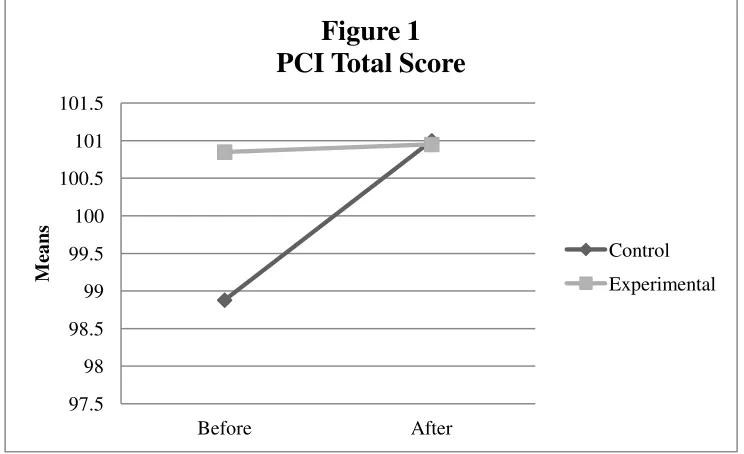
A mixed-design ANOVA was used to consider changes in overall PCI scores over time. No main
effect was found for the between-groups factor (experimental condition), F (1,26) = 0.09, p =
.772, or for the repeated-measures factor (change over time), F (1,26) = 0.64, p = .430. The
anticipated interaction effect was not found, F (1,26) = 0.53, p = .472 (See Figure 1).
Figure 1. PCI total score.
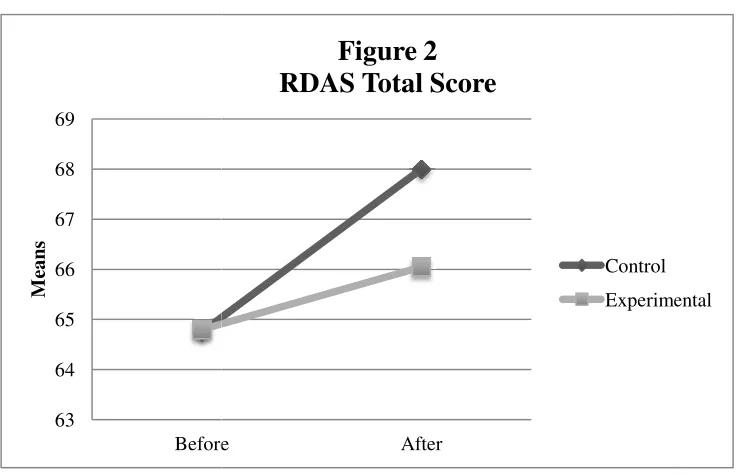
A mixed-design ANOVA was used to consider changes in overall RDAS scores over
time. No main effect was found for the between-groups factor (experimental condition), F (1,26)
= 0.16, p = .692, or for the repeated-measures factor (change over time), F (1,26) = 3.69, p =
.066. The anticipated interaction effect was not found, F (1,26) = 0.73, p = .401 (see Figure 2).
97.5 98 98.5 99 99.5 100 100.5 101 101.5
Before After
M
ea
n
s
Figure 1
PCI Total Score
The RDAS measure was
Satisfaction, and Cohesion. A mixed
Consensus scores over time. No main
(experimental condition), F (1,26)
over time), F (1,26) = 1.78, p = .194.
0.79, p = .382 (see Figure 3).
A mixed-design ANOVA
time. No main effect was found for
= 0.01, p = .945. A main effect was
(1,26) = 5.43, p = .028. However,
0.47, p = .499 (see Figure 4).
63 64 65 66 67 68 69 Before M ea n s
Figure 2. RDAS total score.
also analyzed by its three internal constructs: Consensus,
mixed-design ANOVA was used to consider changes
main effect was found for the between-groups factor
(1,26) = 0.47, p = .500, or for the repeated-measures
.194. The anticipated interaction effect was not found,
ANOVA was used to consider changes in RDAS Satisfaction
for the between-groups factor (experimental condition),
was found for the repeated-measures factor (change
However, the anticipated interaction effect was not found,
Before After
Figure 2
RDAS Total Score
Control Experimental
Consensus,
changes in RDAS
factor
measures factor (change
found, F (1,26) =
Satisfaction scores over
condition), F (1,26)
(change over time), F
found, F (1,26) =
Figure Figure 18.5 19 19.5 20 20.5 21 Before M ea n s
RDAS: Satisfaction Total Score
28 28.5 29 29.5 30 30.5 31 Before M e a n s
RDAS: Consensus Total Score
Figure 3. RDAS: Consensus total score.
Figure 4. RDAS Satisfaction total score.
Before After
Figure 4
RDAS: Satisfaction Total Score
Control Experimental
Before After
Figure 3
RDAS: Consensus Total Score
Control
Experimental
A mixed-design ANOVA
time. No main effect was found for
= 0.05, p = .829, or for the repeated
.504. The anticipated interaction
Figur
A bivariate correlation for
PCI and RDAS scores. These factors
nature of participants’ smart phone
the bivariate correlation for the experimental
16 16.1 16.2 16.3 16.4 16.5 16.6 16.7 16.8 Before M ea n s
RDAS: Cohesion Total Score
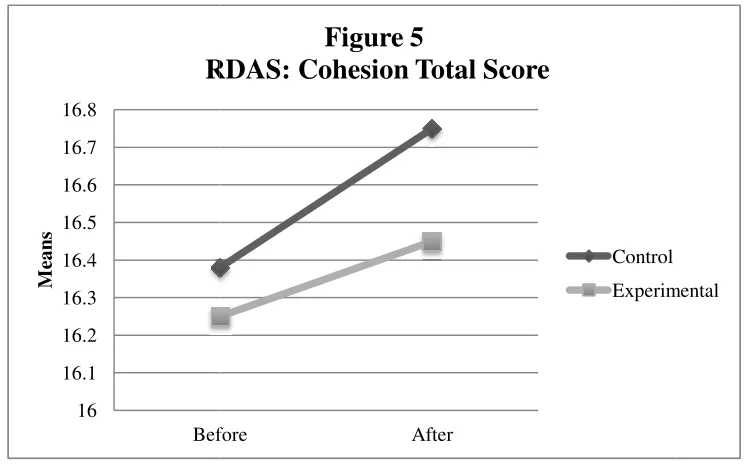
ANOVA was used to consider changes in RDAS Cohesion
for the between-groups factor (experimental condition),
repeated-measures factor (change over time), F (1,26)
effect was not found, F (1,26) = 0.04, p = .838 (see
Figure 5. RDAS: Cohesion total score.
for the experimental group was run on select factors
factors included demographic information, information
phone use, frequency of use, and perception of use.
experimental group can be found in Table 1.
Before After
Figure 5
RDAS: Cohesion Total Score
Control Experimental
Cohesion scores over
condition), F (1,26)
(1,26) = 0.46, p =
(see Figure 5).
factors to compare to
information about the
The results of
Table 1
Results of the Bivariate Correlation for the Experimental Group Pearson Correlation s (Exp Group) PCI: Total (Pre-Test) RDAS: Consensu s (Pre-Test) RDAS: Satisfactio n (Pre-Test) RDAS: Cohesion (Pre-Test) RDAS: Total (Pre-Test) PCI: Total (Post-Test) RDAS: Consensus (Post-Test) RDAS: Satisfactio n (Post-Test) RDAS: Cohesion (Post-Test) RDAS: Total (Post-Test)
Age: -0.208 -0.181 -0.245 -0.06 -0.218 0.072 -0.075 -0.096 -0.042 -0.088
Years Married:
-0.191 -0.454* -0.174 -0.384 -0.472* 0.047 -0.245 -0.227 -0.211 -0.273
Gender: -0.099 -0.304 -0.025 0.17 -0.139 0.143 -0.049 -0.19 0.003 -0.108
Perception of partner’s opinion of their use:
(Pre-Test) 0.506* 0.082 -0.156 0.134 0.041 0.482* 0.319 -0.172 -0.093 -0.011
(Post-Test) 0.324 -0.166 -0.036 0.316 -0.008 0.271 0.012 0.043 0.004 0.026 Times called
partner in last 48 hours:
(Pre-Test) 0.054 -0.026 -0.191 -0.178 -0.143 0.196 0.004 -0.015 0.124 0.041
(Post-Test) -0.154 -0.667* -0.409 -0.629* -0.768* 0.073 -0.424 -0.428 -0.534* -0.554* Times texted
partner in last 48 hours:
(Pre-Test) 0.036 0.148 -0.007 0.197 0.156 0.278 0.011 -0.028 0.163 0.052
(Post-Test) 0.269 0.074 0.282 0.32 0.253 0.564* 0.427 0.216 0.422 0.409 Success
shutting off phone for experiment
condition: 0.384 0.182 0.657* 0.479* 0.506* 0.355 0.508* 0.651* 0.675* 0.744*
Chapter 4
Discussion
This study aimed to examine the possible effects smart phone use may have upon partner
communication and relationship satisfaction. Research surveys continue to show rising
smartphone ownership, as well as frequent use of smartphones for a variety of different tasks.
While some preliminary research findings show a positive correlation between smartphone use
and stress, psychological and relational effects of smartphone use is still a relatively new area of
research. This study was designed to contribute to this need for research by testing the hypothesis
that smart phone use had a negative effect on positive communication and relational satisfaction
among married/partnered couples.
The findings of this study failed to show a significant effect of smart phone use while in
the presence of your partner upon positive partner communication or relational satisfaction.
Participants in the experimental group saw no significant change when compared to the control
group. Both groups did see an increase in relational satisfaction, as measured by the satisfaction
construct within the RDAS; however, this effect was seen across groups. This may suggest that
the examination of one’s own smartphone habits or relational satisfaction via the pre-test survey
somehow prompted an increase in satisfaction, possibly by heightening awareness of each
couple’s opinions of each others’ smartphone use.
The failure to find significant results may be due to a few important factors. Most notably
complete the study or by failing to meet study conditions, only 28 participants remained. This
severely limited the ability to gain more powerful and meaningful results. The control group was
also significantly smaller than the experimental group, due to participant drop-out. Because the
control group was so small, it is likely not a representative control sample, and its results may be
more heavily influenced by outliers. It should be noted that most participants identified as
Christian, and they largely possessed some level of college education. The results of this study
might only describe this specific demographic participant sample. It might be hypothesized that
an effect could be found if the demographics of the participant sample were more varied and
representative of the general populace.
While the experimental sample did not experience a significant effect on marital/partner
satisfaction or communication by the reduction of smartphone use, certain demographic and
smartphone use information was found to be correlated to certain relational factors, as
demonstrated by Table 1. Total years married was negatively correlated with the RDAS total
score at the beginning of the study, but this relationship was not present at the end of the 2-week
intervention. Age and gender were not found to be related to measured scores. The pre- and
post-test surveys also asked each participant to guess how their partnered viewed their smartphone
use. This item was positively correlated with PCI total scores on the pre-test and post-test,
suggesting that partners with positive approval of each other’s smartphone use also experience
more positive partner communication.
Particularly interesting was the strong, negative relationship that contact with partner via
smartphone calling had with a number of measured constructs. An increased number of phone
correlated to post-test RDAS Cohesion and Total scores; interestingly, they were also negatively
correlated to RDAS Consensus, Cohesion, and Total scores on the pre-test survey as
well. It is unclear why an increased amount of verbal communication via smartphone was
negatively related to relational satisfaction and cohesion, and it might be a focus of future
studies. Texting, on the other hand, was found to be positively correlated to positive partner
communication on the post-test, suggesting there may be significant differences between the two
modes of communication.
What might be the most significant factor in describing the results is the positive
correlation of “intervention success” with post-test RDAS totals and all the RDAS constructs.
The intervention success item of the post-test survey asked participants to report how many days
they successfully shut off their phones over the 2-week intervention. Those who were more
successful in completing the intervention over two weeks were also more satisfied with their
relationship across all measured relational constructs found within the RDAS. This could mean a
few different things. It is possible that a failure to complete the intervention for most of the
2-week intervention had a significant effect on the results of the study (namely, measured change
in relational satisfaction). It is also possible that this positive correlation is more of a descriptor
of the participants; those who were able to shut off their phones more often were already more
satisfied with their relationship (as evidenced by the positive correlation with pre-test RDAS
scores). It may be that individuals with higher partner relationship satisfaction simply find it
Limitations
The majority of study participants were gathered from a private university, limiting the
generalization of the results. Financial constraints limited the amount of incentive offered to
potential participants, which may have reduced participation interest. It is also possible that
participants who were interested in the study self-selected for participation. Participants who
self-selected for participation may already possess a greater awareness of their smartphone use,
which could translate to greater partner communication and relational satisfaction. This could
have implications for results generalization. It is possible that individuals and couples with
heavier, more frequent smartphone use opted out of participation due to the study conditions.
The study conditions were also limiting. This study had to rely on each participant’s
initiative to shut off their smart phone during the specified 2-hour intervention period, which
resulted in many participants failing to shut off their phones every day of the 2-week
intervention. While the 2-hour intervention period was supposed to be consistent each day as
well as occur while the participant was with their partner, it is possible that this was not always
the case.
Future Research
While some preliminary research is being conducted on the effects of smartphone use,
there is still a great need for further exploration. Should replications of this study be attempted,
they should focus on achieving a much larger participant sample, which would greatly increase
the power of the results. Greater variation in participant demographics should also be pursued, so
Additionally, future research might pay specific attention to certain factors that found to
be correlated with relational satisfaction. The partner perception of smart phone use might have
significant bearing on positive communication, and this factor should be examined separate from
amount of smart phone use. The type and amount of communication between partners through
their smartphones also may be important. Research examining effects and related factors of these
smartphone communication aspects may yield interesting and relevant results in smartphone
research.
Finally, this research study focused primarily upon smartphone use and certain aspects of
a married or partnered relationship. There are numerous other romantic relationship aspects that
future research might consider in relation to smartphone use. Additionally, researchers should
continue to analyze smartphone ownership and use in a broader relational context, examining
social friendships, work relationships, and family dynamics.
Conclusion
In summary, the primary hypothesis of the research was not supported, as the results
showed no significant change over time when comparing both the control and experimental
group. Pearson’s correlations suggest that there may be significant factor relationships, however,
and future research might consider the mediating effects that amount of between-partner
smartphone communication and partners’ perceptions of each other’s smartphone use may have
on relational satisfaction. Finally, future research might also attempt a replication of this study,
considering the low sample size and the results’ low generalizability that limited the power of the
References
Bargh, J. A., & McKenna, K. Y. A. (2004). The Internet and social life. Annual Review of
Psychology, 55, 573-590.
Bernard, J. (1972). The future of marriage. New York, NY: World.
Blais, J., Craig, W., Pepler, D., & Connolly, J. (2008). Adolescents Online: The importance of
internet activity choices to salient relationships. Journal of Youth and Adolescence, 37,
522-536.
British Psychological Society. (2012). Turn off your smartphone to beat stress [Press
release]. Retrieved from http://www.bps.org.uk/news/turn-your-smart-phone-beat-stress
Busby, D., Christensen, C., Crane, D., & Larson, J. (1995). A revision of the Dyadic Adjustment
Scale for use with distressed and nondistressed couples: Construct hierarchy and
multidimensional scales. Journal of Marital and Family Therapy, 21(3), 289-308.
Caplan, S. E. (2007). Relations among loneliness, social anxiety, and problematic Internet use.
CyberPsychology & Behavior, 10, 234-242.
Center for Disease Control and Prevention. (2013). National marriage and divorce rate trends.
Retrieved from http://www.cdc.gov/nchs/nvss/marriage_divorce_tables.htm
Emmers-Sommer, T. M. (2004).The effect of communication quality and quantity indicators on
intimacy and relational satisfaction. Journal of Social and Personal Relationships, 21,
399-411.
Ericsson ConsumerLab. (2011). From apps to everyday situations - An Ericsson consumer
insight report. Retrieved April 30, 2012, from http://www.ericsson.com/res/docs/2011/
Erwin, B. A., Turk, C. L., Heimberg, R. G., Fresco, D. M., & Hantula, D. A. (2003). The
Internet: Home to a severe population of individuals with social anxiety disorder?
Journal of Anxiety Disorders, 18, 629-646.
ETForecasts, Press Release (2010, July). Worldwide internet users top 1.8 Billion in 2009.
Retrieved from http://www.etforecasts.com/pr/pr071210.htm.
Fenner, G. H. & Renn, R. W. (2010). Technology-assisted supplemental work and
work-to-family conflict: The role of instrumental beliefs, organizational expectations, and time
management. Human Relations 63(1): 63-82.
Gottman Relationship Institute. (2012). Research FAQs. Retrieved from http://www.gottman.
com/49853/Research-FAQs.html
Govindaraju, M., & Seward, D. (2005). Effects of wireless mobile technology on employee work
behavior and productivity: An Intel case study. In: C. Sorenson, K. Yoo, K. Lyytinen, &
J. I. DeGross (Eds.) Designing ubiquitous information environments: Socio-technical
issues and challenges. New York, NY: Springer, 349-351.
Helms, H., & Buehler, C. (2007). Marital quality and personal well-being: A meta-analysis.
Journal of Marriage and Family, 69, 576-593.
Holmes, J. G., & Rempel, J. K. (1989). Trust in close relationships. In C. Hendrick (Ed.),
Close relationships (pp. 187–220). Newbury Park, CA: Sage.
Howard, P. E. N., Raine, L., & Jones, S. (2001). Days and nights on the Internet: The impact
of a diffusing technology. American Behavioral Scientist, 45, 383-404.
Lee, B., & Stapinski, L. (2012). Seeking safety on the internet: Relationship between social
Mazmanian, M., Orlikowski, W. J., & Yates, J. (2005). Crackberries: The social implications of
ubiquitous wireless email devices. In: Sorenson C, Yoo K, Lyytinen K and DeGross JI
(eds) Designing Ubiquitous Information Environments: Socio-technical Issues and
Challenges. New York, NY: Springer, 337-344.
Mazmanian, M., Orlikowski, W. J., & Yates, J. (2006). Ubiquitous email: Individual experiences
and organizational consequences of BlackBerry Use. Academy of Management
Proceedings, Vol. 66.
Mesch, G. (2006). Family relations and the internet: Exploring a family boundaries
approach. The Journal of Family Communication, 6(2), 119-138.
Middleton, C. (2007). Illusions of balance and control in an always-on environment: A case
study of BlackBerry users. Continuum Journal of Media and Cultural Studies, 21:
165-178.
Miller-Ott, A. E., Kelly, L., & Duran, R. (2012). The effects of cell phone usage rules on
satisfaction in romantic relationships. Communication Quarterly, 60(1), 17-34.
Morahan-Martin, J., & Schumacher, P. (2000). Incidence and correlates of pathological
internet use among college students. Computers in Human Behavior, 16, 13-29.
Murray, S. L. (1999). The quest for conviction: Motivated cognition in romantic
relationships. Psychological Inquiry, 10, 23–34.
Navran, L. (1967). Communication and adjustment in marriage. Family Process, 6(2), 173-184.
Nie, N. H., & Erbring, L. (2000). Internet and Society: A Preliminary Report. Stanford Inst.
Nielsen Online. (2014). An era of growth: The cross-platform report (March 2014). Retrieved
from www.nielsen.com
Ofcom. (2011). A nation addicted to smartphones: Communications Market Report: UK.
Retrieved April 5, 2014, from http://stakeholders.ofcom.org.uk/binaries/research/cmr/
cmr11/UK_CMR_2011_FINAL.pdf
Orlikowski, W. J. (2007). Sociomaterial practices: Exploring technology at work. Organization
Science 28(9): 1435-1448.
Peters, C. S., & Malesky, L. A. (2008). Problematic usage among highly-engaged players of
massively multiplayer online role playing games. CyberPsychology & Behavior, 11,
481-484.
Pew Internet & American Life Project. (2008, October 19). Traditional nuclear families use the
Internet and cell phone to create a “new connectedness” that revolves around remote
interactions and shared online experiences. Retrieved from http://www.pewinternet.org/
Press-Releases/2008/Traditional-nuclear-families-use-the-internet-and-cell-phones-
to-create-a-new-connectednes.aspx
Pew Research Center Publications (2012).Nearly half of American adults are smartphone
owners. Retrieved from http://pewresearch.org/pubs/2206/smartphones-cell-
phones-blackberry-android-iphone
Reis, H. T., & Shaver, P. (1988). Intimacy as an interpersonal process. In S. Duck (Ed.),
Handbook of personal relationships (pp. 367-389). Chichester, UK:Wiley.
(2009). Different types of internet use, depression, and social anxiety: The role
of perceived friendship quality. Journal of Adolescence, 32, 819-833.
Solutions Research Group. (2007). BlackBerry Backlash? Americans split on ‘always on’
culture. Toronto, Canada. Retrieved from
http://www.srgnet.com/wp-content/uploads/blackberry-backlash-srg-report-feb-07.pdf
Valkenburg, P. M., & Peter, J. (2008). Adolescents’ identity experiments on the internet.
Communication Research, 35(2), 208-231.
Valkenburg, P. M., & Peter, J. (2007). Preadolescents’ and adolescents’ online
communication and their closeness to friends. Developmental Psychology, 43, 267-277.
Wellman, B., Haase, A. Q., Witte, J., & Hampton, K. (2001). Does the Internet increase,
decrease, or supplement social capital? American Behavioral Scientist, 45, 436-455.
Whisman, M. A. (2001). The association between depression and marital dissatisfaction. In S. R.
H. Beach (Ed.), Marital and family processes in depression: A scientific foundation for
clinical practice (pp. 3-24). Washington, DC: American Psychological Association.
Yin, L. (2009). Communication channels, social support and satisfaction in long distance
romantic relationships (Unpublished master’s thesis). Georgia State University, Atlanta,
Appendix A
Demographic Questionnaire
Age:
Date you were married/partnered:
Number of Children:
What is your gender?
What is your gender? Female Male
Other
What is your race/ethnicity? Mark one or more.
What is your race/ethnicity? Mark one or more. Asian-American African-American
Caucasian Hispanic
Native American
Other (please specify) Highest Level of Education:
Highest Level of Education: Some high school High school diploma
Some college Bachelor's degree
Graduate/professional degree Religion:
Religion: Christian Jewish
Buddhist Muslim Hindu
Appendix B
Curriculum Vitae
Joshua Borrelli
8822 SW Ash Meadows Cir. #1137 Wilsonville, OR 97070 Phone: (503) 550-3677 Email: [email protected]
EDUCATION
Doctor of Psychology in Clinical Psychology Jan 2010-Present
George Fox University in Newberg, Oregon
Graduate Department of Clinical Psychology: APA Accredited Degree Anticipated: May 2015
Dissertation: Exploring the Influence of Smartphone Technology within the Context of Partner Relationships: An Intervention Study
-Final Defense completed June 2014
Master of Arts in Clinical Psychology May 2012
George Fox University in Newberg, Oregon
Graduate Department of Clinical Psychology: APA Accredited
Bachelor of Arts, Psychology Dec 2009
George Fox University in Newberg, Oregon
Magna Cum Laude, Outstanding Psychology Student Award
SUPERVISED CLINICAL EXPERIENCE
Student Health and Counseling Center at Portland State University August 2014-Present
Position: Therapist Portland,OR
Setting: University Student Health and Counseling Center
Population: Non-traditional undergraduate, graduate, and international students, ages 18+, of varying SES, cultural/ethnic backgrounds
Experiences:
• Population Service
o Individual Therapy: Conducting cognitive-behavioral and interpersonal therapy within a time-limited, 50-minute, 12-session model, with a few longer-term clients. Clients exhibit a wide variety of pathology, most commonly presenting with anxiety and depression. Complete structured intake interviews with each client.
o Triage Service and Crisis Evaluation: Evaluate presenting issues and level of risk for walk-in student appointments, provide support and connect student to
appropriate SHAC services or community resources. Requires knowledge of available resources, appropriate referrals and recommendations for each client’s unique presentation, and crisis management.
o Group Therapy: Co-lead an interpersonal process group on a weekly basis. The group has focused on processing grief and loss, exploring family relationship dynamics, and processing relational interactions that occur in-session.
o Comprehensive Assessment: Test and evaluate students for learning disability and/or ADHD diagnoses. Comprehensive reports are composed, and results are presented to the client in a feedback session.
Tests Administered and Scored: Advanced Clinical Solutions for WAIS-IV and WMS-WAIS-IV (ACS) - Test of Effort; Attention Deficit Disorders Evaluation Scale – Self-Report and Home Version; Beck Anxiety Inventory (BAI); Color Trails Test; Integrated Visual and Auditory Continuous Performance Test – Advance Edition (IVA-AE); Integrated Visual and Auditory Continuous Performance Test – Plus Edition (IVA-Plus); Minnesota Multiphasic Personality Inventory- 2nd Edition (MMPI-2); Nelson-Denny Reading Test; Rey Complex Figure Test (RCFT); Stroop Color-Word Test; Weschler Adult Intelligence Scale- 4th Edition (WAIS-IV); Weschler Memory Scale- 4th Edition Flexible Approach (WMS-IV); Woodcock-Johnson IV, Tests of Achievement (WJ-IV, ACH); Woodcock-Johnson IV, Tests of Cognitive Abilities (WJ-IV, COG)
• Consultation
o Weekly consultation with a multi-disciplinary team to discuss difficult cases, appropriate referrals, and holistic client care.
• Supervision/Training
o Weekly, 2-hour individual supervision of individual therapy client service with Noelle Savatta, PhD
o Weekly, 1-hour case presentations with other trainees and licensed, staff psychologists
o Weekly, 1-hour didactic trainings on a variety of topics aimed at client service and professional growth from a variety of professionals
o Weekly, 1-hour professional development meetings with Cheryl Forster, PsyD
o Weekly, .5-hour individual supervision of interpersonal process group with Lisa Koralewicz, MPH, LCSW
o Weekly individual supervision of assessment cases as needed with Jennifer Dahlin, PsyD
Health and Counseling Center at George Fox University Sept 2013-May 2014
Position: Therapist Newberg,OR
Setting: University Health and Counseling Center
Population: Traditional undergraduate students between the ages of 18-25
Supervisor: William Buhrow Jr., PsyD, licensed and practicing psychologist, Dean of Student Services
Experiences:
• Population Service
o Individual Therapy: Conducting cognitive-behavioral and solution-focused therapy within a short-term, 50-minute, 6-session model with some long-term clients. Clients exhibit a wide variety of pathology, most commonly anxiety and depression. Complete structured intake interviews with each client.
o Crisis Evaluation: Evaluate level of risk for students in crisis, provide support and connect student to appropriate support systems.
o Couples/Relationship Therapy: Focus on conflict resolution, communication skills, and relational insight building.
o Comprehensive Assessment: Test and evaluate students for learning disability, personality assessment, and ADHD diagnoses. Comprehensive reports are composed, and results are presented to the client in a feedback session.
Tests Administered and Scored: Wechsler Adult Intelligence Scale, 4th Edition (WAIS-IV); Personality Assessment Inventory (PAI); Wechsler Memory Scale, 4th Edition (WMS-IV); Conners’ Adult ADHD Scale
• Consultation
o Consultation and collaboration of care with on-site nurse practitioner to provide holistic treatment for undergraduate students.
• Supervision/Training
o Weekly, 2-hour training seminars led by William Buhrow Jr., PsyD
Willamette Family Medical Clinic Sept 2012-June 2013 Position: Therapist, Mental Health Consultant Salem, OR Setting: Medical clinic with multidisciplinary staff
Population: Ethnically, culturally, and sexually diverse, low-SES individuals and families Supervisor: Joel Gregor, PsyD, licensed and practicing psychologist, professor
Experiences:
• Population Service
o Individual Therapy: Conducted cognitive-behavioral therapy within a short-term, 50-minute, 8-session model, including a few long-term patients. Patient referrals were received from on-site medical providers. Patient pathology treated included anxiety, depression,
obsessive-compulsive disorder, autism, oppositional-defiant disorder, bereavement, drug abuse, developmental disability, addiction, attention deficit disorder, and relational conflicts. Also completed a structured intake interview for each new client
o Crisis Evaluation/Triage: Accepted “warm hand-offs” from providers to immediately meet with and assess patients under significant distress. Conducted quick assessment of levels of functioning, severity of
symptoms, and level of risk to self or others. Made appropriate referrals and recommendations.
o Family Therapy: Facilitated family therapy sessions with children and parents to correct faulty communication patterns, examine relational dynamics, and improve parenting techniques
o Couples/Relationship Therapy: Examined conflict resolution difficulties, communication patterns, and relational needs within the context of a 50-minute therapy session with both partners present.
o Comprehensive Assessment: Testing and assessment was conducted to assist on-site providers with diagnosis, most commonly for ADHD and autism. Results were presented to the patient and/or family in a feedback session and discussed with the medical provider.
Scales; Brown ADD Scales; Child Autism Rating Scale (CARS); Sensory Profile
• Consultation/Collaboration
o Consulted with medical providers and staff on patient cases to provide holistic care, which included discussion of client symptoms, level of functioning, medication prescription and dosage, and significant medical issues of the patient.
o Often scheduled patients to meet with therapist and medical provider sequentially for effective, holistic treatment.
• Presentations
o Composed and presented relevant mental health information and training to medical providers and staff during their lunch breaks.
Topics presented: suicide risk assessment; diagnosis and behavioral treatment of attention-deficit/hyperactivity disorder
• Supervision/Training
o Weekly, 1-hour individual supervision with Joel Gregor, PsyD
o Weekly, 1-hour group supervision with Joel Gregor, PsyD
o Received 1-hour trainings from Joel Gregor, PsyD on a monthly basis
o Weekly peer case consultation with other masters-level graduate students
St. Paul School District Sept 2011-June 2012
Position: School Psychologist/Counselor St. Paul, OR
Setting: Rural high school system with full range of educational and administrative staff Population: Adolescent students, Latino/a majority and Caucasian minority
Supervisor: Elizabeth Hamilton, PhD, licensed and practicing psychologist, professor Experiences:
• Population Service
o Individual Therapy: Conducted Rogerian and cognitive-behavioral therapy within a short-term, 30-minute, “as-needed” model, including a few long-term clients. Student referrals were received from teachers, school staff, or through
self-referral. Student pathology treated included anxiety, depression, bullying victims, physical abuse victims, significant trauma, autism, bereavement, attention deficit disorder, and relational conflicts. Significantly distressed students were usually seen immediately, and risk assessment was conducted.
o Program Development: Developed class curriculum for study skills class and social skills group through adaption of evidence-based curriculum and material.
o Class Instruction: Led semester-long, weekly, 1-hour study-skills class. Included lesson planning, instruction and demonstration of material, classroom
o Group Workshop/Counseling: Led semester-long, weekly, 1-hour social-skills training group. Included lesson planning, classroom management, instruction, group dynamic facilitation, and group intervention.
o Comprehensive Assessment: Testing and assessment was conducted on-site for learning disorder evaluations. Full reports of results were completed. Results were presented to parents, children, teachers, and IEP boards.
Tests Administered and Scored: Wechsler Intelligence Scale for Children, 4th Edition (WISC-IV); Wechsler Individual Achievement Test, 3rd Edition (WIAT-III); Wechsler Nonverbal Scale of Ability (WNV); Wide Range Achievement Test, 4th Edition (WRAT4); Wide Range Assessment of Memory and Learning, 2nd Edition (WRAML-2); Wide Range Intelligence Test (WRIT); Behavior Assessment System for Children, 2nd Edition (BASC-2)
• Consultation/Collaboration
o Consulted with teachers and administrative staff to provide appropriate in-class and in-system interventions and expectations for struggling students. Met with system administrators regularly to discuss new ways to serve the school system and student population.
• Supervision/Training
o Received 1-hour trainings from Elizabeth Hamilton, PhD on a monthly basis
o Weekly, 1-hour individual supervision with Elizabeth Hamilton, PhD
o Weekly, 1-hour group supervision with Elizabeth Hamilton, PhD
o Weekly peer supervision and case consultation with MA graduate student
Charity Benham, PsyD Private Practice June 2012-July 2014
Position: Psych-technician Salem, OR
Setting: Private practice office housing six clinicians
Population: Marion County referrals of applicants for developmental disability services, and private practice clientele
Supervisor: Charity Benham, PsyD, licensed and practicing psychologist Experiences:
• Population Service
o Psychological Test Battery Administration: Administer numerous cognitive, personality, and neuropsychological tests to private practice clients or client referrals from the county for developmental disability assessment.
Responsibilities include reviewing client charts, administering tests, scoring, relaying results and observations to Dr. Benham, and discussing possible diagnoses.
(WAIS-IV); Wide Range Achievement Test, 4th Edition (WRAT4); Wide Range Assessment of Memory and Learning, 2nd Edition (WRAML2); Delis-Kaplan Executive Function System; Rey- Complex Figure Test; Grip-Strength Test; Finger-Tapper Test; Trail- Making Test; Personality Assessment Inventory (PAI); Rorschach
• Supervision
o Regular meetings with Charity Benham, PsyD to discuss client cases, review charts, construct assessment batteries, conceptualize results, and discuss diagnosis.
SUPERVISION EXPERIENCE
George Fox University, PsyD Program Sept 2013-May 2014
Position: Peer Supervisor Newberg, OR
Supervisor: Mark McMinn, PhD Experience:
• Peer Supervision of 2nd-year graduate student
o Weekly, 1-hour meetings
o Developmental approach to supervision
o Discuss student’s professional development in areas of academics, research, and clinical work
o Examine student’s clinical casework, case conceptualization, and interventions used
o Provide appropriate feedback and advice to aid in professional development in stated domains
• Supervision of peer supervision
o Weekly, 1-hour supervision with Mark McMinn, PhD
George Fox University, PsyD Program Sept 2012-Dec 2013
Position: Teacher’s Assistant, Cognitive Assessment Class Newberg, OR Supervisor: Wayne Adams, PhD, Professor
Experience:
• Co-lead and instruct weekly, 1-hour lab for Cognitive Assessment course in the GFU
Graduate Department of Clinical Psychology
o Class consisted of 2nd-year graduate students in the clinical psychology doctoral program
o Instruct and demonstrate correct test administration and scoring for the following tests: Wechsler Intelligence Scale for Children, 4th Edition (WISC-IV); Wechsler Adult Intelligence Scale, 4th Edition (WAIS-IV); Wechsler Individual
Edition (WRAT4); Wide Range Intelligence Test (WRIT); Wide Range Assessment of Memory and Learning, 2nd Edition (WRAML2)
• Weekly, 1-hour meetings with Wayne Adams, PhD
o Review lab instruction, graded assignments of students, and student progress in the course and development of assessment competency
• Review and grade all class coursework
o Review scored test protocols for scoring accuracy and technique
o Edit and provide feedback on assessment report writing
• Review video-taped test administrations
o Check for administration accuracy
o Provide appropriate feedback of student strengths and areas of growth
• Regular meetings with students
o Provide feedback on development of assessment administration and scoring proficiency
o Provide one-to-one additional instruction and demonstration
RESEARCH EXPERIENCE
Dissertation
Title: Exploring the Influence of Smartphone Technology within the Context of Partner Relationships: An Intervention Study
Preliminary Defense Completed: April 2013 Final Defense Completed: June 2014
Dissertation Chair: William Buhrow Jr., PsyD Description:
• The purpose of this study was to examine possible negative or positive effects smart
phone use may have on partner satisfaction and couple-communication within a married or partnered couple. This was measured via survey administration and comparison of groups of married/partnered couples with varying degrees of
Research Vertical Team March 2011-Present Description:
• Composed of eight students in GFU Clinical Psychology Doctoral Program and one
program faculty member (William Buhrow Jr., PsyD)
• 2-hour, twice-monthly meetings
• Designed to assist graduate students and faculty members in the development and
completion of student dissertations and supplemental research projects Experience:
• Training on construction of dissertation proposal, research design, poster design
and presentation, interpretation of research results and data
• Received feedback on dissertation intervention design, written dissertation
proposal, and poster presentation from peers and faculty member
• Collaboration with peers and faculty member on own research and the research
projects of others
• Feedback and collaboration led directly to successful preliminary defense of
dissertation and acceptance of poster presentation into national
George Fox University Program Evaluation April 2013
Description:
• Part of research team to examine student satisfaction of spiritual formation curriculum
within the George Fox University Clinical Psychology Doctoral Program, as well as the curriculum’s effectiveness according to certain student behaviors.
Experience:
• Designed survey to be sent out to all students and alumni of the clinical psychology
doctoral program
• Organized and interpreted results of survey
• Presented results of survey to peers and faculty members • Results led directly to publication of article
POSTER PRESENTATIONS
Borrelli, J., Buhrow Jr., W., & Snider, J. (2013, April). The effect of premarital education on marital communication. Poster presented at the annual national conference of the Christian Association for Psychological Studies, Portland, OR.
Poster presented at the annual conference of the Oregon Psychological Association, Eugene, OR.
PUBLICATIONS
McMinn, M., Goodworth, M.C., Borrelli, J., Goetsch, B., Lee, J., & Uhder, J. (2013). Spiritual formation training at George Fox University. Journal of Psychology and Christianity, 32, 313-319.
AFFILIATIONS
American Psychological Association 2010-Present
Affiliate Member
CLINICAL TRAININGS AND SEMINARS
Systems-Centered Group Psychotherapy Dec 15, 2014 Susan Gantt, PhD
Integrated Primary Care Sept 25, 2013 Brian Sandoval, Psy.D and Juliette Cutts, Psy.D
African American History, Culture, Addictions, & Mental Health Treatment Jan 30, 2013 Danette C. Haynes, LCSW and Marcus Sharpe, Psy.D
Sexual Identity Nov 4, 2012 Erica Tan, Psy.D
Cross-Cultural Psychological Assessment Nov 2, 2011 Tedd JudD, PhD
Motivational Interviewing Oct 4, 2011 Michael Fulop, Psy.D
REFERENCES
Noelle Savatta, PhD Supervisor, Therapist
Portland State University: Student Health and Counseling Center, Portland, Oregon Phone #: 503-725-2800
Email: [email protected]
Karen Ledbetter, PsyD
Supervisor, Assessment Coordinator, Therapist
Portland State University: Student Health and Counseling Center, Portland, Oregon Phone #: 503-725-2800
Email: [email protected]
William Buhrow, PsyD
Professor, Supervisor, Advisor, Director of GFU Health and Counseling Center George Fox University: Health and Counseling Center, Newberg, Oregon Phone #: 503-554-2340
Email: [email protected]
Joel Gregor, PsyD
Professor, Supervisor, Head of GFU Behavioral Health Clinic
George Fox University: Graduate Department of Clinical Psychology, Newberg, Oregon Phone #: 503-899-2293