Montana Law Review
Volume 17
Issue 1
Fall 1955
Article 3
July 1955
Elements of Reservoir Engineering
John J. Wanner
Follow this and additional works at:
https://scholarship.law.umt.edu/mlr
Part of the
Law Commons
This Article is brought to you for free and open access by The Scholarly Forum @ Montana Law. It has been accepted for inclusion in Montana Law Review by an authorized editor of The Scholarly Forum @ Montana Law.
Recommended Citation
Elements of Reservoir Engineering
By JOHN J. WANNER*
INTRODUCTION
The first step in the production process following the origination and accumulation of petroleum is that of getting the oil or gas to the surface. There are many physical properties that will affect the rate and quantities of hydrocarbons that are recovered. Earlier in the history of the oil busi-ness, these physical properties were known but only in the last thirty years have they been applied and only in the last twenty years has the industry, through necessity, paid particular attention to them. It has been a natural process, in that as it became apparent that particular kinds of rocks gave up more oil and gas than others and that certain types of oil were easier to recover than others, the answer "why" sparked a new phase of engineering that has become known in the industry as reservoir engineering. Reservoir engineering is advancing at a rapid rate and is constantly developing new concepts. Although the physical properties of the reservoir rock and its associated fluids can be studied closely in the laboratories, the exact rela-tionship with each other, under conditions existing in the reservoir, are not thoroughly understood. Because of these unknown factors, the field of reservoir engineering has been aptly described as more of an art than a science. Fundamentally, the process of a producing well is a matter of establishing a pressure differential in the reservoir wherein the fluids in the reservoir will move from a high pressure area to a low pressure area, the well bore, where they can either flow naturally to the surface or where they can be picked up and mechanically lifted to the surface. There are many factors inherent in the reservoir rock and also in the fluids to retard this movement.
RESERVOIR ROCK CHARACTERISTICS
Porosity. A term defined in percent of the total pore space,
inter-granular openings, and used to indicate the openings in such rocks as lime-stones, dolomites and conglomerates. A distinction must be made between total porosity and effective porosity. The term effective porosity deals with that porosity or pore space that is interconnected. This is the value obtained in the laboratory by the Boyle's law method and the mercury injection (Washburn-Bunting) method. Total porosity is also determined in the laboratory and is reported as bulk porosity. Where cores are not available, it is possible to estimate porosity from electric logs and radioactivity logs. In most instances, a reasonable value can be obtained with their use. In addition to the intergranular and vugular type porosity, there is also the fracture, fissure, or joint porosity. This type of opening is known to be the effective pore space in many reservoirs. It is very difficult to estimate, however, and is normally considered to be but a fraction of intergranular or matrix porosity. (Particles comprising pay are not perfect spheres; they range from round particles, oolites, mica-like plates all held together by a bonding material.) Porosity of various rock types vary considerably. A
*Manager, Production Department, George J. Greer, Trustee; National delegate of Billings Petroleum Chapter, A.I.M.E.; Billings, Montana.
MONTANA LAW REVIEW
commercial sandstone rock will have a porosity ranging between 10-25%, limestones and dolomite between 6-10%, and honeycomb vugular porosity as high as 30%.
Permeability. This is that property of a rock that determines the rate at
which a fluid will pass through it. It can be defined as the rock's fluid con-ductivity, or as the ability of fluid to flow within the interconnected pore network. If the pores of the rock were not connected, there would not be any permeability; hence, it is natural to expect a relationship between per-meability and effective porosity, but not with absolute porosity. All of the factors which influence porosity-grain size, cementing material, grain shape-will also affect permeability. Premeability is determined in the laboratory by use of an apparatus and process which involves the prepara-tion of a small plug of the core and accurately measuring the amount of air passed through the plug.
Effective and relative permeability relationship. Should a test core
plug be saturated partially with water, and supposing that the water satura-tion is maintained constantly, the permeability to oil will be appreciably less than if the plug were saturated 100% with oil. This is known as the effec-tive permeability to oil. Effeceffec-tive permeability can be determined in one, two, or three phase flow, that is, to oil, water or gas, inasmuch as these phases may flow simultaneously. Obviously, the other fluids present reduce the ability of any one fluid to flow; consequently, effective permeabilities are always less than absolute measured permeabilities.
Relative Permeability. This is the ratio of effective permeability to
absolute permeability and, therefore, is always a fraction between 0 and 1. There are effective and relative permeabilities to all three reservoir liquids -- oil, gas and water. The shapes of the relative permeability curves, there-fore, are a function of the fluid distribution within the reservoir rock. The segregation of the reservoir fluids within the rocks are a function of the saturation and also of the wetting characteristics of the reservoir rock. We may have a reservoir that is either oil wet or water wet. Oil wet means that oil will preferentially cling to the reservoir surfaces. Truly oil wet reservoirs are relatively uncommon. The Oklahoma City Wilcox Sand is generally con-sidered an oil wet sand, as well as portions of the Bradford Sand in Penn-sylvania. In recent years it has. also become apparent that some of the fields of the Rocky mountains are producing sands that are either partially oil wet or truly oil wet. Water wet reservoirs predominate. This is to be expected in that water was the first fluid present. However, a long asso-ciation and contact may change wetting properties. The phenomena of wetting characteristics are being studied continuously in fundamental re-search laboratories. An oil wet sancd will have a low connate water satura-tion; for example, Oklahoma City Wilcox Sand connate water saturations are approximately 10%, whereas connate water saturations of 40% are not uncommon in water wet sands.
Connate water. It is assumed that all reservoirs were originally filled
with water. This water was displaced by oil and gas migrating into the trap. The water displacement was not 100% because of the natural capil-lary forces present. The reservoir, at the time of discovery, is normally believed to be in equilibrium in that sufficient time has elapsed for all forces to come to a balance. Connate water then can be defined as the irreductible
water saturation. It is a function of permeability in that a low permeability rock will have a higher connate water saturation than a high permeability rock, which is a direct function of the capillary pressure forces. The water-oil contact, that is, the point of contact between water-oil and water levels, is not sharp, due to capillary action. In a tight reservoir, division is broad. This area between 100% water and 100% oil is called a transition zone. (In a highly permeable reservoir, it is quite sharp.) The thickness of the transi-tion zone depends upon the individual fluid, porosity and permeability.
Connate water values are determined in the laboratory, using core plugs. If core plugs are not available, it is possible to estimate water saturations by using electric logs. The electric log method is reasonably accurate in areas of good control but sometimes can be very misleading in wildcat areas.
Capillary Pressure. The term "capillary pressure" has been used
fre-quently in this discussion and it can be explained as the combined effect of surface tension, interfacial liquid tensions, pore size and shape, and the wetting properties of the reservoir rock. The force of capillary pressure is not used directly as a means of reservoir control or evaluation but as an aid in explaining the distribution of connate water through a reservoir and as a tool in detailed reservoir studies.
PHYSICAL AND CHEMICAL PROPERTIES OF PETROLEUM
In order to understand and to predict the behavior of oil and gas reservoirs, a knowledge of the physical and chemical characteristics of the fluids involved must be acquired. It is preferable that these properties be measured on representative samples obtained under reservoir conditions at the time of discovery. 12 many instances, however, this information is not available particularly in old fields. A bottom hole sample is a sample of the fluid, and all its associated gas, taken under reservoir conditions by means of a fluid sampler.. The sampler consists of a device built of steel which is lowered into the well and can be opened, permitting reservoir fluids to enter, then be closed and returned to the surface. The sampler can then be taken into the laboratory and run through the necessary analyses. If a bottom hole sample is not available, a recombination sample can be obtained. This is a simple operation, consisting of taking a surface well head sample of the oil and a sample of the gas from the separator and recombining the two under conditions simulating bottom hole temperatures and pressures. The third means is by use of correlating charts based upon analogy with known crude oils over a wide range of conditions. This is only an estimate, however, but is reasonably accurate and in some cases is the only means to establish the physical properties of a crude.
Viscosity. This is that property of a liquid that describes its resistance to
MONTANA LAW REVIEW
Relative volume factor. As gas dissolves in crude oil, there is an
in-crease in the total liquid volume. The change in oil volume, upon liberation of gas, must be described in some way. The generally preferred basis is stock tank oil. It is essential, for some reservoir calculations, to know the space that would be occupied in the reservoir at any pressure below that originally existing by the contests of a unit volume of original reservoir oil, or by a unit of stock tank oil and all the gas which was originally in it.
Bubble point or saturation pressure. At a given reservoir pressure, the
oil is capable of holding in solution only a given amount of gas. When this condition exists, the oil is said to be saturated. Any excess gas beyond that necessary to saturate the oil at the existing pressure, will be trapped in the formation as free gas, generally at or near the crest of the structure in a "gas cap." Petroleum is not necessarily saturated with dissolved gas at the existing reservoir pressure even though surplus gas is available in the reservoir. The oil in this case would be "undersaturated." When a higher pressure exists than that at which the oil is saturated, subsequent reduction of pressure by production will not release any gas from solution in the oil, until a pressure is reached below that at which the oil is saturated. This is the saturation pressure or bubble point of the oil. The bubble point signi-fies a pressure at which gas is released from solution and is reflected by the formation of small bubbles of free gas in the oil.
Oil Oil
Sand Sand Sand and
Grain Groin Grain Groin Gas bubble
Connote
Connote Snd Water
GrainWaterGroin
Fig. 1.
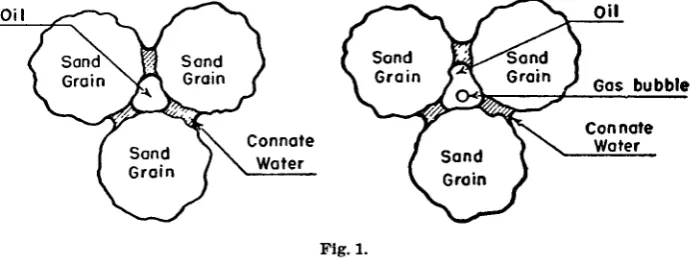
The importance of the bubble point on the relative permeability char-acteristics of the reservoir rock justifies a short review of permeability at this point. In examining the sketch of the three sand grains in Figure 1, it can be seen that the intergranular space occupied by the oil without any gas present is greater and offers a clear unobstructed channel to flow. How-ever, when the first bubble of oil breaks out of solution, it will occupy a position in the center of the intergranular space and will act as an obstruc-tion to the flow of oil. This hindrance increases as the gas bubble grows in size. When the gas bubble becomes large enough to connect with an ad-joining bubble, the ability for the reservoir rock to flow oil terminates be-cause it is much easier for the gas to move through the reservoir rock.
Solution gas-oil ratio. This is the amount of gas dissolved in reservoir
oil at any pressure below saturation pressure and is described as a given number of cubic feet per barrel of oil.
API gravity. API gravity is the relationship between specific gravity of
water and crude oil at the same temperature base. It has been adopted as a
standard by the American Petroleum Institute. Under API scale, for ex-ample, water would have a gravity of 10°API. The higher the API gravity of an oil, the greater the light gasoline content.
Specific gravity of gas. The specific gravity of a gaseous mixture is the
ratio of its apparent molecular weight to that of air. As a rule, the higher the specific gravity the more wet the gas-the greater the amount of pro-panes, butanes, pentanes, etc. A dry gas of practically pure methane, for example, will have a value of 0.58 whereas a wet gas high in pentanes will be in the order of 0.8 to 0.9.
A complicating factor found in the Rocky mountain oil fields parti-cularly and fields elsewhere of appreciable structural closure, is a marked variation in fluid properties with structural elevation. In any detailed analytical work, it is necessary to correlate fluid properties with structural elevation. The variation is very pronounced in some fields, with viscosities increasing with lower elevations, bubble points changing and relative volume factors altering with depth.
RELATIONSHIP BETWEEN GEOLOGY AND RESERVOIR PERFORMANCE
As with water in a sponge, the oil in a reservoir rock has no inherent ability to expel itself but can only be produced by the action of some placing fluid. Petroleum reservoirs are classified according to the dis-placing fluid and the source of energy available.
Water drive. A water drive performance requires the incoming of
wa-ter into the trap in sufficient quantities to replace, volumetrically, the oil and gas produced. A 100% replacement would indicate a barrel of water taking the place of every barrel of reservoir space voided by the production of oil and gas. Water may encroach into the oil reservoir in two ways, either by artesian flow or by volumetric expansion. Artesian flow is the more important of these types of encroachment. Artesian water requires the intake of fresh supplies of water at an outcrop of the reservoir forma-tion; hence, the formation must have stratigraphic continuity. Water drives are not found in stratigraphic type traps because insufficient communica-tion exists within the reservoir rocks of a stratigraphic type trap. Limited water drives are possible in a stratigraphic type trap if there is sufficient volumetric expansion from entrapped connate waters in a lenticular bed. Water drive is the most efficient type of expulsion in recovering oil from reservoir rock. A water drive recovery can range as high as 90%.
Depletion Drives. A depletion drive, sometimes called solution gas
drive, produces oil at the expense of expanding dissolved gases. This type of drive is found predominantly in stratigraphic type pools. A depletion drive control has an efficiency of 15-30%-much less efficient than a wate-drive.
Segregation Drives or gas cap expansion drives, are encountered mainly
MONTANA LAW REVIEW
CROSS SECTION
IDEALIZED PRODUCING ANTICLINE Fig. 2.
These are the three general types of reservoir control and a reservoir may be affected by any combination of the three. Figure two depicts an idealized reservoir in which all three types of reservoir control are indicated. For example, it would be entirely possible for the northwest portion of the field to be under the effect of an active water drive, whereas the southeast-ern portion of the field could be far enough away from the water-oil contact and be isolated through a low permeability barrier that its chief means of production would be through a process of depletion drive. The gas cap area, assuming that it is being produced, would be producing through the effect of an expanding gas cap. In addition to all of these factors affecting the reservoir, it is also possible that on the steep dip flanks of the anticline the effects of gravity drainage are active. The various production mechan-isms that affect the various portions of this reservoir, illustrate the basis for the widely divergent economic value of individual leases located from the crest to the flanks of a reservoir.
It becomes apparent from this brief review of the chemical and physical properties of the reservoir and its fluids, that there is a substantial amount of data to be taken during the development and producing history of a reservoir. An ideal program to be followed from the time of the discovery well through the producing history of the field, so far as pertinent engineer-ing data is concerned, would be as follows:
1. Well logs: Electric logs, radioactivity logs, temperature logs and
sample logs.
2. Core analyses, including porosity, permeability and saturations.
3. Bottom hole samples.
4. Initial bottom hole pressures and temperatures and subsequent pres-sure surveys during the producing life of the field.
5. Accurate withdrawal data on oil, gas and water. 6. Individual well tests.
7. Maps: Structure, isopac, pressure and any other parameter that
might appear desirable, depending upon the conditions existing in any particular reservoir.
It is very important that as much of this data be assembled as quickly as possible and that a comprehensive evaluation of the reservoir be made as the greatest increase in oil recovery, both from a primary and a secondary recovery program, can be obtained only when proper production methods are initiated in the early stages of depletion.