A b s t r a c t. In the present study the author determined the mechanical properties of pea stems as expressed by the rigidity and the elasticity coefficients and maximum bending stress of the pea stems of the Piast and Agra varieties. It was found that the Piast variety is characterized by a much higher rigidity and elasticity of stems, and by lower values of maximum bending stress, as compared to the Agra variety. The study showed that the pea cultivars under study differ in the strength of their stems.
K e y w o r d s: rigidity, elasticity coefficient, maximum ben-ding stress, pea stems
INTRODUCTION
The pea is a plant with a strong tendency to lodge. Pea growers have been calling for the creation of a variety resistant to lodging [1,2]. Literature on the subject offers some studies indicating a relation between the amount of xyloglucan in the cellular walls and the mechanical pro-perties of pea stems [3].
As is now widely known, the mechanical properties of plants under study (cereals, rape, etc.) show significant differences between the particular cultivars and between phenological phases, and correlate with the resistance of the plants to lodging [4,5].
Therefore, the author undertook a study to determine the mechanical properties of the stems of some pea cultivars, and developed a method for the determination of the strength properties of pea plant stems through the mecha-nical parameters of the stems. Also, an analysis was per-formed of the variability of those parameters on the length of the stems, and during the course of the plant’s growth and ripening. The study involved two cultivars in order to enable the identification of intervarietal differences.
MATERIAL AND METHOD
In this study, tests concerned with the mechanical properties of pea stems were performed on plants whose seeds originated from the breeding experiments conducted in Institute of Plant Genetics, Polish Academy of Sciences, Poznañ, and the plants themselves were grown at the experimental plots of the University of Agriculture, Lublin.
The method for the determination of the mechanical properties of pea stems was developed on the basis of the static test, using an Instron strength tester. The mechanical parameters were determined in the process of bending sections of the stems, 4 cm long, supported at both ends, the bending force being applied in the middle of the section length. Within the range of force values corresponding to elastic deformation, the author determined the rigidity (EI) and the modulus of elasticity (E), as well as the maximum bending stress (smax) at the point of maximum bending force
application. The moment of inertia (I) was determined for
the cylindrical section of the stems. To identify the variability of the mechanical properties along the length of the stems, measurements were taken at five points on the stem length, from the root to the top of the plant. Also,
measurements were taken of the inner (Fw) and outer (Fz)
diameters at the points where the bending forces were applied, these being necessary for the determination of the
second moment of cross section (I) and the bending section
modulus (W). A schematic presentation of the bending of
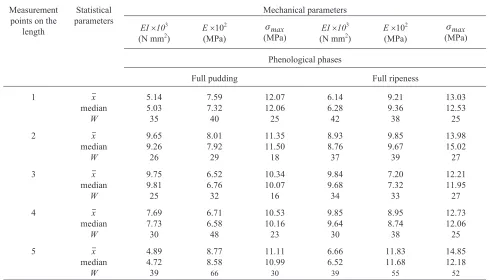
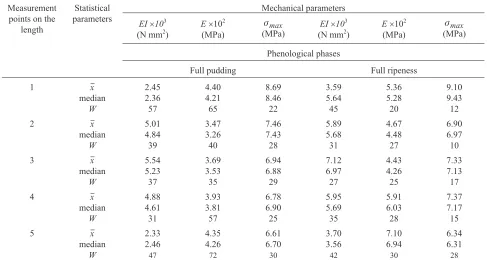
pea stems, together with a description of the parameters under analysis, is presented in Fig. 1 and results in Figs 2-6 and Tables 1 and 2.
The method developed for this study was tested on pea stems of the Agra and Piast varieties with a leaf-type stem
Method for the determination of the mechanical properties of pea stems
G. Skubisz
Institute of Agrophysics, Polish Academy of Sciences, Doœwiadczalna 4, P.O. Box 201, 20-290 Lublin 27, Poland
Received November 10, 2000; accepted February 1, 2001
© 2002 Institute of Agrophysics, Polish Academy of Sciences
Author’s e-mail: [email protected]
w
w
Fb
f=5 l=40
Fb Fbm
y
b=bending deformationDFb
Dyb
yb yb m
E =
I
E=
where
where
I
=
W=
s
bm=
p
p
Mg
max64
32
W
(
f f
42-
W4)
(
f f
2)
4
-
W4f2
F.
bl
3F.
bl
348 y
D
b48 y .
D
bI
Fig. 1.Schematic presentation of the test used in the study of mechanical properties of pea stems.
Measurement points on the
length
Statistical parameters
Mechanical parameters
EI´103
(N mm2)
E´102 (MPa)
smax (MPa)
EI´103
(N mm2)
E´102 (MPa)
smax (MPa)
Phenological phases
Full pudding Full ripeness
1 x
median
W
5.14 5.03 35
7.59 7.32 40
12.07 12.06 25
6.14 6.28 42
9.21 9.36 38
13.03 12.53 25
2 x
median
W
9.65 9.26 26
8.01 7.92 29
11.35 11.50 18
8.93 8.76 37
9.85 9.67 39
13.98 15.02 27
3 x
median
W
9.75 9.81 25
6.52 6.76 32
10.34 10.07 16
9.84 9.68 34
7.20 7.32 33
12.21 11.95 27
4 x
median
W
7.69 7.73 30
6.71 6.58 48
10.53 10.16 23
9.85 9.64 30
8.95 8.74 38
12.73 12.06 25
5 x
median
W
4.89 4.72 39
8.77 8.58
66
11.11 10.99
30
6.66 6.52
39
11.83 11.68
55
14.85 12.18
52
Measurement points on the
length
Statistical parameters
Mechanical parameters
EI´103
(N mm2)
E´102 (MPa)
smax (MPa)
EI´103
(N mm2)
E´102 (MPa)
smax (MPa)
Phenological phases
Full pudding Full ripeness
1 x median W 2.45 2.36 57 4.40 4.21 65 8.69 8.46 22 3.59 5.64 45 5.36 5.28 20 9.10 9.43 12 2 x median W 5.01 4.84 39 3.47 3.26 40 7.46 7.43 28 5.89 5.68 31 4.67 4.48 27 6.90 6.97 10 3 x median W 5.54 5.23 37 3.69 3.53 35 6.94 6.88 29 7.12 6.97 27 4.43 4.26 25 7.33 7.13 17 4 x median W 4.88 4.61 31 3.93 3.81 57 6.78 6.90 25 5.95 5.69 35 5.91 6.03 28 7.37 7.17 15 5 x median W 2.33 2.46 47 4.35 4.26 72 6.61 6.70 30 3.70 3.56 42 7.10 6.94 30 6.34 6.31 28
T a b l e 2.Mean values of mechanical parameters of the Agra variety (x, mediana ,W- coefficient of variability)
1 3 4 5 6 7 8 9 10 11 12 13 Modulus of elasticity (10 MPa) 2 E 2 3
Length of the pea stems
4 5
Piast - I the term Piast - II the term Agra - I the term Agra - II the term
y =968x -202x+35 y =1256x -338x+63 y =513x -104x+18 y =745x -257x+54
1 2 3 4 2 2 2 2
Fig. 2.Modulus of elasticity (E) of the stems pea varieties ( 1...5 points on the length of stem from the root to the tip: I - complete filling pod, II - full ripeness).
1 2 3 4 5 6 7 8 9 10 Rigidity (10 N m m ) 32 El 2 3
Length of the pea stems
4 5
y =-216x +6938x-1198 y =1244x +5726x-921 y =-1546x +4851x-815 y =-773x +5166x-867
1 2 3 4 2 2 2 2
morphology. The Piast variety is more resistant to lodging than the Agra variety. The tests were performed at the time of full podding, and during full ripeness.
RESULTS AND DISCUSSION
The study permitted definition of the mechanical parameters of pea stems for the two varieties, at the time of full podding, and during full ripeness.
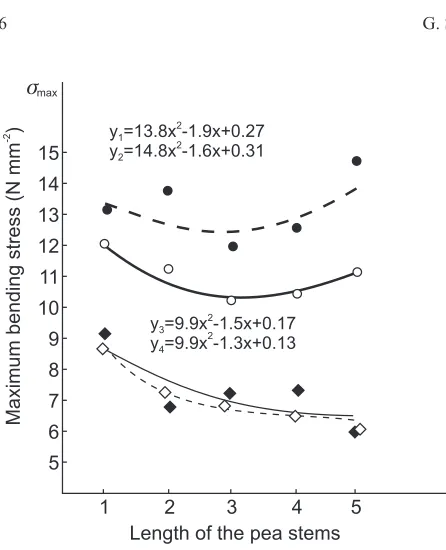
The mean values of the parameters studied are presented in Tables 1 and 2, while the variability of the parameters along the length of the stems is shown in Figs 2 through 4.
The stems of pea plants with a strong lodging tendency had particularly high values of the coefficients of elasticity close to the roots, as well as close to the top of the plant, while a minimum of those characteristics was observed around the middle of the plant height. Rigidity, on the other hand, had strong maximum characteristics in the middle of the stem length. The maximum bending stress showed a much less pronounced difference in values along the length of the stems.
In the course of studying the mechanical properties of the plant stems, the location of extreme values on the stem length was recorded. The minimum value of the modulus of elasticity was found at a third of the distance from the stem base to the plant top in the case of winter wheat stems [4].
The study showed that the pea cultivars under analysis differed in the strength of their stems. The Piast variety is characterized by a much higher rigidity and elasticity of stem, and by lower values of maximum bending stress when
1 5 6 7 8 9 10 11 12 13 14 15
Maximum
bending
stress
(N
mm
)
-2
s
max2 3
Length of the pea stems
4 5
y =13.8x -1.9x+0.27 y =14.8x -1.6x+0.31
1
2 2
2
y =9.9x -1.5x+0.17 y =9.9x -1.3x+0.13
3
4 2
2
Fig. 4.Maximum bending stress (smax) of the stems pea varieties. Explanations as in Fig. 2.
0
0
Piast
Piast
Piast
Agra
Agra
Agra 2
2
2 4
4
4 6
6
6 8
8
8 10
10
10 12 E
EI
s
- Full poddings - Full ripeness
- Full poddings - Full ripeness
- Full poddings - Full ripeness
Modulus
elasticity
(10
MPa)
2
Rigidity
(10
N
mm
)
32
Maximum
bending
stress
(N
mm
)
-2
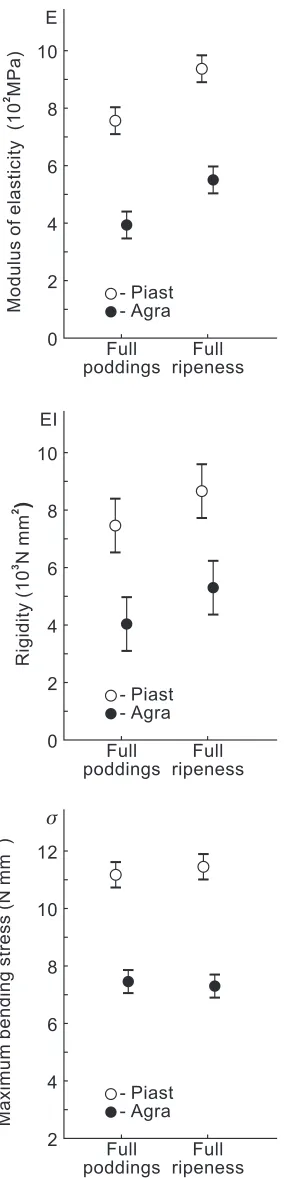
Fig. 5.Mean values and the 95% Tukey HSD intervals ofE,EIand
compared with the Agra variety. The above is true for both the phenological phases covered in the study.
Significant differences were observed between the mechanical properties of the stems of the two pea varieties (Figs 5 and 6). The results obtained indicate that the strength characteristics of the stems of pea varieties under study showed significant difference in their mechanical parame-ters during the course of plant growth and development.
The method developed for the study helped to obtain knowledge about the strength properties of the stems of pea varieties under examination.
CONCLUSIONS
1. It was found that the Piast variety is characterized by a much higher rigidity and elasticity of stem, and by lower values of maximum bending stress, as compared to the Agra variety. The above holds true for both phenological phases analyzed.
2. Significant intervarietal differences were observed as a result of variance analysis of the mechanical parameters of pea stems.
3. The study showed that the method developed by the author can be used for the determination of the mechanical parameters of various pea cultivars.
ACKNOWLEDGMENTS
The author hereby extends her thanks to Prof. Wojciech Œwiêcicki (Institute of Plant Genetics, Polish Academy of Sciences, Poznañ) for making breeding plant material available and to Prof. Helena £abuda (University of Agri-culture, Lublin) for the founding of experimental plots for this research.
REFERENCES
1. Boros L. and Sawicki J., 1997. Assessment of selected varieties and forms in a collection of sowing peas (Pisum sativum L.). Part I. The variability and heritability of pea quality features (in Polish). Zesz. Probl. Post. Nauk Roln., 446, 101-106.
2. Boros L. and Sawicki J., 1997. Assessment of selected varieties and forms in a collection of sowing peas (Pisum sativumL.). Part II. Crop yield stability and correlation of features (in Polish). Zesz. Probl. Post. Nauk Roln., 446, 107-112.
3. Cutillas-Iturralde A. and Lorences E.P., 1997.Effect of xyloglucan oligosacharides on growth, viscoelastic properties, and long-term extension of pea shoots. Plant Physiology 113 (1), 103-109.
4. Skubisz G., 1982.Cereal stalk elasticity (in Polish). Problemy Agrofizyki, 38.
5. Skubisz G., 1995.Studies of the mechanical properties of winter rape stems. Zemedelska Technika, 41(2), 65-68. 0
0
Full poddings
Full poddings
Full poddings
Full ripeness
Full ripeness
Full ripeness 2
2
2 4
4
4 6
6
6 8
8
8 10
10
10 12 E
EI
s
- Piast - Agra
- Piast - Agra
- Piast - Agra
Maximum
bending
stress
(N
mm
)
-2
Rigidity
(10
N
m
m
32
)
Modulus
of
elasticity
(10
MPa)
2
Fig. 6.Mean values and the 95% Tukey HSD intervals ofE,EIand