Practical Argumentation as
Reasoned Advocacy
M
ARCINL
EWIŃSKIArgLab, Nova Institute of Philosophy Universidade Nova de Lisboa
Avenida de Berna 26C, 1069-061 Lisbon Portugal
Abstract: The paper offers a theo-retical investigation into the sources of normativity in practical argumen-tation. The chief question is: Do we need objectively-minded, unbiased arguers or can we count on “good” argumentative processes in which individual biases cancel each other out? I address this question by ana-lysing a detailed structure of practi-cal argument and its varieties, and by discussing the tenets of a com-parative approach to practical rea-son. I argue that given the compara-tive structure proposed, reasoned advocacy in argumentative activity upholds reasonableness whenever that activity is adequately designed. I propose some basic rules for such a design of practical argumentation.
Résumé: Cet article offre un exa-men théorique des sources de nor-mativité dans l’argumentation prati-que. La question principale qui nous occupe est la suivante: avons-nous besoin d’argumentateurs objectifs et non-biaisés ou pouvons-nous comp-ter sur de “bons” processus argu-mentatifs susceptibles de neutraliser les biais individuels? Je traite d’abord cette question à travers une analyse de la structure détaillée de l’argumentation pratique et de ses variétés et ensuite par une discussion des fondements d’une approche comparative de la raison pratique. Je défends l’idée que selon la structure comparative proposée, tout plaidoyer raisonné dans une activité argumentative maintient la raison-nabilité tant que cette activité est conçue de manière appropriée. Je propose quelques règles de base pour une telle conception de l’argumentation pratique.
Keywords: advocacy, argumentation, comparativism, deliberation, polylogue, practical argument
1. Introduction
What grounds objectively rational choice? […] The an-swer I propose is what I call “comparativism.” According to comparativism, comparative facts are what make a choice objectively correct; they are that in virtue of which a choice is objectively rational or what one has most or sufficient normative reason to do. (Chang, 2016, pp. 213-214)
The solution thus rests on the notion of “comparative facts” cap-turing basic comparison relations: better than, worse than and equally good. In a “well-formed choice situation”—“one in which there is a determinate and small set of alternatives” to choose from—it is rational to go for the alternative X whenever “X is better than Y [Z, etc.] with respect to p,”1 where p is a “covering consideration,” such as beauty or efficiency (Chang, 2016, p. 215, 217). As simple as it may seem, with all argu-ments laid out and all footnotes carefully filled in (Chang, 2002; 2004; Temkin, 2012), comparativism makes a comparatively strong theory of the normative grounds of practical reason.
Chang is quick to specify that she offers a theory of prac-tical reason and not of practical reasoning: it doesn’t tell us “how we should arrive at rational choice” but “instead that in virtue of which a choice is rational, however we should arrive at it” (Chang, 2016, p. 216; emphasis in original). The idea that “the correct decision procedure determines the correct ground of rational choice” (Chang, 2016, p. 216, fn. 4) is thus deemed “controversial” and abandoned.
This last move is, of course, well-known to argumentation scholars. If arguments are abstract objects existing in a Fregean realm of otherworldly ontology where their correctness is exclu-sively established, then argumentation theory is merely a theory of the uses of arguments, of actual processes and procedures that may bring us closer to the good arguments, defined out there. Normatively speaking, it thus becomes a theory of approxima-tion (how might we get there, as close as we can), rather than a theory of “rational,” “objective grounds” of “normative rea-sons.”
Unsurprisingly, such philosophical views do not have much currency among communication scholars. For them, the immanent or internal (as opposed to transcendent or external) normativity of argumentation is a fundamental part of human communication. Accordingly (see Lewiński, in press), a central
question in argumentation theory would be: How do we align our knowledge of what a good reason is with our knowledge of how reasons get actualised in the world? For Wenzel (1990), all three perspectives on argument—that of logical product, dialec-tical procedure and rhetorical process—are equally relevant, “equally good” might we say, normative takes on the human practices of argument. Craig & Tracy (1995) go a step further and find the normative grounds for communication in the very thick of communicative practices, often characterised by com-peting goals and the ensuing need for balanced management of communicative trade-offs. Ideals are thus always already situat-ed rather than brought down from heavens.2 Further, to avoid simplifying discipline divisions, many philosophers share, in-deed inspire, these views. Searle (1969; 2001; 2010) has long promoted the view that the speech act performance in the social world is imbued with an internal deontology derived from the very semantics of speech acts and “the institution of language.” In particular, in the world of conflicting individual desires and overlapping social obligations, there can be no deductive logic of practical reason—and yet there exists rationality in action (Searle, 2001). In his own way, Habermas (1984) captures this embodied normativity by defining communicative rationality as grounded in the pragmatic presuppositions governing rational-critical discussions allowing for a free and open rational-critical verifica-tion of arguers’ “validity claims” attached to speech acts.
Goodwin (2005), discussing Habermasian ideas via Rehg’s analysis, admits we might never be in a position to con-clusively determine whether the norms of argument are contex-tually designed by arguers themselves in and through their situ-ated argumentative transactions—or, by contrast, they simply locally specify some stable and generalizable ideas of rationality (Goodwin, 2005, esp. pp. 158-159). Her own work tilts strongly toward the first option. However, even those argumentation scholars who define normativity of argumentation in terms of universal and external philosophical ideal of critical rationali-ty—such as pragma-dialecticians (van Eemeren & Grootendorst, 2004)—would subscribe to the idea that: “Rational decision making is not so much a matter of making the right decision, but one of making the decision right” (Miller, 1994, p. 43; quoted in Fairclough & Fairclough, 2012, p. 49). Whether “the correct
procedure” (Chang, see above) contextually constitutes the grounds of reasonable argumentation, or merely implements some general norms of reason constituted elsewhere, it does matter as an indispensable vehicle for making the decision right. (As shown below, even Chang indirectly admits that.)
So, how do we make the decision right without losing the sight of the theories, such as comparativism, which supposedly offer objective normative grounds for the right decision? In par-ticular: Do we need objectively-minded, unbiased arguers or can we count on “good” argumentative processes or procedures in which individual biases cancel each other out?
This is the question I will consider in this paper. To spoil the surprise, I will count myself among those who count on “good” argumentative procedures to answer the question of the grounds of practical reasoning. This is not to deny that good arguers are needed for such procedures, and that argumentation has always an inescapable cognitive aspect which filters out what argumentation eventually becomes, both descriptively and normatively (e.g., Hample, 2005).
I will go about it as follows. Below, in section 2, I will present an extended schema of practical argument I have been developing, which is compatible with the main tenets of com-parativism. Further, in section 3, I will argue that the context of well-structured advocacy is an answer to the question of how the rationality of so conceived practical argument can be best squeezed out, or grounded. Finally, in section 4 I will propose a tentative procedure for such a context.
2. The structure of practical argument
Take a simple example of practical reasoning stolen from Goodwin:
Assume you are shopping for one of the new-fangled, ef-ficient but expensive light bulbs at your local hardware store. While staring at the one of the multitude of options, you receive this message: “You should buy it—it lasts a lot longer!” This is an argument, and seems potentially relevant to your choice. But it suffers from a fatal vague-ness: longer than what? How do you fill in the missing information? (Goodwin, 2013, p. 15)
assertive (see Lewiński, 2016a). Further, the only argument ex-plicitly given here is a comparative argument: “it lasts a lot longer.” We can easily rephrase it in terms of a basic positive comparative fact: Bulb X is better than Y with respect to lon-gevity. The crucial unknown here is if we’re dealing with a de-terminate set of alternatives over which we compare, that is, are we in a “well-formed choice situation”? (Chang, 2016, p. 215). We would indeed be, if the comparative “longer than” pertained to “some light bulb that is directly relevant to your decision— perhaps the light bulb you are currently using, or the light bulb of a different manufacturer that is comparable to the one in question in every way except how long it lasts” (Goodwin, 2013, p. 15). If, by contrast, “longer than” referred vaguely to “some light bulb or other—perhaps longer than one of the man-ufacturer’s cheaper light bulbs, or longer than last year’s model” (Ibid.), then we would face a rather vague, suspiciously open set of options, which would eventually make comparisons spurious (cf. “It lasts longer than Edison’s first bulb”). In the former case, we are in a position to make a rational choice: all other things being equal, or at least “comparable,” longevity might be the decisive, reasonable criterion. In the latter case, due to the ill-defined set of alternatives we are prone to lapses in our practical rationality: the comparative fact that the bulb lasts longer than a cheaper type of bulbs which “by definition” last much shorter, cannot reasonably ground our choice. (The fact that the econo-my class ticket is cheaper than any business class ticket will not help us much in choosing the best economy fare we are looking for. Etc.)
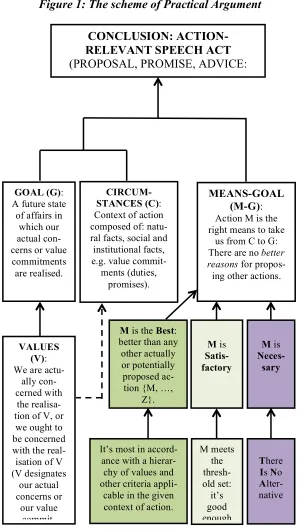
Goodwin’s original problem was how to reconstruct the rest of this overly laconic argument. This is no easy undertaking. Yet I can see how this tiny bit of argumentation can—indeed has to—be considered as a part of a much complex schema for prac-tical argumentation. This schema seems to comprehensively grasp all “the missing information” (Goodwin, 2013, p. 15) needed to analyse and evaluate this kind of argument. Below I will present its general elements, using the lightbulb shopping as a running example.
analysis of all the premises constituting the scheme ( Circum-stances, Goal, Values), I will briefly mention some basic ad-vantages of the scheme.
Figure 1: The scheme of Practical Argument
Derived from: Fairclough & Fairclough (2012)
M is the Best: better than any other actually or potentially proposed ac-tion {M, …,
Z}.
It’s most in accord-ance with a hierar-chy of values and other criteria appli-cable in the given context of action.
M is
Satis-factory
M is
Neces-sary
There
Is No
A lter-native M meets the thresh-old set: it’s good enough CONCLUSION: ACTION-RELEVANT SPEECH ACT (PROPOSAL, PROMISE, ADVICE:
e.g., LET’S DO M!)
GOAL (G): A future state
of affairs in which our actual con-cerns or value
commitments are realised.
CIRCUM-STANCES (C): Context of action composed of: natu-ral facts, social and
institutional facts, e.g. value commit-ments (duties,
promises).
MEANS-GOAL (M-G):
Action M is the right means to take
us from C to G: There are no better reasons for
propos-ing other actions.
VALUES (V): We are
actu-ally con-cerned with
the realisa-tion of V, or
we ought to be concerned with the
real-isation of V (V designates our actual concerns or
commit-Possible, contextually-determined decision criteria:
direct or indirect costs and benefits (negative and beneficial consequences / side effects)2⦁
opportunity costs ⦁
practical feasibility ⦁
ethical, moral, or legal implications ⦁
likelihood of realization or of success ⦁
conformance with other goals or strategies, their timing, duration, or lo-cation ⦁
(derived from: McBurney, Hitchcock, & Parsons, 2007, p. 99)
As I have argued before (Lewiński, 2015, 2016a), the scheme distinguishes between independent and context-dependent elements of PA. Its basic general structure (as per Fairclough & Fairclough: all the white boxes in Figure 1) re-mains constant, while contextual criteria for choosing “the right means” (below the diagram) fluctuate.3 It also provides a new account of how to criticise and evaluate PA. It clearly demar-cates the attacks on the main premises (Circumstances, Goals, Values, Means-Goals), from those concerning context-dependent decision criteria, and from criticisms of the inference licences related to the type of the inferential step made (neces-sary, satisfactory, or the best means). Further, the scheme de-fines its conclusion in terms of a class of action-relevant speech acts, thus pointing to a “unity in diversity” of what we can argue for in PA.
Two other features of the scheme are crucial to the current investigations. First, it clarifies the notion of the means-goal premise. This premise is grounded in one of the three basic in-ference licences warranting the choice of “the right means” tak-ing us from the current (unwelcome) Circumstances to the (de-sired) Goals: the means can be necessary, satisfactory (good enough) or simply the best among all the possible, comparable alternatives. (These are mutually exclusive, so we can follow only one of them at a time. See below for elaboration.)
Second, as I will argue below, the scheme shapes the framework of relevance for (multi-party) deliberation where advocacy is instrumental to making a reasonable decision. Typi-cally, different parties argue for the contextual betterness of their proposals for action {M, N, O… Z} (see the “M is the Best” box). Their deliberation develops then as an
tive polylogue (Lewiński, 2014; Lewiński & Aakhus, 2014) along the lines of possible disagreements over the various ele-ments of the structure (basic premises, inference rules and con-textual criteria).
It is in these two features where comparativism takes hold of our exercise of practical rationality. One of the three paths for justifying the means to be taken (“M is the best”) is straightfor-wardly based on comparison as the principle of reasonable choice. The two other paths are too based on comparisons, but in a less direct way. Realising that a given means is necessary, re-quires its prior comparison to other—unattainable, inadmissible or inefficient—means, thus leaving this means as the only, hence necessary, alternative for reaching the goal (possibly in conjunction with other means, which can all be individually necessary, but only jointly sufficient). The satisfactory path re-quires a comparison to a threshold set in advance (“Any bulb of this kind cheaper than €10 is fine”; more on satisficing below). The model of advocacy-based deliberation I propose below, suggests a reasonable way to do it, to engage in exhaustive and critically justified comparisons. I say “suggests” to acknowledge the possible leap in the dark between making the decision right to making the right decision. Before moving on to this crucial point, I will say something about the possible paths for justify-ing the choice of “the right” means.
As I argued before (Lewiński, 2015), the simplest formu-lation of the scheme of practical reason does not really work, due to its incomplete take on the means-goal premise. The basic scheme of practical reason discussed in philosophy and argu-mentation theory looks more or less like this:
Let’s do X! (Conclusion) because
X leads to Y. (Means-Goal premise) and
Y is our desired goal. (Goal premise)
That this scheme does not quite capture the rationality of PA can be shown by producing arguments that clearly follow the scheme but are not so clearly rational:
Let’s stop feeding our children! because
This will save us lots of money. and
Here, from acceptable premises (the Goal of saving money is morally acceptable; the Means-Goal relation between stopping feeding children and saving money is technically speaking cor-rect in many contexts) we get a highly objectionable conclusion. That means that there is a problem with the validity of the prac-tical inference drawn here—and thus with the simple scheme in general. What is missing is the “inference licence” regarding the quality of the link between the desired goal (premise) and the proposed means of action (conclusion). The Means-Goal infer-ence needs to be thickened beyond asserting simple causality: “X leads to Y.”
One obvious option is to take X as a means necessary to reach Y. Whenever we want to achieve Y, we have to do X. An exception occurs when X involves an objectionable (morally unacceptable, too expensive) action, in which case we should abandon our goal.4
While being the philosophers’ favourite, the necessary means is something of a laboratory case. It is appealing, for it allows to construe the practical inference as modus ponens which makes it valid by standards of classic deductive logic (“If we want Y, then only by means of X; and we do want Y; ergo, we need to do X”). Yet, in real life, we often have several alter-native ways of reaching the goal. Each of these alteralter-natives is typically considered as a sufficient means, an action that in itself is sufficient to take one from the current state of affairs to the desired goal. The choice between available alternatives in PA was recognised already by Aristotle, who famously declared that if the desired end “seems to be produced by several means they [deliberators] consider by which it is most easily and best pro-duced” (Nicomachean Ethics, 1112b12-15). Unsurprisingly, in practical philosophy there is a long tradition of investigating what the “most easily and best produced” means might be. Briefly, when reasoning or arguing over the Means to produce our Goals, we can licence our inference through one of the two basic strategies (see Byron, 1998, 2004):5
4 “Who wills the end, wills (so far as reason has a decisive influence on his actions) also the means which are indispensably necessary and in his power” (Kant, Groundwork of the Metaphysics of Morals, pp. 80-81; cited in Broome, 2013, p. 159). Indeed, the necessity of means is typically considered the paradigmatic type of inference licence in practical reason (Broome, 2013; Walton, 2007).
A) Going for “the best”: optimising / maximising. What “the best” is, is typically contextually de-termined, sometimes loosely (when deciding on the best place to take summer holidays), some-times in a very strict, administratively defined way (when deciding on the best public pro-curement offer, or best job or grant application). While the general criteria or parameters for se-lecting the best course of action can be suggest-ed (see the bottom of Figure 1, also: Hitchcock, 2011; McBurney et al., 2007), their exact set, scope, precision and weight depend on the con-text and cannot be pre-defined. Therefore, they constitute the fluctuating conditions in the scheme of PA. One can, however, distinguish between simple and subtle optimising:
i. Simple optimising applies when deliberators deal with a “static context,” that is, when the set of alternative options (means of action) is finite and known (Byron, 1998; this is what Chang, 2016, calls a “well-formed choice situation”): we should simply take the best (most efficient, beautiful, heavy-duty, cheapest) bulb from the display panel in the shop.
ii. Subtle optimising takes place when we are fac-ing an ever-changfac-ing “dynamic context” in which the set of options is open-ended and con-stantly updated (Byron, 1998): Shall we buy the 2016 Philips bulbs or wait a little for the 2017 Samsung line? What better offers can we get in the near future? Such risky questions (Hamblin, 1970, p. 216) call for an on-going calculation of costs and benefits under uncertainty.
B) Going for the “good enough”: satisficing by set-ting a threshold which will fulfil our basic crite-ria: “Any 10 Watt or less LED bulb for less than € 10 is fine.” This, of course, is not the “best way all things considered” but it is an important and reasonable way to licence conclusions of our PA under many typical circumstances: i. In dynamic contexts, satisficing lets us
analysis. (This plays to the “we are cognitive misers” argument discussed below.)
ii. In static contexts, it allows for global optimisa-tion by letting us being somewhat “easy” on less important local results: “Just take the € 9.99 Philips and let’s go, we have plenty of other things to do.”
In these ways, satisficing also falls under the “no better reasons” principle (see the Means-Goal box in Figure 1). In dynamic con-texts, we (so far) have no better option than the one which first meets the threshold. In static contexts, while locally merely sat-isficing, we might be optimising in terms of the bigger plan.6
The basic inference licence in PA is then: there are no bet-ter reasons for proposing other courses of action.7 Only when strengthened with this principle is the “X leads to Y” Means-Goal premise properly licenced and the entire PA generates rea-sonable, even if expectedly defeasible, results.8
Apart from necessary and sufficient (either satisfactory or best) means, there is still one more option, which is likely the most common and the least discussed kind of means we consid-er in our PA. I call them conducive means in order to convey their presumed worthiness in approaching the desired Goal, de-spite their being neither necessary nor sufficient means. Condu-cive means should be considered against a disjunction of other alternatives (for they are not necessary) and in conjunction with other means (for they are not sufficient). Examples of such means are plenty: “In order to cut household spending I should
6 For similar reasons, it has been argued (e.g. Byron, 1998) that satisficing is eventually a species of optimisation, as it aims at finding the optimal balance between overall costs (effort, time, other resources) and benefits (satisfaction of preferences and values) of our actions.
7 Chang (2016, p. 231ff.) criticises this way of defining rational choice— which she calls “maximalism”—on the account that it is based on a negative (“no better reasons,” “not worse”) rather than a positive comparative fact (“better than,” “equal to”). However, with some uncontroversial additional assumptions (“not worse iff better than or equal to”), both views are compat-ible in this respect.
buy some new energy-saving LED lightbulbs.” Clearly, LED lightbulbs are not a necessary means to save money. Instead, I can quit smoking, stop buying books I’ll never read, or find a Portuguese girlfriend rather than pay for expensive private clas-ses of Portuguese. Likewise, it is not a sufficient means: alone, even super-efficient LED bulbs will not save me all that much. Still, when supported with other premises of the scheme of PA, and as part of a bigger plan, buying a set of new energy-saving and long-lasting bulbs for the entire house might be not a bad conclusion at all. It might be more efficient, or less painful or troublesome than quitting smoking, books, and my current girl-friend. Or it might just save me per annum the sum I’m looking to save. Shortly, whether because it is an optimal or a satisfacto-ry means, it takes us some way from current Circumstances to the Goal and is thus presumably reasonable.
Following all this, we arrive at the following types of in-ferences licencing our PA:
a) Doing X is necessary to get to Y
b) Doing X is sufficient (and best / good enough way) to get to Y
c) Doing X is conducive (and best / good enough way) to get to Y
3. Two basic ways to design practical argumentation
3.1 Solo reasoning vs. collective argumentation
model of practical reasoning in its purity (Hitchcock, 2011). This is the first view on where to search for the normative grounds of practical reasoning.
However, Aristotle prefaces his proto-comparativism with a telling disclaimer: “We call in others to aid us in deliberation on important questions, distrusting ourselves as not being equal to deciding” (Nicomachean Ethics, 1112b11). To those seeking the path to rationality in an undisturbed, clear and distinct indi-vidual mind, this is puzzling. But not to all. Dascal argues that Aristotle was deliberately vague on the distinction between pri-vate (internal) and public (collective) deliberation as chief activ-ities of practical reason, in order to expose “a deep analogy be-tween his conceptions of the two domains” (Dascal, 2005, p. 52). Moreover, an individualistic approach to practical argument runs the risk of being “solipsistic, egoistic and anti-social” (Hitchcock, 2002), so the grounds of practical argument are best found in dialogical practices of argumentation where collective values, goals, and institutions are duly considered in a critical argumentative discussion.9 When we distrust ourselves on the rationality of our decisions, we then better resort to some criti-cal, and thus corrective, exchange with others. This is the second view.
A number of arguments give substance to the claim that the way to get to a reasonable decision based on a critically test-ed practical argument, is to put it to the test of collective delib-eration where arguers act as advocates of the possible alterna-tives. Several vivid metaphors have been in circulation to make this point.
One is that of a council. Dascal quotes a passage from Stuart Hampshire, where Aristotle’s vagueness, perhaps conti-nuity, between the internal (individual) and external (collective) deliberation is portrayed in terms of a mind as “a council cham-ber, in which the agent’s contrary interests are represented around the table, each speaking for itself” (Hampshire, 1991, p. 51 as quoted in Dascal, 2005, p. 70, n. 13). The “council mem-bers” thus advocate for “their” interests which are contrary to “other members’” interests before “the chairman”—the will. We can presume that having heard the best arguments made for each
member’s interests, the chairman gains enough insight to issue a reasoned decision to be acted on.
Perelman & Olbrechts-Tyteca take up similar imagery and claim not only simple similarity between public and private de-liberation but rather primacy of the former over the latter:
[…] inward deliberation […] appears to be constructed on the model of deliberation with others. Hence, we must expect to find carried over to this inner deliberation most of the problems associated with the conditions necessary for discussion with others. […] Accordingly, from our point of view, it is by analyzing argumentation addressed to others that we can best understand self-deliberation, and not vice versa. (1969, pp. 14, 41)
The same point is elaborately defended in Billig’s (1996) rhetor-ical approach to social psychology. His chief polemic point is to argue “against those cognitive theories of thinking, which tend to treat thinking as if it were the silent, internal processing of information” (p. 2). Billig’s task is to redefine some basic con-cepts of cognitive psychology through a 180º turn:
Thinking is a form of internal argument, modelled on outward dialogue; attitudes are rhetorical stances in mat-ters of controversy; justification and criticism are key rhetorical activities; and so on. […] An argument for an issue of controversy is also an argument against counter-views. Any reasoned argument seeks to exclude, or per-suade against, counter-arguments. (Billig, 1996, p. 2; emphasis in original)
This sounds familiar enough to rhetoricians and dialecticians who approach argumentation as a communicative process, pro-cedure or transaction (Wenzel, 1990; Goodwin, 2005). It’s also not uncommon among dialogically minded formal logicians (Dutilh Novaes, 2015; Krabbe, 2013; MacKenzie, 1989). As it turns out, mutual relations between argumentative discussion and solo reasoning might be more pervasive than officially af-firmed (Lewiński, in press).
According to comparativism, alternatives must “do bat-tle” in the arena of reasons. Whichever alternatives emerge as victors can be rationally chosen. Or less vio-lently: the alternatives “meet and discuss” which of them will go forth into the world of intention and action. The ones that go forward as a result of that discussion can be rationally chosen. […] In short, comparativism holds that what makes a choice rational is some achievement, a stamp of approval, a gold star. (Chang, 2016, p. 234).
Despite Chang’s disclaimers, we are thus back to Hampshire’s metaphor of a reasoning mind as a council chamber in session. The vehicle or source of this metaphor, in line with Perelman & Olbrechts-Tyteca’s (et al.’s) argument, is the actual battle or discussion in a council, which thus takes precedence over the internal practical reasoning of an individual, the target concept. In this externalised sense, the battle of alternatives or a discus-sion over them are procedures or designs for argumentation. They can take two different shapes: one closer to the discussion, another closer to the battle. This, also, is no news to argumenta-tion scholars.
3.2 Issue-based deliberation vs. role-based advocacy
How can we reasonably compare alternatives and decide on the best one through collective practical argumentation? There are, of course, hundreds of ways to do it, but two broad ways have been distinguished.
I have described one of them as an issue-based dialectics (Lewiński, 2016b). A well-known historical precedence is Cice-ro’s argumentum in utramque partem aimed at a “balanced con-sideration of alternatives” (Schofield, 2008, p. 64). Today, Wal-ton and others would call it a deliberation dialogue (Walton & Krabbe, 1995, ch. 3; Walton, 1998, ch. 6; McBurney, Hitchcock, & Parsons, 2007; Atkinson, Bench-Capon, & Walton, 2013). Blair (2016), capturing a similar concept, brands it as inquiry (while also pondering exploration and discovery).
de-fined position on it and that they do not defend the superiority of “their” position by making a case, that is, by advancing argu-ments that consistently support the position. Rather, each partic-ipant is supposed to give pro and con reasons on each possible solution to the open problem, and to welcome the final weighing of reasons without being committed to one “best” option all along (see Figure 2).
persua-sion dialogues over actions—positions and arguments are “owned” or “championed” by discussants. By contrast, in delib-eration dialogues—which exemplify an issue-based approach— “there should be no ‘ownership’ of options” (Atkinson et al., 2013, p. 123).
Deliberation understood as a role-based exchange is a de-cision-making activity in which positions are clearly defined and explicitly advocated by given parties, who need to be mindful all along to remain consistent in their argumentative commit-ments.10 The goal is to select, upon critical examination, “the best” of these positions.11 There are thus “winners” and “losers.”
4. Advocacy-based model for practical argumentation
4.1 To inquire or to advocate?
Which way should we go, then? Goodwin suggests that informal logicians will in general be suspicious of advocacy, on the ac-count that for epistemic argumentative jobs it “will be taken as biased, irrelevant and possibly even fallacious” (2013, p. 2). An example of this is Blair, who advocates against the advocacy model and for the inquiry, largely based on his personal experi-ence. He recalls “meetings when members’ advocacy
10 By contrast, in issue-based activities, participants can be inconsistent, as they are allowed—even expected or obligated!—to advance pro and con arguments for each alternative, criticise and retract the arguments they sug-gested, and freely change their mind regarding each alternative.
tation produced or reinforced divisions in the group and blocked opportunities for open-minded investigations of alternatives” (Blair, 2016, p. 53). However, Grasso’s smart response to Blair’s paper strongly suggests that properly, “systematically” designed argumentative models of inquiry (discovery) and ad-vocacy would yield “almost indistinguishable results”: both “would require a comprehensive and exhaustive exploration of all possibilities: all options are considered in the discovery pro-cess, all voices are heard in the advocacy process” (Grasso, 2016, p. 71). Assuming that she is right, the issue then is that of a proper argumentation design (Aakhus & Jackson, 2005; Jack-son, 2015).
But there are reasons tilting the solution towards advoca-cy. Blair himself mentions that this is how most groups argue by default, whether by adopting explicit rules of order for advocacy (such as Robert’s Rules of Order) or simply because quickly enough “the pro and con advocacy begins” in typical group meetings (Blair, 2016, p. 60). A good normative pragmatic de-signer would surely take this into account—rather than go against this “natural” tendency.
Anecdotal empirical evidence aside, there are important theoretical reasons to try to model practical argumentation in terms of advocacy. To start with, decisions where various voices are heard through advocacy easier gain the crucial facet of dem-ocratic legitimacy when compared to decisions somewhat ab-stractly (or even paternalistically), “rationally considered” in detachment from actual parties claiming stake in the issue (Ben-habib, 1994). Further, advocacy might aid us in being cognitive misers; it allows us “to outsource some of the time-consuming and wearisome activity of reasoning to someone who is zealous about it” (Goodwin, 2013, p. 16). This view has been forcefully argued for by Mercier & Sperber (2011) in terms of the division of cognitive labor under the conditions of the well-known con-firmation bias:
In line with this argument, the current literature on dealing with cognitive biases in rational decision-making is increasingly at-tentive to the design of contexts for argumentation, while grow-ing sceptical of individual cognitive remedies for solo arguers (Kenyon & Beaulac, 2014).
Within the framework suggested here, it is crucial that advocacy is more readily consistent with comparativism and the model of practical argument presented above. In models of is-sue-based deliberation à la Blair, first the rational pooling of arguments for and against each option takes place—and only once this is done, the options are compared (see also McBurney et al., 2007). Comparisons are thus consequences of argu-ments—rather than grounds of arguments, as they rationally should be. Following our lightbulb example: The fact that the bulb lasts 10% longer than some kind of a standard bulb sounds like a pro-argument. But until we have the proper comparison, it remains utterly empty. Do new competitive bulbs last 30% or 3% longer? If 30%, then our bulb is a weak contender on this account, and the argument is in fact a con-argument. It is clear, then, that the basic comparative relations (better than, worse than, equally good) operate at the very core of the practical ar-gument in the first place—rather than in the final, post-argumentative “summation” (Blair, 2016). In Blair’s procedure, they should belong to Task 2: Investigation using arguments, rather than Task 3: Summation and application, where they are now.12
12 In his elaborate account of practical rationality, Temkin (2012) distin-guishes between the Internal Aspects View and the Essentially Comparative View on how to rationally ground our choices. His preference goes for the comparative view, with wide-ranging consequences, such as the suspension of the transitivity axiom (so that X > Y > Z > X is a possible reasonable re-sult). Without claiming an exact correspondence with my distinctions pro-posed in terms of argumentation theory, I cite his explanation of these con-cepts as yet another important argument for the view I defend here:
represent-4.2 How to advocate in practical argumentation
One can start thinking of an advocacy procedure for practical argumentation in terms of the existing role-based dialectical models but extended to incorporate the clash of more than just two positions on an issue; in this way, the model will be a model of a polylogue (Lewiński, 2014; Lewiński & Aakhus, 2014). Such a procedure can be constructed in a largely formal manner or informally, using the extant pragmatically-oriented dialectical approaches as a basic theoretical background. The pragma-dialectical model of a critical discussion may be particularly useful in this endeavour as a well-defined normative account of everyday argumentation. It offers a useful heuristic of dividing argumentative discussions into four “dialectical stages”: con-frontation, opening, argumentation and concluding (van Eeme-ren & Grootendorst, 2004, pp. 57ff.). The four stages can define the procedure for multi-party argumentation in general (Lew-iński & Aakhus, 2014), but they can also be crafted to advocacy-based deliberation in particular. In the latter case, the scheme of practical argument expounded in section 2 can serve as the pat-tern of relevance for all argumentative moves in deliberation. What is offered below, are procedural rules and guidelines, without any strong claim regarding their individual normative status and systemic closure.
To start with, the confrontation and opening stages are intertwined, and possibly opening comes analytically first—a marked difference from the pragma-dialectical critical discus-sion, where confrontation is the first ideal step.
Opening:
1. What is at stake? What is the issue?
1a. Arrive at a satisfactory representation of Circumstances: the issue to be tackled.
1b. Define the Goals: future desired states of affairs.
1c. Define the Values which justify the goals and, possibly, also shape the perspective on circumstances and constrain the choice of means.
1d. Decide on the basic principle of means selection in case of non-necessary means: optimising or satisficing.
ing how valuable an outcome really is” (Temkin, 2012, p. 229, emphasis in original).
1e. Decide on the contextually-relevant criteria for realising the values and selecting the optimal or satisfactory means.
Instrumental practical argumentation in a strict sense is one in which these premises are agreed in advance and held constant: so that we argue solely about the means to be adopted. In reality, of course, this hardly ever happens, so argumentation would develop in all these directions. (All these elements would be kicked back and forth between opening and argumentation.) Confrontation
Now, given the circumstances, goals, values and criteria, delib-erators are in a position to ask:
2. What shall we do (with this issue)? Or:
2’. What is the best means to take us from the current circum-stances to the desired goals?13
2a. Examine the nature of the issue:
2a1. A yes/no question? (“Shall we take the Philips bulb?”) 2a2. An alternative question / (safe) Wh-question: the set of rel-evant alternatives is finite and known to the arguers (“Shall we take Philips, Samsung or Osram bulb?” / “Which of the bulbs from the display panel shall we take?”)
2a3. An open (risky) Wh-question: the set of relevant alternatives is open-ended (“Which of the new lightbulbs shall we buy?”) 2b. Gather all the possible proposals: Let us do m, n, o, ..., z. Of course, 2b and 2a2-2a3 are cross-determined.
2c. Determine the nature of proposals: What is the proposal im-plying?
2c1. Determine its illocutionary force (Lewiński, 2016a):
1) Strong, with the highest level of commitment when “the proposer must openly commit herself to speak in defense of her resolution” (Kauffeld, 1998, p. 249)
2) Neutral, when the proponent is committed to the proposal as a serious consideration/option for deliberators: “in-ducement to tentative consideration” (Kauffeld, 1998, p. 250)
3) Weak, when the proposal is a mere, tentative “suggestion” (as in “brainstorming sessions”: McBurney et al., 2007, p. 100, 116; Walton, 2006, pp. 216-217).
Here, as noted above, I am dealing mostly with 1) and 2)— situations of advocacy in deliberation. A proponent has thus an obligation to advocate the positions she proposes to take—that is to say, once the proposal (and not merely a suggestion) is made, advocacy is needed. Overall, there seems to be a continu-um: from pure brainstorming or “thinking aloud” without strong commitment and with strong cancellability (level 3), to propos-ing somethpropos-ing as a serious consideration (level 2), to strongly defending one’s proposal/choice, presumably made upon best prior consideration of an issue (level 1). It might be hard to say where deliberation (as opposed to persuasion or negotiation dia-logues) starts and ends, especially when the level of commit-ment fluctuates over the course of discussion (diachronic varia-tion) and across various participants (synchronic variavaria-tion). In such cases, any clear-cut demarcating line would be arbitrary (as I think it is in Atkinson et al., 2013 and Walton, 2006). This model thus takes a maximally advocacy-based interpretation of deliberation as a position-defending-and-attacking argumenta-tive activity. Timid arguers are best advised to instead follow Blair’s (2016) inquiry model.
2c2. Determine the proposal’s propositional content 1) My position is that means m is necessary If not, then:
2) My position is that means m is sufficient and best. If not, then:
3) My position is that means m is conducive and best. Having made all this clear, deliberators can move to the third stage:
Argumentation
circum-stances, goals, values, and contextual criteria defined at the opening stage. In the case of sufficient and conducive means, the presuppositions are precisely the components of the “best-ness” of the advocated means; they constitute the sub-premises of the means-goal premise. A proponent of a given option should, depending on contextual constraints, be able to defend any of the qualities of the advocated option (see Figure 1, fol-lowing McBurney et al., 2007, p. 99): direct or indirect costs and benefits, their opportunity costs, their consequences, their prac-tical feasibility, etc.
The crucial guideline is at this stage is:
3. Construct your main arguments in terms of comparative facts: Option m is better than n with respect to {costs and bene-fits, feasibility, moral / aesthetic values, conformance with other goals or strategies, …}
Eventually, the argumentation stage should return a set of parative facts, critically tested in the back-and-forth of the com-petitive argumentative discussion.
Concluding
This brings us to the problems of concluding the discussion on the basis of the results of argumentative procedures. In a dyadic discussion, this is a fairly straightforward business, since arguers can choose from but two options: that “the protagonist’s stand-point is acceptable and the antagonist’s doubt must be retracted, or that the standpoint of the protagonist must be retracted” (van Eemeren & Grootendorst, 2004, p. 61). Such a limitation to du-ality is an all-too-common trick in the literature (see Lewiński & Aakhus, 2014 for an overview). Witness Chang’s strategy who, upfront, declares that: “To simplify, I will henceforth treat choice situations as involving only two alternatives” (2016, p. 215).
(2016, p. 66) and Chang. This applies especially in the case where they decide to split their procedure into a sequence of dual pro-et-contra encounters: Shall we do m? Shall we do n? Shall we do o? Dialectically speaking, such local concluding stages seem the most viable option, but the final evaluation of the entire multi-party deliberation may face a number of prob-lems (Lewiński & Aakhus, 2014). One of them is that more than one such sub-discussion ends with a yes resolution, while only one course of action can be taken. Another is that all options are objectionable for one reason or another, and the end result is nothing but a series of nos. Finally, there is the difficulty men-tioned above: if dyads directly compare two proposals (Shall we do m or n? Etc.), each proposal can be once better and once worse, making it hard to decide on a single “best” option (m > n > o > m).14 Some novel methods of concluding complex pol-ylogues are yet to be developed—especially if the ideal model-ling aims at grasping some form of a reasonable “resolution,” rather than mere “settling” of deliberations, for instance through voting or preference-aggregation—which, by the way, generate their own well-known issues such as a 50-50 vote or Condorcet cases.
5. Conclusion
So where is the reasonableness of practical argument?
It can be grounded in some abstract ideal detached from actual practical argumentation, such as proposed by Chang. Or it can be constituted in practical reasoning or argumentation. In the former case, reasoning or argumentation can better or worse approach the ideal; in the latter it can better or worse ground the ideal. Let us give up the hope of deciding which one is the case. We are still left with the same (meta-theoretical) comparative, normative framework: in both cases we can do it better or worse. Clear and distinct—or: objective and unbiased—solo practical reasoning is one way to do it better, rather than worse. Collective argumentation is another, where we can go for more co-operative inquiry / open deliberation—or for more competi-tive advocacy / dialectics.
I have argued here that the last option is empirically ade-quate and theoretically consistent. When properly designed, ad-vocacy becomes what we would consider a reasonable dialecti-cal argument at large: diligent, even zealous, argumentation in
defence of a contested thesis, yet within the bounds of some mutually recognised rules and constraints (Goodwin, 2013). A victor in such a benevolent battle is then not just some alterna-tive or other, but the rationality itself (that’s Aristotle). Even if not exclusively, a rational choice can be the end result of an ad-vocacy procedure.
Acknowledgements: An earlier, shorter version of this paper was presented during the 11th International Conference of the Ontario Society for the Study of Argumentation (OSSA): Argu-mentation, Objectivity, and Bias, 18-21 May 2016, Windsor, ON, and appeared in the proceedings edited by Patrick Bondy and Laura Benacquista. I would like to thank Jean Goodwin (my OSSA commentator) and the audience for many useful com-ments and suggestions. This work has been supported by an ex-ploratory grant for international projects, awarded by the Faculty of Social Sciences and Humanities (FCSH), Universidade Nova de Lisboa, as well as a grant of the Portuguese Foundation for Science and Technology (FCT): PTDC/MHC-FIL/0521/2014.
References
Aakhus, M., & Jackson, S. (2005). Technology, interaction, and design. In K. Fitch & R. Sanders (Eds.), Handbook of Lan-guage and Social Interaction (pp. 411-436). Mahwah, NJ: Lawrence Erlbaum.
Aristotle. (1984). Nicomachean ethics. In J. Barnes (Ed.), The Complete Works of Aristotle, Vol. II (pp. 1729-1867) (transl. by W. D. Ross & J. O. Urmson). Princeton, NJ: Princeton University Press.
Atkinson, K., Bench-Capon, T., & McBurney, P. (2006). Com-putational representation of practical argument. Synthese, 152(2), 157-206.
Atkinson, K., Bench-Capon, T., & Walton, D. (2013). Distinc-tive features of persuasion and deliberation dialogues. Argu-ment and Computation, 4(2), 105-127.
Benhabib, S. (1994). Deliberative rationality and models of democratic legitimacy. Constellations, 1(1), 26-52.
Blair, J. A. (2016). Advocacy vs. inquiry in small-group deliber-ations. In D. Mohammed & M. Lewiński (Eds.) (2016). Ar-gumentation and Reasoned Action: Proceedings of the 1st European Conference on Argumentation, Lisbon 2015. Vol. I (pp. 53-68). London: College Publications.
Broome, J. (2013). Rationality through reasoning. Oxford: Blackwell.
Byron, M. (1998). Satisficing and optimality. Ethics, 109(1), 67-93.
Byron, M. (Ed.) (2004). Satisficing and maximizing: Moral the-orists on practical reason. Cambridge: Cambridge University Press.
Chang, R. (2002). The possibility of parity. Ethics, 112(4), 659-688.
Chang, R. (2004). All things considered. Philosophical Perspec-tives, 18(1), 1-22.
Chang, R. (2016). Comparativism: The grounds of rational choice. In E. Lord & B. McGuire (Eds.), Weighing reasons (pp. 213-240). Oxford: Oxford University Press.
Craig, R. T., & Tracy, K. (1995). Grounded practical theory: The case of intellectual discussion. Communication Theory, 5(3), 248-272.
Dascal, M. (2005). Debating with myself and debating with oth-ers. In P. Barrotta & M. Dascal (Eds.), Controversies and subjectivity (pp. 33-73). Amsterdam: John Benjamins.
Dutlih Novaes, C. (2015). A dialogical, multi-agent account of the normativity of logic. Dialectica, 69(4), 587-609.
Eemeren, F. H., van (2016). Identifying argumentative patterns: A vital step in the development of pragma-dialectics. Argu-mentation, 30(1), 1-23.
Eemeren, F. H., van & Grootendorst, R. (2004). A systematic theory of argumentation: The pragma-dialectical approach. Cambridge: Cambridge University Press.
Fairclough, I., & Fairclough, N. (2012). Political discourse analysis. London: Routledge.
Goodwin, J. (2005). The public sphere and the norms of transac-tional argument. Informal Logic, 25(2), 151-165.
Grasso, F. (2016). The deliberation and the advocacy rooms: Commentary on Blair’s Advocacy vs. inquiry in small-group deliberations. In D. Mohammed & M. Lewiński (Eds.) (2016). Argumentation and Reasoned Action: Proceedings of the 1st European Conference on Argumentation, Lisbon 2015. Vol. I (pp. 69-73). London: College Publications. Habermas, J. (1984). The theory of communicative action. Vol.
1: Reason and the rationalization of society (transl. by T. McCarthy). Boston: Beacon.
Hamblin, C. L. (1970). Fallacies. London: Methuen.
Hample, D. (2005). Arguing: Exchanging reasons face to face. Mahwah, NJ: Lawrence Erlbaum.
Hitchcock, D. (2002). Pollock on practical reasoning. Informal Logic,22(3), 247-256.
Hitchcock, D. (2011). Instrumental rationality. In P. McBurney, I. Rahwan & S. Parsons (Eds.), Argumentation in Multi-Agent Systems: Lecture Notes in Computer Science (pp. 1-11). Dordrecht: Springer.
Jackson, S. (2015). Design thinking in argumentation theory and practice. Argumentation, 29(3), 243-263.
Kauffeld, F. J. (1998). Presumptions and the distribution of ar-gumentative burdens in acts of proposing and accusing. Ar-gumentation, 12(2), 245-266.
Kenyon, T., & Beaulac, G. (2014). Critical thinking education and debiasing. Informal Logic, 34(4), 241-263.
Krabbe, E.C.W. (2013). Topical roots of formal dialectic. Ar-gumentation, 27(1), 71-87.
Lewiński, M. (2014). Argumentative polylogues: Beyond dia-lectical understanding of fallacies. Studies in Logic, Gram-mar and Rhetoric, 36(1), 193-218.
Lewiński, M. (2015). Practical reasoning and multi-party delib-eration: The best, the good enough and the necessary. In B. Garssen, D. Godden, G. Mitchell & A. F. Snoeck Henkemans (Eds.), The Eighth Conference of the International Society for the Study of Argumentation (ISSA) (pp. 851-862). Amster-dam: SicSat.
Lewiński, M. (2016b). Dialectics and polylogues: The case of multi-party deliberations. In R. von Burg (Ed.), Dialogues in Argumentation (pp. 105-123). Windsor, ON: Windsor Stud-ies in Argumentation.
Lewiński, M. (in press). Argumentative discussion: The ration-ality of what? TOPOI: An International Review of Philoso-phy. Online first, DOI: 10.1007/s11245-015-9361-0.
Lewiński, M., & Aakhus, M. (2014). Argumentative polylogues in a dialectical framework: A methodological inquiry. Argu-mentation, 28(2), 161-185.
MacKenzie, J. (1989). Reasoning and logic. Synthese, 79(1), 99-117.
McBurney, P., Hitchcock, D., & Parsons, S. (2007). The eight-fold way of deliberation dialogue. International Journal of Intelligent Systems, 22(1), 95-132.
Mercier, H., & Sperber, D. (2011). Why do humans reason? Arguments for an argumentative theory. Behavioral and Brain Sciences, 34(2), 57-74.
Perelman, Ch., & Olbrechts-Tyteca, L. (1969). The new rheto-ric: A treatise on argumentation (transl. by J. Wilkinson & P. Weaver). Notre Dame: University of Notre Dame Press. (Original work published 1958.)
Prakken, H. (2009). Models of persuasion dialogue. In I. Rahwan & G.R. Simari (Eds.), Argumentation in Artificial Intelligence (pp. 281-300). Dordrecht: Springer.
Schofield, M. (2008). Ciceronian dialogue. In S. Goldhill (ed.), The end of dialogue in antiquity (pp. 63-84). Cambridge: Cambridge University Press.
Searle, J. R. (1969). Speech acts: An essay in the philosophy of language. Cambridge: Cambridge University Press.
Searle, J. R. (2001). Rationality in action. Cambridge, MA: MIT Press.
Searle, J. R. (2010). Making the social world: The structure of human civilization. Oxford: Oxford University Press.
Temkin, L. S. (2012). Rethinking the Good: Moral ideals and the nature of practical reasoning. Oxford: Oxford University Press.
Walton, D. (1998). The new dialectic: Conversational contexts of argument. Toronto: University of Toronto Press.
Walton, D. (2006). How to make and defend a proposal in a deliberation dialogue. Artificial Intelligence and Law, 14(3), 177-239.
Walton, D., & Krabbe, E.C.W. (1995). Commitment in dia-logue: Basic concepts of interpersonal reasoning. Albany: State University of New York Press.