Controlling measles in NSW: how are
we doing in the context of other countries
in the Western Pacific?
Robert I. Menzies
A,B,F, Margaret Burgess
B,Cand David N. Durrheim
D,EA
National Centre for Immunisation Research and Surveillance, The Children’s Hospital at Westmead
B
Sydney Medical School, The University of Sydney C
Sydney Children’s Hospital Network D
Hunter New England Population Health E
School of Medicine and Public Health, The University of Newcastle FCorresponding author. Email: [email protected]
Global measles control over the past decade has been very successful. Estimated deaths have fallen by 74% from
535 300 in 2000 to 139 300 in 2010.1 While the goal of
eradicating global measles transmission has not yet been formally adopted, five of six World Health Organization (WHO) regions have set deadlines for elimination of endemic measles transmission* (the exception being the South East
Asian Region).2This was achieved in the Americas in 2002
and has been maintained since then.3However, after 8 years
of decline, global case numbers have increased in the past
3 years due to substantial outbreaks in Africa and Europe.4
In Europe in 2011 there were more than 30 000 cases of
measles notified with at least eight deaths.5Significant
out-breaks occurred in France (15 000 cases), Italy, Spain, Romania and Germany. More than 80% of cases occurred in unvaccinated persons – the main reason for these outbreaks is failure to vaccinate. It is likely that countries with major outbreaks will need to consider ‘catch-up’ programs, as well as improved primary vaccination coverage with two doses of measles-containing vaccine. In Africa large outbreaks have
recently been experienced in 60% of countries.6
In the WHO Western Pacific Region, major progress to control measles has been made in recent years. The Western Pacific Region focused on measles control during the 1990s before adopting the goal of elimination in 2003 and, in 2005, declaring
the target year as 2012.7Control activities have accelerated in
recent years: reported coverage with one dose of measles-containing vaccine increased from 85% in 2000 to 97% in 2011 (the highest of any WHO region), and coverage is 91% for the second routine dose of measles-containing vaccine. Supple-mental immunisation activities, usually targeting children from the age of 9 months up to 14 years, have been conducted in 30
of 37 countries and areas in the region.7The largest
supple-mental immunisation activity in history was conducted in
China in 2010, with over 103 million children vaccinated.4
The fruits of these activities can be seen in a 91% reduction in
reported measles cases between 2000 and 2011,8 and an
estimated 76% reduction in deaths between 2000 and 2010.1
Although cessation of endemic measles virus circulation in every country in the region is unlikely to be achieved in 2012, elimination appears to have already been achieved in 25 of 37 countries and areas within the Western Pacific Region. These are: South Korea (the only Western Pacific Region country to formally announce elimination), all Pacific Island countries,
Australia, Hong Kong and Macau.9Substantial progress has
been made in recent years in the four countries with the largest
populations – China, Japan, Philippines and Viet Nam.7This
remarkable progress in the region has resulted in the Western Pacific Regional Director appointing a Regional Verification Commission to formally assess regional and individual country progress towards meeting the elimination goal.
Although not yet formally verified in Australia, measles elimination may have already been achieved, judging from our high two-dose coverage, limited transmission from imported cases, cessation of endemic genotype circulation,
national serosurvey data and modelling studies.10Australia
NSW PUBLIC HEALTH
BULLETIN
CONTENTS – See back page w w w . p u b l i s h . c s i r o . a u / j o u r n a l s / p h b
Immunisation in NSW
*Endemic transmission is defined as ongoing transmission of the same strain of
virus for $12 months (see Annex 4 of: http://www.wpro.who.int/about/
has been requested to appoint a National Verification Committee to provide evidence supporting elimination.
Recent increases in measles cases in New South Wales
(NSW) described by Rosewell et al.11were associated with
outbreaks in Sydney high schools that have particular popula-tions with low vaccination coverage and transmission in hospital emergency departments. Although outbreaks have not occurred in other Australian states and territories this year, outbreaks linked to imported cases occurred in all jurisdic-tions in 2011, and the numbers of cases nationally has
increased in recent years.12,13 The source countries for
NSW-imported cases were predominantly from the Western Pacific, European and South East Asian regions, probably reflecting a combination of travel patterns and source country
disease incidence. Unlike in Europe,14 outbreaks in NSW
have not yet resulted in the re-establishment of endemic
transmission.11However, to ensure this, continued high levels
of vaccination coverage throughout the community are essential, as is continued vigilance through sensitive case surveillance and meticulous outbreak investigation and con-trol (including genotyping to exclude common circulating types). Serosurveillance studies help to determine whether and when a catch-up campaign may be needed. In addition, we must pay particular attention to the vaccination status of travellers not only to endemic areas but also to high profile mass gatherings.
Supporting strengthened elimination efforts internationally will also benefit NSW and Australia by limiting the potential for the importation of cases. One relatively minor step could be reporting discarded measles case numbers to WHO; a discarded measles case is one originally suspected as being measles but subsequently confirmed as not measles. Cur-rently, suspected measles cases are deleted once measles has been excluded as the cause in NSW and other Australian
jurisdictions. The benchmark of$2 discarded measles cases
per 100 000 population is a key indicator that a country’s measles surveillance is adequate for verifying elimination. Australia is one of only four countries not providing these
data to the Western Pacific Regional Office,7but studies in
northern NSW and Victoria have confirmed Australia’s
ability to collect the data to meet this benchmark.2,15This
information would provide a valuable reassurance to other countries in the region about our surveillance quality and commitment to regional elimination efforts.
While much progress has been made in measles control over the past decade, NSW and Australia must maintain vigilance at home as well as supporting active partnership with elimination efforts in the Western Pacific.
References
1. Simons E, Ferrari M, Fricks J, Wannemuehler K, Anand A, Burton A et al. Assessment of the 2010 global measles mortality
reduction goal: results from a model of surveillance data.Lancet
2012; 379: 2173–8. doi:10.1016/S0140-6736(12)60522-4
2. Wang YH, Andrews RM, Kelly H, Lambert SB. Evaluating measles surveillance using laboratory-discarded notifications of
measles-like illness during elimination.Epidemiol Infect2007;
135(8): 1363–8. doi:10.1017/S095026880700828X
3. World Health Organization. Global elimination of measles: report by the Secretariat. Executive Board 125th Session, 16 April 2009 (EB125/4). Available at: http://apps.who.int/gb/ ebwha/pdf_files/EB125/B125_4-en.pdf (Cited 18 May 2012).
4. Centers for Disease Control and Prevention (CDC). Progress in
global measles control, 2000–2010.MMWR Morb Mortal Wkly
Rep2012; 61(4): 73–8.
5. European Centre for Disease Prevention and Control. European monthly measles monitoring (EMMO). Issue 8: 21 February 2012. Available at: http://ecdc.europa.eu/en/publications/ Publications/SUR_EMMO_European-monthly-measles-monitoring-February-2012.pdf (Cited 18 May 2012).
6. World Health Organization. Measles outbreaks and progress towards meeting measles pre-elimination goals: WHO African
Region, 2009–2010.Wkly Epidemiol Rec2011; 86(14): 129–36.
7. Sniadack DH, Mendoza-Aldana J, Jee Y, Bayutas B, Lorenzo-Mariano KM. Progress and challenges for measles elimination
by 2012 in the Western Pacific Region.J Infect Dis2011;
204(Suppl 1): S439–46. doi:10.1093/infdis/jir148
8. Sniadack DH, Wang X. Update on measles elimination in the Western Pacific Region. Presentation to the WHO Global Measles and Rubella Management Meeting, 20 March 2012. Available at: http://www.measlesinitiative.org/portal/site/mi/ menuitem.32caa2468d334463c1062b10133f78a0/
?vgnextoid=90bdb27b785a3210VgnVCM10000089f0870 aRCRD&cpsextcurrchannel=1 (Cited 20 April 2012).
9. Centers for Disease Control and Prevention (CDC). Progress toward the 2012 measles elimination goal – Western Pacific
Region, 1990–2008.MMWR Morb Mortal Wkly Rep2009;
58(24): 669–73.
10. Heywood AE, Gidding HF, Riddell MA, McIntyre PB, MacIn-tyre CR, Kelly HA. Elimination of endemic measles
transmis-sion in Australia.Bull World Health Organ2009; 87(1): 64–71.
doi:10.2471/BLT.07.046375
11. Rosewell A, Reinten-Reynolds T, Spokes PJ. EpiReview:
Measles in NSW, 2002-2011.N S W Public Health Bull2012;
22(9–10): 201–7.
12. Communicable Diseases Network Australia. NNDSS Fort-nightly summary notes – 2011. Fortnight 24: 18 November to 2 December 2011. Available at: http://www.health.gov.au/ internet/main/publishing.nsf/Content/cdnareport-fn24-11.htm (Cited 20 April 2012).
13. Martin N, Foxwell R. Measles status in Australia, and outbreaks
in the first quarter of 2009.Commun Dis Intell2009; 33(2):
225–31.
14. Eurosurveillance editorial team. Stepping up European measles
surveillance.Euro Surveill2011; 16(28): 19917.
15. Kohlhagen JK, Massey PD, Durrheim DN. Meeting measles elimination indicators: surveillance performance in a regional
area of Australia.Western Pacific Surveillance and Response
NSW Annual Vaccine-Preventable
Disease Report, 2011
Alexander Rosewell
A,B, Paula J. Spokes
Aand Robin E. Gilmour
AA
Health Protection NSW B
Corresponding author. Email: [email protected]
Abstract: Aim:To describe the epidemiology of selected vaccine-preventable diseases in NSW for
2011. Methods: Data from the NSW Notifiable
Conditions Information Management System were analysed by: local health district of resi-dence, age, Aboriginality, vaccination status, and organism, where available. Risk factor and vacci-nation status data were collected by public health units for case-patients following notification
under the NSW Public Health Act 1991*.
Results:Outbreaks of measles and pertussis were reported in 2011, associated with unimmunised groups for measles, and a variety of factors for pertussis. Notification rates for other selected vaccine-preventable diseases remained stable.
Conclusion: Vaccine-preventable diseases are generally well controlled in NSW. However, pertussis remains an important public health issue. To prevent measles high population vaccination coverage, including vaccination in risk groups, is essential.
The objectives of vaccine-preventable disease surveillance are, at an individual level, to identify events that may require immediate public health control measures, and at a population level, to identify risk factors such as age and geographic location that inform better targeted immunisa-tion efforts.
This report describes notification data for measles,
pertus-sis, rubella,Haemophilus influenzaeserotype b invasive
infection, invasive meningococcal disease, mumps, teta-nus, and invasive pneumococcal disease in New South Wales (NSW) in 2011 and provides comparison with recent trends.
Methods
The notification requirements for medical practitioners, hospital general managers and laboratories under the state’s public health legislation have been previously
described.1 On receipt of a notification, a public health
unit surveillance officer determines whether or not the notification meets the definition of a case of
vaccine-preventable disease according to national criteria,2and if
so enters data gathered on each notified case into the NSW Notifiable Conditions Information Management System (NCIMS). In this report, a person with an illness that meets the case definition is called a case-patient.
Data describing cases in NCIMS were extracted for selected vaccine-preventable diseases with a date of onset in 2011. Rates were calculated using Australian Bureau of Statistics population estimates and are presented as annual rates per 100 000 total population or population in age groups. Risk factor and vaccination status data were collected for case-patients through public health unit follow-up with general practitioners (GPs) and other sources such as case-patient or carer reports. The inci-dence of cases were analysed by geographic area of residence.
Results
Haemophilus influenzae serotype b invasive infection
In 2011, four cases ofH. influenzaeserotype b infection
were notified; this was the lowest annual incidence within the last decade. Three case-patients were aged less than 1 year and one was a 2-year old child; all were male. Of the three infants aged less than 1 year, one 10-month old and one 11-month old infant were fully vaccinated for age (3 doses), while one 9-month old infant was partially vaccinated for age (2 doses). The 2-year old case-patient was fully vaccinated (4 doses). No case-patients were identified as being Aboriginal. All lived in regional NSW.
Measles
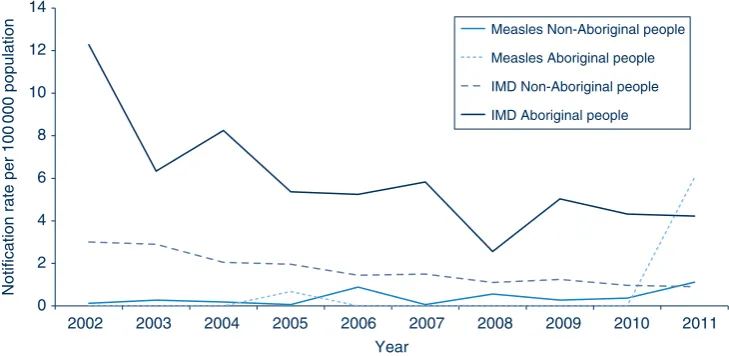
amongst whom case notification rates were significantly higher than in non-Aboriginal people (6.0 and 1.1 per 100 000, respectively) (Figure 1). Measles cases were notified in 10 local health districts (LHDs); the highest rate was in the Greater Southern LHD (10 cases, 4.9 per 100 000 population) (Table 2).
Of the 90 cases, 50 (56%) were unvaccinated, 18 (20%) were vaccinated, and 22 (24%) had missing vaccination status. Of the 18 vaccinated cases, five (all aged 15–35 years) had two documented doses, three one dose only and 10 did not have information on the number of doses of vaccine that they had received. Of the five fully vaccinated case-patients, vaccination history was validated by written records in three (one through the Australian Childhood Immunisation Register and two their personal health record), and for two based on self-report only. None of the nine case-patients who acquired their infection over-seas had documented evidence of measles vaccination.
During the past decade, measles has been rare in NSW compared with the period before the 1998 Measles Control Campaign, with outbreaks primarily occurring in under-immunised populations and international travellers. Of the 90 cases notified in 2011, 12 (13%) were acquired over-seas, 11 (12%) were epidemiologically linked to these cases, while in 67 (74%) no link to an overseas-acquired case could be established. Among clusters in metropolitan Sydney, repeat presentations of case-patients to health settings prior to diagnosis were common. Source case-patients were retrospectively identified in emergency departments in several clusters. In two clusters,
case-patients were children overdue for immunisation.3,4
In Western Sydney LHD, 26 cases (23 locally acquired) were notified from one local government area. Twelve of
these were children from Pacific Islander communities, seven of whom attended the same high school. In Southern NSW LHD there were seven cases notified in an outbreak centred on a high school with low vaccination coverage in the Australian Capital Territory.
Internationally, there are eight different clades and 24
subclades of measles viruses referred to as genotypes.5In
2011, 34 (38%) cases had measles genotyping results. Of these, five (15%) were measles genotype D8, seven (21%) were measles genotype D4 and 22 (65%) were measles genotype D9. Travel to France and Italy was associated with measles genotype D4 while travel to the Philippines was associated with measles genotype D9. In recent years, the measles virus D9 genotype has been identified in Europe and as endemic in selected countries of the Asia-Pacific region, while measles virus D4 and D8 genotypes
have been identified more widely.1
Meningococcal disease (invasive)
In 2011, 72 cases of invasive meningococcal disease were notified in NSW (62 confirmed and 10 probable), com-pared with 76 cases notified in 2010. Four deaths among case-patients were notified in 2011 across a wide age range, including: one infant aged less than 1 year, one 45–49-year old, one 70–75-year old and one 80–85-year old (all caused by serogroup B). This compares to five deaths in 2010 (three caused by serogroup B, one ser-ogroup W135, and one with an unknown serser-ogroup).
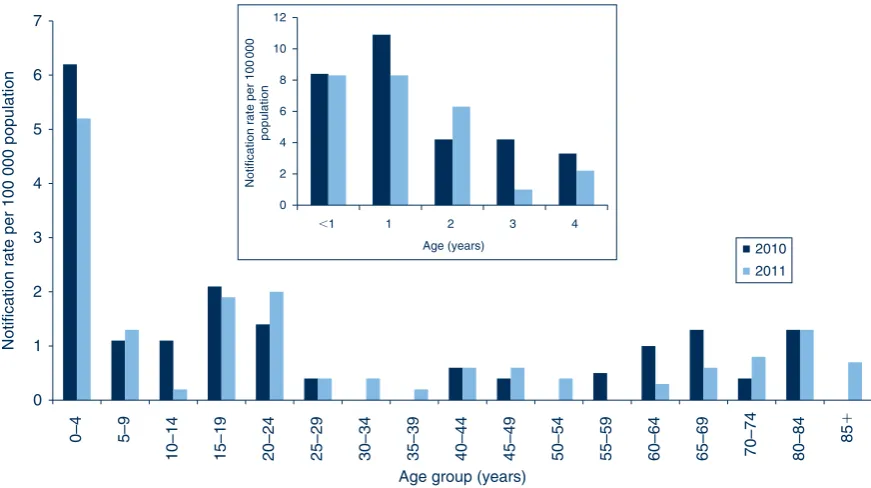
The highest case notification rates of invasive meningo-coccal disease were among children aged less than 5 years at onset of illness (25 cases, 5.2 per 100 000 population) and young people aged 20–24 years (10 cases, 2.0 per 100 000 population) (Figure 2). Of the case notifications among children aged less than 5 years, the highest rates 0
2 4 6 8 10 12 14
2002 2003 2004 2005 2006 2007 2008 2009 2010 2011
Notification rate per 100
000 population
Year
Measles Non-Aboriginal people Measles Aboriginal people IMD Non-Aboriginal people IMD Aboriginal people
Figure 1. Case notifications of measles and invasive meningococcal disease (IMD) per 100 000 population in NSW, for Aboriginal and non-Aboriginal people, for each year of the period 2002–2011.
were reported from children aged 13–24 months (eight cases, 8.3 per 100 000 population) and infants aged less than 12 months (eight cases, 8.3 per 100 000 population).
In 2011, 36 case-patients (50%) with invasive meningo-coccal disease were male. Seven case-patients were Aboriginal people, amongst whom notification rates were 4.6 times higher (95% CI 2.1, 10.0) than in non-Aboriginal people (4.2 and 0.9 per 100 000, respectively) (Figure 1). Geographically in NSW, the highest case notification rates were from Western NSW LHD (2.2 per 100 000 population).
Of the 72 cases notified in NSW in 2011, serogroup information was recorded for 54 (75%). Of these 54 case-patients, for 44 (81%) disease was caused by ser-ogroup B infection (for which there is no vaccine); 32% of these case-patients were aged less than 5 years, 57% were
.5 years and,65 years of age, and 11% were.65 years
of age. For four case-patients (7%), disease was caused by serogroup Y infection; of these people three were aged less than 25 years of age and one was aged between 25 and 80 years. For four case-patients (7%), disease was caused by serogroup W135 infection (of these people three were less than 2 years of age and one was aged between 2 and 40 years). Only two case-patients (4%) had disease caused by serogroup C infection, one aged 32 years, the other 69 years – both were ineligible for vaccination and were not vaccinated. Of the 18 cases (25%) of unknown ser-ogroup, two were unable to be typed and eight had clinical findings consistent with meningococcal disease but no laboratory confirmation. Of the seven case-patients who
were Aboriginal people, for four disease was due to serogroup B infection, two W135 infection and one due to serogroup Y. Information describing vaccination status was complete for 54 case-patients (75%); there were no cases caused by serogroup C among people who had been vaccinated against serogroup C.
Mumps
In 2011, 65 cases of mumps were notified in NSW compared to 39 in 2010. The highest case notification rates of mumps were among young adults aged 20–24 years at onset of illness (11 cases, 2.2 per 100 000 popula-tion). In 2011, 35 case-patients (54%) were male.
In NSW, notified cases of mumps are not routinely followed up by public health units. No outbreaks of mumps were reported in 2011.
Pertussis
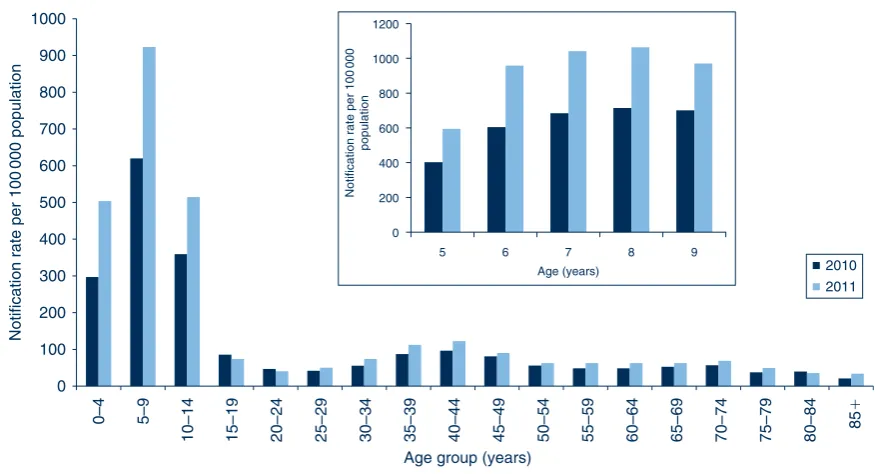
In 2011, 13 053 cases of pertussis were notified in NSW (the highest level on record), compared with 9332 in 2010. The highest age-specific pertussis case notification rates were in children aged 5–9 years (4120 cases, 923.1 per 100 000 population) and 10–14 years (2334 cases, 514.7 per 100 000 population), an increase from 2010 when 2744 cases (620.0 per 100 000 population) and 1627 cases (359.4 per 100 000 population) were notified in the 5–9 and 10–14-year age groups respectively (Figure 3). The greatest increase from 2010 to 2011 was among children aged 6 years (958.0 per 100 000 population in 2011 0
1 2 3 4 5 6 7
0–4 5–9
10–14 15–19 20–24 25–29 30–34 35–39 40–44 45–49 50–54 55–59 60–64 65–69 70–74 80–84
85
⫹
Notification rate per 100 000 population
Age group (years)
2010 2011
0 2 4 6 8 10 12
⬍1 1 2 3 4
Notification rate per 100
000
population
Age (years)
Figure 2. Comparison of annual case notification rates per 100 000 population for invasive meningococcal disease by 5-year age groups, NSW, 2010 and 2011. Comparison of annual case notification rates per 100 000 population for children aged less than 5 years for each year of age, NSW, 2010 and 2011, presented inset.
compared to 604.0 per 100 000 population in 2010) and 7 years (1041.8 per 100 000 population in 2011 compared to 683.9 per 100 000 population in 2010). Of the case-patients aged less than 5 years, the highest notification rates were in children aged 3 years (588 cases, 601.8 per 100 000 population) and 2 years (529 cases, 554.1 per 100 000 population). One death was reported in a 1-month old infant, who was too young to be vaccinated.
In 2011, 5939 case-patients (45%) were male. Of the 2403 case-patients aged 0–4 years (who are followed up by public health units), 132 (5%) were Aboriginal children. Geographically, the highest case notification rates were reported in Murrumbidgee (including Albury) (440.2.0 per 100 000 population) and Nepean Blue Mountains (332.7 per 100 000 population) LHDs.
In total, 520 case-patients were aged less than 12 months. Of these, 309 (59%) were infants too young to have received three doses of vaccine (i.e. aged 6 months or less at onset of illness). Of the 1885 case-patients who were children aged 1–4 years, 247 (7%) were reported to be not immunised, 31 (2%) reported less than three doses of vaccine, and 1618 (86%) reported three or more doses. For the remainder of case-patients (5%) data on vaccine doses was not reported.
Pneumococcal disease (invasive)
In 2011, 524 cases of invasive pneumococcal disease were notified compared to 500 in 2010. Fifty-seven deaths were identified in 2011: one case-patient who died was a child aged less than 2 years who was fully vaccinated (due to disease caused by a serotype that was not included in the
vaccine), nine case-patients who died were aged between 80 and 84 years and 15 were aged 85 years and over.
The highest case notification rates of invasive pneumococ-cal disease were in adults aged older than 85 years (55 cases, 37.9 per 100 000 population) and 80–85 years (40 cases, 26.3 per 100 000 population), and in children aged less than 5 years (70 cases, 14.7 per 100 000 popula-tion) (Table 1). Of the case-patients less than 5 years of age, the highest notification rates were in infants aged less than 12 months (21 cases, 21.8 per 100 000 population) and children aged 12–23 months (20 cases, 20.8 per 100 000 population).
Fifty-two percent of case-patients were male. Of the 383 case-patients aged 0–4 years or older than 50 years (who are followed up by public health units), 12 (3%) were Aboriginal people. Geographically, the highest notification rates were reported in Western NSW (41 cases, 15.3 per 100 000 population), Nepean Blue Mountains (36 cases, 10.4 per 100 000 population) and Illawarra Shoalhaven (35 cases, 9.0 per 100 000 population) LHDs (Table 2).
From 1 July 2011, 13-valent conjugate pneumococcal vaccine (PCV-13) replaced 7-valent conjugate pneumo-coccal vaccine (PCV-7) on the NSW Immunisation Pro-gram. The PCV-13 vaccine includes the additional serotypes 1, 3, 5, 6A, 7F and 19A.
Rubella
In 2011, 17 cases of rubella were notified in NSW compared to 13 in 2010. All case-patients were people aged between 15 and 60 years. Seven case-patients (41%) 0
100 200 300 400 500 600 700 800 900 1000
0–4 5–9
10–14 15–19 20–24 25–29 30–34 35–39 40–44 45–49 50–54 55–59 60–64 65–69 70–74 75–79 80–84 85
⫹
Notification rate per 100
000 population
Age group (years)
2010 2011
0 200 400 600 800 1000 1200
5 6 7 8 9
Notification rate per 100
000
population
Age (years)
Figure 3. Comparison of annual case notification rates per 100 000 population for pertussis by 5-year age groups, NSW, 2010 and 2011. Annual case notification rates for children aged 5–9 years for each year of age, NSW, 2009 and 2010, presented inset.
were male. Geographically, the highest notification rates were in the Sydney LHD (0.5 per 100 000 population). Notifications have not changed over the previous 5 years. There were no case notifications of congenital rubella.
Tetanus
In 2011, one case of tetanus was notified in NSW. This case-patient resided in Sydney LHD and was an 18-year old male who reported being vaccinated 12 years ago.
The number of notified cases of tetanus has remained relatively stable over the past 5 years, ranging from 1 to 2 cases annually. Most tetanus cases occur in older adults who are not adequately immunised. This was the youngest case-patient notified in the last decade in NSW.
Discussion
While there are limitations to the data,1
vaccine-preventable disease surveillance in NSW enables the implementation of timely public health measures, permits a better understanding of disease trends and helps inform policy. Notifications of some vaccine-preventable diseases
(such asH. influenzaeserotype b, invasive meningococcal
disease, pneumococcal disease, mumps and rubella) have remained stable or declined over recent years.
Outbreaks of measles continue to occur, mostly as a result of people who are unvaccinated or have incomplete vacci-nations travelling to countries where measles transmission is common and then returning home whilst infectious or during their incubation period. As measles is a highly infectious disease, local transmission can occur among the susceptible members of the contact network of these travellers, including infants too young to be protected through vaccination. In addition, there were 67 cases (including 11 clusters affecting 32 people) with no direct links to overseas travel. These cases were therefore thought to be locally acquired from infectious measles patients that may not have been diagnosed or sought medical attention. This highlights the challenges to comprehensive identifi-cation and notifiidentifi-cation of cases of measles where many clinicians may not have previously seen or diagnosed measles.
Pertussis remains an important public health problem in NSW. Public health activities should focus on the preven-tion of severe disease (which frequently occurs in young infants) and death (which mostly occurs in infants less than 2 months of age). One important recommendation (accord-ing to the Australian Immunisation Handbook) is that new parents, grandparents and adult carers of infants are
vaccinated.6 While vaccine-induced selection pressure
on pertussis strains has been suggested as a possible explanation for the significant increases in notifications
in Australia in recent years,7 this is unconfirmed. The
greater contribution is likely to have been increased (and
more sensitive) testing for pertussis.8Vaccination remains
the key prevention and control tool, especially in the prevention of severe pertussis and death.
The number of notified cases of invasive meningococcal disease has declined significantly since the National Meningococcal C Immunisation Program commenced in 2003. The greatest reduction in notified cases of meningo-coccal disease has been for serogroup C, from 45 cases (29% of those with known serogroup) in 2003, to less than 10 cases annually over the last 5 years, and two cases (4% of those with known serogroup) in 2011. The number of cases of meningococcal disease associated with serogroup B has also decreased over time, but remains the most commonly identified serotype. The notifications of other serogroups (W135 and Y) have remained relatively stable over time.
Vaccine-related invasive pneumococcal disease (IPD) has diminished since the introduction of the 7-valent conjugate pneumococcal vaccine (PCV-7) in 2005, whilst serotypes not covered by the PCV-7 have been steadily increasing. Serotypes 1, 3, 6A, 7F and 19A (included in the 13-valent pneumococcal vaccine (PCV-13)) have been responsible for up to 59% (predominantly serotype 19A: 36%) of IPD in children aged less than 5 years since 2005. Following the introduction of PCV-13 in 2011, further reduction in IPD is expected in children. It remains to be seen whether similar reductions in IPD due to serotypes covered by PCV-13 in
people aged.5 years will be equivalent to those seen with
PCV-7.
Conclusion
Acknowledgments
The authors would like to thank and acknowledge the NSW public health network including laboratory staff for their work in identi-fying and managing cases of vaccine-preventable disease in NSW.
References
1. Spokes PJ, Gilmour RE. NSW Annual Vaccine-Preventable
Disease Report, 2010.N S W Public Health Bull2011; 22(9–10):
171–8. doi:10.1071/NB11028
2. Department of Health and Ageing. Australian national notifiable diseases and case definitions. Australian Government Depart-ment of Health and Ageing. Available at: http://www.health. gov.au/casedefinitions (Cited 8 May 2012).
3. Jayamaha J, Binns PL, Fennell M, Ferson MJ, Newton P, Tran T et al. Laboratory diagnosis, molecular characteristics, epidemi-ological and clinical features of an outbreak of measles in a low
incidence population in Australia.J Clin Virol2012; 54(2):
168–73. doi:10.1016/j.jcv.2012.02.025
4. Hope K, Boyd R, Conaty S, Maywood P. Measles transmission in health care waiting rooms: implications for public health
response.Western Pacific Surveillance and Response Journal
(in press).
5. Measles virus nomenclature update: 2012.Wkly Epidemiol Rec
2012; 87(9): 73–81.
6. National Health and Medical Research Council. The Australian Immunisation Handbook. 9th ed. Canberra: Australian Govern-ment DepartGovern-ment of Health and Ageing; 2008.
7. Octavia S, Sintchenko V, Gilbert GL, Lawrence A, Keil AD, Hogg G et al. Newly Emerging Clones of Bordetella pertussis Carrying prn2 and ptxP3 Alleles Implicated in Australian
Pertussis Epidemic in 2008–2010.J Infect Dis2012; 205(8):
1220–4. doi:10.1093/infdis/jis178
8. Kaczmarek MC, Lambert SB, Kelly HA, Ware R, Valenti L, Britt H. Seven-fold rise in likelihood of pertussis-test requests during Australian GP encounters, 2011–2011. Seven-fold rise in likelihood of pertussis-test requests during Australian GP encounters, 2011–2011. Darwin, NT, Australia: Public Health Association of Australia; 2012. p. 37.
*ThePublic Health Act 2010(NSW) (http://www.health.nsw.gov.au/phact/)
ThePublic Health Act 2010(NSW) was passed by the NSW Parliament in December 2010 and commenced on 1 September 2012. The Public Health
NSW Annual Immunisation Coverage
Report, 2011
Brynley Hull
A,D, Aditi Dey
A,
Sue Campbell-Lloyd
B, Robert I. Menzies
A,Cand Peter B. McIntyre
A,CA
National Centre for Immunisation Research and Surveillance, The Children’s Hospital at Westmead
BCentre for Health Protection, NSW Ministry of Health C
Sydney Medical School, The University of Sydney D
Corresponding author. Email: [email protected]
Abstract: This annual report, the third in the series, documents trends in immunisation cover-age in NSW for children, adolescents and the
elderly, to the end of 2011.Methods:Data from
the Australian Childhood Immunisation Register, the NSW School Immunisation Program and the NSW Population Health Survey were used to calculate various measures of population coverage.
Results:During 2011, greater than 90% coverage was maintained for children at 12 and 24 months of age. For children at 5 years of age the improvement seen in 2010 was sustained, with coverage at or near 90%. For adolescents, there was improved coverage for all doses of human papillomavirus vaccine, both doses of hepatitis B vaccine, varicella vaccine and the dose of diphtheria, tetanus and acellular pertussis given to school attendees in Years 7 and 10. Pneumococcal vaccination cover-age in the elderly has been steadily rising, although it has remained lower than the influenza coverage
estimates.Conclusion:This report provides trends
in immunisation coverage in NSW across the age spectrum. The inclusion of coverage estimates for the pneumococcal conjugate, varicella and menin-gococcal C vaccines in the official coverage assess-ments for ‘fully immunised’ in 2013 is a welcome initiative.
This is the thirdNew South Wales (NSW) Annual
Immunisa-tion Coverage Report.This series of annual reports provides information on trends and issues in immunisation coverage in NSW to facilitate the monitoring of NSW immunisation programs. This report uses the longstanding international
practice of reporting coverage at key milestone ages to measure coverage against national benchmarks and to track trends over time. It is adapted from annual national
immu-nisation reports published since 2008.1
The Australian Childhood Immunisation Register was established on 1 January 1996 by incorporating demo-graphic data from Medicare on all Medicare-registered
children aged less than 7 years.2 The operations of the
Australian Childhood Immunisation Register have been
discussed in detail elsewhere.3
High levels of reporting to the Australian Childhood Immunisation Register are maintained by a system of incentive payments for immunisation providers and carers.
These have been discussed in detail elsewhere.3However,
changes to immunisation policy, the incentive payment system and changes to the ‘fully immunised’ coverage algorithms may have an impact on reported vaccination coverage; some recent changes are highlighted in Box 1 and also referred to in this report.
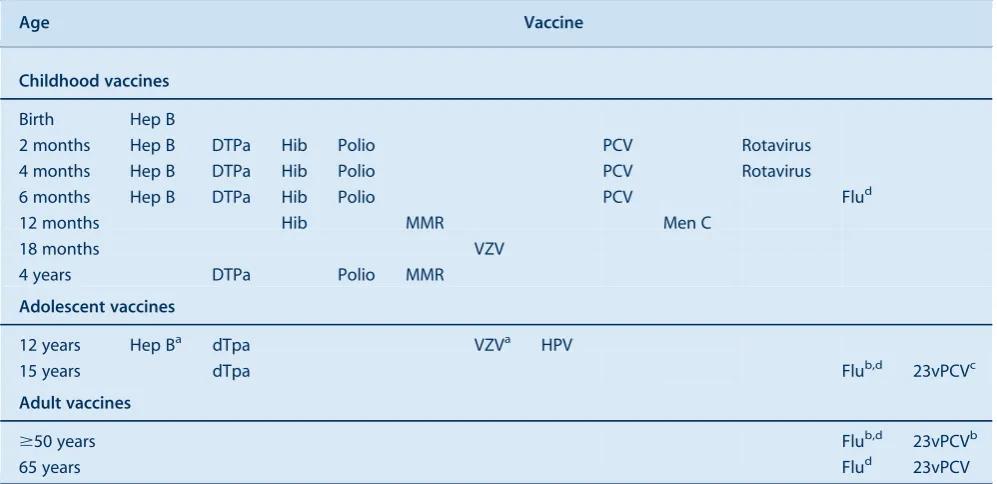
Table 1 presents the vaccines delivered through the NSW Immunisation Program for children in 2011. The only new vaccine to be introduced into the NSW Immuni-sation Program in 2011 was the 13-valent pneumococcal
conjugate vaccine, Prevenar 13Ò, which replaced
PrevenarÒ, the 7-valent vaccine, on 1 July.
Methods
Measuring immunisation coverage using the Australian Childhood Immunisation Register
The cohort method has been used for calculating coverage
at the population level (national and state/territory)4since
the inception of the Australian Childhood Immunisation Register. Cohort immunisation status is assessed at 12 months of age (for vaccines due at 6 months), 24 months of age (for vaccines due at 12 months), and 5 years of age (for vaccines due at 4 years). A 3-month lag period is allowed for the late notification of immunisations to the
Australian Childhood Immunisation Register.4If a child’s
records indicate receipt of the last dose of a vaccine that requires more than one dose to complete the series, it is assumed that earlier vaccinations in the sequence have
been given. This assumption has been shown to be valid.5,6
Box 1. Recent changes in immunisation policy, immunisation incentives and coverage calculation algorithms
October 2011]Children aged between 12 and 35 months who have completed a primary pneumococcal vaccination course with
PrevenarÒ(7-valent pneumococcal conjugate vaccine, 7vPCV) were eligible to receive a free supplementary dose of Prevenar 13Ò
(13-valent pneumococcal conjugate vaccine, 13vPCV) from 1 October 2011 to 30 September 2012.
July 2011]Prevenar 13Ò(13-valent pneumococcal conjugate vaccine, 13vPCV) replaced PrevenarÒ(7-valent pneumococcal conjugate vaccine, 7vPCV) on the National Immunisation Program for children at 2, 4 and 6 months of age in all states and territories except the Northern Territory (which replaced 10vPCV with 13vPCV from 1 October 2011).
December 2009]Changes in the coverage calculation algorithms that tightened the rules regarding receipt ofHaemophilus influenzaetype b and hepatitis B vaccines for children aged 12 and 24 months to lead to more accurate measures ofHaemophilus influenzaetype b and hepatitis B vaccine coverage in Australia.
October 2009]The recommendation by the Australian Technical Advisory Group on Immunisation that the fourth dose of diphtheria, tetanus and acellular pertussis (DTPa)-containing vaccine can be given from 3½ years of age instead of the previously recommended 4 years of age.
March 2009]The recommendation by NSW Health and the Australian Technical Advisory Group on Immunisation to parents and immunisation providers to consider bringing the first dose of DTPa forward to 6 weeks of age to provide earlier protection. January 2009]Changes to the overdue rules so that children were classified as overdue for pre-school boosters at 4 years and 1 month instead of the previous 5 years of age. This applied to parental and provider incentive payments.
The Maternity Immunisation Allowance changed from a full payment at 18]24 months of age to being paid in two instalments: the
first when the child is fully immunised and aged between 18 and 24 months; and the second when the child is fully immunised and aged between 4 and 5 years. This applied only to children who had not yet already received the full payment at 2 years of age. October 2008]The General Practice Immunisation Incentive Service Incentive Payment ($18.50 for completing a schedule point) ceased. Information payments of $6 were retained.
December 2007]Coverage algorithm for immunisations due at 4 years of age changed to assess children at 5 years, not 6 years.
Table 1. Schedule of vaccines delivered through the NSW Immunisation Program, to children, adolescents and adults in 2011
Age Vaccine
Childhood vaccines
Birth Hep B
2 months Hep B DTPa Hib Polio PCV Rotavirus
4 months Hep B DTPa Hib Polio PCV Rotavirus
6 months Hep B DTPa Hib Polio PCV Flud
12 months Hib MMR Men C
18 months VZV
4 years DTPa Polio MMR
Adolescent vaccines
12 years Hep Ba dTpa VZVa HPV
15 years dTpa Flub,d 23vPCVc
Adult vaccines
$50 years Flub,d 23vPCVb
65 years Flud 23vPCV
Hep B: hepatitis B vaccine; DTPa: diphtheria, tetanus, and acellular pertussis-containing vaccine; dTpa: adolescent and adult formulation DTPa; Hib:
Haemophilus influenzaetype b vaccine; MMR: measles-mumps-rubella vaccine; VZV: varicella zoster virus vaccine; PCV: pneumococcal conjugate
vaccine (7vPCV till 30 June 2011, 13vPCV from 1 July 2011 onwards); Men C: meningococcal C vaccine; HPV: human papilloma virus vaccine (females only); Flu: influenza vaccine; 23vPCV: 23-valent pneumococcal polysaccharide vaccine.
aCatch-up only.
bFor Aboriginal people only.
cAboriginal adults with medical risk factors.
the vaccines of interest by the designated age as the numerator and the total number of Medicare-registered children in the age cohort as the denominator. Vaccines included were those used nationally for the purposes of incentive payments. ‘Fully immunised’ at 12 months of age was defined as a child having a record on the Australian Childhood Immunisation Register of three doses of a diphtheria, tetanus and pertussis (DTP)-containing vaccine, three doses of polio vaccine, two or
three doses of PRP-OMP containingHaemophilus
influ-enzaetype b (Hib) vaccine or three doses of any other Hib
vaccine, and two or three doses of ComvaxÒhepatitis B
vaccine or three doses of all other hepatitis B vaccines. ‘Fully immunised’ at 24 months of age was defined as three or four doses of a DTP-containing vaccine, three doses of polio vaccine, three or four doses of PRP-OMP containing Hib vaccine or four doses of any other Hib
vaccine, three or four doses of ComvaxÒ hepatitis B
vaccine or four doses of all other hepatitis B vaccines, and one dose of a measles- mumps- and rubella (MMR)-containing vaccine. ‘Fully immunised’ at 5 years of age was defined as four or five doses of a DTP-containing vaccine, four doses of polio vaccine, and two doses of an MMR-containing vaccine.
Previous reports included analysis by local health district (LHD), data on other National Immunisation Program vaccines not included in ‘fully immunised’ calculations (pneumococcal conjugate vaccine, rotavirus vaccine, vari-cella vaccine and meningococcal C vaccine), vaccination timeliness and data comparing Aboriginal and non-Aboriginal children. However, it was not possible to include these analyses in this report due to a review by the Department of Health and Ageing of processes for releasing data from the Australian Childhood Immunisa-tion Register.
Coverage in adolescents and the elderly
Information describing coverage for vaccines given to adolescents was collected from the NSW School Immuni-sation Program. Vaccination status is recorded by school immunisation teams and counts are collated by LHDs and NSW Health. The denominator is the number of school enrolments at the start of the year. The coverage rates may underestimate the true vaccination coverage as they repre-sent only those vaccinations received through the school program and do not include doses received from general practitioners or other immunisation providers. Methods are
presented in more detail elsewhere.7 For varicella and
hepatitis B vaccines, students who were not vaccinated due to previous vaccination or varicella infection are included in the denominator. The proportion of these students is unknown.
Influenza and pneumococcal vaccination coverage esti-mates in the elderly were obtained from the NSW
Population Health Survey. This is a rolling random digit-dialled telephone survey, with vaccination status deter-mined from patient recall at the time of the interview. Influenza and pneumococcal vaccination coverage esti-mates are based on 4732 and 4395 respondents in NSW, respectively. Methods and results are presented in more
detail elsewhere.8
Results
Overall coverage estimates
In NSW, coverage for all individual vaccines for the 12-month age group is greater than 91%. Similarly, for Table 2. Percentage of children immunised at 12 months, 24 months and 5 years of age, by vaccine, in NSW compared with Australia, 2011
Vaccine Milestone age
(months) NSW% Australia%
Diphtheria, tetanus, pertussis
12a 92.1 92.1
24b 94.5 94.6
60c 90.1 90.0
Poliomyelitis 12a 92.1 92.1
24b 94.4 94.5
60c 90.1 90.0
Haemophilus influenza type b
12a 91.7 91.8
24b 94.7 94.6
60c NI NI
Hepatitis B 12a 91.7 91.6
24b 94.0 94.0
60c NI NI
Measles-mumps-rubella
12a NI NI
24b 93.7 93.9
60c 90.0 89.9
Fully immunised 12a 91.3 91.4
24b 92.0 92.2
60c 89.6 89.5
aBirth cohort born 1 January 2010–31 December 2010: Three doses of a diphtheria, tetanus and pertussis (DTP)-containing vaccine, three doses of polio vaccine, two or three doses of PRP-OMP containing
Haemophilus influenzaetype b (Hib) vaccine or three doses of any
other Hib vaccine, and two or three doses of ComvaxÒhepatitis B
vaccine or three doses of all other hepatitis B vaccines.
bBirth cohort born 1 January 2009–31 December 2009: Three or four
doses of a diphtheria, tetanus and acellular pertussis-containing vaccine, three doses of polio vaccine, three or four doses of PRP-OMP containingHaemophilus influenzaetype b (Hib) vaccine or four doses
of any other Hib vaccine, three or four doses of ComvaxÒhepatitis B
vaccine or four doses of all other hepatitis B vaccines, and one dose of a measles- mumps- and rubella-containing vaccine.
cBirth cohort born 1 January 2006–31 December 2006: Four or five doses of a diphtheria, tetanus and acellular pertussis-containing vaccine, four doses of polio vaccine, and two doses of a measles-mumps- and rubella-containing vaccine.
NI: this vaccine at this age milestone is not included in the calculation of coverage estimates.
the 24-month age group, coverage for all individual vaccines is also higher than 90%. Recorded coverage for the 5-year age group is higher than 90% for all vaccines (Table 2). Figure 1 shows time trends in ‘fully immunised’ childhood vaccination coverage at three milestone ages in NSW. The proportion ‘fully immunised’ at 1 and 2 years of age has been at high levels since 2003 whereas coverage at 5 years of age increased markedly during 2010 and remained at that level during 2011.
Coverage estimates for children aged less than 3 years
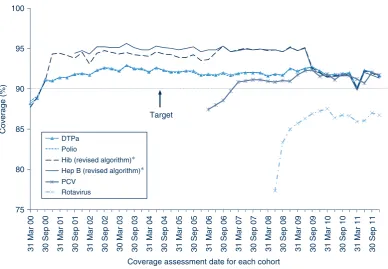
In NSW before 2009, coverage for the 12-month and 24-month age groups for Hib and hepatitis B vaccines was greater than for DTPa and polio, due to a less stringent algorithm for calculating coverage. Since the change in algorithm in the latter half of 2009, coverage estimates for Hib and hepatitis B have lowered and become similar to
those of DTPa and polio at just under 92% (Figure 2) for the 12-month age group and approximately 95% (Figure 3) for the 24-month age group. These newer estimates more accurately reflect the true proportion of children fully vaccinated for these vaccines. Also in 2011, coverage for the MMR vaccine for the 24-month age group was around 94% (Table 2).
Coverage estimates for children aged 5–6 years
The trends in childhood vaccination coverage in NSW for individual vaccines (DTPa, polio and MMR) at 5 years of age (6 years of age prior to December 2007) are shown in Figure 4. Coverage for all three vaccines was almost identical and remained steady across the whole period until mid-2006 when a sharp increase of almost 5% was recorded, likely due to the introduction of combination vaccines. Coverage at 5 years of age was substantially lower than at 6 years of age due to the shorter time for the 50
55 60 65 70 75 80 85 90 95 100
31 Mar 00 30 Sep 00 31 Mar 01 30 Sep 01 31 Mar 02 30 Sep 02 30 Mar 03 30 Sep 03 31 Mar 04 30 Sep 04 31 Mar 05 30 Sep 05 31 Mar 06 30 Sep 06 31 Mar 07 30 Sep 07 31 Mar 08 30 Sep 08 31 Mar 09 30 Sep 09 31 Mar 10 30 Sep 10 31 Mar 11 30 Sep 11
Coverage (%)
Coverage assessment date for each cohort
ACIR – fully vaccinated by 12 monthsa
ACIR – fully vaccinated by 24 monthsb
ACIR – fully vaccinated by 5 yearsc
ACIR – fully vaccinated by 6 yearsc
Coverage at 24 months now greater than at 12 months
18-month dose of DTPa removed from schedule
Combination vaccines introduced, leading to fewer injections
Coverage algorithm changed to assess children at 5 years, not 6 years
4 year olds now overdue at 4 years and 1 month instead of 5 years
Figure 1. Trends in ‘fully immunised’a,b,cvaccination coverage, NSW, 2000–2011, for four age cohorts of children.
aThree doses of a diphtheria, tetanus and acellular petussis-containing (DTPa) vaccine, three doses of polio vaccine, two or three
doses of PRP-OMP containingHaemophilus influenzaetype b (Hib) vaccine or three doses of any other Hib vaccine, and two or
three doses of ComvaxÒhepatitis B vaccine or three doses of all other hepatitis B vaccines.
bThree or four doses of a DTPa-containing vaccine, three doses of polio vaccine, three or four doses of PRP-OMP containing Hib
vaccine or four doses of any other Hib vaccine, three or four doses of ComvaxÒhepatitis B vaccine or four doses of all other
hepatitis B vaccines, and one dose of a measles, mumps and rubella (MMR)-containing vaccine.
cFour or five doses of a DTPa-containing vaccine, four doses of polio vaccine, and two doses of an MMR-containing vaccine.
ACIR: Australian Childhood Immunisation Register.
recording of delayed vaccinations. However, in 2011, the 5-year coverage for DTPa, polio and MMR increased markedly to be slightly above 90% following a change to due and overdue rules. The overall ‘fully immunised’ rate for 5-year coverage was 89.6% in NSW, which was similar to the national 5-year coverage rate of 89.5% (Table 2). However, at 5 years of age, the proportion recorded as being ‘fully immunised’ was lower than that at earlier age milestones.
Coverage in adolescents
NSW Adolescent Vaccination Program coverage data for high school students for 2011 by LHD are shown in Table 3. For NSW, coverage varied by vaccine and dose with better coverage for the first and second doses of human papillomavirus vaccine (HPV) and the dose of dTpa in Year 7 attendees. In 2011, coverage in adoles-cents increased for all vaccine types and doses compared
to the previous year.9The greatest improvement was seen
with varicella vaccine, with coverage increasing 13 per-centage points from 32% to 45%. Vaccine coverage in adolescents varied by LHD (Table 3).
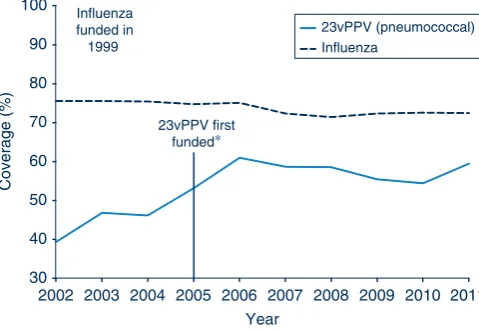
Vaccines for the elderly (pneumococcal and influenza) The proportion of people aged 65 years and over who were vaccinated for influenza in the past 12 months has remained relatively stable at over 70% in NSW during the period 2002–2011. However, pneumococcal vaccination
(23-valent pneumococcal polysaccharide vaccine,
23vPPV) in the previous 5 years remained lower than the influenza coverage estimates. The highest coverage estimate for pneumococcal vaccination in the elderly was observed in 2006 at 61%, the year after its inclusion on the National Immunisation Program (Figure 5). Coverage in 2011 was 60%. Vaccine coverage in the elderly varied by LHD (Table 4).
Discussion
These data reveal that 90% coverage benchmarks have been reached for children at both 12 and 24 months of age for NSW. During 2011, there was an increase in coverage at the 5-year milestone, to approximately 90%.
Coverage at 24 months of age exceeds that at 12 months in NSW. This is likely related to the greater period of time 75
80 85 90 95 100
31 Mar 00 30 Sep 00 31 Mar 01 30 Sep 01 31 Mar 02 30 Sep 02 30 Mar 03 30 Sep 03 31 Mar 04 30 Sep 04 31 Mar 05 30 Sep 05 31 Mar 06 30 Sep 06 31 Mar 07 30 Sep 07 31 Mar 08 30 Sep 08 31 Mar 09 30 Sep 09 31 Mar 10 30 Sep 10 31 Mar 11 30 Sep 11
Coverage (%)
Coverage assessment date for each cohort
DTPa Polio
Hib (revised algorithm)∗ Hep B (revised algorithm)∗ PCV
Rotavirus
Target
Figure 2. Trends in ‘fully immunised’ coverage estimates for individual vaccines at 12 months of age (third dose of DTPa, polio, hepatitis B and Hib), NSW, 2000–2011.
By 3-month birth cohorts born between 1 January 1999 and 31 December 2010. Coverage assessment date was 12 months after the last birth date of each cohort.
*Prior to December 2009, the algorithm stated that receipt of two or three doses ofHaemophilus influenzaetype b (Hib) and
hepatitis B vaccines rendered a child ‘fully immunised’ for these vaccines. After December 2009, changes to the algorithm were made to tighten the rules regarding ‘fully immunised’ for Hib and hepatitis B vaccines.
DTPa: diphtheria, tetanus, pertussis (acellular) – paediatric formulation Hep B: hepatitis B
PCV: pneumococcal conjugate vaccine
70 75 80 85 90 95 100
31 Mar 00 30 Sep 00 31 Mar 01 30 Sep 01 31 Mar 02 30 Sep 02 30 Mar 03 30 Sep 03 31 Mar 04 30 Sep 04 31 Mar 05 30 Sep 05 31 Mar 06 30 Sep 06 31 Mar 07 30 Sep 07 31 Mar 08 30 Sep 08 31 Mar 09 30 Sep 09 31 Mar 10 30 Sep 10 31 Mar 11 30 Sep 11
Coverage (%)
Coverage assessment date for each cohort 18-month dose of DTPa removed
from schedule
DTPa Polio Hib Hep B MMR Varicella Men C
Figure 3. Trends in ‘fully immunised’ coverage estimates for individual vaccines at 24 months of age (DTPa, polio, hepatitis B, Hib, MMR, varicella, Men C),afor NSW 3-month birth cohorts between 2000 and 2011.
By 3-month birth cohorts born between 1 January 1999 and 31 December 2009. Coverage assessment date was 24 months after the last birth date of each cohort.
aThird dose of DTPa (fourth dose – pre-Sept 2003); third dose of polio; third dose of hepatitis B, third dose of Hib; one dose of MMR).
DTPa: diphtheria, tetanus, pertussis (acellular) – paediatric formulation Men C: Meningococcal C
Hep B: hepatitis B MMR: measles-mumps-rubella
Hib:Haemophilus influenzaetype b
Source: Australian Childhood Immunisation Register.
70 75 80 85 90 95 100
31 Mar 02 30 Sep 02 30 Mar 03 30 Sep 03 31 Mar 04 30 Sep 04 31 Mar 05 30 Sep 05 31 Mar 06 30 Sep 06 31 Mar 07 30 Sep 07 31 Mar 08 30 Sep 08 31 Mar 09 30 Sep 09 31 Mar 10 30 Sep 10 31 Mar 11 30 Sep 11
Coverage (%)
Coverage assessment date for each cohort
DTPa at 5 years DTPa at 6 years Polio at 5 years Polio at 6 years MMR at 5 years MMR at 6 years
Coverage algorithm changed to assess children at 5 years,
not 6 years
Figure 4. Trends in ‘fully immunised’ coverage estimates for individual vaccines (DTPa, polio and MMR)aat 5 years of age (6 years up to December 2007) in NSW.
Coverage assessment date was 72 months after the last birth date of each cohort up to December 2007 and then 60 months after the last birth date of each cohort.
aFourth dose of DTPa and polio and second dose of MMR.
DTPa: diphtheria, tetanus, pertussis (acellular) – paediatric formulation. MMR: measles-mumps-rubella
between due date and assessment time (12 and 6 months respectively), and potentially the maternity incentive pay-ment assessed at 18–24 months. The continued improve-ment in coverage at 5 years of age is due to further improved timeliness of vaccination, and is probably
related to the change to the overdue rules in January 2009, where children became overdue for their pre-school boosters at 4 years and 1 month of age instead of the previous 5 years (Box 1). This change had an impact on eligibility for child care benefits for parents and outcome payments for providers. It is also possible that the splitting of the Maternity Immunisation Allowance in 2011 could have affected these data, as it applied to children turning 4 years from 2011 onwards.
It should be noted that at present several vaccines on the National Immunisation Program schedule are not included in the assessment of ‘fully immunised’ (i.e. PCV, menin-gococcal C, rotavirus and varicella). This annual report does not provide coverage data on these vaccines. Only data for the more longstanding and established vaccines are provided to Medicare Locals, public health units and immunisation providers. As these non-assessable vaccines have been routinely incorporated into the childhood immu-nisation schedule for some time, their inclusion in the official coverage assessments for ‘fully immunised’ (except for rotavirus vaccine) has been made policy by the Department of Health and Ageing and is effective from 1 July 2013. This will facilitate more complete monitoring of program delivery, potentially boost coverage by allow-ing existallow-ing incentive payments to apply to them, and provide a more realistic assessment of ‘fully immunised’.
School-based vaccination in NSW has achieved relatively high coverage for most vaccines, which is similar to or better than that achieved in other Australian jurisdictions and higher than in settings where adolescent vaccines are
implemented through primary care.7 Coverage for
Table 3. Vaccination coverage estimates for individual vaccines, NSW adolescent school attendees in NSW, 2011
Vaccine Local Health Districta Total doses
administered N CC
% FW% HNE% IS% MN% MM% NBM% NN% NS% SES% SN% SWS% SYD% WN% WS% NSW%
HPV dose 1b 88 68 81 77 80 85 78 73 82 80 78 83 81 83 81 81 34 524
HPV dose 2b 82 61 75 70 74 82 72 67 77 75 72 82 80 81 76 76 32 582
HPV dose 3b 77 56 68 63 65 75 68 59 75 70 68 78 77 73 71 71 30 426
Hepatitis B
dose 1b
71 59 66 67 75 73 64 70 60 86 69 69 66 73 64 68 30 426
Hepatitis B
dose 2b
66 47 59 59 64 66 58 61 57 81 60 66 63 66 59 63 53 517
dTpab 89 70 80 70 76 77 74 70 79 87 70 72 76 74 77 77 65 756
Varicellab 52 51 52 36 49 48 44 45 37 48 34 43 43 43 48 45 38 409
dTpac 77 61 70 60 65 66 61 73 67 61 64 62 71 68 66 66 57 633
aCC: Central Coast; FW: Far West; HNE: Hunter New England; IS: Illawarra Shoalhaven; MN: Mid North Coast; MM: Murrumbidgee; NBM: Nepean Blue
Mountains; NN: Northern NSW; NS: Northern Sydney; SES: South Eastern Sydney; SWS: South Western Sydney; SN: Southern NSW; SYD: Sydney; WN: Western NSW; WS: Western Sydney; NSW: New South Wales.
bYear 7 school attendees. cYear 10 school attendees. HPV: human papillomavirus
dTpa: diphtheria, tetanus, pertussis (acellular) – adolescent and adult formulation Source: NSW School Immunisation Program.
30 40 50 60 70 80 90 100
2002 2003 2004 2005 2006 2007 2008 2009 2010 2011 Year
23vPPV (pneumococcal) Influenza
23vPPV first funded∗ Influenza
funded in 1999
Coverage (%)
Figure 5. Trends in vaccination coverage estimates for individual vaccines (23vPPV and influenza) for adults aged 65 years and overain NSW, vaccinated against pneumococcal disease in the last 5 years and vaccinated against influenza in the last 12 months, 2002–2011.
aVaccinated against pneumococcal disease in the last
5 years and vaccinated against influenza in the last 12 months.
*In 2005, 23vPPV was included in the National Immunisation Program.
23vPPV: 23-valent pneumococcal polysaccharide vaccine
varicella is lower than other vaccines in all other jurisdic-tions as well as NSW. This is likely due to a combination of students not vaccinated due to previous clinical history of chickenpox, students with previous receipt of varicella vaccine, and perceived less serious clinical outcomes. The change in advice given to parents about the need for a dose at 12 years of age that occurred in 2011 may also have had an impact. Coverage for all adolescent vaccines increased from 2010 to 2011.
Coverage for the elderly has been consistently high for influenza vaccine, but less so for pneumococcal vaccine, perhaps due to greater awareness of the yearly influenza vaccination programs. Uptake of pneumococcal vaccine in 2011 is likely to have been negatively affected by reported adverse events in that year and the associated temporary suspension of any doses of pneumococcal vaccine in NSW. These results may also be partly explained by an Australian study in the elderly that found, in comparison to written records held by immunisation providers, a telephone survey over-estimated influenza coverage in the elderly by 3%, and under-estimated
pneumococcal coverage by 8%.10
Conclusion
Data provided in this report by the Australian Childhood Immunisation Register reflect the successful delivery of the National Immunisation Program in NSW, while identifying some areas for improvement. The Australian Childhood Immunisation Register, the NSW Population Health Survey and monitoring through the NSW School Vaccination Program continue to be very useful tools for administering the National Immunisation Program and monitoring its implementation in NSW.
References
1. Hull B, Deeks S, Menzies R, McIntyre P. Immunisation
cover-age annual report, 2007.Commun Dis Intell2009; 33: 170–87.
2. Hull BP, McIntyre PB, Heath TC, Sayer GP. Measuring immu-nisation coverage in Australia. A review of the Australian
Childhood Immunisation Register.Aust Fam Physician1999;
28: 55–60.
3. Hull BP, Deeks SL, McIntyre PB. The Australian Childhood Immunisation Register – a model for universal immunisation
registers?Vaccine2009; 27: 5054–60. doi:10.1016/
j.vaccine.2009.06.056
4. O’Brien ED, Sam GA, Mead C. Methodology for measuring
Australia’s childhood immunisation coverage.Commun Dis
Intell1998; 22(3): 36–7.
5. Hull BP, McIntyre PB. Immunisation coverage reporting through the Australian Childhood Immunisation Register – an
evaluation of the third-dose assumption.Aust N Z J Public
Health2000; 24(1): 17–21. doi:10.1111/j.1467-842X.2000. tb00717.x
6. Hull BP, Lawrence GL, MacIntyre CR, McIntyre PB. Estimating immunisation coverage: is the ‘third dose assumption’ still
valid?Commun Dis Intell2003; 27(3): 357–61.
7. Ward KF, Menzies RI, Quinn HE, Campbell-Lloyd S.
School-based vaccination in NSW.N S W Public Health Bull2010;
21(9–10): 237–42. doi:10.1071/NB10046
8. Centre for Epidemiology and Evidence. Health Statistics New South Wales. Sydney: NSW Ministry of Health. Available at: http://www.healthstats.nsw.gov.au/Indicator/ com_flupneumoimmu_age/com_flupneumoimmu_age_trend (Cited 17 October 2012).
9. Hull BP, Dey A, Campbell-Lloyd S, Menzies RI, McIntyre PB.
NSW Annual Immunisation Coverage Report, 2011.N S W
Public Health Bull2010; 22(9–10): 179–95.
10. Andrews RM. Assessment of vaccine coverage following the introduction of a publicly funded pneumococcal vaccine
pro-gram for the elderly in Victoria, Australia.Vaccine2005; 23:
2756–61. doi:10.1016/j.vaccine.2004.11.039
Table 4. Vaccination coverage estimates for individual vaccines (23vPPV and influenza) for adults aged 65 years and over in NSW, vaccinated against pneumococcal disease in the last 5 years and vaccinated against influenza in the last 12 months, 2011
Population surveyed and vaccine
Local Health Districta Total doses
administered N CC
% FW% HNE% %IS MN% MM% NBM% NN% NS% SES% SN% SWS% SYD% WN% WS% NSW%
Influenza (males)
76 67 74 67 75 73 70 69 76 71 75 71 66 66 70 72
4732 Influenza
(females)
76 70 78 78 74 73 73 74 69 74 75 71 73 79 68 74
Pneumococcal (males)
60 48 61 55 59 60 46 53 57 49 57 47 47 54 50 54
4395 Pneumococcal
(females)
64 52 66 64 60 57 58 65 56 58 63 54 56 63 56 60
aCC: Central Coast; FW: Far West; HNE: Hunter New England; IS: Illawarra Shoalhaven; MN: Mid North Coast; MM: Murrumbidgee; NBM: Nepean Blue
Mountains; NN: Northern NSW; NS: Northern Sydney; SES: South Eastern Sydney; SWS: South Western Sydney; SN: Southern NSW; SYD: Sydney; WN: Western NSW; WS: Western Sydney; NSW: New South Wales.
NSW Annual Report Describing Adverse
Events Following Immunisation, 2011
Deepika Mahajan
A,D, Su Reid
B, Jane Cook
C,
Kristine Macartney
Aand Robert I. Menzies
A ANational Centre for Immunisation Research and Surveillance, The Children’s Hospital at Westmead
B
Health Protection NSW C
Office of Medicine Safety Monitoring, Therapeutic Goods Administration
D
Corresponding author. Email: [email protected]
Abstract: Aim:This report summarises Australian passive surveillance data for adverse events following immunisation in NSW for 2011.
Methods:Analysis of de-identified information on all adverse events following immunisation reported
to the Therapeutic Goods Administration.Results:
449 adverse events following immunisation were reported for vaccines administered in 2011; this is
slightly higher than in 2010 (n¼439) and the second
highest number since 2003. The most commonly reported reactions were injection site reaction, fever, allergic reaction and malaise. A large number of injection site reactions were reported following administration of the 23-valent pneumococcal poly-saccharide vaccine in adults aged 65 years and over (97.4/100 000 doses) and in children aged less than 7 years following administration of the 13-valent pneumococcal conjugate vaccine (29.4/100 000 doses) and combined diphtheria, tetanus, pertussis (acellular) and inactivated poliovirus (quadrivalent)-containing vaccines (47.1/100 000 doses). Only 10% of the reported adverse events were cate-gorised as serious. There were two reports of death however both were attributed to causes other than
vaccination. Conclusion: The increased number
of reports in 2011 is attributable to the high rates of injection site reactions in children associated with the administration of combined diphtheria, tetanus, pertussis (acellular) and inactivated polio-virus (quadrivalent)-containing vaccines and the 13-valent pneumococcal conjugate vaccine, as well as in adults following receipt of the 23-valent pneumococcal polysaccharide vaccine.
An adverse event following immunisation is defined as any untoward medical occurrence which follows immuni-sation and which does not necessarily have a causal
relationship with the usage of the vaccine.1The adverse
event may be any unfavourable or unintended sign,
abnormal laboratory finding, symptom or disease.1
Thus, adverse events may be caused by a vaccine(s) or may be coincidental. Adverse events may also include conditions that occur following the incorrect handling and/or administration of a vaccine(s). Post-licensure surveillance – the practice of monitoring the safety of a vaccine after it has been licensed and released in the market – is particularly important to detect rare, late onset and unexpected events which are difficult to detect in pre-licensure vaccine trials.
This is the third annual report for adverse events following immunisation in New South Wales (NSW). It summarises passive surveillance data reported from NSW in 2011 and describes reporting trends over the 12-year period 2000–2011. To assist readers, a glossary of the abbreviations of the vaccines referred to in this report is provided in Box 1.
Trends in reported adverse events following immunisation are influenced by changes to vaccines provided through the National Immunisation Program. Changes in previous
years have been reported elsewhere.2–10 Two recent
changes influenced the adverse events surveillance data presented in this report:
(i) From 1 July 2011, Prevenar 13Ò(13-valent
pneumo-coccal conjugate vaccine, 13vPCV) replaced
Pre-venarÒ (7-valent pneumococcal conjugate vaccine,
7vPCV) on the National Immunisation Program for children at 2, 4 and 6 months of age in all states and territories except the Northern Territory (which
adopted 13vPCV from 1 October 2011).11 Children
aged 12–35 months who had completed a primary pneumococcal vaccination course with 7vPCV are eligible to receive a free supplementary dose of
Prevenar 13Òfrom 1 October 2011 to 30 September
2012.
(ii) On 25 March 2011, the Therapeutic Goods
Adminis-tration issued a recall of Batch N3336 of PneumovaxÒ
23 (23-valent pneumococcal polysaccharide vaccine, 23vPPV) as a precautionary measure following an increased number of reports of adverse reactions in
advice to health professionals not to administer a
second or subsequent dose of PneumovaxÒ23 vaccine
was provided in April 2011.13Revised
recommenda-tions regarding which patients should be re-vaccinated under the National Immunisation Program was
pro-vided in December 2011.14
Methods
Adverse events following immunisation (AEFI) are notifi-able to public health units by medical practitioners and
hospital Chief Executive Officers under the NSWPublic
Health Act 1991.* Case-patients with outstanding infor-mation and all serious adverse events are followed up by public health units and the NSW Ministry of Health, and all notifications are forwarded to the Therapeutic Goods Administration. The Therapeutic Goods Administration also receives reports directly from vaccine manufacturers,
members of the public and other sources.15,16
AEFI data
All reports are assessed by the Therapeutic Goods
Admin-istration (TGA) using internationally-consistent criteria17
and entered into the Australian Adverse Drug Reaction Reporting System database. The term ‘AEFI record’ is used throughout this report because a single adverse event notification to the TGA can generate more than one record in the Australian Adverse Drug Reaction Reporting Sys-tem database. This may occur if there is a time sequence of separate adverse reactions in a single patient.
Typically, each AEFI record lists several symptoms, signs and diagnoses that have been coded by TGA staff from
the description provided by the reporter into standardised terms using the Medical Dictionary for Regulatory
Activi-ties (MedDRAÒ).18
Study definitions of AEFI outcomes and reactions
AEFI records are classified by medical officers within the TGA as ‘suspected’ to be causally related to immunisation. An AEFI record is classified as ‘not suspected’ and excluded from the Adverse Drug Reaction Reporting System database if: there is no reasonable temporal asso-ciation between the use of a drug and the clinical event (generally described as onset of symptoms within 28 days following vaccination); the record does not contain enough information for an adequate assessment or the information is contradictory; or if a clinical event is explained as likely to have arisen from other causes.
Because children generally receive several vaccines at the same time, all administered vaccines are usually listed as ‘suspected’ of involvement in a systemic adverse event as it is usually not possible to attribute the event to a single vaccine.
AEFIs were defined as ‘serious’ or ‘non-serious’ based on information recorded in the Australian Adverse Drug Reaction Reporting System database and using criteria
similar to those used elsewhere.17,19 In this report, an
AEFI is defined as ‘serious’ if the record indicated that the person had recovered with sequelae, been admitted to a hospital, experienced a life-threatening event, or died.
Box 1. List of abbreviations of vaccine types used in this report
BCG Bacillus of Calmette and Gue´rin (i.e. tuberculosis bacillus)
dT diphtheria-tetanus, adolescent and adult formulation
DTPa diphtheria-tetanus-pertussis (acellular), paediatric formulation
dTpa diphtheria-tetanus-pertussis (acellular), adolescent and adult formulation
dTpa-IPV combined dTpa and inactivated poliovirus
DTPa-HepB combined diphtheria-tetanus-pertussis (acellular) and hepatitis B
DTPa-IPV combined diphtheria-tetanus-pertussis (acellular) and inactivated poliovirus (quadrivalent)
DTPa-IPV-HepB combined diphtheria-tetanus-pertussis (acellular), inactivated poliovirus and hepatitis B (pentavalent)
DTPa-IPV-HepB-Hib combined diphtheria-tetanus-pertussis (acellular), inactivated poliovirus, hepatitis B and Haemophilus influenzaetype b vaccine (hexavalent)
HepB hepatitis B
Hib Haemophilus influenzaetype b
Hib-HepB combinedHaemophilus influenzaetype b and hepatitis B
HPV human papillomavirus
IPV inactivated poliovirus vaccine
Men4PV meningococcal polysaccharide tetravalent vaccine
MenCCV meningococcal C conjugate vaccine
MMR measles]mumps]rubella
7vPCV 7-valent pneumococcal conjugate vaccine