University of Bolton
UBIR: University of Bolton Institutional Repository
Bolton Business School: Examples of Research
Proposals Bolton Business School
2010
Research proposal: Kathryn Orange
Kathryn Orange
University of Bolton, [email protected]
This Other is brought to you for free and open access by the Bolton Business School at UBIR: University of Bolton Institutional Repository. It has been accepted for inclusion in Bolton Business School: Examples of Research Proposals by an authorized administrator of UBIR: University of Bolton Institutional Repository. For more information, please [email protected].
Digital Commons Citation
Student Number: 0708319
Course: PT MBA
Level: M
Module: Research Methods MBA
Credits: 20
Assignment: 1 of 1
Date issued: 11.09.09
Submission date: 25.01.10
CHAPTER 3
RESEARCH METHODOLOGY
3.1 Research Philosophy
Easterby-Smith et al (2008:56) explain that failure to think through philosophical
issues can seriously affect the quality of management research. They also outline
that knowledge of philosophy can help the researcher recognise which designs
will work best and that it enables the achievement of a satisfactory outcome for
the research activity. Saunders et al (2009:107) develop this further and explain
that research philosophy supports the creation of knowledge in a particular field
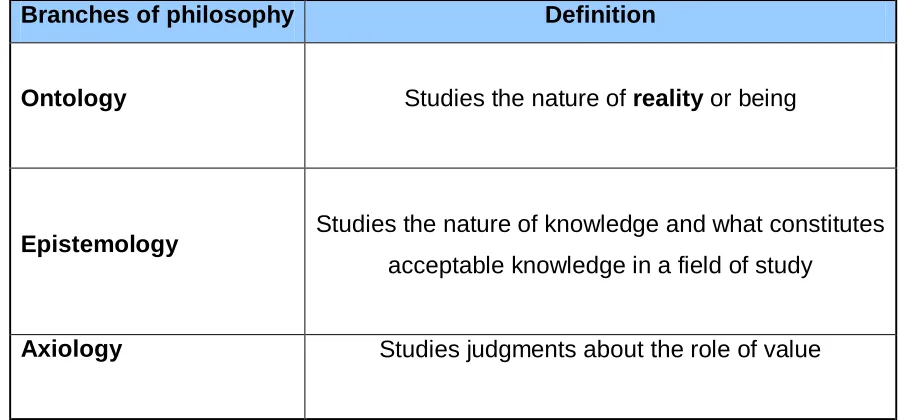
and is influenced by the way a researcher thinks. They outline three branches of
philosophy as shown in figure 8 below with a definition for each.
Table 4: Three branches of Philosophy outlined by Saunders et al (2009)
Branches of philosophy Definition
Ontology Studies the nature of reality or being
Epistemology Studies the nature of knowledge and what constitutes
acceptable knowledge in a field of study
Axiology Studies judgments about the role of value
Bryman and Bell (2007) and Easterby-Smith et al (2008) write that there are two
branches of philosophy epistemology described as an issue that concerns the
question of what is acceptable knowledge and ontology which is concerned with
philosophy is influenced by the way you think about the development of
knowledge because this will affect the way you go about the research itself.
3.2 Positivism
Bryman and Bell (2007) state positivism is the position that is associated with
imitating the natural sciences to the study of social reality and knowledge is
arrived at through the gathering of facts, should be value free, objective and
independent of social actors. Easterby-Smith et al’s (2008) viewpoint is similar as
they make the point that positivism within the social external world does not
measure sensation, reflection or intuition. Saunders et al (2009) explain positivism
asthe epistemological position that works with an observable social reality with
the emphasis on highly structured methodology to facilitate replication. Gill and
Johnson (2002) and Remenyi et al (1998:32) cited in Saunders et al (2009)
support this view and explain that the end product can be law-like generalisations
similar to those produced by the physical and natural scientists. The literature has
identified that the task of the positivist is to collect facts and measurement to
understand how certain patterns occur. Bryman and Bell (2007) explain that critics
of the positivist approach reject the application of natural sciences to the study of
social reality because of the difficulty of disentangling the data.
3.3 Social Constructionism
Social constructionism which is also referred to as Interpretivism is a research
philosophy that views the social world as being socially constructed. Morgan and
Smircich (1980:494 cited in Saunders et al 2009) explain that the social world is a
pattern of symbolic relationships and meanings sustained through a process of
human action and interaction. Bryman and Bell (2007) and Saunders et al (2009)
hold similar views and explain that constructionism is an ontological position which
asserts that social phenomena and their meanings are continually being
accomplished by social actors and are “socially constructed” giving meaning from
people. Easterby-Smith et al (2008) state that social constructionism focused on
the ways that people make sense of the world especially through the sharing of
experiences with others (Berger and Luckman 1966, Watzlawick 1984, Shotter
1993). Bryman and Bell (2007) explain that Interpretivism is a term given to a
of social sciences such as people is fundamentally different from that of the
natural sciences. The author believes that the principle aim should be to explain
why people have different experiences through social interaction and to
understand that they are continually changing. It is clear that researchers present
a specific version of social reality rather than one that suggests people’s roles are
continually being updated and created and are in a constant state of revision
rather than one that can be regarded as definitive. Thomas and Linstead (2002)
make this point through research of managers following the economic downturn
moving to increased job insecurity and in some cases forms a pessimistic view of
the future. They explain that by adopting a social constructionist framework and
an alternative more positive way of thinking about the ‘reality’ of their assumptions
that the term itself is a social construct and leads them to new ways of focusing on
their identity and understanding how they make sense of new language and
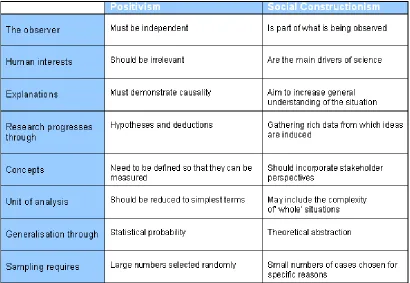
changing work roles. The literature has identified two contrasting methods in
relation to social sciences which are outlined in table 4 below.
Table 5: Contrasting implications of positivism and social constructionism
3.4 Realism
Saunders et al (2009) argue that this is the most important determinant of the
research philosophy because the essence of realism is what the senses show us
is reality, the truth and that objects have an existence independent of the human
mind. Bryman and Bell(2007) and Saunders et al (2009) share the same view
that it is possible to work within both positivist and interpretivist (social
constructionism) positions. Bryman and Bell further suggest that there are two
major forms of realism; empirical realism which simply asserts that through
appropriate methods, reality can be understood. Bhaskar (1989:2) cited in
Bryman and Bell (2007) explain the second form, critical realism which recognises
the reality of the natural order and events that can only be identified through
practical and theoretical work of the social sciences. Bhaskar (1989:4) provides a
useful description and states that this approach accepts neither a constructionist
nor a positivist and instead take the view that the ‘social world’ is reproduced and
transformed in daily life. Easterby-Smith et al (2008) have a different view and
point out that although there has been strong parallels drawn between natural and
social sciences there are clear differences. The natural science debate has been
between realism and relativism; traditional realists state that the world is concrete
and external and that science can only progress through observation. Putnam
(1987) cited in Easterby-Smith et al (2008) have a different view and state that it is
only possible to gather evidence of what is going on through the physical
processes. Latour and Woolgar (1979) and Knorr-Cetina (1983) cited in
Easterby-Smith et al (2008) provide an alternative view and explain that once the science
has been discovered the relativist position goes a stage further in suggesting that
scientific laws may not be so irreversible and that the acceptance of a theory is
highly influenced and tied into personal career and statuses.
Relativism is therefore concerned with the recognition of what reality is as
opposed to the senses (invention and discovery). Easterby-Smith et al (2008)
state that a number of approaches may be used such as triangulation for design
and using techniques such as survey’s. Table 5 represents the three
Table 6:
Methodological implications of different epistemologies within the social science.
Source: Easterby-Smith et al (2008:63)
The author has identified from the research that authors cannot agree on common
names or explanations for the different ways of thinking when discussing research
philosophies. However, there are three philosophical positions which dominate in
management research; these are positivism, realism and phenomenological also
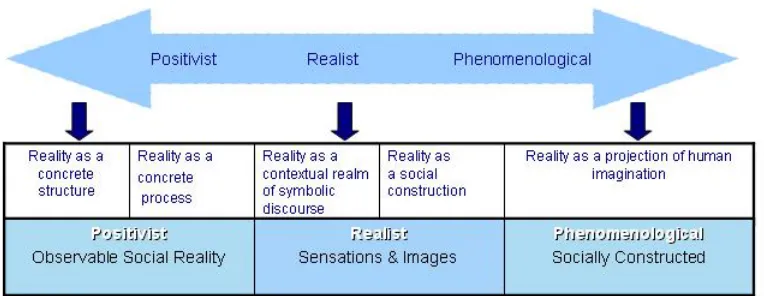
known as social construct. Morgan and Smircich (1980:492) outline the three
major ways of thinking in figure 9 below.
Figure 8: Continuum of Ontological Assumptions.
Philosophical position
The principle objective of this research is to identify best optimal structure that
would support the delivery of objectives using the conceptual framework in
chapter 2 (figure 7). The literature review identified leaders within the hierarchy as
highly dependant on the delivery of each of the objectives through staff. The
influence of social interaction that exists within an organisation through its people
and their values are all closely linked to the elements of the conceptual framework
therefore a social constructionism approach would be used.
Strategy is also an integral part of the conceptual framework and is usually
measured and progress evaluated through tangible elements such as reporting
which would suggest a positivist approach. However, the focus point (external
and internal environments - EVR model) and its affect on the opportunity to
identify and deliver growth ideas for the employing organisation move to a
different approach. The role of the leaders within the hierarchy is to understand
the social effects through its staff and has been identified as highly dependent on
delivery of the objectives through its teams which would suggest a relativism
approach would be a more appropriate method.
Structure is another element of the framework that is created to align staff to
support strategy delivery which has clear tangible elements. Conversely, staff
within the structure and the influence that individuals have, such as their
behaviour, how they deliver the service and their values, point to the use of a
relativist research design.
Conversely, staff within the structure and the influence individuals has such as
their behaviour, how they deliver the service and their values point to the use of a
relativist research design.
The conceptual framework has clear tangible elements such as the back office
processes with progress monitored through multiple measurement systems.
introduced; specifically to measure the number of visits by sales teams which
would lead this to a positivist approach.
Reviews of the most suitable approaches from tangible (physical) elements to
social (human interaction / behaviour) indicate that a relativist approach is the
most appropriate for the research design.
3.5 Research Strategy
Saunders et al (2009) explain that your choice of research strategy will be guided
by your research questions and objectives and whether it will enable you to meet
your objectives. Some of the strategies named are survey, case study, action
research, cross-sectional, experiment and field work. A case study design has
been selected as the most suitable as the research will focus on a specific topic or
case within the employing organisation. Robson (2002:178 cited in Saunders et
al 2009) defines case study as a strategy for carrying out research which involves
observed investigation of a particular phenomenon within its real life context. Yin
(2002) cited in Easterby-Smith et al (2008) believe the case study to be the best
method in their application of the social sciences as it allows the study of one
organisation, event or individual over time. He outlines weaknesses for some of
the research designs from a positivist viewpoint and the use of data. His concern
is that they produce huge amounts of data which allows researchers to make any
interpretations they want. Stake (2006) cited in Easterby-Smith (2008) outlines
another view that the social constructionist is less concerned with issues of
validity, and more concerned with providing a picture of behaviour in groups or
organisations. Therefore the case study design is viewed as an in-between
position amongst the two extremes of experiment (positivist) and fieldwork (social
constructionism) which supports the relativist approach Easterby-Smith (2008).
3.6 Research Methods
A relativist research approach has already been established for the research
project and a case study design has been selected as it allows the study of one
organisation. The research study will use a combination of both quantitative and
Curran and Blackburn (2001;151) and Tashakkori and Teddlie (2003:151 cited in
Saunders et al 2009) explain that the terms qualitative and quantitative techniques
for business and management research have been replaced with the mono
(single data) and multi-method (more than one data) terminology. There does
however appear to be agreement between authors regarding how they distinguish
between the two methods of research; quite simply quantitative research employs
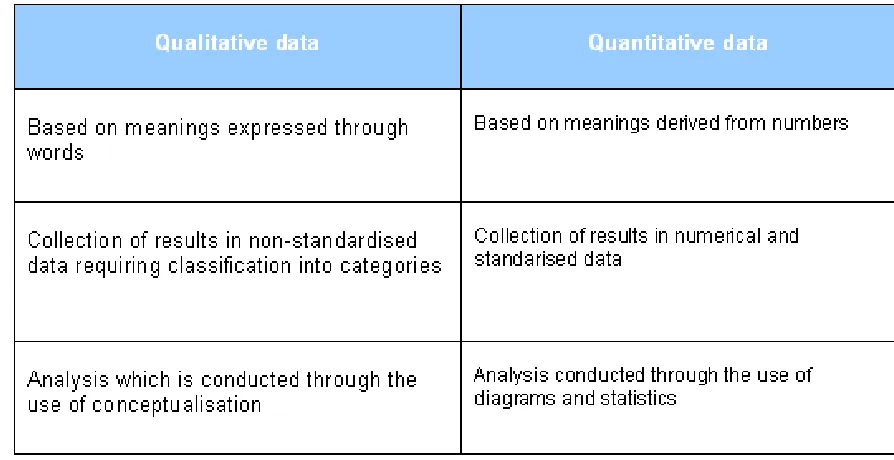
measurement and qualitative does not. The distinctions between both methods
have been explained by a number of authors and are outlined in table 7 below.
Table 7: Distinctions between Qualitative and Quantitative data
Source: Dey (1993); Healey and Rawlinson 1994) cited in Saunders et al (2009)
Bryman and Bell (2007) explain quantitative research as the collection and
analysis of data and that it embodies a view of social reality as an external and
objective reality. By contrast, qualitative research emphasises the use of words
and the ways individuals interpret their social world.
Three different research methods will be used for these studies which are
secondary data, self completed questionnaire with closed questions and
3.7 Method 1 - Secondary Analysis
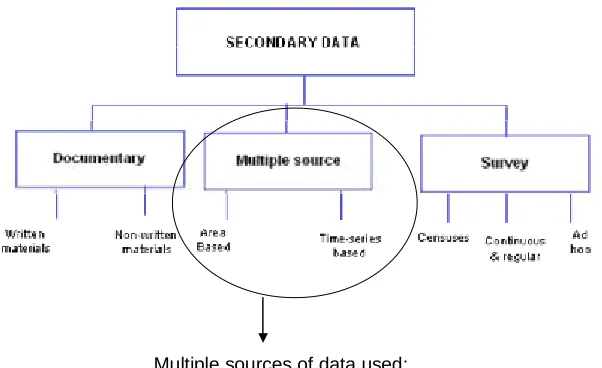
Saunders et al (2009) explain that secondary analysis is data that is used for a
research project that was originally collected for some other purpose and both
qualitative and quantitative methods can be used. Kervin (1999) cited in
Saunders et al (2009) explains that secondary data may have had little processing
and limited summarising and such data is useful in business research as part of a
case study. There are some advantages gained from using this method for the
researcher which are: additional time to review the data, reduced costs, anonymity
of responses, no repercussions for the respondents supporting truthful answers
therefore a high rate of reliability and validity of the data. There are some
disadvantages which are: no additional information / ideas received as a result of
the method (i.e. face to face would bring ideas), the data may not offer solutions
to the specific objectives in the area of research. Saunders et al (2009) outline
three sub-groups that can be used as part of the secondary data analysis and
different researchers have generated different classifications see figure 9 below.
Figure 9: Types of secondary data. Source: Saunders et al (2009)
Multiple Sources Data
Hakim (2000) and Saunders et al (2009) explain that multiple sources can be
used entirely on documentary or on survey secondary data. The author used this Multiple sources of data used:
method to capture secondary data from both qualitative (survey) and quantitative
(statistical) based. The quantitative statistical based data has been used to
demonstrate the number of field visits both pre and post organisational structure
changes. The multi method approach has been adopted for the relativist position
as the data is current and any missing information was gained from the
self-completed questionnaires and semi-structured interview methods.
Documentary Data
Bryan and Bell (2007) outline the importance of raw data sources such as written
documents to provide qualitative data that can be used to generalise statistical
measures such as data on absenteeism and profitability. Documentary data is
usually used within most organisations that collect and store a wide variety such
as written materials which can be used to support a research project.
Survey Data
Saunders et al (2009) explain that survey data refers to organisations, people and
households and is usually collected through one of the three distinct survey sub
types outlined in figure 9. Surveys based data which will be used as part of the
research strategy for the employing organisation as the information is current and
post the organisational changes. Survey data created by TNS International
Telephone Centre in London was used to capture customer satisfaction scores
generated pre organisational change with 300 customer interviews the data is
current and represents the view of customers post organisational change. In
addition an employee engagement survey was also undertaken post
organisational changes by Kenexa organisation recognised globally for employee
surveys. The overall response rate was high, 89% and although the research is
specific to the field sales and office support teams they represent 64.5% of the
overall organisation (131 staff). The validity of the data is high as the surveys
were conducted through an anonymous questionnaire and independent of the
employing organisation in November 2009 (post organisational changes). The
results should be highly reliable and used as a benchmark to measure the
3.8 Method 2 – Self-completed Questionnaire
Saunders et al (2009) describes a self completed questionnaire to include the
data collection in which each person is asked to respond to the same set of
questions in a predetermined order. Bryman and Bell (2007) offer a new way of
self completing questionnaires through mobile phone and text which achieve a
high percentage of responses. However, this method would not be used as the
staffs within the employing organisation do not all have company mobile phones.
A self completed questionnaire was used to investigate the elements of the
conceptual framework (figure 7) it was sent to all members of the staff which
totalled 131 people (24 managers and 107 staff). The same questions were
created for both field and office teams but separate surveys were sent to leaders
and staff members to evaluate responses at different levels within the hierarchical
structure. In all cases the questionnaires were self administered through an
electronic survey system (Zoomerang) and sent to individual emails with a link to
respond so that the survey response was anonymous. The researcher collected
the completed responses from a receipt box which is part of the software features
which supported achievement of the reliability and validity of the data. In addition
as outlined following the data analysis review the questionnaire was used to
investigate other areas of interest or enquiry from the secondary data. Of the 61
respondents, 11 were managers (6 field based and 5 office based) and 50 staff
(32 field based and 18 office based). The advantages of this method are many
which are: minimal cost to complete and easy to distribute, minimal amount of
time required to create, high quality data as its new, anonymity of responses
which are up to date and the fact that the data has been created specifically for
the research which brings familiarity, understanding and speed. The
disadvantages of this method are: closed questions which may limit the
responses, missed opportunity to qualify responses which can be used in face to
face and a misunderstanding of any comments added to the free text section.
Self-completed Questionnaire Sample Size
The distribution of the self-completed questionnaires was sent anonymously to all
of the office and field teams (131 people). This overall number was tested using a
http://www.raosoft.com/samplesize.html with the results indicating a minimum
recommended sample size of 98 using the following indicators; margin of error
5%, confidence level 95% and total sample size 131.
Self-completed Questionnaire Pilot
The questionnaire was initially piloted with eight employees from both field and
office and who held both management and staff positions. Following this a
number of modifications were undertaken to the questionnaire which were; a
comments box at the end of each question and a summary comments box at the
end of the questionnaire. Additionally a paragraph was added to the introduction
that provided an option for individuals to take part in the third method a
semi-structured interview with the authors name and contact details added.
Return Rate
The return rate for the self-completed questionnaire overall was 44.85% of which
39.29% were managers and 46.30% were staff.
3.9 Method 3 - Semi-structured Interview
Saunders et al (2009) outline different types of interview which are: highly
structured and formalised, semi structured and unstructured. The research study
third method allowed the interviewer to use a list of themes and questions to
pursue with responses noted down with body language and tone of voice
remaining neutral. This method was chosen at the end to capture other themes
that required further discussion and understanding from the previous two
methods. The advantages of this method are that the questions were specific to
the objectives, high quality data and current plus the researcher was familiar with
the primary data which improved understanding. The disadvantages are the lack
of anonymity which could lead to untruthful answers as it’s face to face, and it may
not be easy to collect data and capture ideas because the researcher is busy
conducting the interview and moving onto the next question. The reliability of the
responses should be noted as it may be difficult to gain the true facts from all of
the staff due to the seniority of the author’s position in the organisation. Maanen
‘Hawthorn effect’ and state that it draws attention to the way in which researchers
themselves represent ‘an audience’ to the actors being studied, and therefore
likely that the researcher’s activity will have an influence on the research setting.
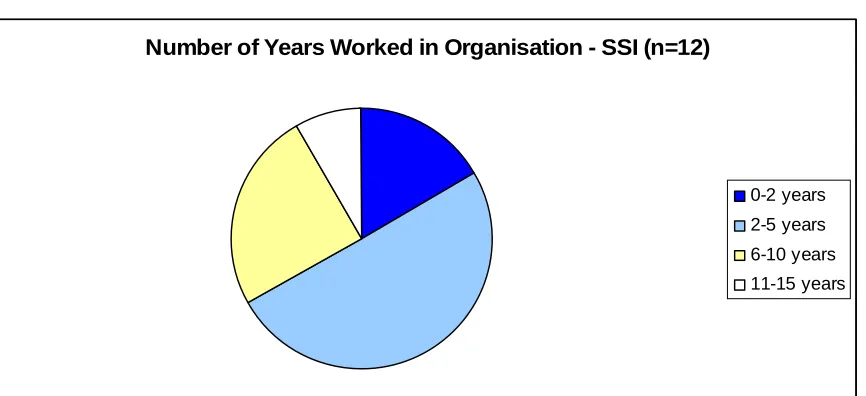
Of the 12 interviewees, 4 were managers (2 field and 2 office based) and 8 staff
(6 field based and 2 office based). The number of years worked for the
organisation was as follows:
Figure 10:
Number of Years Worked in Organisation - SSI (n=12)
0-2 years 2-5 years 6-10 years 11-15 years
Semi-structured Interviews Sample Size
Due to the time constraints of the study the sample size selected was small but
represented feedback and views from leaders and staff in both office and field
roles. The total sample size was 12 people as follows:
• 1 x Office Team Manager (Field Sales) – responsible for a UKI support. • 1 x Office Team Manager (Customer) - responsible for a UKI support teams • 1 x Field Team Manager (LSP Sector) – responsible for UKI field teams. • 1 x Field Team Manager (Distributor) – responsible for a region within UKI. • 3 x Field Sales Executives (Existing Customer) – responsible for retention. • 1 x Field Sales Executive (New Customer) – responsible for growth.
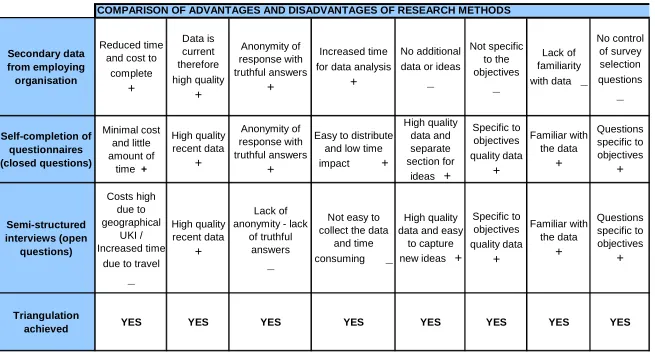
Table 8: Framework to demonstrate methodological triangulation of methods used Source: Author (2010)
Secondary data from employing organisation
Reduced time and cost to
complete + Data is current therefore high quality + Anonymity of response with truthful answers + Increased time for data analysis
+
No additional data or ideas
_ Not specific to the objectives _ Lack of familiarity with data _
No control of survey selection questions _ Self-completion of questionnaires (closed questions) Minimal cost and little amount of
time +
High quality recent data + Anonymity of response with truthful answers +
Easy to distribute and low time impact +
High quality data and separate section for
ideas +
Specific to objectives quality data + Familiar with the data + Questions specific to objectives + Semi-structured interviews (open questions) Costs high due to geographical UKI / Increased time
due to travel
_
High quality recent data
+
Lack of anonymity - lack
of truthful
answers
_
Not easy to collect the data
and time consuming _
High quality data and easy
to capture new ideas +
Specific to objectives quality data + Familiar with the data + Questions specific to objectives + Triangulation
achieved YES YES YES YES YES YES YES YES
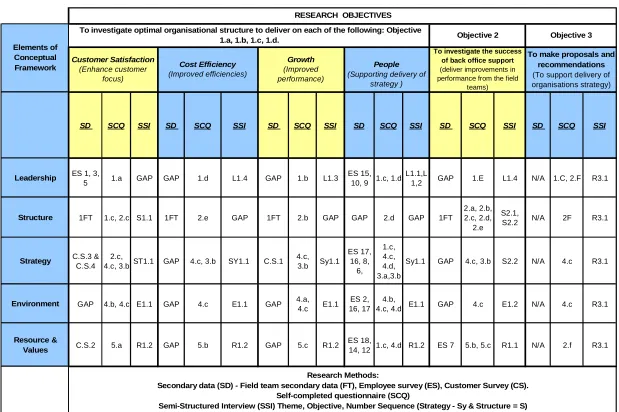
Cross Mapping Matrix
The cross mapping matrix (table 9) is used to ensure congruence between three
aspects as follows:
• Conceptual framework (Concept headings) • Individual research methods (S.D, S.C.Q & S.S.I) • Research objectives
The matrix is used to provide a check to identify if multi-methods/sources have
been used to ensure that triangulation of the three methods will occur for each of
Table 9: Cross Mapping Matrix
SD SCQ SSI SD SCQ SSI SD SCQ SSI SD SCQ SSI SD SCQ SSI SD SCQ SSI
Leadership ES 1, 3,
5 1.a GAP GAP 1.d L1.4 GAP 1.b L1.3 ES 15,
10, 9 1.c, 1.d L1.1,L
1,2 GAP 1.E L1.4 N/A 1.C, 2.F R3.1
Structure 1FT 1.c, 2.c S1.1 1FT 2.e GAP 1FT 2.b GAP GAP 2.d GAP 1FT
2.a, 2.b, 2.c, 2.d,
2.e
S2.1,
S2.2 N/A 2F R3.1
Strategy C.S.3 &
C.S.4 2.c,
4.c, 3.b ST1.1 GAP 4.c, 3.b SY1.1 C.S.1 4.c, 3.b Sy1.1 ES 17, 16, 8, 6, 1.c, 4.c, 4.d, 3.a,3.b
Sy1.1 GAP 4.c, 3.b S2.2 N/A 4.c R3.1
Environment GAP 4.b, 4.c E1.1 GAP 4.c E1.1 GAP 4.a, 4.c E1.1
ES 2, 16, 17
4.b,
4.c, 4.d E1.1 GAP 4.c E1.2 N/A 4.c R3.1
Resource &
Values C.S.2 5.a R1.2 GAP 5.b R1.2 GAP 5.c R1.2
ES 18,
14, 12 1.c, 4.d R1.2 ES 7 5.b, 5.c R1.1 N/A 2.f R3.1
Objective 2 Objective 3
To investigate the success
of back office support (deliver improvements in
performance from the field teams)
To make proposals and
recommendations
(To support delivery of organisations strategy)
Research Methods: Secondary data (SD) - Field team secondary data (FT), Employee survey (ES), Customer Survey (CS).
Elements of Conceptual Framework
RESEARCH OBJECTIVES
Customer Satisfaction (Enhance customer focus) Cost Efficiency (Improved efficiencies) Growth (Improved performance) People
(Supporting delivery of strategy )