A Monthly Double-Blind Peer Reviewed (Refereed/Juried) Open Access International e-Journal - Included in the International Serial Directories Indexed & Listed at:
VOLUME NO.5(2015),ISSUE NO.03(MARCH) ISSN 2231-5756
INTERNATIONAL JOURNAL OF RESEARCH IN COMMERCE, IT & MANAGEMENT
CONTENTS
Sr.
No.
TITLE & NAME OF THE AUTHOR (S)
Page
No.
1.
CHALLENGES OF INFORMATION & COMMUNICATION TECHNOLOGY (ICT) AS A TEACHING AND LEARNING
TOOL IN THE EDUCATION SECTOR IN ZAMBIA: A CASE STUDY OF SELECTED SECONDARY SCHOOLS OF
MONGU DISTRICT
DR. B. NGWENYA & J. KAUNDA
1
2.
TO MEASURE SIGNIFICANT DIFFERENCE IN FINANCIAL PERFORMANCE OF SELECTED FERTILIZER
COMPANIES IN INDIA BASED ON PROFITABILITY RATIOS
ANKIT D. PATEL
4
3.
A STUDY ON DEMOGRAPHIC PROFILE AND PROBLEMS FACED BY THE POWERLOOM OWNERS WITH
SPECIAL REFERENCES TO COIMBATORE CLUSTER
DR. S. SARAVANAN & K. A. RAMYA
8
4.
ANALYTICAL STUDY OF DIRECT TAX CODE TO BE INTRODUCED IN INDIAN ECONOMY
DR. MAHESH BHIWANDIKAR
13
5.
NEED OF ICT FOR DIRECT RELATION BETWEEN FARMER AND CONSUMER
DR. MANOJKUMAR JYOTIRAM GAIKWAD & PRAKASHKAILASHCHANDRAVYAS
16
6.
FINANCIAL ANALYSIS OF COMMERCIAL BANKS: A COMPARATIVE STUDY
DR. ATIYA MAHBOOB
19
7.
EFFICIENCY OF COMMODITY FUTURES IN PRICE DISCOVERY: AN EMPIRICAL STUDY OF AGRICULTURAL
COMMODITIES
SIDDULA NARSIMHULU & DR. S. V. SATYANARAYANA
22
8.
NON PERFORMING ASSETS MANAGEMENT IN HDFC BANK
S. R. PRASAD
29
9.
COMMERCIALISATION OF FOREST RESOURCES: AN EMERGING ISSUE IN ARUNACHAL PRADESH
DR. TASI KAYE
33
10.
AN ANALYSIS OF FACTORS AFFECTING ONLINE CONSUMER BUYING BEHAVIOR IN INDIA
PRACHI GOYAL & DR. BHUMIJA CHOUHAN
38
11.
EVOLUTION OF INDIA’S TELECOMMUNICATIONS INDUSTRY
GAUTAM KUMAR JHA
46
12.
STUDENT AWARENESS OF EDUCATION LOANS AS A SOURCE OF FINANCING – A STUDY OF BELGAUM CITY,
KARNATAKA
SONAL REVANKAR
55
13.
EFFECT OF CAPITAL STRUCTURE ON PROFITABILITY OF LISTED MANUFACTURING COMPANIES IN SRI
LANKA
ANANDASAYANAN S & SUBRAMANIAM V. A.
57
14.
AN EVALUATION OF THE ECONOMIC AND FINANCIAL CAPACITY OF INDIGENOUS UNDERWRITING FIRMS
FOR MARINE RISKS AND INVESTMENT COVER IN NIGERIA
NWOKORO, IGNATIUS A. & NWOKEDI, THEOPHILUS C.
61
15.
HOUSEHOLD SAVING BEHAVIOR IN JIMMA ZONE OF OROMIA REGION, ETHIOPIA
TADELE MENGESHA
65
16.
AN EMPIRICAL ANALYSIS OF FACTORS AFFECTING WLB OF EMPLOYEES IN SERVICE SECTOR
ANJU CHAWLA
77
17.
PROSPECT AND POTENTIAL OF RURAL TOURISM IN BODHGAYA
AJIT KUMAR SINGH
81
18.
VERTICAL PRICE TRANSMISSION BETWEEN CEREALS AND BREAD AND OTHER PREPARED FOODS: DOES
PRICE STABILITY IN CEREALS MARKET STABILIZES PRICE OF BREAD AND OTHER PREPARED FOODS?
YONAS ABERA MAMO, HABTAMU REGASSA LEMMA & YOHANNES MENGESHA
83
19.
SERVICE MARKETING INNOVATION: A PARADIGM SHIFT (A CASE STUDY OF INDIAN BANKING SYSTEM)
AHMAD AZHAR
91
20.
A CASE STUDY OF SAHARA INDIA PARIWAR SCANDAL (WITH REFERENCE TO ETHICAL AND GOVERNANCE
ISSUES INVOLVED)
NANCY RAO
100
CHIEF PATRON
PROF. K. K. AGGARWAL
Chairman, Malaviya National Institute of Technology, Jaipur
(An institute of National Importance & fully funded by Ministry of Human Resource Development, Government of India)
Chancellor, K. R. Mangalam University, Gurgaon
Chancellor, Lingaya’s University, Faridabad
Founder Vice-Chancellor (1998-2008), Guru Gobind Singh Indraprastha University, Delhi
Ex. Pro Vice-Chancellor, Guru Jambheshwar University, Hisar
FOUNDER PATRON
LATE SH. RAM BHAJAN AGGARWAL
Former State Minister for Home & Tourism, Government of Haryana
Former Vice-President, Dadri Education Society, Charkhi Dadri
Former President, Chinar Syntex Ltd. (Textile Mills), Bhiwani
CO-ORDINATOR
AMITA
Faculty, Government M. S., Mohali
ADVISORS
DR. PRIYA RANJAN TRIVEDI
Chancellor, The Global Open University, Nagaland
PROF. M. S. SENAM RAJU
Director A. C. D., School of Management Studies, I.G.N.O.U., New Delhi
PROF. M. N. SHARMA
Chairman, M.B.A., Haryana College of Technology & Management, Kaithal
PROF. S. L. MAHANDRU
Principal (Retd.), Maharaja Agrasen College, Jagadhri
EDITOR
PROF. R. K. SHARMA
Professor, Bharti Vidyapeeth University Institute of Management & Research, New Delhi
CO-EDITOR
DR. BHAVET
Faculty, Shree Ram Institute of Business & Management, Urjani
EDITORIAL ADVISORY BOARD
DR. RAJESH MODI
Faculty, Yanbu Industrial College, Kingdom of Saudi Arabia
PROF. SANJIV MITTAL
University School of Management Studies, Guru Gobind Singh I. P. University, Delhi
PROF. ANIL K. SAINI
VOLUME NO.5(2015),ISSUE NO.03(MARCH) ISSN 2231-5756
INTERNATIONAL JOURNAL OF RESEARCH IN COMMERCE, IT & MANAGEMENT
DR. SAMBHAVNA
Faculty, I.I.T.M., Delhi
DR. MOHENDER KUMAR GUPTA
Associate Professor, P. J. L. N. Government College, Faridabad
DR. SHIVAKUMAR DEENE
Asst. Professor, Dept. of Commerce, School of Business Studies, Central University of Karnataka, Gulbarga
ASSOCIATE EDITORS
PROF. NAWAB ALI KHAN
Department of Commerce, Aligarh Muslim University, Aligarh, U.P.
PROF. ABHAY BANSAL
Head, Department of Information Technology, Amity School of Engineering & Technology, Amity
University, Noida
PROF. A. SURYANARAYANA
Department of Business Management, Osmania University, Hyderabad
DR. SAMBHAV GARG
Faculty, Shree Ram Institute of Business & Management, Urjani
PROF. V. SELVAM
SSL, VIT University, Vellore
DR. PARDEEP AHLAWAT
Associate Professor, Institute of Management Studies & Research, Maharshi Dayanand University, Rohtak
DR. S. TABASSUM SULTANA
Associate Professor, Department of Business Management, Matrusri Institute of P.G. Studies, Hyderabad
SURJEET SINGH
Asst. Professor, Department of Computer Science, G. M. N. (P.G.) College, Ambala Cantt.
TECHNICAL ADVISOR
AMITA
Faculty, Government M. S., Mohali
FINANCIAL ADVISORS
DICKIN GOYAL
Advocate & Tax Adviser, Panchkula
NEENA
Investment Consultant, Chambaghat, Solan, Himachal Pradesh
LEGAL ADVISORS
JITENDER S. CHAHAL
Advocate, Punjab & Haryana High Court, Chandigarh U.T.
CHANDER BHUSHAN SHARMA
Advocate & Consultant, District Courts, Yamunanagar at Jagadhri
SUPERINTENDENT
CALL FOR MANUSCRIPTS
We invite unpublished novel, original, empirical and high quality research work pertaining to recent developments & practices in the areas of Computer Science & Applications; Commerce; Business; Finance; Marketing; Human Resource Management; General Management; Banking; Economics; Tourism Administration & Management; Education; Law; Library & Information Science; Defence & Strategic Studies; Electronic Science; Corporate Governance; Industrial Relations; and emerging paradigms in allied subjects like Accounting; Accounting Information Systems; Accounting Theory & Practice; Auditing; Behavioral Accounting; Behavioral Economics; Corporate Finance; Cost Accounting; Econometrics; Economic Development; Economic History; Financial Institutions & Markets; Financial Services; Fiscal Policy; Government & Non Profit Accounting; Industrial Organization; International Economics & Trade; International Finance; Macro Economics; Micro Economics; Rural Economics; Co-operation; Demography: Development Planning; Development Studies; Applied Economics; Development Economics; Business Economics; Monetary Policy; Public Policy Economics; Real Estate; Regional Economics; Political Science; Continuing Education; Labour Welfare; Philosophy; Psychology; Sociology; Tax Accounting; Advertising & Promotion Management; Management Information Systems (MIS); Business Law; Public Responsibility & Ethics; Communication; Direct Marketing; E-Commerce; Global Business; Health Care Administration; Labour Relations & Human Resource Management; Marketing Research; Marketing Theory & Applications; Non-Profit Organizations; Office Administration/Management; Operations Research/Statistics; Organizational Behavior & Theory; Organizational Development; Production/Operations; International Relations; Human Rights & Duties; Public Administration; Population Studies; Purchasing/Materials Management; Retailing; Sales/Selling; Services; Small Business Entrepreneurship; Strategic Management Policy; Technology/Innovation; Tourism & Hospitality; Transportation Distribution; Algorithms; Artificial Intelligence; Compilers & Translation; Computer Aided Design (CAD); Computer Aided Manufacturing; Computer Graphics; Computer Organization & Architecture; Database Structures & Systems; Discrete Structures; Internet; Management Information Systems; Modeling & Simulation; Neural Systems/Neural Networks; Numerical Analysis/Scientific Computing; Object Oriented Programming; Operating Systems; Programming Languages; Robotics; Symbolic & Formal Logic; Web Design and emerging paradigms in allied subjects.
Anybody can submit the soft copy of unpublished novel; original; empirical and high quality research work/manuscriptanytime in M.S. Word format
after preparing the same as per our GUIDELINES FOR SUBMISSION; at our email address i.e. [email protected] or online by clicking the link online
submission as given on our website (FOR ONLINE SUBMISSION, CLICK HERE).
GUIDELINES FOR SUBMISSION OF MANUSCRIPT
1. COVERING LETTER FOR SUBMISSION:
DATED: _____________
THE EDITOR
IJRCM
Subject: SUBMISSION OF MANUSCRIPT IN THE AREA OF.
(e.g. Finance/Marketing/HRM/General Management/Economics/Psychology/Law/Computer/IT/Engineering/Mathematics/other, please specify)
DEAR SIR/MADAM
Please find my submission of manuscript entitled ‘___________________________________________’ for possible publication in your journals.
I hereby affirm that the contents of this manuscript are original. Furthermore, it has neither been published elsewhere in any language fully or partly, nor is it under review for publication elsewhere.
I affirm that all the author (s) have seen and agreed to the submitted version of the manuscript and their inclusion of name (s) as co-author (s).
Also, if my/our manuscript is accepted, I/We agree to comply with the formalities as given on the website of the journal & you are free to publish our contribution in any of your journals.
NAME OF CORRESPONDING AUTHOR:
Designation:
Affiliation with full address, contact numbers & Pin Code: Residential address with Pin Code:
Mobile Number (s): Landline Number (s): E-mail Address: Alternate E-mail Address:
NOTES:
a) The whole manuscript is required to be in ONE MS WORD FILE only (pdf. version is liable to be rejected without any consideration), which will start from the covering letter, inside the manuscript.
b) The sender is required to mentionthe following in the SUBJECT COLUMN of the mail:
New Manuscript for Review in the area of (Finance/Marketing/HRM/General Management/Economics/Psychology/Law/Computer/IT/
Engineering/Mathematics/other, please specify)
c) There is no need to give any text in the body of mail, except the cases where the author wishes to give any specific message w.r.t. to the manuscript. d) The total size of the file containing the manuscript is required to be below 500 KB.
e) Abstract alone will not be considered for review, and the author is required to submit the complete manuscript in the first instance.
f) The journal gives acknowledgement w.r.t. the receipt of every email and in case of non-receipt of acknowledgment from the journal, w.r.t. the submission of manuscript, within two days of submission, the corresponding author is required to demand for the same by sending separate mail to the journal.
2. MANUSCRIPT TITLE: The title of the paper should be in a 12 point Calibri Font. It should be bold typed, centered and fully capitalised.
3. AUTHOR NAME (S) & AFFILIATIONS: The author (s) full name, designation, affiliation (s), address, mobile/landline numbers, and email/alternate email address should be in italic & 11-point Calibri Font. It must be centered underneath the title.
4. ABSTRACT: Abstract should be in fully italicized text, not exceeding 250 words. The abstract must be informative and explain the background, aims, methods,
VOLUME NO.5(2015),ISSUE NO.03(MARCH) ISSN 2231-5756
INTERNATIONAL JOURNAL OF RESEARCH IN COMMERCE, IT & MANAGEMENT
5. KEYWORDS: Abstract must be followed by a list of keywords, subject to the maximum of five. These should be arranged in alphabetic order separated by commas and full stops at the end.
6. MANUSCRIPT: Manuscript must be in BRITISH ENGLISH prepared on a standard A4 size PORTRAIT SETTING PAPER. It must be prepared on a single space and
single column with 1” margin set for top, bottom, left and right. It should be typed in 8 point Calibri Font with page numbers at the bottom and centre of every page. It should be free from grammatical, spelling and punctuation errors and must be thoroughly edited.
7. HEADINGS: All the headings should be in a 10 point Calibri Font. These must be bold-faced, aligned left and fully capitalised. Leave a blank line before each
heading.
8. SUB-HEADINGS: All the sub-headings should be in a 8 point Calibri Font. These must be bold-faced, aligned left and fully capitalised.
9. MAIN TEXT: The main text should follow the following sequence:
INTRODUCTION REVIEW OF LITERATURE
NEED/IMPORTANCE OF THE STUDY STATEMENT OF THE PROBLEM OBJECTIVES
HYPOTHESES
RESEARCH METHODOLOGY RESULTS & DISCUSSION FINDINGS
RECOMMENDATIONS/SUGGESTIONS CONCLUSIONS
SCOPE FOR FURTHER RESEARCH ACKNOWLEDGMENTS REFERENCES APPENDIX/ANNEXURE
It should be in a 8 point Calibri Font, single spaced and justified. The manuscript should preferably not exceed 5000 WORDS.
10. FIGURES &TABLES: These should be simple, crystal clear, centered, separately numbered & self explained, and titles must be above the table/figure. Sources of data should be mentioned below the table/figure. It should be ensured that the tables/figures are referred to from the main text.
11. EQUATIONS:These should be consecutively numbered in parentheses, horizontally centered with equation number placed at the right.
12. REFERENCES: The list of all references should be alphabetically arranged. The author (s) should mention only the actually utilised references in the preparation
of manuscript and they are supposed to follow Harvard Style of Referencing. The author (s) are supposed to follow the references as per the following:
•
All works cited in the text (including sources for tables and figures) should be listed alphabetically.•
Use (ed.) for one editor, and (ed.s) for multiple editors.•
When listing two or more works by one author, use --- (20xx), such as after Kohl (1997), use --- (2001), etc, in chronologically ascending order.•
Indicate (opening and closing) page numbers for articles in journals and for chapters in books.•
The title of books and journals should be in italics. Double quotation marks are used for titles of journal articles, book chapters, dissertations, reports, working papers, unpublished material, etc.•
For titles in a language other than English, provide an English translation in parentheses.•
The location of endnotes within the text should be indicated by superscript numbers.PLEASE USE THE FOLLOWING FOR STYLE AND PUNCTUATION IN REFERENCES: BOOKS
•
Bowersox, Donald J., Closs, David J., (1996), "Logistical Management." Tata McGraw, Hill, New Delhi.•
Hunker, H.L. and A.J. Wright (1963), "Factors of Industrial Location in Ohio" Ohio State University, Nigeria.CONTRIBUTIONS TO BOOKS
•
Sharma T., Kwatra, G. (2008) Effectiveness of Social Advertising: A Study of Selected Campaigns, Corporate Social Responsibility, Edited by David Crowther & Nicholas Capaldi, Ashgate Research Companion to Corporate Social Responsibility, Chapter 15, pp 287-303.JOURNAL AND OTHER ARTICLES
•
Schemenner, R.W., Huber, J.C. and Cook, R.L. (1987), "Geographic Differences and the Location of New Manufacturing Facilities," Journal of Urban Economics, Vol. 21, No. 1, pp. 83-104.CONFERENCE PAPERS
•
Garg, Sambhav (2011): "Business Ethics" Paper presented at the Annual International Conference for the All India Management Association, New Delhi, India, 19–22 June.UNPUBLISHED DISSERTATIONS AND THESES
•
Kumar S. (2011): "Customer Value: A Comparative Study of Rural and Urban Customers," Thesis, Kurukshetra University, Kurukshetra.ONLINE RESOURCES
•
Always indicate the date that the source was accessed, as online resources are frequently updated or removed.WEBSITES
NEED OF ICT FOR DIRECT RELATION BETWEEN FARMER AND CONSUMER
DR. MANOJKUMAR JYOTIRAM GAIKWAD
HEAD
DEPARTMENT OF ECONOMICS
VASANTRAONAIK COLLEGE OF ARTS AND SCIENCE
SHAHADA
PRAKASHKAILASHCHANDRAVYAS
ASST. PROFESSOR
DEPARTMENT OF COMMERCE
GDM ARTS KRN COMMERCE & MD SCIENCE COLLEGE
JAMNER
ABSTRACT
Today all of we lives in e-World, means electronic world. Most of transactions of Business, Industries and Services are done through electronically, via computer & communication technology. The paper suggest the need of ICT to our Indian agricultural field. If this is adopted then it will change our current scenario of agriculture and create a high growth of development in India.
KEYWORDS
ICT, electronic world.
INTRODUCTION
ndia is an agricultural country. Agriculturing is the primary business of India, and so many businesses are depends upon agriculture. We uses ICT for developing businesses, industries and service sector. But there is less use of ICT in agriculture field. This paper focuses on need of ICT for maintaining direct relation between farmers and consumers so farmers can be get more profits and also consumers can be get cheaper goods directlyfrom farmers and the mediators and theirs profits is to be omitted from this procedure. And it is also important for to develop our agricultural based economy.
OBJECTIVES OF THE STUDY
1. To study the impact ICT in agriculture.
2. To study the need of ICT for Farmers and Consumers.
3. To suggest the advantages of ICT in agriculture.
4. To study the limitations of ICT in agriculture.
HYPOTHESIS
1. There is less use of ICT in agriculture field.
2. Most of farmers don’t know about ICT.
3. Traditional way of selling and buying of goods are adopted in India.
4. It is very challengeous to adopting ICT in all area of agricultural field.
RESEARCH METHODOLOGY
Primary data are collected through observation and survey in local area market, marketing committee and secondary data are collected from web media, books, Journals/ research paper.
USES & LIMITATIONS OF THE STUDY
This research paper useful to farmers as well as consumers to maximizes their connectivity directly through electronic media and do their transactions more effectively and get satisfaction about profit, price and quality. But this paper not useful to them who are not educated.
MEANING & DEFINITION OF ICT
ICT means information and communication technology in which computer and communication technology combinely play a vital role to develop e-world. Computer and internet are the key points of this technology. ICT includes multimedia, EDI (electronic data interchange ), commerce, Business, services, e-marketing, e-banking, e-payment, e-e- communication, e-shopping etc. Its capture global market electronically.
Current scenario in agriculture field in India:
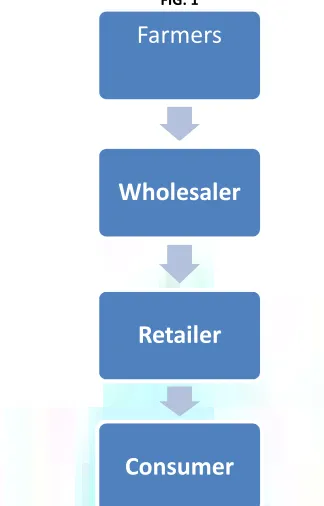
The buying and selling procedure of agricultural goods are as follows in our India.
VOLUME NO.5(2015),ISSUE NO.03(MARCH) ISSN 2231-5756
INTERNATIONAL JOURNAL OF RESEARCH IN COMMERCE, IT & MANAGEMENT
FIG. 1The above figure shows a simple supply chain of distributing goods. As per the distance between farmers and consumers more agents and mediators are added in this chain automatically. But normally if we think about above chain farmer go to the wholesaler who purchase or auction the product and receive commission from farmers. After that wholesaler included his profit and covered his expenses and sale to the retailers. And retailers added more profit and covered their expenses and sale to the consumer at higher rate and earn more profits.
For example – If a farmer sales wheat to the wholesaler, as per quality of wheat wholesaler paid Rs.14 per kg. to farmer after wholesaler sale it to retailer at Rs. 16 and then retailer sold it to consumer at Rs. 20. Retailer have no fixed rate to sale it to consumer .Hence he earn more profit with comparison of farmers and wholesalers. In this procedure farmers get less profit and mediators earn high profit and also consumer pays high rate for it.This creates inequality in our economy and society.
TABLE 1
Product Farmer sale or wholesaler purchase price/cost – 1 kg. Wholesaler sale or retailer purchase price/cost – 1 kg. Retailer sale or consumer
purchase price/cost – 1 kg.
Wheat 14 16 20
Jawar 15 17 22
Bajra 13 15 19
Source: Local area market .
TABLE 2: SUGGESTED CHAIN FOR BUYING AND SELLING GOODS WITH USE OF ICT
NEED AND ADVANTAGES OF ICT FOR FARMERS AND CONSUMERS
1. For to increase the farmers profit.
2. It helps to sale and buy product through online minimizes cost, expenses, time, money, travelling and efforts of both faemers and consumers.
3. It removes the mediators profits.
4. Consumers purchase goods at lower and cheaper price.
5. It gives employment to computer hardware and software maintainers.
6. Improved consumer’s satisfaction.
7. For privacy of information in transactions.
8. Remain open all the time 24 hours/ 365 days.
9. Competition between farmers increase quality
10. It provides users more options and quicker delivery of product.
11. It helps to growth of economic development.
12. Farmers adopting latest technology in farming field.
13. Banking, transport, advertising, insurance all service sectors growing rapidly.
14. Products can be purchased from remote areas.
LIMITATIONS OF ICT IN AGRICULTURAL FIELD
1. Hackers creates problems for farmers and consumers to complete their transactions.
2. Ill literacy about ICT is creates problems to operate online transactions.
3. There can be lack of system security, reliability, or standards owing to poor implementation of e –Commerce.
Farmers
Wholesaler
Retailer
Consumer
4. User may not trust the site being unknown faceless seller.
5. Lack of touch or feel of products during online shopping.
6. ICT applications are still evolving and changing rapidly.
7. Internet access is still not cheaper and inconvenient to use for many potential farmers and consumers like one living in remote villages.
8. Barrier in telecommunications and internet connection affects transactions.
9. It creates unemployment for mediators.
10. Power cut creates problems to users of computers.
SUGGESTIONS
1. Workshops and Training based programmes taken by government for literacy of ICT for farmers.
2. Subsidies provided to internet user farmers to develop ICT in agriculture field.
3. Cheaper internet facility are to be provided by the web companies.
4. Be careful from hacking and harmful activities. Cyber laws are to be followed properly.
5. All service sectors combinely helps to farmers to increase the use of ICT.
CONCLUSION
Compare with traditional agriculture activities it is an innovative technique, which is more useful to farmers and consumers, but due to above limitations it is very challengeous to adopting this technology all the remote and far flung village area. It is more flexible and provides 24 hours, 365 days facility any time anywhere. There is more need of literacy and help of government and service sectors to improve this technology in agriculture field.
REFERENCE
VOLUME NO.5(2015),ISSUE NO.03(MARCH) ISSN 2231-5756
INTERNATIONAL JOURNAL OF RESEARCH IN COMMERCE, IT & MANAGEMENT
REQUEST FOR FEEDBACK
Dear Readers
At the very outset, International Journal of Research in Commerce, IT & Management (IJRCM)
acknowledges & appreciates your efforts in showing interest in our present issue under your kind perusal.
I would like to request you tosupply your critical comments and suggestions about the material published
in this issue as well as on the journal as a whole, on our [email protected] for further
improvements in the interest of research.
If youhave any queries please feel free to contact us on our E-mail
.
I am sure that your feedback and deliberations would make future issues better – a result of our joint
effort.
Looking forward an appropriate consideration.
With sincere regards
Thanking you profoundly
Academically yours
Sd/-
Co-ordinator
DISCLAIMER