i tif c n
e C
i o
c n
S f
l e
a r
n e
o n
i c
t e
a
2
nr 0
et 1
1
n I
ISC 2011
Proceeding of the International Conference on Advanced Science,
Engineering and Information Technology 2011
Hotel Equatorial Bangi-Putrajaya, Malaysia, 14 - 15 January 2011
ISBN 978-983-42366-4-9
ISC 2011
International Conference on Advanced Science, Engineering and Information Technology
ICASEIT 2011
Cutting Edge Sciences for Future Sustainability
Hotel Equatorial Bangi-Putrajaya, Malaysia, 14 - 15 January 2011
SR
IE
AUNVIIT
NESIE
DO KB
IN N
R AG
JA A
L S
A A
E N
P M
N A
A L
U A
T Y
A S
S A I
R
EP
N I
NO OD
I TAI COSSA STNEDUTS NA IESN
Organized by Indonesian Students Association Universiti Kebangsaan Malaysia
Proceeding of the
Bit Error Rate Performance for Multicarrier Code
Division Multiple Access over Generalized η-µ
Fading Environment
James Osuru Mark , Brahim Belhaouari Samir and Mohammed Naufal
Department of Electrical & Electronic Engineering, Universiti Teknologi PETRONAS,
Bandar Seri Iskandar 31750, Tronoh, Perak, Malaysia.
E-mail: [email protected],
[email protected], [email protected]
Abstract The multicarrier code division multiple access (MC-CDMA) system has received a considerable attention from researchers
owing to its great potential in achieving high data rates transmission in wireless communications. Due to the detrimental effects of multipath fading the performance of the system degrades. Similarly, the impact of non-orthogonality of spreading codes can exist and cause interference. This paper addresses the performance of multicarrier code division multiple access system under the influence of frequency selective generalized η-µ fading channel and multiple access interference caused by other active users to the desired one. We apply Gaussian approximation technique to analyse the performance of the system. The avearge bit error rate is derived and expressed in Gauss hypergeometic functions. Maximal ratio combining diversity technique is utilized to alleviate the deleterious effect of multipath fading. We observed that the system performance improves when the parameter η increase or decreasse in format 1 or format 2 conditions respectively.
Keywords MC-CDMA , generalized η-µ fading , average bit error rate, maximal ratio combining.
I. INTRODUCTION
Multicarrier Code Division Multiple Access (MC-CDMA) is a digital modulation and multicarrier scheme which results from the combination of Orthogonal Frequency Division Multiplexing (OFDM) and Code Division Multiple Access (CDMA). Based on this combination, three multiple access techniques are formed, viz: Multicarrier (MC) –CDMA, Multicarrier Direct Sequence (DS)-CDMA and Multitone (MT)-CDMA. Therefore, these multiple access schemes have both the advantages and disadvantages of the elements that constitutes them. Hence, these multicarriers techniques are further classified into frequency domain and time domain spreading codes. In case of frequency domain , the
original datastream is spreaded using spreading code and modulate different subcarriers with each chip while for time domain, original datastream is serial-parallel conversion and spread using spreading code,then each subcarrier is modulated differently with each of the datastream. The main aim for these multicarrier access schemes is to provide sprectral efficiency, interference suppression capability and high data rate transmission over frequency selective fading channels. Similarly, the issue of how to spread the signal bandwidth without increasing the effect of delay spread is also addressed [1]. Hence, the other two multicarrier techniques will not be discussed in this paper.
the same. Suppose the original symbol rate is high enough to become subject to frequency selective fading, then the signal should first be converted from serial to parallel before spreading over the frequency domain. This is to ensure that multicarrier transmission over each subcarrier should be frequency non selective fading. Therefore, MC-CDMA system transmits the same data bit over all subcarriers without changing the original baud rate [2].
The Bit Error Rate (BER) performance of the MC-CDMA system over frequency selective fading channels was addressed using equal gain combining and maximal ratio combining [3]. Effects of multipath delay on multicarrier received signals was investigated and a new closed form formula for BER was derived based on the orthogonal MC – CDMA system [4]. The authors [5] proposed a simple and efficient receiver design for frame based MC-CDMA in
multipath Nakagami-m fading channels. The performance of
the model were illustrated using different fading
Nakagami-m parameters, modulation schemes (4, 16, and 64 QAM)
and different number of users. In [6] the system performances is compared with that of the conventional DS-CDMA, it was observed that the multicarrier system outperforms when the system parameters are properly selected. The investigation of the performance of the MC-CDMA system in uplink channel with frequency selective Rayleigh fading channels was conducted [7].
This paper tackles the effects of multipath fading and multiuser interference on performance of MC-CDMA
wireless communication system over generalized η-µ fading
channels. The maximal ratio combining diversity method is applied to mitigate the serious impact of multipath fading. The average bit error probability (ABEP) for measuring the performance of the MC-CDMA wireless communication system is derived and expressed in Gauss hypergeometric functions. The paper is organized as follows: Section II outlines system and channel models. Analysis of the received signal is explained in section III, while the application of the Gaussian approximation method to analyse the signal is described in section IV. In section V, ABEP for the MC-CDMA system is derived, meanwhile the numerical results and discussion is explained in section VI. Finally, section VII deals with conclusion.
II. SYSTEM AND CHANNEL MODEL
A. MC-CDMA Transmitter Model
MC-CDMA system transmits datastream by first carrying out serial to parallel conversion and then spreads datastream in frequency domain (F-domain). The symbol duration of the transmitted signal is Ts=qTb, where q is the number of substreams and Tb is the bit duration before conversion. Hence, after conversion each datastream is spread over Np subcarriers using spreading code of Ck[0], Ck[1], .., Ck[Np-1] assigned to user k in F-domain. The separation between two adjacent subcarriers is assumed to be 1/Ts. The spreading codes are assumed to be random variables with values -1 or +1 having equal probability of 0.5. In this case, each chip of data symbol is transmitted in parallel on different subcarrier. Then, the k th user transmitted signal is given by [8].
2
1cos
2
,
11 1
k ij ij k
k i q
i N
j p
k t NPb tC j f t
S p
where P denotes transmitted power per bit, Np represents the number of subcarriers and q is the number of bits, fij is a
subcarrier frequency, bik (t) is the i th binary data stream of
user k
TS
s
n k i k
i t b nP t nT
b
, where bik[n] is
assumed to be a random variable which takes the values of
+1 or -1 with equal probability, PTS(t) represents a
rectangular waveform defined as pτ(t)=1,0≤t≤ τ and zero
elsewhere, фik denotes a random phase introduced by carrier
modulation assumed to be uniformly distributed in [0,2π).
B. Channel Model
The link between the transmitter and the corresponding receiver is assumed to be slowly flat fading channel for each subcarrier. The fading envelope of the received signal is
modelled as generalized η-µ fading distribution. Therefore,
in the analysis of the performance of the system, special
cases for the generalized η-µ distribution are also
considered. Hence, the impulse response for the k th
transmitted signal over the i th subcarrier is given by [9]
exp
k
,
2i k
K i K
i t t j
h
where αki , τk and ψki denote the attenuation factor, delay
and phase shift respectively. δ(.) represents Dirac delta function. The delay is assumed to be uniformly distributed over [0,Ts ). Therefore, attenuation factor, delay and phase shift are assumed to be constant over a symbol period.
The η-µ distribution is a general fading distribution that
can be used to better represent the small scale variation of the fading signal envelope in a nonline of sight conditions[10]. The considered signal composes of clusters of multipath waves propagating in a nonhomogenous environment. In a cluster, the phases of the scattered waves are random and have similar delays, with delay-time spreads of different clusters being relatively large [10]. The inphase and quadrature components of the fading signal within each cluster are considered to be independent of one another and have different powers. This distribution includes
Nakagami-q, Nakagami-m, Rayleigh and One-Sided Gaussian
distribution as special cases. Hence, suppose α follows
generalized η-µ distribution, then the probability density
function of the instantaneous SNR is given by [10], [11]
3
,
2
2
exp
2
5 . 0
5 . 0 5 . 0 5 . 0
5 . 0
H
I
h
H
h
f
where
2 2
1
2
h
H
Var
E
, E[.] is thegamma function and Ix(.) is the modified Bessel function of the first kind of order x. The parameters H and h are
presented into cases as
H
1
/
4
and
2
1
/
4
h
where 0<η<∞ is the power ratio ofthe inphase and quadrature scattered waves in each multipath
cluster. The other case is
H
/
1
2
and
1
2
/
1
h
where -1<η<1 is the correlation coefficientbetween the inphase and quadrature waves in each multipath cluster.
C. MC-CDMA Receiver Model
We assume K asynchronous CDMA users simultaneously communicating with the base station employing MC-DMA system. It is also assumed that the users exploit the same number of bits as well as subcarriers. Similarly, perfect power control is assumed. Then, the received signal at the base station is given by [8].
2
,
41 2
1 1 1
t n t
f Cos
j C t b N
P t
r
k ij ij
k k k i K
k q
i N
j k ij p
p
where n(t) is the Additive White Gaussian Noise (AWGN) with zero mean and double sided power spectral density
(PSD) of N0/2, k ij k
ij k ij k
ij f
2 , ψijk is a random
phase introduced by the channel, ijk is assumed to be
random variable uniformly distributed in [0,2π), τk is the misalignment of user k with respect to the reference user,
k ij
denotes the amplitude attenuation due to the channel, it
is also a random variable.
III. RECEIVED SIGNAL ANALYSIS
In this case, the receiver makes use of all the received signal energy of an Np – chip code scattered in the F-Domain. In frequency selective fading channels, different subcarriers can experience amplitude attenuation and phase shift differently. Therefore, this results in destroying orthogonality of the subcarrier which leads to interchannel interference. The statistic decision variable Zu of the 0 th data bit in u th data subcarrier for the reference user is given by [8]
1
2
,
51 0
dt t f Cos M v C t r
Z uv uv uv
N
v T
u
p s
where Muv is a parameter for identifying diversity combining techniques. Hence, the above equation can be express as
6, 0 2
1
D I I
Zu
where D is the reference user or desired user, I1 is a multiuser interference due to subcarriers having the same frequency, I2 is multiple access interference due to other subcarriers with different frequencies. Assume that the received signal k=1 is the reference user, τk =τ1 =0 and the phase difference is also zero. Then, the desired user is given by
0,
72 1 uv n
N
u uv s p
b M T
N P D
p
where bn [0] is the 0 th data bit transmitted by uv subcarriers of the reference user. Similarly, the MAI due to the same subcarrier frequency is expressed as
1 1 ,
82
0 2
1 M Cos b t C v Cv dt
N P
I k k
T k i uv K
k k uv p
s
where k uv
ij
, also the MAI due to other active users
with distinct subcarriers frequencies is
1
2
,
91 2
0 2 1 1 1 2
dt t f f Cos v C
j C t b M N
P I
uv ij
k k T
k i uv K
k q
i N
j N
v k ij p
s
p p
and finally
1
2
,
101 0
0 M Cv ntCos fuvt uvdt N
v T
uv
p s
is noise due to AWGN
IV. GAUSSIAN APPROXIMATION METHOD
This method is used for determining the bit error rate of the multiple access communication system depending on decision statistic [12]. The interfering components to the desired one are assumed to be zero mean Gaussian random variables. Similarly, AWGN is a Gaussian random process and is a zero mean Gaussian random variable [13].
A. Noise Analysis
The noise engendered by AWGN is described by equation (10). Hence, this noise term is assumed to be Gaussian random variable with zero mean and variance
,
112 1
0 2
0
p
N
v b
uv
E N
Var
where Eb is the energy per bit.
B. Interference Analysis (I1 )
This multiple access interference (MAI) is caused by the subcarrier having the same frequency. Then MAI is assumed to be Gaussian random variable with zero mean and variance
,
123
2 ' 1 uv
I Var
where
t
C
v Cv dtb Cos M N
P
I k k
T k i uv
k uv p
s
1 1 2
0 '
1
C. Interference Analysis (I2)
,
13 2 2 2 ' 2 q v j u i I Var uv where
f f t
dtCos v C j C t b T M N P I uv ij k k T k i s uv k ij p s
2 1 1 2 0 ' 2Therefore, the decision variable is given by
14, 2 1 2 2 1 1 0
' 2 ' 1
p p N v K k K k q i N j uv s pu NP T D I I
Z
The mean of the decision variable is
0 ,
151 uv N v uv u
u b M
Z E p
and the variance
is
1
1
,
163 1 2 1 2 0 2
p N v uv m p b p qI N K K E N N where
q u N v p m p v u I qN I 1 1 ,
1 and
q i N j p p q v j u i N q v u I1 1 2 2 2
1 1
1 ,
Hence, if the maximal ratio combining is employed, i.e., αuv=Muv , then the signal to interference noise ratio is given by
17, 1 2 1 2 2 1 2
p p p N v v N v uv N v uv MSINR
Where
1
0 1 1
3 1 2
p m
b
p K K N qI
E N N
Therefore, the instantaneous signal to interference noise ratio is given by
p N v v 1 2 . Then, the fading envelope α can be modelled
as generalized η-µ distribution random variable and
assuming multipath intensity profile (MIP) to be uniformly
distributed for the MC-CDMA scheme. Therefore,
p N v v 1 2
obeys noncentral Chi-square distribution with 2Np degrees of freedom. The pdf of the instantaneous SINR is expressed as [10]
182 2 exp 2 5 . 0 5 . 0 5 . 0 5 . 0 5 . 0 H I h H N h f p p p p p p N N N N p N N
V. BIT ERROR RATE ANALYSIS
Since the transmitted signal is coherently modulated using binary phase shift keying (BPSK) , then, the conditional probability of error is given by [15], [16]
,
192 , 5 . 0 2 Q Pb
Hence, the unconditional probability of error is given by [15]
2
,
200
f d
Q E
Pb
Expressing (18 ) in series form of modified Bessel function [ 11]
21, 2 exp 5 . 0 ! 2 1 2 2
0 2 2
2 2 2
h i N i H N h f i Ni N i p
i i N p N p p p p
This series converges for all values of except for =0.
The average error probability is given by [15], [16 ]
22, 1 ; 1 2 2 ; 5 . 0 2 2 , 1 1 2 2 5 . 0 2 2 5 . 0 ! 2 3 5 . 0 2 2
0 2 2
2 2
i N i N F i N i N i N i H N h E P p p i N p pi N i p
i N p N b p p p p where
2
h
and 3F2(.) denotes Gausshypergeometric function.
VI. NUMERICAL RESULTS AND DISCUSSION
The BER performance of MC-CDMA system over
generalized η-µ fading channels is carried out using (22). In
this case, the number of iterations used for evaluating the series which yields better results is 20 times.
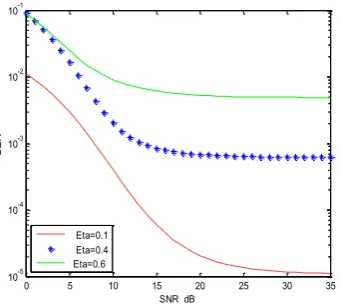
Fig. 1 depicts the BER versus SNR, it is seen that the BER increases as the number of users increase as well. Hence, the system performance degrades. As illustrated in fig. 2, the BER decreases as the parameter η increases resulting to system performance improvement. But in fig. 3 BER decreases when the value of η decreases as well. Therefore, the performance of the system in these two cases format 1 and format 2 improves generally.
0 5 10 15 20 25 30 35 10-4
10-3 10-2 10-1 100
SNR dB
BER
1 User
4 Users 7 Users 10 Users
Fig. 1 MC-CDMA system performance over generalized η-µ fading channels (µ=1.5, η=2, format 1).
0 5 10 15 20 25 30 35
10-5 10-4 10-3 10-2 10-1
SNR dB
BER
Eta=0.1 Eta=0.4 Eta=0.6
Fig. 2 BER versus SNR for MC-CDMA system performance over generalized η-µ fading channels (Users=3, µ=1,Format 1).
0 5 10 15 20 25 30 35
10-5 10-4 10-3 10-2 10-1
SNR dB
BER
Eta=0.1 Eta=0.4 Eta=0.6
Fig.3 BER versus SNR MC-CDMA system performance over generalized η-µ fading channels(Users=3,µ=1,Format 2).
0 5 10 15 20 25 30
10-4 10-3 10-2 10-1 100
USER
BER 5 dB
20 dB
35 dB
Fig. 4 Effect of signal power on MC-CDMA system performance generalized η-µ fading channels.
0 10 20 30 40 50 60
10-4 10-3 10-2 10-1
Number of subcarriers
BER
U=10U=20 U=30
Fig. 5 Effect of active users on MC-CDMA system performance over generalized η-µ fading channels.
0 2 4 6 8 10 12 14 16 18 20
10-5 10-4 10-3 10-2 10-1
BER
Number of USERS L=16
L=24 L=32
Fig. 6 Impact of subcarriers on performance of MC-CDMA system over generalized η-µ fading channels.
VII. CONCLUSION
The BER performance of the MC-CDMA system over
frequency selective generalized η-µ fading channel is
multipath fading can be reduced by increasing the number of the subcarriers. It is observed that the performance of the system improves when SNR increases. Similarly, we deduced that the performance of the system becomes better
when the parameter η increases and decreases in format 1
and format 2 conditions respectively.
ACKNOWLEDGEMENTS
We would like to recognize and express thankfulness to PETRONAS for financial assistance. We also express gratitude to the reviewers for their constructive suggestions which lead to the improvement of this paper.
REFERENCES
[1] Shinsuke Hara and Ramjee Prasad, “Overview of
Multicarrier CDMA,” in Proc. IEEE 4 th Int. Symp.
Spread Spectrum Techniques and Applications, Mainz, Sept. 22-25, 1996, pp. 107-114.
[2] N. Yee, J. P. Linnartz and G. Fettweis, “ Multicarrier
CDMA in indoor Wireless Radio Networks,” Proc. Of
IEEE PIMRC’93, Yokohama, Japan, Sept. 1993, pp.109-113.
[3] Xiang Gui and Tung Sang Ng, “Performance of
Asynchronous Orthogonal Multicarrier CDMA System in Frequency Selective Fading Channel,”IEEE Trans. Commun., vol. 47, NO. 7, pp.1084-1091, July 1999.
[4] Mingqi Li, Qicong Peng and Yubai Li, “ Performance
Analysis of Multicarrier CDMA Systems in Multipath
Fading Channels,” IEEE International Conf. on
Commun., vol 1, pp.303-307,2002.
[5] Hassan M. Elkamchouchi and Ahmed M. Medra,
“Efficient Receiver Design for Frame Based MC-CDMA
in Multipath Nakagami-m Fading Channels,” 26 th
National Radio Science Conference(NRSC2009) March 17-19, 2009.
[6] Essam Sourour and Masao Nakagawa, “Performance of
Orthogonal Multi-Carrier CDMA in a Multipath Fading Channel,”IEEE Trans. Commun., vol. 44(3) pp. 356-367, 1996.
[7] Md. Rezaul Haque Khan, Md. Akbar Hossain, AHM
Razibul Islam and Ju Bin Song, “ SINR Performance of Multicarrier CDMA system in Frequency Selective Rayleigh Fading Channels,”International Conference on inf. And Commun. Tech., Dhaka, Bangladesh,7-9 th March 2007
[8] Lie-Liang Yang, Multicarrier Communications,
John Wiley & Sons Ltd., 2009.
[9] Besma Smida, Lajos Hanzo and Sofiene Affes, “ Exact
BER Performance of Asynchronous MC-DS-CDMA over Fading Channels,” IEEE Trans. Wireless Commun., vol. 9. NO. 4, pp.1249-1254, April 2010.
[10] Michel Daoud Yacoub, “The К-µ distribution and the η-µ
distribution,” IEEE Antennas and Propagation Magazine, Vol. 49, No. 1, pp.68-81, Feburary 2007.
[11] D.B. da Costa amd M. D. Yacoub, “Moment Generating
Function of Generalized Fading Distribution and
Applications,” IEEE Communications Letters, Vol.12,
No. 2, pp.112-114, Feburary 2008.
[12] Michael B. Pursley, “ Performance Evaluation for
Phase-Coded Spectrum Multiple-Access Communication-Part I: System Analysis,” IEEE Trans. Commun., vol. Com-25, NO.8, pp.795-799, August 1977.
[13] Joseph C. Liberti and Theodore S. Rappaport, Smart
Antennas for Wireless Communications IS-95 and Third Generation CDMA applications, Prentice Hall PTR, 1999.
[14] Lajos Hanzo, Lie-Liang Yang, E-L Kuan and K. Yen,
Single- and Multicarrier DS-CDMA Multiuser detection, Space-Time Spreading, Synchronization and Standard., John Wiley & Sons Ltd. 2003.
[15] Marvin K. Simon and Mohamed-Slim Alouini, Digital
Communication over Fading Channels, 2 nd Edition, John Wiley & Sons Ltd, Newjersey, 2005.
[16] I. S. Gradshteyn and I. M. Ryzhik, Table of Integrals,