______________
E-mail address: [email protected] Received March 3, 2019
Adv. Fixed Point Theory, 9 (2019), No. 3, 239-252 https://doi.org/10.28919/afpt/4050
ISSN: 1927-6303
MAPPING NEARLY CONTINUOUS FUNCTION BY NEWTON-LIKE
OPERATORS IN BAIRE’S SPACE
STEPHEN EHIDIAMHEN UWAMUSI
Department of Mathematics, Faculty of Physical Sciences, University of Benin, Benin City, Edo State, Nigeria
Copyright © 2019 the authors. This is an open access article distributed under the Creative Commons Attribution License, which permits unrestricted use, distribution, and reproduction in any medium, provided the original work is properly cited.
Abstract: The paper presents a mapping 𝐹𝑛: 𝑋 → 𝑌, where 𝐹acts on a topological space 𝑋 into a regular topological space 𝑌 that is nearly continuous. We use Newton-like operators in Baire’s space in the presence of singularities of Jacobian matrices with contributory factor of the Tikhonov regularization parameter introduced on the discontinuous system in order to enforce the homeomorphic image to be continuous under the induced closed graph theorem.
Keywords: nonlinear system; Baire’s space; Newton-like methods; strange attractor.
2010 AMS Subject Classification: 65H10, 65B05, 46A08, 46A30.
1.0 INTRODUCTION
In the paper, we study numerical solution of nonlinear system of equation
0 ) (x =
F , (1.1)
whereF is assumed to be nearly continuous on D(x)Rm →Rn,mn.
Such problems are often encountered in Category theorems, e.g., the Baire’s category theorems.
We give a few properties of Baire space as a prelude to the discussion. Firstly, a complete metric
space shares property of a Baire space and, a topological space that is homeomorphic to an open
subset of a complete pseudo-metric space is also a Baire space. Such a good example of
completely metrizable topology of Baire space would be the uniform boundedness principle ,
belongs to the interior of its closure. A subspace Tof a topological spaceXis said to be rare
when X \T everywhere dense.
Particularly, as a measure of our discussion is that a bounded linear surjection of a Banach space
X into a Banach space Y is an open mapping. The inverse mapping theorem states that a
bounded linear bijection of a Banach space X onto a Banach space Yhas a bounded inverse, that
is in addition, a topological isomorphism.
In what follows, we relate the Jacobian matrices of the nonlinear system of Equation (1.1) to
regularity spaces for ,(i 1,2,...,n, j 1,2,...,n)
x F A
j
i = =
and for x near enoughx*, one can find
( )
*,0 Bx
x such that
,...,.) 2 , 1 , 0 ( ,
1 = + =
+ x s k
xk k k (1.2)
Wherefrom,
) ( )
( )
(xn sk F xk F xk
A + ,the desired approximate solution converges to x* for good
enough starting pointx0.
Considering the perturbed Jacobian matrixA= A+A
^
defined, and supposing there is a
constant M in existence such that
A
−1 M^
, xB
( )
x*, , it would hold that( )
x A K AA k − k
^
for the Lipschitz matrix K. By using ideas closely related to Fowler and
Kelley (2005) would lead us to write that:
( )
(
)
MA K M x
A k 1 1 1 2
−
−
−
, (1.3)
and
(
1)
( )2 k k
k M F x
s + . (1.4)
The monotone coerciveness of the mapping F is explained as follows:
Definition 1.1 (Ortaga and Rheinboldt (2000). A mapping n n
R R D
F: → is weakly coercive
on the open set D0 D if there exists a point tD0 with the property that, for any 0, there
is an open, bounded set Dr D0 containing t for which Dr D0
−
(
x t)
F(x) x t 2, x D0T −
− in Dr
−
. By further setting D=D0 =Rn, and t =0forces F to be coercive.
The concept of Uniform monotonicity theorem Ortega and Rheinboldt (2000) states that: If
n n
R R
F: → is continuous and uniformly monotone, then F is a homeomorphism of n R onto
itself.
Via inclusion of nested sequences for the generated Jacobian matrices
) ,..., 2 , 1 , ,..., 2 , 1 (
, i n j n
x F A
j
i = =
the full rank matrixA in the topological space, whichAk
occupy should be completely regular, uniformable, Hausdorff and Polish (i.e., metrizable ,
complete and separable).
Being inspired in this direction, we invoke the hereditary properties of Hausdorff spaces Akfor the matrices in the sense of Bourles (2014), namely:
An open subset of a polish (resp. Suslin, Baire) space is such;Every polish space is Baire, the collections of countable many open subsets is dense;
Every closed subsets of Baire space is a continuous image of the Baire space and every Polish
space is a continuous image of the Baire space;
A Banach space is barrelled just as ultrabornological space is barrelled, however,ultrabornological space need not be Baire as well.
Consequently following, a topological space is F polish space if F is a complete separable
metrizable topological space, Hola (1990). We basically; may be interested in the effective
Polish space, the complete separable metric space that has a computable representation.
A computable topological space is a computable locally compact separable Hausdorff space.
Thus, such a computable topological space has effective intersection property, effective
disjointness property, effective inclusion property and effective covering property. It must be
stated that membership of a recursive closed set need not be decidable.
This inspires the following definition for a useful purpose.
Definition 1.1 Hola (1990). Let E,F be topological spaces. A mapping f from E to f is
called nearly continuous if for every xE and one can find a neighbourhood U of f(x) such
It holds that a function f :E→F will be called Borel measurable of class one if the pre-images
of open sets are F −sets.
Motivated by the above terminologies, we state the following relevant theorem.
Theorem 1.1, Hola (1990). Let E be a topological space with a −locally finite almost base
and such that every singleton is a G-set. Let F be a Polish space with at least two elements.
The following statements are equivalent:
(1) E is a Baire space;
(2) Every nearly continuous mapping f :E→F which is Borel measurable of class one is
continuous;
(3) Every nearly continuous mapping f :E →F whose graph is a G-set is continuous.
We introduce in our presentation the homeomorphism induced by the following assertion
pertaining to Baire Class one as follows:
Definition 1.3. A mapping F:X →Y acting between topological spaces X and Y that is point-wise limit of a sequence
(
Fn:nN)
of a continuous mapping is said to be of Baire Classone given that U is any open subset of Y for which
( )
U F( )
U FU
F n
n k N n
1 1
1
)
( − −
−
,
implying that:
) (
int 1
1
U F U
F −
−
−
is a residual subset of intF−1
( )
U .The orbit of F is a sequence
xi such that xi+1F( )
xi for every i.Similarly, the reverse of an orbit of F is an orbit ofF−1.In the realm of computation, an operator F is Lower –semi-continuous if F−1(U) is open
whenever U is open.
Consequently, we give the Cantor’s theorem on Baire space for a useful purpose.
Cantor’s theorem asserts that if X be a complete metric space and x1,x2,...,xn be a decreasing
sequence of non-empty closed subsets of X , with diam Fn →0 , there exists a point
x F Xx
n n =
=
1
, in addition it holds that
=
1
n
The major task which every numerical analyst faces in arithmetical computation is how to relate
a discontinuous system with continuity which says that if f be any map from a metric space X
into another metric space Y there exists set of points of discontinuity of f that has empty
interior.
2.0 PRELIMINARIES: THE NEWTON-LIKE METHODS
It may be difficult and boring re-evaluating the Jacobian at every iteration step. As a result, we
use Broyden operators as a good alternative in the work. Broyden method is very useful in
Chemical Engineering practices where the solution of interactions between chemical reactors
converging to equilibrium condition may be required, Buhler and Barth (2001) and Jaulin et al
(2001). The Broyden-rank one update in the sense of Golub and Vanloan (1983), Uwamusi
(2004) for the case of system of nonlinear equation of ordern is given by the equation
,...) 1 , 0 ( , ) ( )
(Bk dk =F xk k = (2.1) Where,
k
B is updated in the form:
(
)
k T k
k k k k k k
d d
d d B y B
B +1 = + − (2.2)
,
1
−
−
= k k
k x x
d yk = F(xk)−F(xk−1)
The solution to system 1.1 will be written as
) ,..., 1 , 0 ( ,
1 = + =
+ x d k
xk k k (2.3) We take B0 as a starting approximation for the Jacobian matrix ( 0)
/
x
F .The algorithmic
structure is presented below for purposes of clarity:
ALGORITHM
1) Initialize x0,−order of accuracy
2) k=0; compute
), ( ), (x0 J x0 F
) ( 0
0
0d F x
B =− ,
0 0
1 x d
x = + .
1
+
=k
k
(
)
(
k)
T k
T k k k k k k
d d
d d B y B
B +1 = + −
( ) ( )
11, −
− = −
−
= k k k k k
k x x y F x F x d
4) xk+1 = xk +dk
5) Compute the ratio
( )
(
)
(
)
( )
k k k kk
d
d x F x
F p
2
2 2
2 − +
=
6)
( )
( )
( )
22 2
2 k k k
k F x B x d x
F − +
=
7) If
( )
; 12
− − k
k J x and p
B write solution obtained at the k-th step
endif
end
We state the superlinear convergence of Broyden’s method.
Let F:Rn Rn be continuously differentiable in the open convex set DRn, and assume that
j i x F J
. Given that there exists an x*D such that F(x*)=0 and
j i
x x F
( *)
exists. Let
( )
) (
:Rn Rn →P Rn
be defined in a neighbourhood N = N1N2 of (x*,J(x*)) where
1
N is contained in D and N2 contains only the non-singular matrices. If in addition there are
constants 1,2 reals such that for each (x,B) in N such that x x B−1F(x)
−
−
= , the function
satisfies
− −
+ −
− +
−J(x*) 1 1max x− x* B J(x*) 2max x− x*, x x*
B
F
F
for each B(x,B)
−
. Then for arbitrary r(0,1), there are positive constants (r) and (r) such
that for x0 −x* (r) and B0 −J(x*) (r) and Bk+1
(
xk,Bk)
,k 0, the sequence) (
1
1 k k k
k x B F x
x + = − − is well defined and converges to *
x .
Furthermore,
* *
1 x r x x
xk+ − k − for each k 0 and
13.0 THE METHOD OF SVD AND STRANGE ATTRACTORS FOR THE BALL.
The SVD approach for the system is given by
( )
( )
=
−
=
= n i
A T
i i T i A
A v VdiagU b
b u A x
1
1
)
(
. (3.1)
We give the Low rank approximation for the data (matrix) , the Jacobian matrix. Such
applications are useful in image processing, signal processing as well as data analysis, Paige and
Strakos (2006). Define E=UVT as an approximation toA, we write that
T V U
E− , (3.2)
and,
2
2 2
2 x
I
EA− n + . (3.3)
With inverse matrix E=V
(
T +2I)
−1UT, we discuss the iterated Landwebber method for system of Equation (3.1). Starting from the iterative system below(
1)
1 −
− + −
= k
T k
k x A b Ax
x , (3.4)
where x0 =0 with a fixed parameter . Then after the kth iteration, we should have that
(
)
−(
) ( )
=
− +
−
= 1
0 0
k i
T i T k
T
k I A A x I A A A b
x
=
( )
ATA −1(
1−(
I −ATA)
k)
( )
ATb (3.5) Using ATA=V(
T )
VT, I =VVT, it would follow that(
)
(
)
=
−
− = k
i
i i T i k i
k v
b u I
x
1
2
1
(3.6)
Method (3.6) converges if and only if the term 1−i2 1 which gives that 0 2
2
i for
which holds the estimate, i
i
22
.
As →0 for large enoughk,
(
)
(
)
lim 1(
)
1lim
2 2
2
=
+ − =
+ − +
→
→ k
i k k
k i
k k i
k
.
The Point of attraction for the Ball, thestrange attractors usingone –step stationary iterations in
the sense of Ortega and Rheinboldt (2000) is defined:
( )
, 0,1,2,...,1 = =
+ G x k
The operator G:DRn →Rn is assumed to be any of Newton methods, thus the k-step Newton –SOR and SOR-Newton methods for the map G:DRn →Rn has a fixed point
) int(
* D
x , G is F-differentiable at x* and G/(x*)=0. The x* is a point of attraction for the
process (3.7) and R1(,x*)=Q1(,x*)=0. In addition, if for some ball,S =S
( )
x*,r D, theestimate
S x x
x x
G x
G( )− ( *) − * p, with OR
(
x)
OQ(
x)
p* *
,
, for some p1, and for
some 0 then, OR x =OQ
(
x)
= p* *
, )
,
( .
Utilizing the above preambles, we state the following definition.
Definition 3.1, Ortega and Rheinboldt(2000). Let F:DRn →Rn be F-differentiable at a point x*int(D) for which F(x*)=0 . Assuming further that RL(Rn) is such that
(
− /( *))1)
= I RF x
. Then x* is a point of attraction for the iteration
,...,. 1 , 0 ; ) (
:xk+1 =xk −RF xk k =
and that R1(,x*)= .
For a continuous mapping B:DRm →L(Rn) at a point x0 D for which B
( )
x0 isinvertible, and a 0 such that B(x) is invertible, and B
( )
x 1 , x D
S(
x0,)
− −
, the
( )
−1x
B is feasible.
For verification of continuous map F:(X,)→(Y,), we set u=u(x0) in the metrizable space
topology (X,) for which f(u)V. V is a neighbourhood of f(x0), that is , V =V(f(x0))
.By open mapping theorem, we can find 0 such that B(f(x0),)V and
(
)
f(x),f(x0)) whenever
(
x,x0)
.That f(
B(
x0,)
)
B(
f( )
x0 ,)
remains valid. Themap f :
(
X,)
→(Y,) is isomorphic to the defining base topology it generates. Theconnectedness for the map is implied by the Hausdorff space.
The path connected set for the map f :
(
X,)
→(Y,)is constructed by choosing two arbitrarypoints x1,x2Xfor which f is continuous on
(
X,)
. We take d as an open set in( )
Y, .(
) (
2)
1 1
1 1
) ( )
( )
(d f d x f d x
f − = − − . Therefore, continuity of f on x1 and x2 implies that
2 1
1 1
) ( , )
(d x f d x
f − − are open sets onx1, respectively onx2.
The component of the metric shows that f is connected on
(
X,)
, the closure of f is alsoconnected. Set as X =fx and x
(
X,)
. Choose positive integers m,nN we can find
m n f
f implying accumulation point is reached when fm
( )
x − fn( )
x .The question is under what conditions will Broyden’s method fail woefully even when the
Nonlinear system of equations is well defined? The poised question is a major obstacle in
enclosure problems for the Numerical analysts.
The above posed question is answered in the context of Corollary of Cantor’s theorem.
Theorem 3.1 (Cantor’s theorem). Supposing that X be a complete metric space, and
2 ...
1 F
F be a decreasing sequence of nonempty closed subsets of X , with diam.
O
Fn → . Then, there exists a point xX such that
=
= 1
n
n x
F . In particular, we have that
=
1
n n F .
We state a corollary to theorem 3.1 as follows:
Corollary : Let F be any map from a metric space X into another metric space Y . Then the set
of points of discontinuity of F is either meagre or else has non empty interior.
Because of Equation 3.7, we suppose that there exists a map G that is a bounded linear map
from a Banach space X into a normed linear map Y .Assuming further that G[X] is non
meagre in Y, it would hold that G is surjective , that is that, G[X]=Y and an open mapping by
implication..
4.0 MAIN RESULTS
We take the numerical example from Uwamusi (2004) given by the function
(
)
(
)
(
)
(
)
Tx x
x x x x
x e
x x
x
x x x
x F
1 . 0 , 1 . 0 , 1 . 0 ,
,
0 3
3 10 20
0 06 . 1 sin 1 . 0 81
0 5 . 0 cos
3 ) (
) 0 ( 3 ) 0 ( 2 ) 0 ( 1 ) 0 (
3
3 2
2 2
1
3 2 1
2 1
− =
=
= − + +
= + +
+ −
= − −
=
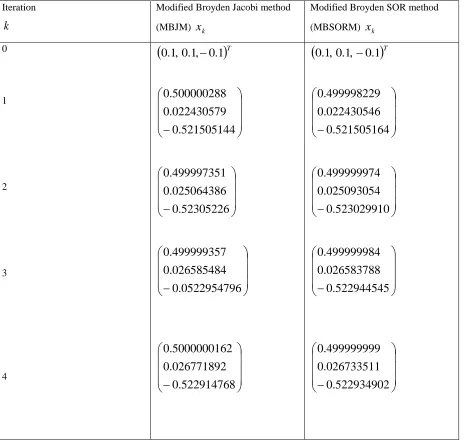
The results have been computed as in Uwamusi(2004) we used modified Broyden Jacobi method
(MBJM) and modified Broyden SOR method (MBSORM) and obtained .
Table 1. Computed results for problem 1 with Modified Broyden Jacobi and Modified Broyden
SOR methods.
Iteration
k
Modified Broyden Jacobi method (MBJM) xk
Modified Broyden SOR method (MBSORM) xk
0
1
2
3
4
(
)
T1 . 0 , 1 . 0 , 1 . 0 −
−0.521505144 022430579 . 0 500000288 . 0
−0.52305226 025064386 . 0 499997351 . 0
−0.0522954796 026585484 . 0 499999357 . 0
−0.522914768 026771892 . 0 5000000162 . 0
(
)
T1 . 0 , 1 . 0 , 1 . 0 −
−0.521505164 022430546 . 0 499998229 . 0
−0.523029910 025093054 . 0 499999974 . 0
−0.522944545 026583788 . 0 499999984 . 0
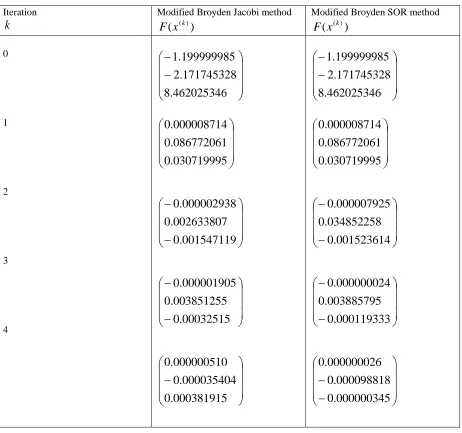
Table 2: Results for the function Evaluates for Modified Broyden Jacobi and Modified Broyden
SOR methods.
Iteration
k
Modified Broyden Jacobi method
) (x(k) F
Modified Broyden SOR method
) (x(k) F 0 1 2 3 4 − − 462025346 . 8 171745328 . 2 199999985 . 1 030719995 . 0 086772061 . 0 000008714 . 0 − − 001547119 . 0 002633807 . 0 000002938 . 0 − − 00032515 . 0 003851255 . 0 000001905 . 0 − 000381915 . 0 000035404 . 0 000000510 . 0 − − 462025346 . 8 171745328 . 2 199999985 . 1 030719995 . 0 086772061 . 0 000008714 . 0 − − 001523614 . 0 034852258 . 0 000007925 . 0 − − 000119333 . 0 003885795 . 0 000000024 . 0 − − 000000345 . 0 000098818 . 0 000000026 . 0
Using the numerical information contained in Tables 1 and 2, we formed over determined linear
systems for Modified Broyden Jacobi method and Modified Broyden SOR methods using
averaging technique for the solution vectors and functional evaluates. We denote these systems
Problem 2 = 0001156737 . 0 001174733 . 0 00036125 . 0 039166923 . 0 69676001 . 1 0000 . 0 0000 . 0 0013 . 0 0000 . 1 0040 . 0 0250 . 0 1581 . 0 0000 . 1 0000 . 0 0000 . 0 0012 . 0 0000 . 1 0000 . 0 0000 . 0 0003 . 0 0000 . 1 0010 . 0 0100 . 0 10000 . 0 0000 . 1 4 3 2 1 m m m m With solution − − + = 6246 . 5 1631 . 1 0436 . 0 0001 . 0 * 03 0 . 1 ^ e m . Problem 3 − = 000003305 . 0 0012554793 . 0 0111069063 . 0 039166923 . 0 696760011 . 1 0000 . 0 0000 . 0 0001 . 0 0000 . 1 0000 . 0 0000 . 0 0012 . 0 0000 . 1 0000 . 0 0000 . 0 0007 . 0 0000 . 1 0000 . 0 0000 . 0 0003 . 0 0000 . 1 0010 . 0 0100 . 0 10000 . 0 0000 . 1 4 3 2 1 v v v v With solution − + = − 0057 . 6 6057 . 0 0007 . 0 0000 . 0 * 05 0 . 1 e v
The implication of the numerical example on the described method indicated that the map F has
a closed graph for which xn D,xn →x and f(x)= y. We used Tikhonov type regularization procedure in conjunction with Cholesky –SVD type Factorization on problems 2 and 3 to obtain
5.0 CONCLUSION
The paper described the inexact newton method often referred to as the Broyden’s method
which acts on a topological space F:X →Y for nonlinear system of equations. We used the Baire’s category theorem as a prelude to our presentation. The modified Broyden’s method using
Jacobi and Successive Overrelaxation methods were adopted as earlier used in Uwamusi (2004)
as a continuation path. It was established that computable topological space is a computable
locally compact separable Hausdorff space. Thus such a computable topological space has
effective intersection property, effective disjointness property, effective inclusion property and
effective covering property. It was also pointed out that membership of a recursive closed set
need not be decidable.
In the context of convergence, the point of attraction for the ball often seen as the strange
attractor was stated in the sense of Ortega and Rheinboldt (2000). This enables us to have a focus
on the ball-radius epsilon a strong criterion of Banach fixed point theory.
We described the Singular Values decomposition possible for adoption in the least squares
solution occurring in the solution process which enables the noise filtering in the data space. We
demonstrated the described methods on problem 1 using Cholesky –SVD factorization and
results obtained are quite revealing.
Conflict of Interests
The authors declare that there is no conflict of interests.
REFERENCES
[1] H.Bourles, On the Closed Graph theorem and Open mapping theorem, arXiv:1411.5500v1 [math.FA]. (2014). [2] K.Buhler, W.Barth, A New intersection algorithm for parametric surfaces based on linear interval estimation.
Scientific Computing, Validated Numerics, Interval Methods, (in Kramer and Wolf von Gudenberg edtn), Kluwer Academic/Plenum Publishers, New York, (2001), 179-190.
[3] J.Chung,M. Chung, D.P. O’ Leary, Optimal filters from calibration Data for image deconvolution with Data acquisition error, J. Math. Imag. Vision, 44(3)(2012), 366-374.
[5] G.Golub,F.Van-Loan, Matrix Computations. The Johns Hopkins University Press, Baltimore Maryland, (1983). [6] L.Hola, Functional characterization of Baire space. Proc. Amer. Math. Soc. 109(4) (1990), 1121-1124.
[7] L.Jaulin, I.Breams, M.Kieffer, E.Walter, Nonlinear state estimation using forward-backward propagation of intervals in an algorithm. Scientific Computing, Validated Numerics, Interval Methods, (in Kramer and Wolf von Gudenberg edtn), Kluwer Academic/Plenum Publishers, New York (2001), 191-201.
[8] R.A.McCoy, Baire spaces and Hyper surfaces, Pac J Math. 58 (1)(1975), 133-142.
[9] J.M.Ortega, W.C. Rheinboldt, Iterative solution of Nonlinear equations in several variables. Society for Industrial and Applied Mathematics, Philadelphia, USA, (2000).
[10]C.Paige, Z. Strakos, Core problems in Linear Algebraic Systems, SIAM J. Matrix Anal. Appl. 27(3)(2006), 861-875.