JAST. Vol. 9, No. 1, pp 59-73
© Iranian Aerospace Society, Winter - Spring 2012
J
Journal of Aerospace Science and TechnologyA S T
Crack Analysis, Using a New Coupled FE-EFG Method
S. Mohamadnejad
1, A. Darvizeh
2, M. Darvizeh
2, R. Ansari
3, and A. Basti
4To solve crack problems, some coupled methods have been developed in recent years. Most of these methods have some shortcomings such as the need for a are widely used for this class of problems. In order to take the advantages of these methods while avoiding the disadvantages, it is essential to follow solution ap-proaches based on a combination of them. Prompted by this idea, in this article, ! method. In this procedure, the usage of transition region is bypassed by " # $ is put to use in the areas far from the crack tip. Static analysis of two-dimensional crack problems, according to the plane stress condition under mode-I loading, has been done. The results from the present method are indicated to be in excel-lent agreement with those from the existing analytical solutions.
%&'( ) *& (+(( Iran.
/0 () *& (+((1 230 () *& (+(( 1(456
730 () *& (+(( Iran.
1 Introduction
! ! "!-#$ !#% " " & ' ! ( $ $)$$ #!-" $ * #!-" # + " ! /# &&%8:;<#+!" ! $ " ## !! = & >& # ? ! @ ) @ & B &) # CD E) FG8& 4 # 8"D@ ) 48@&+ H/#! ! "!! *-#J
" & " & =# $" ""& & ! ) ( " & $! ! ! "#:$"-! " "#:$"-! ! ! & (& &! $ #
K "!-!! !! #L ! $ $! & "& ! # & $) $ D ##@D48@DB48@D" " #MO" P:; !! ! " * 4% # @D & B &-)< #
6E S. Mohamadnejad, A. Darvizeh, M. Darvizeh, R. Ansari, and A. Basti
# J ! )& D ! &#! ! ) $ ! # & " -&!! &) # ( F F 6 " @ $ # @ H ? " & #X=)C" $@#
J@D -&:8Y@D #
* !Z"!$ ! " &!!- (-4%" ( 8M /# 4 & $! & ) K ;$ &K<#
2 An Overview on Element Free Galerkin Method
@&B &) #6 !! =?#% !!@ ! $Z
# J" *4%* & ! !
# @ )$)!-&!*
/# K !&!! (!&# * * @ !
&
:
$&!*
$! $Z(1)
:
.
V
b
0
in
,
$[$
&!
"#&Z
(2)
u t
u
u
on
on
t
n
.
V
*
*
B@$)!!*-# &&B@$)!!*-#34; & &Z
(3)
t T T
T
d t u b
d u d D
t *
:
:
3
³
:³
: .³
* .2 1
H
H
$=(! u n
"-b&!
u
&
*
t
#( ! & !$" ! Z
(4)
) ( ) (
) ( ) ( )
(
1
x a x p
x a x p x
u
T i m
i i h
¦
$ pi(x), i 1,2,,m,
!m !
)
(
x
a
i !!!#Overview on Moving Least Square Method
" * 4% $ & 4 % )) C (- !!@#4%(-$Z( ! !#% ($* !&#(! ! 4% "*#;#!" &Z
(5)
$^
p
T(
1
,
x
1,
x
2)
.( ( ! $ CZ
(6)
) ( ) (
) ( ) ( )
, (
1
x a x p
x a x p x
x u
i T
i i m
i i i
h
¦
#
6 Crack Analysis, Using a New Coupled FE-EFG Method
$xi 4%D !(#
!!$!!!-!
u
h(
x
)
!(&$ *# ! $"Z
(7)
$w(xxI) $ !
)
,...,
2
,
1
(
I
n
x
I "x
#x$*?Z
(8)
)
)(
(
)
(
P
a
u
W
x
P
a
u
J
T$
(9)
), ,
( 1 2 n
T u u u u
(10)
(11)
»
»
»
»
¼
º
«
«
«
«
¬
ª
)
(
0
0
0
)
(
0
0
0
)
(
)
(
2 1 nx
x
w
x
x
w
x
x
w
x
W
!Z
(12)
, 0 w w a Jwe have:
(13)
u x B x a xA( ) ( ) ( )
$+$($ "&Z
(14)
P
x
W
P
x
A
(
)
T(
)
*#/$"Z
(15)
u
x
B
x
A
x
a
(
)
1(
)
(
)
(
u
h(
x
)
Z(16)
I n I I h u x u x xu ( ) ( ) ( )
1
¦
) )$)(x) ! $ ! $
! Z
(17)
) ( ) ( ) ( )) ( , ), ( ), ( ( ) ( 1 2 x B x A x P x x x x T n I ) ) ) )J & #
3 Weight Function
!$!4% "& #J! $ Z
{ $!( !!
$$Y
{
{
"-"" #
=!!$!"" !#
x( ! $-!Z
(18)
^
`
^ `
^ `
u X u W P P W P X p Xuh T T
) ( ]] ][ [[ ] ] ][ ][ [[ ) ( ) ( 1 ) !!
(19)
]] ][ [ ] ] ][ ][ [[ )} ( { ) 1 W P P W P X p X T T»
»
»
»
¼
º
«
«
«
«
¬
ª
)
(
)
(
)
(
)
(
)
(
)
(
)
(
)
(
)
(
2 1 2 2 2 2 1 1 1 2 1 1 n m n n m mx
p
x
p
x
p
x
p
x
p
x
p
x
p
x
p
x
p
P
)
(
)
(
x
P
W
x
6 S. Mohamadnejad, A. Darvizeh, M. Darvizeh, R. Ansari, and A. Basti
4 Enriched EFG
!@
{ D
{ (!!
{ !!!#
! # #J* )! )! ) ! ) $ !#B!(!(-!!=L & "#%&$ -(!#O8 P#+:D! !$ " &#+ ! & ! !( #
J$D -&$)$ $* (#J!D $ )$-$* (#!!! )$ ! * / / $ "& "& # & !B(@#-& !B(@#-& !$ /#
J*EBB(B
B(Z$ J( :"!:(!B(# "D B ( $ ! $!Z
Crack
Figure 1. Assortment of enriched particles: (a) Discontinuous enriched particles, (b) Close to front enriched particles [3].
(20)
»
»
»
¼
º
«
«
«
¬
ª
<
)
<
)
<
)
<
)
<
)
<
)
<
)
<
)
x I I I x I y I I I y I y I I I y I x I I I x I enr IB
, , , , , , , ,)
(
)
(
)
(
)
(
)
(
)
(
0
0
)
(
)
(
>
Std enr@
enrI
B
B
B
5 Numerical Examples:
x ) ! # & [#+ +BK= ! "&
(20)
)
2
sin
2
1
(
2
cos
2
)
1
(
2
)
,
(
T
Q
2T
S
Q
T
r
E
K
r
u
I x(21)
)
2
cos
2
2
(
2
sin
2
)
1
(
2
)
,
(
T
Q
2T
S
Q
T
r
6/ Crack Analysis, Using a New Coupled FE-EFG Method
:
&!8- #+BK=* $!;;#+ EE /EE6>E#/[E; >#-&!+BK=$##= ! !*#E#
J $ ()$ #
!*D;# ) && $ ( % <# M ;; @ !)-!// #& !#;D#
GJ&!!J ) &!( !! " #J $!$ & */;(! !$(Z
(25)
^
`
T
T
T
T
T
T
sin
2
sin
sin
2
cos
2
sin
2
cos
r
r
r
r
J & 4 !!*#< & # J $ & & # /E D! @ ) @ # % ! ! $D "#
K Z
(26)
]
sin
2
sin
,
sin
2
cos
,
2
sin
2
cos
,
,
,
1
[
)
(
T
T
T
T
T
T
r
r
r
r
y
x
x
P
TK D Z
(27)
]
sin
2
sin
,
sin
2
cos
,
2
sin
,
2
cos
,
,
,
,
,
,
1
[
)
(
2 2T
T
T
T
T
T
r
r
r
r
xy
y
x
y
x
x
P
T) ! & $ "#x(4% $ " " -*#+&$& "! &# (4%(-8M#
! "# ! %J & & & $ "# ; $&!J& & (4%#
#L!& )! :" ! ( & )# :" ! &) $ ) -#!)! $& !@ )#
& $ !$ & B &)< ! X#!) ! # J " ! ) )#
5 Coupling Technique
! ! @ $ " " # & X D$) C# + @ H ? " ! ^ # K / &!!$! ! @ ) # K " ! $
6; S. Mohamadnejad, A. Darvizeh, M. Darvizeh, R. Ansari, and A. Basti
! $$&Z
x C $!
x K $
x :)B
x %&
x D "
x KB KB" #
* # #M! " " ! @ ) # J $ ( !! 4 & !" & &(#
" & * ! -$ -$Z
(28)
}
{
}
]{
[
K
u
f
J ! G !! ( ! "&
2
2u DKijZ
(29)
j i j T iij
B
D
B
S
K
ui
)
)
³
³
:D
*(30)
y y x x y xu
prescribed
if
s
u
prescribed
if
s
s
s
S
1
1
0
0
»
¼
º
«
¬
ª
$
B
i,
B
j " * ; )i,)j "*?# @$$B
$-!
B
iand
B
j#+D
&-#
(!Z
(31)
$t !
&!" &#
+ -!!#!!! ( " )*# YD/#
> " @ ! !!#%!!" # =!!*#Y"! $! $# #
(32)
ui j i j iij BDB d S d
K
ui ) ) *
:
³
³
:D
*" #
(33)
ui j i T il j T i T il ljd
S
T
d
D
B
B
T
K
ui*
)
)
:
³
³
* :D
" #(34)
jn ui j i jn j T i inT
d
S
T
d
D
B
B
K
ui
)
)
*
:
³
³
* :D
!" " #(35)
jn j i T li jn j T i T liT
d
S
T
T
d
D
B
B
T
K
ui
)
)
*
:
³
³
* :D
ln $= &(D ( )(x)
!"*#?#
6< Crack Analysis, Using a New Coupled FE-EFG Method
(36)
$Tjn " ni
N
!! (
[
j,K
j)!" # K & ! ! " ## *#/((#
Z
(37)
$" Z
(38)
6 Determination of the Stress-intensity Factor (SIF)
M !@) &"& '! ! & !! # & ! %J 4 " ! #J"! & )!-D &F FY6C//#J$D ! &"-'!( !( &)()"//Z
Figure 3. The three modes of failure [34].
(39)
,/
,
1
,
2
³
/W
t
u
d
k
J
k nk k j jk/
)!! ) V.H
2 1
W
&&
t
jV
ijn
i-!
/
$ "
/
# %J !//Z
(40)
,
2
'2
E
K
K
J
I II$
E
'E
!)
1
/(
2 'E
v
E
! #!*#/C!! J JJ%J!D #-! &D&-///< &! %J#+ & !( !! $$Z
(41)
II I
J J
J1 1 1
.
Mode 2 Mode 1
Mode 3
#
#
66 S. Mohamadnejad, A. Darvizeh, M. Darvizeh, R. Ansari, and A. Basti &$Z
(42)
II
I
M
k
d
u
t
n
W
J
kM M k Mj Mjk,
;
2
,
1
,/
³
/ & JJJ& D& " &# x &D&-! $Z(43)
¿
¾
½
¯
®
¿
¾
½
¯
®
¿
¾
½
¯
®
¿
¾
½
¯
®
II I II I p II II II I pu
u
u
u
u
u
u
u
u
u
u
u
2 2 1 1 ' 2 ' 1 2 2 1 1 2 1 ',
$(44)
¿
¾
½
¯
®
¿
¾
½
¯
®
¿
¾
½
¯
®
¿
¾
½
¯
®
' 2 2 ' 1 1 2 1 ' 2 2 ' 1 1 2 12
1
,
2
1
'
u
u
u
u
u
u
u
u
u
u
u
u
Antisymm II II II p I I"&
V
ijID&
V
ijII $ "$Z
(45)
, 2 1 ' 12 12 ' 22 22 ' 11 11 12 22 11 ° ¿ ° ¾ ½ ° ¯ ° ® ° ¿ ° ¾ ½ ° ¯ ° ® V V V V V V V V V symm I I I , 2 1 ' 1 2 12 ' 2 2 22 ' 1 1 1 1 1 2 22 11 ° ¿ ° ¾ ½ ° ¯ ° ® ° ¿ ° ¾ ½ ° ¯ ° ® V V V V V V V V V symm II II II A !$$$-" & # I
J1 II J1 //Z
(46)
' 2 1E
k
J
I I' 2
1
E
k
J
II II& !! " ! ) &# + ( X /6 # x ! /?D; ! ) - & # L $ * $ $ ) $ & # ;# * " ! !4%)" ! &#
( ! @ ) X@ -* $ & F) D$) ! )( $D &'$-" !)! D !;/D;<#+;; ! ) $ D( $#x " 4 $ ! $ & !#) ! # !"" ;6#
7 Result and Discussion
6? Crack Analysis, Using a New Coupled FE-EFG Method
(a)
(b)
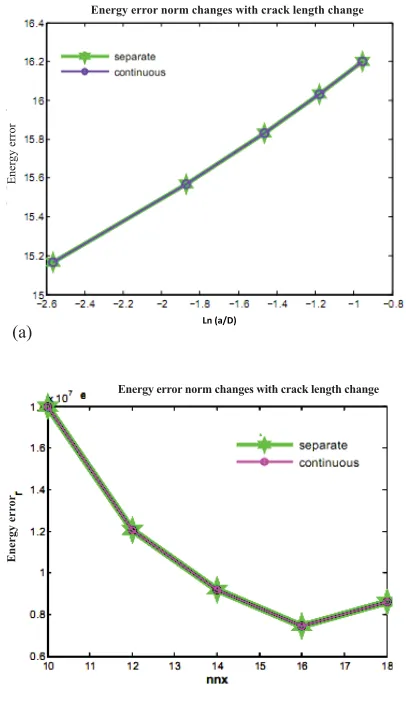
Figure 5. The changing of maximum displacement error with respect to dmax: (a) the continuous method, (b) the separate method.
Energy error norm changes with crack length change
nnx
Ln (a/D)
(Energy err
or)
6 " ! %J $ ) ! ( #+ ! ! ( -!$ @ "& #
#?DE !$# x" 6; #?DE#! ! $ Z! " $ 6 # ! !#J#?D OP)O P !)&#
(b)
(b)
Figure 4. (a) the variation of energy error by changing a/D for the separate and continuous methods, (b) the variation of energy error by changing the number of nodes in the EFG region and using the separate !"# !$
Energy error norm changes with crack length change
Energy error norm changes with crack length change
Energy error norm changes with crack length change
Ln (a/D)
Energy error norm changes with crack length change
Energy err
or
&
Y difference between this method and exact solution, continuous method
(
Maximum Err
or
6C S. Mohamadnejad, A. Darvizeh, M. Darvizeh, R. Ansari, and A. Basti
(a)
(b)
(c)
(d)
Split nodes
(b)
Figure 6. The variation of SIF in the coupled method with crack length change compared with analytical solutions: (a) Using 4 el-ements and 14 particles, (b) Using 32 elel-ements and 14 particles.
y
x
@!
FEM deformed shape
%& '!
(a)
6Y Crack Analysis, Using a New Coupled FE-EFG Method
(e)
(b)
(c)
(d)
EFG stress, xx
Figure 7. Cont’d.
EFG stress, xx
(f)
@[((
@!
@[((
FEM deformed shape
%& '!
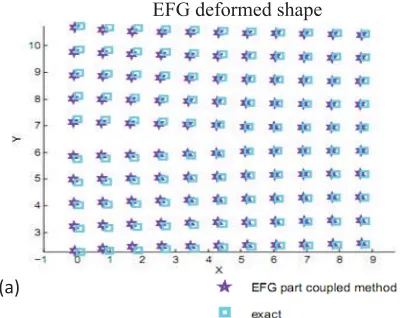
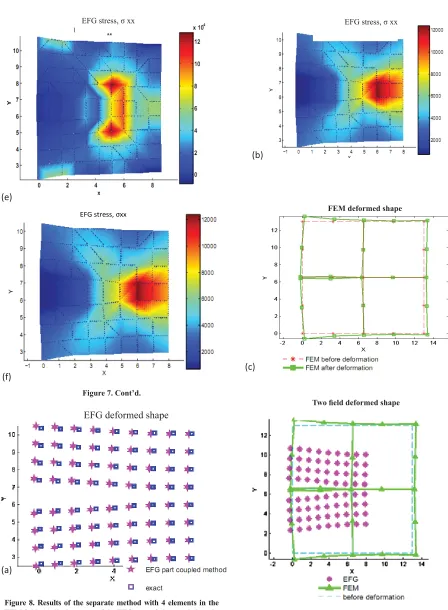
Figure 8. Results of the separate method with 4 elements in the 89 ;"$ !'8@' !-od compared with exact displacement, (b) tension distribution, (c) Displacement of the FEM part of the coupled method compared H !< "$ '! ' & Condition: D =13; nu = 0.3; = ;E = ;a =5;nnx =14;dmax =1.6
(a)
?E S. Mohamadnejad, A. Darvizeh, M. Darvizeh, R. Ansari, and A. Basti
(d)
Two field deformed EFG deformed
FEM deformed shape @!
@[((
@! !! @@!!
6 8
(a)
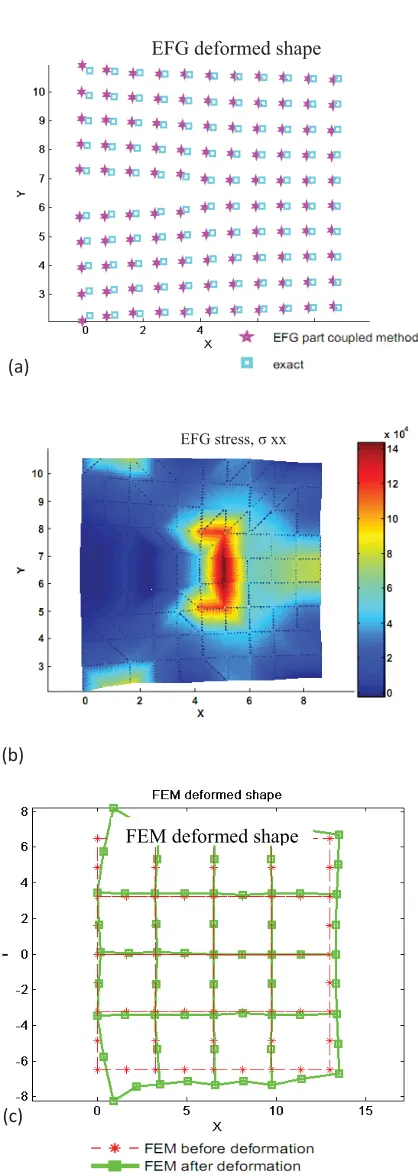
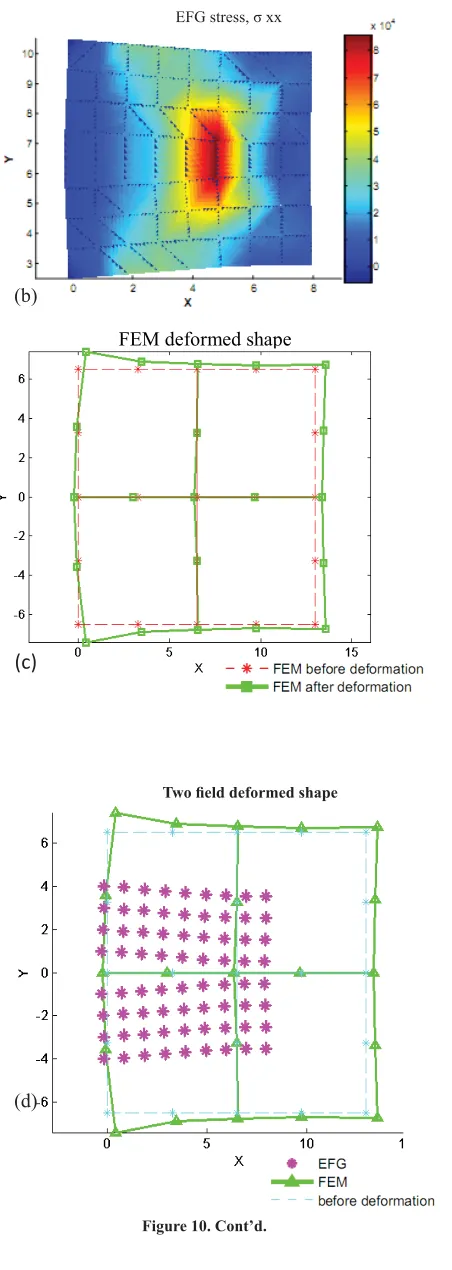
Figure 10. The continuous method with 4 elements in FEM ;"$ !'8@' ! compared with exact displacement, (b) tension distribution, (c) displacement of the FEM part of the coupled method compared &H !<"$'!'& Condition: D =13;nu = 0.3;
V
= 1 04;E = 3 01 06 ;a =5 nnx =14 ;dmax =1.6;(a)
(b)
(c)
P%!&+0 !89 ; (a) displacement of the EFG part of the coupled method compared with exact displacement, (b) tension distribution, (c) displacement of the FEM part of the coupled method compared with exact !< "$ '! ' & ; Q =13;nu = 0.3;
V
= 1 04;E = 3 01 06 ;a =5 nnx =14 ;dmax =1.6;? Crack Analysis, Using a New Coupled FE-EFG Method
8 Concluding Remarks
! ! *&D# !!!) & &"&D#
% ! ) " ) & $ # " )$ !!)#J " $ "!#
+$ & : 8 Y $) & ) # $ D) $ &#
> & ! ! ) ( $ $ # ! @ Z $ ( ( &# -"!!" *!&!) #
9 References
# H)$ L#K# & F#4# O P;@$D: YCY#
# K)F#=# )=#%#8 ##“
+ ! +
”/x &%YCY#
/# 8 >## F) # B %# = # O Z+F"$KJ-8 +PK-% 79/#?6/DC/EEC# ;# ##O+%8:
8&KP4888CYDY6YC# <# @ F#+# ## O% &&Z &
D PMon. Not. Astronom.Soc#181
88/?<^/CYY??#
6# 4& 4#B#P + ! & + O#8 88 E/D E;Y??#
?# >& B#@# 8#O@
-(c)
@[((
%& '! FEM deformed shape
? S. Mohamadnejad, A. Darvizeh, M. Darvizeh, R. Ansari, and A. Basti
Z =!!+(=!! PK -10<88/E?D/CYY#
C# B &)#4#@4#O @ ) PInternational Journal for
& 37 88 YD
<6#YY;#
Y# G& 8#B &)#O D!@ -) Z K" !
!OComput. Methods
3& (48/D;88<?D??YY?#
E# B &)# #L=#G# 4 xG#P %
!@ )P#J.
Com-put. Appl. Math. 7488^6YY6#
# ) ! ! & ! D PComput.
3 & #139 ^; 88Y<^?
YY6#
# 4@#F#@##O 8"^@ )48@$
-& OComput.
Mech.26688</6^<;6EEE#
/# + %#># H # O+ $ 8"D@ ) 48@
OComputational Mechanics22
88?^?#YYC#
;# : =#P ! @ )
$ P
& 3 & #/< 88;/D
66YY6#
<# B &)#L=#G#+ ^ ! @ ) O
ComputMec?/YY<.
6# F#B#>#%#FP+ D
-!! &!)P
Inter-national Journal of pressure Vessels and Piping78
886;?D6<?EE#
?# @### H 4#K# PK ! ! !!
) P &
7588YC6DEE;EEC#
C# X #H# =) # PK !
@ P3
-gineering Software, 3388<E?D<<EE#
Y# KD: 4# KD8 8#P K
!= ! @
-) P#Tamkang
8' (1088;D
<EEE?#
E# G#B &)#P@( $ ""PInt. J. Numer.
& 41,88<^//YYC#
# L =# # & # B &) # PK (!-"(&!!&P
Com-put. Mech#1888<^/<YY6#
# # K #+# B# B &)# P D! @ ) ! ) P 1 8 9 & . 40 88;C/^<E;YY?#
/# @# X #X# B &) # P+" " $&
(!)$&@PInt. J.
9 & . 5488Y/^Y;;EE#
;# K +# P8D) D!
& ! " ) P
& #32886<^?CYCY#
<# K +# O+ D" " )
! *D P
Mech#6988E?^?EE#
6# B &)# 4# @4# O @ ) P International Journal for
& 37 88 YD
<6YY;#
?# >& B#@# 8#O@ Z =!!+(-=!! O Computational
Me-chanicsE<88/E?D/CYY#
C# 4 8# % )) G# O%! & " * O ,Math.
Com-put.3788;D<CYC
Y# >) =# G$ #P + > + & * M D @ ) P
KAWAHARALAB,L4/>"88;EE#
/E# #K#+#B#B &) # P D! @ ) !
) PInternational Journal for
& (40 88;C/^<E;
YY?#
/# @D H# D %# P+
-P1 8 9 & #48 88 6<^
6/6EEE#
?/ Crack Analysis, Using a New Coupled FE-EFG Method
! J##>#;C88 6<^6/6EEE#
//# 8 +#+ #:#O &
-Z!!" !)
O(189 & 33886Y^
C?YY#
/;# +#8#O+ &
) ! &
O&': (+
&-setts Amherst, &EEC.
/<# :L#>) #G@#O
L-!D !/=) OInt J
6488//Y^;CYY/#
/6# B &)#B )#O )$
$ O#Int J
& 45<886E^EYYY#
/?# B &)##O D! @ ) O#Int J Numer
& '39688Y/^/CYY6#
/C# 4 # B &) # #O D! @ ) ! $"D
!O# : & 3&
-ng126^88/^</YY<#
/Y# B &) # 4 # O D! @ )
!&!OInt J
Sol-ids Struct3288<;?^?EYY<#
;E# B &) # 4 # @ 4#OK)
& D! @ ) O
(-Mech5188Y<^/<YY<#
;# G& 8#B &)#O !@ -) ! & ! & /D= )O#1 8 9 & ;;6 88 ?6?^CEEYYY#
;# @# X # B &)#O+ " " $&( !)$&@O189; & -gng54688Y/^;;EE#
;/# F)#H@#O+!
! & ! " )O
ComputMech39688?;/^6EEE?#
;;# F)#B%#H@#O
!! D) &OComputMech ZE#EE? EE;66DEE6DED#EE6#
;<# F) #+ 8# O+ ! ! &" ")(
-P#:& '16Z<^/E
EE6#
;6# B F#P + ! D! @ )
P & (
![Figure 1. Assortment of enriched particles: (a) Discontinuous enriched particles, (b) Close to front enriched particles [3].](https://thumb-us.123doks.com/thumbv2/123dok_us/8946526.1855894/4.595.308.530.339.730/assortment-enriched-particles-discontinuous-enriched-particles-enriched-particles.webp)
![Figure 3. The three modes of failure [34].](https://thumb-us.123doks.com/thumbv2/123dok_us/8946526.1855894/7.595.312.527.109.354/figure-the-three-modes-of-failure.webp)