J. Agric. Sri. (1960), 55, 1 With 1 text-figure Printed in Oreat Britain
1[
Determination of nitrogen in soil by the Kjeldahl method
BY J. M. BREMNER
Rothamsted Experimental Station, Harpenden, Herts
(Received 7 July 1959)
Very little attention has been given to the develop-ment of reliable methods of determining nitrogen in soil. It is difficult to account for this, because the few studies on the determination of nitrogen in soil which have been reported provide no grounds for assuming that the Kjeldahl methods normally used for this determination are satisfactory. For example, Dyck & McKibbin (1935) analysed twenty-six organic soils by the Dumas and Kjeldahl methods and found that with every sample tested, the Dumas method gave a considerably higher nitrogen value (cf. McKibbin, Snell & Dyck, 1935). Ashton (1936) compared the efficiencies of selenium and copper sulphate as catalysts in Kjeldahl diges-tion of three soils and concluded that digesdiges-tion must be continued after clearing for at least 24 hr. with copper sulphate and for 3 hr. with selenium. This work casts doubt on the reliability of Kjeldahl methods used for soil analysis which involve short periods of digestion using copper or selenium as catalyst. For Kjeldahl analysis, Ashton used 10 g. of soil, 50 ml. of water, 40 ml. of sulphuric acid and 1-0 g. of copper sulphate or 0-2 g. of selenium. Water was added because Bal (1925) found that the nitrogen values obtained when some clay soils were analysed by the Kjeldahl method -were con-siderably higher when the soils were treated with water before analysis. Ashton confirmed Bal's findings. Similar observations on the effect of pre-treating soils with water before Kjeldahl analysis were reported by Srinivasan (1932) and Walkley (1935). Murneek & Heinze (1937) compared various catalysts, singly and in combination, in the deter-mination of nitrogen in thirteen soils by the Kjeldahl-Gunning-Amold method to include ni-trate. They found that the clearing time in Kjeldahl digestion was greatly reduced when selenium was employed, particularly when it was used in combi-nation with mercury, but that the use of different catalysts did not significantly affect the results of Kjeldahl analysis. They recommended that a mixture of selenium, copper sulphate and mercuric oxide be employed as catalyst for Kjeldahl digestion of soil. Unfortunately they did not study the effect of varying the period of digestion with the different catalysts tested, but adopted the practice of di-gesting for 1-5 times the clearing time, so that the
average period of digestion of their soils using the method recommended was only 19 min. The dangers of this practice, which were already ap-parent from the work of Ashton (1936) and others, have been emphasized by Chibnall, Rees & Williams (1943) and Jonnard (1945), who found that an 8-16 hr. period of digestion after clearing was required for Kjeldahl analysis of proteins, which are not regarded as particularly refractory materials. The criticism that clearing is not a criterion of com-pleteness of digestion is also applicable to the method of determining nitrogen in soils recom-mended by the Association of Official Agricultural Chemists (1955) in which digestion using copper sulphate and ferrous sulphate as catalysts is stopped when the mixture is colourless or nearly so. The most recent study of the determination of nitrogen in soil by the Kjeldahl method is that of Alves & Alves (1952). They compared the effectiveness of selenium, copper and mercury, singly and in com-bination, in macro-Kjeldahl analysis of soil (30 ml. sulphuric acid, 10 g. sodium sulphate) using the following amounts of catalyst: Hg, 1-0 g.; CuSO4,
1-0 g.; Se, 0'2g.; HgO, 0-5 g.; CuSeO3, 0096 g.
(with 11-9 g. sodium sulphate). They studied the effect of varying the period of digestion with each catalyst and found that the maximal value ob-tained, and the period of digestion required to attain this value, depended greatly upon the catalyst employed. The highest nitrogen values were ob-tained using copper sulphate as catalyst, the lowest using selenium. Taking the recovery with CuSO4
as 100%, the recoveries with the other catalysts were as follows (periods of digestion after clearing required to obtain maximal values are given in parentheses): CuSO4, 100% (3-5 hr.); Se + HgO,
99-2 % (2-5 hr.); Se + CuSO4, 96-0 % (6-5 hr.); HgO,
92-6% (3-5 hr.); CuSeO3, 89% (2-5 hr.); Se + Hg,
86-3 % (1-5 hr.); Hg, 85 % (2 hr.); Se, 84-9 % (3 hr.). Alves & Alves recommended that the Se-HgO method be used for Kjeldahl analysis of soil as it gave almost the same values as the CuSO4 method
12
J. M. BBEMNER beyond the time required to achieve the maximalvalue. For example, the recovery with Hg dropped from 85 % at 2 hr. to 79 % at 3-5 hr.
It is clear from this survey that the investiga-tions so far reported cast considerable doubt on the reliability of the Kjeldahl methods commonly used for soil analysis. Further doubt arises from the knowledge that these methods fail to recover cer-tain forms of nitrogen, for example, nitrogen in some heterocyclic compounds and in compounds containing N-N and N - 0 linkages. The presence of such forms of nitrogen in soil cannot be excluded because the chemical nature of a considerable fraction of soil nitrogen is still obscure.
Bremner & Shaw (1958) found that the Dumas and Kjeldahl methods gave almost identical results with mineral soils, but that with organic soils the Dumas method gave values 10-20% higher than the Kjeldahl method. The latter observation, which confirmed the findings of Dyck & McKibbin (1935), suggested that the Kjeldahl method was unreliable when applied to organic soils, but further work indicated that the higher values obtained with these soils by the Dumas method were due to occlusion of atmospheric nitrogen by organic matter. It was not considered profitable to continue this com-parative investigation, because, apart from the fact that it would not be practicable to use the Dumas method for most types of soil nitrogen in-vestigations, there is no reason to believe that the results obtained with soils by this method are reliable. It is commonly assumed that the Dumas method is superior to the Kjeldahl method in that it is of universal applicability, but there is no basis for this assumption. The customary Dumas methods fail with many compounds, particularly hetero-cyclic compounds, which tend to form nitrogenous chars that are difficult to burn (see Alford, 1952). The Kjeldahl methods commonly used also fail with certain compounds, but numerous modifica-tions of these methods have been developed which greatly extend the scope of Kjeldahl's (1883) original technique. For example, satisfactory Kjeldahl methods are now available for the deter-mination of nitrogen in refractory compounds such as nicotinic acid, pyridine and tryptophan, and modifications of the Kjeldahl method involving pretreatment with hydriodic acid and other re-agents have been developed for analysis of com-pounds containing N-N and N - 0 linkages. Indeed, there would appear to be few, if any, naturally occurring forms of nitrogen that cannot be deter-mined by some version of the Kjeldahl method. It was decided, therefore, to study the reliability of the Kjeldahl methods commonly employed to determine nitrogen in soil, by comparing them with various Kjeldahl procedures known to include forms of nitrogen not recovered by the conventional
methods of soil analysis. A further object of the work reported was to eliminate some of the un-certainties and difficulties associated with Kjeldahl digestion of soil by studying the factors affecting this process.
EXPERIMENTAL Materials
Soils. The samples used (Table 1) were selected to provide a variety of soils that differed greatly in nitrogen content. Samples 1-3 were from the Broadbalk continuous wheat plots at Rothamsted where the soil is derived from clay-with-flints over-lying chalk. Sample 1 was from the 73-81 in. depth of a profile of plot 7, which receives complete minerals and nitrogen annually, sample 2 from the 0-6 in. layer of plot 3 (no manure or fertilizer since 1839), and sample 3 from the 0-6 in. layer of plot 2B, which receives farmyard manure annually. Sample 4 was from the surface layer of a garden near Rothamsted which has been cultivated with heavy applications of organic manure for almost 100 years. Sample 5 was from the surface layer of a soil near Littleport in the Cambridgeshire fen district, sample 6 from the 9-15 in. layer of a profile near Capel Curig which had developed under vegetation consisting chiefly of Molinia and Nardus 8pp., and sample 7 from the surface layer of an Anglesey peat overlying a lacustrine deposit of calcium carbonate (dominant vegetation: Carex
flacca, C. paniculata and C. spicata).
Before use the samples were air-dried and ground to pass a 100-mesh sieve. In the analyses reported in Table 1, carbon was determined by the wet com-bustion method of Shaw (1959), nitrogen by a macro-Kjeldahl method which included nitrite and nitrate (Bremner & Shaw, 1958), CaCO3 by the
method of Collins (1906), and pH by the glass electrode. The ammonium-, nitrate- and nitrite-N contents of the soils were determined by analysis of N-KC1 extracts, ammonium- and nitrate-N being determined by microdiffusion methods previously described (Bremner & Shaw, 1955) and nitrite-N by the colorimetric method of Shinn (1941). Only trace amounts of nitrite were detected.
Reagents. Unless otherwise stated, the chemicals used were Analar grade products obtained from Hopkin and Williams Ltd. The concentrated sulphuric acid employed had a specific gravity of 1-84. Sodium sulphate was used as the anhydrous powder, copper sulphate and sodium thiosulphate as the pentahydrates.
METHODS
em-Determination of nitrogen in soil by the Kjeldahl method
13
ployed that permitted the use of smaller amounts of reagents and of soil. These modified methods will be described as micro-Kjeldahl methods, although they are not true micro-methods. The amounts of soil used for Kjeldahl analysis were as follows
Soil 1 2 3 4 5 (> 7
Amount
Micro-methods 1-0 1-0 0-50 0-25 0-20 0-20 0-20
of soil (g.)
Macro-methods 10-0 10-0 5-0 2-5 0-80 0-60 0-50
Macro-Kjeldahl methods
Kjeldahl digestion. Digestions were performed in 350 ml. Pyrex Kjeldahl flasks using the gas-heated six-flask digestion stands supplied by Griffin and George Ltd. The top plate of each stand was covered with a sheet of asbestos drilled with holes 5-5 cm. in diameter. At full heat the burners on the stands brought 100 ml. of water in a 350 ml. Kjeldahl flask to a rolling boil in approximately 3-5 min. Digestions were generally performed using the full heat of the burners so that the sulphuric acid condensed about one-third of the way up the neck of the flask.
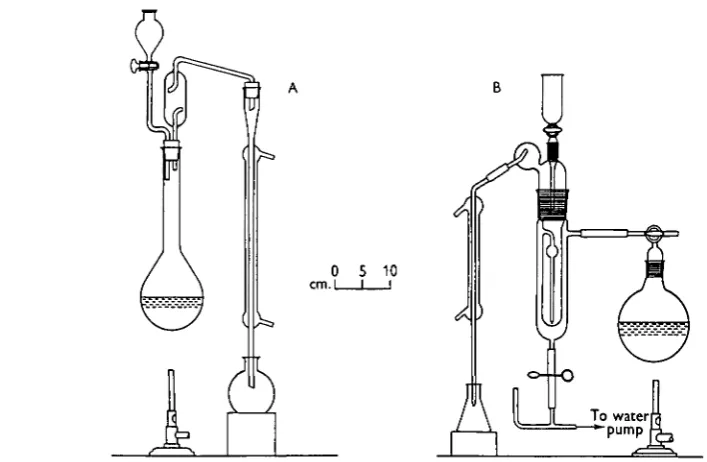
Determination of ammonium in digest. The cooled digests were taken up with water, made to volume (500 ml.), and aliquots of the diluted solutions were used for ammonium determinations. The aliquot (50 ml. with soils 2-7, 100 ml. with soil 1) was pipetted into a 500 ml. Kjeldahl flask containing two glass beads (to reduce bumping) and two drops of liquid paraffin (to prevent frothing), and water was added to give a total volume of 250 ml. The flask was connected to the distillation apparatus (Fig. 1A), and its contents were made alkaline, mixed and distilled. Heating was regulated so that the rate of distillation was about 10 ml./min., the distillate being collected in a 200 ml. flask contain-ing 10 ml. of boric acid-mixed indicator solution. Tests showed that it was not necessary to collect more than 70 ml. of distillate to ensure quantitative recovery of the amounts of ammonium-N present in the aliquots taken for distillation, but 150 ml. of
distillate were always collected because this gave time to prepare the next set of distillations. Using a bank of six distillation units it was easily possible to carry out seventy distillations in a normal work-ing day.
Micro-Kjeldahl methods
Kjeldahl digestion. Digestions were performed in 50 ml. Pyrex Kjeldahl flasks using the gas-heated six-flask micro-Kjeldahl digestion stands supplied by Gallenkamp and Co. Ltd. As the vapour tubes provided with these stands cannot be used with 50 ml. Kjeldahl flasks, digestions were performed in a fume cupboard, the necks of the flasks being supported by a slotted sheet of asbestos fitted between the spring clips normally used to hold the vapour tube. The wire gauzes supplied with the stands were not employed. At full heat the burners on the stands brought 25 ml. of water in a 50 ml. Kjeldahl flask to a rolling boil in approximately 2-5 min. Digestions were generally performed using the full heat of the burners and with the sulphuric acid condensing about one-third of the way up the neck of the flask.
Determination of ammonium in digest. For determination of ammonium after digestion, the cooled digest was taken up with about 25 ml. of water and the entire contents were transferred with a further 25 ml. of water to the chamber of the Hoskins (1944) steam distillation apparatus (Fig.
1B), made alkaline, and steam distilled. In analyses of soils 4-7 the digests were sometimes made to volume and an aliquot taken for distillation. The macro-version of the Hoskins interchangeable macro- and micro-steam distillation apparatus supplied by Gallenkamp and Co. Ltd. was used. A detailed investigation of the use of this apparatus (see Appendix) showed that distillations could be performed with up to 90 ml. of liquid in the chamber of the apparatus, but the distillation procedure was standardized so that the total volume of liquid in the chamber, after addition of alkali and before distillation, was always 80 ml. Using this pro-cedure, quantitative recovery of up to 10 mg. of ammonium-N was obtained by distilling at a rate of approximately 6 ml./min. into 5 ml. of boric acid-mixed indicator solution and collecting 30 ml.
Xo. 1 2 3 4 5 6 7
Soil Clay Clay loam Clay loam Clay loam F e n
Mountain peat Low-moor peat
Table 1. Analysis of soils
PH
6-9 8-3 8-0 7-2 7-1 3-7 6-2
Organic-C 0-15 0-99 2-56 8-68 22-8 53-6 45-0
Percentage
Total-N 0-031 0-102 0-250 0-500 1-49 2-07 2-69
on moisture-free basis
NH4-N
0-0002 0-0006 0-0008 0-0020 0-0054 0-0352 0-0079
NO3-N
0-0002 0-0002 0-0011 0-0013 0-0067 0-0010 0-0041
14
J. M. BREMNEE, of distillate. This distillation technique wasthere-fore adopted, the 50 ml. Erlenmeyer flasks used to collect the distillate being marked to indicate a level of 35 ml. The chamber of the distillation unit was also marked to indicate levels of 50 and 80 ml. Considerable time was saved by employing two units with the waste tubes from their steam-jackets connected to a water-pump as shown in Fig. 1, because the chambers of the units could be emptied and washed very rapidly by suction. With this arrangement it was easily possible to perform eighty distillations in a normal working day.
The amount of alkali used for distillation of ammonium was varied according to the amount of acid used for Kjeldahl digestion (usually 30-40 ml. H2SO4 in macro-methods and 3-4 ml. in
micro-methods), the general procedure being to calculate the amount of sulphuric acid in the aliquot taken for distillation, assuming that no acid was lost during digestion, and to add sufficient lON-NaOH to ensure an excess of 10 ml. For distillation of digests containing mercury it was necessary to eliminate interference caused by the formation of mercuric oxide-ammonium complexes on addition of alkali. Sodium thiosulphate was generally used for this purpose, the reagent being dissolved in the sodium hydroxide used to make the digest alkaline (Hiller, Plazin & Van Slyke, 1948). A 2-5% (w/v) solution of Na2S2O3.5H2O in 10N-NaOH was used
for most of the distillations, but sodium sulphide was sometimes used instead of thiosulphate. In methods using mercury as catalyst, the efficiency of the procedure recommended for determination of
ammonium was always tested by determining the recovery of ammonium-N added to control digests. In both macro- and micro-methods the ammonia liberated by distillation of the digests was collected in 2 % (w/v) boric acid solution containing 20 ml./l. of mixed indicator and determined by titration
with 0-01N-H2SO4. The boric acid-mixed indicator
solution was prepared by dissolving 20 g. of Analar boric acid in 980 ml. of distilled water and adding 20 ml. of mixed indicator made by dissolving 0-099 g. of bromocresol green and 0-066 g. of methyl red in 100 ml. of absolute alcohol.
Repeated tests showed that with the distillation assemblies used in this work it was not necessary to distil with the end of the condenser under the surface of the boric acid in the receiving flask in order to avoid loss of ammonia (see Appendix). With both assemblies unsatisfactory results were sometimes obtained when water condensing on the external surface of the condenser entered the receiving flask. A collar of filter-paper attached to the base of the water-jacket on each condenser prevented this.
RESULTS
Determination of nitrogen in soils by standard method
Before starting this investigation it was necessary to establish that the soils chosen did not contain significant amounts of nitrate- or nitrite-N (which are not recovered by normal Kjeldahl procedures), and that they did not require the pretreatment
Determination of nitrogen in soil by the Kjeldahl method
15
with water before Kjeldahl analysis that Bal (1925) found necessary with certain clay soils. Investiga-tion of these quesInvestiga-tions showed that the amounts of nitrate and nitrite in the soils were too small to affect the results of Kjeldahl analysis (Table 1) and that pretreatment of the soils with water had no effect on their analysis by the Kjeldahl method (Table 9). A reliable method of including nitrate and nitrite in Kjeldahl analysis of soil has already been described (Bremner & Shaw, 1958).
Various methods have been used in our labora-tory to determine nitrogen in soil, but the method favoured by the author is a macro-Kjeldahl pro-cedure in which the soil is treated with 10 g. K2SO4,
1 g. CuSO4.5H8O, 0-1 g. Se and 30-40ml. HaSO4,
and the mixture is heated until it clears and subse-quently boiled gently for 5 hr. (Bremner & Shaw, 1958). This period of digestion after clearing is con-siderably longer than that generally used in Kj eldahl analysis of soil. It was adopted because experi-ments with several soils showed that higher
nitrogen values were not obtained using longer periods of digestion, whereas significantly lower values were sometimes obtained using shorter periods. These findings were confirmed by experi-ments reported in Table 2, which also showed that the same values were obtained whether 30 or 40 ml. of sulphuric acid were employed. In subsequent work with this method, the 5 hr. period of digestion was retained but only 30 ml. of sulphuric acid were used. This procedure is henceforth described as the standard method, but it may be emphasized that it is standard only in the sense that it is the method generally used by the author.
Unless otherwise stated, all results presented were derived from duplicate or triplicate analyses. The reproducibility of the results obtained by the standard method is illustrated by the data in Table 3.
As Ashton (1936) has pointed out, it is doubtful whether the term 'clearing' may be legitimately applied to Kjeldahl analysis of soil, because soil
Table 2. Effects of varying volume of sulphuric acid and period of digestion in Kjeldahl analysis of soils by standard method
Period of digestion after clearing (hr.)
Soil 1
2
3 4
5 6
7
H2SO4
(ml.) 30 40 30 40 30 30 40 3 0 30 40 30 40
Clearing 0 time (min. 9 10 11 12 13 16 22 15 15 18 15 19
0-0278 — 00956 0-0951 0-223 0-460 0-445 1-27 1-75 — 2-15 2-13
1
0-0300 — 0-0994
— 0-241 0-481 0-475 1-33 1-78 — 2-23 —
2 3 4 5 6
Total nitrogen (percentage of air-dried
0-0300 — 0-100
— 0-244 0-484 — 1-34 1-80 1-79 2-26 2-26
00302 0-0300 0-100 0-100 0-244 0-487 0-486 1-35 1-82 — 2-28 —
0-0303 — 0-101
— 0-244 0-484 0-484 1-36 1-84 — 2-29 2-28
Table 3. Reproducibility of results obtained Period of
digestion after r-Soil
2
3
5
7
clearing (hr.) No. 1
3 5 1 3 5 1 3 5 1 3 5
4 4 4 6 6 6 5 5 5 5 5 5
0-0303 0-0303 0-0302 — 0-101 0-100 0-101 — 0-244 0-243 0-487 0-486 0-486 — 1-36 1-35 1-83 1-84 1-84 — 2-29 2-28 — 2-27
8 10 soil)
0-0302 0-0302 0-0302 — 0-101 0-100
— — 0-244 0-243 0-484 0-485 0-485 0-487 1-36 1-35 1-83 1-83 — — 2-27 2-28 — —
! by standard method Total-N determinations*
Mean 0-0994 0-100 0-101 0-241 0-244 0-244 1-33 1-35 1-36 2-23 2-28 2-29
A
Range 0-0987-0-0999
0-100-0-101 0101-0102 0-239-0-243 0-242-0-245 0-243-0-245 1-31-1-34 1-34-1-36 1-35-1-36 2-21-2-24 2-27-2-29 2-28-2-30
S.E.f 0-0005 0-0006 0-0006 0-0014 0-0012 0-0006 0-015 0-007 0-008 0-012 0-011 0-012
12
0-0302
0101 0-100 0-244 0-487 0-486 1-35 1-84 1-83 2-28 2-27
16
J. M. BBEMNER digests usually contain a considerable amount ofsuspended material. However, for lack of a suitable alternative, the term is retained here to describe the stage in Kjeldahl digestion of soil at which the digested material ceases to lose colour and is free from char. Information concerning clearing times in different Kjeldahl methods is of limited value, as it is customary to adjust the rate of heating before clearing according to the suscepti-bility of the digestion mixture to frothing. Clearing times are therefore recorded here only where they were determined using a standard rate of heating and are accordingly of some value for purposes of comparison.
Comparison of different Kjeldahl methods
To test the reliability of the standard method, its results were compared with those obtained by a variety of Kjeldahl techniques, which included procedures recommended for soils (Ashton, 1936; Murneek & Heinze, 1937; Piper,1944; Alves & Alves, 1952; Association of Official Agricultural Chemists [A.O.A.C.], 1955; Jackson, 1958) and for refractory nitrogen compounds such as nicotinic acid, pyri-dine, lysine and tryptophan (Belcher & Godbert, 1941; White, Secor & Long, 1948; Willits, Coe & Ogg, 1949; Middleton & Stuckey, 1951; Lake, 1952; McKenzie & Wallace, 1954). Methods involving pretreatments designed to include nitrogen com-pounds not determined by straightforward Kjeldahl methods were also used.
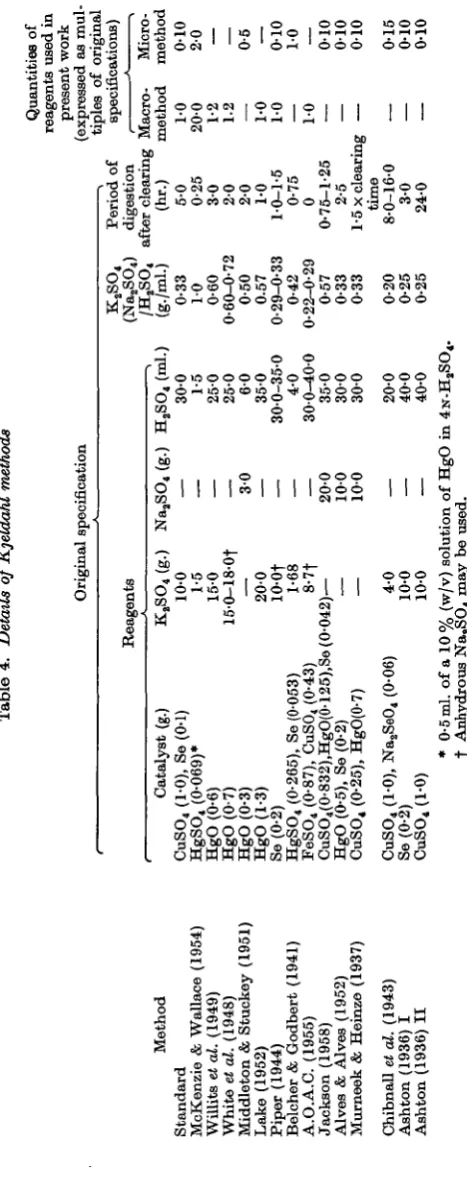
Details of the methods that did not involve pre-treatments are given in Table 4, which also shows where the methods were modified for macro- and micro-analysis of soil. In methods employing a combination of catalysts, mixtures of finely ground catalysts were generally prepared to simplify weighing. Where methods permitted variation in the amount of a reagent, the following amounts were taken as the specified quantities: White et al. (1948), 16-5 g. K2SO4; Piper (1944), 30-0 ml. H2SO4;
A.O.A.C. (1955), 35-0 ml. H2SO4. In methods that
permitted variation in the period of digestion after clearing, the following periods were used: Piper (1944), 1-5 hr.; Jackson (1958), 1-0 hr.; Chibnall et al. (1943), 80 hr. Belcher & Godbert (1941) specify that a digestion period of 45 min. be used with their method, but do not mention clearing. In applying their method to soil, digestion was continued for 45 min. after clearing.
Two Kjeldahl methods that did not involve pre-treatments were used in addition to those listed in Table 4. One was a modification of the A.O.A.C. method in which macro-Kjeldahl digestion was performed with the amounts of catalyst and potas-sium sulphate and the minimal amount of sulphuric acid specified in the A.O.A.C. method, digestion being continued for 5 hr. after clearing. The other
was the method of Beet (1954, 1955), which does not involve digestion with catalysts or potassium sulphate, but is based on oxidation of the nitro-genous material with potassium permanganate in the presence of sulphuric acid. In this method, the sample is treated with H2SO4 (10 ml.), the mixture
is warmed for 5 min., and KMnO4 is added in
approximately 0-05 g. lots at intervals of 30 sec, the mixture being shaken after each addition. The permanganate is added in this fashion until the surface of the acid is covered with a slight froth and then more cautiously until the colour of the digest changes from dark brown to dark orange, lemon and finally colourless. After slight cooling the colourless digest is treated with about 0-2 g. KMnO4 (added with constant shaking over a period
of 1 min.), and the mixture is brought to the boil and immediately cooled. The cooled digest should have a dirty sage-green colour. The colour changes recorded by Beet could not be detected when his method was applied to soils (using amounts taken for micro-Kjeldahl methods) even when the KMnO4
was added very cautiously, and the procedure finally adopted was to add the permanganate as directed until the digest assumed a distinct green colour, raise the temperature of the mixture to the boiling point, and immediately cool. The cooled soil digests had the cloudy sage-green colour described by Beet. Ammonium-N in the digests was deter-mined by transferring the entire contents with water to 500 ml. Kjeldahl flasks and distilling with alkali using the macro-Kjeldahl distillation appara-tus (Fig. 1).
Table 5 gives the results obtained by the methods that did not involve pretreatment with various reagents before Kjeldahl analysis, and Table 6 shows the effect of varying the period of digestion in analysis of soils by these methods. Results ob-tained in Kjeldahl analysis of refractory nitrogen compounds (nicotinic acid and tryptophan) by the standard method and by the methods of Piper (1944) and McKenzie & Wallace (1954) are given in Table 7. The micro-modifications of these methods were used, the analyses being performed on 2 ml. aliquots of 0-4N-H2SO4 solutions of nico-tinic acid (B.D.H. Ltd.) or DL-tryptophan (B.D.H. Ltd.) which contained l-0mg. N/ml. Since nico-tinic acid does not char during Kjeldahl digestion, a small amount (c. 10 mg.) of glucose was added before digestion of this compound, and the time required for the digest to become colourless was taken as the clearing time.
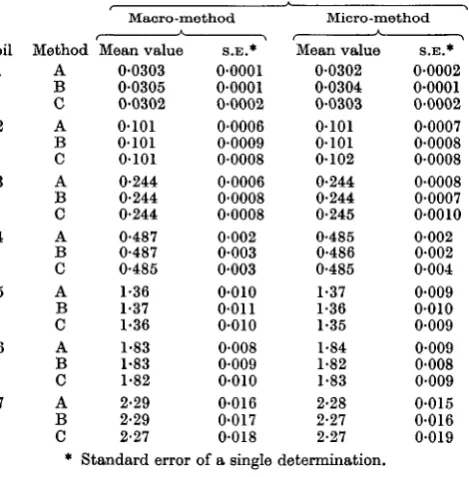
The results obtained with soils by micro- and macro-modifications of three methods are com-pared in Table 8.
Deter Tabl e 4 . Details of Kjeldahl methods Metho d Standar d McKenzi e & Wallac e (1954 ) Willit s et al. (1949 ) Whit e et al. (1948 ) Middleto n & Stucke y (1951 ) Lak e (1952 ) Pipe r (1944 ) Belche r & Godber t (1941 ) A.O.A.C . (1955 ) Jackso n (1958 ) Alve s & Alve s (1952 ) Murnee k & Heinz e (1937 ) Chibna U et al. (1943 ) Ashto n (1936 ) I Ashto n (1936 ) I I Catalys t (g. ) CuSO 4 (1-0) , S e (0-1 ) HgSO 4 (0-069) * Hg O (0-6 ) Hg O (0-7 ) Hg O (0-3 ) Hg O (1-3 ) S e (0-2 ) HgSO 4 (0-265) , S e (0-053 ) FeSO 4 (0-87) , CuS0 4 (0-43 ) Origina l specificatio n Reagent s K2 SO 4 (g. ) Na a SO 4 (g. ) 10-0 — 1-5 — 15 0 — 15-0-18-O f — — 3 0 20 0 — io-o t — 1-6 8 — 8-7 t — CuSO 4 (0-832),HgO(0-125),S e (0-042) ^ 20-0 Hg O (0-5) , S e (0-2 ) CuSO 4 (0-25) , HgO(0-7 ) CuSO 4 (1-0) , Na 2 Se0 4 (0-06 ) S e (0-2 ) CuSO 4 (1-0 ) * 0-5 ml . o f a "f Anhydrou s '. — 10 0 — 10 0 4-0 — 10-0 — 10-0 — 1 0 % (w/v ) solutio n o f Hg O Na 2 SO 4 ma y b e used . Ha SO 4 (ml. ) 30-0 1-5 25 0 25-0 6 0 35 0 300-35 0 4-0 300-40 0 35-0 30 0 30 0 20-0 40-0 40-0 in 4N-H 2 SO 4 . K2 SO 4 (Na 2 SO 4 ) /H 2 SO 4 (g./ml. ) 0-3 3 1 0 0-6 0 0-60-0-7 2 0-5 0 0.5 7 0-29-0-3 3 0-4 2 0-22-0-2 9 0-5 7 0-3 3 0-3 3 0-2 0 0-2 5 0-2 5 Perio d o f digestio n afte r clearin g (hr. ) 5-0 0-2 5 3 0 2 0 2-0 1-0 1-0-1-5 0-7 5 0 0-75-1-2 5 2-5 Quantitie s o f reagent s use d i n presen t wor k (expresse d a s mul -tiple s o f origina l specifications ) ' ]Macro * metho d 1-0 20-0 1-2 1. 2
— 1-0 1-0 1-0 — —
1-5 x clearin g — tim e 8-0-16-0 3 0 24-0 — — Micro -metho d 0-1 0 2
0 — —
0-5 — 0-1 0 1-0 — 0-1 0 01 0 01 0 0-1 5 0-1 0 0-1 0
Is
§.i
it
oi
Co 05s-1
18
J. M. BBEMNEKTable 5. Analysis of soils by different Kjeldahl methods Soil
Standard*
McKenzie & Wallace (1954)* Willits et al. (1949)
White et al. (1948)
Middleton & Stuckey (1951) Lake (1952)
Piper (1944)t
Belcher & Godbert (1941) A.O.A.C. (1955)
Modified A.O.A.C. Jackson (1958) Alves & Alves (1952) Murneek & Heinze (1937) Chibnall et al. (1943) Ashton (1936) I Beet (1954, 1955)
1
00303 0-0305 0-0307 0-0304 0-0304 0-0304 0-0303 0-0303 0-0195 0-0303
0-0251
2 3 4
Total nitrogen (percentage
0-101 0-101 0-101 0-100 0-101 0-101 0-102 0-101 0-088 0-101 0-101 0-101 0-094 0-101 0-101 0-088 *Macro -modification fMicro-modification
0-244 0-244 0-244 0-244 0-245 0-243 0-245 0-243 0-221 0-244 0-242 0-244 0-227 0-244 0-243 0-215 used. used.
0-487 0-487 0-484 0-485 0-485 0-481 0-485 0-479 0-437 0-485 0-478 0-480 0-443
0-483 0-422
5 of air-dried
1-36 1-37 1-36 1-35 1-36 1-35 1-35 1-33 1-22 1-36
1-34 1-27 1-35 i-36 1 1 0
6 soil)
1-83 1-83 1-84 1-82 1-83 1-82 1-83 1-80 1-67 1-83 1-82 1-82 1-83 1-33
7
2-29 2-29 2-28 2-29 2-29 2-28 2-27 2-28 2-07 2-27 2-25 2-26 2 1 3 2-25 2-28 2-01
by straightforward Kjeldahl methods; the results obtained by the standard method are included for comparison (method 1). The following procedures were adopted.
Method 2 (macro-method). The soil sample was shaken with water (30 ml.) and after 2 hr., the mixture was treated with 30 ml. H2SO4 and heated
until the water was removed. The mixture was cooled, treated with 10 g. K2SO4, 1 g. CuSO4. 5H2O
and 0-1 g. Se, heated until clearing occurred, and boiled for 5 hr. The pretreatment with water used in this method has been found necessary by Bal (1925) and other workers for satisfactory Kjeldahl analysis of some clay soils.
Method 3 (macro-method). The soil sample was shaken with 30 ml. H2SO4 containing 1-0 g.
sali-cylic acid for 30 min., and the mixture was allowed to stand overnight, treated with 5 g. Na2S2O3. 5H2O,
and heated over a low flame until it cleared. Potassium sulphate (10 g.), CuSO4.5H2O (1 g.),
Se (0-1 g.) and H2SO4 (10 ml.) were then added and
the mixture was boiled for 5 hr. This pretreatment with salicylic acid and thiosulphate is commonly used to include nitrate in Kjeldahl analysis of soils and other materials. Bradstreet (1954) found that it was unreliable if used for Kjeldahl analysis of nitro compounds.
Method 4 (macro-method). The procedure de-scribed by McCutchan & Roth (1952) was followed, Kjeldahl digestion (mercury catalyst) after treat-ment with thiosalicyclic acid and sulphuric acid being continued for 2 hr. after clearing. McCutchan & Roth found that pretreatment with thiosalicylic acid before Kjeldahl analysis permitted quantita-tive determination of nitrogen in nitro-type compounds.
Method 5 (micro-method). The soil sample was treated with 0-1 g. glucose, 1 g. K2SO4, 0-1 g.
CuSO4.5H2O, 001 g. Se and 3-5 ml. H2SO4, and
the mixture was heated until clear and boiled for 5 hr. This method was tested because Elek & Sobotka (1926) found that the addition of glucose before Kjeldahl digestion permitted accurate analysis of nitro compounds.
Method 6 (macro-method). The modified Olsen (1929) method described by Bremner & Shaw (1958) was used. The pretreatments with per-manganate and reduced iron used in this method permit quantitative recovery of nitrite and nitrate in Kjeldahl analysis of soil.
Method 7 (micro-method). The soil sample was treated with 2 ml. hydriodic acid (B.D.H. 'M.A.R.' reagent; sp.gr. 1-7) and the mixture was refluxed gently for 45 min., cooled, treated with 1 g. K2SO4,
3 ml. H2O and 3 ml. H2SO4, and boiled to remove
iodine and hydriodic acid. Three further evapora-tions with 3 ml. water were performed to ensure complete removal of iodine and hydriodic acid, and the mixture was cooled, treated with 0-08 g. HgO, heated until clear, and boiled for 1-5 hr.
Tabl e 6 . Effect of varying period of digestion in Kjeldahl analysis of soil by different methods Perio d o f digestio n afte r clearin g (hr. ) Metho d McKenzi e & Wallac e (1954) * Willit s el al. (1949 ) Middleto n & Stucke y (1951 ) Lak e (1952 ) Belche r & Godber t (1941 ) Pipe r (1944) f A.O.A.C . (1955 ) Modifie d A.O.A.C . Jackso n (1958 ) Alve s & Alve s (1952 ) Murnee k & Heinz e (1937 ) Chibnal l el al. (1943 ) Ashto n (1936 ) I Ashto n (1936 ) I I Recommende d perio d o f digestio n afte r clearin g (hr. ) 0-2 5 3 0 2-0 1 0 0-7 5 1-0-1-5 5-0 0-75-1-2 5 2-5 0-10 J 8-0-16-0 3 0 24-0 Soi l
1 3 7 2 4 6 3 5 2 3 4 1 3 4 1 2 3 4 7 1 2 3 4 5 6 7 1 2 3 4 5 6 7 2 3 2 3 2 3 2 3 3 4 3 4
0-2 5 0-5 0 1-0 2-0 3-0 4-0 5-0 8 0 Tota l nitroge n (percentag e o f air-drie d soil ) 0-019 5 0088 0 0-22 1 0-43 7 1-2 2 1-6 7 2-0 7 0-026 9 0-089 6 0-22 2 0-43 8 1-2 4 1-7 0 21 1 0090 1 0-22 3 0-030 3 0-24 4 2-2 9 0030 3 0-24 5 2-2 8 0-099 1 0-029 1 0-24 2 0-46 4 0-098 0 0-23 1 0-23 4 0-46 7 0-21 3 0-43 9 0099 1 0-23 9 0-23 8 0-46 9 0-22 8 0-44 7 0030 2 0-24 3 2-2 8 0-10 0 0-48 6 1-8 2 0-24 3 1-3 4 010 1 0-24 3 0-48 1 0-030 3 0-24 3 0-48 0 0-030 3 0-10 1 0-24 2 0-48 2 2-2 5 0-027 9 0-097 5 0-22 9 0-45 0 1-2 9 1-7 1 2-1 6 0-028 7 0-099 1 0-23 6 0-45 3 1-3 0 1-7 7 010 1 0-24 2 0-10 1 0-24 4 0-099 6 0-24 3 0098 1 0-23 5 0-24 1 0-47 0 0-23 3 0-45 9 0-24 3 2-2 8 0-10 1 0-48 7 1-8 4 0-24 5 1-3 6 010 1 0-24 3 0-48 2 0030 1 0-24 3 0-48 1 0030 2 0-10 2 0-24 5 0-48 6 2-2 8 0-029 7 0-098 0 0-23 3 0-46 1 1-3 0 1-7 3 2-2 0 0-029 9 0099 5 0-24 1 0-46 6 1-3 1 1-8 0 2-2 2 0-10 1 0-24 3 010 1 0-24 4 0-10 0 0-24 4 0-099 1 0-24 2 0-24 4 0-48 0 0-24 1 0-46 3 0-24 4 0-24 2 — 010 1 0-48 4 1-8 4 0-24 4 1-3 5 0-10 1 0-24 4 0-48 5 2-2 7 0-030 0 0-098 9 0-23 5 0-46 7 1-3 2 1-7 6 2-2 2 0-030 1 0-10 0 0-24 4 0-47 8 1-3 3 1-8 1 2-2 4 0-10 0 0-24 4 0-10 1 0-24 5 0-10 1 0-24 3 0-10 0 0-24 4 0-24 3 0-48 2 0-24 2 0-47 4 0-10 1 0-48 3 0-10 2 0-24 4 0-48 4 0-030 1 0099 5 0-23 8 0-47 2 1-3 3 1-7 8 2-2 4 0-030 2 0-10 1 0-24 3 0-48 3 1-3 5 1-8 2 0-24 3 0-10 1 0-24 4 0-10 0 0-24 2 0-10 1 0-24 3 0-24 4 0-48 4 0-24 3 0-47 7 0-10 0 1-8 3 — 0-24 3 — 0-48 0 — 0-10 1 0-48 0 0-030 3 010 0 0-24 1 0-47 9 1-3 4 1-8 0 2-2 6 0-030 3 0-10 1 0-24 4 0-48 5 1-3 6 1-8 3 2-2 7 0-24 4 0-10 0 0-24 3 0-10 1 0-24 4 0-24 4 0-48 6 0-24 4 0-48 2 0-030 3 010 1 0-24 3 0-48 4 1-3 6 1-8 3 2-2 8 0-030 3 010 1 0-24 3 0-48 4 1-3 6 1 8 3 2-2 8 010 1 0-24 4 0-24 3 0-48 5 0-24 4 0-48 4
b a.
I-
o re §a
CD20
J. M. BREMNERTable 7. Effect of varying period of digestion in Kjeldahl analysis of nicotinic acid and tryptophan by different methods
Period of digestion after clearing (hr.) 0-25 0-50 1-0 2-0 3-0 4-0 5-0 6-0 7-0
Recovery of nitrogen (%) Compound
Nicotinic acid
Tryptophan
Method Standard Piper (1944) McKenzie & Standard Piper (1944) McKenzie &
Wallace
Wallace (1954)
(1954) , 9-2 7-2 99-1 83-2 73-2 99-4
15-9 99-6 87-2 75-7 99-6
31-6 29-2 99-3 95-1 86-8 99-5
66-1 53-5 99-3 98-2 94-5 99-6
—*— 84-3 70-7 — 99-2 98-7
90-6 85-1 — 99-6 99-1
95-0 90
99' 99' •0
3 6
97-5 93-1 — 99-7 99-8
v
98-9 95-9 — — —
Table 8. Comparison of macro- and micro-Kjeldahl methods of determining nitrogen in soil (A, standard method; B, method of McKenzie & Wallace (1954); C, method of Piper (1944). Values reported represent means of four determinations.)
Total-N (percentage of air-dried soil)
Soil 1
2
3
4
5
6
7
Method A B C A B C A B C A B C A B C A B C A B C
Macro -method Mean value
0-0303 0-0305 0-0302 0-101 0-101 0-101 0-244 0-244 0-244 0-487 0-487 0-485 1-36 1-37 1-36 1-83 1-83 1-82 2-29 2-29 2-27
S.B.* 0-0001 0-0001 0-0002 0-0006 0-0009 0-0008 0-0006 0-0008 0-0008 0-002 0-003 0-003 0-010 0-011 0-010 0-008 0-009 0-010 0-016 0-017 0-018
Micro -method Mean value
0-0302 0-0304 0-0303 0-101 0-101 0-102 0-244 0-244 0-245 0-485 0-486 0-485 1-37 1-36 1-35 1-84 1-82 1-83 2-28 2-27 2-27
S.B.* 0-0002 0-0001 0-0002 0-0007 0-0008 0-0008 0-0008 0-0007 0-0010 0-002 0-002 0-004 0-009 0-010 0-009 0-009 0-008 0-009 0-015 0-016 0-019 Standard error of a single determination.
Table 9. Analysis of soils by Kjeldahl methods involving pretreatments with various reagents Soil
Method 1 2 3 4 5 6 7 8 9 10
Reagents used in pretreatment Water
H2SO4 and salicylic acid H2SO4 and thiosalicylic acid H2SO4 and glucose
H2SO4, KMnO4 and Fe* Hydriodic acid
Phenol and hydriodic acid H.COOH, HC1, Zn and Fe* H2SO4 and HF
1
' 0-0304 0-0302 0-0301 0-0304 0-0303 0-0303
—
0-0302 2
0-101 0-101 0-101 0-101 0-101 0-101 0-101 0-100
3 Total N (%
0-244 0-243 0-243 0-243 0-243 0-244 0-243 — 0-244 0-245
4 of air-dried
0-486 0-482 0-482 0-483 0-482 0-484 0-483 0-484 0-483 0-481
5 soil) 1-36 1-35 1-35 1-36 1-36 1-35 1-37 1-35 —
6
1-83 1-82 1-83 1-83 1-84 1-83 1-82 —
7
1
2-28 2-26 2-28 2-28 2-28 2-28 2-28 2-29 —
Determination of nitrogen in soil by the Kjeldahl method
21
using this method it was found essential to add glass beads and regulate the rate of heating carefully in order to prevent violent bumping. Bumping was so severe when Belcher & Godbert's (1941) modi-fication of the Friedrich method was applied to soils that the use of their method had to be abandoned.
Method 8 (micro-method). The procedure followed was the same as in method 7 except that the soil sample was heated with phenol (0-2 g.) on a water-bath for 10 min. before treatment with hydriodic acid. This method was tested because Friedrich et al. (1933) found that diazo-compounds could be analysed by their hydriodic acid modification of the Kjeldahl method if the unstable diazo compounds were converted to stable azo derivatives by coupling with phenol before treatment with hydriodic acid.
Method 9 (micro-method). The method used differed from that described by Steyermark, McGee, Bass & Kaup (1958) only in that twice the recommended quantities of reagents were employed. This zinc-iron reduction method has proved sucess-ful with azo and nitro compounds, hydrazines, oximes and other compounds containing N—N and N—O linkages.
Method 10 (micro-method). In this method, which was designed to include ammonium or organic nitrogen held by clay minerals, the soil sample was mixed in a platinum crucible with 1 ml. 50 % (v/v) H2SO4 and 4 ml. 4 0 % H F (cf. Rodrigues, 1954),
and after 2 hr., the mixture was transferred with water to a 50 ml. Kjeldahl flask and treated with 2-5 ml. H2SO4. The mixture was boiled rapidly to
remove water and HF, cooled, treated with 2-5 g.
K2SO4
(g-) 0 0 0 0 0 0 1 0 1-0 1-0 1-0 1-0 1-0 1-0 2-0 2-0 2-0 3-0 3-0 4-0
Table 10. Effect of catalyst in (Analyses were performed on
Reagents used in Kjeldahl digestion
H2SO4
(ml.) 3 0 3-0 3 0 3 0 3 0 3 0 3-0 3 0 3 0 3-0 3 0 3 0 3 0 3-0 3 0 3 0 3-0 3-0 3-0 ( CuSO4 (g-) 0 0-10 0 0 0-10 0 0 0-10 0-10 0 0 0 0 0 0 0 0 0 0 Catalyst Se (g-) 0 0 0 0 1 0-02 0-01 0 0 0 0-01 0-01 0-02 0-10 0 0 0-02 0 0 0 0 HgO (g-) 0 0 0 0 0 0-10 0 0 0 0 0 0 0-10 0 0 0-10 0 0-10 0
K2SO4/
H2SO4
(g./ml.) 0 0 0 0 0 0 0-33 0-33 0-33 0-33 0-33 0-33 0-33 0-66 0-66 0-66 1-00 1-00 1-33 Clearing time (min.) 60 30 10 9 10 16 22 10 4 4 4 4 5 9 7 7 9 8 9
Kjeldahl digestion <
0-5 g. sampl<
Period 1 Total 0-215 0-226 0-228 0-231 0-233 0-230 0-226 0-230 0-241 0-240 0-242 0-240 0-241 0-242 0-244 0-243 0-244 0-244 0-244 of soil
3S of soil 3)
L of dis(
2
aqt-iQTl Hiftifll
3
• clearing
4 N (percentage of air-dried
0-221 0-231 0-235 0-236 0-236 0-236 0-235 0-239 0-244 0-243 0-244 0-244 0-242 0-243 0-244 0-244 0-244 0-243 0-243 0-224 0-233 0-239 0-240 0-239 0-240 0-237 0-244 0-244 0-244 0-244 0-244 0-243 0-244 — 0-244 0-244 0-244 — 0-225 0-235 0-241 0-242 0-242 0-242 0-240 0-244 0-244 0-243 0-244 0-243 0-244 0-244 — (hr.) 5 soil) > 0-226 0-236 0-242 0-243 0-243 0-244 0-241 0-244 0-244 0-244 0-244 — 0-244 —
Table 11. Effect of catalyst in Kjeldahl digestion of soil using different amounts of potassium sulphate (Digestion was continued for a period of 1 hr. after clearing.)
Reagents used in Kjeldahl digestion
KaSO4
(g-) 1 0 1-0 1-0 2-0 2-0 2-0 3-0 3 0
H2SO4
(ml.) 3-0 3-0 3-0 3-0 3-0 3-0 3-0 3-0 Catalyst Se (g-) 0 0-02 0 0 0-02 0 0 0 HgO (g-) 0 0 0-07 0 0 0-07 0 0-07
K2SO4/
H2SO4
(g./ml.) 0-33 0-33 0-33 0-66 0-66 0-66 1-00 1-00 2 Total 0-096 0-101 0-099 0-100 0-101 0-100 0-100 0-101 3 nitrogen 0-231 0-243 0-243 0-243 0-242 0-243 0-244 0-243 4 K
(percentage of air-dried
22
J. M. BREMNERTable 12. Recovery of ammonium-N after Kjeldahl digestion of ammonium sulphate using selenium as catalyst
Period of digestion (hr.) H2SO4
(ml.) *2-5
3 0 3-0 3-0 f3-0 3-0 J3-0 3-0 3 0 3-0 3 0 3 0 20-0 §20-0
*
t
§
3 u a o u IIL A. KaSO4
(g-) 0-136 0 0 1-0 1-0 1-0 1-0 1 0 1 0 1 0 2-0 3-0 6-0 6-0 Figure in Standard Figures ir
Se (g-) 0-014 0 0-02 0 0-01 0-01 0-02 0-04 0-06 0-10 0-02 0-02 0 0-05
CuSO4 (g-) 0 0 0 0 0-1 0 0 0 0 0 0 0 0-2 0-2 parentheses is recovery
method.
X
99-7 (90-4) 99-8 99-8 99-8 99-5 99-7 99-9 99-6 99-5 99-5 99-6 99-0 99-6 99-8 (97-4)
2 Recovery
99-2 99-6 99-9 99-7 99-7 99-5 99-7
99-0 96-0
o
o
of ammonium-N 99-9 99-6 99-9 99-6 99-6 99-8 99-4 99-2 98-3 98-5 92-5 99-5 99-7 (95-6) 99-5 (94-5) reported by Anantakrishnan & Srinivasa
Method of Piper (1944). i parentheses are recoveries reported by Patel &
(%)
99-7 99-9 99-5 99-4 99-5 99-5
97-5 91-5 — Pai (1952). Sreenivasan (1948).
K
O
99-8 99-8 99-8 99-6 99-5 99-2 99-0 98-6 97-5 96-9 90-0 99-6 99-6
Table 13. Effect of varying amount of potassium sulphate in Kjeldahl digestion of soil in the absence of catalyst
(Micro-Kjeldahl digestions (3-0 ml. H2SO4) performed with soils 1-4, macro-Kjeldahl digestions (30-0 ml. HaSO4) with soils 5-7; period of digestion, 1-5 hr.)
Soil
K2SO4/
H2SO4
(g./ml.) 0 0-33 0-66 1-00 1-33 1-66 2-00 2-33
1
0-0258 0-0294 0-0303 0-0300 0-0300
—
2 Total 0-0887 0-0968 0-100 0-100 0-100 0-0974 0-0868 0-0225
3 nitrogen
0-211 0-231 0-243 0-244 0-244 0-240 0-231 0-191
4 (percentage
0-399 0-444 0-476 0-482 0-484 0-478 0-420 0-306
5 of air-dried soil)
1-15 1-28 1-35 1-37 1-37 1-35 1-21 0-567
6
1-52 1-71 1-80 1-84 1-84 —
7
1-98 2-19 2-29 2-29 2-29 2-20 1-30 0-01 of K2SO4: CuSO4. 5H2O: Se (10:1:0-1) mixture and
2-5 ml. H2SO4, heated until clear, and boiled for
2hr.
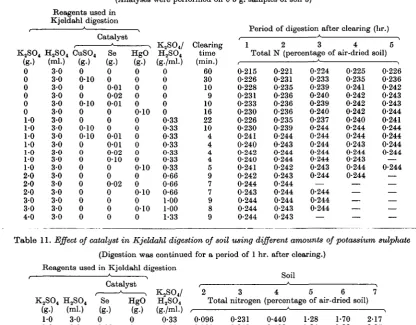
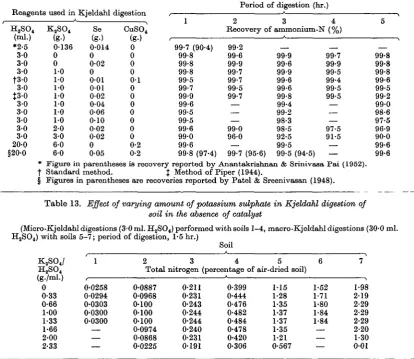
Effect of catalyst in Kjeldahl digestion Table 10 shows the effect of different catalysts in Kjeldahl digestion of soil 3, and Table 11 shows the effect of catalyst in Kjeldahl digestion of soils 2-7 using different amounts of potassium sulphate. Table 12 gives the recoveries of ammonium-N after Kjeldahl digestion of ammonium sulphate using selenium as catalyst. Digestions were performed on 2-0 ml. aliquots of a solution of ammonium sulphate containing 1-0 mg. NH4-N/ml.
Effect of potassium-sulphate concentration in Kjeldahl digestion
Tables 13 and 14 give the results of experiments to determine the effect of varying the amount of
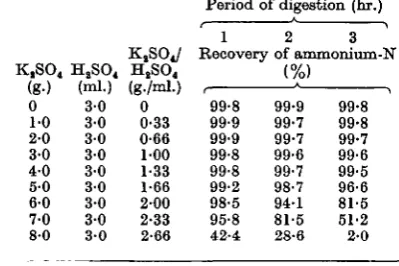
potassium sulphate in Kjeldahl digestion of soil in the absence of catalyst. Table 15 gives the results of similar experiments using ammonium sulphate instead of soil (2-0 ml. aliquots of a solution of ammonium sulphate containing 1-0 mg. NH4-N/ml.
were taken for Kjeldahl digestion).
Determination of nitrogen in soil by the Kjeldahl method
23
Table 14. Kjeldahl analysis of soil in absence of catalyst. Effect of varying period of digestion with different amounts of potassium sulphate
(Micro-Kjeldahl digestions (3-0 ml. HaSO4) performed
with soil 3, macro-Kjeldahl digestions (30-0 ml. HaSO4)
with soil 5.)
Period of digestion (hr.)
KaSO4/
H2SO4
Soil (g./ml.) 3 0
0-33 0-66 1-00 1-33
r> o
0-33 0-66 1-00 1-33
1 Total
0-209 0-230 0-242 0-244 0-244 1 1 4 1-27 1-34 1-36 1-37
2 nitrogen (%
0-214 0-234 0-244 0-244 0-243 1-16 1-28 1-35 1-37 1-36
3 4
of air-dried soil)
0-220 0-239 0-244 0-244 0-237 1-18 1-29 1-36 1-36 1-36
0-224 0-241 0-244 0-242 0-234 1-20 1-30 1-35 1-37 1-36
Table 15. Recovery of ammonium-N after digestion of ammonium sulphate with sulphuric acid and different amounts of potassium sulphate
Period of digestion (hr.)
K,SO4
(g-) 0 1-0 2-0 3-0 4-0 5 0 6 0 7-0 8-0
HaSO4
(ml.) 3 0 3-0 3 0 3 0 3-0 3 0 3-0 3-0 3-0
H8SO4
(g./ml.) 0 0-33 0-66 1-00 1-33 1-66 2-00 2-33 2-66
1 Recovery
99-8 99-9 99-9 99-8 99-8 99-2 98-5 95-8 42-4
2 3
of ammonium-N (%)
99-9 99-7 99-7 99-6 99-7 98-7 94-1 81-5 28-6
99-8 99-8 99-7 99-6 99-5 96-6 81-5 51-2 2-0
calcium, ferric and aluminium sulphate on the boiling point of sulphuric acid were abandoned because violent bumping occurred using these salts even when the salt concentration was as low as 0-2 g. salt/ml, sulphuric acid.
Loss of sulphuric acid during Kjeldahl digestion
Table 17 shows the amounts of sulphuric acid lost by boiling under the conditions used in the macro- and micro-modifications of the standard method, and Tables 18 and 19 give the amounts consumed by soils and other materials during Kjeldahl analysis by the micro-modification of this method. In the experiments reported in Table 17 the amount of acid present after various periods of heating was determined by titrating with 2N-NaOH using methyl orange as indicator. In those reported in Tables 18 and 19, the soil sample or other material (0-1-1-0 g.) was treated with 1-11 g. SHjChSe (10:1:01) mixture and
3-0 ml. H2SO4, and the mixture was digested until
clear and subsequently boiled for 1 hr. The amount of acid in the cooled digest was determined by titration with 2N-NaOH (methyl orange), and acid consumption by the material during Kjeldahl digestion was calculated from the amount of acid present after heating for the same period without added material. The soil samples used represented a wide variety of soil types; their carbon contents, as determined by the method of Shaw (1959), ranged from 0-14 to 53-6%. The materials chosen for the experiments reported in Table 19 included mineral constituents of soils (clay minerals, feld-spar, CaCO3, FeaO3, etc.), organic materials often
present in soils as plant residues (straws, grasses), and compounds used in modifications of the Kjeldahl method to include nitrate in soil analysis. The grasses used were samples of perennial rye-grass (Lolium perenne; I-IV), Italian rye-rye-grass (L. italicum; V), and meadow fescue (Festuca pratensis; VI). The lignin preparations were com-mercial wood lignins sold under the trade names of Indulin A (lignin I) and Meadol MBM (lignin II). The humic acids were preparations isolated by acidification (pH 2-0) of 0-5 M-sodium fluoride (I),
Table 16. Boiling points of salt-sulphuric acid mixtures
(Barometric pressure, 746 mm.)
Salt
KaSO4
KaSO4
KaSO4
KaSO4
K2SO4
NaaSO4
NaaSO4
NaaSO4
Table 17. Loss of sulphuric acid in Kjeldahl digestion by standard method
A, 30-0 ml. sulphuric acid heated with 10-0 g. KaSO4,
1-0 g. CuSO4.5HaO and 0-1 g. Se in 350 ml. Kjeldahl
flask.
B, 3-0 ml. sulphuric acid heated with 1-0 g. KaSO4,
0-1 g. CuSO4.5HaO and 0-01 g. Se in 50ml. Kjeldahl
flask.
Loss of HaSO4
Salt/
H2SO4
(g./ml.) 0 0-33 0-66 1-00 1-33 1-66 0-33 0-66 1-00
Boiling point of mixture
(°C.) 331 342 356 371 387 >400 335 350 365
Period of digestion
(hr.) 1 2 3 4 5
(ml.
A 0-22 0-45 0-66 0-89 1-12
24
J. M. BREMNERTable 18. Acid consumption during Kjeldahl digestion of mineral and organic soils
Acid consumption ( 3 6 N - H2S O4)
Soil Clay
Clay Sandy loam Medium sandy loam Clay loam
Clay loam Clay loam Fine sandy loam Silty loam Clay loam Sandy loam Sandy loam Greenhouse Clay loam Clay loam Fen Fen Low-moor peat Mountain peat PH 7-4 6-9 6-9 5-8 8-3 7-9 7-7 6-5 4-8 8-0 5-3 6-3 7-0 7-2 7-8 7-1 7-3 6-2 3-7 Percentage on moisture-free basis Organic-C
0 1 5 0-15 0-16 0-80 0-99 1-08 1-09 1-77 2-15 2-56 3-38 4-37 5-71 8-68 12-3 22-8 36-5 45-0 53-6 Total-N 0-031 0-031 0-034 0-070 0-102 0-117 0-122 0-161 0-175 0-250 0-322 0-375 0-540 0-500 1-17 1-49 3-00 2-69 2-07 CaCO3 0-1 0-1 0 0 2-1 0-6 0-6 0-1 0 2-4 0 0 1-8 1-3 9-5 3-2 4-7 0 0 ml./g. of soil 0-34 0-34 0-24 0-20 0-28 0-29 0-29 0-26 0-58 0-53 0-52 0-64 0-71 1-03 1-63 2-48 3-89 4-30 6-10 ml./g. of organic-C 10-9 10-6 9-6 11-4 ml./amount of soil containing
10 mg. N 11-0 11-0 7-06 2-86 2-75 2-48 2-38 1-62 3-31 2-12 1-61 1-71 1-31 2-06 1-39 1-66 1-30 1-60 2-95
Table 19. Acid consumption during Kjeldahl digestion of various materials
Material Grass I Grass I I Grass I I I Grass IV Grass V Grass VI Oat straw Wheat straw Lignin I Lignin I I Humic acid I Humic acid I I Humic acid I I I Casein Edestin Glucose Sucrose Starch Pectin Cellulose Stearic acid Phenol Salicylic acid Thiosalicylic acid Sand Feldspar Kaolinite Illite Bentonite Vermiculite Na2S,O3.5H,O CaCO3
Fe2O3
A12O3
* Moisture-free C content (%)* 44-2 41-7 42-8 42-6 45-3 43-2 45-2 44-3 65-2 64-7 44-7 47-2 59-3 50-9 50-6 40-0 42-1 43-6 39-3 43-7 76-Of 76-6-j-60-9f 54-5J — — .— — — — — — basis. Acid consumption
( 3 6 N - H2S O4)
ml./g. of material* 4-30 4-38 4-17 4-20 4-44 4-10 4-26 4-26 7-06 6-36 4-55 4-42 6-20 4-83 4-82 4-00 4-00 4-52 4-06 4-47 8-22 9-20 6-76 6-56 0-02 0-13 0-61 0-57 0-61 0-60 0-58 0-55 l-04f 1-63 ml./g. of carbon 9-73 10-5 9-74 9-86 9-80 9-49 9-43 9-62 10-8 9-83 10-2 9-36 10-5 9-49 9-52 10-0 9-50 10-4 10-3 10-2 10-8 12-0 1 1 1 12-0 — — — — t Calculated.
0-1 M-sodium pyrophosphate (II) and 0-5 M-sodium hydroxide (III) extracts of organic soils. Before use they were twice re-precipitated (pH 2-0) from solution in the reagent used for extraction; prepara-tion I I I was also subjected to the acid treatment used by Forsyth (1947) for purification of soil humic acids. Casein, edestin, stearic acid, thio-salicylic acid, pectin (citrus) and A12O3
(chromato-graphic grade) were obtained from British Drug Houses Ltd.; glucose, sucrose, phenol, starch (soluble), CaCO3 and Na2S2O3.5H2O from Hopkin
and Williams Ltd. (Analar-grade chemicals); cellu-lose (Whatman cellucellu-lose powder) from W. and R. Balston Ltd.; bentonite (Wyoming) from R. Greene-Kelly; illite and kaolinite from G. Brown; vermiculite (unexpanded) from Dupre Vermiculite (Exfoliators) Ltd.; feldspar from P. W. Arnold; and Fe2O3 (freshly prepared) from C. Bloomfield.
The sand used was the acid-washed material supplied by Hopkin and Williams Ltd. Before use the feldspar and clay minerals were ground to pass a 100-mesh sieve. The carbon contents of the materials were determined as follows: grasses, straws, humic acids I and II, method of Tinsley (1950); proteins, carbohydrates and humic acid III, method of Shaw (1959); lignins, dry combustion method (Weiler & Strauss, Oxford).
Analyses of various batches showed that the Analar concentrated sulphuric acid used in this work was always about 37 N with respect to sul-phuric acid. It is generally assumed, however, that the concentrated sulphuric acid used for Kjeldahl analysis is about 36 N, and for this reason the acid consumptions recorded in Tables 17-19 have been
Determination of nitrogen in soil by the Kjeldahl method
25
DISCUSSION
The results in Tables 2 and 3 show that the Kjeldahl method used by the author to determine nitrogen in soils gives highly consistent results, and that the values obtained by this method are not affected when the time of digestion is increased boyond the recommended period of 5 hr. The latter finding is a good indication that the method in-cludes any refractory nitrogen compounds that may be present in soil, and this is confirmed by the fact that methods known to include such com-pounds did not give higher values (Table 5). The Kjeldahl methods for soil analysis recommended by Ashton (1936), Piper (1944), Alves & Alves (1952) and Jackson (1958) gave results in close agreement with those obtained by the standard method, but the methods recommended by Murneek & Heinze (1937) and by the Association of Official Agricultural Chemists (1955) gave much lower values (Table 5). Failure of the A.O.A.C. method to give satisfactory results is not surprising, because the literature on the Kjeldahl method shows that the catalysts employed in this method (ferrous sulphate and copper sulphate) are not very effec-tive, and that the period of digestion recommended (until the mixture is colourless or nearly so) is inadequate for satisfactory Kjeldahl analysis. The retention of this method for soil analysis by the Association in successive editions of their Methods of Analysis is rather puzzling, because the Associa-tion has conducted several admirable studies on the Kjeldahl method and has recommended longer periods of digestion and more effective catalysts for Kjeldahl analysis of fertilizers and other materials. It is also difficult to understand why the A.O.A.C. method does not include the pre-treatment with water found necessary with some clay soils. When the A.O.A.C. method was modified by using the highest concentration of potassium sulphate permitted in the A.O.A.C. specifications and by increasing the period of digestion to 5 hr., the values obtained agreed closely with those given by the standard method (Table 5). The per-manganate method of Beet (1954, 1955) gave very inconsistent results, and the mean values were much lower than those obtained by the standard method.
The results in Table 6 show that the periods of digestion recommended for the various methods tested were generally satisfactory when the methods were applied to soils. The exceptions were the A.O.A.C. method and the method of Murneek & Heinze, and satisfactory results were obtained by these procedures when the period of digestion recommended was increased. With the A.O.A.C. method it was necessary to digest for more than 5 hr. to obtain satisfactory results with some soils
if the highest concentration of potassium sulphate permitted in the A.O.A.C. specifications was not employed. The pretreatment with salicylic acid and thiosulphate used by Murneek & Heinze (1937) in their method for soil analysis was not adopted because none of the soils examined contained significant amounts of nitrate. The reagents used in this pretreatment may increase the rate of Kjeldahl digestion, because they consume sul-phuric acid (Table 19) and this will increase the temperature of digestion. The results obtained by Ashton's methods show that it is not always neces-sary to digest for as long as 24 hr. using copper sulphate as catalyst, but they confirm Ashton's finding that selenium is considerably more effective than copper sulphate as a catalyst for Kjeldahl digestion of soil. Alves & Alves (1952) found that the values obtained in Kjeldahl analysis of soil by their method decreased significantly when digestion was continued for even a short time beyond the recommended period, but this was not observed in the analyses reported in Table 6, and no loss of nitrogen could be detected with any of the methods tested when digestion was continued beyond the recommended time. The long periods of digestion recommended by Chibnall et al. (1943) for analysis of proteins were not required when their method was applied to soils, but their method of digestion was found to be much less effective with soils than most of the other methods tested (Table 6). Their method is undoubtedly ineffective because the concentration of potassium sulphate is too low (0-20g./ml. H2SO4). McKenzie & Wallace (1954)
showed that a period of 15 min. digestion after clearing is adequate for satisfactory analysis of proteins and amino-acids when digestion is done with a high concentration of potassium sulphate (1-0 g./ml. H2SO4) using mercury as catalyst. The
superiority of their procedure over methods using lower concentrations of potassium sulphate in Kjeldahl analysis of refractory compounds such as nicotinic acid and tryptophan is illustrated by the results in Table 7. Comparison of the effects of varying the period of digestion in Kjeldahl analysis of soils and of nicotinic acid by the standard method (Tables 2 and 7) shows that only a small fraction of soil nitrogen can be in the form of compounds as refractory as nicotinic acid. If this were not true, the results obtained with soils by the standard method would have increased greatly with time of digestion.
26
J. M. BBEMNEB macro-methods are probably more convenientwhen there is enough soil. The results in Table 8 were obtained using 0-2-1-0 g. samples of soils ground to pass a 100-mesh sieve. Good results were also obtained using samples ground to pass an 80-mesh sieve, but highly reproducible results could not be obtained with some soils using material ground to pass a 60-mesh sieve.
Table 9 shows that methods in which the soils were pretreated with various reagents before Kjeldahl analysis, to include various forms of nitro-gen not recovered by straightforward Kjeldahl procedures, gave the same results as the standard method. The pretreatments employed are known to lead to the inclusion of compounds with N—N linkages (hydrazines, hydrazones, azo and diazo compounds, etc.) and with N—O linkages (nitrite, nitrate, nitro- andnitroso-compounds, oximes, etc.), and the fact that the same results were obtained when they -were omitted shows that very little, if any, of the nitrogen in the soils analysed occurred in such linkages.
Taken together, the results in Tables 5 and 9 establish beyond reasonable doubt that the method used by the author for Kjeldahl analysis of soil is reliable, because none of the other methods tested gave higher values, and almost every form of nitrogen can be determined by one or other of these methods. The list of compounds successfully analysed by the methods tested is too extensive to be catalogued here (for partial lists see Belcher & Godbert, 1941; Middleton & Stuckey, 1951). I t includes all the types of nitrogen compounds known or likely to occur in soil (proteins, peptides, amino-acids, hexosamines, nucleic amino-acids, etc.). The methods tested are not always successful with compounds containing N—N linkages which are part of a ring (e.g. pyrazolones, diazines), but such compounds are not likely to occur in soil. For practical pur-poses the most important conclusion from Tables 5 and 9 is that relatively simple and straight-forward Kjeldahl procedures can be used with con-fidence to determine nitrogen in soil provided the period of digestion is adequate. Modification of these procedures is necessary only when the soil may require the pretreatment with water found necessary with some clay soils or when it contains significant amounts of nitrate or nitrite.
Recent work (e.g. Rodrigues, 1954; Dhariwal & Stevenson, 1958; Bremner, 1959) has shown that much of the nitrogen in some soils, particularly subsoils, is in the form of ammonium fixed by clay minerals. I t is important, therefore, to know whether such fixed ammonium-N is determined by the Kjeldahl method. This question was discussed in a previous paper (Bremner, 1959), which pre-sented good evidence that fixed ammonium in soil is determined quantitatively by the standard
Kjeldahl procedure described here. This conclusion is supported by the finding (Table 9) that pre-treatment of the soils with hydrofluoric acid to decompose clay minerals and release fixed am-monium did not affect the results of Kjeldahl analysis. At least three of the soils examined (nos. 1-3) contained fixed ammonium. Soil 1 was in fact selected for this work because analysis by the N - H F :N-HC1 method (Bremner, 1959) indicated that about 23 % of its nitrogen was in the form of fixed ammonium; the corresponding figures for soils 2 and 3 were 6-0 and 3-9%, respectively. Further evidence that the Kjeldahl method need not be modified to include fixed ammonium was obtained by studying the effect of treating ammonium-saturated vermiculite with HF and H2SO4 before analysis by the standard method.
Analysis of the ammonium-vermiculite (prepared by N-NHjCl treatment of unexpanded nitrogen-free vermiculite) by the N - H T : N - H C 1 method showed that it contained 82-6 m.e. of fixed ammonium-N/100 g. of material. Kjeldahl analysis without pretreatment with HF to destroy the mineral gave 94-5 m.e. N/100 g.; Kjeldahl analysis after this pretreatment gave 94-9 m.e. N/100 g.
Determination of nitrogen in soil by the Kjeldahl method
27
to metallic mercury. It is also necessary to use a non-metallic distillation apparatus, because the metal (e.g. silver, block tin) condenser tubes often fitted to Kjeldahl distillation units become amalga-mated when such units are used to distil digests containing mercury. The latter precaution presents no difficulty, but many workers have experienced trouble with the techniques used to prevent inter-ference by mercuric oxide. For example, the use of the reagents recommended to eliminate inter-ference sometimes leads to the evolution of hydro-gen sulphide, to the appearance of metallic mercury in the distillate, to serious bumping when the mercury is precipitated as the sulphide, and to the formation of a black deposit in the condenser of the distillation apparatus. These effects were observed in the present work, but they could be eliminated by some modification of the method of distillation. The black deposit on the condenser—a common sight in laboratories using mercury as catalyst— does not appear to have been studied, but it is presumed to be mercuric sulphide. It does not interfere with the determination of ammonium even when it falls into the flask used to collect the ammonia. Robinson (1956) found that the use of either sodium thiosulphate or sodium sulphide to decompose mercuric oxide-ammonium complexes before steam distillation of digests containing mercury led to acidification of the boric acid-mixed indicator solution used to collect the ammonia immediately before the ammonia distilled over. The same difficulty was experienced in the present work using the Hoskins steam distillation apparatus, and it was always associated with the evolution of hydrogen sulphide. It was not encountered using tho macro-Kjeldahl distillation unit, and it could be eliminated in distillations using the Hoskins apparatus by cooling the chamber of the apparatus thoroughly before adding the digest and alkali. Hydrogen sulphide was evolved more frequently with sodium sulphide than with sodium thio-sulphate, and the latter reagent was therefore used in most of the analyses reported. Zinc dust was not used either to reduce mercuric oxide to metallic mercury or to control bumping during Kjeldahl distillation. Campbell & Hanna (1937) have cautioned against the use of zinc in combination with selenium as it may give rise to noxious fumes of hydrogen selenide. Perrin (1953) found that the use of zinc dust to prevent bumping in distillation of digests containing copper led to carry-over of alkali into the distillate, because the copper sulphate greatly increased the volume of hydrogen generated by zinc during distillation with alkali. The precise reasons for some of the difficulties experienced in distillation of ammonium from mercury digests are still obscure. McKenzie & Wallace (1954) found that, when sodium thiosulphate was used to
eliminate interference by mercuric oxide, the success of the method depended on the ratio of thio-sulphate to mercuric oxide. Some red mercuric oxide was precipitated when the NaaS2O3. 5H2O/HgO
ratio was 3, whereas black mercuric sulphide was always precipitated when this ratio was 5. Similar observations were made in the present investiga-tion, and it was further observed that when a con-siderable excess of alkali was used for distillation after precipitation of mercury as the sulphide, the mixture turned yellow and metallic mercury dis-tilled into the flask used to collect the ammonia. In using thiosulphate, therefore, enough must be added to precipitate all the mercury as black mercuric sulphide, and the excess of alkali used for distillation must not be so great as to decom-pose the sulphide.
Since its introduction by Lauro (1931), the use of selenium and its compounds as catalysts in Kjeldahl digestion has been extensively investigated and many conflicting results have been reported. The effectiveness of selenium as a catalyst is well established, but considerable disagreement exists concerning claims that selenium causes loss of nitrogen. The extensive literature on this subject cannot be discussed adequately here (for reviews see Kirk, 1947, 1950), but it can be stated that most of the evidence indicates that selenium is a safe and effective catalyst when properly used, and that nitrogen is lost only when too much selenium is employed, or it is used with large amounts of potassium (or sodium) sulphate, and digestion is prolonged. These conclusions are sup-ported by Tables 10-12, which show that no nitrogen was lost when small amounts of selenium were used for Kjeldahl digestions involving the customary amounts of potassium sulphate even when digestion was prolonged, whereas there were losses when the quantity of selenium or the concentration of potas-sium sulphate was increased, particularly with long periods of digestion. Reports by Patel & Sreeni-vasan (1948) and Anantakrishnan & Srinivasa Pai (1952) that serious loss of nitrogen occurs even when small amounts of selenium are used with low concentrations of potassium sulphate could not be confirmed (Table 12; cf. results by standard method in Table 2 and by Piper's method in Table 6).
28 J. M. BREMNEB affects the rate and completeness of digestion.
However, clear evidence of the importance of temperature has emerged from recent work by Ogg & Willits (1950), Lake, McCutchan, Van Meter & Neel (1951), Perrin (1953), and McKenzie & Wallace (1954), who showed that even refractory compounds such as nicotinic acid and pyridine can be decomposed rapidly and completely to am-monium by digesting with sulphuric acid containing a high concentration of potassium sulphate using mercury as catalyst. Further evidence of the importance of temperature in Kjeldahl digestion is provided by Tables 6, 10, 11, 13 and 14. Table 6 shows that the period of digestion required for Kjeldahl analysis of soil by different methods decreases with increase in the concentration of potassium (or sodium) sulphate. Tables 10 and 11 show that catalysts have an important effect when the concentration of potassium sulphate is low, but not when the concentration is high. Comparison of Tables 5 and 13 shows that satisfactory Kjeldahl analysis of soils is possible without the use of catalyst by digesting for a comparatively short time with sulphuric acid containing a high concentra-tion of potassium sulphate (e.g. 1-0 g. K2SO4/
ml. H2SO4). Loss of nitrogen during Kjeldahl
digestion of soil without a catalyst was detected only when the concentration of potassium sulphate was as high as 1-33 g./ml. H2SO4, and it did not
occur at this concentration unless digestion was continued for several hours (Tables 13 and 14). In similar studies using ammonium sulphate in-stead of soil, loss of nitrogen during Kjeldahl digestion was not detected until the concentration of potassium sulphate exceeded 1-33 g./ml. H2SO4,
and it was not serious when the concentration was 1-66 g./ml. provided digestion was not prolonged (Table 15). I t is rather difficult to measure the boiling points of salt-sulphuric acid mixtures accurately, and this probably explains why few attempts have been made to determine the tem-perature of digestion in different Kjeldahl methods or the temperature at which nitrogen is lost during digestion. The author made several attempts to determine the boiling points of salt-sulphuric acid mixtures using high-temperature thermometers, but the results did not appear very reliable because of the inaccuracies associated with stem corrections. The results obtained using compact 295-400° C. thermometers calibrated for partial immersion (Table 16) were similar to those obtained by Ogg & Willits (1950) using a platinum-platinum 10% rhodium thermocouple, but they differed con-siderably from those reported by other workers. However, the values obtained by different workers cannot be strictly compared because the barometric pressure during temperature measurements is not always stated. Comparison of Tables 15 and 16
indicates that nitrogen is not lost during Kjeldahl digestion until the temperature exceeds about 400° C. Lake et al. (1951) found that serious loss of nitrogen occurred during Kjeldahl digestion of tar bases and ammonium oxalate when the tempera-ture of digestion was above 420° C. and concluded that the upper safe temperature in digestion is about 410° C.
During Kjeldahl digestion of soil some sulphuric acid is lost by volatilization and decomposition during boiling, and some is consumed in oxidation of organic matter and by reaction with the mineral constituents of the soil. I t is important to know the magnitude of loss of sulphuric acid by these processes, because loss of acid increases the salt concentration and temperature of digestion, and nitrogen can be lost should the temperature of digestion become too high (Table 15). The amount of acid lost by boiling during Kjeldahl digestion was very small (Table 17). The amount consumed by soil during digestion depended greatly upon the organic matter content, and varied from 0-20 ml. H2SO4/g. soil with a sandy soil to 6-10ml./g. with