0 INTRODUCTION
Nowadays the increasing performance of modern computers makes it possible to solve very large linear systems of millions of degrees of freedom (DOF). Nevertheless, since dynamic analysis requires solving a lot of linear systems and since the refinement of finite element models is increasing faster than the computing capabilities, dynamic substructuring still remains an essential tool for analyzing dynamical systems in an efficient manner. Building reduced models of subparts of a structure enables sharing models between design groups. Moreover the reduction of the DOF of substructures is also important for building reduced order models for optimization and control. If a single component of a system is changed, only that component needs to be reanalyzed and the system can be analyzed at low additional cost. Thus dynamic substructuring offers a flexible and efficient approach to dynamic analysis.
Dynamic substructuring techniques can be classified in two categories depending on the
underlying modes which are used [1]. The term mode
can refer to all kind of structural shape vectors. The
first class consists of methods using fixed interface vibration modes and interface constraint modes to represent the substructure dynamics. The method commonly used is the Craig-Bampton method (CBM)
[2] which assembles the substructures in a primal
way using interface displacements in order to enforce interface compatibility. The second class consists of methods using free interface vibration modes and attachment modes. Common representatives
of that class are MacNeal‘s method (MNM) [3] and
Rubin‘s method (RM) [4] using a primal assembly
process as well. Herting generalizes in [5] the concept
of component mode synthesis to include any kind of interface boundary condition for the modes. In contrast to the aforementioned methods, the dual
Craig-Bampton method (DCBM) [6] uses the same
ingredients as MacNeal‘s and Rubin‘s method, but assembles the substructures in a dual way using interface forces. As a consequence, the DCBM enforces only weak interface compatibility between the substructures, thereby avoiding interface locking problems as sometimes experienced in the primal assembly approaches. Furthermore, the dual Craig-Bampton method leads to simpler reduced matrices
Evaluation of Substructure Reduction Techniques
with Fixed and Free Interfaces
Gruber, F.M. – Rixen, D.J.
Fabian M. Gruber* – Daniel J. Rixen
Technical University of Munich, Institute of Applied Mechanics, Germany
Substructure reduction techniques are efficient methods to reduce the size of large models used to analyze the dynamical behavior of complex structures. The most popular approach is a fixed interface method, the Craig-Bampton method (1968), which is based on fixed interface vibration modes and interface constraint modes. In contrast, free interface methods employing free interface vibration modes together with attachment modes are also used, e.g. MacNeal‘s method (1971) and Rubin‘s method (1975). The methods mentioned so far assemble the substructures using interface displacements (primal assembly). The dual Craig-Bampton method (2004) uses the same ingredients as the two aforementioned free interface methods, but assembles the substructures using interface forces (dual assembly). This method enforces only weak interface compatibility between the substructures, thereby avoiding interface locking problems as sometimes experienced in the primal assembly approaches using free interface modes. The dual Craig-Bampton method leads to simpler reduced matrices compared to other free interface methods and the reduced matrices are sparse, similar to the classical Craig-Bampton matrices. In this contribution we evaluate the primal (classical) formulation of the Bampton method, the MacNeal method, the Rubin method and the dual formulation of the Craig-Bampton method. The presented theory and the comparison between the four substructuring methods will be illustrated on the Benfield truss, on a three-dimensional beam frame and on a two-dimensional solid plane stress problem.
Keywords: dynamic substructuring, component mode synthesis, model order reduction, dual assembly, Craig-Bampton method, free interface method
Highlights
• Derivation of the Craig-Bampton, MacNeal, Rubin and dual Craig-Bampton method in a common framework. • Highlighting the differences and emphasizing the similarities between the four methods.
• Assessing the accuracy of the methods.
• Evaluation of the sparsity pattern of the reduced matrices.
compared to other free interface methods and the reduced matrices are sparse, similar to the classical Craig-Bampton matrices. In this contribution we evaluate the primal (classical) formulation of the Craig-Bampton method, the MacNeal method, the Rubin method and the dual formulation of the Craig-Bampton method. The presented theory and the comparison between the four substructuring methods will be illustrated on three different examples.
In section 1, the differences between primal and dual assembly are stated. Following this, the formulation of the CBM, the MNM, the RM and the DCBM will be outlined in section 2 explaining general properties of the fixed interface method (subsection 2.1) and of the free interface methods (subsection 2.2). These properties will be illustrated subsequently in detail in section 3 using the Benfield Truss (subsection 3.1), a three-dimensional beam frame (subsection 3.2) and a two-dimensional solid plane stress problem (subsection 3.3). Finally a brief summary and conclusions are given in section 4.
1 PRIMAL AND DUAL ASSEMBLY OF SUBSTRUCTURES
Consider a finite element model of a global domain.
This domain is divided into N non-overlapping
substructures such that every node belongs to exactly one substructure except for the nodes on the interface boundaries. The linear/linearized equation of motion of one substructure is written as
M( ) ( )s �us +K u( ) ( )�s s = f( )s +g( )s , (1)
where the superscript (s) is the label of the particular substructure
(
s=1,...,N)
. M( )s , K( )s and u( )s arethe mass matrix, the stiffness matrix and the displacement vector of the substructure, respectively.
f( )s is the external force vector and g( )s is the vector
of reaction forces on the substructure due to its connection to adjacent substructures at its boundary
DOF. The local displacements u( )s of each
substructure can be divided in local internal DOF ui( )s and boundary DOF ub( )s :
u u u L I u u
s bs
is
bs b
is ( ) ( ) ( ) ( ) ( ) = = 0
0 . (2)
The boundary DOF ubs L u
bs b
( )= ( ) of the
substructure are a subset of the assembled boundary
DOF ub of the global domain. L( )bs is a Boolean
localization matrix (connectivity matrix) relating the
assembled boundary DOF ub of the global domain to
the substructure boundary DOF ub( )s . Consequently,
the equation of motion, Eq. (1), of one substructure partitioned in the same manner writes
M M
M M
K u
u
bbs bis
ibs iis bs is bb ( ) ( ) ( ) ( ) ( ) ( ) + ss bis
ibs bbs bs is bs is ( ) ( ) ( ) ( ) ( ) ( ) ( ) = = K K K u u f
f(( )
( ) +
gbs
0 . (3)
Defining the local Boolean localization matrix
A( )s which is selecting the boundary DOF of
substructure s gives the relation
ub( )s =A u( ) ( )s s , (4)
which will be used later.
1.1 Primal Assembly
The Eqs. (1) and (2) of all substructures N can be
assembled in a primal way as:
Ma au +K ua a= fa, (5)
where
M
M M M
M M �
� �
M � M
a
bb bi biN
ib ii ib N ii N = ( ) ( ) ( ) ( ) ( ) ( ) 1 1 1 0 0
, (6)
K
K K K
K K �
� �
K � K
a
bb bi bi
N
ib ii
ibN iiN
= ( ) ( ) ( ) ( ) ( ) ( ) 1 1 1 0 0
, (7)
u u u u f f f f a b i iN a b i iN = = ( ) ( ) ( ) ( ) 1 1 ,
, (8)
with
M L M L
M M L M L M
bb s
N
bs bbs bs
ib ibs bs bi bs b
T T = = = = ( ) ( ) ( ) ( ) ( ) ( )
∑
1 ,, iis
bb s
N
bs bbs bs
ib ibs bs bi b
T ( ) = ( ) ( ) ( ) ( ) ( ) = = =
∑
, , ,K L K L
K K L K L
1 ss bis b s N bs bs
T T ( ) ( ) = ( ) ( ) =
∑
Kf L f
,
1
The reaction forces g( )s on the interfaces of the
substructures cancel out during assembly. This assembly is called primal assembly since the compatibility between the substructures is enforced using the same boundary displacements for adjacent substructures.
1.2 Dual Assembly
Another way to enforce the interface compatibility between the substructures is to consider the interface connecting forces as unknowns. These forces must be determined to satisfy the interface compatibility condition (displacement equality) and the local equation of motion of the substructures:
B us s s
N ( ) ( )
= =
∑
1 0, (9)M u( ) ( )s s K u( ) ( )s s B( )sT f( )s
+ + =
λλ . (10)
B( )s is a signed Boolean matrix (constraint matrix)
acting on the substructure interface DOF. B( )sT
λλ is representing the interconnecting forces between substructures which is corresponding to the negative interface reaction force vector g( )s in Eq. (1) meaning
gs Bs g B
bs bs
T T
( )= − ( )λλ, ( )= − ( )λλ, (11)
and λλ is the vector of all Lagrange multipliers acting on the interfaces which are the additional unknowns.
The displacement vector u( )s is partitioned according
to Eq. (2). With the block-diagonal matrices
M M
M
=
( )
( )
1 0
0
N
, (12)
K K
K
=
( )
( )
1 0
0
N
, (13)
and
u u
u f
f
f
=
=
( )
( )
( )
( )
1 1
N N
, , (14)
B= B( )1 B( )
N , (15)
the set of Eqs. (9) and (10) can be written as:
M u K B
B
u f
0
0 0 0 0
+
=
λλ λλ
T
(16)
In this hybrid formulation the Lagrange
multipliers λλ enforce the interface compatibility
constraints and can be identified as interface forces [6]. The dual assembled system in Eq. (16) is equivalent to the primal assembled system in Eq. (5) since both systems express the same local equilibrium for each substructure and enforce the same interface compatibility.
2 COMPONENT REDUCTION METHODS
2.1 Craig-Bampton Method (CBM)
Considering the partitioned equation of motion in Eq. (3), the internal DOF ui( )s of every substructure can be seen as being excited by its boundary DOF
ub( )s , namely
Mii( ) ( )suis +K uii( ) ( )s is = fi( )s −K uib( ) ( )s bs −Mib( ) ( )subs . (17)
This indicates that ui( )s of each substructure can be approximated by a superposition of a static
response and of eigenmodes associated to Mii( )s and
Kii( )s . The static response is given by
ui stats K K u u
iis ibs bs ibs bs ,
( ) = − ( )−1 ( ) ( )= ( ) ( )
Ψ
Ψ , (18)
where the columns of matrix ΨΨib( )s are the static
response modes also called constraint modes [2]. The
fixed interface normal modes φφ( )ks are obtained as
eigensolutions of the generalized eigenproblem
Kii( ) ( )sφφks =ωk( )s Mii( ) ( )sφφks
2
. The columns of the
ni( )s ×nφ( )s matrix ΦΦiφ( )s contain the first nφ( )s fixed
interface normal modes φφk( )s which can also be
considered as the free vibration modes of the substructure s clamped on its boundary DOF ub( )s . The approximation of ui( )s therefore writes
uis u
i stats is s
( )≈ ( ) + ( ) ( )
, ΦΦφηη , (19)
and the displacements of the substructure are approximated by
u u
I u
bs
is
bbs bs
ibs is bs
s ( )
( )
( ) ( )
( ) ( )
( )
=
0φ
φ Ψ
Ψ ΦΦ ηη(( )
, (20)
with the vector of modal parameters ηη( )s of dimension ns
φ( ) corresponding to the amplitudes of the fixed
interface normal modes ΦΦis
φ
( ). The CBM reduction
matrix TCB for reducing the primal assembled system
u
I L
L
a ib b i
ibN bN iN
≈ ( ) ( ) ( ) ( ) ( ) ( ) 0 0 0 0 Ψ Ψ ΨΨ ΦΦ Φ Φ
1 1 1
φ φ ( ) ( ) T u CB b N ηη ηη 1
, (21)
and the CBM reduced matrices
Kred CB T K TCBT a CB
, = , (22)
Mred CB T M TCBT a CB
, = , (23)
are found in [2].
2.2 Free Interface Methods
Considering the equation of motion (Eq. (10)) of
substructure s, every substructure can be seen as being
excited by the interface connection forces and the external forces. This indicates that the displacements of each substructure u( )s can be expressed in terms of
local static solutions ustat( )s and in terms of eigenmodes associated to the entire substructure matrices K( )s and
M( )s :
us u
stats j js js
ns rs
( ) ( ) ( ) ( )
= −
= +
∑
( )1 ( )θθ η (24)with the static solution
ustats K Bs s R
js js j r T s ( ) ( ) ( ) ( ) ( ) = = − + + ( )
∑
λλ 1 α . (25)
The static response ustat( )s is obtained by solving Eq. (10) under the assumption of no inertia forces and no external forces acting on the substructure. K( )s+
is
equal to the inverse of K( )s when there are enough
boundary conditions to prevent the substructure from floating when its interface with neighboring substructures is free [6]. If a substructure is floating,
K( )s+
is a generalized inverse of K( )s and R( )s is the
matrix containing the r( )s rigid body modes as
columns. The vector αα( )s contains the amplitudes α
js ( )
of the rigid body modes and the vector ηη( )s contains
the amplitudes ηj( )s of the local eigenmodes θθ
js ( ) being eigensolutions of the generalized eigenproblem
K s M
js js s js
( ) ( )θθ =ω( )2 ( ) ( )θθ
. An approximation is
obtained by retaining only the first ns
θ( ) free interface
normal modes θθj( )s . Calling ΘΘ( )s the matrix containing
only these ns
θ( ) eigenmodes, the approximation of the
displacements u( )s of the substructure is given by: u( )s K B( )s ( )sT R( ) ( )s s ( ) ( )s s
≈ − + + +
λλ αα ΘΘ ηη . (26)
Since a part of the subspace spanned by ΘΘ( )s is
already included in K( )s+
the residual flexibility
matrix Gr( )s can be used instead of K( )s+
, which is defined by:
Grs j K
s js
js j n
n r s js js
T s s s ( ) ( ) ( ) ( ) = + − ( ) ( ) ( = ( ) = − ( ) ( ) +
∑
θθ θθ θθ θθ ωθ 1 2
)) ( ) = ( )
∑
T s js j n ω θ 21 . (27)
Note that, by construction Grs Grs
T
( )= ( ) , which is
computed using the second equality in Eq. (27). For further properties of Gr( )s see [6]. As a result the approximation of one substructure writes:
u R G B
R
s s s
rs s s s s s T ( ) ( ) ( ) ( ) ( ) ( ) ( ) ( ) ( ≈ − = = ΘΘ ΘΘ αα ηη λλ )) ( ) ( ) ( ) ( ) ( ) ( ) G A g T
rs s s s b s T s 1 αα ηη . (28)
G Ars s
T
( ) ( ) is the matrix containing the residual
flexibility attachment modes of substructure s, since
the Boolean localization matrix A( )sT
as defined in Eq. (4) simply picks the columns of Gr( )s associated to
the boundary DOF [7]. The approximation in Eq. (28)
can now be used to reduce the substructure DOF. Using the orthogonality properties of the modes in Eq. (28) the equation of motion of one substructure in Eq. (1) becomes
M K g g frees s s b s frees s s b ( ) ( ) ( ) ( ) ( ) ( ) ( ) + αα ηη αα ηη ss
sT s s
( ) ( ) ( ) ( )
=T1
(
f +g)
, (29)with the matrices
M T M T
I I
M
frees s s s
r bbs
T ( ) ( ) ( ) ( ) ( ) = = 1 1 0 0 0 0
0 0 ,
, (30)
K T K T
G
frees s s s
r bbs
T ( ) ( ) ( ) ( ) ( ) ( ) = = 1 1 2
0 0 0
0 0 0 0 Ω Ωs , , (31)
Gr bbs A G As rs s
T
,
( ) = ( ) ( ) ( ) , (32)
Mr bbs A G M G As rs s rs s
T
, .
Gr bb( )s, is the residual flexibility and Mr bb( )s, is the interface inertia associated to the residual flexibility
related to the boundary DOF, respectively, and ΩΩ( )s
being a diagonal matrix containing the remaining ns
θ( )
eigenvalues ω( )js .
2.2.1 Rubin Method (RM)
In order to assemble the substructure equation of motion in Eq. (29) in the global system a second
transformation is applied by the RM [4]. The force
DOF gb( )s are transformed back to the boundary
displacements ub( )s using Eq. (28) [7]:
ub( )s =A u( ) ( )s s =Rb( ) ( )sααs +ΘΘ( ) ( )bsηηs +G gr bb( ) ( ),s bs . (34)
Rb( )s and ΘΘ bs
( ) are the subparts of R( )s and ΘΘ( )s
related to the boundary DOF, respectively. From this equation the interface force DOF can be solved as:
gb K u R
s r bb
s b
s b
s s
b
s s
( )= ( )
(
( )− ( ) ( )− ( ) ( ))
, αα ΘΘ ηη , (35)
with Kr bb( )s, =Gr bb( )s, −1
. The transformation matrix T2( )s
from force DOF gb( )s back to the boundary
displacements ub( )s leaving αα( )s and ηη( )s unchanged writes then:
T
I
I
K R K K
2s
r bbs bs r bbs bs r bbs ( )
( ) ( ) ( ) ( ) ( )
=
− −
0 0
0 0
, , ΘΘ ,
.. (36)
Application of this transformation to the matrices of Eqs. (30) and (31) gives the RM reduced matrices of one substructure
Kred Rs T K Ts frees s
T
,
( ) = ( ) ( ) ( )
2 2 , (37)
Mred Rs T M Ts frees s
T
, .
( ) = ( ) ( ) ( )
2 2 (38)
The RM reduction matrix for one substructure writes therefore:
TR( )s =T T1( ) ( )s 2s , (39)
and the RM reduced matrices
Kred R T K T
s R
s s
R s
T
,
( ) = ( ) ( ) ( ), (40)
Mred Rs T M TRs s Rs
T
,
( ) = ( ) ( ) ( ), (41)
are found [7]. These matrices can be directly
assembled using primal assembly to get the RM
reduced matrices Kred R, and Mred R, of the global
system. This process was outlined in section 1.1 and applied in section 2.1 for the CBM. The RM applies
the reduction matrix TR( )s consistently to the mass and stiffness matrix resulting in a true Rayleigh-Ritz
method as was observed in [8].
2.2.2 MacNeal Method (MNM)
The MNM [3] is nearly identical to the RM except for
a small change. First we will derive the preliminary
MNM reduced matrices Kred MNs
,
( ) and M
red MN( )s, following the derivation of the RM to show the similarities between these two methods. The reduced stiffness matrix of both the RM and the MNM are identical (given in Eq. (40))
Kred MN( )s , =Kred R( )s, , (42)
but the MNM reduced mass matrix Mred MNs
,
( ) is
obtained differently. The residual mass term Mr bb( )s, of the matrix M( )frees in Eq. (30) is neglected resulting in a modified matrix labeled
M
I I
free MNs ,
( ) =
0 0
0 0
0 0 0
, (43)
instead of M( )frees for the MNM [7]. The preliminary MNM reduced mass matrix writes now:
Mred MN T M T M
s s
free MN
s s
free MN s
T
, , , .
( ) = ( ) ( ) ( )= ( )
2 2 (44)
This gives in fact inconsistent equations of motion since the mass and stiffness matrices are not reduced with the same basis. The assembly of the
MNM reduced matrices Kred MNs
,
( ) and M
red MN( )s, in the global system proceeds in the same manner as for the
RM. Observing that the boundary DOF ub have no
associated inertia in Eq. (44), those DOF can be condensed out of the equation of motion of the assembled problem and the final MNM reduced matrices Kred MN, and Mred MN, are obtained [3]. Thus the size of the assembled MNM system is reduced
further by the number of DOF of ub.
2.2.3 Dual Craig-Bampton Method (DCBM)
Replacing gb( )s according to Eq. (11) by the Lagrange
multipliers λλ in the equation of motion of one
substructure in Eq. (29), the reduced substructure matrices can be directly coupled using the dual
assembly procedure [6] as outlined in section 1.2.
Assembling all substructures N in a dual fashion by
keeping the interface forces λλ as unknowns, the
u T λλ αα ηη αα ηη λλ ≈ ( ) ( ) ( ) ( ) DCB N N 1 1
, (45)
with the DCBM reduction matrix TDCB:
T
R G B
R G B
I
DCB
r T
N N
rN N T
=
−
−
( ) ( ) ( ) ( )
( ) ( ) ( ) ( )
1 ΘΘ1 1 1
Θ Θ
0 0
0 0
0 0 0 0
. (46)
The approximation of the dynamic equations of the dual assembled system in Eq. (16) is
Mred DCB N K
N red DCB , , αα ηη αα ηη λλ αα 1 1 1 ( ) ( ) ( ) ( ) ( + )) ( ) ( ) ( ) = ηη αα ηη λλ 1 N N DCBT
T f, (47)
with the DCBM reduced mass and stiffness matrix
M T M T I
M
red DCB DCBT DCB
r , = = 0 0 0 0
0 , (48)
K T K B
B T
red DCB DCBT
T DCB , =
0 , (49)
with
Mr B G M G B
s N
s
rs s rs s
T = = ( ) ( ) ( ) ( ) ( )
∑
1. (50)
Mred DCB, and Kred DCB, are diagonal for the parts related to the different substructures. The coupling between the substructures is only achieved by the
rows and columns related to λλ. The DCBM applies
the reduction matrix TDCB consistently to the mass
and stiffness matrix resulting in a true Rayleigh-Ritz method.
The DCBM enforces only a weak compatibility between the substructures and does not enforce a strong displacement compatibility between the interfaces compared to many other common reduction
methods [6]. Considering the system of Eqs. (9)
and (10) multiplied by the reduction matrix TDCBT , the last row of Eq. (47) results from
M K u B f
M K u B
u
u
1 1 1 1 1 1
( ) ( ) ( ) ( ) ( ) ( ) ( ) ( ) ( ) ( ) ( ) + + = + + T T
N N N N N
λλ λλ == = ( ) ( ) ( ) =
∑
f B u N s s s N 1 0, (51)
multiplied from left by the last row of TDCBT which is
− −
B G( ) ( )1 r1 B G( ) ( )N rN I. (52)
Replacing the strong interface compatibility condition of Eq. (9) by the weak form according to the multiplication of Eq. (51) by Eq. (52) can be
interpreted as follows. Denote ∆f( )s the residual
forces of substructure s resulting from the weak
satisfaction of the local equilibrium of the substructure approximating the dynamics by a small number of
free interface normal modes. Name ∆us G ∆f
rs s
( )= ( ) ( )
the displacements these residual force ∆f( )s would
create locally. Then the weak interface compatibility condition (Eqs. (51) and (52)) states that a compatibility error (i.e. an interface displacement
jump) equal to the incompatibility of ∆u( )s is
permitted [6]. Compared to MacNeal‘s and Rubin‘s
method [3] and [4], the weak interface compatibility of the DCBM avoids locking problems occurring during the application of the aforementioned methods. Therefore, the approximation accuracy is
improved [6]. But the fact that a weak interface
compatibility is allowed in the DCBM implies that the infinite eigenvalues related to the Lagrange multipliers
λλ in the non-reduced problem in Eq. (16) are now
becoming finite and negative [9]. In practice those
negative eigensolutions will appear only in the higher eigenvalue spectrum if the reduction space is rich
enough [9]. Nevertheless, the reduction basis has to be
selected with care avoiding potential non-physical effects of the possibly occurring negative eigenvalues.
If Mr in Eq. (48) is neglected strong interface
compatibility is enforced again and the DCBM
reduced system with Mr =0 is equivalent to the
MNM [6]. Then static condensation can be applied
again to remove λλ (as it was done for ub at the end of
the derivation of the MNM in section 2.2.2) from the assembled system since no mass is associated. Thus the size of the assembled system is reduced again by
3 EXAMPLES AND DISCUSSION
3.1 Benfield Truss
The Benfield truss [10] of Fig. 1 is used to compare
the results obtainable by the CBM, the MNM, the RM and the DCBM. The planar truss consists of two substructures having uniform bay section whereas all members have constant area and uniform stiffness and mass properties. The left component consists of five equal bays and has a total of 18 joints and the right component consists of four equal bays and has a total
of 15 joints [10]. The lowest eigenfrequencies ω of
the entire structure shall be approximated by the different methods. The relative error
εrel j, =ωred j, −ωfull j, /ωfull j, of the jth eigenfrequency
is used as a criterion to assess the accuracy of the
different methods. Thereby ωfull j, is the jth
eigenfrequency of the full (non-reduced) system and
ωred j, represents the jth eigenfrequency of the reduced
system obtained by each method. Using 5 elastic (fixed or free interface normal modes) per substructure
the relative errors εrel depicted in the semi-log graph
in Fig. 2 are resulting.
Fig. 1. Benfield truss [10]
Fig. 2. Relative error of eigenfrequency using 5 normal modes per substructure for the approximation of the lowest
eigenfrequencies of the Benfield truss
Since all methods give the correct rigid body modes only the relative errors of the elastic modes are plotted. All methods give a relative error less than 1 % for the first six eigenfrequencies. Comparing the free
interface methods for this example, the RM performs always better than the DCBM and the DCBM performs again always better as the MNM. The CBM and the DCBM result in similar frequency errors.
The sparsity pattern of the reduced stiffness
matrix Kred and reduced mass matrix Mred MN, of the
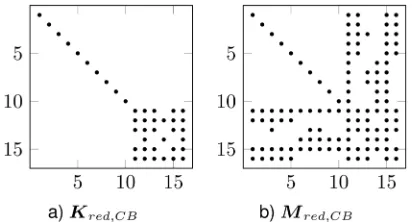
CBM (Fig. 3), the MNM (Fig. 5), the RM (Fig. 6) and the DCBM (Fig. 4), respectively, illustrate the differences of the assembled reduced structures. Both
the reduced stiffness matrix Kred and the reduced
mass matrix Mred applying the CBM and the DCBM,
respectively, have only diagonal entries for the subparts of each substructure. On the one hand the coupling between the substructures using the CBM is entirely achieved by the last rows and last columns in
the mass matrix Mred CB, (Fig. 3b) and the remaining
part is diagonal [2]. On the other hand the coupling
applying the DCBM is entirely achieved by the last rows and last columns in the stiffness matrix Kred DCB,
(Fig. 4a) and again the remaining part is diagonal [6].
The corresponding degrees of freedoms are either the
interface displacements ub or the interface forces λλ
but no direct coupling between the modal parameters of adjacent substructures occurs which ensures the sparse structure.
Fig. 3. Sparsity pattern of the reduced matrices applying the CBM using 5 normal modes per substructure
Fig. 4. Sparsity pattern of the reduced matrices applying the DCBM using 5 normal modes per substructure
In contrast the sparsity pattern of the reduced
Mred obtained by the MNM and the RM, respectively, show full matrices. The MNM gives indeed an entirely
diagonal reduced mass matrix Mred MN, (Fig. 5b) but
causes always a full coupling between all DOF of all substructures via the reduced stiffness matrix Kred MN,
(Fig. 5a). This makes the reusability of reduced models obtained by the MNM very inefficient and therefore nearly impossible from a practical point of view. The RM also causes a coupling between the
substructures via interface displacements ub in the
reduced stiffness matrix Kred R, (Fig. 6a) as well as in the reduced mass Mred R, (Fig. 6b).
Fig. 5. Sparsity pattern of the reduced matrices applying the MNM using 5 normal modes per substructure
Fig. 6. Sparsity pattern of the reduced matrices applying the RM using 5 normal modes per substructure
Moreover all DOF belonging to one reduced substructure are coupled with all other DOF of the same substructure which is why the reduced matrices of the RM are full for the substructure blocks and not diagonal. This result concerning the sparsity of the reduced matrices is outlined in Table 1 which shows
the number n of non-zero elements in the reduced
matrices Kred and Mred and the sum ntotal of both
obtained by the different methods for this example. The reduced matrices of the CBM, the MNM and the DCBM contain a similar number of entries while the RM causes even for such a simple example a remarkable high number of entries. The number of entries of the MNM are comparable to the CBM and the DCBM but will increase dramatically if the
number of substructures is increased since Kred will
always be completely full.
Table 1. Number n of non-zero elements in the reduced matrices obtained by the different methods for the Benfield truss (5 normal modes per substructure)
CBM MNM RM DCBM
n in Kred 40 216 314 196
n in Mred 118 16 354 50
ntotal 158 232 668 246
3.2 Beam Frame
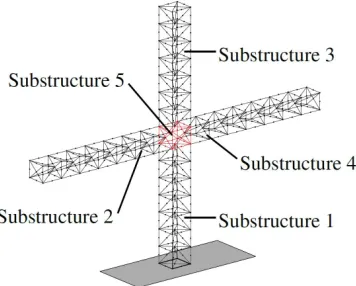
In [6] a three-dimensional frame made of steel beams
(Young‘s modulus 210 GPa, Poisson‘s ratio 0.3, and
density 7500 kgm3) schematically shown in Fig. 7 is
considered. Each cell in the frame has a height of 0.35 m and a width and depth of 0.5 m. All outer beams have a hollow circular cross-section with the outside and inside diameters 0.02 m and 0.018 m. The diagonal members inside the cells have a solid circular cross section with diameter 0.008 m. The frame is divided into 5 substructures and again the objective is
the approximation of the lowest eigenfrequencies ω
of the frame. Approximation of the eigenfrequencies of this system using the four presented methods with 4 normal modes per substructure (rigid body modes are not counted as free interface normal modes) is carried
out. The results presented in [6] for the DCBM were
obtained based erroneously on an incomplete set of free interface modes in the substructures using a simple Lanczos eigensolver: modes related to multiple frequencies were not determined by the simple Lanczos algorithm applied in that work.
Considering the geometry of the beam frame structure of the arms in Fig. 7, the symmetry of the substructures is identifiable resulting in multiple eigenfrequencies of the substructures. The simple Lanczos eigensolver (no blocks, no restarts) used in
[6] was not capable of determining multiple
eigenvalues reliably [11]. Hence, when the simple
Lanczos algorithm is used to determine the free modes of the substructure, modes that are multiple are missing and the representation of the lower spectrum is incomplete. Normal modes associated to the higher eigenfrequencies computed by the simple Lanczos eigensolver are used leading to poor approximation accuracy. Using the block Lanczos method and taking the lowest eigenfrequencies with associated subspaces of eigenvectors, the accuracy of the eigenfrequencies of the reduced global system obtained by the two reduction methods increases in the low frequency
range [11]. In this work we are using an eigensolver
capable of determining multiple eigenvalues for the comparison of the results obtained by the different
methods. Again the eigenfrequencies ωred of the
reduced system applying the CBM, the MNM and the
DCBM as well as the eigenfrequencies ωfull of the
full (non-reduced) system are computed. The
eigenfrequency relative errors
εrel j, =ωred j, −ωfull j, /ωfull j, comparing the eigenfrequencies of the non-reduced model with the
eigenfrequencies ωred of the reduced system obtained
by the reduction methods are plotted in Fig. 8.
Nevertheless, as already observed in [6], this confirms
that the accuracy of the DCBM in the low frequency
range is two orders of magnitude better than the CBM. Comparing only the free interface methods, the RM performs slightly better than the DCBM. Both the RM and DCBM give a much better approximation accuracy than the MNM.
3.3 Two-dimensional solid
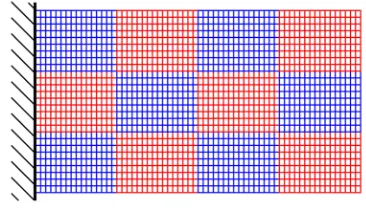
In order to emphasize the weak coupling between the substructure interfaces applying the DCBM, as described in section 2.2.3, the problem of a two
dimensional rectangle (density ρ, Young‘s modulus E,
Poisson‘s ratio ν = 0.3) decomposed in 12 substructures
as illustrated in Fig. 9 is considered. Each substructure
is discretized by 16×9 bilinear four-noded elements
(plane stress) and the structure is clamped on the left side in both directions. Again the objective is to
approximate the lowest eigenfrequencies ω of the
entire structure with the four different methods. Using 8 normal modes per substructure (not including potential rigid body modes) the relative errors
εrel j, =ωred j, −ωfull j, /ωfull j, depicted in Fig. 10 are resulting.
Making use of such a large reduction basis the DCBM and the RM give excellent results in the low frequency range in comparison to the CBM and the MNM. Approximating the 20 lowest eigenfrequencies of the full structure, neither compatibility problems nor trouble with negative eigenfrequencies occur during the reduction process with the DCBM. Similar
graphs depicting the relative errors εrel as in Fig. 10
are obtained using different numbers of normal modes per substructure for the four methods.
When considering a very small reduction basis for the substructures (using only a small number of normal modes), non-physical negative eigenvalues of the reduced problem show up in the low frequency
Fig. 8. Relative error εrel j, of eigenfrequency j using 4 normal
modes per substructure for the approximation of the lowest eigenfrequencies of the entire beam frame
Fig. 9. Two dimensional solid problem (dimensionless width lx = 16, height ly = 9 decomposed in 12 substructures; each
substructure is discretized by 16×9 bilinear four-noded elements (plane stress) and the structure is clamped on the left side in both
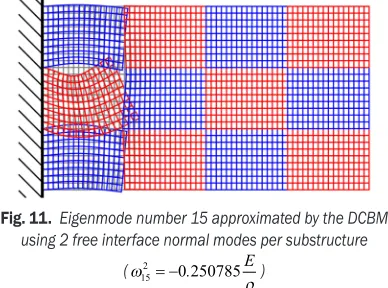
range. Using only 2 normal modes per substructure as reduction basis for this example negative values emerge among the 20 smallest absolute values of
eigensolutions ω2 applying the DCBM. In this case
the first 14 of the lowest absolute values of ω2 are
positive and the associated eigenmodes are approximating the true eigenvalues and eigenmodes of the full system accurately. But, as shown in Table 2,
the 15th eigenvalue is negative and the associated
eigenmode depicted in Fig. 11 shows the non-physical behavior of this eigensolution.
Fig. 10. Relative errorεrel j, of eigenfrequency jusing 8 normal modes per substructure for the approximation of the lowest
eigenfrequencies of the entire structure
Table 2. Number j and associated eigenvalue ωj2 of the two dimensional solid reduced with the DCBM
j ωj ρ
E 2
1 0.000874
2 0.009729
⁞ ⁞
14 0.245011
15 -0.250785
16 0.261676
The eigenmodes corresponding to negative eigensolutions with higher absolute values show similar behavior. All these negative eigenvalues are related to the weak compatibility on the interfaces and not meaningful from a physical point of view. Consequently detecting and filtering out those negative eigenvalues is an additional step in the DCBM compared to the other methods based on primal assembly. This extra step is cheap and therefore does not increase the effort of the reduction process
using the DCBM compared to the other four methods keeping the DCBM very efficient.
Fig. 11. Eigenmode number 15 approximated by the DCBM using 2 free interface normal modes per substructure
(ω
ρ 15
2
0 250785
= − . E)
4 CONCLUSIONS
In this paper the general concepts of the Craig-Bampton method (CBM), the MacNeal method (MNM), the Rubin method (RM) and the dual Craig-Bampton method (DCBM) were briefly presented, compared and discussed using three examples. The DCBM is outperforming the CBM using the same number of normal modes per substructure as reduction basis with comparable computational effort and having similar sparsity pattern of the reduced matrices. Comparing the free interface methods, the RM performs slightly better than the DCBM but results in full matrices. Both the RM and DCBM give a much better approximation accuracy than the MNM while the MNM generated always full coupled reduced matrices.
Properties of the DCBM were outlined and an additional necessary step, namely filtering out the negative eigensolutions, during the reduction process was illustrated. Non-physical negative eigenvalues of the reduced dual assembled problem are intrinsic in the reduction process using the DCBM caused by the weak compatibility on the interfaces between the substructures. Filtering out these negative eigenvalues is the decisive factor for the excellent approximation quality of the DCBM. The numerical effort adding this additional step is negligible keeping the efficiency of this method.
5 REFERENCES
[2] Craig, R.R., Bampton, M.C. (1968). Coupling of substructures for dynamic analyses. AIAA Journal, vol. 6, no. 7, p. 1313-1319, DOI:10.2514/3.4741.
[3] MacNeal, R.H. (1971). A hybrid method of component mode synthesis. Computers & Structures, vol. 1, no. 4, p. 581-601,
DOI:10.1016/0045-7949(71)90031-9.
[4] Rubin, S. (1975). Improved component-mode representation for structural dynamic analysis. AIAA Journal, vol. 13, no. 8, p. 995-1006, DOI:10.2514/3.60497.
[5] Herting, D.N. (1985). A general purpose, multi-stage, component modal synthesis method. Finite Elements in Analysis and Design, vol. 1, no. 2, p. 153-164,
DOI:10.1016/0168-874X(85)90025-3.
[6] Rixen, D.J. (2004). A dual Craig-Bampton method for dynamic substructuring. Journal of Computational and Applied Mathematics, vol. 168, no. 1-2, p. 383-391, DOI:10.1016/j. cam.2003.12.014.
[7] Voormeeren, S.N., Van Der Valk, P.L.C., Rixen, D.J. (2011). Generalized methodology for assembly and reduction of
component models for dynamic substructuring. AIAA Journal, vol. 49, no. 5, p. 1010-1020, DOI:10.2514/1.J050724.
[8] Craig, R.R., Chang, C.J. (1977). On the use of attachment modes in substructure coupling for dynamic analysis. 18th Structural Dynamics and Materials Conference, San Diego, p. 89-99, DOI:10.2514/6.1977-405.
[9] Rixen, D.J. (2011). Interface Reduction in the Dual Craig-Bampton method based on dual interface modes. Linking Models and Experiments, vol. 2, Conference Proceedings of the Society for Experimental Mechanics Series, p. 311-328,
DOI:10.1007/978-1-4419-9305-2_22.
[10] Benfield, W.A., Hruda, R.F. (1971). Vibration analysis of structures by component mode substitution. AIAA Journal, vol. 9, no. 7, p. 1255-1261, DOI:10.2514/3.49936.