Designing and Testing a Structural Model of Attachment Styles and
Negative Affects Variables as Predictors of Young Men's Body
Dissatisfaction
Neda Shahvaroughi Farahani
1, Faramarz Sohrabi
2, Golnaz Mazaheri Nejad Fard
3, Maral Hasan Larijani
41PhD Student of Psychology, Clinical and General Psychology Department, Faculty of Psychology
and Educational Sciences, Allame Tabataba'i University, Tehran, Iran
2Full Professor at Clinical and General Psychology Department, Faculty of Psychology and
Educational Sciences, Allameh Tabatabai University, Tehran, Iran
3PhD Student of Psychology, Applied Psychology Department, Faculty of Psychology and
Educational Sciences, Shahid Beheshti University, Tehran, Iran
4Master of Clinical Psychology, Clinical and General Psychology Department, Faculty of
Psychology and Educational Sciences, Allame Tabataba'i University, Tehran, Iran Submitted: 14 March 2018
Accepted: 17 April 2018
Int J Behav Sci. 2018; 12(1): 36-41
Corresponding Author: PhD Student of Psychology Golnaz Mazaheri_Nejad_Fard Applied Psychology Department, Faculty of Psychology and Educational Sciences,
Shahid Beheshti University, Tehran,
Iran.
E-mail: [email protected]
Abstract
Introduction: The main objective of this study was to investigate the role of attachment styles in body dissatisfaction with the mediating role of negative affects in male students at the Allameh Tabataba'i University.
Methods: In this paper, a cross sectional study was employed to survey convenience sampling method on 250 male students from March to May 2017. They answered the Depression Anxiety Stress Scales (DASS-21), Revised Adult Attachment Scale (RAAS) and Multidimensional Body-Self Relations Questionnaire-Appearance Scales (MBSRQ-AS). Structural equation modeling was utilized in this study. Results: Analysis of the data indicated that the proposed model had adequate goodness-of-fit indices. In addition, the findings demonstrated that attachment style was directly related to the body dissatisfaction. It should be noted that attachments style predicted slightly body dissatisfaction by the mediation of negative affects.
Conclusions: As a result, men with insecure attachment styles are likely to look more critical towards their bodies and experience more negative affects which may maintain body dissatisfaction.
Keywords: Attachment Styles, Negative Affects, Body Dissatisfaction
Introduction
Body image is a multidimensional concept including an individual's body related self-perceptions [1]. Hence, body image dysfunction can happen as perceptual distortion and attitudinal Body Dissatisfaction (BD) [2]. Furthermore, body dissatisfaction, worrying about gaining weight or becoming fat and growing impact of body image on self-evaluation are properties either bulimia nervosa or anorexia nervosa [3].
laws in Iran. For example, the Iranian people have to obey certain rules such as covering their body and hijab [8].
In spite the fact that plenty of research about risk model of body dissatisfaction have only included females [4], body image concerns among men differ from those typically reported by females. As well, it was concluded that young men desire and try to attain a muscular and/or lean body and fitness [9].
It should be mentioned that estimations of the prevalence of clinically significant levels of BD for men have not been observed. Thus researchers have suggested that male BD is related to negative outcomes, such as symptoms of eating disorder [10], unhealthy exercising behavior [11], steroid and drug use [12], and maladaptive dieting behaviors [13]. BD among men is also related to psychological problems, including depression and negative affects [14]. Likewise, since an important time for development of body image is early adulthood [15], thus identifying variables can play a significant role in young men's body dissatisfaction based on the associations between male BD, unhealthy psychological and physical side effects [16].
Moreover, emotional experiences has been
characterized by two main dimensions, like viz. positive Affect (PA) and negative affect (NA) [17]. According to emotion regulations and cognitive-behavioral theories of eating disorders [18], negative affects (e.g., depression, stress, and anxiety) are the closest psychological factors contributing to eating disorders. So, one of the candidates which led to increase the understanding of body dissatisfaction is found to be a negative affect [19]. In particular, it was disclosed that it has been linked to depression [20] and anxiety [21]. Also, a positive relationship has been suggested by researchers between eating pathology and stress [22]. Based on Webb, Zimmer-Gembeck and Mastro [23], people with more BD symptoms try to find relief from appearance-related distress, stress and compulsive behaviors through s.
Because body image roots in our interactions with others, theorists believe that significant others play a main role in the formation of body image [24], which attachment theory can explain it well [25]. It was revealed that attachment comes in three styles, including secure attachment, insecure avoidant attachment and insecure ambivalent/resistant attachment [26]. A great number of researchers have found that anxious attachment is a factor which is associated with body dissatisfaction [6]. However,
Conaway [27] examined the relations among adult attachment patterns, self-discrepancies and body dissatisfaction. As a result attachment style, regardless of the type, was not significantly associated with body dissatisfaction.
According to the attachment theory [28], people who have different attachment styles should vary in their emotional experiences. In addition, people with a secure attachment style should experience favorable emotional relationships characterized by frequent occurrence of moderate and strong positive affects and by less frequent occurrences of moderate and strong negative affects [29]. As well, they who display the avoidant and anxious attachment styles reported experiencing reliably more intense and mild negative affects and less intense and positive affects [30]. Also, regulating affects mediated the relationship between anxious attachment and BD among undergraduates [31].
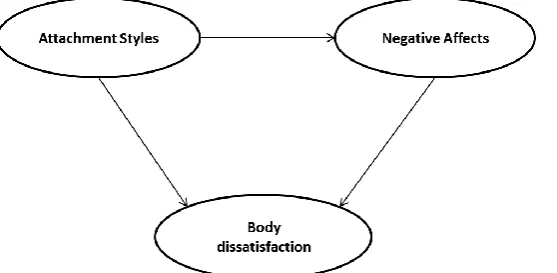
Despite the fact that researchers have only included female's risk factors of body dissatisfaction [4], consideration of body dissatisfaction in men is extremely important because body dissatisfaction has been increased among men within adolescence [32] and adulthood [16]. Moreover, due to cultural and economic differences and impossibility of generalizing the results of research which have been done in developed countries, more research must be carried out on men's body image in Iran as a developing country. Although the variables have been examined in previous related research, the relationship among attachment styles, negative affects and body dissatisfaction with each other and in a conceptual pattern (figure 1) has not yet been examined. Furthermore, the study aims to review the role of predicting attachment styles in body dissatisfaction, directly and indirectly by the mediation of negative affects.
Methods
The current research is a cross-sectional study, since it focuses on the relationship among attachment styles, negative affects and body dissatisfaction. The structural equation modeling method has been used to analyze the data. Hence, in the present study, 250 male students at Allameh Tabataba'i University of Tehran (Iran) were selected
through convenience sampling method from
March to May 2017.
The inclusion criteria for the participants was willing to be a volunteer for this study. Also, individuals were qualified for the present study if they had an Iranian nationality and aged 18–30 years old. Likewise, factors such as being professional athletes, having physical impairment and disability were considered as exclusion criteria. Finally, among all the men who met the inclusion criteria, 250 participants completed the questionnaires singlehandedly after the researcher's explanations. In addition to the needed guideline that was described in the questionnaires’ instructions, it was mentioned that participants should abstain from writing their names. Participants’ informed consent was gained, and it was explained to them that their private information would be kept confidential. The following instruments were employed:
The Multidimensional Body-Self Relations Questionnaire–Appearance Scales (MBSRQ–AS): The shorter version of the MBSRQ is called MBSRQ– Appearance Scales. It is a 34-items version that includes the following subscales: Appearance Evaluation, Appearance Orientation, Overweight Preoccupation, Self-Classified Weight and the Body Areas Satisfaction Scale (BASS). Each MBSRQ subscale score is the mean of its constituent items. Both the main factor and additional subscales of the MBSRQ–AS have good psychometric properties with reported internal consistency coefficients ranging from 0.7 to 0.89 and 1-mo. The test-retest reliabilities ranged from 0.74 to 0.91. The internal consistencies were based on normative samples and the test-retest reliability coefficients were obtained from the samples of college students aged 18 years and over. MBSRQ is also appropriate for individuals aged 15 year or older [33]. It should be noted that Cronbach’s alpha was calculated to be 0.60 in this study.
Depression Anxiety Stress Scale (DASS_21): Negative affects were measured by using the brief 21-item version of Depression Anxiety Stress Scale (DASS_21) that is a widely applied measure of negative affects in adults [34]. A great deal of literature shows that DASS is a reliable and valid measure of depression, anxiety and tension/stress in both nonclinical and clinical populations [35]. It was also found that the respondents displayed the extent to which they experienced each of the symptoms represented in the items during the previous week on a 4-point Likert-type scale ranging from0 (Did not apply to me at all) to 3 (Applying to me very much) [34]. In this study, Cronbach’s alpha and reliability of the questionnaire were 0.85.
Revised Adult Attachment Scale (RAAS): It contains 18 items which are measured through marking on a Likert scale. The three subscales of attachment, closeness, and anxiety are understood by factor analyzing which measures avoidant, secure and anxious ambivalent attachment styles. Collins and Read [36] showed that the subscales of attachment, closeness and anxiety stayed stable in the time-frame of two months and even 8 months, so they reported the Cronbach’s alpha scale was more than 0.80. It is worth to mention that the Cronbach’s alpha scale for the present study was calculated to be 0.62. For this purpose, all data were put into SPSS 16 and LISREL software, then, statistical methods were used to analyze the data.
Descriptive statistics were applied in order to calculate mean and standard deviation. Also, structural equation modeling was adopted to assess the relationships among the three variables in the present study.
Results
The mean and standard deviation of all variables were calculated and obtained 3.41 and 0.45 for attachment styles, 1.17 and 0.63 for negative affects, and 3.42 and 0.40 for body dissatisfaction. The first table illustrates the correlation matrix of variables. According to table 1 which reports linearity test, there is a linear relation between predictor variables and criterion variable (Pearson Correlation Coefficient between attachment styles and body dissatisfaction: 0.69, (P<0.05) and Pearson Correlation Coefficient between negative affects and body dissatisfaction: 0.65, (P<0.05)).
The structural equation modeling method was applied because not only can it measure a series of latent variables with groups of observed variables, but it can also analyze the structural relationships among latent variables. Statistical assumptions of the model of this study are considered appropriate. Table 2 displays the normality test of the data.
Kolmogorov-Smirnov test of table 2 reports the normality of investigated variables at the level of
significance of 0.05 (P˃0.05).
In addition, according to the multicollinearity test, there is an adequate relationship between attachment styles and body dissatisfaction, and
also between negative affects and body
dissatisfaction due to the fact that in this study Tolerance Coefficient is lower than 1 (0.95), and VIF is not higher than 10 and lower than 1 (1.047).
Table 1. Correlation matrix of variables (Pearson correlation coefficient)
Body dissatisfaction Negative affects
Attachment styles 1 Attachment styles
1 0.67
Negative affects
1 0.65
0.69 Body dissatisfaction
(P<0.05)
Table 2. Normality test of data
Attachment styles Negative affects Body dissatisfaction
Kolmogorov-Smirnov 0.85 1.2 0.74
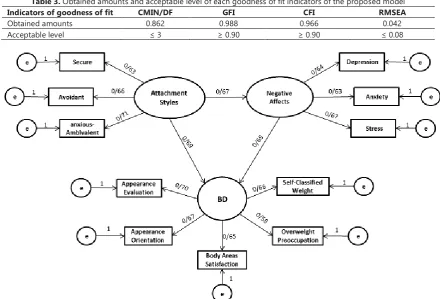
In the present model, all attachment styles, negative affect, and body dissatisfaction variables were latent constructs. Such that, attachment styles involved three observed variables (secure, avoidant and anxious-ambivalent), as well as negative affects included three observed variables (depression, anxiety, and stress), and body dissatisfaction included five markers (appearance
evaluation, appearance orientation, overweight
preoccupation, self-classified weight, and the body areas satisfaction). The results showed that all observed variables which are related to the latent variables in the model, have credible path coefficients. Therefore, the coefficients were calculated from 0.63 to 0.71 for attachment styles, 0.63 to 0.67 for negative affects and
0.58 to 0.70 for body dissatisfaction.
The goodness of fit of model was evaluated by: 1) Comparative Fit Indices (CFI), 2) Absolute Fit Indices (the ration of Chisquare to the degree of freedom or CMIN/DF, the Goodness of Fit Indices (GFI) and 3) Parsimonious Fit Index (the Root Mean Squares Error Approximation (RMSEA).
Table 3 presents the measurements for each goodness-of-fit indicator of the model and the acceptable level for each indicator's goodness-of-fit which is demonstrated [37].
Considering table 3 in detail, there is a good fit between the data and the model, and all coefficients of paths were meaningful.
Table 3. Obtained amounts and acceptable level of each goodness of fit indicators of the proposed model
Indicators of goodness of fit CMIN/DF GFI CFI RMSEA
Obtained amounts 0.862 0.988 0.966 0.042
Acceptable level ≤ 3 ≥ 0.90 ≥ 0.90 ≤ 0.08
Figure 2. The proposed model after fitting for relationship among negative affects, attachment styles and body dissatisfaction
Discussion
This study investigated the phenomenon of young men's body dissatisfaction using structural equation modeling to determine the direction of the relationship between BD and attachment styles. Thus, a mechanism potentially underlying this relationship was examined. Actually, in addition to a direct pathway, BD shows an indirect relationship with attachment styles by the mediation of negative affects. Furthermore, the findings of this research can provide clear support in the proposed model, which had adequate goodness-of-fit indices. Results lend support that BD was directly associated with a greater number of indices of attachment styles (insecure avoidant attachment, insecure ambivalent/resistant attachment and secure attachment), which is consistent with research such as Hardit and Hannum [6].
Due to the cross-sectional design of the study, the causal relation between insecure attachment and body
their own bodies critically as a visible and concrete way to evaluate and devalue themselves. They are also more likely to just notice other's point of view about their appearance and eventually internalize the thin ideals portrayed into other's standpoint in an interpersonal context which results in the increase of their body dissatisfaction. Also, it seems that anxious attachment which represents sensitivity to rejection and abandonment causes individuals to use body surveillance as a procedure to face rejection. This procedure in turn results in poorer body image and increased body dissatisfaction.
As expected, negative affects predicted body dissatisfaction directly [19]. In addition, it can be interpreted that perhaps, men's perceptions of their psychological weakness which stems from negative affects generalizes their beliefs about their physical weakness. As a result, they would want to gain strength via muscle building efforts, such as excessive dieting, unhealthy exercising behaviors, or steroid use [11, 13]. On the other hand, these efforts can be used to deal with negative affects, so that it sounds there is a circle. It means that negative affects cause dissatisfaction of body and then BD intensifies negative affects.
As well, women rate men according to their face and body more than before [38]. Thus, the men's bodies are now being more objectified than before [7]. Besides, there have been increased in the commodification of men's bodies in the last decades [39], which have been associated with media representations of the male body as an identity project [39, 40]. These changes may lead to more negative affects, distress, and worry about looking good and then increases the appearance investment and body dissatisfaction among young men.
The findings of our study also indicates that there is a relationship between BD and attachment styles with the mediating role of negative affects which is consistent with Perry et al. [31]. Furthermore, attachment styles play a central role in affective response patterns. It means that secure attachment style leads to more positive affects and avoidant, as well as anxious attachment styles cause more negative affects. To explain the model, body dissatisfaction might be developed among individuals with preoccupied attachment styles who merge being worried about physical attractiveness with an internalized negative model of self. Hence, adults with different attachment styles should differ in their emotional reactions to potentially negative relational events and in association with our study, individuals who report more anxiety in their relationships with others have more anxiety about the size of their body and form of it due to the importance of appearance for social relations. Moreover, it has been hypothesized that the development of BD is associated with perceived approval or rejection from others among insecurely attached individuals. Because of this heightened concerns over others' reactions, the sense of body dissatisfaction becomes conditional in how a person feels based on others' appearance-related messages. Moreover, if a person with an insecure attachment style receives a negative message
about appearance, the concluded negative affect will cause BD, so that it will cause a more negative affect.
The most significant strength of the present study is a large sample size and the use of a structural model and attention to the body dissatisfaction among Iranian young men. Besides, there were several limitations in this study which should be considered in order to appropriately interpret the findings. Firstly, the study was a cross-sectional one, which reduces causal inferences. Secondly, convenience sampling method was used which led to encountering with the problem of generalizing results. In addition, the present study relied solely on self-report. It is recommended that further studies include additional measures such as objectively measured physiological assessments of stress, assessment of actual behavioral outcomes, or collecting information from other sources such as parents, partners and close friends to clarify this issue. Moreover, the focus of this study was merely on male body image; therefore, we cannot extrapolate the findings to fit the entire population. Despite these limitations, the primary results of the study have implications for prevention and interventions intended to reduce body dissatisfaction.
Conclusions
In summary, men with insecure attachment styles are likely to look more critical towards their bodies and experience more negative affects which may maintain body dissatisfaction. It would be advantageous to focus
on reducing or controlling specific sources of negative
affects and moderating improper attachment styles concurrently in designing targeted prevention programs or treatments.
Acknowledgements
The authors thank the participants for sharing their experiences.
References
1. Cash TF. Body image: Past, present, and future. Body Image. 2004 Jan;1(1):1–5. doi: 10.1016/S1740-1445(03)00011-1. [MubMed PMID: 18089136]
2. Skrzypek S, Wehmeier PM, Remschmidt H. Body image assessment using body size estimation in recent studies on anorexia nervosa. A brief review. Eur Child Adolesc Psychiatry. 2001 Dec; 10(4):215-21. doi: 10.1007/s007870170010 · [PubMed PMID: 11794546]
3. American Psychiatric Association. Diagnostic and statistical manual of mental disorders (5th Ed.), DSM-5. Washington, DC: Author; 2013.
4. Nikniaz Z, Mahdavi R, Amiri S, Ostadrahimi A, Nikniaz L. Factors associated with body image dissatisfaction and distortion among Iranian women. Eating Behav. 2016 Aug; 22:5–9. doi: 10.1016/j.eatbeh.2016.03.018. [PubMed PMID:27046301] 5. Luo Y, Parish WL, Laumann EO. A population-based study of
body image concerns among urban Chinese adults. Body Image. 2005 Dec; 2(4): 333–345. doi: 10.1016/j.bodyim.2005.09.003 6. Hardit SK, Hannum JW. Attachment, the tripartite influence
model, and the development of body dissatisfaction. Body
Image. 2012 Sep; 9(4): 469–475.
doi:10.1016/j.bodyim.2012.06.003. [PubMed PMID: 22795652] 7. Ricciardelli LA, Williams RJ. Beauty over the centuries: Male. In: Cash TF, editor. Encyclopedia of body image and human appearance (Vol. 1) San Diego, CA: Elsevier Academic Press; 2012. p. 50-57. doi: 10.1016/B978-0-12-384925-0.00094-8. 8. Abdollahi P, Mann T. Eating disorder symptoms and body image
and in America. Int J Eat Disord. 2001 Nov; 30(3): 259–268. doi: 10.1002/eat.108. [PubMed PMID: 11746285]
9. Gattario KH, Frisen A, Fuller-Tyszkiewicz M, Ricciardelli L, Diedrichs P, Yager Z, et al. How is men’s conformity to masculine norms related to their body image? Masculinity and muscularity across Western countries. Psychol Men Masc. 2015 Jul; 16(3): 337–347. doi: 10.1037/a0038494
10. Olivardia R, Pope HG, Borowiecki J, Cohane GH. Biceps and body image: The relationship between muscularity and self-esteem, depression, and eating disorder symptoms. Psychol Men Masc. 2004 Jul; 5(2): 112–120. doi: 10.1037/1524-9220.5.2.112. 11. Tod D, Edwards C, Hall G. Drive for leanness and health-related behavior within a social/cultural perspective. Body Image. 2013 Jun; 10(4): 640–643. doi: 10.1016/j.bodyim.2013.05.002. 12. Galito R, Crowther JH. The effects of exposure to slender and
muscular images on male body dissatisfaction. Body Image. 2013 Sep; 10(4): 566–73. doi: 10.1016/j.bodyim.2013.07.009. [PubMed PMID: 24008185]
13. Parent MC, Moradi B. His biceps become him: A test of objectification theory’s application to drive for muscularity and propensity for steroid use in college men. J Couns Psychol. 2011 Apr;58(2):246-56. doi: 10.1037/a0021398. [PubMed PMID: 21142351]
14. Ricciardelli LA, McCabe MP, Lillis J, Thomas K. A longitudinal investigation of the development of weight and muscle concerns among preadolescent boys. J Youth Adolesc. 2006 Mar; 35(2): 177–187. doi: 10.1007/s10964-005-9004-7.
15. McPherson KE. Physical appearance changes across adulthood: Men. In: Cash TF, editor. Encyclopedia of body image and human appearance, 2: 595–601. San Diego, CA: Elsevier Academic Press; 2012. doi: 10.1016/B978-0-12-384925-0.00094-8.
16. Thompson K, Cafri G. The muscular ideal: Psychological, social and medical perspectives. Washington: American Psychological Association; 2007.
17. Watson D, Clark L. On traits and temperament: general and specific factors of emotional experience and their relation to the five-factor model. J Pers. 1992 Jun;60(2):441-76. doi: 10.1111/j.1467-6494.1992.tb00980.x. [PubMed PMID: 1635050]
18. Fairburn CG, Shafran R, Cooper Z. A cognitive–behavioral theory of anorexia nervosa. Behav Res Ther. 1999 Jan;37(1):1-13. doi: 10.1016/S0005-7967(98)00102-8. [PubMed PMID: 9922553]
19. Heywood S, McCabe MP. Negative affect as a mediator between body dissatisfaction and extreme weight loss and muscle gain behaviors. J Health Psychol. 2006 Dec; 11(6): 833-844. doi: 10.1177/1359105306069077.
20. Bearman SK, Stice E. Testing a gender additive model: The role of body image in adolescent depression. J Abnorm Child Psychol. 2008 Nov; 36(8): 1251–1263. doi: 10.1007/s10802-008-9248-2. [PubMed PMID: 3606557]
21. Atalay AA, Gencoz T. Critical factors of social physique anxiety: Exercising and body image satisfaction. Behav Change. 2008 Sept; 25(3): 178-188. doi: 10.1375/bech.25.3.178.
22. Inniss D, Steiger H, Bruce K. Threshold and subthreshold post-traumatic stress disorder in bulimic patients: Prevalence and clinical correlates. Eat Weight Disord. 2011 Mar;16(1):e30-6. doi: 10.1007/BF03327518. [PubMed PMID: 21727779] 23. Webb HJ, Zimmer-Gembeck MJ, Mastro SH. Stress exposure
and generation: A conjoint longitudinal model of body dysmorphic symptoms, peer acceptance, popularity, and victimization. Body Image. 2016 Sep; 18: 14–18. doi: 10.1016/j.bodyim.2016.04.010. [PubMed PMID: 27236472] 24. Tantleff-Dunn S, Gokee JL. Interpersonal influences on body
image development. In: Cash TF, & Pruzinksy T, editors. Body image: A handbook of theory, research, and clinical practice. New York: Guilford Press; 2002. p. 108–116.
25. Cash T, Fleming E. The impact of body image experiences: Development of the body image quality of life inventory. Int J Eat Disord. 2002 May;31(4):455-60.doi: 10.1002/eat.10033. [PubMed PMID: 11948650]
26. Mikulincer M, Florin V. Attachment style and affect regulation: Implications for coping with stress and mental health. In: Fletcher GIG, Clark MS, editors. Blackwell handbook of social psychology: interpersonal process. Oxford, UK: Blackwell publishers; 2001. p. 537-557.
27. Conaway R. Self- discrepancy as a mediator in the relationship between adult attachment and body image dissatisfaction. A
thesis submitted to the Kent State University Honors College in partial fulfillment of the requirements for Department Honors. 2011.
28. Bowlby J. Separation: Anxiety and anger. Attachment and loss: Vol 2. New York: Basic Books; 1973.
29. Berscheid E. Emotion. In: Kelley HH, Berscheid E, Christensen A, Harvey JH, Huston TL, Levinger G, McClintock E, Peplau LA, Peterson DR, editors. Close relationships. New York, NY: Freeman; 1983. p. 110-168.
30. Simpson JA. Influence of attachment styles on romantic relationships. Personality and social psychology. 1990; 59(5): 971-980. doi: 10.1037/0022-3514.59.5.971.
31. Perry S, Ditommaso E, Robinson B, Doiron Y. Attachment and coping: implications for problematic eating behaviors and body image disturbances. Canadian Psychology. 2007; 48, 86. 32. Rodgers RF, Ganchou C, Franko DL, Chabrol H. Drive for
muscularity and disordered eating among French adolescent boys: A sociocultural model. Body Image. 2012 Jun; 9(3):318- 323. doi: 10.1016/j.bodyim.2012.03.002. [PubMed PMID: 22494958]
33. Cash TF. MBSRQ users' manual. 3rd ed. Norfolk, VA: Old Dominion Universal Press; 2000.
34. Lovibond PF, Lovibond SH. The structure of negative emotional state: comparison of the Depression Anxiety Stress Scale (DASS) with the Beck Depression and Anxiety Inventories. Behav Res Ther. 1995 Mar; 33(3):335–343.doi: 10.1016/0005- 7967(94)00075-U. [PubMed PMID: 7726811]
35. Henry JD, Crawford JR. The short-form version of the Depression Anxiety Stress Scale (DASS-21): construct validity and normative data in a large non-clinical sample. Br J Clin Psychol. 2005 Jun; 44(2):227-239. doi: 10.1348/014466505X29657. [PubMed PMID: 16004657] 36. Collins NL, Read SJ. Adult attachment, working models, and
relationship quality in dating couples. J Pers Soc Psychol. 1990 Apr; 58(4), 644-663. doi: 10.1037/0022-3514.58.4.644. [PubMed PMID: 14570079]
37. Mulaik SA, James LR, Van Alstine J, Bennett N, Lind S, Stilwell CD. Evaluation of goodness-of-fit indices of structural equation models. Psychol Bull. 1989 May; 105(3): 430- 445. doi: 10.1037/0033-2909.105.3.430.
38. Braun MF, Bryan A. Female hip and male waist-to-shoulder ratios as determinants of romantic partner desirability. J Soc Pers Relat. 2006 Oct; 23(5):805–819. doi: 10.1177/0265407506068264.
39. Gill R, Henwood K, McLean C. Body projects and the regulation of normative masculinity. Body Soc. 2005 Mar; 11(1):37–62. doi: 10.1177/1357034X05049849.