http://avr.tums.ac.ir
RESEARCH ARTICLE
The effectiveness of group counseling based on problem-solving
on aggression and social adjustment in hearing-impaired
students
Mahdiyeh Azizi1, Mohsen Saeidmanesh1*, Fateme Kazemi1, Vahide Radaie2
1- Department of Psychology, School of Humanities, Science and Arts University, Yazd, Iran 2- Department of Psychology, Science and Research Branch, Islamic Azad University, Tehran, Iran
Received: 5 Aug 2018, Revised: 26 Nov 2018, Accepted: 11 Dec 2018, Published: 15 Jul 2019
Abstract
Background and Aim: One of the common behavioral disorders of hearing-impaired child-ren is aggressive behavior, which can affect soc-ial adjustment in their adolescence. This study was designed to investigate the effectiveness of group counseling based on problem-solving on aggression and social adjustment of hearing-impaired students.
Methods: This study is quasi-experimental with pretest posttest design and a control group. The study population was all adolescents with hear-ing impairment referred to Yazd Speech The-rapy Centers, Yazd City, Iran. A total of 30 stu-dents were selected from the referred hearing-impaired students with high aggression and low social adjustment. Then they were randomly assigned into control (n = 15) and experimental (n = 15) groups. The study instruments were the California social behavior and Buss and Perry aggression inventory. The group couns-eling based on problem-solving intervention consisted of 7 one-hour sessions, presented for the experimental group. We analyzed the obtai-ned data by repeated measures analysis of cova-riance.
Results: Group therapy based on problem-solving can reduce aggression (p < 0.001) and increase social adjustment (p = 0.04).
Conclusion: The professionals in this field are recommended to use group therapy based on problem-solving.
Keywords: Group counseling; problem-solving; aggression; social adjustment; hearing
impairment
Citation: Azizi M, Saeidmanesh M, Kazemi F, Radaie V. The effectiveness of group
counseling based on problem-solving on aggression and social adjustment in hearing-impaired students. Aud Vestib Res.
2019;28(3):164-172.
Introduction
Hearing impairment is either a congenital or acquired injury in children. Studies on deafness suggest that hearing loss is not necessarily ass-ociated with mental health problems; however, hearing loss in combination with physical, com-munication, and adverse conditions of life leads to anxiety, and mood or behavioral problems [1]. Aggression is one of the subjects that can create problems for deaf children. Aggression is often a fixed and sustained behavioral pattern and is part of a symptom pattern in many types of children's pathologies such as oppositional * Corresponding author: Department of Psychology,
School of Humanities, Science and Arts University, Daneshjoo Blvd., Yazd, 13335-89167, Iran. Tel: 009835-38264090,
defiant disorder, conduct disorder, post-trau-matic stress disorder, and mood disorders [2]. literature review have shown that students with hearing impairment show more aggression than other people due to defective cognitive, social, communicational, and emotional skills [3-5]. For example, Amini et al. study results suggest that deaf children express more anxiety, depre-ssion, and aggression than normal peers. Also, this problem is seen more in deaf boys than deaf girls. His study’s results indicate that these individuals show not only more aggression but also inappropriate behavior [4].
The aggression in these children seems to be due to ineffective communication, the feeling of failure to reach their objectives, not effective in interpersonal and social environments. In other words, aggression is a reflection of the lack of power and inadequate efforts to achieve their goals [5]. Literature review and continuous res-earch indicate that such behavioral pattern can disturb social growth and satisfactory relation-ships with peers, and predict social incompa-tibility in adolescence and adulthood. Also, it is associated with poor educational efficacy, lear-ning difficulties, delinquency in school, casta-way, and being fired from the school. Children with behavioral incapability such as aggression, based on their experiences in social situations and interpersonal relationships, develop cogni-tive behavioral bias, and cannot establish rela-tionships based on trust and respect [6]. All of these issues can disturb social adjustment in these children.
Social adjustment is one of the most important predictors of mental health. This topic has dra-wn the attention of psychologists and sociolo-gists in recent decades. Social adjustment invol-ves the individual’s adapting to the external environment by changing the environment or oneself [7]. In a study on social adjustment of deaf children, the result shows that these people are less likely to participate in social activities, and most of them are not members of public social organizations [8]. The results of Hossein Khanzadeh et al.’ study [9] have shown that children with visual and auditory impairment in social situations, such as entering a peer group
and responding to social expectations, have more problems than normal children. Also, according to Bittencourt et al. study [10], deaf students have a more immature social relation-ship than normal hearing students. Biabangard [11] concluded that the social skills defects in deaf children were significantly more than those in blind children. Also, Jones and Loeb [12] reported that deaf people had lower levels of mental health compared to hearing-impaired people, were more socially uncompromising, and had more mood problems than other ren. The cause of low social adjustment in child-ren with hearing impairment can be attributed to their defect in social information processing. These people disturb others by using the wrong method of self-assertion and inability to nego-tiate and talk to others. They may misinterpret social guidance and attribute hostility to the others. The lack of social skills in these indi-viduals may lead to low frustration tolerance, which disrupts their adaptation to the social environment [13].
http://avr.tums.ac.ir Aud Vestib Res (2019);28(3):164-172.
aggression and increase social adjustment in children with hearing impairment. For example, the study results of Gann et al. show that exe-cutive function training, such as decision-mak-ing skills and thinkdecision-mak-ing strategies about the problem reduce aggression in these children [18]. Also, the results of Abdollahi Boughrabadi et al. show that sand-play therapy reduces agg-ression among deaf boy students [13]. The res-ults of Faramarzi and Moradi study also indicate the effectiveness of art therapy on increasing the social adjustment of deaf girl teens [19]. In addition to filling this research gap in our study, another advantage of this study is related to the samples who are hearing-impaired teenagers. Because on the one hand, the teenager faces the crisis of entering the adult world, and on the other hand, he or she undergoes a lot of changes physically, emotionally, and psychologically, which may lead to emotional instability and upheaval against the family and relatives in the adolescent. It also doubles their difficulties when it combines with hearing impairment [20]. Our study also focuses on adolescents with moderate hearing impairment because they ben-efit from rehabilitation and counseling services, and have a better vocabulary than those with severe hearing impairment. However, as previ-ously mentioned, hearing loss causes psycholo-gical problems. Therefore, considering the agg-ression in children with hearing impairment, their need for social adjustment, and the lack of study background, we aimed to investigate the effectiveness of problem-solving skills training on aggression and social adjustment of hearing-impaired adolescents.
Methods
Participants
The present study was a quasi-experimental stu-dy with pretest-posttest and a control group. The statistical population of this study included all adolescents with hearing impairment in Yazd City, Central Iran, who referred to Yazd Speech Therapy centers in 2017. At first, aggression and social adjustment questionnaires were dist-ributed among 90 of them. Then, 30 adolescents who got high aggression scores (cutoff score of
70) and low social adjustment (cutoff score of 55) were selected by convenience sampling method and randomly assigned into experiment-al and control groups. The inclusion criteria were as follows: no vision or mental problems, 14–18 years old, male, with moderate (hearing loss 41−55 dB) or mild hearing impairment (hearing aid 20 to 40 dB), and use of hearing aids as communication tools. The exclusion cri-teria were as follows: extreme psychiatric dis-orders, use of psychiatric drugs such as anxio-lytic drugs, failure to attend training sessions, or inability to complete questionnaires due to sev-ere hearing impairment.
Regarding the ethical considerations, the resear-chers have carefully monitored the completion of the questionnaires and explained study prin-ciples such as the right to participate in the study with informed consent, the right to with-draw from the study, and the confidentiality of their information. The written consent for parti-cipation in the research was obtained. The data collection tools were Buss and Perry (1992) [21] and California social behavior questionnaire [22]. It should be noted that the questionnaires were completed by adolescents, and the resear-chers were accompanied by a speech therapist at the time of the implementation of the question-naires. If the adolescent could not understand the questions, they would be explained to them.
Assessment tools
Aggression questionnaire
anger, and 0.80 for hostility [21].
California social behavioral inventory
In the present study, we measured the social adjustment by a subtest of social adjustment for children and adolescents of California social behavior questionnaire. This test, designed by Clark et al. in 1953, consists of two components of social adjustment and individual adjustment. The subtest of social adjustment consists of 91 two-option (yes or no) questions in which six scores are related to factors such as social tem-plates, social skills, antisocial interests, family relationships, school relationships, social rela-tionships, and a score is related to social adjust-ment [22]. Schaefer obtained the test reliability coefficients by using the modified Spearman-Breton form 0.89−0.90 for individual adjust-ment subtest, 0.87−0.91 for social adjustadjust-ment, and 0.93 for the total score [23]. The reliability coefficients of this test in Khojastemehr study [24] on blind and sighted adolescents was acq-uired using the Kuder-Richardson formula 20. The reliability coefficients for the individual adjustment subtest were 80% for the not-blind group and 88% for the blind group; for the
social adjustment, the reliability coefficients were 79% for the sighted group and 88% for the blind group.
Procedure
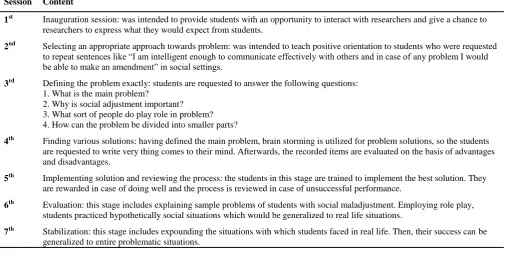
Table 1 presents a summary of problem-solving training sessions. The problem-solving training method in this study is based on the proposed protocol of D’zuriila and Nezu [25], which was presented as "social problem-solving," and the content of the sessions are related to problem-solving in situations and social relationships. The researchers used this protocol because they sought to increase social adjustment and reduce aggression in adolescents with hearing impair-ment. Power point and images were also used to suit this protocol for hearing-impaired teena-gers. The training sessions were held once a week for two hours, and a psychologist with a speech therapist conducted the group therapy.
Data analysis
After 7 sessions, the questionnaires were re-administered as a posttest in both groups. The obtained data were analyzed in SPSS 21. We used the mean and standard deviation to analyze
Table 1. The content of problem-solving-based group counseling sessions
Session Content
1st Inauguration session: was intended to provide students with an opportunity to interact with researchers and give a chance to researchers to express what they would expect from students.
2nd Selecting an appropriate approach towards problem: was intended to teach positive orientation to students who were requested to repeat sentences like “I am intelligent enough to communicate effectively with others and in case of any problem I would be able to make an amendment” in social settings.
3rd Defining the problem exactly: students are requested to answer the following questions: 1. What is the main problem?
2. Why is social adjustment important? 3. What sort of people do play role in problem? 4. How can the problem be divided into smaller parts?
4th Finding various solutions: having defined the main problem, brain storming is utilized for problem solutions, so the students
are requested to write very thing comes to their mind. Afterwards, the recorded items are evaluated on the basis of advantages and disadvantages.
5th Implementing solution and reviewing the process: the students in this stage are trained to implement the best solution. They are rewarded in case of doing well and the process is reviewed in case of unsuccessful performance.
6th Evaluation: this stage includes explaining sample problems of students with social maladjustment. Employing role play, students practiced hypothetically social situations which would be generalized to real life situations.
http://avr.tums.ac.ir Aud Vestib Res (2019);28(3):164-172.
the variables of aggression and social adjust-ment at the descriptive level, and Shapiro-Wilk, Levene’s test, and ANCOVA at the inferential level.
Results
The number of participants in this study was 30 adolescent boys, aged 14 to 18 years. The mean (SD) ages of the experimental group and the control group were 13.5 (3.14) and 14 (3.86) years, respectively. The results of the Levene’s test and Shapiro-Wilk test confirmed that the assumptions of covariance analysis.
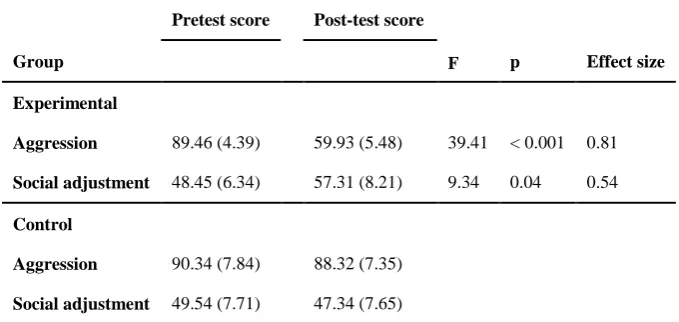
As shown in Table 2, the mean scores for agg-ression in the posttest decreased in the experi-mental group, and the results of the covariance analysis indicated that the F value for the agg-ression variable was 41.39 (1.27). The data indi-cate that this difference between two groups was significant with the elimination of the effect of the pretest because the level of p value was less than 0.05 (p < 0.001). Therefore, problem-solving skills training can reduce aggression in children with hearing impairment. The scores for the effect size indicate that 81% of the diff-erence between the two groups is related to the intervention. Also, in the case of the social adj-ustment variable, the results of this Table indi-cate that the mean scores of the experimental group in the posttest increased compared to the pretest scores, and according to the results of
covariance analysis, the F value for this variable is 34.9 (1.27) and p value is 0.04. Because this value is less than 0.05 (p = 0.04), this value is significant at 95% confidence. Also, the coeffi-cient of effect size indicates that 54% of the difference between the test and control groups is related to problem-solving training. Therefore, problem-solving training increases social adjust-ment in children with hearing impairadjust-ment.
Discussion
This study aimed to investigate the effectiveness of problem-solving group training on aggression and social adjustment of hearing-impaired ado-lescents. As stated, the results of this study sho-wed that group-based problem-solving training reduced aggression in these individuals. The results of this study are consistent with Tageri findings that this training had an impact on stu-dents' aggression and interpersonal sensitivity [15], as well as McMuran et al., and D’zurilla et al., studies which reported a relationship bet-ween problem-solving skills and aggression in people [16,17]. As previously mentioned, res-earchers found no studies on the effect of problem-solving training on the aggression of deaf people, but the results of this study are somewhat consistent with studies that show the effectiveness of the psychological intervention on reducing the aggression of hearing-impaired people. So our results are consistent with Gann
Table 2. Covariance analysis of the mean (standard deviation) score of aggression and social adjustment in experimental and control group (n = 15 each)
Pretest score Post-test score
Group F p Effect size
Experimental
Aggression 89.46 (4.39) 59.93 (5.48) 39.41 < 0.001 0.81
Social adjustment 48.45 (6.34) 57.31 (8.21) 9.34 0.04 0.54
Control
Aggression 90.34 (7.84) 88.32 (7.35)
et al. [18] study results, who reported that teaching skills such as decision-making skills and executive functions would reduce aggre-ssion. Also, Abdullahi Boughrabadi et al. [13] reported that sand play therapy could reduce aggression in deaf children. To explain the res-ults of the present study, we can mention the basis of the problem-solving approach. That is, many psychological and social damages are due to the lack of coping behavior or the use of ineffective coping behaviors [17]. The deficit in coping behavior is the source of maladjustment, aggression, undesirable emotional complicatio-ns, and behavioral problems. Aggressive people adopt fewer solutions to difficult social condi-tions. Also, their solutions are less effective and more aggressive than normal people. During problem-solving training, the individual learns to carefully define the problem and then examines the different solutions to the problem and chooses the most effective one. This new approach creates more esteem and self-worthiness and reduces frustration due to the lack of problem-solving that occurs in people with hearing impairment [19]. The objective of problem-solving training is to teach the subjects how to think about issues. This training is a way to reinforce reasoning and use of personal val-ues to decide on the problems. Eventually, the person with problem-solving skills, unlike those who lack this skill does not show aggressive-ness. Armed with this skill, the person can ana-lyze problems, discover their true reasons, and act effectively and on time. Problem-solving skills enhance social and psychosocial capabi-lities and help people effectively deal with conflicts and life problems [26]. By training the problem-solving skills, the frontal lobe of the brain, which is the center of thinking and decision-making, dominates the limbic system, which is the emotional part of the brain, thereby better controlling the anger emotion [27]. In the cognitive-behavioral approach, aggression and aggressive response are supposed to be due to an inadequate and distorted cognitive struc-ture. As a result of the understanding of difficult situations (in which the person got angered), the people’s behaviors change and modify.
Education and in this research, the problem-solving skills empowerment can change the ina-dequate cognitive structure of the people with a hearing impairment and equips them with new solutions and reduces their aggression [28]. Also, for people with hearing impairment, as mentioned previously, one of the causes of agg-ression is the lack of communication skills and satisfaction in reaching their goals [5]. Group training sessions also help them with group communication skills. The group can allow peo-ple with hearing impairment to know about themselves in the crowd. They can also learn from others who are like themselves and trans-fer their knowledge and experiences.
Another finding of this study was that group-based problem-solving training could increase social adjustment in adolescents with hearing impairment. Unfortunately, we found no study on the effectiveness of problem-solving training on social adjustment of adolescents with hearing impairment, but study on other groups has been done with similar titles. For example, Soudani et al. [29] reported that problem-solving skills tra-ining affected the individual and social adju-stment of divorced women. Also, the results of Pendergrass and Hodges study [30] showed that deaf students had difficulty in social skills, and educating these children could improve their communication and social skills; this result is consistent with this study. Also, investigation of Marschark and Everhart showed that 7-year-old children with hearing impairments had difficulty in problem-solving strategies in comparison with their normal peers, and this would prevent them from resolving cognitive problems [31]. Also, the results of Faramarzi and Moradi study indicate that art therapy is effective on the social adjustment of hearing-impaired students [19]. Our study result is consistent with their study too.
http://avr.tums.ac.ir Aud Vestib Res (2019);28(3):164-172.
ability can help the adolescents with hearing impairment to have a more in-depth insight and attention toward interpersonal communication and social relationships, and rationally resolve issues that arise in this area, also clearly define their expectations and views. So that they can respond more logically to the needs of the envir-onment and their social adjustment increases [29]. Problem-solving is a cognitive behavioral process used by a person to identify and effec-tively deal with difficult daily situations [30]. During problem-solving training sessions, parti-cipants in the group express problems they are facing in the social events, and solutions for solving problems are introduced, and among them, the best solution is chosen, and over time, these solutions are extended to other situations. Therefore, many cognitive skills are obtained through problem-solving skills, such as problem diagnosis, investigation of the consequences of the chosen solution, preoperative thinking. In addition, thinking about various solutions in the learning outcomes increases coping skills like problem-solving, and people with hearing impairments can resolve their conflicts with other people. Teaching problem-solving skills can help adolescents with hearing impairment with their self-awareness. They learn to evaluate their responses when faced with failures and choose the appropriate responses. They get fam-iliar with emotional regulation techniques, thus communicating between them increase, which leads to social adjustment [32]. Teaching social problem solving by combining cognitive-beha-vioral techniques, teaching motivational skills, and useful encounter to cope with continuous changes in life, as well as teaching failure skills, will increase social adjustment in people with hearing impairment [33].
On the other hand, one of the problems in people with hearing impairment is poor self-concept [34]. People with poor self-self-concept show negative perceptions about themselves in social relationships. Problem-solving training improves this self-concept by getting suitable social codes and increasing self-esteem, and as a result of improving self-concept, the relation-ships of people with hearing impairment would
become more effective. Since the problem-solving training program provides basic skills for those who lack them (like those with hearing impairment), this approach might be effective. It can also be argued that one of the most pro-minent characteristics of hearing-impaired peo-ple is their disability to establish productive and satisfying relationships with other people [9-12]. These individuals are in difficulty in acqui-ring social skills, and their cognitive limitation makes them unaware of how to behave in different social situations. On the other hand, long social avoidance may limit the person's opportunities to learn the right social skills, so getting into group training sessions will provide this opportunity to have social communication and thus improve their social adjustment.
This research, like other studies, have some lim-itations. Among these limitations, we can refer to single-sex samples (boys), use of self-repor-ting tools, lack of follow-up, and use of avai-lable sampling method. So researchers recom-mend that the effectiveness of this treatment be investigated in other children with special needs and use clinical interviews rather than ques-tionnaires. Also, studies are recommended to compare the effectiveness of this method with other therapeutic and educational practices for aggression and adjustment. Since the study was conducted on adolescents with moderate and mild hearing impairment, researchers are advi-sed to explore the impact of problem-solving training on people with more severe hearing loss and provide appropriate therapeutic protocols for these groups, too.
Conclusion
Problem-solving skills training is a simple pro-cess that can be easily trained. The results of this study and previous studies have proved the usefulness of this interventional approach. Thus, we recommended its use in therapeutic strate-gies in this area.
Acknowledgments
IR.SSU.REC.1398.008. We thank all those who participated in this study, especially the hearing-impaired children and their family.
Conflict of interest
The authors declared that they had no conflict of interest.
References
1. Pakzad M, Faramarzi S, Ghamarani A. [The effecti-veness of mother training based on the model of positive parenting on the rate of behavioral disorders symptoms in deaf students]. Audiol. 2014;23(4):77-83. Persian.
2. Burk LR, Armstrong JM, Park JH, Zahn-Waxler C, Klein MH, Essex MJ. Stability of early identified aggressive victim status in elementary school and asso-ciations with later mental health problems and functional impairments. J Abnorm Child Psychol. 2011;39(2):225-38. doi: 10.1007/s10802-010-9454-6
3. van Eldik T, Treffers PD, Veerman JW, Verhulst FC. Mental health problems of deaf Dutch children as indi-cated by parents' responses to the child behavior checklist. Am Ann Deaf. 2004;148(5):390-5.
4. Amini D, Afrooz G, Daramadi PS, Homan HA. [Recog-nition of disorders and emotional problems of deaf children using house-tree-person and draw-a-person tests in comparison with normal children of Hamadan Province]. Sci J Hamadan Univ Med Sci. 2013;20(1):49-58. Persian.
5. Babaroglu A. Aggression behaviors in children with and without hearing impairment. Int J Psychol Stud. 2016; 8(2):14-24. doi: 10.5539/ijps.v8n2p14
6. Lochman JE, Lenhart LA. Anger coping intervention for aggressive children: Conceptual models and outcome effects. Clinical Psychology Review. 1993;13(8):785-805. doi: 10.1016/S0272-7358(05)80006-6
7. Polat F. Factors affecting psychosocial adjustment of deaf students. J Deaf Stud Deaf Educ. 2003;8(3):325-39. doi: 10.1093/deafed/eng018
8. Ostadian Khani Z, Fadie Moghadam M. [Effect of acceptance and commitment group therapy on social adjustment and social phobia among physically-disabled persons]. Archives of Rehabilitation. 2017;18(1):63-72.
Persian. doi: 10.21859/jrehab-180163
9. Hossein Khanzadeh A, Yahyazadeh A, Seyyednoori SZ. [A comparative study of the socially problematic con-ditions in blind and deaf students with normal students]. Journal of Disabilities Studies. 2016;6:124-9. Persian.
10. Bittencourt ZZ, Françozo MFC, Monteiro CR, Francisco DD. [Deafness, social network and social protection]. Cien Saude Colet. 2011;16 Suppl 1:769-76. Portuguese. doi: 10.1590/S1413-81232011000700007
11. Biabangard E. [A comparison of soctal skills between blind, deaf and normal high school female students in Tehran]. Journal of Exceptional Children. 2005;5(1):55-68. Persian.
12. Jonas BS, Loeb M. Mood disorders and physical functioning difficulties as predictors of complex activity limitations in young U.S. adults. Disabil Health J. 2010;3(3):171-8. doi: 10.1016/j.dhjo.2009.11.001
13. Abdollahi Boughrabadi G, Sharifi Daramadi P, Dolat
Abadi S. [Impact of sand play therapy in reduction of aggression in students with deafness]. Journal of Psychological Studies. 2010;6(1):111-34. Persian. doi:
10.22051/PSY.2010.1565
14. Guerra NG, Slaby RG. Evaluative factors in social problem solving by aggressive boys. J Abnorm Child Psychol. 1989;17(3):277-89. doi: 10.1007/BF00917399
15. Tajeri B. [Effectiveness of problem solving training on interpersonal sensitivity & aggression in students]. Journal of School Psychology. 2016;5(3):183-92. Persian.
16. McMurran M, Blair M, Egan V. An investigation of the correlations between aggression, impulsiveness, social problem‐solving, and alcohol use. Aggress Behav. 2002; 28(6):439-45. doi:10.1002/ab.80017
17. D'zurilla TJ, Chang EC, Sanna LJ. Self-esteem and social problem solving as predictors of aggression in college students. J Soc Clin Psychol. 2003;22(4):424-40. doi: 10.1521/jscp.22.4.424.22897
18. Gann CJ, Gaines SE, Antia SD, Umbreit J, Liaupsin CJ. Evaluating the effects of function-based interventions with deaf or hard-of-hearing students.J Deaf Stud Deaf Educ. 2015;20(3):252-65. doi:10.1093/deafed/env011
19. Faramarzi S, Moradi MR. [Effectiveness of art therapy on reduction of hopelessness and solitude in children with hearing impairment]. Audiol. 2015;23(6):25-31. Persian.
20. Laursen B, Mooney KS. Relationship network quality: adolescent adjustment and perceptions of relationships with parents and friends. Am J Orthopsychiatry. 2008; 78(1):47-53. doi: 10.1037/0002-9432.78.1.47
21. Mohammadi N. [A perliminary study of the psychometric properties of Buss and Perry's aggression questionnaire]. Journal of Social Sciences and Humanities of Shiraz University. 2007;25(4):135-51. Persian.
22. Tiegs E, Clark W. California Reading Test, Advanced, Form W. Monterey, California: California Test Bureau. 1957.
23. Schaefer ES. Children's reports of parental behavior: An inventory. Child Development. 1965;36(2):413-24. doi:
10.2307/1126465
24. Ahadi B, Mirzaee P, Narimani M, Abolghasemi A. [The effect of training social problem-solving strategies on social adjustment and academic performance among secondary shy students]. Journal of Exceptional Children. 2009;9(3):193-202. Persian.
25. D’Zurilla TJ, Nezu AM. Problem-solving therapy. In: Dobson KS, editor. Handbook of cognitive-behavioral therapies. 3rd ed. New York: The Guilford Press; 2010. p. 197-225.
26. Ghartappeh A, Talepasand S, Kajbaf M, Abolfathi M, Solhi M, Gharatappeh S. [Relationship between personal and social adjustment with locus of control and gender in intelligent high school student]. Iran J Health Educ Health Promot. 2015;3(2):159-66. Persian.
27. Otterpohl N, Stranghoener D, Vierhaus M, Schwinger M. Anger regulation and school-related somatic comp-laints in children with special educational needs: a longitudinal study. Learn Individ Differ. 2017;56:59-67. doi:10.1016/j.lindif.2017.05.001
http://avr.tums.ac.ir Aud Vestib Res (2019);28(3):164-172. Nigeria. Child Adolesc Psychiatry Ment Health.
2016;10(1):31. doi: 10.1186/s13034-016-0116-5
29. Soudani M, Shafie Abadi AA, Imanirad A. The effects of problem solving training to increasing social and individual adjustment female divorced Kermanshah city. Journal of Social Psychology (New Findings in Psycho-logy). 2012;7(23):115-27.
30. Pendergrass RA, Hodges M. Deaf students in group blem-solving situations: a study of the interactive pro-cess. Am Ann Deaf. 1976;121(3):327-30.
31. Marschark M, Everhart VS. Problem-solving by deaf and hearing students: twenty questions. Deafness & Education International. 1999;1(2):65-82. doi:
10.1179/146431599790561370
32. Suárez M. Promoting social competence in deaf students: the effect of an intervention program. J Deaf Stud Deaf Educ. 2000;5(4):323-33. doi:
10.1093/deafed/5.4.323
33. Antia SD, Stinson MS, Gaustad MG. Developing membership in the education of deaf and hard-of-hearing students in inclusive settings. J Deaf Stud Deaf Educ. 2002;7(3):214-29. doi:10.1093/deafed/7.3.214