*Corresponding author: Department of English Language and Literature, Allameh Tabataba‟i University, Sa'adat Abad, Tehran,Iran.
Email address: [email protected]
The Effect of Explicit and Implicit Instruction through Plays on EFL Learners’ Speech Act Production
Mohammad Khatib
Associate Professor of Applied Linguistics, Allameh Tabataba’i University, Tehran, Iran
Mohammad Baqerzadeh Hosseini* Ph.D. Candidate of Applied Linguistics, Allameh Tabataba’i University, Tehran, Iran
Received 6 February 2015; revised 28 July 2015; accepted 5 August 2015
Abstract
Despite the general findings that address the positive contribution of teaching pragmatic features to interlanguage pragmatic development, the question as to the most effective method is far from being resolved. Moreover, the potential of literature as a means of introducing learners into the social practices and norms of the target culture, which underlie the pragmatic competence, has not been fully explored. This study, then, set out to investigate the possible contribution of plays, as a medium of instruction, to the pragmatic development through either explicit or implicit mode of instruction. To this end, 80 English-major university students were assigned to four experimental groups: two literary and two nonliterary groups. One of the literary groups (Implicit Play) received typographically enhanced plays containing the speech acts of apology, request, and refusal and the other (Explicit Play) received the same treatment in addition to the metapragmatic instruction on the acts. The medium of instruction for the nonliterary groups were dialogs containing the given functions; they were also given either enhanced input (Implicit Dialog) or input plus metapragmatic information (Explicit Dialog). Analyses of the four groups‟ performance on a Written Discourse Completion Test (WDCT) before and after the treatment did not show any advantage for the literary
medium, i.e., there was no significant difference between literary and nonliterary groups. It was rather the mode of instruction that mattered most, where explicit groups outperformed their implicit counterparts. These findings indicate that even though implicit teaching, that is, exposure to enhanced input followed by some awareness-raising tasks, is effective in pragmatic development, it cannot contribute so much to learning as can the explicit instruction.
Keywords: Play; Explicit; Implicit; Apology; Request; Refusal; WDCT
Introduction
The study of the ways in which nonnative speakers acquire and use L2 pragmatic knowledge (Kasper, 1996) known as Interlanguage Pragmatics (ILP) has been a thriving area of inquiry in the past two decades. This is evident in many publications hosting empirical papers that describe instructional methods and learning opportunities for pragmatic development (Taguchi, 2011). The majority of the ILP studies have addressed the questions of the efficacy of instruction and the effect of different instructional approaches. The first question, which embraces both the teachability of pragmatics and the effect of instruction versus mere exposure, has been answered positively (e.g. Rose, 2005; Taguchi, 2011; Takahashi, 2010). According to Taguchi (2015), review papers on instructed pragmatics provide “the generalization that that pragmatics is indeed teachable; instructed groups, particularly those who have received explicit instruction, tend to outperform their non-instructed counterparts” (p. 4). However, the second question is yet to be answered through more empirical research. The literature on differential effects of instructional approaches toward teaching pragmatics is predominantly occupied with explicit-implicit dichotomy. This state of affairs may be attributed to the generally held contention that the pragmatic features of the input will not be attended to unless language learners are directed to them through implicit or explicit instruction (Kasper & Rose, 2002). According to Takahashi (2010), the explicit instruction has been confirmed to be more effective than implicit instruction, but there is not enough research so as to make any incontrovertible claim regarding the primacy of explicit instruction over the implicit one.
Besides investigating the degree of effectiveness of different approaches to teaching pragmatics, it is also possible to explore the contribution of different materials or means for delivering pragmatic instruction. However, the ILP research has been so preoccupied with the methods of pragmatic instruction that it has
almost disregarded the question of materials. Few studies seem to have addressed the question of materials for delivering pragmatic instruction, and their differential effects on pragmatic development (Li & Taguchi, 2014). This may be due to viewing teaching materials as the by-products of instructional methods on the grounds that teaching methods are reflected in teaching materials (Taguchi, 2011). However, it seems reasonable to compare different types of teaching materials under the same theoretical framework including explicit versus implicit teaching.
Moreover, the search for engaging and authentic content has been one of the persistent problems of language teaching, particularly in an EFL context , and a well-chosen literary form can solve the problem by offering “not just motivating content but also the necessary context” (Bibby, 2012, p. 5). Besides its contribution to the development of both the oral and written communication skills of L2 learners, literature can be used as a means of introducing the learners into the social practices and norms of the target culture (Allington & Swann, 2009; Hall, 2005; Kim, 2004). This twofold contribution of literature to linguistic competence and sociocultural knowledge could make literary materials suitable for pragmatic instruction as they cater for both pragmalinguistic and sociopragmatic aspects of pragmatic competence. The former relates to the knowledge of structures needed to convey communicative acts, and the latter to the social knowledge required to comprehend and perform communicative/speech acts (Rose & Kasper, 2001). Accordingly, the present study was aimed at exploring this potential of literature by examining the effect of both explicit and implicit modes of pragmatic instruction through the medium of playas a literary form.
Review of the Related Literature
Teaching Pragmatics
According to Rose (2005), since 1990s, ILP research is characterized by three main areas of investigation: (a) can pragmatic features be taught?, (b) is instruction more effective than no instruction or mere exposure?, and (c) are different teaching approaches differentially effective? Upon reviewing a number of studies (Bardovi-Harlig, 2001; Liddicoat & Crozet, 2001; Safont, 2003; Salazar, 2003), Rose (2005) concludes that there is ample research evidence as to the teachability of pragmatic features (p. 392). Regarding the second area of investigation, it appears that instruction outpaces mere exposure in learning second language pragmatics (ibid. p. 393). According to Bardovi-Harlig (2001), input opportunities are necessary for
L2 pragmatic development, but that even abundant input, in the absence of instruction, is likely to fail to affect target-like pragmatic competence.
As for the third question, the majority of the studies in the field have addressed the explicit-implicit dichotomy. Reviews (Jeon & Kaya, 2006; Rose, 2005; Taguchi, 2011, 2015; Takahashi, 2010) of the interventionist studies show that both types of instruction can be effective, but explicit pragmatic instruction, that is, instruction which includes metapragmatic information, has generally led to superior performance on measures of pragmatic competence. Such metapragmatic information can include contextual information analyzed in terms of social status, social and psychological distance, and degree of imposition. Mere exposure to pragmatic input (as in implicit teaching) may not lead to learners‟ pragmatic development, or the learning may emerge very slowly (Alcon, 2005; Fukuya & Clark, 2001; Rose 2005). Generally speaking, explicit teaching appears to heighten learners‟ attention to specific linguistic features and an understanding of how these features relate to contextual factors (both in terms of how the context may shape language and how the use of certain language forms can shape the contextual relationship). This is in line with the noticing hypothesis (Schmidt, 1993, 2001), which calls for conscious attention to pragmatics-related information in the L2 classroom, rather than learners‟ mere exposure to pragmatics-rich input. Then, an explicit approach with a provision of analysis of language and context has been found to be generally more effective than implicit teaching in experimental studies (e.g., Alcon, 2005; Koike & Pearson, 2005; Nguyen et al., 2012).
Addressing the question of the effect of different instructional approaches, Alcon (2005) investigated the effect of two instructional approaches, i.e. explicit and implicit instruction, on learners‟ knowledge and ability to use request strategies. The explicit group received instruction by means of direct awareness-raising tasks and written metapragmatic feedback on the use of appropriate requests, while the implicit group was provided with typographical enhancement of request strategies and a set of implicit awareness-raising tasks. Results of the study indicated that learners‟ awareness of requests benefited from both explicit and implicit instruction. However, the explicit group showed an advantage over the implicit one.
In a similar vein, Koike and Pearson (2005) examined the effectiveness of teaching pragmatic information through the use of explicit or implicit pre-instruction, and explicit or implicit feedback, to third-semester English-speaking learners of Spanish. Results on a pretest, posttest, and delayed posttest revealed
that the groups that received explicit pre-instruction and explicit feedback during exercises performed significantly better than the implicit group and the control group in a multiple-choice discourse completion task.
Nguyen, Pham, and Pham (2012) also evaluated the relative effectiveness of explicit and implicit form-focused instruction on developing L2 pragmatic competence. The explicit group participated in consciousness-raising activities, received explicit meta-pragmatic explanation and was corrected on errors of forms and meanings. The implicit group, on the other hand, took part in pragmalinguistic input enhancement and recast activities. The two treatment groups were compared on pre-test and post-test performance, consisting of a discourse completion task, a role play and an oral peer feedback task. A delayed post-test comprising of the same production tasks was also conducted for the two treatment groups to measure long-term retention. The results revealed that the explicit group performed significantly better than the implicit group on all measures. Overall, the studies reviewed lend support to the primacy of explicit approach to pragmatic instruction while acknowledging the benefit of implicit teaching.
Teaching literature
There have been various categorizations of approaches to teaching literature. Perhaps the first and the most simple is that of Maley (1989). He distinguishes two primary purposes for „literature reading‟: 1. the study of literature (the literary critical approach and the stylistic approach); and 2. the use of literature as a resource for language learning. Carter and Long (1991) offer three models for teaching literature: the Cultural, the Language, and the Personal Growth models.
The cultural model, which represents the traditional approach to teaching literature, requires learners to explore and interpret the social, political, literary, and historical context of a specific text. By using such a model to teach literature, we not only reveal the universality of such thoughts and ideas, but also encourage learners to understand different cultures and ideologies in relation to their own.
The language model, which Carter and Long refer to as the „language-based approach‟ is one that enables learners to access a text in a systematic and methodical way in order to exemplify specific linguistic features, e.g. literal and figurative language, direct and indirect speech. As the model is amenable to different language teaching strategies (e.g. cloze procedure, creative writing, and role-play), it can serve specific linguistic goals.
The Personal Growth model tries to connect the cultural model and the language model by concentrating on the particular use of language in a text, as well as placing it in a specific cultural context. Learners are encouraged to express their feelings and opinions and make connections between their own personal and cultural experiences and those expressed in the text. This function relates to theories of reading which emphasize the interaction of the reader with the text. Thus, learning is said to take place when readers are able to interpret text and construct meaning on the basis of their own experience (adapted from Savvidou, 2004, para. 9-11).
Viewing the models in light of the components of the pragmatic competence, it seems that the cultural model caters only for the sociopragmatic component and the language model supports solely the pragmalinguistic side of pragmatics. Ideally, it is the personal growth model that seems to provide both components, as it focuses on „the particular use of language in a specific cultural context‟, which entails having a repertoire of linguistic means to convey meaning (pragmalinguistics) and knowing how to utilize that resource in a variety of social contexts (sociopragmatics).
However, the majority of research and practice in L2 teaching have addressed the second, i.e. language model. Paran (2008) conducted a survey on the current state of research articles on literature use in L2 education and noticed , among other things, lack of investigation on “the role of literature in a foreign language in supporting inter-cultural competence” and on “[a view] of literature as discourse”(p. 490). His survey also demonstrated that almost all the studies focus on the effects of reading literature on L2 learning (e.g., Hanauer, 2001; Kim, 2004; Wang, 2009).
Hanauer (2001), for example, evaluated the role of poetry reading task in L2 learning. Through qualitative analysis, he described the way advanced EFL learners read and understood English poetry, and considered how this task contributed to language learning. It was found that the learners used their existing linguistic knowledge in a creative way to construct meaning, which allowed them to „focus on form‟, and “extend their understanding of the potential range of uses and meanings of existing linguistic structure” (p. 319). In addition, by involving both world knowledge and linguistic resource in negotiation of the potential meanings of a piece of poetry, the task created a situation wherein the language learners were likely to notice the gap between the poem's content and their own knowledge of the target culture and hence develop cultural awareness.
Kim (2004) also addressed the significance of using literature in L2 education. He examined the interactions of ESL learners with literary texts and their peers as they read fictional works and discussed the readings, and considered the relationship between these interactions and the learners‟ language development. The qualitative analysis of classroom discourse showed that literature discussions had the potential to engage students in enjoyable reading, enabled them to practice the target language through active social interactions, and contributed to their L2 communicative competence by offering opportunities for them to produce extended output.
Another empirical study of literary reading was conducted by Wang (2009), who explored the benefit of using novels with advanced freshmen in Taiwan. To this end, various activities, such as group discussion on guided questions, presentation of reading diary, and peer correction of reflection poems were used to enhance students‟ learning. The students then answered a questionnaire and took an English proficiency test. Results showed that literature instruction effectively promoted students' English skills and their awareness of cultural differences.
As we can see, empirical studies on the use of literature in the language classroom provide support to the theoretical rationale of using literature in L2 education. Indeed, use of various literary genres with different methods of instruction in a variety of contexts has been shown to have a positive impact on L2 learning. These empirical studies lend support to the idea that literature can be used to enhance linguistic and cultural knowledge of the target community as well as to develop the students‟ L2 communicative competence. This supports Carter and Long‟s (1991) thesis that the integration of language and literature works on different levels and can be used to achieve a diverse number of goals.
The Present Study
Various studies have investigated the contribution of teaching different literary genres to EFL learners‟ general proficiency, or to their learning of language skills and components. However, none of them has either directly or indirectly addressed the effect of literary instruction on the development of pragmatic competence. On the other hand, ILP studies have largely focused on social or cognitive approaches to teaching pragmatics, being less explicit on the contribution of teaching materials for pragmatic development. Moreover, they have not paid any attention to the potential of literary genres for raising pragmatic awareness in EFL learners.
Considering the fact that literature has a lot to offer in terms of cultural (Allington & Swann, 2009; Kim 2004) and linguistic knowledge (Hanauer, 2001; Iida, 2012; Paesani, 2005) and that plays have a conversational structure (speech acts are mostly instantiated through conversational interactions), the present study investigated whether implicit or explicit instruction through plays had any effect on learners‟ pragmatic competence as indexed by their appropriate production of speech acts. Specifically, the study aimed to answer the following questions:
1. Is there any significant difference in the production of speech acts among the four groups as a result of the four different types of instruction, i.e. explicit instruction using plays, implicit instruction using plays, explicit instruction without plays (dialogs only), implicit instruction without plays?
2. Is there any significant difference in the production of speech acts among the groups in terms of the medium (literary vs. nonliterary) of pragmatic instruction?
3. Is there any significant difference in the production of speech acts among the groups in terms of the mode (explicit vs. implicit) of pragmatic instruction?
4. Is there any significant difference between the pretest and posttest performance of each of the four groups?
Methodology
Participants
As the study required a degree of proficiency (intermediate) to make sense of English plays, the participants of the study were some 80 second-semester (freshman) students majoring in English Translation, and English Language and Literature at Hazrat Ma‟soumeh University, Mofid University, and Qom University in Qom, Iran. The participants, who were 58 female and 22 male students with an age range of 18 to 23, formed four intact groups. Based on the treatment condition, the groups were labeled as Explicit Play (EP), Implicit Play (IP), Explicit Dialog (ED), and Implicit Dialog (ID).
Instrumentation
The testing instruments of the study included a test of General English Proficiency and a Written Discourse Completion Test (WDCT). The proficiency test, used for
ensuring homogeneity within and across the groups, was a 60-item tailored test which comprised three sections: the structure section (25 items) with two subsections (10 gap-fill and 15 structural error recognition items); the vocabulary section (15 items testing synonymy); and the reading section (20 items) with four passages/paragraphs on a variety of subjects.
The test was adopted and adapted from a sample of proficiency tests used by an Iranian university (Tarbiat Modarres University) several years ago. However, there remained the questions of validity and reliability. To validate the test, a TOEFL test (2005) was administered in one of the groups, and it was found that the test correlated highly (r = 0.86) with the TOEFL. Considering the reliability concern (as the test was truncated for practicality considerations), a Cronbach‟s Alpha analysis was carried out, and the result suggested still a high reliability (α = 0.78) for the measure.
The WDCT included 12 items that tested students on the three speech acts of apology, request, and refusal (4 items for each act). For each task, there was a scenario which provided the necessary context on the status and distance of the participants involved in a given speech act, and the test-takers were required to write what they would say in the given situation. The apology section comprised four situations wherein the offender needed to apologize on the harm/offence done in terms of the addressee‟s position and distance, control over the offence, and the gravity of the situation. As for the request section, there were again four scenarios in which the requester needed to adjust his/her request according to addressee‟s status (equal or unequal) and distance (familiar or unfamiliar). The refusal section included situations where the testees needed to refuse invitations (from an equal unfamiliar and an unequal familiar person), a suggestion (from an unequal unfamiliar person), a request (from an unequal familiar person).The items for the apology and request sections were adapted from Khatib and Ahmadi-Safa (2011), and the refusal items were taken from Valipour and Jadidi (2015). The test items had been checked and approved by native English speakers (the test was posted as a google form (an online survey software) on Linked-in, a social networking service, and native speakers were requested to complete the form and comment on the situations).
Teaching Materials
The instructional materials of the study included short or one-act plays, dialogs, and some metapragmatic information. The plays, which were taken from
plays.com, were St Martin’s Summer by Cosmo Hamilton, Her Tongue by Henry Arthur Jones, Roulette by Douglas Hill, Bloody Mary by Greg Vovos, and The Boor by Anton Chekhov. The plays were scanned and the instance of the acts and their adjuncts were underlined for easy access and input enhancement. Hamilton‟s play was used as a medium of instruction for apology, Her Tongue and Roulette were employed for teaching request, Bloody Mary and The Boor were used for refusal.
The dialogs were adapted mainly from Communicating in English: Examples and models (Matreyek, 1990) and partly from the Four Corners series (Richards and Bohlke, 2012). The dialogs centered on a specific speech act and provided the context and the pragmalinguistic resources (structures) needed for fulfilling each act. On the average six dialogs were picked for each instructional session.
The metapragmatic information given to the two explicit groups (EP and ED) preceded the plays and sample dialogs in each session. The information for the first session consisted of a definition of the apology speech act and a classification of apology strategies by Olshtain and Cohen (1983), followed by a note on the use of a combination of those strategies with unfamiliar people or people of a higher status. The second lesson was on the specification of the request speech act and the levels of directness associated with this act (Blum-Kulka & Olshtain, 1984), and an account of politeness in terms of position, distance, and imposition plus a categorization of downgraders meant to extenuate the directness of request particularly with unfamiliar, or people of higher status. The third lesson discussed adjuncts to request, which are known as external modifiers. The information on the speech act of refusal, which was given in the fourth session, included a categorization of refusal strategies (Salazar et al., 2009) and the adjuncts used with this act. And the last (fifth) lesson was an instruction on how to decline requests, invitations, and suggestions made by people of different status and familiarity.
Procedure
First, the TOEFL test was given to the participants to ensure homogeneity within and across the four groups in terms of their general proficiency, and to see if there was any positive relationship between general proficiency and pragmatic competence. Then, the participants took the pretest (the WDCT), which was aimed at determining their level of pragmatic competence before the onset of instruction, thus setting a baseline for later comparison, and making sure that the groups did not significantly differ in terms of pragmatic competence.
Subsequent to the pretest, the students started to receive the five-week pragmatic instruction. With the explicit groups, the teacher first reviewed the metapragmatic information on pragmalinguistic aspect of the given speech act and explained the way the speech act in question should be used with regard to the situations and the participants involved (sociopragmatic knowledge). Then, students were supposed to read the typographically enhanced (with instances of the speech acts underlined) play or dialogs and determine the head act, its adjuncts, and the strategies used to fulfill the speech act, and decide if the act had been appropriately realized regarding the actors involved in the play or dialogs. Each session lasted 25-30 minutes.
In the implicit groups, the learners received no metapragmatic instruction. Instead, they were required to read the play or the dialogs, focusing on the underlined parts, and see how the speech act in question had been materialized, and decide whether it had been properly fulfilled in each case. This latter task, which was also used with the explicit groups, was meant to raise the students‟ awareness about the realization of the speech acts in each situation. Each instructional session lasted 15-20 minutes. The Implicit Play group members were also required to act out the play on an almost voluntary basis for the following session.
Finally, a week after the last treatment session, the participants took the posttest (the same WDCT test used as pretest) to reveal the effect of the different modes (explicit vs. implicit) and mediums (play vs. dialog) of instruction on the acquisition of the given speech acts. (As the time interval between the pretest and the posttest was almost two months, due to the two-week Iranian New Year‟s Holidays, the same test was used as both pretest and posttest, feeling almost certain that the test-takers would not remember much from the first administration of the test.)
Data Analysis
Using Taguchi's (2006) rating scale of appropriateness, the author and two other nonnative professionals (researchers in interlanguage pragmatics) rated the participants' performance on the WDCT. Appropriateness, defined as “the ability to perform speech acts appropriately according to situations” (Taguchi, 2006, p. 519), was measured with a 6-point rating scale ranging from 0 (no performance) to 5 (excellent) (Appendix 2). The scale evaluated the learners‟ performance on the basis of appropriate and accurate production of the speech acts in the given situations. Inter-rater reliability was estimated by using the Pearson correlation and
yielded a high level of agreement for inter-rater reliability (r =.90). The final scores of the participants were the average scores of the three raters. Then, in order to compare the four groups‟ performance before and after the treatment, the scores obtained from the three tests (general proficiency test, WDCT pretest and posttest) were statistically analyzed using ANOVA, ANCOVA, and t-test. The study had two independent variables, medium and mode of instruction, and a dependent variable, performance on the WDCT. In this study, medium referred to instructional materials, and had two levels: literary and non-literary, and mode, the term used for instructional approach, also had two levels: explicit and implicit.
Results
Analysis of Proficiency Test Performance
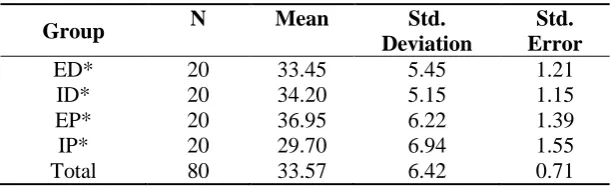
To ensure the homogeneity of the groups in terms of general English proficiency, the descriptive statistics of the performance of the four groups on the general proficiency test were calculated. Table 1 displays the descriptive statistics of the groups‟ performance on the proficiency test. As can be seen, EP performed the best (M=36.95), and IP did the worst (M=29.70), with ID and ED falling in between.
Table 1
Descriptive statistics of the groups‟ proficiency test scores
*ED: Explicit Dialog, ID: Implicit Dialog, EP: Explicit Play, IP: Implicit Play
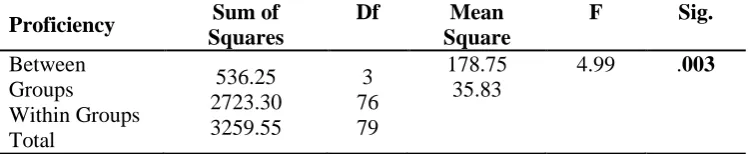
In order to compare the groups‟ performance on the proficiency test, one-way ANOVA was carried out. The result of the one-way ANOVA of the groups‟ performance on the general proficiency test revealed that there was a significant difference among the groups (Table 2). The P value (Sig = .003) was considerably below the critical value (.05), which confirmed that the groups were significantly different in terms of general proficiency at the outset of the study. It is noteworthy
Group N Mean Std.
Deviation
Std. Error
ED* 20 33.45 5.45 1.21
ID* 20 34.20 5.15 1.15
EP* 20 36.95 6.22 1.39
IP* 20 29.70 6.94 1.55
Total 80 33.57 6.42 0.71
that the difference was inflated by the relatively weaker performance of only one group (IP), particularly when compared to the performance of EP, while the mean differences of the other three were not very large.
Table 2
ANOVA of the four groups‟ performance on the proficiency test
Pretest Performance Analysis
To compare the performance of the groups on the WDCT pretests, one-way ANOVA was carried out on the WDCT test scores. The ANOVA of the WDCT pretest scores yielded the P value (Sig. = .000), which was considerably below the critical .05 value (Table 3). Therefore, there was a statistically significant difference among the four groups in terms of their production of the given speech acts. This means that the four groups were not homogeneous regarding pragmatic competence before the onset of instruction. This initial significant difference among the groups laid the ground for subsequent use of the ANCOVA for analyzing the groups‟ performance on the posttest.
Proficiency Sum of
Squares
Df Mean
Square
F Sig.
Between Groups Within Groups Total 536.25 2723.30 3259.55 3 76 79 178.75 35.83
4.99 .003
Table 3
ANOVA of the four groups‟ performance on the WDCT pretest WDCT Pretest Sum of
Squares
Df Mean
Square
F Sig.
Between Groups Within Groups Total 2443.64 3863.25 6306.89 3 76 79 814.54 50.83
16.02 .000
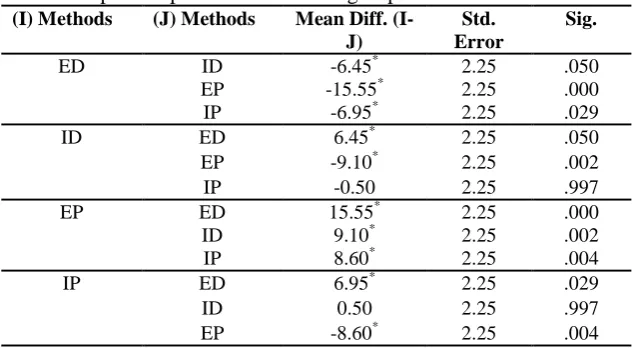
The Scheffe post hoc test located the significant differences among the pairs of the groups. Almost all the groups were significantly different (Table 4). The mean difference (MD) was the greatest between the two explicit groups, ED and EP (MD = 15.55) with the P value of Sig. = .000.The minimum significant difference was seen between the two nonliterary groups, ED and ID (MD = 6.45) with the P value of Sig. = .050 (equal to the critical value). However, the two implicit groups, ID and IP, did not show a statically significant difference (MD = 0.50) with the P value of Sig. = .997. In the following table, use or nonuse of minus before the figures indicates which group performed better, for instance, the MD of -15.55 for ED and EP suggests that EP outperformed ED on the WDCT pretest.
Table 4
Multiple comparisons of the four groups on the WDCT Pretest (I) Methods (J) Methods Mean Diff.
(I-J)
Std. Error
Sig.
ED ID -6.45* 2.25 .050
EP -15.55* 2.25 .000
IP -6.95* 2.25 .029
ID ED 6.45* 2.25 .050
EP -9.10* 2.25 .002
IP -0.50 2.25 .997
EP ED 15.55* 2.25 .000
ID 9.10* 2.25 .002
IP 8.60* 2.25 .004
IP ED 6.95* 2.25 .029
ID 0.50 2.25 .997
EP -8.60* 2.25 .004
*. The mean difference is significant at the 0.05 level.
As the groups were not significantly similar in their pretest performance, ANCOVA, which takes the pretest performance of the groups into account, was adopted for the analysis of the groups‟ performance on the posttest.
Posttest Performance Analysis
The first and foremost question of the study concerned whether there was a significant difference among the four groups in production of the given speech acts as a result of the four different teaching conditions. Table 5 shows the descriptive statistics of the four groups‟ performance on the WDCT pretest and posttest. The
table indicates that ED (M = 46.81) performed the best, EP (M=45.72) came second, ID was the third (M = 43.78) and IP (M = 41.22) had the weakest performance on the WDCT posttest, taking account of the group‟s pretest performance as covariate.
Table 5
Descriptive statistics of the groups‟ performance on WDCT posttest
Methods Mean
Std. Error
95% Confidence Interval Lower
Bound
Upper Bound
ED 46.81a 1.25 44.33 49.30
ID 43.78a 1.11 41.58 45.99
EP 45.72a 1.29 43.15 48.29
IP 41.23a 1.11 39.02 43.43
a. Covariates appearing in the model are evaluated at the following values: WDCT Pretest = 29.0375.
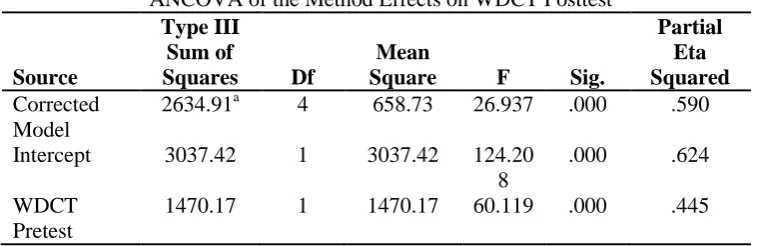
The one-way ANCOVA analysis of the performance of the groups on the WDCT pretest and posttest revealed that there was a significant difference among the four groups and hence a difference in the effect of methods (mode-medium blends) on the pragmatic development in terms of the production of the given speech acts. The P value (Sig = .004) for the method variable was considerably below the critical .05 value, which indicates a significant difference among the groups (Table 6). In other words, each method or teaching condition differentially contributed to the production of the targeted speech acts on the posttest.
Table 6
ANCOVA of the Method Effects on WDCT Posttest
Source
Type III Sum of
Squares Df
Mean
Square F Sig.
Partial Eta Squared Corrected
Model
2634.91a 4 658.73 26.937 .000 .590
Intercept 3037.42 1 3037.42 124.20
8
.000 .624
WDCT Pretest
1470.17 1 1470.17 60.119 .000 .445
Methods 358.78 3 119.59 4.890 .004 .164
Error 1834.08 75 24.45
Total 162089 80
Corrected Total
4468.99 79
a. R Squared = .590 (Adjusted R Squared = .568)
The Scheffe post hoc test located the significant differences among the groups. The analysis revealed that the differences between ED and IP (Sig = .001), and between EP and IP (Sig = .010) were significant and the other differences were not statistically significant. That is, ED and EP performed significantly better than IP on the WDCT posttest, but the three groups (ED, EP, and ID) performed similarly, although there were some insignificant differences among them. The results of multiple comparison are presented pairwise in Table 7.
Table 7
Multiple comparisons of the groups on the WDCT Posttest
a. Adjustment for multiple comparisons: Least Significant Difference (equivalent to no adjustments).
(I) Methods (J) Methods Mean Diff. (I-J)
Std. Error
Sig.a
ED ID 3.03 1.64 .070
EP 1.09 1.99 .585
IP 5.59* 1.66 .001
ID ED -3.03 1.64 .070
EP -1.93 1.72 .265
IP 2.56 1.56 .106
EP ED -1.09 1.99 .585
ID 1.93 1.72 .265
IP 4.49* 1.71 .010
IP ED -5.59* 1.66 .001
ID -2.56 1.56 .106
EP -4.49* 1.71 .010
*. The mean difference is significant at the .05 level.
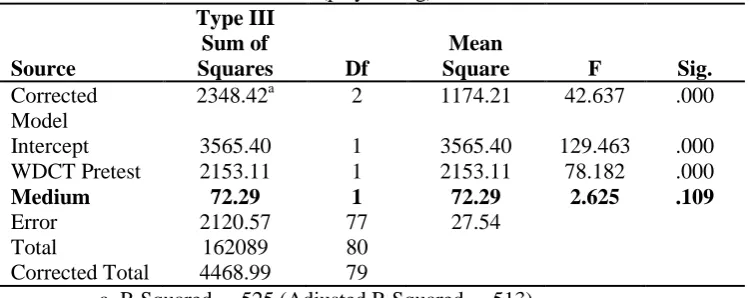
The second research question, which related to the medium of instruction, was whether there was any significant difference in the production of speech acts between literary (play) and nonliterary (dialog) groups. The one-way ANCOVA analysis of the performance of the groups on the WDCT pretest and posttest yielded the P value of Sig = .109 for the medium, which was considerably above the critical .05 value, indicating that there was no significant difference between the literary (EP and IP together) and nonliterary (ED and ID together) groups, and hence no significant effect for the medium (play/dialog) of presenting speech acts. This can be seen under the category of Medium in Table 8.
Table 8
ANCOVA of the Medium (play/dialog) Effects on WDCT Posttest
Source
Type III Sum of
Squares Df
Mean
Square F Sig.
Corrected Model
2348.42a 2 1174.21 42.637 .000
Intercept 3565.40 1 3565.40 129.463 .000
WDCT Pretest 2153.11 1 2153.11 78.182 .000
Medium 72.29 1 72.29 2.625 .109
Error 2120.57 77 27.54
Total 162089 80
Corrected Total 4468.99 79
a. R Squared = .525 (Adjusted R Squared = .513)
The third question concerned the mode of instruction; it was aimed at investigating whether there was any significant difference in the production of speech acts between explicit and implicit groups. The one-way ANCOVA analysis of the performance of the groups on the WDCT pretest and posttest revealed that there was a significant difference between the explicit and implicit groups and hence a significant effect for the mode of presenting speech acts. The P value for the mode was Sig = .001, which was considerably below the critical .05 value, indicating that the explicit and implicit groups were significantly different and hence the presentation mode (explicitly or implicitly) was significantly effective. This is given in Table 9 under the category of Mode.
Table 9
ANCOVA of the Mode (ex-/implicit) Effects on the WDCT posttest
Source
Type III Sum
of Squares Df Mean Square F Sig.
Corrected Model 2562.82a 2 1281.41 51.763 .000
Intercept 5087.95 1 5087.95 205.530 .000
WDCT Pretest 2171.21 1 2171.21 87.707 .000
Mode 286.70 1 286.70 11.581 .001
Error 1906.16 77 24.75
Total 162089 80
Corrected Total 4468.99 79
a. R Squared = .573 (Adjusted R Squared = .562)
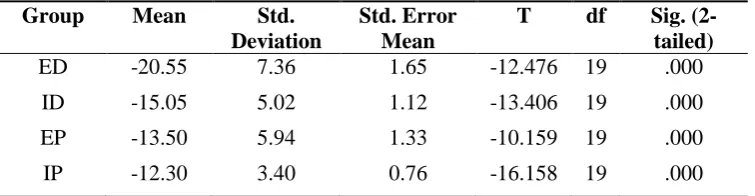
The last research question involved examining whether each of the groups showed any significant difference across the two administration of the WDCT. That is, in order to see if each teaching condition made a difference, the performance of each group was compared before and after the instruction. The paired sample t-test analysis of the performance of the groups across the two administrations of the WDCT revealed that there was a significant difference between each group‟s performance on the WDCT pretest and on the WDCT posttest. Table 10 summarizes the results of the t-test analysis. The observed T values for all the groups has yielded Sig. = .000, which is below the critical P value of Sig.= 0.05, meaning that there was a significant difference between each group‟s performance on the pretest and posttest. This suggests that all the teaching conditions made a difference and hence were effective.
Table 10
Paired Samples T-Test of the groups on Pre- and Posttest
Group Mean Std.
Deviation
Std. Error Mean
T df Sig. (2-tailed)
ED -20.55 7.36 1.65 -12.476 19 .000
ID -15.05 5.02 1.12 -13.406 19 .000
EP -13.50 5.94 1.33 -10.159 19 .000
IP -12.30 3.40 0.76 -16.158 19 .000
Discussion
The study investigated the contribution of literary (play) vs. nonliterary (dialog) materials in combination with either explicit or implicit modes of instruction to pragmatic development. Overall, it was found that it is the mode of instruction (explicit vs. implicit) that matters rather than the medium (play vs. dialog). Moreover, plays did not contribute so much as dialogs to pragmatic development. In what follows, the findings of the study will be discussed in light of theory and past research.
Concerning the first question as to the effectiveness of medium-mode combination, the analyses revealed that ED (Explicit Dialog) outperformed the other three groups. EP (Explicit Play) received the second place, ID (Implicit Dialog) came third, and IP (Implicit Play) came last. This finding suggests that, in general, explicit mode of pragmatic instruction is at an advantage, which is in line with the majority of the past research findings that showed the superiority of explicit instruction over implicit teaching (e.g. Rose & Kasper, 2001; Rose, 2005). It also shows that explicit instruction is more fruitful when accompanied with several compact instances (dialogs) than a relatively long play. The second and third questions addressed the medium and mode issues separately.
As for the medium (material), the comparison of the literary (EP and IP) groups with nonliterary (ED and ID) groups revealed no significant difference, suggesting that the instructional material by itself is not a determining force in learner‟s performance. That is to say, it makes no difference whether we choose to teach pragmatics by means of speech-act-rich dialogs or via plays hosting the given speech acts. However, apparently the gain scores (i.e. the difference between pretest and posttest) of the non-literary groups was better than their literary counterparts. This could be explained by the fact that in the non-literary groups, the learners were exposed to several dialogs that were compact packages of speech-act-embedded input providing enough context on the situation and the people involved therein, and they could easily access instances of the acts within a short space. Moreover, the dialogs were taken from textbooks specially written for instructional purposes. On the other hand, learners in literary groups had to go through one relatively long extended dialog, i.e. play, which was not written with a pedagogical aim, and had to process the dispersed instances of the given speech act within a wider space.
As was seen above, the explicit groups surpassed their implicit counterparts, i.e. ED did better than ID and EP excelled IP. The fourth question addressed the effect
of mode (explicit vs. implicit) of presentation. In this respect, the performance of explicit groups (ED and EP) was compared to that of the implicit groups (ID and IP). The result of the analysis illuminated that the explicit groups performed much better than the implicit ones. This finding comes as no surprise because it is in line with the majority of the research in the field. In a review of more than 58 experimental studies in interlanguage pragmatics, Taguchi (2015) found that explicit form-focused instruction involving metapragmatic information was generally more effective than its implicit counterpart, and that input exposure alone could not exceed the level of learning produced by the explicit instruction, even when the input is made salient through enhancement techniques. The provision of explicit metapragmatic information on the pragmalinguistic and sociopragmatic aspects of the speech acts, together with explicit awareness-raising tasks, probably raised the learners‟ "metapragmatic awareness," rather than simply "awareness as noticing." It is also likely that pragmalinguistic and sociopragmatic features are more amenable to explicit than implicit instruction (Rose, 2005). For the implicit condition to be as effective as the explicit condition, treatment needs to be organized in a way that involves learners in processing the form-function-context mappings (Taguchi, 2015).
Concerning the last question, i.e. difference between pretest and posttest performance of the groups, it was generally found that there was a significant difference between the two administrations of the WDCT test for each group. In other words, all the groups involved in the study performed better on the posttest, suggesting that the four teaching conditions made a difference, and hence were effective. The groups‟ gains across the two administration of the same test, regardless of the type of instruction, can be explained in light of the noticing hypothesis, according to which in order to become intake, relevant input features should be registered under attention (i.e. noticed) and related to relevant contextual features (i.e. understood) (Schmidt, 1993). All the teaching conditions are likely to have raised the participants' consciousness of relevant pragmalinguistic forms and sociopragmatic features, reflected in speech act perception and production, leading to their focus on forms. It is likely that two common features across the four conditions jointly fulfilled this consciousness-raising function: (a) typographic input enhancement and (b) follow-up consciousness-raising (CR) tasks with varying degrees of directness. The first option by itself could not have contributed if it had not been followed with the second. In other words, the salience induced by mere typographic enhancement might not fully account for the improvement of the input enhancement group (Taguchi, 2015). The improved speech act production
ability of the participants in the present study is presumably attributable to the very
combination of visual input enhancement with awareness-raising tasks (Alcon, 2005).
The CR task for the implicit groups involved calling students‟ attention to the underlined parts within both plays and dialogs and asking them to comment on the appropriateness of the given structures. For the explicit groups, on the other hand, the CR task involved more than simply judging appropriateness. Learners were also required to determine the head act and adjuncts, and the strategies used to fulfill the act based on the metapragmatic information provided beforehand. The provision of metapragmatic information and the corresponding CR task might have led to a heightened awareness of the pragmatic features, and hence account for the better performance of the explicit groups. This probably activated their selective attention to the target speech acts, directly or indirectly made salient in the instructional materials. It is likely that in this way, the participants‟ cognitive
macro-processes such as form-function-context mapping and knowledge
internalization were triggered (Doughty, 2001, p. 249).
However, each group performed differentially on the posttest vis-à-vis their pretest performance, i.e. their use of the given speech acts on the posttest was an improvement over their pretest production of the acts. The difference was the most significant with the ED group (MD = 20.55) and the least evident with the IP group (MD = 12.3), and the ID group (MD= 15.05) and the EP group (MD= 13.5) fell in between the two extremes. This suggests that instruction whether explicit or implicit, through either play or dialog is effective, but the learning outcomes differ as a matter of the differential teaching conditions. This is in line with the conclusion that Rose (2005) draws upon reviewing a number experimental studies on the effectiveness of instruction, while making the point that we are far from making a claim as to the best approach to teaching pragmatics, even though research points to the superiority of explicit instruction over implicit one.
Conclusion
The general aim of the study was to build a bridge between literature as an age-old resource of motivating and authentic content and interlanguage pragmatics as a relatively new thriving area of inquiry within Applied Linguistics. Plays, as authentic literary materials, were contrasted with specially written dialogs for instruction to see if they could be more beneficial for teaching certain speech acts. The assumption was that besides providing content and context for both pragmalinguistic and sociopragmatic aspects of pragmatics, plays could engage
learners better and therefore lead to better learning. Moreover, there was the question of whether pragmatic instruction could be more effective when it is delivered in explicit mode or in an implicit manner. However, plays as the medium or materials of instruction did not prove to be any better than their nonliterary counterpart (dialogs) and, even their combination with either mode of instruction was surpassed by their nonliterary equal, i.e. learners who were taught explicitly through dialogs performed better than those who received explicit instruction via plays, and learners who were taught implicitly through dialogs outperformed those who got implicit instruction using plays. It was also found that explicit groups taken together did better than the implicit groups, showing once more the advantage of explicit instruction over implicit teaching. Nevertheless, it was evident that all teaching conditions, regardless of the medium-mode combination, made a difference when pretest and posttest results were compared. This was particularly noteworthy with implicit play group, where learners received only typographically enhanced plays without any metapragmatic information.
In line with past research, the findings generally imply the significant role of pragmatic input in English language teaching and point to the benefits of instruction especially in EFL context. The results also indicate the primacy of explicit teaching over implicit instruction, even though both metapragmatic explanation and input enhancement raise pragmatic awareness leading to pragmatic development. Moreover, although literary materials (plays) did not prove to be a better medium for delivering pragmatic instruction, they could be employed as core or subsidiary materials to teach pragmatics as long as they are relatively short and at the same host the most instances of pragmatic functions. Overall, it is recommended that teachers and materials developers incorporate a blend of engaging input and metapragmatic information into the language class and teaching materials in order to help learners develop pragmatic competence.
Notes on Contributors
Mohammad Khatib is Associate Professor of Applied Linguistics at Allameh Tabataba‟i University, Tehran, Iran. He has published many articles in various journals in the area of English language teaching (ELT). His primary research interests include use of literature in ELT, Culture, and Second Language Acquisition.
Mohammad Baqerzadeh Hosseini is PhD Candidate in Applied Linguistics at Allameh Tabataba‟i University, Tehran, Iran. He is a faculty member at Islamic Azad University, Naragh Branch, Markazi Province. His primary research interests include Pragmatics, Critical Discourse Analysis, and Vocabulary.
References
Alcon, E. (2005). Does instruction work for learning pragmatics in the EFL context? System, 33(3), 417–435.
Alcon-Soler, E., & Martinez-Flor, A. (2008). Investigating pragmatics in foreign language learning, teaching and testing. Bristol, UK: Multilingual Matters. Allington, D., & Swann, J. (2009).Researching literary reading as social practice.
Language and Literature, 18(3), 219–230.
Bardovi-Harlig, K. (2001) Evaluating the empirical evidence: Grounds for instruction in pragmatics? In Rose, K.R., & G., Kasper (Eds.), Pragmatics in language teaching (pp. 13–32). Cambridge: Cambridge University Press.
Bibby, S. (2012). Teaching literature in the language classroom: An introduction. The Journal of Literature in Language Teaching, 1, 5-9.
Carter, R., & Long, M.N. (1991). Teaching Literature. Harlow, Essex: Longman.
Doughty, C. (2001). Cognitive underpinnings of focus on form. In Robinson, P. (Ed.), Cognition and second language instruction (pp. 206-257). Cambridge:
Cambridge University Press.
Fukuya, Y. J., & Clark, M. K. (2001) A comparison of input enhancement and explicit instruction of mitigators. In Bouton, L.F. &Y. Kachru (Eds.), Pragmatics and language learning (Vol. 10, pp. 111–130). Urbana, IL: Division of English as an International Language, University of Illinois at Urbana- Champaign.
Goodwin, J. (2001) Teaching Pronunciation. In Celce-Murcia, M. (Ed.), Teaching English as a second or Foreign language (3rd ed., pp. 117-137). Boston, MA: Heinle & Heinle.
Hall, G. (2005). Literature in language education. Basingstoke, UK: Palgrave Macmillan.
Hanauer, D. I. (2001).Poetry reading in the second language classroom. Applied Linguistics, 22(3), 1–15.
Iida, A. (2012). The value of poetry writing: Cross-genre literacy development in a second language. Scientific Study of Literature, 2(1), 60–82.
Jeon, E-H, & Kaya, T. (2006).Effects of L2 instruction on interlanguage pragmatic development. In John, N. & L. Ortega (Eds.), Synthesizing research on language learning and teaching (pp. 165–211). Philadelphia, PA: John Benjamins.
Kasper, G. (1996). Introduction: interlanguage pragmatics in SLA. Studies of Second Language Acquisition, 18, 145-148.
Kasper, G., & K. Rose (2002). Pragmatic development in a second language. Oxford, UK: Blackwell.
Khatib, M., &Ahmadi-Safa, M.(2011). The effectiveness of ZPD-wise explicit/implicit expert peers and co-equals' scaffolding in ILP development. Iranian Journal of Applied Linguistics, 14(1), 49-75.
Kim, M. (2004).Literature discussions in adult L2 learning. Language and Education, 18(2), 145–166.
Koike, D.A., & Pearson, L. (2005).The effect of instruction and feedback in the development of pragmatic competence. System, 33(3), 481-501.
Lazar, G. (1994). Using literature at lower levels. ELT Journal, 48, 115–124. Leech, G. (1983). The principles of Pragmatics. London: Longman.
Li, S., & Taguchi, N. (2014).The effects of practice modality on pragmatic development inL2 chinese. The Modern Language Journal, 98(3), 794-812. Liddicoat, A., & Crozet, C. ( 2001). Acquiring French interactional norms through
instruction. In Rose, K., & G.,Kasper, (Eds.), Pragmatics in Language Teaching (pp. 125–144). Cambridge: Cambridge University Press.
Maley, A. (1989).Down from the pedestal: Literature as a resource. In Brumfit, C.J., & Carter, R.A. (Eds.), Literature and the learner: Methodological approaches (pp. 10-23). London: McMillan.
Matreyek, W. (1990).Communicating in English: Examples and models (Vol. 1 Functions). Prentice Hall International (UK) Ltd.
Nguyen, T. M., Pham, T. H., & Pham, M. T. (2012) The relative effects of explicit and implicit form-focused instruction on the development of L2 pragmatic competence. Journal of Pragmatics, 44, 416–434.
Olshtain, E., & Cohen, A. (1983). Apology: A speech act set. In Wolfson, N.& E. Judd (Eds.), Sociolinguistics and language acquisition (pp. 18–36). Rowley, MA: Newbury House.
Olshtain, E., & Cohen, A.D. (1991). Teaching speech act behavior to nonnative speakers. In Celce-Murcia, M. (Ed.), Teaching English as a second or foreign language (pp. 154-165). Boston, MA: Heinle & Heinle.
Paesani, K. (2005). Literary texts and grammar instruction: Revisiting the inductive presentation. Foreign Language Annals, 38, 15–24.
Paran, A. (2008). The role of literature in structured foreign language learning and teaching: An evidence-based survey. Language Teaching, 41, 465–496.
Richards, J. C. (2012). Four corners: student’s book. Cambridge: Cambridge University Press.
Rose, K. R. (2005). On the effects of instruction in second language pragmatics. System, 33(3), 385–99.
Rose, K. R., & Kasper, G. (2001) Pragmatics in language teaching. New York: Cambridge University Press.
Safont, M.P.( 2003). Instructional effects on the use of request acts modification devices by EFL learners. In Martinez-Flor, A., Uso , E., Fernandez, A. (Eds.), Pragmatic Competence and Foreign Language Teaching (pp. 211–232). Castellon, Spain: Servei de Publicacions de la Universitat Jaume I.
Salazar, P.C. (2003). Pragmatic instruction in the EFL context. In: Martinez-Flor, A., Uso , E., Fernandez, A. (Eds.), Pragmatic Competence and Foreign Language Teaching ( pp. 233–246). Castellon, Spain: Servei de Publicacions de la Universitat Jaume I.
Salazar, P., M. P. Safont, & V. Codina (2009) Refusal Strategies: a proposal from a sociopragmatic approach. RAEL: Revista Electrónica de Lingüística Aplicada, 8, 139-150.
Savvidou, C. (2004). An integrated approach to the teaching of literature in the EFL classroom. The Internet TESL Journal, 12. Retrieved from http://iteslj.org/Techniques/Savvidou-Literature.html
Schmidt, R. (1993). Consciousness, learning, and interlanguage pragmatics. In Kasper,& Blum-Kulka (Eds.), Interlanguage Pragmatics (pp. 21-42). Oxford: Oxford University Press.
Schmidt, R. (2001). Attention. In Robinson, P. (Ed.), Cognition and second language instruction (pp. 3–32). Cambridge, UK: Cambridge University Press. Taguchi, N. (2006). Analysis of appropriateness in a speech act of request in L2
English. Pragmatics, 16(4), 513-533.
Taguchi, N. (2011). Teaching pragmatics: Trends and issues. Annual Review of Applied Linguistics 31, 289–310.
Taguchi, N. (2015). Instructed pragmatics at a glance: Where instructional studies were, are, and should be going. Language Teaching, 48, 1-50.
Takahashi, S. (2010).Assessing learnability in second language pragmatics. In Trosborg, A. (Ed.), Handbook of pragmatics: Vol. VII (pp. 391–421). Berlin, Germany: Mouton de Gruyter.
Valipour, S.,& Jadidi, S. (2015). Study of Iranian English language teachers' familiarity with language functions in request, apology, refusal, and greeting. International Journal of Research Studies in Language Learning, 4(1), 13-30. Wang, P–L. (2009). The application of integrated literature instruction in freshman
English teaching. Sino-US English Teaching, 6(9), 1–11. Appendix 1. WDCT Sample Items
Dear Test Taker: complete the following dialogues in the given situations with the most appropriate sentences. Please pay attention to the situation and the people who are involved.
Apology
1. Context: You accidentally step on someone's foot on the bus. How would you apologize?
Man: Oh! Be careful, would you?
You:
……… 2. Context: You are late for a meeting with a friend. How would you apologize? Friend: What happened to you? You're late!
You:
………
Request
1. Context: You, a college student, wants to borrow your professor's book. What's the best way to ask your professor to lend you the book?
You: Actually, the book is not available in the library.
Prof.: But that is your main source. You need to have it for next week. You:
……….. 2. Context: You need to ask a friend on the phone to bring some drinks to your party.
You: Can you make it to the party tonight?
Friend: well, yes sure. I am already done with my chores. You:
………
Refusal
1. You are an English teacher in institute. One of English teacher whom you don‟t know has invited you to his home. You have a problem and must write some questions for exam. You refuse his request by saying:
………... ....
2. You are a university teacher. One of your students has a birthday party in his house. He comes to you and invites you to the party. You don‟t like to attend the party.
You refuse his invitation by saying:
………...
Appendix 2.Taguchi's (2006) rating scale of appropriateness
Ratings Descriptors
5 Excellent - Expressions are fully appropriate for the situation. - No or almost no grammatical and discourse errors.
4 Good - Expressions are mostly appropriate.
- Very few grammatical and discourse errors.
3 Fair - Expressions are only somewhat appropriate.
- Grammatical and discourse errors are noticeable, but they do not interfere appropriateness.
2 Poor - Due to the interference from grammatical and discourse errors,
appropriateness is difficult to determine.
1 Very Poor - Expressions are very difficult or too little to understand. There is no evidence that the intended speech acts are performed.
0 - No performance
Appendix 3. Apology Lesson Sample (Explicit Play)
Apologizing implies that you recognize that there is something wrong with what you have said or done , and that you are completely or partly responsible for that. Apology like most speech acts consists of two parts: the head act which is the very function of apologizing and the adjunct which is an accompanying statement meant to give more force and sincerity (sense of realness) to that function.
Olshtain and Cohen (1983) provide a classification of apology strategies into five main categories where the first strategy relates to the head act and is more direct, and the rest has to do with adjunct to the act:
1. An expression of an apology (head act); a. An expression of regret, e.g. “I‟m sorry” b. An offer of apology, e.g. “I apologize”
c. A request for forgiveness, e.g. “Pardon me”, “Excuse me”
2. Acknowledgement of responsibility. It is used when the offender recognizes his/her fault and he/she feels responsible for the offence. The recognition level consists of:
a. Accepting the blame, e.g. “It‟s my fault”
b. Expressing self-deficiency, e.g. “I was confused”, “I didn‟t see you”, “I was thinking”
c. Expressing lack of intention, e.g. “I didn‟t mean to” d. Recognizing of deserving apology, e.g. “You are right”
3. An offer to repair. It is something to do with physical injury or other damage resulting from the speaker‟s infraction, e.g. “I‟ll buy/pay for the lost book”, and “Would you be willing to reschedule the meeting?”
4. An explanation or account of the situation. The offence explains the situation that brings about him/her to do an indirect way of apologizing. For instance, “There was a terrible traffic jam”, “The bus was delayed”
5. A promise of forbearance. The offender promise not to do the offense again, e.g. “It won‟t happen again”.
Following there is a one-act play containing several instances of apology. Read the play focusing on the underlined sentences and determine the head act and the type of adjunct used to support it. Regarding the people involved, do the expressions appropriately fulfill apology?
ST. MARTIN'S SUMMER by Cosmo Hamilton
ENID: [seated, calling] Jack! [A pause, she lowers her voice slightly to talk to a boy who is under the window.] I say, Jack, I can't come for half an hour. Isn't it rot?
[Enter HAWKHURST. He crosses to the fireplace and stands with his back to it. Loading a pipe, he puts a silver tobacco box on couch.]
ENID: What? I know I did, but father's got to see his agent, and has told me off to keep the Colonel and Mrs. Allingham amused until he's free. Frightfully sorry. And look here, it isn't for you to look surly. The Colonel's a darling, and Mrs.
Allingham's the sweetest thing on earth; but I never know what to say to old people-- what?--aren't they? Oh well, they seem old to me.
HAWKHURST: [who, at the mention of age, has drawn himself up and raised his eyebrows] I agree with Jack, my child-sensible young man, Jack.
ENID: [turning quickly]You've heard?
HAWKHURST: Mrs. Allingham and I are not old people. ENID: I'm awfully sorry.
HAWKHURST: [playing at indignation] Old people!
ENID: I'm most awfully! It is a bad habit of mine sort of think-aloud and I didn‟t mean to insult you.
HAWKHURST: Shun! Six paces to the front. Quick march.
ENID: [comes across to him]Please forgive me. I don‟t know how can I make up for that.
HAWKHURST: [putting his hands on her shoulders] Old people, are we? [He laughs.] ... Will you withdraw your libelous remark?
ENID: [with a smile] Consider it scratched. I'll never say that you're old again, and I won't even think it. ...
Appendix 3. Request Lesson Sample (Explicit Dialog)
Requests express the speaker‟s wish that the hearer do something behave in such-and-such a way, i.e. do something for or act on behalf of the hearer. A request as an speech act may comprise three segments: (a) Address Term (Alerter); (b) Head act; (c) Adjuncts to Head act
e.g. Danny! Could you lend me £100 for a week? I've run into problems with my tuition fee.
Alerter Head act Adjunct
There seem to be three major levels of directness that can be expected to be manifested universally by requesting strategies:
a. the most direct level imperatives (Open the door!),
performatives (I ask you to open the door) and
hedged performatives (I would like you to open the door); b. the indirect level
conventional: indirect speech acts (e.g. 'could you do it' or 'would you do it' meant as requests);
nonconventional: indirect strategies (hints) that realize the request by reference to contextual clues (e.g. 'Why is the window open'? / 'It's cold in here').
Adjuncts to requests
In the previous lesson we learned about the levels of directness of request in relation to the situation in which it is used and the participants involved. Now we turn to the sentences that are used before or after the head act of request the provide the ground for or support this function.
a. Preparator. The speaker precedes the act by an utterance that attempts to prepare the interlocutor for the request.
Will you do me a favor? Could you perhaps lend me your notes for a few days?
b. Checking on availability. Before he/she makes a request, the speaker uses an utterance to check if the precondition necessary for the act is available.
Are you going in the direction of the town? And if so, is it possible to join you?
c. Grounder. The speaker indicates the reasons for the request. (Grounders may precede or follow the Head act)
Judith, I missed class yesterday, could I borrow your notes?
d. Sweetener. By expressing exaggerated appreciation of the hearer's fulfilling of the request, the speaker lowers the imposition involved.
You have beautiful handwriting, would it be possible to borrow your notes for a few days?
e. Disarmer. The speaker indicates his/her awareness of a potential offense, thereby attempting to anticipate possible refusal.
Excuse me, I hope you don't think I'm being forward, but is there any chance of a lift home?
Following are four conversations containing request. Read the dialogs focusing on the underlined parts and determine the head act and the adjuncts and their type. Regarding the people involved, do the expressions appropriately fulfill request?
1. A woman talking on the telephone asks his husband to turn down the TV. W: Just a minute, Patty. I can't hear you. Bill‟s watching the football game on TV. Bill ... turn down the TV a little, will you?
H: What?
W: Can you turn down the volume on the TV a little?
H: Yeah, yeah . .. O.K. Is this better?
W: A little . . . Can you turn it down a little more? I'm on the phone . . .
H; Oh, sure. Sorry.
2. A man calls the waitress at a restaurant
M: Excuse me, Miss. Can I please have another glass of water?