Vol. 14, No. 1, 2017, 109-116
ISSN: 2320 –3242 (P), 2320 –3250 (online) Published on 11 December 2017
www.researchmathsci.org
DOI: http://dx.doi.org/10.22457/ijfma.v14n1a13
109
International Journal of
A New Approach on Multiple Attribute Decision Making
with Interval-Valued Knowledge Measure
M. Maragatham1 and P.Lakshmi Gayathri2 1
Department of Mathematics, Periyar EVR college, Trichy-23, Tamilnadu, India. 2
Department of Mathematics, Dr.M.G.R.Janaki College, Chennai-28, Tamilnadu, India.
Received 1 November 2017; accepted 4 December 2017
Abstract. In this paper, firstly some entropy measures and knowledge measure for the interval-valued intuitionistic fuzzy sets are discussed. Also interval-valued intuitionistic fuzzy weighted geometric averaging operator (IVIFWA), interval-valued intuitionistic fuzzy ordered weighted geometric averaging operator (IVIFOWGA) and interval-valued intuitionistic hybrid geometric averaging operator (IVIFHGA) are discussed. Based on the concepts mentioned above, a new multi attribute decision making method for interval-valued intuitionistic fuzzy numbers is proposed. Finally some illustrations are performed to demonstrate the effectiveness of the proposed method.
Keywords: Fuzzy sets, knowledge measure, interval-valued intuitionistic fuzzy sets, interval-valued intuitionistic fuzzy averaging operator, multiple attribute decision making.
AMS Mathematics Subject Classification (2010): 03E72
1. Introduction
110
intuitionistic fuzzy weight geometric (IVIFWG) operator, interval- valued intuitionistic fuzzy ordered weighted geometric (IVIFOWG) operator and the interval-valued intuitionistic fuzzy ordered hybrid geometric (IVIFHG) operator for multiple attribute decision making . Xu, Chen and some other author methods have the drawback on their corresponding operators. It was overcome by Shyi-mingchen [6] and Wei-Hsiang Tsai by introducing a multiple attribute decision making based on novel interval-valued intuitionistic fuzzy geometric operators. Also at present there are several measures for IVIFS. In [4] Hoang Nguyen extended the knowledge measure for IFSs developed to present a novel interval-valued knowledge measure for IVIFSs.
Based on the above discussed things we have developed a new multiple attribute decision making under interval- valued intuitionistic fuzzy environment. This paper is organized as follows: In section 2, we review some basic concepts of IVIFSs and the existing measures for ranking the alternatives. Section 3 provides interval- valued intuitionistic fuzzy weighted geometric averaging (IVIFWGA) operator, the interval- valued intuitionistic fuzzy ordered weighted geometric (IVIFOWGA) operator and the interval- valued intuitionistic fuzzy ordered hybrid geometric (IVIFHG) operator. Section 4 explains the entropy measure and knowledge measure for IVIFSs. Section 5 we propose a new multiple attribute decision making method based on interval- valued intuitionistic fuzzy weighted geometric averaging (IVIFWGA) operator, the interval- valued intuitionistic fuzzy ordered weighted geometric (IVIFOWGA) operator and the alternatives are ranked by knowledge measure. Finally an illustration is explained to prove the effectiveness of the proposed method.
2. Preliminaries
Definition 2.1. Interval-valued intuitionistic fuzzy sets
Let a set be fixed, an AIFS in is defined as = {(, (), ()),∈ } where and are mappings from to the closed interval [0,1] such that 0 ⩽ () ⩽1, 0 ⩽() ⩽1 and 0 ⩽ ()+() ⩽1, for all ∈ , and they denote the degrees of membership and non-membership of element ∈ to set , respectively.
The intervals (x) and νA(x) denote, respectively, the degree of belongingness
and the degree of non-belongingness of the element x to A. Then for each x ∈ X, (x) and () are closed intervals and their lower and upper end points are denoted byL(x),
U(x), L() and U(), respectively, and thus we can replace Eq. with A ={<x, [L(x), U(x)], [L(),U()]>}: x ∈ X},
where 0 ≤U(x)+ U()) ≤ 1
Xu (2007a) called = <[a, b], [c, d]>an interval-valued intuitionistic fuzzy number (IVIFN), where [a, b] ∈ [0, 1], [c, d] ∈ [0, 1] and b +d ≤ 1.
Definition 2.2. Score function
Let a= <[a, b], [c, d]> be an IVIFN, then the score function is defined as
S(a)= (a-c+b-d), (1) whereas (a) ∈ [−1, 1]. The larger the value of s(a), the higher the IVIFN a.
Definition 2.3. Accuracy function
Knowledge Measure
111
` h(a)= (a+c+b+d), (2) where h(a)∈ [0, 1]. The larger the value of h(a), the higher the accuracy degree of the IVIFN a.
Definition 2.4. Hesitancy degree
Let a= <[a, b], [c, d]> be an IVIFN, then the hesitancy degree, the mid-point of intuitionistic fuzzy number is defined as
() = [1-a-c, 1-b-d] (3)
Definition 2.5. Comparison of two interval-valued intuitionistic fuzzy numbers
Let =<[a1, b1], [c1, d1]> and =<[a2, b2], [c2, d2]>be two interval valued intuitionistic fuzzy numbers. Let S() and S() denote the Score function of and respectively. Let H() and H() denote the accuracy functions of and respectively.
Then ,
(i) If S ()>S (), then is greater than, denoted by >. (ii) If S()=S(), then
If H () =H (), then and represent the same information. If H () >H (), then is greater than , denoted by >.
Knowledge measure for IVIFSs
Most of the measures for IFSs and IVIFSs cannot distinguish the cases, whose membership and non-membership degrees are identical. Nguyen (2015) proposed a new knowledge measure for IFSs as follows:
Definition 2.6. Knowledge measure for IFSs
Let IFS(X) denote the family of all the IFSs, the knowledge measure of an IFS A€ IFS(X) is define as its normalized Euclidean distance from reference level 0 of information F(x, 0,0);
KF(A) =
√∑ ((μ (x))+ (ν (x))((μ (x) + ν (x)) (4) For instance, knowledge measure is equal to 1 for the crisp sets and 0 for the most fuzzy intuitionistic set F(x, 0,0).
Definition 2.7. Knowledge measure for IVIFSs
The knowledge measure of an interval- valued intuitionistic fuzzy set is defined as
KFl = [KF(<x, µ-A (xi), ν -A (xi) ] , KF(<x, µ+A (xi), ν +A (xi)]Where KF(<x, µ-A (xi), ν -A (xi)=
1
√2! "((μ#(x))+ (ν#(x))((μ#(x) + ν#(x))
And
KF(<x, µ+A (xi), ν +A (xi)=
112
We denote A- = <x, µ-A (xi), ν -A (xi) > and A+ = <x, µ+A (xi), ν +A (xi)> two IFSs in the interval [0,1] is define as : KFl(Al)= [KF(A-), KF(A+)].
3. Interval-valued intuitionistic fuzzy geometric aggregation operators
In 2016, Chen and Tsai proposed a new interval-valued intuitionistic fuzzy geometric averaging operators of IVIFSs.
Definition 3.1. IVIFWGA operator
Let , … . . be IVIFVs where = ([ai, bi], [ci,di]), 0≤ai≤bi≤1, 0≤ci≤di≤1, 0≤bi+di≤1
and 1≤i≤n. Let wi be the weight of αi, where wi∈ [0,1], 1≤i≤n and ∑ ( = 1. Then the IVIFWGA operator of the IVIFVs is defined as follows:
IVIFWGA (, … . . ) =
(*∏ (1 − - )./ − ∏ 1 − − -./ , ∏ 1 − 0 ./ − ∏ 1 − 1 − 0./ 2,
*1 − ∏ 1 − - ./, 1 − ∏ 1 − 0 ./2) (6)
where w= (w1, w2,……wn.)T be the weight vector of (i=1,2,…n) and wi>0,
∑(= 1.
Definition 3.2. IVIFOWGA operator
Let , … . . be IVIFVs where = ([ai, bi], [ci,di]), 0≤ai≤bi≤1, 0≤ci≤di≤1, 0≤bi+di≤1
and 1≤i≤n. Let wi be the weight of αi, where wi ∈ [0,1], 1≤i≤n and ∑(= 1. Then the IVIFWGA operator of the IVIFSs is defined as follows:
IVIFOWGA (, … . . ) =
(3∏ 41 − - 56./− ∏ 41 − 5− -56./, ∏ 41 − 0 56./− ∏ 41 −
15− 05./7, 31 − ∏ 41 − - 56./, 1 − ∏ 41 − 0 56./7 (7) where w= (w1, w2,……wn.)T be the weight vector of (i=1,2,…n) and wi>0,
∑(= 1, and
5= 35, 157, *-5, 05]) and 5, 5, … … … . . 5 is the permutation of
, … . . such that 5is the largest IVIFV among the IVIFVs.
We now analyze the drawbacks of the operators developed by Xu and Chen with the one proposed by Chen and Tsai.
Definition 3.3. Interval-valued intuitionistic fuzzy weighted geometric aggregation operator (IVIFWG)
Let =<[ai, bi], [ci, di]>, i=1,2,….n be a collection of interval-valued
intuitionistic fuzzy values, then the IVIFWG operator of the IVIFSs is defined as follows: IVIFWG(, … . . ) = *∏./,∏1./ 2 ,
*1 − ∏ 1 − - ./, 1 − ∏ 1 − 0 ./2) (8) where w= (w1, w2,……wn.)T be the weight vector of (i=1,2,…n) and wi>0, ∑( =1
Definition 3.4. Interval-valued intuitionistic fuzzy ordered weighted arithmetic aggregation operator (IVIFWAG)
Let =<[ai, bi], [ci, di]>, i=1,2,….n be a collection of interval-valued
Knowledge Measure
113
IVIFWAG(, … . . ) = ( *1 − ∏ 1 − ./, 1 − ∏ 1 − 1 ./2, [∏-./,∏ 0./ 2
) (9) where w= (w1, w2,……wn.)T be the weight vector of (i=1,2,…n) and wi>0, ∑( =1.
The drawback is that when there is only one membership degree of an IVIFV equal to [0,0], the membership degree *∏./,∏ 1./ 2 of the aggregated IVIFSs of n IVIFVs becomes [0,0] even though all the other membership degree of other n-1 IVIFVs are not equal to zero.
Similarly when there is only one non membership degree of an IVIFV equal to [0,0], the non-membership degree *∏ - ./,∏ 0./ 2 of the aggregated IVIFSs of n IVIFVs becomes [0,0] even though all the other non-membership degree of other n-1 IVIFVs are not equal to zero.
4. The proposed method for multiple attribute group decision making based on new interval-valued intuitionistic fuzzy geometric averaging operators with knowledge measure.
Let D=89:mxn be a decision matrix, shown as follows:
. .
Dj8;mxn=
1 2 3 4 5 ?
@ A
. .
. .
..
B
. .
B
. . .
. . .
. .
BC
D E
Given by the decision makers Dj where 9: is an evaluating IVIFV of attribute Ai with respect to alternative xk represented by an IVIFV ;= ([aij, bij], [cij,dji]), 0≤aij≤bij≤1,
0≤cij≤dij≤1, 0≤bij+dij≤1 and 1≤i≤n. Let wi be the weight of αi, where wi€[0,1], 1≤i≤n and
∑( = 1.
The proposed multiple attribute decision making method is as follows:
Step 1: Based on the IVIFWGA operator shown in eq (6) aggregate the evaluating
IVIFVs for each decision matrix in to a single decision matrix with the weight vectors assigned to each decision maker.
Step 2: Based on the IVIFWGA operator shown in eq (6) aggregate the elements
appearing at the kth row of the aggregated decision matrix in to an IVIFV 9, where
9= ([aij, bij], [cij,dji]) ]), 0≤aij≤bij≤1, 0≤cij≤dij≤1, 0≤bij+dij≤1 and 1≤i≤n. Let wi be the
weight of αi, where wi€[0,1], 1≤i≤n and ∑(= 1.Here wj is the weight of the attribute.
Step 3: Calculate the interval-valued knowledge measureKF
l
114
Denote KFl (9) with [µ-ak, µ+ak]≥[ν -ak, ν +ak] by positive interval-valued knowledge measure KFl (9) and [µ-ak, µ+ak]≤[ν -ak, ν +ak] by negative interval-valued knowledge measure KFl (9).
Our goal is to select the best alternative with the most positive interval valued measure.
Step 4: Rank the alternatives in the descending order of their positive interval-valued
knowledge measures and in the ascending order of their negative interval-valued knowledge measures.
The best alternative is the one with the biggest positive interval-valued knowledge measures and the worse alternative is the one with the biggest negative interval-valued knowledge measures.
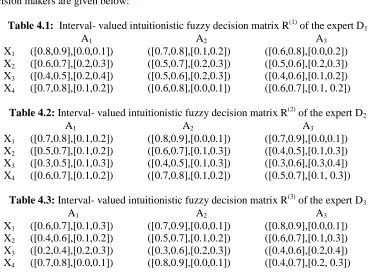
Example. A firm needs to identify a best supplier from a set of four suppliers namely S1,
S2, S3 and S4. Three criteria must be evaluated. They are Quality (C1), Reliability (C2), and Price (C3). The interval valued intuitionistic decision matrix provided by the decision makers are given below:
Table 4.1: Interval- valued intuitionistic fuzzy decision matrix R(1) of the expert D1
A1 A2 A3 X1 ([0.8,0.9],[0.0,0.1]) ([0.7,0.8],[0.1,0.2]) ([0.6,0.8],[0.0,0.2]) X2 ([0.6,0.7],[0.2,0.3]) ([0.5,0.7],[0.2,0.3]) ([0.5,0.6],[0.2,0.3]) X3 ([0.4,0.5],[0.2,0.4]) ([0.5,0.6],[0.2,0.3]) ([0.4,0.6],[0.1,0.2]) X4 ([0.7,0.8],[0.1,0.2]) ([0.6,0.8],[0.0,0.1]) ([0.6,0.7],[0.1, 0.2])
Table 4.2: Interval- valued intuitionistic fuzzy decision matrix R(2) of the expert D2
A1 A2 A3
X1 ([0.7,0.8],[0.1,0.2]) ([0.8,0.9],[0.0,0.1]) ([0.7,0.9],[0.0,0.1]) X2 ([0.5,0.7],[0.1,0.2]) ([0.6,0.7],[0.1,0.3]) ([0.4,0.5],[0.1,0.3]) X3 ([0.3,0.5],[0.1,0.3]) ([0.4,0.5],[0.1,0.3]) ([0.3,0.6],[0.3,0.4]) X4 ([0.6,0.7],[0.1,0.2]) ([0.7,0.8],[0.1,0.2]) ([0.5,0.7],[0.1, 0.3])
Table 4.3: Interval- valued intuitionistic fuzzy decision matrix R(3) of the expert D3
A1 A2 A3 X1 ([0.6,0.7],[0.1,0.3]) ([0.7,0.9],[0.0,0.1]) ([0.8,0.9],[0.0,0.1]) X2 ([0.4,0.6],[0.1,0.2]) ([0.5,0.7],[0.1,0.2]) ([0.6,0.7],[0.1,0.3]) X3 ([0.2,0.4],[0.2,0.3]) ([0.3,0.6],[0.2,0.3]) ([0.4,0.6],[0.2,0.4]) X4 ([0.7,0.8],[0.0,0.1]) ([0.8,0.9],[0.0,0.1]) ([0.4,0.7],[0.2, 0.3])
Let ηk = (1/6,2/6,3/6)T be the weight of each decision maker Di (i=1,2,3) and w=(0.3,0.4,0.3)T be the weight of the attributes aj(j=1,2,3).
Step 1: Derive the collective evaluation values using IVIFWA operator in eq (6) with the
Knowledge Measure
115
Table 4.4: Collective evaluation values of alternatives on attributes by all experts
A1 A2 A3
X1 ([0.682,0.815], [0.035,0.184])
([0.738,0.883], [0.017,0.118])
([0.743,0.883], [0.000,0.117])
X2 ([0.484,0.782], [0.167,0.218])
([0.536,0.748], [0.117,0.252])
([0.518,0.665], [0.151,0.435])
X3 ([0.271,0.455], [0.167,0.300])
([0.373,0.575], [0.157,0.300])
([0.365,0.629], [0.219,0.371])
X4 ([0.239,0.849], [0.480,0.151])
([0.741,0.865], [0.035,0.135])
([0.466,0.716], [0.151, 0.234])
Step 2: Derive the overall collective evaluation values ; of alternatives xi by utilizing
IVIFWA operator to aggregate the individual evaluation 9 with the attribute weight vector w=(0.3,0.4,0.3)T.
=([0.723,0.862],[0.017,0.138]) =([0.515,0.697],[0.142,0.303]) F=([0.342,0.678],[0.179,0.322]) G=([0.490,0.830],[0.223,0.170])
Step 3: Calculate the interval-valued knowledge measures of alternatives from their
overall collective evaluation values 9. KFl(8)= [0.732,0.939]
KFl(8)= [0.461, 0.889] KFl(8F)= [0.459, 0.884] KFl(8G)= [0.632, 0.927]
Step 4: The positive interval-valued knowledge measures are
KFl(8)= [0.732,0.939]
KFl(8)= [0.461, 0.889],KFl8(F)= [0.459, 0.884],KFl(8G)= [0.632, 0.927]. There is no negative interval-valued knowledge measure.
Rank these positive interval-valued knowledge measures as follows: KFl(8)>KFl(8G)>KFl(8)>KFl(8F). Thus ranking of the alternatives in accordance with the knowledge measures as : x1>x4>x2>x3 and the best alternative is x1.
5. Conclusion
Thus we propose a new multiple attribute decision making method under intuitionistic fuzzy environment with the help of knowledge measure. This method overcomes all the drawbacks in the existing methods. Further this can be extended to type 2 interval fuzzy sets also.
REFERENCES
1. K.Atanassov, Intuitionistic fuzzy sets, Fuzzy Sets and Systems, 20 (1986) 87-96. 2. K.Atanassov and G.Gargov, Interval-valued intuitionistic fuzzy sets, Fuzzy Sets and
116
3. K.Atanassov, Operators over interval-valued intuitionistic fuzzy sets, Fuzzy Sets and Systems, 64(2) (1994) 159-174.
4. H.Nguyen, A new interval-valued knowledge measure for interval-valued intuitionistic fuzzy sets and application in decision making, Expert System with Applications, 56 (2016) 143-155.
5. S.M.Chen, L.W.Lee and H.C.Liu and S.W.Yang, Multiple attribute decision making based on interval-valued intuitionistic fuzzy sets, Expert Systems Appl., 39 (12) (2012)) 10343-10351.
6. S.M.Chen and W.H.Tsai, Multiple attribute decision making based on novel interval valued intuitionistic fuzzy geometric averaging operators, Information Sciences, 367-368 (2016) 1045-1065.
7. Z.S.Xu and R.R.Yager, Some geometric aggregation operators based on intuitionistic fuzzy sets, International Journal of General System, 35 (2006) 417-433.
8. Z.S.Xu, Intuitionistic fuzzy aggregation operators, IEEE Transactions on Fuzzy Systems, 15(6) (2007) 1179-1187.
9. Z.S.Xu, Methods for aggregating interval-valued intuitionistic fuzzy information and their application to decision making, Control and Decision, 22 (2) (2007) 215-219. 10. Z.S.Xu and J.Chen, An approach to group decision making based on interval-valued
intuitionistic judgment matrices, System Engineer-Theory & Practice, 27(4) (2007) 26-133.