International Journal of Advances in Engineering Research http://www.ijaer.com
(IJAER) 2016, Vol. No. 11, Issue No. III, March e-ISSN: 2231-5152/ p-ISSN: 2454-1796
ATTITUDES TOWARD TECHNOLOGY-BASED
LEARNING PLATFORMS: A CROSS-CULTURAL
ANALYSIS OF STUDENTS IN THE U.S. AND CHINA
* Yinan Bao, ** Zongyu Li, *** Shaoshi Zou, ****Shuilin Wang
*University of Wisconsin, Madison, USA **Dalian No.24 High School, China ***Western Christian High School, USA
****High School Attached to Dalian University of Technology, China
ABSTRACT
The field of education has witnessed rapid technological advances in recent years due to IT. This study examines students’ attitudes toward learning using IT-based platforms such as smartphones and other smart IT devices by conducting a cross-cultural analysis of high school students in the U.S. and China. Students generally had slightly unfavorable attitudes toward smart devices, with U.S. students significantly less likely to favorably view smart devices for learning than their Chinese counterparts. Students generally emphasized enjoyable content as the most important educational factor, followed by content quality. content availability, and effective interface, in that order. U.S. students identified content quality as the most important educational factor, whereas Chinese students identified enjoyable content. These results have important policy and practical implications.
Keywords: Attitude, Technology-Based Learning Platforms, Smart Devices, Cross-Cultural Analysis, High School Students, U.S., China
INTRODUCTION
Recently years have witnessed massive advances in smart technologies such as smartphones and other smart devices. Such technologies and applications have provided people with a great variety of options for entertainment, business, and daily tasks. In addition, such technologies have been playing a key role in educating students of all ages. Many take online courses and use their smartphones to expand their vocabulary and prepare for their tests. Many schools try to equip themselves with the latest IT devices for learning purposes in the classroom. According to Nyagowa, Ocholla, and Mutula (2012), Kenya has successfully implemented e-learning technologies in academic contexts.
International Journal of Advances in Engineering Research http://www.ijaer.com
(IJAER) 2016, Vol. No. 11, Issue No. III, March e-ISSN: 2231-5152/ p-ISSN: 2454-1796
positive correlation between the user of smart devices and academic performance (Nyagowa, Ocholla & Mutula, 2012).
However, because smart devices are still technology-driven platforms, not humans, students may have some difficulty engaging activity and on a long-term basis with smart devices for effective learning (Bellekens, 2010). In addition, smart devices entail limited human interaction, so it may lead to a reduced role of human teachers, which has unexplored implications for society.
In this regard, smart devices entail both positive and negative attributes, and therefore people may perceive their usefulness and value in different ways. Jyothi and Chalapathi (2012) found that a vase majority of teachers viewed the use of technology for learning and teaching but that many reported having difficulty using technology in the classroom setting.
In addition, cultural differences may have considerable influence on attitudes toward technology-based learning and smart devices. Many researchers have considered individualism and collectivism in the context of cultural differences on human perceptions. McFeeters (2003) showed that individualistic individuals tend to perceive education as a way to learn and gain money, whereas collectivistic individuals tend to pursue education for higher socioeconomic status. Therefore, cultural differences may have considerable influence on people's attitudes toward technology-based learning and smart devices.
In this regard, this paper examines students’ attitudes toward technology use in the context of learning by considering U.S. and Chinese high school students.
THEORETICAL FRAMEWORK
A. General Perceptions
This paper examines high school students’ attitudes toward learning through smart devices, a representative technology-based learning platform, by considering students from the U.S. and China. Kahveci (2010) found Turkish students to have favorable attitudes toward technology use for learning. Lowerison, Sclater, Schmid, and Abrami (2006) investigated students' attitudes toward the effectiveness of IT and computers in the classroom. Seliaman (2012) investigated mobile learning by considering students in Saudi Arabia and found positive perceptions toward ICT applications. Faha (2009) considered students in Saudi Arabia and found mobile learning to be effective for both teaching and learning. Hong, Ridzuan, and Kuek (2003) analyzed technology-enriched teaching and learning in the context of Malaysia and found positive attitudes. These findings suggest that students may have positive attitudes toward smart devices. In this regard, this paper examines whether these findings are extendable to learning through smart devices based on the following research question:
RQ1: How do U.S. and Chinese high school students view learning through smart devices? B. Educational Factors
International Journal of Advances in Engineering Research http://www.ijaer.com
(IJAER) 2016, Vol. No. 11, Issue No. III, March e-ISSN: 2231-5152/ p-ISSN: 2454-1796
In terms of the quality of educational content, many students need and want to access educational content outside the traditional academic environment. For example, students in remote areas of residence can benefit from learning online for subjects not available due to a lack of human teachers in the area. Recognizing such need, many institutions and government have made increasing efforts to produce high-quality content for those students who require remote learning through online (Kim & Chung, 2012).
In terms of the enjoyableness of educational content, Nyagowa, Ocholla, and Mutula (2012) investigated smart learning and applications and found that students generally find learning through innovative technologies to be useful and that students can generally improve their academic performance through various technological platforms. Further, IT-based learning can provide education to those previously without educational opportunities and make such opportunities more enjoyable (Rey-Lopez, Diaz-Redondo, Fernandez-Vilas, Pazoe-Arias, Lopez-Nores, Garcia-Duque, Gil-Solla & Ramos-Cabrer, 2008).
In terms of the effectiveness of the learning interface, Nyagowa, Ocholla, and Mutula (2012) found that smart devices can improve student performance and that online learning allows students and teachers to collaborate with one another.
In terms of the availability of educational content, students learning from outside the traditional school environment can learn by using smart devices available anytime, anywhere (Kim & Chung, 2012). In addition, the Internet is making learning available to more people than ever before through online learning. Students can access virtually unlimited educational opportunities, indicating vast opportunities for learning (Bellekens, 2010). This prompts the following research question:
RQ2: What educational factors are emphasized by students for learning through smart devices?
C. Cultural Differences
Cultural differences play a crucial role in people's attitudes and perceptions. Studies have explored the impact of cultural differences on attitudes toward learning through technological innovations based on Hofstede’s cultural dimension theory, including differences in attitudes toward learning in the context of individualism and collectivism. VonDras (2005) found that cultural differences have significant effects on academic achievement through the individualistic or collectivistic learning/academic environment such that collectivistic students are less likely to adopt new technologies for learning. Mcfeeters (2003) found Europeans’ technology adoption for learning purposes to vary according to cultural differences. In this regard, because the U.S. is more individualistic than China, there may be some cultural differences in terms of students' attitudes toward learning through technology. In this regard, the following research questions are considered:
RQ3: Are there cultural differences in attitudes toward learning through smart devices between U.S. and Chinese students?
International Journal of Advances in Engineering Research http://www.ijaer.com
(IJAER) 2016, Vol. No. 11, Issue No. III, March e-ISSN: 2231-5152/ p-ISSN: 2454-1796
METHODS
D. Participants
A total of 60 students were surveyed (31 U.S. students and 29 Chinese students). All these students resided and attended schools in their respective countries of origin.
E. Procedure
U.S. students were randomly approached from the College Confidential website, a site specializing in helping high school students find information on colleges and programs. A total of 40 students were approached, and 31 agreed to participate (a 78% response rate). The questionnaire took about three minutes to complete. Data for U.S. students were collected from Jan. 7 to 30, 2016. For Chinese students, two employees solicited participation by approaching Chinese students at malls in Beijing and Shenzhen, two large regions of China. A total of 50 students were approached, and 29 agreed to participate (a 58% response rate). Data for Chinese students were collected from Jan. 7 to 30, 2016.
F. Instrumentation
Four items were used to determine student attitudes toward learning through smart devices, and these four items were measured using a five-point Likert-type scale ranging from “strongly disagree” (1) to “strongly agree” (5). Internal consistency and reliability of these four items were examined through Cronbach’s α (.536), which indicated relatively weak internal consistency and reliability (Nunnally, 1978). These four items were as follows: "Learning based on smart devices would help me be more academically successful," "I would get satisfaction from learning using smart devices," "I am interested in learning using smart devices," and "Learning based on smart devices would be valuable for my academic career."
For attitudes toward educational factors, the following four factors were used: content quality, enjoyable content, effective interface, and content availability.
G. Analysis
For RQ1, means and standard deviations for four items for attitudes toward learning through smart devices were assessed separately for U.S. and Chinese students. For RQ3, differences in means between U.S. and Chinese students were evaluated, and statistical significance was determined using the independent-samples t-test. For RQ2 and RQ4, the chi-square test was used with four educational factors.
RESULTS
H. RQ1
International Journal of Advances in Engineering Research http://www.ijaer.com
(IJAER) 2016, Vol. No. 11, Issue No. III, March e-ISSN: 2231-5152/ p-ISSN: 2454-1796
was 3.19 (SD=.09). Here the higher the mean, the more favorable the attitude toward learning through smart devices.
I. RQ2
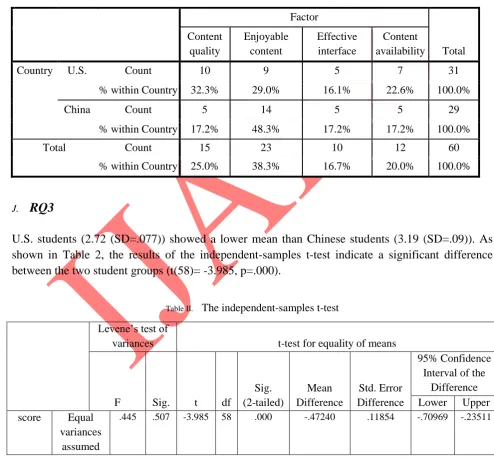
As shown in Table 1, students emphasized enjoyable content (38.3%) as the most important educational factor, followed by content quality (25.0%). content availability (20.0%), and effective interface (16.7%), in that order.
Table I. Most important education-related factors by country (N, %)
Factor
Total Content
quality
Enjoyable content
Effective interface
Content availability
Country U.S. Count 10 9 5 7 31
% within Country 32.3% 29.0% 16.1% 22.6% 100.0%
China Count 5 14 5 5 29
% within Country 17.2% 48.3% 17.2% 17.2% 100.0%
Total Count 15 23 10 12 60
% within Country 25.0% 38.3% 16.7% 20.0% 100.0%
J. RQ3
U.S. students (2.72 (SD=.077)) showed a lower mean than Chinese students (3.19 (SD=.09)). As shown in Table 2, the results of the independent-samples t-test indicate a significant difference between the two student groups (t(58)= -3.985, p=.000).
Table II. The independent-samples t-test
Levene’s test of
variances t-test for equality of means
F Sig. t df
Sig. (2-tailed)
Mean Difference
Std. Error Difference
95% Confidence Interval of the
Difference Lower Upper score Equal
variances assumed
International Journal of Advances in Engineering Research http://www.ijaer.com
(IJAER) 2016, Vol. No. 11, Issue No. III, March e-ISSN: 2231-5152/ p-ISSN: 2454-1796
K. RQ4
As shown in Table 1, U.S. students identified content quality (32.3%) as the most important educational factor, followed by enjoyable content (29.0%), content availability (22.6%, and effective interface (16.1%), in that order. Chinese students identified enjoyable content (48.3%) as the most important educational factor, followed by the remaining three factors equally at 17.2%. The results of the chi-square test for the relationship between the country and these factors indicate no significant relationship (χ2(3) = 3.024, p=.388). Cramer’s V was .224, implying a strong relationship.
DISCUSSION
This paper investigates U.S. and Chinese students’ attitudes toward learning through smart devices. According to the results, students generally had slightly unfavorable attitudes toward smart devices (mean = 2.95). U.S. students (2.72) showed a lower mean than Chinese students (3.19), and there was a significant difference between the two student groups. Students generally emphasized enjoyable content as the most important educational factor, followed by content quality. content availability, and effective interface, in that order. U.S. students identified content quality as the most important educational factor, followed by enjoyable content, content availability, and effective interface, in that order. Chinese students identified enjoyable content as the most important educational factor, followed by the remaining three factors equally.
The results have important practical implications for educational policymakers. Noteworthy is that U.S. students were less likely than their Chinese students to accept smart devices for learning purposes. This result is surprising in that U.S. students, being more individualistic, were expected to embrace new technologies for learning. The results may be due to the fact that Chinese students, in their desire to catch up to U.S. students, may view new technologies as a means to achieve this. In this regard, U.S. policymakers should emphasize the value of smart devices for learning purposes for U.S. students, and Chinese policymakers should find ways to further facilitate learning through technology-based platforms.
The results have important implications for practitioners. U.S. and Chinese students agreed on enjoyable content as a key factor influencing their favorable attitudes toward smart devices for learning purposes. In this regard, to better promote the technology, technology managers should focus on making content and interfaces more enjoyable, and companies should emphasize this feature in their marketing efforts.
International Journal of Advances in Engineering Research http://www.ijaer.com
(IJAER) 2016, Vol. No. 11, Issue No. III, March e-ISSN: 2231-5152/ p-ISSN: 2454-1796
REFERENCES
Al-Fahad, N. "STUDENTS' ATTITUDES AND PERCEPTIONS TOWARDS THE EFFECTIVENESS OF MOBILE LEARNING IN KING SAUD UNIVERSITY, SAUDI ARABIA." Turkish Online Journal of Educational Technology – TOJET 8.2 (2009): n.pag. Web. 19 Jul 2013.
Hong, Kian-Sam, Abang Ridzuan, and Ming-Koon Kuek. "Students' attitudes toward the use of the Internet for learning: A study at a university in Malaysia."Educational Technology & Society 6.2 (2003): n.pag. Web. 19 Jul 2013.
Kahveci, Murat. “STUDENTS’ PERCEPTIONS TO USE TECHNOLOGY FOR LEARNING: MEASUREMENT INTEGRITY OF THE MODIFIED FENNEMA-SHERMAN ATTITUDES SCALES." TOJET: The Turkish Online Journal of Educational Technology 9.1 (2010): n.pag. Web. 19 Jul 2013.
Lowerison, Gretchen, Jennifer Sclater, Richard Schmid, and Philip Abrami. "Student perceived effectiveness of computer technology use in post-secondary classrooms." Computers &
Education 47. (2006): n.pag. Web. 19 Jul 2013.
Jyothi, T., and R. Chalapathi. "AN ANALYSIS OF SCHOOL TEACHERS’ PERCEPTIONS ON THE USE OF TELEVISION, INTERNET AND COMPUTERS (TIC) AS LEARNING TOOLS."TRANS Asian Research Journals. 1.2 (2012): 25-31. Web. 20 Aug. 2013.
McFeeters, Forrest. The Effects of Individualism Vs. Collectivism on Learner’s Recall, Transfer and
Attitudes Toward Collaboration and Individualized Learning. Diss. Virginia Polytechnic Institute
and State University, 2003. Blacksburg: 2003. Print.
Nyagowa, Hesbon, Dennis Ocholla, and Stephen Mutula. "Evaluation of Success of NEPAD’s Pilot e-Schools in Kenya: An overview." 2012. Web. 15 Jul. 2013.
Rey-Lopez, Marta, Rebecca Diaz-Redondo, Ana Fernandez-Vilas, Jose Pazoe-Arias, Martin Lopez-Nores, Jorge Garcia-Duque, Alberto Gil-Solla, and Manuel Ramos-Cabrer. "T-MAESTRO and its authoring tool: using adaptation to integrate entertainment into personalized t-learning." (2008): n. page. Web. 15 Jul. 2013.
Seliaman, Mohamed, and M Al-Turki. "Mobile Learning Adoption in Saudi Arabia ." World
International Journal of Advances in Engineering Research http://www.ijaer.com
(IJAER) 2016, Vol. No. 11, Issue No. III, March e-ISSN: 2231-5152/ p-ISSN: 2454-1796
"Software Tools and Technologies for Delivering Smart Media-Optimized Applications in the CLOUD."Computing. 2013: n. page. Web. 15 Jul. 2013.