
Vol. 5, No. 1, 2017, 17-23 ISSN: 2321 – 9238 (online) Published on 22 April 2017 www.researchmathsci.org
DOI: http://dx.doi.org/10.22457/pindac.v5n1a3
Progress in
An Efficient Approach for Finding an Initial Basic Feasible
Solution for Transportation Problems
Md. Abdul Hakim1 and Md. Rejuan Kabir2 Department of Mathematics Comilla University, Comilla, Bangladesh 1
Email: [email protected]; 2Email: [email protected]
Received 14 March 2017; accepted 1 April 2017
Abstract: Transportation problem is famous in operation research for its wide application in real life. This is a special kind of the network optimization problems in which goods are transported from a set of sources to a set of destinations subject to the supply and demand of the source and destination, respectively, such that the total cost of transportation is minimized. Finding an initial basic feasible solution is the prime requirement to obtain an optimal solution for the transportation problems. In this article, a new approach named ‘Row-Column’s Divided Method’ is proposed to find an initial basic feasible solution for the transportation problems. The method is also illustrated with numerical examples and comparison of the results obtained by various methods.
Keywords: Transportation problem, initial basic feasible solution, row-column’s divided method, optimal solution.
1. Introduction
This is a type of linear programming problem that may be solved using a simplified version of the simplex technique called transportation method. Because of its major application in solving problems involving several product sources and several destinations of products, this type of problem is frequently called the transportation problem.
condition for a paradox in a linear fractional transportation problem with mixed constraints. Adlakha and Kowalski [8] derived a sufficient condition to identify the cases where the paradoxical situation exists. Ryan [9] developed a goal programming approach to the representation and resolution of the more for less and more for nothing paradoxes in the distribution problem. Deineko et al. [10] developed a necessary and sufficient condition for a cost matrix which is immune against the transportation paradox. Dahiya and Verma [11] considered paradox in a nonlinear capacitated transportation problem. Adlakha et al. [12] developed a simple heuristic algorithm to identify the demand destinations and the supply points to ship more for less in fixed-charge transportation problems. Storoy [13] considered the classical transportation problem and studied the occurrence of the so-called transportation paradox (also called the more-for-less paradox). Joshi and Gupta [14] studied an efficient heuristic algorithm for solving more-for-less paradox and algorithm for finding the initial basic feasible solution for linear plus linear fractional transportation problem.
2. Proposed approach to find an initial basic feasible solution
We, now introduce a new method called ‘Row-Column’s Divided Method’ for finding an initial basic feasible solution to a transportation problem. The Row-Columns Divided Method’ proceeds as follows:
Step 1: Construct a Transportation Table (TT) from the given transportation problem.
Step 2: Ensure whether the TP is balanced or not, if not, make it balanced.
Step 3: Divide each row entries of the transportation table by the respective row minimum and then divide each column entries of the resulting transportation table by respective column minimum.
Step 4: Write the round figure of 1.( write 1 for 1-1.74 and 2 for 1.75-1.99). Now there will be at least one 1 in each row and in each column in the reduced cost matrix.
Step 5: Select the first 1 (row-wise) occurring in the cost matrix. Suppose (i, j)th one(1) is selected, count the total number of one’s (excluding the selected one) in the ith row and jth column. Now select the next 1 and count the total number of 1 in the corresponding row and column in the same way. Continue it for all 1’s in the cost matrix.
Step 6: Now choose a 1 for which the number of 1 counted in step 5 is minimum and supply maximum possible amount to that cell. If tie occurs for some 1’s in step 5 then choose a (m,n)th 1 breaking tie such that the total sum of all the elements in the nth column (excluding the selected cell) in main cost matrix is maximum. Allocate maximum possible amount to that cell (row-wise).
Problems
Step 8: Check whether the resultant matrix possesses at least one 1 in each row and in each column. If not, repeat step 3, otherwise go to step 9.
Step 9: Repeat step 4 to step 8 until and unless all the demands are satisfied and all the supplies are exhausted.
3. Numerical example (1) with illustration
Consider the following cost minimizing transportation problem with three origins and four destinations
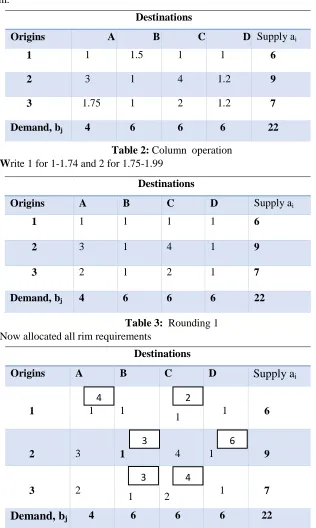
Solution. Finding initial basic feasible solution according to Row-Columns Divided Method:
Step 1: Divide each row entries of the transportation table by the respective row minimum.
Table 1: Row operation Destinations
Origins A B C D Supply, ai
1 4 3 2 5 6
2 6 1 4 3 9
3 7 2 4 6 7
Demand, bj 4 6 6 6 22
Destinations
Origins A B C D Supply ai
1 2 1.5 1 2.5 6
2 6 1 4 3 9
3 3.5 1 2 3 7
2
3 4
Step 2: Divide each column entries of the transportation table by the respective column minimum.
Table 2: Column operation Step 3: Write 1 for 1-1.74 and 2 for 1.75-1.99
Table 3: Rounding 1 Step 4: Now allocated all rim requirements
Table 4: Final row-column divided allocation Destinations
Origins A B C D Supply ai
1 1 1.5 1 1 6
2 3 1 4 1.2 9
3 1.75 1 2 1.2 7
Demand, bj 4 6 6 6 22
Destinations
Origins A B C D Supply ai
1 1 1 1 1 6
2 3 1 4 1 9
3 2 1 2 1 7
Demand, bj 4 6 6 6 22
Destinations
Origins A B C D Supply ai
1 1 1
1 1 6
2 3 1 4 1 9
3 2
1 2 1 7
Demand, bj 4 6 6 6 22 4
Problems
Illustration
• In first row, (1,A)th1has the minimum 1 in the corresponding row and columns. So select it and set x1A = min(4,6) = 4 and allocate it in the cell (1,A), therefore demand of destination A is satisfied completely.
• Next Select (1,C)th1has the next minimum 1 in the corresponding row and columns. So select it and set x1C = min(2,6) = 2 and allocate it in the cell (1,C); therefore the capacity of 1 row is exhausted.
• In 2nd row there are two 1 in the cell (2,B) and (2,D) respectively, both cell have same number of 1 in the corresponding row and columns but for cell (2,D): total sum of all the elements in the D column (excluding the selected cell) in main cost matrix is maximum. So set X2D= min(9,6)= 6 and allocate it in the cell (2,D);), therefore demand of destination D is satisfied completely.
• Next set X2B= min(3,6)= 3 and allocate it in the cell (2,B),therefore the capacity of 2 row is exhausted.
• Similarly next set X3B= min(0,3)= 3 and allocate it in the cell (3,B),therefore B is satisfied.
• Next set X3C= min(4,4)= 4 and allocate it in the cell (3,C),therefore the capacity of 3 row is exhausted and also all rim requirements are satisfied.
Here the number of basic variable is 6=(3+4-1) which is satisfied the condition (m+n-1) Total transportation cost is = (4× 4 + 2 × 2 + 1 × 3 + 3 × 6+ 2 × 3 + 4× 4)= $ 63
4. Numerical example (2) without illustration
Consider the following cost minimizing transportation problem with three origins and four destinations.
Destinations
Origins A B C D Supply ai
O1 13 18 30 8 8
O2 55 20 25 40 10
O3 30 6 50 10 11
Solution: Initial basic feasible solution according to row-columns divided method:
Table 5: Final row-column divided allocation
• Total cost is = (13*4) + (8*4) + (20*4) + (25*6) + (6*3) + (10*8) = 52 + 32 + 80 + 150 + 18+ 80
= $ 412
5. Result analysis and comparison
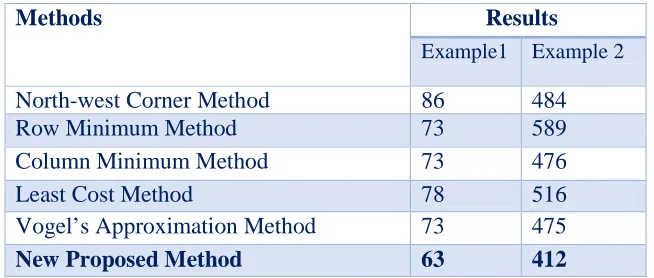
After obtaining an IBFS by the proposed “Row Column’s Divided Method”, the obtained result is compared with the results obtained by other existing methods is shown in the following table:
Table 6: Comparison of the results obtained by various methods
As observed from Table 6, the proposed allocation table method provides comparatively a better initial basic feasible solution than the results obtained by the traditional algorithms which are either optimal or near to optimal. Again the performance of the solution varies for other methods which may happen also in case of the proposed
Destinations
Origins A B C D Supply ai
O1 1 2.25
3 1 8
O2 1 1 1 2 10
O3 3.07
1 6.67
1 11
Demand, bj 4 7 6 12 29
Methods Results
Example1 Example 2
North-west Corner Method 86 484
Row Minimum Method 73 589
Column Minimum Method 73 476
Least Cost Method 78 516
Vogel’s Approximation Method 73 475
New Proposed Method 63 412
4 4
8 3
Problems
6. Conclusion
In this article, a new approach named ‘Row- Column’s Divided Method’ for finding an initial basic feasible solution of transportation problems is proposed. Efficiency of allocation table method has also been tested by solving several number of cost minimizing transportation problems and it is found that the allocation table method yields comparatively a better result. Finally it can be claimed that the allocation table method may provide a remarkable initial basic feasible solution by ensuring minimum transportation cost. This will help to achieve the goal to those who want to maximize their profit by minimizing the transportation cost.
REFERENCES
1. F.L.Hitchcock, The distribution of a product from several resources to numerous localities, Journal of Mathematical Physics, 20 (1941) 224-230.
2. A.Charnes, W.W.Cooper and A.Henderson, An introduction to linear programming, Wiley New Work, (1953).
3. G.M.Appa, The transportation problem and its variants, Operational Research Quarterly, 24 (1973) 79 − 99.
4. D.Klingman and R.Russel, The transportation problem with mixed constraints, Operational Research Quaterly, 25 (1947) 447-455.
5. A.Charnes and D.Klingman, The more-for-less paradox in the distribution model, Cachiers du Centre dEtudes de Recherche Operationelle, 13 (1971) 11-22.
6. W.Szwarc, The transportation paradox, Naval Research Logistics Quarterly, 18 (1973) 185 − 202.
7. A.Gupta, S.Khanna and M.C.Puri, A paradox in linear fractional transportation problems with maxed constraints, Optimazation, 27 (1993) 375-387.
8. V.Adlakha and K.Kowalski, A quick sufficient solution to the more-for-less paradox in a transportation problem, Omega, 26 (1998) 541 − 547.
9. M.J.Ryan, The distribution problem, the more for less (nothing) paradox and economies of scale and scope, European Journal of Operational Research, 121 (2000) 92-104.
10. D.S.Dinagar and K.Palanivel, On trapezoidal membership function in solving transportation problem under fuzzy environment, International Journal of Computational Physical Sciences, 1 (2009) 1-12.
11. K.Dahiya and V.Verma, Paradox in a non-linear capacitated transportation problem, Yugoslav Journal of Operations Research, 16 (2006)189-210.
12. V.Adlakha, K.Kowalski, R.R.Vemugantia and B.Levc, More-for-less algorithm for fixed-charge transportation problems, Omega, 35 (2007) 116 - 127.
13. S.Storoy, The Transportation Paradox Revisited, N-5020 Bergen, Norway, (2007).
14. V.D.Joshi and N.Gupta, On a paradox in linear plus fractional transportation problem, Mathematica, 26 (2010) 167-178.

![Avaliando a similaridade semântica entre frases curtas através de uma abordagem híbrida (A hybrid approach to measure Semantic Textual Similarity between short sentences in Brazilian Portuguese)[In Portuguese]](data:image/gif;base64,R0lGODlhAQABAIAAAP///wAAACH5BAEAAAAALAAAAAABAAEAAAICRAEAOw==)