Carpinus gigabracteatus
, a new species from
southeast Yunnan, China
Zhiqiang Lu1,2
1 CAS Key Laboratory of Tropical Forest Ecology, Xishuangbanna Tropical Botanical Garden, Chinese Aca-demy of Sciences, Mengla 666303, Yunnan, China 2 Center of Plant Ecology, Core Botanical Gardens, Chinese Academy of Sciences, Mengla 666303, Yunnan, China
Corresponding author: Zhiqiang Lu ([email protected])
Academic editor: N. Holstein | Received 17 December 2019 | Accepted 11 March 2020 | Published 10 April 2020
Citation: Lu Z (2020) Carpinus gigabracteatus, a new species from southeast Yunnan, China. PhytoKeys 145: 47–56.
https://doi.org/10.3897/phytokeys.145.49488
Abstract
Carpinus gigabracteatus Z. Qiang Lu, a new hornbeam species from southeast Yunnan of China, is de-scribed and illustrated in this study. It possesses extremely large bracts and is closely related to C. tsaiana Hu and C. tschonoskii Maxim., based on the characters of large bract size and bracts without lobes at the base of inner margins. Furthermore, morphological comparison suggested it was distinctly different from C. tschonoskii by a series of characters from leaf, infructescence, bract and nutlet and from C. tsaiana by its leaf length to width ratio (1.4–2.0 vs. 2.0–2.4), lateral veins significantly impressed adaxially, number of lateral veins on each side of midvein (9–14 vs. 14–17), bract length (3.9–4.8 vs. 2.5–3.2 cm) and bract length to width ratio (2.3–3.1 vs. 1.5–2.1). Therefore, this hornbeam, based on only one population from southeast Yunnan, is here erected as a new species, named as C. gigabracteatus.
Keywords
Carpinus gigabracteatus, large bract, new species
Introduction
The hornbeam genus Carpinus L. is the largest genus in the subfamily Coryloideae of Betulaceae (Holstein and Weigend 2017; Li et al. 2018). To the present time, more than 40 species have been published (Hu 1964; Qi 1981; Liang and Zhao1991; Li and Skvortsov 1999; Tong et al. 2014; Holstein and Weigend 2017; Lu et al. 2017, 2018). Due to their peculiar and beautiful fruit cluster, some hornbeams are used
http://phytokeys.pensoft.net
Copyright Zhiqiang Lu. This is an open access article distributed under the terms of the Creative Commons Attribution License (CC BY 4.0), which permits unrestricted use, distribution, and reproduction in any medium, provided the original author and source are credited.
as important ornamental plants (Fini and Ferrini 2011; Li et al. 2018). The bract characters of fruit clusters are also important evidence for species identification (Hu 1964; Li and Skvortsov 1999; Lu et al. 2017). According to the bract characters, three morphological groups are separated by bracts completely covering the nutlet, all bracts with conspicuous lobes at the base of inner margins and bracts without lobes or rarely with inconspicuous lobes at the base of inner margins, respectively (Li and Skvortsov 1999; Lu et al. 2017). In China, the last is the largest group, including about 26 species (Holstein and Weigend 2017; Lu et al. 2018), most of them being narrow endemics within China (Li and Skvortsov 1999). Bract size is the critical trait for distinguishing these species between each other (Hu 1964; Li and Skvortsov 1999). Almost all species in this group have bracts less than 3.2 × 1.3 cm. However, the present author found a hornbeam population during field surveys in southeast Yunnan with bracts without lobes at the base of inner margins, but with large bracts (3.9–4.8 × 1.4–2.0 cm) and these could not be ascribed to any described species. In addition, those hornbeams distributed in other regions, including Carpinus betulus L., C. caroliniana Walter, C. faginea Lindl., C. laxiflora (Siebold & Zucc.) Blume, C. orientalis Mill. and C. tropicalis (Donn.Sm.) Lundell, all have smaller bract size than this Yunnan population, which also distinctly differs in bract lobes at the base of inner margins and leaf characters (Hu 1964; Furlow 1987; Holstein and Weigend 2017). However, in China, within the morphological group possessing bracts without lobes at the base of inner margins, only C. tsaiana Hu has the same bract width but differs from the Yunnan population by bract length. C. tschonoskii Maxim. has similar bract length but with different bract width (Li and Skvortsov 1999). The present author, therefore, hypothesised that this morphologically different population from southeast Yunnan may represent a poten-tial new hornbeam. In order to test this hypothesis, the present author carried out morphological comparisons with representatives of all hornbeams in China.
Material and methods
Field surveys and specimen examination
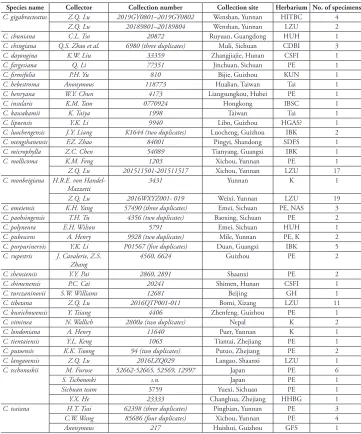
Table 1. Specimens preserved in herbarium used for morphological comparison.
Species name Collector Collection number Collection site Herbarium No. of specimens
C. gigabracteatus Z.Q. Lu 2019GY0801–2019GY0802 Wenshan, Yunnan HITBC 4 Z.Q. Lu 20189801–20189804 Wenshan, Yunnan LZU 2 C. chuniana C.L. Tso 20872 Ruyuan, Guangdong HUH 1 C. chingiana Q.S. Zhao et al. 6980 (three duplicates) Muli, Sichuan CDBI 3 C. dayongina K.W. Liu 33359 Zhangjiajie, Hunan CSFI 1
C. fargesiana Q. Li 77351 Jinchuan, Sichuan PE 1
C. firmifolia P.H. Yu 810 Bijie, Guizhou KUN 1
C. hebestroma Anonymous 118773 Hualian, Taiwan Tai 1 C. henryana W.Y. Chun 4173 Liangsungkou, Hubei PE 1
C. insularis K.M. Tam 0770924 Hongkong IBSC 1
C. kawakamii K. Taiya 1998 Taiwan Tai 1
C. lipoensis Y.K. Li 9940 Libo, Guizhou HGAS? 1
C. luochengensis J.Y. Liang K1644 (two duplicates) Luocheng, Guizhou IBK 2 C. mengshanensis F.Z. Zhao 84001 Pingyi, Shandong SDFS 1 C. microphylla Z.C. Chen 54089 Tianyang, Guangxi IBK 1
C. mollicoma K.M. Feng 1203 Xichou, Yunnan PE 1
Z.Q. Lu 201511501-201511517 Xichou, Yunnan LZU 17 C. monbeigiana H.R.E. von
Handel-Mazzetti 3431 Yunnan K 1
Z.Q. Lu 2016WXYZ001- 019 Weixi, Yunnan LZU 19 C. omeiensis K.H. Yang 57490 (three duplicates) Emei, Sichuan PE, NAS 3 C. paohsingensis T.H. Tu 4356 (two duplicates) Baoxing, Sichuan PE 2 C. polyneura E.H. Wilson 5791 Emei, Sichuan HUH 1 C. pubescens A. Henry 9928 (two duplicates) Mile, Yunnan PE, K 2 C. purpurinervis Y.K. Li P01567 (five duplicates) Duan, Guangxi IBK 5 C. rupestris J. Cavalerie, Z.S.
Zhang 4560, 6624 Guizhou PE 2
C. shensiensis Y.Y. Pai 2860, 2891 Shaanxi PE 2
C. shimenensis P.C. Cai 20241 Shimen, Hunan CSFI 1 C. turczaninovii S.W. Williams 12681 Beijing GH 1 C. tibetana Z.Q. Lu 2016QTP001-011 Bomi, Xizang LZU 11 C. kweichowensis Y. Tsiang 4406 Zhenfeng, Guizhou PE 1 C. viminea N. Wallich 2800a (two duplicates) Nepal K 2
C. londoniana A. Henry 11640 Puer, Yunnan K 1
C. tientaiensis Y.L. Keng 1065 Tiantai, Zhejiang PE 1 C. putoensis K.K. Tsoong 94 (two duplicates) Putuo, Zhejiang PE 2 C. langaoensis Z.Q. Lu 2016LZQ029 Langao, Shaanxi LZU 1 C. tschonoskii M. Furuse 52662-52665, 52569, 12997 Japan PE 6
S. Tschonoski s.n. Japan PE 1
Sichuan team 3759 Yuexi, Sichuan PE 1
Y.X. He 23333 Changhua, Zhejiang HHBG 1 C. tsaiana H.T. Tsai 62398 (three duplicates) Pingbian, Yunnan PE 3 C.W. Wang 85686 (four duplicates) Xichou, Yunnan PE 4
Anonymous 217 Huishui, Guizhou GFS 1
Morphological analysis
of the specimens. In addition, values of minimum and maximum bract width/length, recorded in Flora of China and other published studies (Hu 1964; Li and Skvortsov 1999; Tong et al. 2014; Holstein and Weigend 2017; Lu et al. 2017, 2018), were also used to determine the closely related species, based on the comparative analysis of bract size and other characters. Finally, many morphological differences between this Yunnan population and other closely related hornbeams were clarified through the morphological comparison, based on 115 specimens (including type specimens).
Results
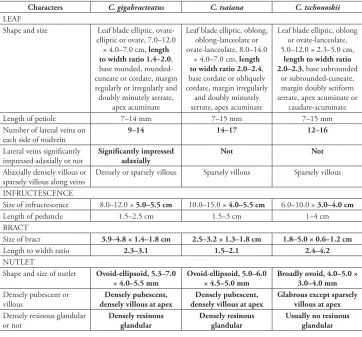
This hornbeam population from southeast Yunnan possesses extremely large bracts (3.9– 4.8 × 1.4–2.0 cm) (Figures 1, 2). Phenotypic differentiation of bract length and width for hornbeams in China showed it was closely related to C. langaoensis, C. tsaiana and C. tschonoskii (Figure 3). Bracts, with and without lobes at the base of inner margins, corresponded to C. langaoensis and the Yunnan population, respectively (Figure 3). Mor-phological comparison with C. tsaiana and C. tschonoskii showed the Yunnan population distinctly differed from C. tschonoskii by leaf length to width ratio (1.4–2.0 vs. 2.0–2.3), lateral veins significantly impressed adaxially, infructescence size (8.0–12.0 × 5.0–5.5 cm vs. 6.0–10.0 × 3.0–4.0 cm), bract width (1.4–1.8 vs. 0.6–1.2 cm), nutlet shape (ovoid-el-lipsoid vs. broadly ovoid), nutlet size (5.3–7.0 × 4.0–5.5 mm vs. 4.0–5.0 × 3.0–4.0 mm) and densely pubescent or villous and resinous glandular on nutlet (Table 2) and from C. tsaiana by leaf length to width ratio (1.4–2.0 vs. 2.0–2.4), lateral veins significantly im-pressed adaxially, number of lateral veins on each side of midvein (9–14 vs. 14–17), bract length (3.9–4.8 vs. 2.5–3.2 cm) and bract length to width ratio (2.3–3.1 vs. 1.5–2.1).
Taxonomic treatment
Carpinus gigabracteatus Z. Qiang Lu, sp. nov.
urn:lsid:ipni.org:names:77209333-1 Figures 1, 2
大苞鹅耳枥
Diagnosis.Carpinus gigabracteatus differs from C. tsaiana by leaf length to width ratio 1.4–2.0 (compared to 2.0–2.4), lateral veins impressed adaxially, 9–14 lateral veins on each side of the midvein (compared to 14–18), bract length 3.9–4.8 cm (compared to 2.5–3.0 cm) and bract length to width ratio 2.3–3.1 (compared to 1.5–2.1).
Type. China. Yunnan: Wenshan Prefecture, 23°09'35"N, 104°05'53"E, 1591 m alt., karst limestone hill, 23 Sep 2019, Z.Q. Lu 2019GY0801 (holotype, HITBC; iso-types, HITBC and LZU).
Table 2. Morphological comparison of C. gigabracteatus with C. tsaiana and C. tschonoskii.
Characters C. gigabracteatus C. tsaiana C. tschonoskii
LEAF
Shape and size Leaf blade elliptic, ovate-elliptic or ovate, 7.0–12.0
× 4.0–7.0 cm, length to width ratio 1.4–2.0, base rounded, rounded-cuneate or cordate, margin regularly or irregularly and doubly minutely serrate,
apex acuminate
Leaf blade elliptic, oblong, oblong-lanceolate or ovate-lanceolate, 8.0–14.0
× 4.0–7.0 cm, length to width ratio 2.0–2.4, base cordate or obliquely cordate, margin irregularly
and doubly minutely serrate, apex acuminate
Leaf blade elliptic, oblong or ovate-lanceolate, 5.0–12.0 × 2.3–5.0 cm,
length to width ratio 2.0–2.3, base subrounded
or subrounded-cuneate, margin doubly setiform serrate, apex acuminate or
caudate-acuminate
Length of petiole 7–14 mm 7–15 mm 7–15 mm
Number of lateral veins on
each side of midvein 9–14 14–17 12–16
Lateral veins significantly
impressed adaxially or not Significantly impressed adaxially
Not Not
Abaxially densely villous or
sparsely villous along veins Densely or sparsely villous Sparsely villous Sparsely villous INFRUCTESCENCE
Size of infructescence 8.0–12.0 × 5.0–5.5 cm 10.0–15.0 × 4.0–5.5 cm 6.0–10.0 × 3.0–4.0 cm
Length of peduncle 1.5–2.5 cm 1.5–3 cm 1–4 cm
BRACT
Size of bract 3.9–4.8 × 1.4–1.8 cm 2.5–3.2 × 1.3–1.8 cm 1.8–5.0 × 0.6–1.2 cm
Length to width ratio 2.3–3.1 1.5–2.1 2.4–4.2
NUTLET
Shape and size of nutlet Ovoid-ellipsoid, 5.3–7.0
× 4.0–5.5 mm Ovoid-ellipsoid, 5.0–6.0 × 4.5–5.0 mm Broadly ovoid, 4.0–5.0 × 3.0–4.0 mm Densely pubescent or
villous densely villous at apexDensely pubescent, densely villous at apexDensely pubescent, Glabrous except sparsely villous at apex Densely resinous glandular
or not Densely resinous glandular
Densely resinous glandular
Usually no resinous glandular
Figure 1.Carpinus gigabracteatus Z. Qiang Lu A the whole plant, habitat and location B branches with infructescences and leaves C infructescences D leaf E bracts F nutlet.
Nutlet ovoid-ellipsoid, 5.3–7.0 × 4.0–5.5 mm, densely pubescent, densely villous at apex, densely brown resinous glandular, prominently 9 or 11-ribbed.
Etymology. This hornbeam from southeast Yunnan has extremely large bracts, which are distinctly different from other closely related hornbeams, and therefore is given the epithet gigabracteatus.
Phenology. Flowering from April to May and fruiting from July to September.
Figure 2.Carpinus gigabracteatus Z. Qiang Lu was drawn from Z.Q. Lu 2019GY0801 (HITBC).
Figure 3. Phenotypic differentiation of bract length and width, across all Chinese hornbeam species ac-cording to Holstein and Weigend (2017). Data from all examined specimens in Table 1 and descriptions by Hu (1964), Qi (1981), Liang and Zhao (1991), Li and Skvortsov (1999), Tong et al. (2014) and Lu et al. (2017, 2018). Those hornbeams, whose bracts are without lobes or rarely with inconspicuous lobes at the base of inner margins, are in bold.
its rarity and horticultural and ornamental value. According to the IUCN Categories and Criteria (IUCN 2016), the present author here classifies this species as “Critically Endangered” (CR). Fortunately, these mature trees can provide the possibility to ex-pand population based on seeds.
Additional specimens examined. China. Yunnan: Wenshan Prefecture, 23°09'35"N, 104°05'53"E, 1591 m alt., karst limestone hill, 23 Sep 2019, Z.Q. Lu 2019GY0802; the same locality, 10 July 2019, Z.Q. Lu 20189801–Z.Q. Lu 20189804.
Discussion
Skvortsov 1999; Lu et al. 2017, 2018). In addition, more characters, based on leaf and nutlet, can also distinguish both of them (Lu et al. 2017). Furthermore, other horn-beams distributed outside of China, including C. betulus, C. caroliniana, C. faginea, C. laxiflora, C. orientalis and C. tropicalis, are all different from this hornbeam population from southeast Yunnan, by the smaller bract size and other characters of bract and leaf (Hu 1964; Furlow 1987; Holstein and Weigend 2017). Finally, morphological comparison suggested it differed from C. tschonoskii by a series of characters from leaf, infruGctescence, bract and nutlet (Table 2), which was consistent with the description by Li and Skvortsov (1999). Therefore, the most similar species to the Yunnan popu-lation is C. tsaiana, based on similar morphology and distribution (Li and Skvortsov 1999; Holstein and Weigend 2017). However, all eight typical specimens of C. tsaiana (including seven type specimens) from three populations were distinctly different from this Yunnan population by leaf length to width ratio (1.4–2.0 vs. 2.0–2.4), lateral veins significantly impressed adaxially, number of lateral veins on each side of midvein (9–14 vs. 14–17), bract length (3.9–4.8 vs. 2.5–3.2 cm) and bract length to width ratio (2.3–3.1 vs. 1.5–2.1) (Table 2; Figures 1–3). Hence, the present author proposes to recognise this hornbeam population from Yunnan as a new species.
Acknowledgements
This work is supported by grants from the National Natural Science Foundation of China (31901326) and CAS “Light of West China”.
References
Fini A, Ferrini F (2011) Effects of mulching with compost on growth and physiology of Acer campestre L. and Carpinus betulus L. Advances in Horticultural Science 25(4): 232–238. Furlow JJ (1987) The Carpinus caroliniana complex in North America. II. Systematics.
System-atic Botany 12(3): 416–434. https://doi.org/10.2307/2419267
Holstein N, Weigend M (2017) No taxon left behind? – a critical taxonomic checklist of
Carpinus and Ostrya (Coryloideae, Betulaceae). European Journal of Taxonomy 375: 1–52. https://doi.org/10.5852/ejt.2017.375
Hu HH (1964) The materials on the monography of genus Carpinus L. of China. Acta Phytataxonomica Sinica 9(3): 281–298.
IUCN (2016) Guidelines for Using the IUCN Red List Categories and Criteria. Version 12. Prepared by the Standards and Petitions Subcommittee. http://www.iucnredlist.org/docu-ments/RedListGuidelines.pdf
Li PC, Skvortsov AK (1999) Betulaceae. In: Wu C Y, Raven PH (Eds) Flora of China (Vol. 4). Science Press, Beijing, 86–313.
Liang SB, Zhao FZ (1991) A new species of Carpinus from Shandong. Bulletin of Botanical Research 11(2): 33–34.
Lu ZQ, Liu SY, Yang XY, Liang QL, Yang YZ, Zhang D, Milne R, Liu JQ (2017) Carpinus langaoensis (Betulaceae), a new hornbeam species from the Daba Mountains in Shaanxi, China. Phytotaxa 295(2): 185–193. https://doi.org/10.11646/phytotaxa.295.2.6
Lu ZQ, Li Y, Yang XY, Liu JQ (2018) Carpinus tibetana (betulaceae), a new species from south-east Tibet, China. PhytoKeys 98: 1–13. https://doi.org/10.3897/phytokeys.98.23639 Qi CJ (1981) Three new woody species from Hunan Province. Journal of Nanjing
Technologi-cal College of Forest Products 3: 123–126. https://doi.org/10.1111/j.1475-1305.1981. tb00386.x