Reviewable v1 Commentary
Widening the wind power cluster framework with
a regional energy cluster: a research note
Jari Sarja
‡ Lapland University of Applied Sciences, Kemi/Rovaniemi, Finland
Corresponding author: Jari Sarja ([email protected])
Received: 06 Jun 2019 | Published: 13 Jun 2019
Citation: Sarja J (2019) Widening the wind power cluster framework with a regional energy cluster: a research note. Research Ideas and Outcomes 5: e36877. https://doi.org/10.3897/rio.5.e36877
Abstract
The energy industry is identified as a growing business area and the target of development in a case study region. This practitioner’s report describes how the regional energy cluster was defined by using the wind power cluster framework as a basis. The identified energy industry players are positioned in the wind power cluster framework and the actors and operating environment are described and analyzed. According to this study the cluster framework can be a basis for cluster definitions of other industries, especially in the same case region. The practical object of the study is to give regional officials a clear picture of the energy industry operating environment and its cooperation network.
Keywords
Cluster; regional energy cluster; wind power cluster; framework; research note; practitioner’s report
Introduction
Local authorities and research institutes of the case region have identified the energy industry as one growing local business area and target of development. One approach has been the business cluster consideration. The business cluster can be identifiable and
‡
admitted, or accidentally appearing, groups of firms in the same industry without any cooperation plan, or it can be merely a scenario. The small side unit of one of the biggest universities in Finland (University of Oulu), located close to the case region, has made a proposal of a regional energy cluster. The work was done by using the wind power cluster framework Sarja (2013) as a background. The aim of the work was to introduce a defined energy cluster model for the authorities and business owners of the case region or to those in the public who may be interested.
The case area in this study was a medium-sized Finnish town named Raahe and its sub-region. The location of the city of Raahe is on the western coast of Northern Finland (64° 41’N, 24°28’E). A significant amount of Finland’s wind power capacity is produced in the case region, and around 20 new wind farms have been planned for the region (Sarja and Halonen 2012, Sarja and Halonen 2013, Sarja 2013). Apart from wind power production and extension plans there are many other energy industry related iniatives in the region. The most remarkable is the Hanhikivi 1 nuclear plant project.
This research note is structured as follows. First, a short summary of industrial cluster theories and the model of the wind power cluster are presented. Then, the framework of the regional energy cluster led by the wind power cluster is described. Lastly, the results of the energy cluster model and the complementary actions completed during the study are discussed.
Industrial cluster theories
Industrial cluster research in an old discipline. Early researchers, such as von Thunen (1826), Launhardt (1885), and Weber (1909), explained the benefits of regional networks with savings in transportation costs. Marshall (1890) brought together business productivity, location, and proximity to other companies in the field (vom Hofe and Chen 2006), and found other long-term advantages in clustering, such as the spread of information between enterprises, [skilled] labor market development, and cost benefits by achieving non-commercial sharing inputs (e.g. research and training). The starting point of current cluster research can be considered to be the first edition of Porter’s The Competitive Advantage of Nations in 1998 in which he investigated 883 clusters in 49 different countries (vom Hofe and Chen 2006).
In previous studies, Cooke (1998), Cooke (2003), it was found that there is something systematic in the concentrations of the same industries. According to Nummi and Lahenius (2004), a local innovation system consists of [manufacturer] companies, component suppliers, service providers, customers, research and educational institutions, commercial associations and the public sector actors.
businesses as well as public sector organizations including educational and research institutions. Commercial clusters involve multiple consortia. The energy cluster defined for the case region is clearly a regional cluster.
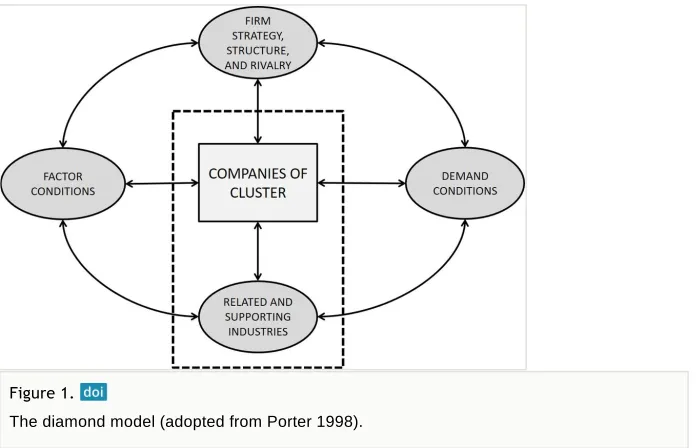
Porter (1998)diamond model Fig. 1 is probably the most well-known cluster model. It can be used in cluster analysis to describe the operating environment of regional companies and public organizations and the formation of competitiveness in a certain industry. The context is built around four background factors: factor conditions of production; strategy, structure and rivalry; demand conditions; and the related and supporting industries. The success of enterprises correlates with the favorability of the background factors.
This study focuses on the key product or the core companies of the cluster as well as their supporting businesses and organizations. This focus area is limited by the dotted line in Fig. 1.
Model of the actors in a wind power cluster
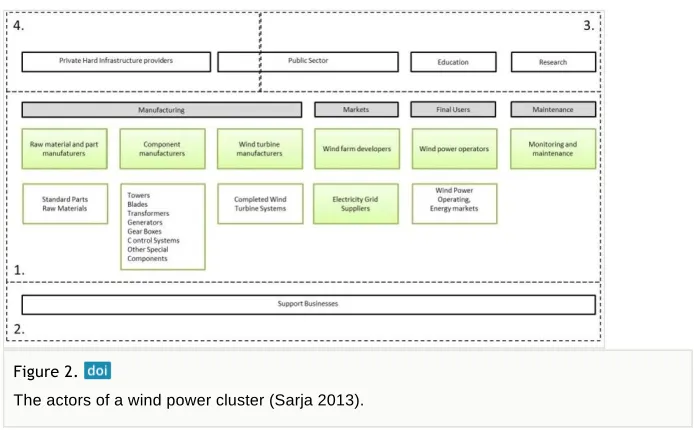
Sarja (2013) defined the wind power cluster model in his article based on related literature: Bolon et al. (2007), Boeckle et al. (2010), Villafafila et al. (2007) and Cornett and Sörensen (2011). The core companies of wind power clusters are the wind turbine manufacturers, component manufacturers, developers of the wind farms, wind power operators, and service and maintenance organizations. The supporting businesses support the core companies directly or indirectly. The soft infrastructure consists of educational and research arrangements which support the industry. The hard infrastructure connects the business environment, for example, to transportation, telecommunication links and electricity grids. Fig. 2 presents the model of a wind power cluster. The rough grouping
Figure 1.
illustrates the core members of a wind power cluster (section 1), supporting businesses (section 2), soft infrastructure (section 3), and hard infrastructure (section 4).
Proposal for regional energy cluster
The regional energy cluster proposal Fig. 3 was led by using the introduced wind power cluster model as a basis. For a start we analyzed what kind of energy industry players we had in the case region. Compared to the wind power specific cluster model we had to take an upper standpoint; whereas the whole industry is divided into small components within the supply chain (manufacturing, markets, end users, maintenance) in the wind power specific model, the energy cluster scenario represents the actors of the cluster as separate industry disciplines. Also, the remits of the supply chain were slightly changed to better fit to the context.
Figure 2.
The actors of a wind power cluster (Sarja 2013).
Figure 3.
Energy production in case region
Energy production in the case area can be divided roughly into three sources (nuclear power, wind power and bioenergy) as well as decentralized production outside the grids. All of these production forms are also identified in the provincial energy strategy which is valid until 2020 (Pohjois-PohjanmaanLiitto 2012). The strategy highlights mention production forms and state that the other production forms are complementary sources to already achieved capacity saturation. The strategically important energy production forms are
summarized inFig. 3. Despite mention of wind power and nuclear power projects, some
bioenergy and decentralized energy projects also exist in the case region.
The actors of the cluster
The regionally important energy production forms, supplemented by surplus heat production from steelwork (used in local district heating network) form the core of the cluster. Upgrading, sales and maintenance activities are also defined as core actions ( section 1 in Fig. 4). The supporting businesses (section 2) in this study were defined by collecting other regionally identified support legs. The traditionally important and capable industries are engineering, engineering works, the building trade and the ICT industry. The two-way collaboration between the energy industry and supporting businesses should strengthen the competitiveness and business opportunities throughout the case region. The empty box (with the symbol "X") in Fig. 4. illustrates the other prospective supporting industries. The existing soft infrastructure (section 3) and hard infrastructure (section 4) are regionally specific factors, and are the same regardless of the observed industry.
Discussion
It can be concluded that in this case it was effectual to use the cluster framework of the other industry as a background. This may also be generalized with restrictions. Depending
Figure 4.
on similarities of the industries in question it reflects the work to be done; but in any case the framework provides a good starting point for cluster defining studies.
The practical aim of this study was to provide a clearer picture to regional decision-makers about the energy industry and its operating environment, as well as its cooperation network. Defining the other regional industry clusters with capable industries (see ‘Supporting businesses’ section of Fig. 4) might show the overlap clusters of different industries describing lots of reliance and targets of regional development. For clarification of the current regional energy scene we also drew up a poster on the subject. To allocate the strengths and targets of development we also did a SWOT analysis based on the cluster definition study.
Acknowledgements
The author acknowledges his host institution for supporting the article writing work.
Hosting institution
Lapland University of Applied Sciences
References
• Boeckle R, Dua M, Henriques D, Simon P, Tronci F (2010) The German wind technology cluster. http://www.isc.hbs.edu/resources/courses/moc-course-at-harvard/documents/pdf/ student-projects/germany_wind_power_2010.pdf. Accessed on: 2014-3-30.
• Bolon E, Caso de los Cobos PG, Commons M, Des Rosiers F, Kukrika N (2007) The Spanish wind power cluster. https://www.isc.hbs.edu/resources/courses/moc-course-at-harvard/Documents/pdf/student-projects/Spain_WindPowerCluster_2007.pdf. Accessed on: 2014-3-22.
• Cluster Navigators Ltd (2001) Cluster building: a toolkit. http://www.vaxtarsamningur.is/ files/skra_0023777.pdf. Accessed on: 2014-6-08.
• Cooke P (1998) Introduction: origins of the concept. https://papers.ssrn.com/sol3/ papers.cfm?abstract_id=1497770. Accessed on: 2014-6-06.
• Cooke P (2003) Economic globalization and its future challenges for regional development. International Journal in Technology Management 26 (2): 401‑420.
• Cornett AP, Sörensen NK (2011) Regional economic aspects of the Danish windmill cluster: the case of the emerging off shore wind energy cluster on the west coast of Jutland. 14th Uddevalla symposium, Bergamo, 16-18.6.2011.
• Launhardt W (1885) mathematische begrunding der wolkwirtschaftslehre. Teubner, Leipzig. • Marshall A (1890) Principles of economics. Macmillan, London.
• Pohjois-PohjanmaanLiitto (2012) Hyvinvointia energiasta - Pohjois-Pohjanmaan energiastrategia 2020. www.pohjois-pohjanmaa.fi/file.php?fid=1027. Accessed on: 2014-3-20.
• Porter ME (1998) The competitive advantage of nations. MacMillan, London. [ISBN 0029253616]
• Sarja J, Halonen V (2012) Case study of a wind turbine sourcing: manufacturer selection criteria. Case study of a wind turbine sourcing: manufacturer selection criteria. Annual electrical power and energy conference, London, Ontario, 10-12.10.2012. https:// doi.org/10.1109/EPEC.2012.6474953
• Sarja J, Halonen V (2013) Wind turbine selection criteria: a customer perspective. Journal of Energy and Power Engineering 7 (9): 1795‑1802.
• Sarja JM (2013) The actors of a wind power cluster: a case of a wind power capital. Journal of Urban and Environmental Engineering 7 (1): 143‑150. https://doi.org/10.4090/ juee.2013.v7n1.143150
• Villafafila R, Bak-Jensen B, Gomis O, Ramirez R, Sudria A, Sumper A, Suwannarat A (2007) On wind power integration into electrical power system: Spain vs. Denmark. International conference on renewable energies and power quality - poster session, Sevilla, 28.-30.3.2007. https://doi.org/10.24084/repqj05.374
• vom Hofe R, Chen K (2006) Whither or not industrial cluster: conclusions of confusions? The Industrial Geographer 4 (1): 2‑28.
• von Thunen JH (1826) Der isolierte Staat in Beziehung auf Landwirtschaft und Nationalökonomie. Perthes, Hamburg.