R E S E A R C H
Open Access
Comparing the effects of dynamic
computer visualization on undergraduate
students
’
understanding of osmosis with
randomized posttest-only control group
design
Shannon Hsianghan-Huang Sung
1*, Ji Shen
2, Shiyan Jiang
3and Guanhua Chen
3* Correspondence: [email protected]
1Assistant Professor, Education
Department, Spelman College, 350 Spelman Lane, Atlanta, GA 30314, USA
Full list of author information is available at the end of the article
Abstract
This study describes the impact of embedding dynamic computer visualization (DCV) in an online instrument that was designed to assess students’understanding of osmosis. The randomized posttest-only control group research was designed to compare the effect and the perceived helpfulness of the integration of DCV before and after the administration of an osmosis instrument. College students from three large classes (N= 640) were randomly assigned to participate in the research through an online system. Rasch-PCM was applied to determine the psychometric properties of the instrument and differentiate the student’s understanding of osmosis. Welch two-samplettest was applied to examine whether there was significant discrepancy between groups. Multiple regressions analysis was conducted to evaluate the association between predictors and the student’s understanding level, alluding to the performance on the online instrument. We found (a) the psychometric properties of the instrument with DCVs were reliable with good construct validity, (b) students who viewed DCV before they took the assessment performed better than those without, especially on solvation-related items, (c) students’time spent on the DCVs significantly contributed to their performance, (d) the current data analytics enabled us to study respondents’DCV navigation behavior, and (e) we summarized how participants perceived DCVs that are in the assessment. Educational implications and significance of this study is also discussed.
Keywords:Dynamic computer visualization, Osmosis, Online assessment, Item response theory, Data analytics, Navigation behavior
Introduction
A growing number of reforms and studies stress on the practice of deepening learners’ understanding of dynamic interaction in natural phenomena (Chiu and Linn 2014; NGSS Lead States 2013; Smetana and Bell 2012; Wu et al. 2010). Demand to integrate advanced educational technologies to model or represent natural science systems in action, thus, is also increasing in this decade (Cook 2006; Marbach-Ad et al. 2008; Quellmalz et al. 2012; Xie and Tinker 2006). Incorporating dynamic computer visualization (DCV) in instruction on students’science learning has been documented
in abundant studies (e.g., Brunye et al. 2004; Chiu and Linn 2014; Jensen et al. 1996; Ryoo and Linn 2012; Sanger et al. 2001; Smetana and Bell 2012).
With the development of technology-enhanced activities and curricula, conventional ways of assessing students’ knowledge gradually become inadequate to precisely deter-mine their understanding about the dynamic interactions of science systems (Marbach-Ad et al. 2008; Quellmalz et al. 2012; Wu et al. 2010). Unlike DCV (e.g., Molecular Work-bench, Xie and Pallant 2011; PhET, Wieman et al. 2008), text or static visualizations used in a traditional assessment instrument are less likely to elicit higher-level molecular rea-soning for the dynamic nature of phenomena (Jensen et al. 1996; Marbach-Ad et al. 2008; McElhaney et al. 2015; Levy 2013; Pedrosa and Dias 2000; Smetana and Bell 2012).
To address the potential assessment gap, emerging technologies have enabled the in-tegration and administration of a measurement instrument that captures complex learning processes (Linn and Eylon 2011; Quellmalz and Pellegrino 2009). The ad-vancement of technology also has the affordance of documenting users’ behavior in using the designated means (e.g., animation, inquiry learning tools, simulation) when progressing along with the online assessment (Ryoo and Linn 2012; Ryoo and Bedell 2017). Nevertheless, very little research has examined the measure and impact of in-corporating DCV in assessing students’performance on the same instrument (e.g., pilot study in Wu et al. 2010) and how exactly students utilize DCV during assessment.
Rationale of using dynamic computer visualization for osmosis
The concept of osmosis is listed as one of the most important and difficult concepts for undergraduate science learning (Shen et al. 2015; Odom and Barrow 1995, 2007; Sanger et al. 2001). Osmosis is the net movement of water through a selectively perme-able membrane from a region of lower solute concentration to a region of higher solute concentration. It is a phenomenon that associates with molecular level interactions that oftentimes could be observed macroscopically (e.g., U-tube example in Fig. 5). Osmosis is also critical to various biological processes that are essential to plant water intake, maintaining cell shapes, water balance and transport in all types of living creatures, and sustaining a nurturing ecosystem. It is related to many physical and chemical concepts, such as pressure, solutions, and the particulate nature of matter (Friedler et al. 1987; Jensen et al. 1996; Sanger et al. 2001).
Studies suggested that even with the assistance of dynamic visualization, learners may still experience a difficult time comprehending the dynamic and interactive struc-tures of biological systems (Buckley and Quellmalz 2013; Hmelo-Silver and Pfeffer 2004; Rundgren and Tibell 2010; Tasker and Dalton 2006). The learning obstacle could be partly attributed to the lack of explicit demonstration concerning how osmosis is ap-plicable among different systems when dynamic visualizations are introduced and used (Buckley and Quellmalz 2013). For instance, in our textbook analysis study (Sung et al. 2015), we found that in many textbooks, the classic U-tube experiment was used to demonstrate and explain osmosis as governed by stringent scientific law (e.g., random motion of molecules that takes place without external energy input), which is always carried out in a well-defined, lifeless scenario. In our study, we would like to capture whether participants find the DCVs helpful in responding to the osmosis items.
The learning challenge might also be caused by their inability to acknowledge “ dy-namic equilibrium,” (Meir et al. 2005) which is closely related to one of the seven crosscutting concepts summarized in the National Research Council’s (NRC) Frame-work for K-12 Science Education(2012)—stability and change. The dynamic equilibrium depicts the ongoing random movement of molecules when the system stabilizes, which is an essential concept in order to fully acquire understanding of osmotic processes at the microscopic level. Failing to recognize the dynamic process, students might be stuck with the macroscopic, static equilibrium example portrayed in the textbooks. The raised column of solution provides visual reinforcement that osmosis must be sustained by an external input of energy, just like the static equilibrium example where the “stair is leaning against the wall”(National Research Council (NRC) 2012).
Many of these misconceptions students have on osmosis will be carried over through the different stages of education. This does not have to be the case as many of these misconceptions can be addressed by well-designed DCVs (Meir et al. 2005; Rundgren and Tibell 2010). For example, a previous study did show that students with DCV ex-posure were less likely to perceive that particles stopped moving at equilibrium (Sanger et al. 2001). However, assessment items that include concrete, dynamic representation of abstract concepts (Wu et al. 2010) and incorporate essential variables that could draw attention to the target mechanism (Smetana and Bell 2012) are relatively scarce.
In order to address the aforementioned challenges, we developed four short DCVs in an online assessment instrument to assess the effect of dynamic visualizations on college stu-dents’interdisciplinary understanding of osmosis (Shen et al. 2014). The study evaluated the effect of the integration of DCVs demonstrating molecular movement on the student’s understanding of osmosis. Specifically, three research questions (RQs) directed the exam-ination of whether these DCVs imposed any impact on students’performance:
1. What are the psychometric properties of the instrument with DCVs in assessing students’understanding of osmosis?
2. How does the integration of DCVs impact students’performance on the osmosis assessment? Specifically, the following two sub-questions were investigated: (a) What is the difference between treatment group, which interacted with four DCV
clips prior to answering the osmosis survey, as compared to the control group? (b)What variable(s) (e.g., gender, language, major, time spent on animation or
3. How do students use and perceive the DCVs when responding to and reviewing the assessment?
Due to the highly dynamic interactions among water and solute molecules during osmo-sis, we believe that the DCVs could visually simulate the interactive nature among water, solute molecules, and the selectivity of the permeable membrane at the microscopic level.
Background
DCV has significantly enriched the ways in which science instruction is delivered (Na-tional Research Council 2014; Scalise et al. 2011; Yarden and Yarden 2010). One of the many benefits of DCVs in science instruction is that they are better than static visuali-zations in serving as conceptual references for complex, dynamic molecular representa-tions and processes (Marbach-Ad et al. 2008; Smetana and Bell 2012; Savec et al. 2005). Furthermore, recent NRC reports have called for creative ways of incorporating computer technology including DCV in assessing students’science understanding and practices (National Research Council 2014). McElhaney et al. (2015) conducted a meta-analyses study documenting how dynamic visualization contributes to conceptual learning and deeper understanding of complicated science topics. They found dynamic visualization to be most effective in showcasing dynamic processes, e.g., “continuity of motion”(p. 62), and enhancing learners’comprehension of target phenomenon (McEl-haney et al. 2015). They also assessed the use of static and dynamic visualizations in their analysis and found the latter to be more favorable for inquiry-based and collabora-tive learning. The merit of dynamic visualization, as summarized in McElhaney et al.’s article, is most frequently found in effective prompts that tasked learners to contrast among several components of a phenomenon. Their meta-analysis on the dynamic and static comparison studies revealed that among the 26 identified articles, only 11 focused their assessment at the small/particulate level. Our work on the effectiveness of DCVs at the microscopic level is needed to fill the limited work being conducted.
Ever since the call made by the National Research Council (2014), advancement in in-corporating DCVs in assessment has been gradually achieved at the classroom level for formative assessment purposes. For instance, researchers have embedded DCV and as-sociated assessment items within technology-enhanced curriculum (e.g., Ryoo and Linn 2015; Shen and Linn 2011). Recently, attempts have been made to incorporate DCV in evidence-centered assessment design, model-based learning, and large-scale state sci-ence assessment (Quellmalz et al. 2012).
There are at least two major advantages of incorporating DCV in science assessment: (1) DCVs can provide more concrete contexts to assess the complex/abstract science phe-nomena (Quellmalz et al. 2012) and (2) the rich information exhibited in DCVs can facili-tate the assessment of complex learning processes (Quellmalz and Pellegrino 2009).
apparent advantage of animations. Also, it is difficult to elicit learners’understanding of the dynamic nature of scientific phenomenon by means of administering conventional, text-based, or static visualization assessment. Some studies revealed that proper inte-gration of DCV during science learning enhanced the student’s conceptual understand-ing (Ryoo and Linn 2012; Savec et al. 2005); some found either small or no effect with the inclusion of DCV on performance (Byrne et al. 1999; Höffler and Leutner 2007; Kim et al. 2007; Tversky et al. 2002), while others only found that the effect was more obvious under certain conditions (e.g., differential spatial ability (Merchant et al. 2013), learners with disabilities (Quellmalz et al. 2012)) or enhanced affective attributes that are not directly related to subject matter performance, such as perceived comprehensi-bility, interestingness, or motivation (Hwang et al. 2012; Kim et al. 2007). Furthermore, dynamic visualization and static materials may bring about different learning outcomes, and some researchers argued that DCVs had no advantages in increasing performance with recall assessments; however, students’ performance on inference assessment was typically significantly positive for DCV conditions (e.g., McElhaney et al. 2015).
In light of the mixed and disagreeing findings reporting the effect (or no effect) of embedded DCVs on students’ conceptual understanding, many of them approached from the impact of curriculum and instruction perspectives on learning but not the in-spection of the validity of the assessment instrument or the behavior of the participants engaged with DCV activities (e.g., Kehoe et al. 2001; McElhaney et al. 2015), we aimed to develop and validate the assessment instrument that could be used to determine the effectiveness of DCVs. We adopted a randomized posttest-only control group experi-ment designed to investigate the effect of incorporating DCVs in an assessexperi-ment instru-ment on which students’performance was examined. We expect students who received DCVs before they take the osmosis assessment will perform better than those without.
Methods
Context of the study
The research was conducted in a large university in the southeast USA.
The study used a randomized posttest-only control group experiment with a conveni-ence sample from three classes: biology, physics, and physiology. The students in these three classes were randomly assigned to two conditions: animation prior to responding to osmosis survey and animation after responding to osmosis survey.
Participants
Student participants are consisted of 60.8% female and 39.1% male; 30.2% in their freshman and sophomore year, 64% in their junior and senior year, and 5.8% are fifth year and beyond; and 89.7% of the respondents use English as their first language and 10.2% reported otherwise.
Assessment instrument
the items that especially require students’ deeper understanding of osmosis that con-nects the molecular level and the macroscopic level.
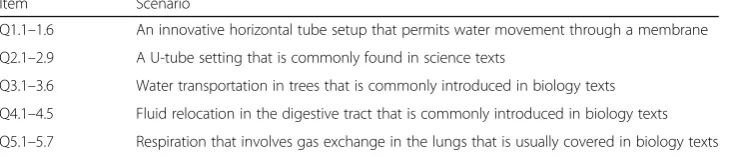
The present version included 20 multiple-choice items and 13 constructed-response questions targeting students’interdisciplinary understanding of osmosis. Table 1 enlists the five scenarios in the assessment. More details concerning the instrument and item design can be found in our prior study. (Shen et al. 2014).
The results of our previous survey suggested that students had difficulty in under-standing the molecular mechanism for solvation and water movement in osmosis (Shen et al. 2014). Therefore, we developed four short DCVs (total time = 108 s) and incorpo-rated them in the current survey.
Dynamic computer visualization design
Designing dynamic computer visualization
The DCVs are operationally defined as the computer-based, visual representations showcasing the dynamic movement and interactions of molecules in the format of ani-mated video clips. The users can adjust the rate (e.g., forward, pause, reverse) of playing the DCVs in accordance to the theoretical perspectives (e.g., cognitive load (Chandler and Sweller 1991)) and multimedia learning (Mayer 2001).
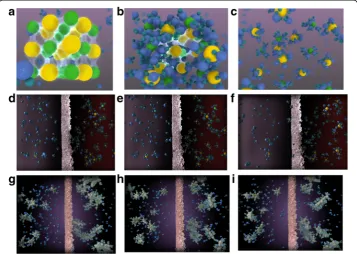
There are four DCVs introduced in the study (see Fig. 1 for the images of the three 3-D representations made by our team). The first clip (18 s) exemplifies the process of molecular-level solvation (or dissolution), showcasing the attraction and association of solvent molecules (e.g., water) with molecules or ions of a solute; the second clip (49 s) represents the diffusion of the random movement of individ-ual particles as opposed to the intentional/directional movement of molecules. The visualization shows that when a dye droplet is added in water, its molecules diffuse from the region of high concentration of dye to the region of low concentration and eventually reaches dynamic equilibrium. The third clip (16 s) demonstrates the osmosis as the net diffusion of water across a selectively permeable membrane. This visualization shows how osmosis is caused by a solute concentration gradient and differential solvation capacity to bind water. It creates a concentration gradient of free wateracross the membrane. The last visualization (25 s) shows the differential water-binding capacity of two different solutes with the same molar concentration across a mem-brane that is only permeable to water. The solute molecules on the right are bigger and can each bind more water molecules than the ones on the left. This leaves less free water on the right and creates a concentration gradient of free water molecules across the membrane. Osmosis still occurs as a result.
Table 1Scenario of each item sets in the osmosis survey
Item Scenario
Q1.1–1.6 An innovative horizontal tube setup that permits water movement through a membrane
Q2.1–2.9 A U-tube setting that is commonly found in science texts
Q3.1–3.6 Water transportation in trees that is commonly introduced in biology texts
Q4.1–4.5 Fluid relocation in the digestive tract that is commonly introduced in biology texts
Assessment survey design, implementation, and data collection
The osmosis survey is consisted of knowledge questions, demographic questions surveying students’ gender, language use, academic status, etc. At the end of the survey, questions asking students to reflect on their perceived helpfulness of the DCVs were administered.
The osmosis assessment was administered in the same semester in three classes (biology, physics, and physiology). It was delivered through the Web-based Inquiry Science Environment (WISE; wise.berkeley.edu), which provides logging capability, allowing researchers to record variables such as time spent on each step, the frequency of steps visited, and the sequence of steps visited.
It was administered as a 1-week homework assignment. The students in each class were randomly assigned to two conditions: Visualization Before (VB)— stu-dents view the DCVs prior to responding to the osmosis knowledge assessment, and Visualization After (VA)—students respond to the assessment and then view the DCVs. A total of 667 students took the survey, but 640 were considered as valid ones (e.g., agreed to sign off the consent form or completed at least 50% of the knowledge items).
Data analysis
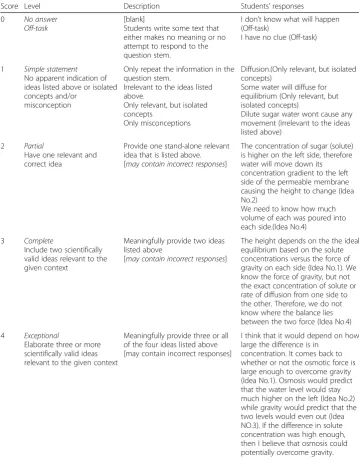
The multiple-choice items were graded dichotomously (1—correct/0—incorrect). There are up to five levels in the coding rubric for the constructed-response items (see
Table 2) (Shen et al. 2014). The inter-rater reliability reached 0.80 after several itera-tions. Inconsistent coding was resolved during research team meetings.
Item response theory
We applied the Rasch model to analyze the dichotomous data and the Partial Credit Model (PCM) to analyze polytomous data (i.e., the constructed-response scores) using the Winsteps 3.0 software (Linacre 2012). In the Rasch model, only item difficulty (b) and student ability (θ) are considered. In the Rasch model, the probability of the re-spondentngetting a dichotomous questioniright is denoted by the expression:
Pr xn;i¼1jθ;b
¼ eðθn−biÞ
1þeðθn−biÞ
The term (θn−bi) is the log odds or simply called logit. Persons at the same logit
scale have approximately 50% chance of getting the corresponding item(s) correct. Per-sons positioned at a higher logit scale have greater than 50% chance of responding to the item right, and vice versa (Glynn 2012). A plot (i.e., Wright map), which provides information about students’ osmosis understanding (θn) and item difficulty (b)
simul-taneously was constructed. This map is often used to identify the gaps between items with different difficulty levels. Infit and outfit were inspected in this study. Item infit/ outfit indicates whether students from a high ability group and a low ability group per-form “normally” as predicted. A large infit value for one item implies that a person’s ability close to a particular item difficulty level is not consistent with the model’s pre-diction. A large outfit value for an easy item indicates that a high ability level student fails to respond to the question correctly, and vice versa. The item parameters, infit/ outfit parameters, and the Wright map were reported.
Welch two-samplettest
A Welch two-sample t test was conducted to evaluate whether students’ performance on the assessment is different in the two conditions.
Multiple regression
Multiple regression examining what factors contributed to students’success in solving the osmosis problems was conducted (see Table 3 for the list of variables). Outliers (spent over 6000 s on the assessment) were deleted from the multiple regression ana-lyses. Akaike information criterion (AIC) was used as the criterion to compare model-fitting results in the model selection algorithm.
Visualize log data
identified two respondents with comparable scores, one from VA and one from VB. When respondents interact with the osmosis assessment items, they need to submit their answers every step and they were not allowed to change their answers after submission.
Table 2Scoring rubric of the constructive-response item on differential height
Score Level Description Students’responses
0 No answer
Off-task
[blank]
Students write some text that either makes no meaning or no attempt to respond to the question stem.
I don’t know what will happen (Off-task)
I have no clue (Off-task)
1 Simple statement No apparent indication of ideas listed above or isolated concepts and/or
misconception
Only repeat the information in the question stem.
Irrelevant to the ideas listed above.
Only relevant, but isolated concepts
Only misconceptions
Diffusion.(Only relevant, but isolated concepts)
Some water will diffuse for equilibrium (Only relevant, but isolated concepts)
Dilute sugar water wont cause any movement (Irrelevant to the ideas listed above)
2 Partial
Have one relevant and correct idea
Provide one stand-alone relevant idea that is listed above. [may contain incorrect responses]
The concentration of sugar (solute) is higher on the left side, therefore water will move down its concentration gradient to the left side of the permeable membrane causing the height to change (Idea No.2)
We need to know how much volume of each was poured into each side.(Idea No.4)
3 Complete
Include two scientifically valid ideas relevant to the given context
Meaningfully provide two ideas listed above
[may contain incorrect responses]
The height depends on the the ideal equilibrium based on the solute concentrations versus the force of gravity on each side (Idea No.1). We know the force of gravity, but not the exact concentration of solute or rate of diffusion from one side to the other. Therefore, we do not know where the balance lies between the two force (Idea No.4)
4 Exceptional
Elaborate three or more scientifically valid ideas relevant to the given context
Meaningfully provide three or all of the four ideas listed above [may contain incorrect responses]
I think that it would depend on how large the difference is in
concentration. It comes back to whether or not the osmotic force is large enough to overcome gravity (Idea No.1). Osmosis would predict that the water level would stay much higher on the left (Idea No.2) while gravity would predict that the two levels would even out (Idea NO.3). If the difference in solute concentration was high enough, then I believe that osmosis could potentially overcome gravity.
Key ideas:
1. The movement of free water is determined by two factors here, the concentration difference and the hydrostatic pressure difference
2. Some water diffuses from the right side to the left side because the left side has higher solute concentration than the right side
3. Some (free) water diffuses from the left side to the right side because the left side has a higher hydrostatic pressure than the right side initially
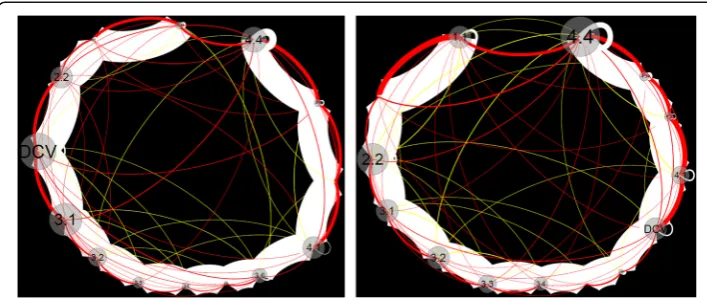
The log files show how long students interact with each step, the sequence students follow to visit steps, and the frequency of steps visited. Using the sequence and fre-quency data from the log files, the study visualized students’ navigation behavior in both conditions via free library D3.js. The first visualization will depict the overall, cu-mulative navigation behavior of the respondent from the VA and VB groups, while the second visualization will illustrate a linear navigation pattern of participants.
Perceived helpfulness
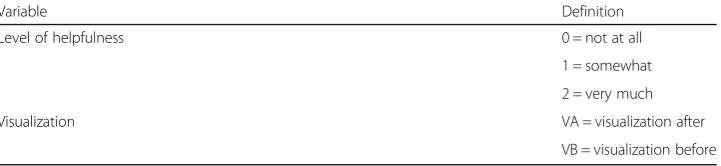
One of the exit questions is a two-tier question that is consisted of an ordinal-format item eliciting the student’s perceived helpfulness of the animation on their response to the survey followed by the explanations they provided for the previous Likert question. For the animation-after-survey group, the question to elicit their perception toward the helpfulness of the animation was worded slightly different with a multiple-choice prompt:“How much do you think the visualizations in the previous activity would have helped you answer some of the survey questions?” also followed by their explanations. The self-reported Likert-scale item has three levels: not helpful at all, somewhat, and very much. The variables are listed in Table 4.
Mann-WhitneyUtest
We analyzed the exit two-tier question inquiring students’ perceptions of the DCVs. The first part was a Likert-scale item that has three levels:not helpful at all,somewhat, and very much; the second part was their explanation of why the DCVs (could have) helped or not. The parenthesis in the prompt was phrased slightly different for the two groups.
Table 3Denotation of variables and their basic descriptive statistics
Variable (meaning) Values Counts/M(SD)
BIOL (in biology class) 0 = non-BIOL, 1 = BIOL 251
PHYS (in physics class) 0 = non-PHYS, 1 = PHYS 226
VPHY (in physiology class) 0 = non-VPHY, 1 = VPHY 124
VCOND (visualization condition) 0 = VB, 1 = VA 280
GENDER 0 = non-FEMALE, 1 = FEMALE 364
ENGL (English used at home as first language) 0 = non-ENGL, 1 = ENGL 543
TASSESS(time spent on assessment) 0–6000 (seconds) 2534.8 (1337.3)
TDCV(time spent on DCV) 0–500 (seconds) 180.6 (142.6)
U(osmosis understanding; dependent variable) −4–4 (logit) −0.02 (0.81)
Table 4Variables in the perceived-helpfulness question
Variable Definition
Level of helpfulness 0 = not at all
1 = somewhat
2 = very much
Visualization VA = visualization after
A Mann-Whiney Utest was conducted to evaluate the difference of the Likert-scale responses between the two conditions. The open-ended responses to the aforemen-tioned question were reviewed to triangulate with the student’s Likert-scale response from the VA and VB groups.
Results and Discussion
Psychometrics properties
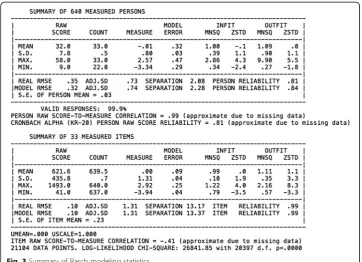
In response to RQ1, the psychometrics properties are reported in the following. The Wright map (Fig. 2) shows that student ability in solving osmosis problems and item difficulty matched fairly well with two outlying items, one on each end of the scale (i.e., items 4.4 and 2.8). The students’abilities ranges from −3.34 to 2.57 logits. Figure 3 shows a summary of Rasch modeling for the osmosis survey based on a sample of 640 subjects. Overall person separation and reliability was helpful in determining model-data-fit. The test differentiated subjects with a person separation index of 2.08 based on the empirical data or 2.28 based on the model expectations. A separation index above 2.0 is indicative of acceptable sensitivity of the instrument to differentiate high
and low performers. The Cronbach alpha for those separations were .81 and .84, which also represented acceptable test reliability. The item separation index is 13.17 based on the empirical data or 13.37 based on the model expectations. Cronbach’s alpha for those separation indices were both .99, indicating satisfactory item reliability. High item separation verifies the item hierarchy, implying that the number of person sample is large enough to confirm the item difficulty hierarchy or construct validity of the osmo-sis assessment instrument.
The Wright map shows that student osmosis understanding and item difficulty matched fairly well with two outlying questions, one on each end of the item difficulty scale (i.e., questions 4.4 and 2.8). The Wright map shows that although overall students’ abilities spread over a range from −3.34 to 2.57 logits, there were two gaps in items. For instance, question 2.8 (b= 2.92) was more difficult than the student ability because there was no corresponding participant at that logit level. Also, there was a large item gap between logit −2 to −4, meaning that subjects whose abilities fall within this gap were not clearly differentiated by the osmosis understanding instrument. There were several items clustered around logits 0 and 1 that measure similar osmosis understand-ing levels but from different item sets. All the infit values were within acceptable range [0.7–1.3] (Wright and Linacre 1994).
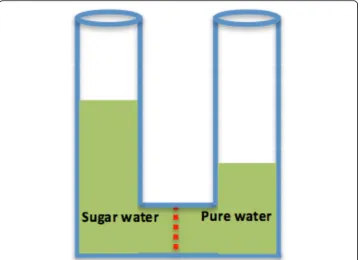
The most difficult item (i.e., question 2.8 on the Wright map) was contextualized in an innovative context. The prompt reads“Jessie quickly poured some dilute sugar water on the left side and pure water on the right side of the U-tube so that, initially, the left column was higher than the right one. What will happen to the height of each col-umn?” (see Fig. 4) With furtherttest, VA and VB students did not have significant dif-ference in their mean score on this item (t(638) = 1.143, p= 0.253); only 6.4% of the students correctly responded to this question. Rubrics for students’rationale for their height prediction are given in Table 2. The formation of rubrics is guided by the idea of
knowledge integration (Author 2011), where all possible key ideas to respond to the question was first laid out, and then the levels were assigned based on the linkage of ideas found in the responses.
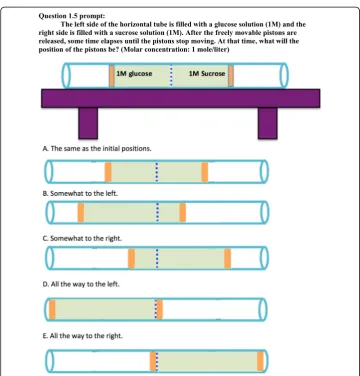
The second most difficult question (i.e., question 1.5 on the Wright map) was one of the innovative assessment context, in which we replace the classical U-tube example with a horizontal tube divided by a selectively permeable membrane that is only perme-able to water. On each side of the tube, a freely movperme-able piston is held fixed initially (see Fig. 5). The rationale to design such a question was to simplify the gravitational force associated with the U-tube example and direct the respondent’s attention solely to the osmosis process between the two compartments divided by the membrane. The question 1.5 prompt is shown in Fig. 5. With further ttest, VA and VB students had significant difference in their mean score on this item (t(596) = 3.75, p= 0.000); only 12.3% of the students correctly respond to this question.
Regarding RQ2-a, confirming our hypothesis, the students in the VB condition dem-onstrated higher understanding of osmosis than those in the VA condition (MVB=
0.056, SDVB= 0.751 and MVA=−0.083, SDVA= 0.856, Welch two-sample t(608) = 2.17,
p= 0.03,d= 0.17).
Predictors
To answer RQ2-b, a multiple regression analysis was conducted to evaluate how well the student-associated attributes predicted osmosis-understanding level. The final model for the multiple regression included the following predictors (Table 3): class, DCV condition, gender, English as first language, time spent on knowledge assessment, and time spent on DCVs, while the dependent variable was the estimated student
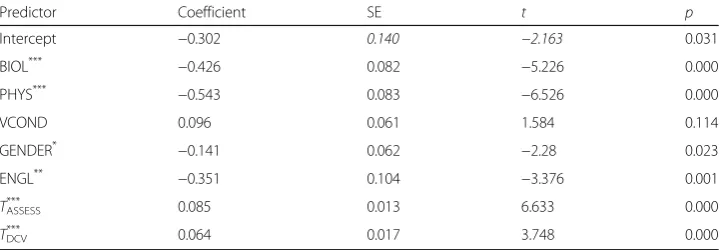
ability in solving osmosis problems. The model was statistically significant (F(7, 562) = 22.99, p< 0.000). The sample multiple correlation coefficient was .472, indicating that approximately 22.3% of the variance of the osmosis understanding in the sample can be accounted for by the linear combination of the predictors. Table 5 shows the coeffi-cients of the predictor variables and their significance level. We found that the science-class-enrolled, time spent on assessment, and time spent on DCV were all significant predictors atp < 0.001 level, while English usage at home and gender were significant predictors of student ability atp <0.05 and 0.01, respectively. The results indicated that there are other variables affecting student ability in addition to the DCV treatment. In particular, in this multiple regression model with seven predictors, the time spent on assessment and DCV had significant positive regression weights. It indicates that stu-dents, who invest more time on both the test and watching DCV, after controlling for the other variables in the model, were expected to have a higher ability score. Enroll-ment in biology and physics classes as well as English used at home as the first lan-guage had significantly negative weights. That is, students from families in which English is the first language or those who chose biology or physics were expected to
have a lower ability score after controlling for other variables. Gender contributed mar-ginally significantly to students’ ability score, with female students expected to have higher score than male students. It is interesting to find that when other predictors are being considered together, visualization condition did not significantly contribute to the multiple regression model.
To answer RQ3, first of all, students in the VA group perceived the DCV to be more helpful than those in the VB group (Mann-Whiney Utest, z=−6.055,p< 0.000). The finding resonated with students’ reasoning to the open-ended question responses as discussed below.
According to the log data, time spent on the osmosis assessment ranged from 60 to 22,411 s. Figure 6 illustrates the summative navigation behavior of students who major in biology in the VB (Fig. 6—top) and VA (Fig. 6—bottom) groups, respect-ively. Collectively, the students jumped back (red line) to the animation in both situations, and the density of the red line in the VA group is higher than that in the VB group. It implies that the students who view the DCV after finishing the assessment revisited previous question steps more frequently than those who view the DCV first. Note that students could not change the answers they have submitted and they could not jump back to DCVs if they did not submit their response to each step (i.e., 3.1–3.5).
There were 26 students (6 students are in the VB group, and 20 students are in the VA group) who visited the DCV at least twice and reported the visualizations to be useful (see the supplementary material for the logging behavior of the 26 students). We identified student 44394 from VB and student 44821 from VA who received similar scores and com-pared their linear navigation behavior during item review (see Fig. 7 and more detailed webpage information from the supplementary material). With the color-coded linear navi-gation bar, we can tell that even student 44821 has spent a longer time reviewing the items; when s/he jumped back to the DCV, this student spent less than 10 s on reviewing the DCV, just like student 44394. These two visualizations of the log data explored the po-tential of communicating navigation behavior with advanced data analytics.
Student feedback
Many students in the VA group perceived DCVs could have been helpful for them, for instance:
Table 5Summary of multiple regression analysis from the predictors for student ability
Predictor Coefficient SE t p
Intercept −0.302 0.140 −2.163 0.031
BIOL*** −0.426 0.082 −5.226 0.000
PHYS*** −0.543 0.083 −6.526 0.000
VCOND 0.096 0.061 1.584 0.114
GENDER* −0.141 0.062 −2.28 0.023
ENGL** −0.351 0.104 −3.376 0.001
TASSESS*** 0.085 0.013 6.633 0.000
TDCV*** 0.064 0.017 3.748 0.000
I would have been able to answer…correctly after seeing a 3D representation of ‘free’water molecules in solutions containing larger solute particles versus those containing smaller solute molecules.
Some students from the VB group found certain DCVs to be particularly helpful in conceptual understanding but did not necessarily help them answer the questions:
I already knew 3 of them (DCVs)…water molecules tend to conglomerate around larger organic molecules was a good reminder.
…it didn’t help as much visualizing the water movement in the stomach questions.
Many students in VB are either neutral or negative about the helpfulness of DCVs be-cause they reflected that they relied more on their prior knowledge rather than these short, basic DCVs. We speculate that the “helpfulness” will be enhanced if we allow students to freely retrieve the DCVs while they were responding to the osmosis assessment. The reason for lower perceived helpfulness could be due to the fact that they were not allowed to revisit the DCVs and change their answer. Some preferred narration or audio accompanying the DCVs. For example:
I already knew about osmosis…I didn’t need them (DCVs) to answer questions.
I wish someone would explain what is happening while the video is playing.
Their feedback speaks to the diverse learning styles of students that reflect on their perceived helpfulness of adopting DCVs in the assessment.
Our analysis showed that the psychometric properties of the assessment instrument with the inclusion of DCVs in the assessment items demonstrated acceptable reliability and high construct validity. The most difficult item required students’reverse thought processes in order to predict the movement of the solution. In order to answer this
question correctly, students would need to critically consider the variables given in the target system, analyze the dynamic nature of molecule movement, and then apply their understanding from the macroscopic level to associate with potential impact on the microscopic mechanisms (for more details about student reasoning, see Zhang et al. 2015). Therefore, the integration of DCVs in the osmosis assessment in VB did not pro-vide them with a better chance to answer this innovative assessment item. This is prob-ably due to the DCVs’ stress on the microscopic interactions rather than the introduction of explicit connections between macroscopic and microscopic relationship.
We also found that the VB group performed significantly better in the second most difficult question, which was directly related to our DCVs. The idea of designing ques-tion 1.5 originated from our faculty research meeting, where the convenques-tional assess-ment of osmosis does not consider the differential solvation effect of the solute. The DCVs portrayed the differential ability of sugar-water bonding during solvation, and the significantly better performance on this item is indicative of the significant effect of DCV treatment before students answer their osmosis questions.
The results from the Welch two-samplettest showed that the DCVs played a signifi-cant role when students were completing the assessment. First, the students who viewed the DCVs first (i.e., the VB group) outperformed those who viewed them later (i.e., the VA group). This result is remarkable, considering that the DCVs only took them about 3 min to complete and the average amount of time a student needs to fin-ish the osmosis assessment portion of the entire survey was 47 min. The finding reso-nates with Kühl et al.’s (2011) study that dynamic visualization condition outperformed those with text-only condition. In addition, the time spent on watching DCV (TDCV)
contributes significantly to the student’s osmosis understanding. This result resonates with O’Day’s study, in which learners who were exposed to the dynamic visualization with more time outperformed those with less exposure (O’Day 2006). Anyhow, even though the ttest result suggests that the VB group performed significantly better than its counterpart, the mean ability scores of each group showed that the winning group has only a slight edge. That is, the ability score average is 0.056 logit for the VB group as opposed to−0.083 logit for the VA group within a wide range from−3.34 to 2.57.
That is why when multiple predictors were considered, the different DCV treatment became a non-significant predictor in the model. We do not expect a wide score gap between both groups, given that students from the VB group spent only 180.6 s, on average, watching the animation. However, the results do show the potential of inte-grating DCVs in science education to enhance learning. And our future work should be focused on the nature of the impact of DCVs on student performance and how they could be integrated in an efficient manner. In the conclusion section, how students from the VB group interact with DCVs will be described.
Conclusion
Students did come back to the DCVs during the assessment for the VB group; however, counterintuitively, we found the reviewing pattern for the VA group more intriguing than the usage pattern of DCV for the VB group. Notice that while the VB group reviewed their response to the assessment, they revisited the visualization section and then resumed reviewing items. This observation might have explained why the students in the VA group perceived that DCVs could have been more helpful than those in the VB group. The result echoed with that from students’feedback to the open-ended re-sponse for the VA and VB groups. Many students in the VB group viewed the DCVs more critically (e.g., design feature) than those in the VA group, which might contribute to their lower perceived helpfulness score on the Likert-scale item. Sometimes students came back to DCVs directly from certain assessment items during their review. It sug-gested that students might be confused about the knowledge component in the item and realized that the video could provide information related to the item. In addition, we found that most students who came back to the DCVs did not per-form well in the assessment. It provides further evidence that the DCVs might offer additional self-paced learning opportunities for those who were academically underrepresented in science learning. The low perceived helpfulness from students’ feedback also resonates with that from Tversky and her colleagues’ review study, in which animated graphics are only beneficial for participants with lower spatial abil-ity (Tversky et al. 2002).
Limitations
Significance of the study and future work
After iterative validation processes of the assessment instrument on osmosis, the psy-chometric properties approved the innovative osmosis survey to be valid and reliable. Educators and other researchers interested in eliciting students’ deeper understanding of osmosis could administer the osmosis survey to acquire some understanding of where students stand before teaching the subject matter. They can then engage in cur-ricular design to specifically address the gaps found in their understanding. Further-more, we were able to study students’ navigation behavior using current data analytics tool to decipher the underlying message conveyed from the logging data. The applica-tion is critical to visualize and communicate with interested audience concerning the dynamics of participant-DCV interactions.
The findings suggest that the integration of short DCVs has a positive impact on stu-dents’performance on the osmosis assessment. The instructors in higher education are recommended to incorporate DCVs in their (formative) assessments to elicit students’ deeper understanding of microscopic, molecular-level reactions.
Some modification of the features and operational design of embedding DCVs in the assessment is expected to improve participants’perceptions toward the helpfulness of adopting dynamic visualizations in their assessment instrument. Future research on more in-depth navigation behavior of DCVs could focus on enhancing the planning of data analytics to grasp more subtle DCV-usage behavior of respondents, especially when the osmosis assessment is administered via a technology-enhanced environment.
Authors’contributions
GC performed Welch t-test and multiple regression to help identify the effectiveness of DCV and the contributing pre-dictors to the student ability on responding to the osmosis assessment SJ performed Mann- Whiney U test to deter-mine students' perception toward DCVs. She also assisted visualizing student log data and discuss the navigation behavior of students when they review items. JS was the director of the research project. He oversees the writing process of this research paper. He engaged in the process of assessment generation, validation, theoretical framework identification, and contributed to the review and discussion of the manuscript. SS led the research with assessment item design, administration, data collection, Rasch-PCA data analysis, instrument validation, and literature review. She also coordinated the findings into conclusions and discussions. All authors read and approved the final manuscript.
Competing interests
The authors declare that they have no competing interests.
Publisher’s Note
Springer Nature remains neutral with regard to jurisdictional claims in published maps and institutional affiliations.
Author details
1Assistant Professor, Education Department, Spelman College, 350 Spelman Lane, Atlanta, GA 30314, USA.2Associate
Professor, Department of Teaching and Learning, University of Miami, 5202 University Drive, Coral Gables, FL 33124, USA.3Doctoral Student, Department of Teaching and Learning, University of Miami, 5202 University Drive, Coral
Gables, FL 33124, USA.
Received: 27 November 2017 Accepted: 7 December 2017
References
Brunye, T, Rapp, DN, Taylor, HA (2004). Building mental models of multimedia procedures: Implications for memory structure and content. InProceedings of the 26th Annual Meeting of the Cognitive Science Society.
Buckley, BC, & Quellmalz, ES (2013). Supporting and assessing complex biology learning with computer-based simulations and representations. InMultiple representations in biological education, (pp. 247–267). Dordrecht: Springer https://doi.org/10.1007/978-94-007-4192-8_14.
Byrne, MD, Catrambone, R, Stasko, JT. (1999). Evaluating animations as student aids in learning computer algorithms.
Computers and Education,33(4), 253–278 https://doi.org/10.1016/S0360-1315(99)00023-8.
Chandler, P, & Sweller, J. (1991). Cognitive load theory and the format of instruction.Cognition and Instruction,8(4), 293–332 https://doi.org/10.1207/s1532690xci0804_2.
Chiu, JL, & Linn, MC. (2014). Supporting knowledge integration in chemistry with a visualization-enhanced inquiry unit.
Cook, MP. (2006). Visual representations in science education: the influence of prior knowledge and cognitive load theory on instructional design principles.Science Education,90(6), 1073–1091 https://doi.org/10.1002/sce.20164. Fisher, KM, Williams, KS, Lineback, JE. (2011). Osmosis and diffusion conceptual assessment.CBE Life Sciences Education,
10(4), 418–429 https://doi.org/10.1187/cbe.11-04-0038.
Friedler, Y, Amir, R, Tamir, P. (1987). High school students’difficulties in understanding osmosis.International Journal of Science Education,9(5), 541–551 https://doi.org/10.1080/0950069870090504.
Glynn, SM. (2012). International assessment: a Rasch model and teachers’evaluation of TIMSS science achievement items.Journal of Research in Science Teaching,49(10), 1321–1344.
Hmelo-Silver, CE, & Pfeffer, MG. (2004). Comparing expert and novice understanding of a complex system from the perspective of structures, behaviors, and functions.Cognitive Science,28, 127–138.
Höffler, TN, & Leutner, D. (2007). Instructional animation versus static pictures: a meta-analysis.Learning and Instruction,
17, 722–738 http://doi.org/10.1016/j.learninstruc.2007.09.013.
Hwang, I, Tam, M, Lam, SL, Lam, P. (2012). Review of use of animation as a supplementary learning material of physiology content in four academic years.Electronic Journal of E-Learning,10(4), 368–377.
Jensen, MS, Wilcox, KJ, Hatch, JT. (1996). A computer-assisted instruction unit on diffusion and osmosis with a conceptual change design.Journal of Computers in Mathematics and Science Teaching,15(1–2), 49–64. Kehoe, C, Stasko, J, Taylor, A. (2001). Rethinking the evaluation of algorithm animations as learning aids.International
Journal of Human-Computer Studies,54(2), 265–284 https://doi.org/10.1006/ijhc.2000.0409.
Kim, S, Yoon, M, Whang, S-M, Tversky, B, Morrison, J b. (2007). The effect of animation on comprehension and interest.
Journal of Computer Assisted Learning,23(3), 260–270 https://doi.org/10.1111/j.1365-2729.2006.00219.x.
Kramer, EM, & Myers, DR. (2012). Five popular misconceptions about osmosis.American Journal of Physics,84, 694–699. Kühl, T, Scheiter, K, Gerjets, P, Gemballa, S. (2011). Can differences in learning strategies explain the benefits of learning from static and dynamic visualizations?Computers & Education,56(1), 176–187 https://doi.org/10.1016/j.compedu. 2010.08.008.
Levy, D. (2013). How dynamic visualization technology can support molecular reasoning.Journal of Science Education and Technology,22(5), 702–717 https://doi.org/10.1007/s10956-012-9424-6.
Linacre, JM (2012).Winsteps® Rasch measurement computer program user’s guide. Beaverton: Winsteps.com http://www. winsteps.com/index.htm. Retrieved 14 Feb 2013.
Linn, MC, & Eylon, B-S (2011).Science learning and instruction: taking advantage of technology to promote knowledge integration. New York: Routledge.
Marbach-Ad, G, Rotbain, Y, Stavy, R. (2008). Using computer animation and illustration activities to improve high school students’ achievement in molecular genetics.Journal of Research in Science Teaching,45(3), 273–292 https://doi.org/10.1002/tea.20222. Mayer, RE (2001).Multimedia learning. New York: Cambridge University Press.
McElhaney, KW, Chang, H-Y, Chiu, JL, Linn, MC. (2015). Evidence for effective uses of dynamic visualisations in science curriculum materials.Studies in Science Education,51(1), 49–85.
Meir, E, Perry, J, Stal, D, Maruca, S, Klopfer, E. (2005). How effective are simulated molecular-level experiments for teaching diffusion and osmosis?Cell Biology Education,4(3), 235–248 https://doi.org/10.1187/cbe.04-09-0049. Merchant, Z, Goetz, E t, Keeney-Kennicutt, W, Cifuentes, L, Kwok, O, Davis, T j. (2013). Exploring 3-D virtual reality
technology for spatial ability and chemistry achievement.Journal of Computer Assisted Learning,29(6), 579–590 http://doi.org/10.1111/jcal.12018.
National Research Council (2014). Developing assessments for the next generation science standards. Committee on developing assessments of science proficiency in K-12. Board on testing and assessment and board on science education. In JW Pellegrino, MR Wilson, JA Koenig, AS Beatty (Eds.),Division of Behavioral and Social Sciences and Education. Washington, DC: The National Academies Press.
National Research Council (NRC) (2012).A framework for K-12 science education: practices, crosscutting concepts, and core ideas. Washington, DC: National Academies Press.
NGSS Lead States (2013).Next generation science standards: for states, by states. Washington: The National Academies Press.
O’Day, DH. (2006). Animated cell biology: a quick and easy method for making effective, high-quality teaching animations.CBE-Life Sciences Education,5, 255–263.
Odom, AL. (1995). Secondary and college biology students’misconceptions about diffusion and osmosis.The American Biology Teacher,57(7), 409–415 https://doi.org/10.2307/4450030.
Odom, AL, & Barrow, LH. (1995). Development and application of a two-tier diagnostic test measuring college biology students’understanding of diffusion and osmosis after a course of instruction.Journal of Research in Science Teaching,32(1), 45–61 https://doi.org/10.1002/tea.3660320106.
Odom, AL, & Barrow, LH. (2007). High school biology students’knowledge and certainty about diffusion and osmosis concepts.School Science and Mathematics,107(3), 94–101 https://doi.org/10.1111/j.1949-8594.2007.tb17775.x. Pedrosa, M, & Dias, M. (2000). Chemistry textbook approaches to chemical equilibrium and student alternative
conceptions.Chemistry Education Research and Practice,1 https://doi.org/10.1039/A9RP90024A.
Quellmalz, ES, & Pellegrino, JW. (2009). Technology and testing.Science,323(5910), 75–79 http://doi.org/10.1126/science.1168046. Quellmalz, ES, Timms, MJ, Silberglitt, MD, Buckley, BC. (2012). Science assessments for all: Integrating science simulations into balanced state science assessment systems.Journal of Research in Science Teaching,49(3), 363–393 http://doi. org/10.1002/tea.21005.
Rundgren, C-J, & Tibell, LAE. (2010). Critical features of visualizations of transport through the cell
membrane—an empirical study of upper secondary and tertiary students’meaning-making of a still image and an animation.International Journal of Science and Mathematics Education,8(2), 223–246 https://doi.org/ 10.1007/s10763-009-9171-1.
Ryoo, K, & Bedell, K. (2017). The effects of visualizations on linguistically diverse students’understanding of energy and matter in life science.Journal of Research in Science Teaching,54(10), 1274–1301 https://doi.org/10.1002/tea.21405. Ryoo, K, & Linn, MC. (2012). Can dynamic visualizations improve middle school students’understanding of energy in
Ryoo, K, & Linn, MC. (2015). Designing and validating assessments of complex thinking in science.Theory Into Practice,
0(ja), 0 http://doi.org/10.1080/00405841.2015.1044374.
Sanger, MJ, Brecheisen, DM, Hynek, BM. (2001). Can computer animations affect college biology students’conceptions about diffusion & osmosis?The American Biology Teacher,63(2), 104–109 https://doi.org/10.2307/4451051. Savec, VF, Vrtacnik, M, Gilbert, JK (2005). Evaluating the educational value of molecular structure representations. In JK
Gilbert (Ed.),Visualization in science education, (pp. 269–297). Dordrecht: Springer. https://doi.org/10.1007/1-4020-3613-2_14.
Scalise, K, Timms, M, Moorjani, A, Clark, L, Holtermann, K, Irvin, PS. (2011). Student learning in science simulations: design features that promote learning gains.Journal of Research in Science Teaching,48(9), 1050–1078 http://doi. org/10.1002/tea.20437.
Shen, J., Liu, O., & Sung, S. (2014). Designing interdisciplinary assessments in sciences for college students: An example on osmosis. International Journal of Science Education, 36(11), 1773-1793. doi:10.1080/09500693.2013.879224. Shen, J., Sung, S., & Zhang, D. (2015). Toward an analytic framework of interdisciplinary reasoning and communication
(IRC) processes in science. International Journal of Science Education, 37(17), 2809–2835. https://doi.org/10.1080/ 09500693.2015.1106026.
Shen, J., & Linn, M. C. (2011). A technology-enhanced unit of modeling static electricity: Integrating scientific explanations and everyday observations. International Journal of Science Education, 33(12), 1597–1623. https://doi. org/10.1080/09500693.2010.514012.
Smetana, LK, & Bell, RL. (2012). Computer simulations to support science instruction and learning: a critical review of the literature.International Journal of Science Education,34(9), 1337–1370 https://doi.org/10.1080/09500693.2011. 605182.
Sung, S., Shen, J., Stanger-Hall, K. F., Wiegert, C., Wan-I Li, Robertson, T., & Brown, S. (2015). Toward Interdisciplinary Perspectives: Using Osmotic Pressure as an Example for Analyzing Textbook Explanations. Journal of College Science Teaching, 44(4), 76–87.
Tasker, RF, & Dalton, RM. (2006). Research into practice: visualisation of the molecular world using animations.Chemistry Education Research and Practice,7, 141–159.
Tversky, B, Morrison, JB, Betrancourt, M. (2002). Animation: can it facilitate?International Journal of Human–Computer Studies,57, 247–262.
Wieman, CE, Adams, WK, Perkins, KK. (2008). PhET: simulations that enhance learning.Science,322(5992), 682–683. Wright, B, & Linacre, JM. (1994). Reasonable mean-square fit values.Rasch Measurement Transactions,8, 370. Wu, H-C, Yeh, T-K, Chang, C-Y. (2010). The design of an animation-based test system in the area of Earth sciences.
British Journal of Educational Technology,41(3), E53–E57 https://doi.org/10.1111/j.1467-8535.2009.00977.x. Xie, Q, & Pallant, A (2011). The molecular workbench software: an innovative dynamic modeling tool for nanoscience
education. In MS Khine, IM Saleh (Eds.),Models and modeling: cognitive tools for scientific enquiry, (pp. 121–132). New York: Springer.
Xie, Q, & Tinker, R. (2006). Molecular dynamics simulations of chemical reactions for use in education.Journal of Chemical Education,83(1), 77 https://doi.org/10.1021/ed083p77.
Yarden, H, & Yarden, A. (2010). Learning using dynamic and static visualizations: students’comprehension, prior knowledge and conceptual status of a biotechnological method.Research in Science Education,40(3), 375–402 https://doi.org/10.1007/s11165-009-9126-0.