New strategy to control cell migration and
metastasis regulated by CCN2/CTGF
Aguiar
et al.
REVI E W
Open Access
New strategy to control cell migration and
metastasis regulated by CCN2/CTGF
Diego Pinheiro Aguiar
1*, Gabriel Correa de Farias
1, Eduardo Branco de Sousa
1, Juliana de Mattos Coelho-Aguiar
2,
Julie Calixto Lobo
1, Priscila Ladeira Casado
1, Maria Eugênia Leite Duarte
1and José Garcia Ribeiro Abreu Jr
2Abstract
Connective tissue growth factor (CTGF)/CCN family member 2 (CCN2) is a CCN family member of matricellular signaling modulators. It has been shown that CCN2/CTGF mediates cell adhesion, aggregation and migration in a large variety of cell types, including vascular endothelial cells, fibroblasts, epithelial cells, aortic smooth muscle and also pluripotent stem cells. Others matricellular proteins are capable of interacting with CCN2/CTGF to mediate its function. Cell migration is a key feature for tumor cell invasion and metastasis. CCN2/CTGF seems to be a
prognostic marker for cancer. In addition, here we intend to discuss recent discoveries and a new strategy to develop therapies against CCN2/CTGF, in order to treat cancer metastasis.
Keywords:CCN2, CTGF, Adhesion, Migration and Metastasis
CCN2/CTGF historical profile
Connective tissue growth factor (CTGF)/CCN2 family member 2 (CCN2) was isolated from human endothelial cells and outlines a secreted growth factor involved in cell proliferation and chemotaxis as former described in 1991, by Dr Bradham et al. [1]. CCN2/CTGF has 349 amino acids and depending on post-translational modifi-cations, CCN2/CTGF can be glycosylated, causing either 36 or 38 kDa, which appears as a double band on Western immunoblotting [2]. In the same year, CCN2/CTGF orthologous was described in mice and named Fisp-12 [3] or even other synonyms asβIG-M2, IGF-BP8, IGFBP-rP2, HBGF-0.8, Hcs24 or ecogenin [4]. Since its identi-fication, CCN2/CTGF’s role has been studied, in a large variety of biological phenomena, especially in cell chemo-taxis, migration, adhesion and cancer. Still in the nineties, other proteins with the same domains were identified, such as cysteine-rich 61 (Cyr61), nephroblastoma overex-pressed (Nov), exoverex-pressed in low-metastatic protein (Elm1/ Wisp-1), WNT1-inducible-signaling pathway protein-2 (Wisp-2) and WNT1-inducible-signaling pathway protein-3 (Wisp-protein-3) [5-9]. In the following decade, researches who have had contributed to the understanding of these
proteins, proposed the unification name of these se-creted factors in the CCN family (CYR61/CTGF/NOV), then called CCN1 (Cyr61), CCN2 (CTGF), CCN3 (Nov), CCN4 (Wisp-1), CCN5 (Wisp-2), and CCN6 (Wisp-3) [10]. These proteins share a multimodular structure, with a N-terminal secretory signal followed by four conserved domains with homologies to insulin-like growth factor binding proteins (Module I IGFBP), von willebrand factor type C repeat (module II VWC), thrombospondin type I repeat (Module III TSP) and a carboxy-terminal domain (Module IV - CT) containing a cystine knot [absent in CCN5] [10] (Figure 1).
Studies about the CCN family have been intensified in the last years mainly to understand CCN2/CTGF function. Several studies had also shown the relevance of each cata-lytic domain on proliferation and chemotaxis [1], cell fate [15], adhesion [16], and migration [17] in different cell types and tissues. Several publications had also described interactions of the CCN2/CTGF with extracellular matrix proteins [18]. Ivkovic et al. in 2003 developed a knockout mouse for CCN2/CTGF showing its role in extracellular matrix remodeling and angiogenesis during chondrogene-sis [19]. In addition, CCN2/CTGF knockout mice also shows lower expression of metalloproteinase 9 and vascu-lar endothelial growth factor (VEGF) in the growth plate. These changes lead to skeletal dimorphism, with expanded hypertrophic zones ofCTGF mutant growth plates and a
* Correspondence:[email protected]
1
Research Division, National Institute of Traumatology and Orthopedics, Rio de Janeiro, RJ, Brazil
Full list of author information is available at the end of the article
defective replacement of cartilage by bone during endo-chondral ossification. This study was the first to demon-strate the role of CCN2/CTGF during development.
CCN2/CTGF in cell adhesion and migration
The synthesis of CCN2/CTGF is highly inducible by serum growth factors [20], cytokines [21], and environ-mental stresses such as hypoxia [22] and molecular stretch [23]. Well known inducers of CCN2/CTGF are transform-ing growth factor beta (TGF-beta) and VEGF [24,25].
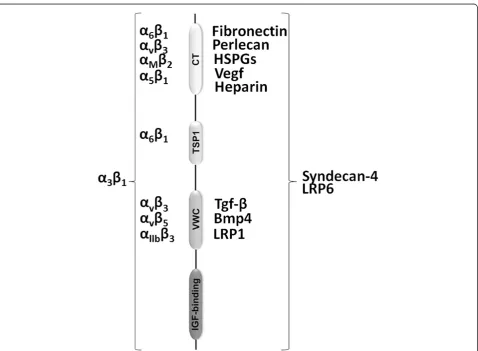
Despite researches willingness, a specific receptor for CCN2/CTGF was never described. However, several possible receptors for this growth factor had been inves-tigated in CCN2/CTGF-mediated adhesion, migration and chemotaxis, including integrins (α6β1,αvβ3,αMβ2,α5β1, α6β1,αvβ3,αvβ5,αIIbβ3 and α3β1) [26,27], LRP1 and LRP6
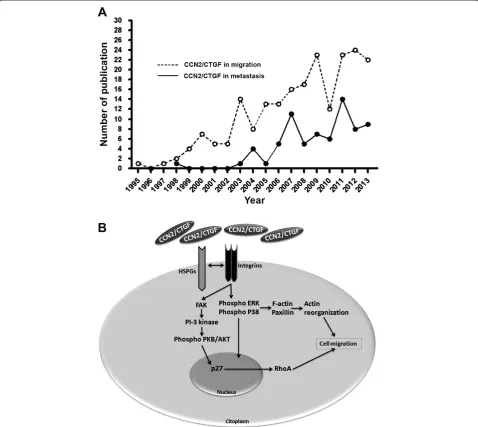
[28,29], and HSPGs (co-receptor) [30] on cell membrane (Figure 2). There are currently 89 published papers relat-ing CCN2/CTGF to migration and adhesion, however, no one has established a CCN2/CTGF receptor (Figure 3A).
Figure 1Schematic representation of the CCN family structure.
The figure shows the current nomenclature (CCN family) and the most used name along the last years. The CCN family domains are arranged into modules as: IGF-binding/module I, VWC/module II, TSP1/module II and CT-cystine knot/module IV. The size in each domain of each CCN family member related to their biological functions [11-14].
Figure 2Interaction of CCN2/CTGF domains with other molecules.The right column shows the interaction between CCN2/CTGF with cell surface receptors, extracellular matrix and growth factors, as Fibronectin, Perlecan, HSPGs, VEGF, TGF-β, BMP4, LRP1, Heparin, Syndecan-4 [28,29,31-35]. The left column shows the interaction between CCN2/CTGF with integrins [30,36-41].
Aguiaret al. Cancer Cell International2014,14:61 Page 2 of 7
The multiple functions of CCN2/CTGF may be ex-plained in part by its interactions with other molecules in the extracellular domain. CCN2/CTGF binds to TGF-beta through the VWC domain and enhances its binding to TGF-beta receptor II, increasing its signaling [31,43]. A comparison of a pull of mRNA extracted from wild type mouse embryonic fibroblast (MEFs) to MEFs deleted for CCN2/CTGF(CTGF−/−MEF), both exposed to TGF-beta, showed downregulation of several molecules in-volved in matrix production and remodeling, cell adhe-sion and contraction, such as: Filamin-β,β-Catenin and
matrix metalloproteinase-14. These results showed CCN2/CTGF as a cofactor required to active cell adhe-sion by TGF-beta [44]. Since CCN2/CTGF was described to interact with other extracellular matrix proteins [45], many efforts have been made to understand how can CCN2/CTGF acts in cell adhesion and migration.
An efficient way to show the role of CCN2/CTGF in cell adhesion was through the exposure of different cell types to a CCN2/CTGF-rich substrate. Thus, it was possible to show that cells exposed to CCN2/CTGF ad-hered to substrate faster than cells exposed only to
free-CCN2/CTGF substrate [46,47]. In order to assay the role of CCN2/CTGF in cell adhesion, CCN2/CTGF coated plastic surface and anti-CCN2/CTGF antibody were used to measure cell adhesion of four different cells types: vascular endothelial cells [HUVECs and hu-man microvascular endothelial cells (HMVECs)], fibro-blasts (NIH 3T3 and AKR2B), mink lung epithelial (Mv1Lu) cells [26,45], and human platelets [48]. All results showed that the absence of CCN2/CTGF prevents cell ad-hesion. In addition, the CCN2/CTGF-mediated adhesion occurs through interaction with other molecules, as fibro-nectin and integrins, reviewed by Arnott et al in 2011 [48]. CCN2/CTGF CT-domain interacts with fibronectin and enhances cell adhesion of chondrocytes through integrin alpha5beta1 [49]. CCN2/CTGF promotes fibroblast adhe-sion by binding to fibronectin, cell surface proteoglycans, and integrins that potentiates the phosphorylation on focal adhesion Kinase (FAK) and ERK and so enhances focal ad-hesion formation and cell spreading by F-actin, Paxilin and RhoA activation [32] (Figure 3B). Although these data suggested that CCN2/CTGF is an adhesive molecule, this property was never directly tested. However, a recent work of our research group demonstrated that CCN2/CTGF is not an adhesive molecule itself.
For the first time optical tweezers technique was used to measure the adhesion strength of different molecules. Ini-tially, It was observed that CCN2/CTGF induced spherical cell aggregates formation when added to MvLu1 and P19 cells [31,46,48]. A dynamic system to assay cell aggrega-tion to CCN2/CTGF was developed by using anti-Flag conjugated agarose beads pre-incubated with recombinant CCN2/CTGF enriched medium and added to sub-confluent P19 cells cultured for 24 h. This experiment aimed to check the local action of CCN2/CTGF on P19 cells aggregation. It was observed none or few P19 cells interacting with untreated beads. In contrast, many P19 cells were detected surrounding and adhering to CCN2/ CTGF-treated beads. The attached cells displayed mor-phological changes varying from a flat to an elongated shape reminiscent from the bead shape [46,48]. In this study, Boyden chamber assay indicated CCN2/CTGF as a chemoattractive molecule increasing the migration of P19 cells up to three folds [48]. In the same study, a new ap-proach was used to measure the adhesive potential of CCN2/CTGF and to compare it with well known adhesive molecules. Using optical tweezers, we obtained quantita-tive parameters to evaluate molecular adhesiveness. Our data supported the CCN2/CTGF chemotactic property, although it is not an adhesive molecule for P19 cells.
From innocent to guilty: CCN2/CTGF as a key molecule in metastasis
The link between CCN2/CTGF and cell adhesion is based on protein interactions in extracellular domain,
stimulus in extracellular matrix production and upregula-tion of adhesion pathways, but not due an own adhesive property [48]. These adhesion pathways are triggered by Integrins or MAPK activation resulting in cell attachment and detachment [50]. Knockdown of CCN2/CTGF in TW2.6 cells was shown to reduce tumor formation and decrease E-cadherin expression in xenotransplanted tu-mors [51]. Although there has been a huge variety of re-search conducted on the harmful effects of increasing levels of CCN2/CTGF, the understanding of its patho-physiology and possible modulators remain unclear. Deendooven et al. detected CCN2/CTGF levels in plasma, serum or urine in patients with fibrotic complications in consequence of hepatitis, diabetes and renal transplant-ation [52]. The high levels of CCN2/CTGF in these secre-tions suggested that it is a relevant biomarker of disorders. Furthermore, there are no efficient treatments for most disorders where the upregulation of CCN2/CTGF is involved.
Taking into account the role of CCN2/CTGF on cell migration process, the expression of CCN2/CTGF has been correlated to metastasis progression. Overexpres-sion of CCN2/CTGF was associated with invasiveness potential of the lung adenocarcinoma cells [53], and osteolytic metastasis of breast cancer [54]. Interestingly, CCN2/CTGF enhanced the motility of breast cancer cells by an integrin-α5β3-ERK1/2-phosphorylation [42]. In chondrosarcoma cells, CCN2/CTGF enhances cell migration by matrix metalloproteinase-13 upregulation through integrinα5β3 [55] and in gastric cancer through downregulation of E-cadherin by NF-κB pathway [56]. Curiously, neutralizing anti-CCN2/CTGF antibody attenu-ated metastasis pancreatic cancer [57]. In cancer and in metastasis, the role of CCN2/CTGF seems to be the same. In the last years, the number of studies showing CCN2/ CTGF involved in migration and metastasis has increased. The treatment of patients with metastasis is not efficient. For this reason, the occurrence of metastasis in cancer is an important issue nowadays, and CCN2/CTGF could be an important target for its attenuation or prevention.
CCN2/CTGF a challenge for the future: Where will we go?
In order to develop specific treatments for disorders where CCN2/CTGF are upregulated, as metastasis, CCN2/CTGF shutdown by epigenetic modulation may be an effective strategy. In general, DNA methylation patterns are estab-lished and modified in response to environmental factors by DNA methyl-transferases (DNMTs) which inhibits gene transcription and regulates gene expression [58]. Therefore, inhibition of CCN2/CTGF expression in spe-cific diseases could be achieved by increasing DNA methylation of the CCN2/CTGF gene on promoter re-gion. DNA methylation of the CCN2/CTGF genomic sequence has already been reported in several cancers
Aguiaret al. Cancer Cell International2014,14:61 Page 4 of 7
[59,60], but a detailed target sequence for DNA methy-lation contributing for gene silencing had never been described. The mechanisms of CCN2/CTGF expression remain unknown. The delivery of DNA methyl-transferase enzyme linked to specific primer for CCN2/CTGF in pro-moter region directs to the target cell, through antibodies that recognize specifically target cell, could be explored as a way to silence CCN2/CTGF. This blockage-pack would have a DNMT linked to CCN2/CTGF primers (Forward and Reverse sense) designed to its promoter region. DNMT would hypermethylate the CCN2/CTGF promoter region and CpG islands will be increased leading to CCN2/CTGF donwregulation (Figure 4). A homozygous deletion of CCN2/CTGF at human chromosome 6q23.2 by hypermethylation could be used or breast cancer cells, for example. It would be useful to block its expression and then decrease cancer metastasis. Our proposed DNA methylation strategy on promoter region of CCN2/CTGF gene to control its expression would certainly control all chain reactions triggered by this growth factor. We hope that in the future, alike strategies that could be used to block target gene transcription and, consequently, inhibit its migration and adhesion by preventing several disorders as metastasis, fibrosis or tissue remodeling.
Competing interests
The authors declare that they have no competing interests.
Authors' contributions
DPA and JGRAJr conceived the idea. DPA and JMCA integrated different points of literatures and drafted the manuscript. GCF, EBS, JCL, PLC, and MELD did literature research on specific points, and got involved in discussion. All authors read and approved the final manuscript.
Author details 1
Research Division, National Institute of Traumatology and Orthopedics, Rio de Janeiro, RJ, Brazil.2Program of Cell and Developmental Biology, Institute of Biomedical Sciences, Federal University of Rio de Janeiro, Rio de Janeiro, RJ, Brazil.
Received: 15 April 2014 Accepted: 21 June 2014 Published: 12 July 2014
References
1. Bradham DM, Igarashi A, Potter RL, Grotendorst GR:Connective tissue growth factor: a cysteine-rich mitogen secreted by human vascular endothelial cells is related to the SRC-induced immediate early gene product CEF-10.J Cell Biol1991,114:1285–1294.
2. Phanish MK, Winn SK, Dockrell ME:Connective tissue growth factor-(CTGF, CCN2)–a marker, mediator and therapeutic target for renal fibrosis. Nephron Exp Nephrol2010,114:83–92.
3. Ryseck RP, Macdonald-Bravo H, Mattei MG, Bravo R:Structure, mapping, and expression of fisp-12, a growth factor-inducible gene encoding a secreted cysteine-rich protein.Cell Growth Differ1991,2:225–233. 4. Moussad EE, Brigstock DR:Connective tissue growth factor: what’s in a
name?Mol Genet Metab2000,71:276–292.
5. O’Brien TP, Yang GP, Sanders L, Lau LF:Expression of cyr61, a growth factor-inducible immediate-early gene.Mol Cell Biol1990,10:3569–3577. 6. Martinerie C, Viegas-Pequignot E, Guenard I, Dutrillaux B, Nguyen VC,
Bernheim A, Perbal B:Physical mapping of human loci homologous to the chicken nov proto-oncogene.Oncogene1992,7:2529–2534. 7. Blacketer MJ, Koehler CM, Coats SG, Myers AM, Madaule P:Regulation of
dimorphism in Saccharomyces cerevisiae: involvement of the novel protein kinase homolog Elm1p and protein phosphatase 2A.Mol Cell Biol
1993,13:5567–5581.
8. Zhang R, Averboukh L, Zhu W, Zhang H, Jo H, Dempsey PJ, Coffey RJ, Pardee AB, Liang P:Identification of rCop-1, a new member of the CCN protein family, as a negative regulator for cell transformation.Mol Cell Biol1998,18:6131–6141.
9. Hurvitz JR, Suwairi WM, Van Hul W, El-Shanti H, Superti-Furga A, Roudier J, Holderbaum D, Pauli RM, Herd JK, Van Hul EV, Rezai-Delui H, Legius E, Le Merrer M, Al-Alami J, Bahabri SA, Warman ML:Mutations in the CCN gene family member WISP3 cause progressive pseudorheumatoid dysplasia. Nat Genet1999,23:94–98.
10. Brigstock DR, Goldschmeding R, Katsube KI, Lam SC, Lau LF, Lyons K, Naus C, Perbal B, Riser B, Takigawa M, Yeger H:Proposal for a unified CCN nomenclature.Mol Pathol2003,56:127–128.
11. Kim HS, Nagalla SR, Oh Y, Wilson E, Roberts CT Jr, Rosenfeld RG:
Identification of a family of low-affinity insulin-like growth factor binding proteins (IGFBPs): characterization of connective tissue growth factor as a member of the IGFBP superfamily.Proc Natl Acad Sci U S A1997,
94:12981–12986.
12. Grotendorst GR, Lau LF, Perbal B:CCN proteins are distinct from and should not be considered members of the insulin-like growth factor-binding protein superfamily.Endocrinology2000,141:2254–2256. 13. Collet C, Candy J:How many insulin-like growth factor binding proteins?
Mol Cell Endocrinol1998,139:1–6.
14. Baxter RC, Binoux MA, Clemmons DR, Conover CA, Drop SL, Holly JM, Mohan S, Oh Y, Rosenfeld RG:Recommendations for nomenclature of the insulin-like growth factor binding protein superfamily.J Clin Endocrinol Metab1998,83:3213.
15. Mason ED, Konrad KD, Webb CD, Marsh JL:Dorsal midline fate in Drosophila embryos requires twisted gastrulation, a gene encoding a secreted protein related to human connective tissue growth factor. Genes Dev1994,8:1489–1501.
16. Kothapalli D, Frazier KS, Welply A, Segarini PR, Grotendorst GR:
Transforming growth factor beta induces anchorage-independent growth of NRK fibroblasts via a connective tissue growth factor-dependent signaling pathway.Cell Growth Differ1997,8:61–68.
17. Shimo T, Nakanishi T, Kimura Y, Nishida T, Ishizeki K, Matsumura T, Takigawa M:Inhibition of endogenous expression of connective tissue growth factor by its antisense oligonucleotide and antisense RNA suppresses proliferation and migration of vascular endothelial cells.J Biochem1998,
124:130–140.
18. Chen CC, Lau LF:Functions and mechanisms of action of CCN matricellular proteins.Int J Biochem Cell Biol2009,41:771–783.
19. Ivkovic S, Yoon BS, Popoff SN, Safadi FF, Libuda DE, Stephenson RC, Daluiski A, Lyons KM:Connective tissue growth factor coordinates
chondrogenesis and angiogenesis during skeletal development. Development2003,130:2779–2791.
20. Pandey DP, Lappano R, Albanito L, Madeo A, Maggiolini M, Picard D:
Estrogenic GPR30 signalling induces proliferation and migration of breast cancer cells through CTGF.EMBO J2009,28:523–532. 21. Igarashi A, Okochi H, Bradham DM, Grotendorst GR:Regulation of
connective tissue growth factor gene expression in human skin fibroblasts and during wound repair.Mol Biol Cell1993,4:637–645. 22. Shimo T, Kubota S, Kondo S, Nakanishi T, Sasaki A, Mese H, Matsumura T,
Takigawa M:Connective tissue growth factor as a major angiogenic agent that is induced by hypoxia in a human breast cancer cell line. Cancer Lett2001,174:57–64.
23. Chaqour B, Yang R, Sha Q:Mechanical stretch modulates the promoter activity of the profibrotic factor CCN2 through increased actin polymerization and NF-kappaB activation.J Biol Chem2006,
281:20608–20622.
24. Holmes A, Abraham DJ, Sa S, Shiwen X, Black CM, Leask A:CTGF and SMADs, maintenance of scleroderma phenotype is independent of SMAD signaling.J Biol Chem2001,276:10594–10601.
25. Suzuma K, Naruse K, Suzuma I, Takahara N, Ueki K, Aiello LP, King GL:
Vascular endothelial growth factor induces expression of connective tissue growth factor via KDR, Flt1, and phosphatidylinositol 3-kinase-akt-dependent pathways in retinal vascular cells.J Biol Chem
2000,275:240725–240731.
26. Babic AM, Chen CC, Lau LF:Fisp12/mouse connective tissue growth factor mediates endothelial cell adhesion and migration through integrin alphavbeta3, promotes endothelial cell survival, and induces angiogenesis in vivo.Mol Cell Biol1999,19:2958–2966.
27. Schober JM, Chen N, Grzeszkiewicz TM, Jovanovic I, Emeson EE, Ugarova TP, Ye RD, Lau LF, Lam SC:Identification of integrin alpha (M) beta (2) as an adhesion receptor on peripheral blood monocytes for Cyr61 (CCN1) and connective tissue growth factor (CCN2): immediate-early gene products expressed in atherosclerotic lesions.Blood2002,99:4457–4465. 28. Mercurio S, Latinkic B, Itasaki N, Krumlauf R, Smith JC:Connective-tissue
growth factor modulates WNT signalling and interacts with the WNT receptor complex.Development2004,131:2137–2147.
29. Gao R, Brigstock DR:Low density lipoprotein receptor-related protein (LRP) is a heparin-dependent adhesion receptor for connective tissue growth factor (CTGF) in rat activated hepatic stellate cells.Hepatol Res
2003,27:214–220.
30. Gao R, Brigstock DR:Connective tissue growth factor (CCN2) induces adhesion of rat activated hepatic stellate cells by binding of its C-terminal domain to integrin alpha (v) beta (3) and heparan sulfate pro-teoglycan.J Biol Chem2004,279:8848–8855.
31. Abreu JG, Ketpura NI, Reversade B, De Robertis EM:Connective-tissue growth factor (CTGF) modulates cell signalling by BMP and TGF-beta. Nat Cell Biol2002,4:599–604.
32. Chen Y, Abraham DJ, Shi-Wen X, Pearson JD, Black CM, Lyons KM, Leask A:
CCN2 (connective tissue growth factor) promotes fibroblast adhesion to fibronectin.Mol Biol Cell2004,15:5635–5646.
33. Ball DK, Rachfal AW, Kemper SA, Brigstock DR:The heparin-binding 10 kDa fragment of connective tissue growth factor (CTGF) containing module 4 alone stimulates cell adhesion.J Endocrinol2003,176:R1–R7.
34. Inoki I, Shiomi T, Hashimoto G, Enomoto H, Nakamura H, Makino K, Ikeda E, Takata S, Kobayashi K, Okada Y:Connective tissue growth factor binds vascular endothelial growth factor (VEGF) and inhibits VEGF-induced angiogenesis.FASEB J2002,16:219–221.
35. Nishida T, Kubota S, Fukunaga T, Kondo S, Yosimichi G, Nakanishi T, Takano-Yamamoto T, Takigawa M:CTGF/Hcs24, hypertrophic chondrocyte-specific gene product, interacts with perlecan in regulating the proliferation and differentiation of chondrocytes.J Cell Physiol2003,196:265–275.
36. Heng EC, Huang Y, Black SA Jr, Trackman PC:CCN2, connective tissue growth factor, stimulates collagen deposition by gingival fibroblasts via module 3 and alpha6- and beta1 integrins.J Cell Biochem2006,
98:409–420.
37. Chen N, Chen CC, Lau LF:Adhesion of human skin fibroblasts to Cyr61 is mediated through integrin alpha 6beta 1 and cell surface heparan sulfate proteoglycans.J Biol Chem2000,275:24953–24961.
38. Leu SJ, Chen N, Chen CC, Todorovic V, Bai T, Juric V, Liu Y, Yan G, Lam SC, Lau LF:Targeted mutagenesis of the angiogenic protein CCN1 (CYR61). Selective inactivation of integrin alpha6beta1-heparan sulfate proteoglycan coreceptor-mediated cellular functions.J Biol Chem2004,
279:44177–44187.
39. Leu SJ, Liu Y, Chen N, Chen CC, Lam SC, Lau LF:Identification of a novel integrin alpha 6 beta 1 binding site in the angiogenic inducer CCN1 (CYR61).J Biol Chem2003,278:33801–33808.
40. Gao R, Brigstock DR:A novel integrin alpha5beta1 binding domain in module 4 of connective tissue growth factor (CCN2/CTGF) promotes adhesion and migration of activated pancreatic stellate cells.Gut2006,
55:856–862.
41. Lau LF, Lam SC:The CCN family of angiogenic regulators: the integrin connection.Exp Cell Res1999,248:44–57.
42. Chen PS, Wang MY, Wu SN, Su JL, Hong CC, Chuang SE, Chen MW, Hua KT, Wu YL, Cha ST, Babu MS, Chen CN, Lee PH, Chang KJ, Kuo ML:CTGF enhances the motility of breast cancer cells via an integrin-alphavbeta3-ERK1/2-dependent S100A4-upregulated pathway.J Cell Sci2007,
120:2053–2065.
43. Khankan R, Oliver N, He S, Ryan SJ, Hinton DR:Regulation of fibronectin-EDA through CTGF domain-specific interactions with TGF {beta} 2 and its receptor TGF {beta} RII.Invest Ophthalmol Vis Sci2011,52:5068–5078. 44. Shi-wen X, Stanton LA, Kennedy L, Pala D, Chen Y, Howat SL, Renzoni EA,
Carter DE, Bou-Gharios G, Stratton RJ, Pearson JD, Beier F, Lyons KM, Black CM, Abraham DJ, Leask A:CCN2 is necessary for adhesive responses to transforming growth factor-beta1 in embryonic fibroblasts.J Biol Chem
2006,281:10715–10726.
45. Kireeva ML, Latinkic BV, Kolesnikova TV, Chen CC, Yang GP, Abler AS, Lau LF:
Cyr61 and Fisp12 are both ECM-associated signaling molecules: activities, metabolism, and localization during development.Exp Cell Res
1997,233:63–77.
46. Aguiar DP, Coelho-Aguiar JM, Abreu JG:CCN2/CTGF silencing blocks cell aggregation in embryonal carcinoma P19 cell.Braz J Med Biol Res2011a,
44:200–205.
47. Aguiar DP, Pontes B, Mendes FA, Andrade LR, Viana NB, Abreu JG:CTGF/CCN2 has a chemoattractive function but a weak adhesive property to embryonic carcinoma cells.Biochem Biophys Res Commun2011,413:582–587.
48. Arnott JA, Lambi AG, Mundy C, Hendesi H, Pixley RA, Owen TA, Safadi FF, Popoff SN:The role of connective tissue growth factor (CTGF/CCN2) in skeletogenesis.Crit Rev Eukaryot Gene Expr2011,21:43–69.
49. Jedsadayanmata A, Chen CC, Kireeva ML, Lau LF, Lam SC: Activation-dependent adhesion of human platelets to Cyr61 and Fisp12/mouse connective tissue growth factor is mediated through integrin alpha (IIb) beta (3).J Biol Chem1999,274:24321–24327.
50. Hoshijima M, Hattori T, Inoue M, Araki D, Hanagata H, Miyauchi A, Takigawa M:CT domain of CCN2/CTGF directly interacts with fibronectin and enhances cell adhesion of chondrocytes through integrin alpha5beta1. FEBS Lett2006,580:1376–1382.
51. Gu J, Liu X, Wang QX, Tan HW, Guo M, Jiang WF, Zhou L:Angiotensin II increases CTGF expression via MAPKs/TGF-β1/TRAF6 pathway in atrial fibroblasts.Exp Cell Res2012,318:2105–15.
52. Chang CC, Hsu WH, Wang CC, Chou CH, Kuo MY, Lin BR, Chen ST, Tai SK, Kuo ML, Yang MH:Connective tissue growth factor activates Pluripotency genes and Mesenchymal-Epithelial Transition in head and neck cancer cells.Cancer Res2013,73:4147–4157.
53. Dendooven A, Nguyen TQ, Brosens L, Li D, Tarnow L, Parving HH, Rossing P, Goldschmeding R:The CTGF -945GC polymorphism is not associated with plasma CTGF and does not predict nephropathy or outcome in type 1 diabetes.J Negat Results Biomed2011,8:10. 4.
54. Chang CC, Shih JY, Jeng YM, Su JL, Lin BZ, Chen ST, Chau YP, Yang PC, Kuo ML:Connective tissue growth factor and its role in lung adenocarcinoma invasion and metastasis.J Natl Cancer Inst2004,96:364–375.
55. Shimo T, Kubota S, Yoshioka N, Ibaragi S, Isowa S, Eguchi T, Sasaki A, Takigawa M:Pathogenic role of connective tissue growth factor (CTGF/
Aguiaret al. Cancer Cell International2014,14:61 Page 6 of 7
CCN2) in osteolytic metastasis of breast cancer.J Bone Miner Res2006,
21:1045–1059.
56. Tan TW, Lai CH, Huang CY, Yang WH, Chen HT, Hsu HC, Fong YC, Tang CH:
CTGF enhances migration and MMP-13 up-regulation via alphavbeta3 integrin. FAK, ERK, and NF-kappaB-dependent pathway in human chondrosarcoma cells.J Cell Biochem2009,107:345–356.
57. Mao Z, Ma X, Rong Y, Cui L, Wang X, Wu W, Zhang J, Jin D:Connective tissue growth factor enhances the migration of gastric cancer through downregulation of E-cadherin via the NF-kappaB pathway.Cancer Sci
2011,102:104–110.
58. Aikawa T, Gunn J, Spong SM, Klaus SJ, Korc M:Connective tissue growth factor-specific antibody attenuates tumor growth, metastasis, and angiogenesis in an orthotopic mouse model of pancreatic cancer. Mol Cancer Ther2006,5:1108–1116.
59. Heyn H, Vidal E, Sayols S, Sanchez-Mut JV, Moran S, Medina I, Sandoval J, Simó-Riudalbas L, Szczesna K, Huertas D, Gatto S, Matarazzo MR, Dopazo J, Esteller M:Whole-genome bisulfite DNA sequencing of a DNMT3B mutant patient.Epigenetics2012,7:542–50.
60. Chiba T, Yokosuka O, Fukai K, Hirasawa Y, Tada M, Mikata R, Imazeki F, Taniguchi H, Iwama A, Miyazaki M, Ochiai T, Saisho H:Identification and investigation of methylated genes in hepatoma.Eur J Cancer2005,
41:1185.
doi:10.1186/1475-2867-14-61
Cite this article as:Aguiaret al.:New strategy to control cell migration and metastasis regulated by CCN2/CTGF.Cancer Cell International
201414:61.
Submit your next manuscript to BioMed Central and take full advantage of:
• Convenient online submission
• Thorough peer review
• No space constraints or color figure charges
• Immediate publication on acceptance
• Inclusion in PubMed, CAS, Scopus and Google Scholar
• Research which is freely available for redistribution