R E S E A R C H
Open Access
Assessing the role of market integration in
the consumption of traditional foods in
Benin: a joint price instability coefficient
and diet composition approach
Barthelemy G. Honfoga
1*, Gervais N
’
tandou-Bonzitou
2, Raymond S. Vodouhè
2, Mauricio R. Bellon
3and Joseph D. Hounhouigan
1* Correspondence: [email protected]
1Faculty of Agronomic Sciences,
University of Abomey-Calavi, 03 BP 2819 Cotonou, Jericho, Benin Full list of author information is available at the end of the article
Abstract
Globalization-driven food trade policies and the transformations of food regimes have led to modernizing food habits and the growing substitution of traditional foods by introduced/industrialized foods in the diets of urban people in sub-Saharan Africa. Such changes in food consumption habits are suspected to be associated with the increasing prevalence of some non-transmittable food-related diseases in the region. The role food markets play in food substitution in the diets needs to be understood. This study analyzes the effects of differential market integration on the consumption of the two types of foods in Southern Benin. Market integration was assessed using the reciprocal of the gap in price instability coefficients between markets (G) and calculated using monthly prices series over the“July 2009–July 2011”period. The findings indicate that markets in the Allada market cluster are more integrated for introduced foods (G= 5.3) than traditional foods (G= 4.3). The integration of primary, assembly, and rural consumer markets with the Bohicon regional market is by far higher for introduced foods (G= 5.3) than traditional foods (G= 1.2). The results in Toffo market cluster were comparable, in spite of less reliable data. The district-level rural markets are more integrated among themselves than with the regional market, either for traditional foods or introduced foods. Considering that most of the latter are processed foods, the result tends to indicate that food processing would trigger greater market integration. Therefore, policies that promote processing and trade of locally produced traditional foods should be implemented. Indeed, processing is key among the factors that increase urban consumers’preferences for introduced foods against traditional foods. On the contrary, the hypothesis which asserts that low levels of market integration among traditional foods contribute to their disappearance in people’s diets is rejected. Indeed, diets in rural areas of Benin are still dominated by“traditional foods.”However, the growing trend in the consumption of imported low nutritional value foods should be controlled by appropriate food production and trade policies.
Keywords:Market integration, Price instability coefficients, Traditional foods, Introduced foods, Food consumption, Food trade policies
Background
Research background, objectives, and hypotheses
A diversity of foods is available to enhance people’s food security in sub-Saharan Africa (SSA), through not only agricultural production and trade but also harvest of wild plants and animals in the nature (FAO/PAR 2010, Assogbadjo et al. 2011). However, this diversity is underutilized today (Dansi et al. 2008) due to the transformations of food systems that are taking place worldwide (Gómez et al., 2013). These transforma-tions evolved from the first to the second food régime, leading to the increasing aban-donment of traditional foods and their replacement with introduced/manufactured foods as a result of increased dependence on modern food businesses for food procure-ment (Atkins and Bowler, 2001). Such a change is being linked with the increasing oc-currence in Africa of some food-related non-transmittable diseases (Abegunde et al. 2007). In many African countries, modernizing food habits go with the belief that“ for-eign is better” (Nzenza 2014). Although that belief is not the sole reason, policies that have silently pushed for such change in food habits over decades have finally created that belief. This is particularly true in Benin where the cotton-biased agricultural policy and investment can be blamed, as it has made food procurement largely dependent on imports, mostly for rice, vegetal oil, and meat and dairy products. For example, the im-port dependency rate1for rice increased from 34.8% in 1999–2005 to 46.5% in 2005– 2013 (FAO/ECOWAS 2015). The annual growth rate of vegetal oil imports (about 18%) is highest among all agricultural products in West Africa, followed by meat, drinks, fruits, and legumes (Hollinger and Staatz 2015). The growing rice imports in Benin could be explained also by the low competitiveness of local rice (Adegbola and Singbo 2005). Indeed, the preference attributes of imported rice—especially cleanness, whiteness, and flavor mostly accruing from industrial processing—are not favorable to local rice (Arinloye 2006). Some macroeconomic variables are overarching explanatory factors. For example, the agricultural sector contribution to GDP decreased from 34% in 1995 to 29.9% in 2008 (MAEP 2010), while high labor prices, climate change, and non-availability of specific fertilizers have made most annual traditional crops become expensive and non-accessible to the poor. As a result, most of these crops have become “underutilized and neglected crops” due to their very low productivity and poor mar-keting systems (Adegbola et al. 2016, Dansi et al. 2003).
Therefore, with increased availability of introduced foods in markets, poor people substitute a diversity of traditional foods with a limited number of introduced foods (Bellon 2010).
have not yet found enough their way in urban markets. Benin can be considered in the early stage of a country’s food system transformation due to its low income, large share of rural population, high reliance by farmers on their own production, and high inci-dence of undernourishment (Gómez et al. 2013).
Hence, there is a re-evaluation of the value of traditional/local foods. There is in-creasing research on the value of these foods (especially, e.g., African leafy vegetables in Kenya and Benin), and the need to maintain or reintroduce them in food systems (see, e.g., Achigan Dako et al., 2006, Dansi et al. 2008, Dansi et al. 2003, Dossou-Aminon 2014). For example, “Glassoman” (Crassocephalum spp.), a wild indigenous leafy leg-ume, is rich in proteins and was widely consumed in forest zones of Benin. “Egusi”
(Citrullus lanatus, Cucumeropsis manii, Lagenaria spp.), an ancient garden crop, and
palm oil (obtained from processing fruits of oil palm—Elaeis guineensis) are rich in vi-tamins (especially vitamin A) and lipids. Egusi is rich in fat and vivi-tamins A, B1, B2, C,
and alpha-tocopherol, a component of vitamin E. It is composed of nearly 50% healthy fats and 30% protein.2Other traditional foods have medicinal values.3Among them in Benin, “Tchayo” (Ocimum gratissimum) is widely recognized to prevent ulcer. In the context of above-mentioned transformations, markets are playing increasing important role, yet their integration with domestic food production areas seems still limited, as well as their positive impact on peoples’diets.
This paper aims to enlighten on the status of market integration, and to know the ex-tent to which it influences direct food substitution dynamics in the diets of rural people in Southern Benin. Rather than the source of procurement only (home/self-production vs. market), the issue at stake here is more about food type (traditional vs. introduced)5 and how market integration affects its presence in the diets overtime.
Relying on empirical data from the abovementioned market study, this paper aims to understand if market integration really plays a role in food habits in Southern Benin.
The following hypotheses are tested:
(i) Introduced foods show higher levels of market integration than traditional foods (ii) Low levels of market integration among traditional foods contribute to their
disappearance in the diets (food consumption frequency and diet composition).
The first hypothesis accrues from the observation that introduced foods are traded widely by merchants who move across all types of markets to make such “new foods” available to consumers (Lutz, 1994). Ascending trade flows of introduced foods from Cotonou to rural markets are faster and more regular than the downward flows of trad-itional foods which are mostly crude and seasonal. The second hypothesis has its theor-etical ground in the relation between food availability, food market dynamics, and food consumption patterns (Smith and Haddad 2001; Honfoga and van den Boom 2003). Its practical justification pertains to several reasons. One is the second food régime earlier mentioned (Friedmann and McMichael 1989). Another reason is the growing imported dependency of Benin, most imported foods being the“introduced foods.”However, be-sides market integration of introduced foods, the limited availability of traditional foods in the markets also explains the disappearance of these foods in the diets in Benin. It is linked to climate change, low availability of farm labor for women who mostly grow traditional foods, and changes in production systems towards monocropping of high-value export crops (cotton, pineapple, cashew nuts, soya beans).
Literature review
Traditional foods vs. introduced foods
brought from outside the community or culture. Their introduction into food habits is quite recent, dating back to only a few decades, whereas traditional foods are being consumed by native peoples, since the very beginning of their settling in the area many centuries ago.
While traditional foods are mostly locally produced, introduced ones are mostly imported (Popkin 2003). Quite often, introduced foods are manufactured and more in-dustrially processed than traditional foods. However, the frontier between the concepts of traditional and introduced foods is not neat. For example, some non-indigenous foods such as parboiled rice and wheat flour have been introduced into endogenous food habits long ago (since colonization times in Africa) and may be considered as traditional foods although they were mostly imported and consumed by middle- or high-income people. Likewise,“vegetal oil”is considered an introduced food, but it is a “mix” of several types of industrially processed vegetal oils and locally produced groundnut oil, which makes it also closer to a traditional food. Today, they are present in all households.
Substitution of traditional foods for introduced foods
The growing view that traditional foods are disappearing (Nzenza 2014) and are being replaced by introduced foods in the diets witnesses the perceived effects of the second food régime in the USA and Europe, where large industrial capitals began to dominate both sides of the agro-food chain and farm products became inputs to manufactured foods rather than products for final end use (Friedmann and McMichael 1989, p.103; Green and Griffith 2002; Honfoga et al. 2002). In SSA, environmental disasters (e.g., droughts, floods), forest destruction for agriculture, decreasing soil fertility, and crop failure due to diseases are important threats to traditional foods (Dossou-Aminon et al. 2014). At the heart of economic reasons is the second food regime, which is also present in SSA because of changing cropping and food systems where farmers are abandoning traditional foods for a few selected food and cash crops demanded by multinational food and fiber industries. Indeed, the diversion of farm labor to the pro-duction and processing of crops most demanded by Western countries’markets is also a reason of the disappearance of traditional foods. The increasing dependence of newly independent post-colonial states on imported food grains, such as wheat, from devel-oped countries to feed their burgeoning populations was—and is still being—paid for by the greater production of industrial crops (e.g., cotton) and high-value tropical and temperate food crops, with damaging consequences for traditional, subsistence-oriented agricultural systems (Atkins and Bowler 2001, p.27). In general, weak food dis-tribution system and decreasing income or growing poverty are the main drivers of per-verse food substitution, unbalanced diets, and malnutrition in those countries (Atkins and Bowler, 2001, p.118; UNDP-Benin 2011, p.66 & 73).
Meanings and applications of the concept of market integration
thereby enabling integration within a market-shed (Fafchamps and Gabre-Madhin 2006). Baulch (1997, p. 477) gives the importance of assessing market integration by link-ing spatial integration of markets, transmission of price signals from urban food deficit to rural food surplus areas, price volatility, specialization of agricultural producers according to long-term comparative advantage, and gains from trade. Therefore, market integration depends on and expresses the nature of physical and economic linkages (particularly mar-ket information) that exist between various production-consumption zones for a selected tradable product. The dynamics are reflected by price movements.
Therefore, two markets are said to be integrated for a given commodity if prices move together, i.e., price movements tend to behave similarly, reflecting the cost of transferring the product between two regions (Rashid and Minot 2010, Hossain and Verbeke 2010). World Food Programme (2001) made this definition more explicit as it affirmed that when markets are integrated, two conditions exist: (a) price are corre-lated, i.e., they move in tandem with one another, but at different levels that are deter-mined by transaction costs (necessary yet insufficient condition of market integration); (b) commodities flow between markets, i.e., markets are integrated through trade, which triggers price transmission from one market to another (necessary and sufficient condition of market integration). However, the statistical interpretation of price correl-ation coefficients is problematic in a context where numerically low price correlcorrel-ations prevail despite other evidence that suggests competitive and rational behavior by a large number of market actors (Delgado 1986). Market integration is influenced by the type of markets (urban, semi-urban and rural). It is product-specific, and price dynamics is a core to assessing it more accurately (Chamberlin and Jayne 2013). Indeed, transaction costs are dynamic and vary by time, space, and product.
Delgado (1986) affirmed that “the yardstick of integration of a pair of village markets within a given season is that the price spread between them stays approximately constant, subject to random variation either way, over the weeks in the season in question.”Lutz (1994) observed that spatial and temporal arbitrage are simultaneously taken into account by price co-integration models, the level of statistical significance of which is used to con-clude whether the markets are integrated or not. The use of co-integration models is rec-ommended to assess market integration for the sake of accuracy, considering the need to separate seasonal, trend, and stochastic variations in price time series or to jointly con-sider them. The critical question is“how do prices on two spatially separated markets ad-just in the long and in the short run?” To answer this question, Ravallion (1986) developed an autoregressive distributed lag (ADL) model with the aim of assessing both the long-run and short-run adjustment process. A“dynamic” structure was developed to take account of the sluggishness of price adaptations. A distinction is made between short-run integration, defined as restrictive target of instantaneous adjustment corre-sponding to the market efficiency hypothesis (Malkiel 1987), and long-run integration, de-fined as a less restrictive target of price integration in the long run (Lutz 1994).
Methods
Study area and selected foods and market clusters
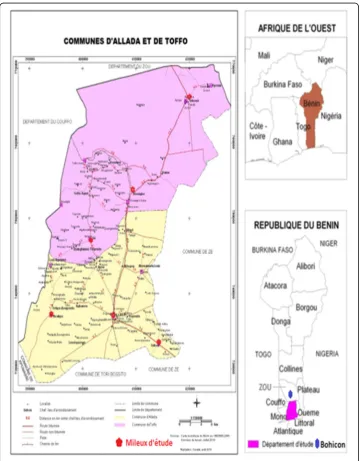
foods in that zone. Three districts were selected: Allada and Toffo (about 60 and 70 km north of Cotonou) in the Atlantique department and Bohicon (about 130 km north of Cotonou) in the Zou department (Fig. 1). The study area is characterized by rural popula-tions with different levels of urbanization: higher urban vs. rural population densities (Bohicon district); higher rural vs. urban population densities (Allada district); and only rural population (Toffo district).
Traditional foods selected for this study include“egusi”(C. lanatus,C. manii,Lagenaria spp.), palm oil (derived from E. guineensis), groundnut (Arachis hypogaea), and maize
(Zea mays). Introduced foods include vegetal oil and imported rice. Many others such as
wheat (wheat products), Irish potato, and canned and other manufactured products were considered by the whole project. Within each district, selected villages are located at
different traveling times to a reference market center. The set of villages within a district constitute a “market-shed” (Anderson et al. 2010), providing different opportunities for households to participate in and be influenced by a network of markets.
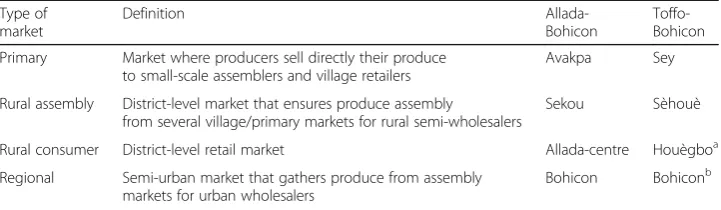
In order to assess market integration and test the hypotheses, the project recorded at fixed intervals the prices of key agricultural goods (including those listed above) traded in village markets. Prices were collected weekly by district-level agents of the state local agricultural service (CARDER), but only average monthly prices were reported in offi-cial agricultural statistics. The spread in these prices will be compared to that in key market towns with which the villages trade, as Baulch (1997) suggested. Product-wise and market-wise averages of relevant market integration indicators will be calculated. For that purpose, the following market clusters were considered: the Allada-Bohicon market cluster, which is composed of a primary market Avakpa, a rural assembly Sekou, a rural consumer market Allada-centre, and the Bohicon regional market, and the Toffo-Bohicon market cluster, which is composed in the same order of Sey, Sèhouè, Houègbo, and the Bohicon regional market (Table 1).
While long-distance trade of locally produced foods occurs from many rural assembly markets of central and southern Benin towards the international market of Dantokpa in Cotonou (Lutz 1994, Fanou et al. 1991), it is increasingly observed that substantial trade flows also go to the regional market of Bohicon. This market was selected for the study as the main regional semi-urban market because of the greater presence of trad-itional foods. Indeed, the trade of tradtrad-itional foods occurs from the rural assembly mar-kets of Sékou and Sèhouè directly towards the regional market of Bohicon, and sometimes via the Allada-centre and Houègbo. Trade flows of introduced (imported) foods go the other way round.
Trade interactions occur between the two market clusters to feed the regular trade flows between Sekou, Allada, Houègbo, Sèhouè, and Bohicon along the main tarred road Cotonou-Bohicon-Parakou. Anyway, Lutz (1994) considered both Bohicon and Dantokpa as urban consumer markets where agricultural products and manufactured goods are traded throughout the year.
Empirical framework
Two markets are said to be integrated for a given commodity if prices move together (Rashid and Minot 2010, Hossain and Verbeke 2010). Market integration is more ac-curately measured through the test of co-integration of market price series when
Table 1Description of market clusters in the study area
Type of market
Definition
Allada-Bohicon
Toffo-Bohicon
Primary Market where producers sell directly their produce to small-scale assemblers and village retailers
Avakpa Sey
Rural assembly District-level market that ensures produce assembly
from several village/primary markets for rural semi-wholesalers
Sekou Sèhouè
Rural consumer District-level retail market Allada-centre Houègboa
Regional Semi-urban market that gathers produce from assembly markets for urban wholesalers
Bohicon Bohiconb
a
Also plays the role of rural assembly market, thanks to its historic position of embedding a railway station
b
adequate data are available. Co-integration models (Lutz 1994) are too data demanding. The price time series should be long enough (usually weekly prices over many years) and uniform and have little or no missing data. They should cover several abundance and lean periods of the agricultural product (Lutz 1994, p. 121; Delgado 1986).
Temple (2000) decomposed a price time series into trend, seasonality, and instability components as follows:
where Y = price time series of a given product, Ʈ = trend component, S = season component or seasonality index,C= cyclical component, andIr= irregular component
associated with instability.
In short time series, the cyclical componentCcould hardly be observed before 6 years for many foodstuffs in Cameroon (Temple and Dury 2003), and it was therefore com-bined with Ir to result intoIr′=C+Ir, andYbecame Y= *S*Ir′. The instability com-ponent Ir or Ir′ should be measured on the irregular component of the price time
series (Scott and Griffon 1998). However, many irregular features can also be observed within the seasonal and cyclical components due to substantial variability between mar-kets for local units of measurements in relation with the types of marmar-kets, products, traders/actors, transactions, and periods (Temple and Dury 2003).
In this study where price data series have less than 30 observations, comparing price instability coefficients between markets is proposed as an alternative to price correl-ation coefficients or co-integrcorrel-ation models for measuring market integrcorrel-ation.
The price instability coefficient has its theoretical justification in (i) the temporal volatility, i.e., the average variation from the mean that shows how stable a particular market is, and (ii) the spatial volatility, i.e., the correlation between prices over space at a given time (World Food Programme 2001).
Assessing market integration by comparing two markets for the price instability coef-ficient is therefore about appraising the dynamics of spatial volatility over time. This in-volves the comparison between markets of average price variation overtime. However, the average variation in the temporal variability should be measured from the trend (predicted price) rather than from the mean in the ordinary coefficient of variation.
The price instability coefficient (I) for a given market expresses the average price de-viation from the trend in percentage of the mean price. Its formulae, as proposed by Heidingsfield and Blankenship (1974) is:
whereΫiis the predicted price on the trend line (Ϋi= a +bt),tis the time or market
day number;
The trend component (Ʈ) in Temple’s equation is captured by the predicted price and the period’s duration T in Eq. 1. The idea is quite similar in terms of harnessing the trend effect through the period’s length in the appraisal of price instability.
In this paper, the reciprocal of absolute gap in price instability coefficients (G) is used to establish the status of market integration in the selected market clusters. The lower the gap (G) is, the greater the market integration would be. The aim is to use an indica-tor of market integration that can be reasonably related to food consumption in the surroundings of each market (see hypothesis 2). Neither statistical significance of a co-integration model nor a price correlation coefficient is appropriate for the purpose. Al-though such approach to assess market integration does not have previous direct refer-ence in the literature, we believe it makes sense as revealed above by the theoretical link between price volatility and market integration. The approach relies on the basic assumption that price spread between two integrated markets stays approximately con-stant (Delgado 1986). If price spread is not concon-stant, price instability coefficient will be high and market integration would be low. In other words, the greater is the gap in price instability coefficients, the less likely will price movements be parallel and the less will the markets be integrated.
Therefore, the price instability-based indicator of market integration (G) between market 1 and market 2 is:
G¼1=absðI2−I1Þ ð2Þ
Where “abs” indicates the absolute value of the gap in price instability coefficientsI1 and I2, 0≤I1≤100 and 0≤I2≤100. The formula of the price instability coefficient was
given in Eq. 1.
The larger the gap in price instability coefficients, the lower the Gwill be, i.e., low market integration. The value of Gis undetermined or infinite whenI2=I1, i.e., perfect parallelism of price movements in the two markets, meaning perfect market integra-tion. For the purpose of comparisons, especially for testing hypothesis 2, the infinite values of Gwill be set to 100, through setting the zero gap to 0.01. Product-wise and market-wise appraisals are made of G to identify the type of foods (traditional vs. intro-duced) which markets are best integrated for, and which types of market pairs (pri-mary-assembly, primary-rural consumer, assembly-rural consumer, rural-regional) are the most integrated for the same type of foods. In the rural-regional appraisal, rural means primary, assembly, and rural consumer altogether.
Monthly retail price series of the selected traditional and introduced foods over the period July 2009–July 2011 were used for the analysis. These data were collected by the district bureaus of the Ministry of Agriculture. Although prices that are specific to mar-kets’ levels in the chain should have been considered, producer prices and wholesale prices were quite erratically available, whereas retail prices were regularly available in all markets. Therefore, retail prices were deemed more appropriate for the analysis, considering that they also reflect better the actual and overall level of supply-demand interactions in the said markets.
and wet (n= 482) seasons between 2011 and 2012. Villages within districts and their households were selected randomly according to market accessibility, with a mother se-lected for each household (Bellon et al. 2016). However, considering data availability for this paper, average values of consumption frequency over 174 households in Allada, 183 in Toffo, and 115 in Bohicon were used. With available nutrition data being only one-time cross-sectional data, spatial comparisons between market clusters is envisaged for testing the second hypothesis, which is therefore reformulated as:“Consumption of traditional foods decreases in the diets when market integration for introduced foods increases.”
Results and discussion
Product-wise and market-wise comparison of market integration
Traditional foods selected for this study include egusi, palm oil, groundnut, and maize. Introduced foods include vegetal oil (commonly and wrongly called“groundnut oil”by women traders and consumers) and imported rice. Trends in the prices of these prod-ucts are presented in Annex 1.
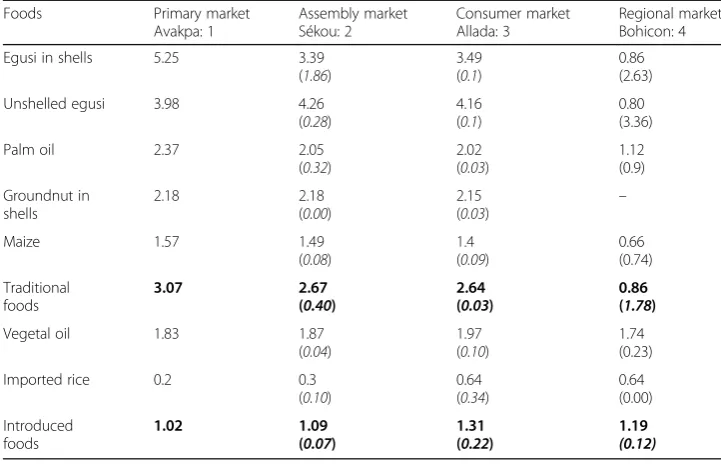
The price instability coefficient is the average deviation of prices from the trend, expressed as percentage the mean price. Table 2 shows the price instability coefficients for all selected products and their relative gaps between successive market pairs in the Allada cluster. In the primary market of Avakpa, its value is 5.25% for egusi in shells, i.e., deviation from the trend over 36 months is 5.25% the mean price. The lower the gap between the coefficients of two markets, the greater are these markets integrated. For the same product, Sekou assembly market is more integrated with the Allada
Table 2Price instability coefficients (I) and gaps between successive market pairs in the Allada-Bohicon market cluster
Foods Primary market
Avakpa: 1
Assembly market Sékou: 2
Consumer market Allada: 3
Regional market Bohicon: 4
Egusi in shells 5.25 3.39
(1.86) 3.49(0.1) 0.86(2.63)
Unshelled egusi 3.98 4.26
(0.28) 4.16(0.1) 0.80(3.36)
Palm oil 2.37 2.05
(0.32) 2.02(0.03) 1.12(0.9)
Groundnut in shells
2.18 2.18
(0.00) 2.15(0.03) –
Maize 1.57 1.49
(0.08) 1.4(0.09) 0.66(0.74)
Traditional foods
3.07 2.67
(0.40)
2.64 (0.03)
0.86 (1.78)
Vegetal oil 1.83 1.87
(0.04) 1.97(0.10) 1.74(0.23)
Imported rice 0.2 0.3
(0.10) 0.64(0.34) 0.64(0.00)
Introduced foods
1.02 1.09
(0.07)
1.31 (0.22)
1.19 (0.12)
Number of observations: 25 (monthly prices, July 2009–July 2011)
Figures in parentheses are the absolute gaps between price instability coefficients (I) for successive markets. They are put in italics in order to differentiate them from the actual price instability coefficients. Values in bold are product
consumer market than with the Avakpa primary market, the gap in price instability co-efficients being respectively 0.1 and 1.86.
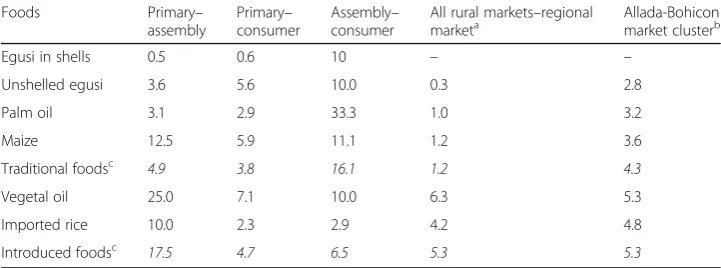
Derived from Table 2, values of the market integration indicator G are computed in Table 3 for all products and relevant market pairs for a complete analysis. Aver-age values of G indicate that markets in the Allada market cluster are more inte-grated for introduced foods (G= 5.3) than traditional foods (G= 4.3). The integration of primary, assembly, and rural consumer markets with the Bohicon re-gional market is by far higher for introduced foods (G= 5.3) than traditional foods (G= 1.2). The district-level rural markets are also more integrated among them-selves than with the regional market, either for traditional foods or introduced foods. The higher market integration for introduced foods than traditional foods is due to vegetal oil which has very low gaps in price instability coefficients and hence high values for the reciprocal, i.e., the G indicator. Market integration is higher for palm oil and unshelled egusi than egusi in shells because the first two are processed foods and are more regularly and widely traded than the latter. Hence, the more is a food traded, the more integrated its markets would be. Pro-cessing of locally traded traditional foods is likely to improve market integration in rural market clusters. Indeed, processing is key among the factors that increase urban consumers’ preferences for introduced foods against traditional foods (Adeg-bola and Singbo 2005). However, the basic food classification (“introduced” and “traditional”) adopted in this study cannot strictly be assimilated to the groupings “processed” and “unprocessed foods.” For example, palm oil is a processed food but remains traditional.
The market-wise analysis indicates that assembly and consumer markets are more in-tegrated for traditional foods than is the case with primary market and the regional market or the rural consumer market. Low market integration between primary/assem-bly markets and consumer/regional markets is due not only to delays in produce trans-fer, resulting from bad road accessibility (distance and state of roads, and therefore travel times and transport costs), but also to the heterogeneity of critical marketing tools such as units of weight/volume of measurement (Temple and Dury 2003, Thodey 1969). Differential price and margin appraisal capacity of customers is also a probable explanation. For example, Chamberlin and Jayne (2013) found in Kenya that distances
Table 3Price instability-based market integration indicator (G) in Allada-Bohicon market cluster
Foods Primary–
assembly
Primary– consumer
Assembly– consumer
All rural markets–regional
marketa Allada-Bohiconmarket clusterb
Egusi in shells 0.5 0.6 10 – –
Unshelled egusi 3.6 5.6 10.0 0.3 2.8
Palm oil 3.1 2.9 33.3 1.0 3.2
Maize 12.5 5.9 11.1 1.2 3.6
Traditional foodsc 4.9 3.8 16.1 1.2 4.3
Vegetal oil 25.0 7.1 10.0 6.3 5.3
Imported rice 10.0 2.3 2.9 4.2 4.8
Introduced foodsc 17.5 4.7 6.5 5.3 5.3
a
This features the rural-urban market integration appraisal, the regional market being the main consumption center
b
Average values here are row averages over market pairs. They are rounded to the next one-digit decimal
c
to physical infrastructure are often not representative of farmers’ access to markets; changes in specific market access conditions may have more to do with the behaviors of marketing agents. A very traditional food like egusi in shells illustrates the low mar-ket integration situation of this type of foods. Indeed, there are delays and lack of ac-curacy in the transmission of market information, especially for such raw/traditional food. On the contrary, all rural markets in Allada are quite uniformly integrated for vegetal oil, palm oil, and maize because those foods are well known to all market actors and are regularly and widely traded.
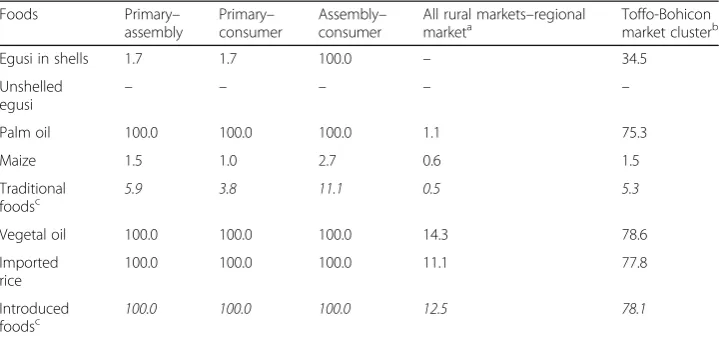
The results of the Toffo-Bohicon market cluster are reported in Tables 4 and 5. Price instability coefficients are quite constant, and the gaps between district-level market pairs are nil for most products, except maize and egusi in shells. Uniform or constant prices by market level in that district is the source of such results, giving the impression of quite perfect market integration between successive markets. There might have been a localized oligopoly by market level in the supply chains in that district, as Adegbidi et al. (2003) reported for maize in the Plateau department. However, the results confirm the trends in market integration that were observed for the Allada-Bohicon market cluster. For the purpose of testing the second hypothesis, the infinite values of G indi-cator in this case are arbitrarily set to 100, through setting the zero gap to 0.01.
Overall status of market integration in the study area
The foregoing analysis leads to a few key concluding points on the status of market in-tegration in the study area. Markets are more integrated for introduced foods than traditional foods, yet higher market integration for the processed foods vs. unprocessed
Table 4Price instability coefficients and gaps between successive market pairs in the Toffo-Bohicon market cluster
Foods Primary market
Sey: 1 Assembly market Sèhouè: 2 Consumer market Houègbo: 3 Regional market Bohicon: 4
Egusi in shells 1.53 2.11
(0.58)
2.11 (0.00)
0.86 (1.25)
Unshelled egusi – – – 0.80
(–)
Palm oil 2.03 2.03
(0.00)
2.03 (0.00)
1.12 (0.91)
Groundnut in shells 4.94 4.94
(0.00)
4.94
(0.00) –
Maize 2.88 2.21
(0.67) 1.84 (0.37) 0.66 (1.18) Traditional foods 3.09 2.92
(0.17) 2.83(0.09) 0.86(1.97)
Vegetal oil 1.67 1.67
(0.00)
1.67 (0.00)
1.74 (0.07)
Imported rice 0.55 0.55
(0.00) 0.55 (0.00) 0.64 (0.00) Introduced foods 1.11 1.11
(0.00) 1.11(0.00) 1.19(0.12)
Number of observations: 22 (monthly prices, July 2009–July 2011)
Figures in parentheses are the absolute gaps between price instability coefficients (I) for successive markets. Figures in italics are product type-wise averages
foods is a more relevant standpoint for food trade policies. District-level rural markets are more integrated with each other than with the regional market of Bohicon. Assem-bly and rural consumer markets are more integrated to the regional market than are primary markets with the regional market. This is due to low consumer price variations in the regional market, whereas larger price variations occur in the primary markets than in the assembly and rural consumer markets. The latter are strongly integrated, ei-ther for traditional foods or introduced foods.
Relationship between market integration and food consumption
The second hypothesis is formulated to check if consumption of traditional foods de-creases when market integration for introduced foods inde-creases. This means observing what happens to both variables (market integration and food consumption) when one moves from a producer area (with a certain number of rural markets) to a consumption area (with at least two major consumer markets or market towns). Unfortunately, final consumer price data were collected only on the Bohicon regional consumer market. The consumption data available include food consumption frequency (in number of days/week) and diet composition in terms of food presence or not in the diet. Testing of the above relationship goes this way: The variation of traditional foods’consumption frequency is compared to that of G value of introduced food. The results show that while average consumption frequency of traditional foods remained the same in both clusters (5 times/week in average), the index of market integration for introduced foods increased from 5.3 in Allada-Bohicon market cluster to 78.1 in Toffo-Bohicon market cluster (Table 6). This means greater market integration for introduced foods did not alter the frequency of traditional foods’consumption. Likewise, while average consump-tion of introduced foods remained constant at twice a week, market integraconsump-tion of trad-itional foods rather increased slightly from 4.3 to 5.3. This means greater market integration of traditional foods did not modify the frequency of introduced foods consumption.
Table 5Price instability-based market integration indicator (G) in Toffo-Bohicon market cluster
Foods Primary–
assembly
Primary– consumer
Assembly– consumer
All rural markets–regional
marketa Toffo-Bohiconmarket clusterb
Egusi in shells 1.7 1.7 100.0 – 34.5
Unshelled egusi
– – – – –
Palm oil 100.0 100.0 100.0 1.1 75.3
Maize 1.5 1.0 2.7 0.6 1.5
Traditional
foodsc 5.9 3.8 11.1 0.5 5.3
Vegetal oil 100.0 100.0 100.0 14.3 78.6
Imported rice
100.0 100.0 100.0 11.1 77.8
Introduced
foodsc 100.0 100.0 100.0 12.5 78.1
a
This features the rural-urban market integration appraisal, the regional market being the main consumption center
b
Average values here are row averages over market pairs. They are rounded to the next one-digit decimal
c
More swiftly, looking only at what happens in each market cluster, it appears that market integration was higher for introduced foods than traditional foods (+ 23.2% variation in Allada-Bohicon cluster and + 13.7% in Toffo-Bohicon cluster), whereas consumption fre-quency of traditional foods was rather higher (60% in both clusters). Obviously, higher market integration for introduced foods was not associated with reduced consumption fre-quency of traditional foods. The second hypothesis is therefore rejected.
Alternatively, considering households’ diet composition with regard to the share of traditional foods6 in relation with market integration for introduced foods, Allada-Bohicon market cluster stands for 55% traditional foods in diets and a market integra-tion index for introduced foods of 5.3, against 56% and 78.1, respectively, for Toffo-Bohicon market cluster (Table 7). This result confirms the findings in Table 6 that con-sumption of traditional foods did not change significantly when market integration for introduced foods increased.
Conclusions
This study assessed the status of market integration in the selected study areas where traditional foods are available but not traded enough. The hypothesis according to which rural markets are more integrated for introduced foods than traditional foods is accepted. On the contrary, the hypothesis which asserts that consumption of traditional foods decreases with increasing market integration for introduced foods is rejected. Al-though rural markets are more integrated for introduced/imported foods than local/ traditional foods, the diets in rural areas of Benin are still dominated by locally
Table 6Food consumption frequency and composite market integration index in Allada-Bohicon and Toffo-Bohicon market clusters
Foods Food consumption
frequency (days/week)a
Market integration indicatorG
Allada Toffo Bohicon Allada-Bohicon cluster
Toffo-Bohicon cluster
Egusi – 7 – 2.8 34.5
Maize 6 6 4 3.6 1.4
Palm oil 4 2 5 3.2 75.3
Traditional foodsb 5 5 5 4.3 5.3
Vegetal oil 2 2 2 6.3 78.6
Rice 1 – 2 4.2 77.8
Introduced foodsb 2 2 2 5.3 78.1
Variation between traditional and introduced foods
(%) −60.0 −60.0 −
60.0 + 23.2 + 13.7
a
Values of consumption frequency are averages of 174 households in Allada, 183 in Toffo, and 115 in Bohicon
b
Figures in italics are product type-wise averages –data not available
Table 7Share of traditional foods in diets and market integration for introduced foods
District Average number of foods in diet
Share of crop-derived traditional foods (%)
Index of market integration for introduced foods with Bohicon
Allada 27.7 55.9 5.3
Toffo 25.0 57.0 78.1
Bohicon 29.3 54.2 –
produced foods. But the time dimension of that hypothesis could not be considered due to the non-availability of multiyear survey data for comparing diet dynamics with market integration overtime.
However, it is worth emphasizing that the more processing foods undergo, the more they are traded, and the more integrated their markets are likely to be. Manufactured foods are greatly demanded due to their cooking abilities; they can also be easily trans-ported and therefore have greater access to markets, a situation which fosters greater market integration. In other words, the hidden reason behind market integration in the study area is the trade potentials of the different foods. Food processing to enable wider and long-distance trade is necessary to foster market integration of traditional foods. However, the growing trend in the consumption of introduced/imported foods should be curbed down by appropriate policies that would favor availability and accessibility of traditional foods to the poor.
Endnotes 1
Import dependency rate = percentage share of imports in total net supply, the latter being production + imports−exports.
2
G + W Blog. G + W Blog. Egusi, the Organic West African Miracle Food. http:// godandwheatgrass.com/2013/07/egusi-an-organic-miracle-food/. Accessed 11 April 2016.
3
Source: https://globalfoodbook.com/benefits-of-ocimum-gratissimum-nchanwu-leaf.
4
These two concepts are defined and discussed later in the “Literature review” section.
5
See detailed discussion in the literature review.
6
Adapted from the project’s database on households’ diet composition. Only crop-derived traditional foods were considered in calculating the share based on number – not quantities–of traditional foods in total diet.
Acknowledgements
We acknowledge the technical and institutional collaboration of the Faculty of Agronomic Sciences, University of Abomey-Calavi. We also thank Mrs. Blandine A. Ekpodilè, MSc, Environmental Sciences and Agricultural Economics, for her dedicated and sustained research assistantship.
Funding
This study was a component of the research project entitled“the effects of market integration on the nutritional contributions of traditional foods to the well-being of the rural poor in Africa”which was financed by the Bill and Melinda Gates Foundation and implemented by Bioversity International.
Availability of data and materials
Data used for this study are available at Bioversity International, Benin Station. They can be shared only with the permission of this organization.
Authors’contributions
Author BGH designed the methodology of the study and performed the data analysis and interpretation. Author GN-B organized the data collection, data archiving, and institutional support for the research. Author RSV provided useful agronomic and policy insights to the study. Author MRB supplied fresh literature and oriented the study results to focus. Author JDH contributed to highlighting the nutrition policy implications of the study. All authors participated in the writing and revision of the paper. All authors read and approved the final manuscript.
Authors’information
Author BGH is a PhD, Agricultural Economics, and a marketing expert and a deputy head, School of Economics, Socio-Anthropology and Communication for Rural Development, Faculty of Agronomic Sciences, University of Abomey-Calavi, Benin.
Author MRB is a PhD, Sociology, and previously a project leader at the Bioversity International Headquarters (Rome). Author JDH is a PhD, Nutrition Sciences and Dean of the Faculty of Agronomic Sciences, University of Abomey-Calavi.
Competing interests
The authors declare that they have no competing interests.
Publisher’s Note
Springer Nature remains neutral with regard to jurisdictional claims in published maps and institutional affiliations.
Author details
1Faculty of Agronomic Sciences, University of Abomey-Calavi, 03 BP 2819 Cotonou, Jericho, Benin.2Bioversity
International—Benin Station, c/o IITA/Benin Research Station, 08 B.P. 0932 Cotonou, Benin.3Comisión Nacional para el Conocimiento y Uso de la Biodiversidad (CONABIO), Liga Periférico-Insurgentes Sur No. 4903, Tlalpan, 14010 Mexico City, Mexico.
Received: 12 August 2016 Accepted: 7 January 2018
References
Abegunde DO, Mathers CD, Adam T, Ortegon M, Strong K (2007) The burden and costs of chronic diseases in low-income and middle-low-income countries. Lancet 370(9603):1929–1938
Achigan Dako GE, Fanou N, Kouke A, Avohou H, Vodouhe RS, Ahanchede A (2006) Évaluation agronomique de trois espèces de Egusi (Cucurbitaceae) utilisées dans lʼalimentation au Bénin et élaboration dʼun modèle de prédiction du rendement. Biotechnol Agron Soc Environ 10(2):121–129
Adegbidi A, Dedehouanou H, Kpenavoun S, Lutz C (2003) Dix ans de libéralisation du marché de maïs au Bénin. In: CDS research report no. 20. Centre for Development Studies, University of Groningen, Netherlands.
Adegbola PY, Komlan-Ahihou CM, Adegbidi A, Adetonah S, Coulibaly O, Mensah G-A, Montcho CMD (2016) Marketing of Jew’s mallow in Agbedranfo local area in the southwest of Benin. Afr J Mark Manage 8(3):20–31 June 2016. DOI: 10.5897/AJMM2016.0486
Adegbola PY, Singbo AG (2005) Impact of imports of rice on the competitiveness and profitability of domestic production in Benin Republic. In: WARDA (ed) Proceedings of the regional workshop on“Policy and strategies to promote rice production and food security in sub-Saharan Africa”, Cotonou, Benin Republic
Anderson CL, Lipper L, Dalton TJ, Smale HJ, Hodgkin T, Almekinders CJ et al (2010) Project methodology: using markets to promote the sustainable utilization of crop genetic resources. In: Lipper L, Anderson CL, Dalton TJ (eds) Seed trade in rural markets. Earthscan, London, pp 31–50
Arinloye AD (2006) Analysis of factors determining rice demand in central and southern Benin. In: Thesis of“Ingenieur Agronome”. Faculty of Agronomic Sciences, University of Abomey-Calavi, Benin
Assogbadjo AE, Glèlè Kakaï R, Vodouhê FG, Djagoun CAMS, Codjia JTC, Sinsin B (2011) Biodiversity and socioeconomic factors supporting farmers’choice of wild edible trees in the agroforestry systems of Benin (West Africa). Forest Policy Econ 14:41–49
Atkins PJ, Bowler IR (2001) Food in Society: Economy, Culture, Geography. Holder Headline Group, 338 Easton Road, London NW1 3BH/Oxford University Press Inc., 198 Madison Avenue, New York, NY10016
Baulch B (1997) Transfer costs, spatial arbitrage and testing for food market integration. Am J Agric Econ 79(2):477–487 Bellon M (2010) The effects of market integration on the nutritional contributions of traditional foods to the well-being
of the rural poor in Africa. Project concept note, Bioversity International, Italy
Bellon MR, Ntandou-Bouzitou GD, Caracciolo F (2016) On-farm diversity and market participation positively influence dietary diversity of rural mothers in southern Benin, West Africa. PLoS One September 8, 2016: https://doi.org/10. 1371/journal.pone.0162535
Bowler I (ed) (1992) The geography of agriculture in developed market economies. Longman, Harlow
Centre of Research Excellence in nutrition and metabolism (CENM) (2016) Traditional Food, http://srbnutrition.info/ english/traditional-foods. Accessed 11 Apr 2016
Chamberlin J, Jayne TS (2013) Unpacking the meaning of‘market access’: evidence from rural Kenya. World Dev 41: 245–264 http://dx.doi.org/10.1016/j.worldev.2012.06.004
Cook I, Crang P, Thorpe M (1999) Eating into Britishness: multicultural imaginaries and the identity politics of food. In: Roseneil S, Seymout J (eds) Practising identity powers and resistance. Macmillan, Basingstoke, pp 223–248 Dansi A, Adjatin A, Adoukonou-Sagbadja H, Falade V, Yedomonhan H, Odou D, Dossou B (2008) Traditional leafy
vegetables and their use in the Benin Republic. Genet Resour Crop Evol 55:1239–1256. https://doi.org/10.1007/ s10722-008-9324-z
Dansi A, Vernier P, Marchand J-L (2003) Les variétés d’igname cultivées : Savoir-faire paysan au Bénin. Groupe de Travail Interdépartemental sur la Biodiversité dans l’Alimentation et l’Agriculture. FAO, Rome
Dawson J, Burt S (1998) European retailing: dynamics, restructuring and development issues. In: Pinder D (ed) The new Europe: economy, society and environment. John Wiley, Chisester, pp 157–176
Delgado CL (1986) A variance components approach to food grain market integration in northern Nigeria. Amer J Agr Econ 68:4 November 1986
Dossou-Aminon I, Loko LY, Adjatin A, Dansi A, Elangovan M, Chaudary P, Vodouhê R, Ambaliou S (2014) Diversity, genetic erosion and farmer’s preference of sorghum varieties [Sorghum bicolor(L.) Moench] in north-eastern Benin. Int J Curr Microbiol App Sci 3(10):531–552
Fanou LK, Lutz CHM, Salami S (1991) Les relations entre les marchés de maïs du Bénin et les marchés des espaces avoisinants au Togo, au Niger et au Nigéria. FSA/UNB, Cotonou and University of Amsterdam
FAO/PAR - FAO and Platform for Agrobiodiversity Research (2010) Biodiversity for food and agriculture contributing to food security and sustainability in a changing world. In: Outcomes of an expert workshop held by FAO and PAR from 14-16 April 2010 in Rome, Italy. FAO, Rome
FAO/ECOWAS (2015) Inputs into FAO contribution to ECOWAP +10 conference. Key findings and messages from AGWA. An ECOWAP policy review report, ECOWAS, Lomé, Togo
Friedmann H, McMichael P (1989) Agriculture and the state system: the rise and decline of national agriculture, 1870 to present. Sociol Rural 29:93–117
Gómez MI, Barret CB, Raney T, Pinstrup-Andersen P, Meerman J, Croppenstedt A, Carisma B, Thompson B (2013) Post-green revolution food systems and the triple burden of malnutrition. Food Policy 42:129–138
Goody J (1982) Cooking, cuisine and class: a study in comparative sociology. Cambridge University Press, Cambridge Green D, Griffith M (2002) Dumping on the Poor: The Common Agricultural Policy, the WTO and International
Development. CAFOD, United Kingdom. https://www.iatp.org/files/Dumping_on_the_Poor_The_Common_ Agricultural_Po.htm
Heidingsfield MS, Blankenship AB (1974) Marketing. In: Harper and Row, Barnes and Noble Book Edition
Hollinger F, Staatz J (2015) Croissance agricole en Afrique de l’Ouest : facteurs déterminants de politique et de marché. BAfD/FAO, Rome
Honfoga BG, Keita MS, Abbey G (2005) Foodgrain market instability and regional trade in the SADAOC zone. In: A medal finalist paper presented at the 6thannual global development conference. Global Development Network (GDN), Dakar, Senegal 22-26 January 2005
Honfoga BG, Pérez M, Chinkanda NE, Rinzin C, Narayan NC (2002) Tina and the milk: southern perspectives on sustainability in the Netherlands. Published by NSDO, the Netherlands August 2002
Honfoga BG, van den Boom GJM (2003) Food-consumption patterns in Central West Africa, 1961 to 2000, and challenges to combating malnutrition. In: Food and nutrition bulletin, vol. 24, no. 2 © 2003, the United Nations University
Hossain MI, Verbeke W (2010) Evaluation of rice markets integration in Bangladesh. Lahore J Econ 15(2):77 Kristbergsson K, Oliveira J (2016) Traditional foods: general and consumer aspects. In: Integrating food science and
engineering knowledge into the food chain. Springer, US, pp 85–86 ISBN 978-1-4899-7648-2 Lupton D (1996) Food, the body and the self. Sage, London
Lutz CHM (1994) The functioning of the maize market in Benin: spatial and temporal arbitrage on the market of a staple food crop. PhD thesis, University of Amsterdam, The Netherlands
MAEP (2010) Strategic Plan for Boosting the Agricultural Sector in Benin (PSRSA), final version, August 2010. Ministry of Agriculture, Cotonou
Malkiel B (1987) Efficient market hypothesis. In: Eatwell J, Milgate M, Newman P (eds) The New Palgrave Dictionary of Economics. MacMillan Press, London, pp 120–122
Nzenza S (2014) Our disappearing traditional foods. Blog in The Herald, March 18, 2014. http://www.herald.co.zw/our-disappearing-traditional-food/. Accessed 11 Apr 2016
Popkin BM (2003) The nutrition transition in the developing world. Dev Policy Rev 21(5-6):581–597
Rashid S and Minot N (2010) Are staple food markets in Africa efficient? Presented at the COMESA policy seminar
“Food price variability: causes, consequences, and policy options”on 25-26 January 2010 in Maputo, Mozambique under the COMESA-MSU-IFPRI African Agricultural Markets Project (AAMP).
Ravallion M (1986) Testing market integration. Am J Agric Econ Volume 68(1):102–109, https://doi.org/10.2307/1241654 Saunders R (2010) What are traditional foods? Agriculture Society, October 28, 2010.http://agriculturesociety.com/
politics-and-food/what-are-traditional-foods/. Accessed 11 Apr 2016
Scott G, Griffon D (1998) Prix produits acteurs. Méthodes pour analyser la commercialisation agricole dans les pays en développement. Editions Khartala, Paris, p 489
Smith LC, Haddad L (2001) How important is improving food availability for reducing child malnutrition in developing countries? Agric Econ 26:191–204
Temple L (2000) Modèle de décomposition des séries chronologiques. In: Application au plantain au Cameroun, Njoumbé, Document du CRBP, no 207, p 18
Temple L, Dury S (2003) Instabilité du prix des produits vivriers et sécurité alimentaire urbaine au Cameroun. Série Urbanisation, alimentation et filières vivrières, In : CIRAD Document no. 6. Cadre méthodologique d'analyse des relations entre prix des vivriers et insécurité alimentaire. CIRAD, Montpellier
Thodey AR (1969) Analysis of staple food price behavior in W. Nigeria. Ph.D. Dissertation, University of Illinois UNDP-Benin (2011) National Report on Human Development 2010-2011. UNDP Benin office, Cotonou, Benin World Food Programme (2001) Market Analysis Framework: Tools and Applications for Food Security Analysis and