International Doctorate School in Information and Communication Technologies
DISI - University of Trento
GO
SSIPING
O
PTIMIZATION
F
RAMEWORK
(
GOOF
)
A
DECENTRALIZED
P2P
ARCHITECTURE FOR
FUNCTION OPTIMIZATION
Marco Biazzini
Advisor:
Prof. Alberto Montresor
Universit`a degli Studi di Trento
This thesis discusses the implementation of function optimization algorithms through distributed and decentralized processing in a peer-to-peer fashion.
Our research is focused on a fully decentralized, general purpose P2P environment, with no special or ad-hoc facility for executing optimization tasks. Relevant information is exchanged among nodes by means of epidemic protocols, exploiting the overlay network topology formed by peers. A key issue in such a context is the relationship between the solution quality and the amount/kind of exchanged information among the various running instances. We propose and detail novel heuristics and hyper-heuristics. Experimental results obtained both in simulated and real P2P environments are presented and discussed as well.
Distributed optimization has a long and rich history, but little has been done to make it exploit the (potentially) large computing facilities a reliable P2P network can provide. We propose a novel framework that aims at easing the burden of performing function optimization tasks in a decentralized P2P network of solvers. Our ‘GOssiping Optimization Framework’ (GOOF)
bridges the gap between P2P services that can provide large reliable networks of interconnected nodes and the needs of optimization practitioners who are often not able to find a reasonably simple way to run their algorithms in such a distributed environment.
Keywords
P2P protocols, optimization search heuristics,
1 Introduction 1
2 State of the Art 5
2.1 Distributed computing . . . 5
2.1.1 P2P networks . . . 6
2.1.2 Epidemic Protocols . . . 9
2.2 Optimization techniques . . . 10
2.2.1 Optimization heuristics . . . 13
2.2.2 Meta-techniques . . . 26
2.2.3 P2P optimization algorithms . . . 31
2.2.4 Optimization frameworks . . . 34
3 GOOF architecture 43 3.1 System Model . . . 44
3.2 Framework Architecture . . . 45
3.3 Topology service . . . 46
3.4 P2P algorithm design . . . 50
4 The Function Optimization Service 53 4.1 The Interfaces . . . 53
4.1.1 The Solver interface . . . 54
4.2 The SolverBox . . . 57
4.3 Distributed PSO . . . 60
4.4 New Hyper-heuristics . . . 63
4.4.1 Pruner . . . 64
4.4.2 Scanner . . . 66
4.5 P2P RASH . . . 69
4.6 Towards a new hybrid meta-heuristic . . . 71
5 The Communication Service 75 6 Experimental results 81 6.1 Experiments with PSO . . . 81
6.1.1 Experimental Setup . . . 82
6.1.2 Evaluating Quality . . . 86
6.1.3 Evaluation of Cycle Length . . . 88
6.1.4 Evaluating Time . . . 90
6.2 Experiments with HH . . . 91
6.2.1 Algorithms . . . 91
6.2.2 Experimental Setup . . . 93
6.2.3 Dominance Analysis . . . 95
6.2.4 Performance on Test Functions . . . 97
6.3 Experiments with DE . . . 99
6.3.1 Experimental settings . . . 100
6.3.2 Some commented results . . . 103
6.4 Preliminary Experiments towards RAPSO . . . 111
2.1 DE operators . . . 24
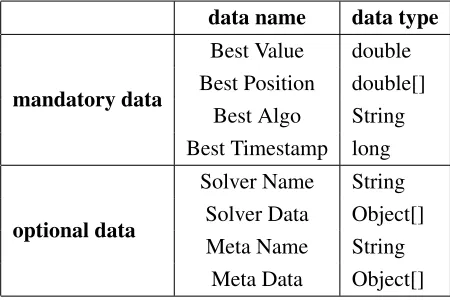
5.1 GOOF’s epidemic message format. . . 77
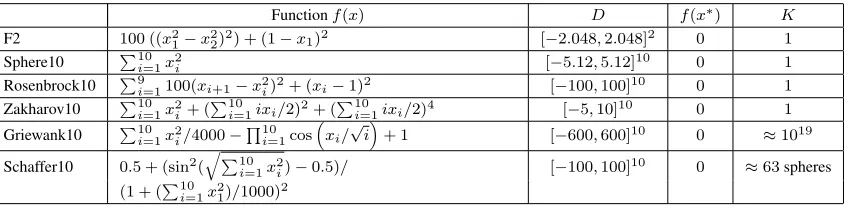
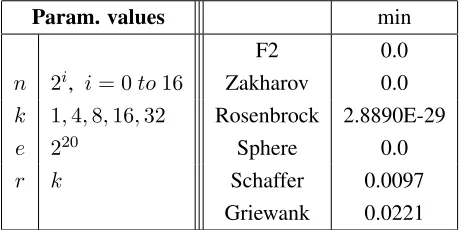
6.1 Evaluating P2P-PSO. Test functions . . . 82
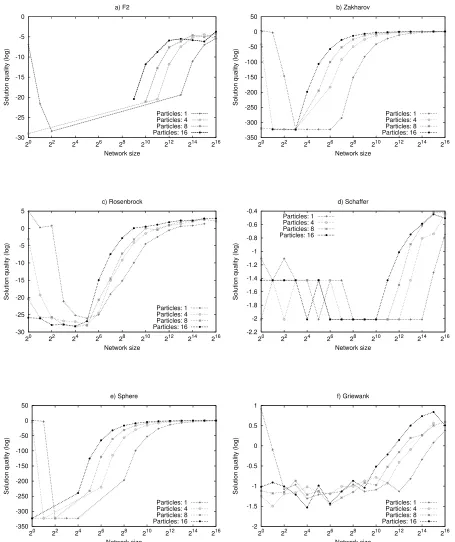
6.2 P2P-PSO swarm size evaluation result summary . . . 85
6.3 P2P-PSO network size evaluation result summary . . . 85
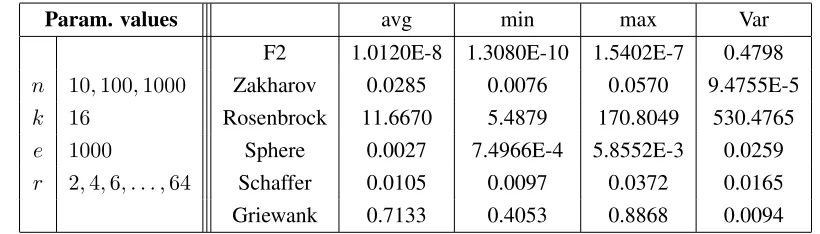
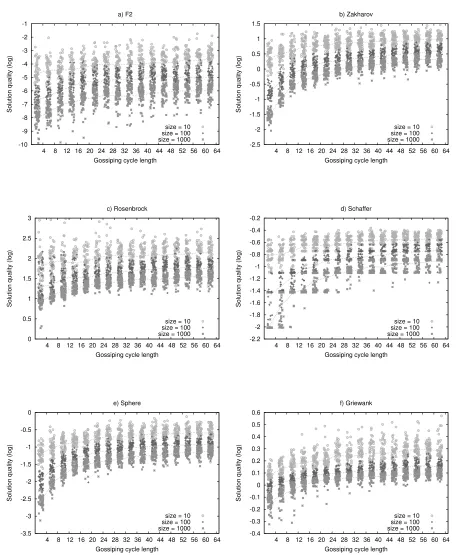
6.4 P2P-PSO gossip cycle length evaluation result summary. . . 86
6.5 P2P-PSO total time evaluation result summary . . . 86
6.6 Evaluating novel HH. DE operators . . . 91
6.7 Our pool of HH . . . 91
6.8 Evaluating novel HH. Test functions . . . 93
6.9 Evaluating novel HH. Mean best fitness rank statistics. . . 95
6.10 Evaluating novel HH. Minimal best fitness rank statistics . . . . 96
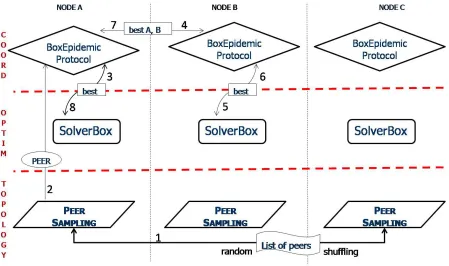
3.1 Framework architecture . . . 46
6.1 Evaluating P2P-PSO. Swarm size . . . 83
6.2 Evaluating P2P-PSO. Network size . . . 84
6.3 Evaluating P2P-PSO. Gossip cycle length . . . 87
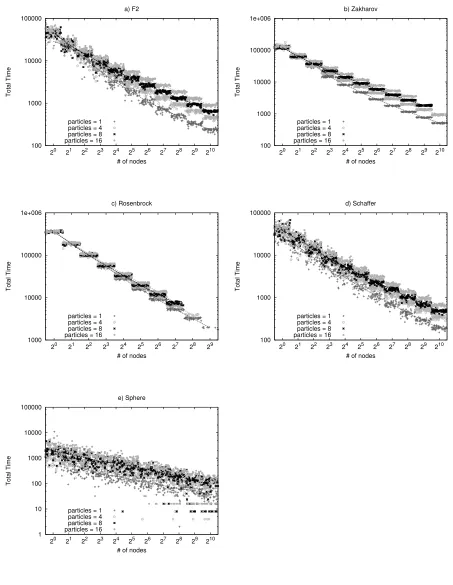
6.4 Evaluating P2P-PSO. Total time . . . 89
6.5 Evaluating novel HH. Mean best fitness . . . 98
6.6 Evaluating gossiping DE. Detail of Rastrigin optimization with DE/Best/1/Exp. . . 104
6.7 Evaluating gossip DE. Gossip rate’s effect on Griewank opti-mization with no churn. . . 105
6.8 Evaluating gossiping DE. Gossip rate’s effect on Rosenbrock optimization. . . 106
6.9 Evaluating gossiping DE. High gossip rate’s effect on Rastrigin optimization with different churn rates. . . 109
6.10 Evaluating gossiping DE. Gossip rate’s effect on Rastrigin op-timization with different churn rates. . . 110
6.11 Work in progress: towards RAPSO (real deployment). . . 113
I’d like to thank in these few lines some people who made it possible to me to walk the road of research and finally defend my work as presented in this Thesis.
Starting with Prof. Roberto Battiti who introduced me to this path and gave me the first precious advises. Then Prof. Mauro Brunato, with whom I collab-orated in the early stages of my work. Special thanks go to my advisor, Prof. Alberto Montresor for his kind and expert guidance throughout these years. I’m really grateful to Dr. M´ark Jel´asity for his kind and valuable support and for his collaboration, which I took from much more than I could give.
Not only fine scientists helped me through these years, but also the friendship and the affection of many people. Too many for a list: I write here a “thank you” to them all. They are anyway enlisted in my heart.
Introduction
The job of scientists working on function optimization often involves two dif-ferent aspects [17]: on the one hand, they are required to benchmark newly developed optimization algorithms against a large collection of existing prob-lems; on the other hand, when confronted with a specific optimization problem, they may be required to attack it with a large arsenal of optimization techniques, to obtain the best possible results.
When the distributed dimension is added, it makes this already complicated scenario even worse. Can existing algorithms be plugged in a distributed envi-ronment? Can multiple instances of the same algorithm cooperate? Can mul-tiple algorithms share their work-in-progress results? How mulmul-tiple instances are organized, and how they communicate? Is there a class of optimization problems that are more appropriate for a distributed environment?
Distributed optimization has a long research history [131]. Most of the pre-vious work assumes the availability of either a dedicated parallel computing facility, or, in the worst case, specialized clusters of networked machines that are coordinated in a centralized fashion (master-slave, coordinator-cohort, etc.). While these approaches simplify management, they normally show severe lim-itations with respect to scalability and robustness.
function optimization. The idea is to adopt recent results in the domain of large-scale decentralized systems and peer-to-peer (P2P) systems, where a large col-lection of loosely-coupled machines cooperate to achieve a common goal. In-stead of requiring a specialized infrastructure or a central server, such systems self-organize themselves in a completely decentralized way, avoiding single points of failure and performance bottlenecks. The advantages of such approach are thus extreme robustness and scalability, and the capability of exploiting ex-isting (unused or underused) resources.
The applicative scenario we have in mind is a potentially large organization that owns, or at least controls, several hundreds or even thousands of personal workstations, and wants to exploit their idle periods to perform optimization tasks. In such systems, high level of churn may be expected: nodes may join and leave the system at will, for example when users start or stop to work at their workstations.
Such a scenario is not unlike a Grid system [84]; a reasonable approach could thus be to collect a pool of independent optimization tasks to be performed, and assign each of them to one of the available nodes, taking care of balancing the load. This can be done either using a centralized scheduler, or using a decen-tralized approach [73].
An interesting question is whether it is possible to come up with an alterna-tive approach, where a distributed algorithm spreads the load of a single opti-mization task among a group of nodes, in a robust, decentralized and scalable way. We can rephrase the question as follows: can we make a better use of our distributed resources by making them cooperate on a single optimization process? Two possible motivations for such approach come to mind: we want to obtain a more accurate result by a specific deadline (focus on quality), or we are allowed to perform a predefined amount of computation over a function and we want to obtain a quick answer (focus on speed).
to have a distributed framework, hosted on every participant node, that can ease the burden of deploying optimization algorithms in such a fully decentralized fashion. A uniform environment, which the optimization task relies on, to carry on the quest for the optimal value and coordinate all the resources that are spread on different machines.
When it comes to making optimization algorithms collaborate and share in-formation, several aspects equally matter. Due to the huge variety of existing and possible optimization algorithms, the framework has to be generic enough to suit most (if not any) of them. It must be designed in such a way that it is not too difficult to plug a new algorithm in the system, meanwhile making the execution of the algorithm not unusual to the user, with respect to the procedure that is well known when the same algorithm is used in a different environment. Another requirement is interoperability. Different optimization algorithms, having very little in common, should be able to cooperate to solve the same problem with little or no user intervention. On the other way round, the same optimization algorithm should be able to operate on a large number of differ-ent problems with no adjustmdiffer-ent or change in either of the two differ-entities being required (except for problem-specific tuning, of course).
No striving should be asked to the user in order to handle and set up the P2P network of solvers. A basic parametrization of the amount of communications to be enabled should be all that the user needs to know about the way the solvers spread information throughout the network. Moreover, the framework should provide a clear and standard way of handling the event of receiving relevant information and making a proper use of it locally.
optimization processes which run in different network nodes, giving a powerful contribution to solve the aforementioned issues.
Structure of the Thesis
State of the Art
Since the very beginning, our research effort has lead us to be involved in dif-ferent fields. Deeply belonging to the function optimization field, strongly con-nected with the distributed computing and the peer-to-peer paradigm as well. Aware as we are that we cannot cover in details the recent history of all of them, we present in this chapter a synthetical survey of those topics that are mostly relevant to our work, discussing some of the latest results that relate to our con-tribution.
In the following we thus examine the field of distributed computing and peer-to-peer networks (Section 2.1), then we present some recent results in the field of optimization, concentrating on those obtained by using search heuristics and evolutionary techniques (Section 2.2).
2.1 Parallel and distributed computing
• Independent tasks within a tightly coupled system
Here we can list all the parallelization flavors of the various algorithms, that are designed and implemented requiring a parallel multiprocessor ar-chitecture or an equivalent dedicated infrastructure. The dynamism of the system is very poor and there are strong limitations with respect to scala-bility and robustness.
• Related tasks handled by a central coordinator within a loosely cou-pled system
The main example of this kind of distributed computing architecture is the so-called “collaborative search”. This expression indicates the fact that different entities give their own contribution in order to reach the general goal of performing a searching task (See the BOINC Project1 as an exam-ple). Although working in a totally distributed environment, projects like these are mostly designed in a centralized fashion. This means that there is a unique coordinator that assigns tasks, collects results and combines the outcomes to find an acceptable solution. Such an architectural design is desirable when the search space – more precisely, the interesting or most promising part of it – is already known. But this is not always the case. . .
2.1.1 P2P applications networks
A third paradigm has actually been devised, that is highly popular and studied in many fields — both belonging to scientific research and not — but not yet fully exploited for optimization purposes. We are talking about peer-to-peer (P2P) applications networks. During the past decade various large scale networks have emerged as computing platforms such as the Internet, the web, in-house clusters of cheap computers, and, more recently, networks of mobile devices. The exploitation of these networks for computing and for other purposes such
as file sharing and content distribution has followed a different path. Whereas computing is normally performed using GRID technologies, other applications, due to legal and efficiency reasons, favored fully decentralized self-organizing approaches, that became known as P2P computing.
A P2P computer network is based on the concept of pooling computing power and bandwidth of the participants in the network, eliminating the distinc-tion between servers and clients. In contrast to the strain imposed on servers by the transfer of large files among multiple users, this system has significa-tive advantages. As the storage space, bandwidth, and computing power of the network’s computers are pooled, the capacity of the network increases as more members join.
There are many possible classifications of P2P networks [125]. We cite here the two of them that are most widely used. The first is according to the net-work’s degree ofcentralization. We can have:
• Pure P2P — peers act as equals, merging the roles of clients and server. There is no central server managing the network and no central router
• Hybrid P2P — a central server keeps information on peers and responds to requests for that information. Peers are responsible for hosting available resources (as the central server typically does not have them), for letting the central server know what resources they want to share, and for making their shareable resources available to peers that request them.
The second is based on how the nodes in the overlay network are linked to each other. We can classify the P2P networks as:
is no correlation between a peer and its managed content, it is also worth saying that various communication paradigms has been devised, that can efficiently tackle the “quest for the content” task (see [144] as an example).
• structured — They overcome the above limitations by maintaining a Dis-tributed Hash Table (DHT) and by allowing each peer to be responsible for a specific part of the content in the network. These networks use hash functions and assign values to every piece of content and every peer in the network and then follow a global protocol in determining which peer is responsible for which content. The drawbacks are related to the overload due to caching, keyboard management and prioritization difficulties for the most popular contents.
The P2P paradigm for distributed computing can make networked applica-tions scaling in previously unseen extents, saving efficiency and robustness as well. Though mostly known in the content distribution area (file sharing), it has been proved to be highly efficient for media streaming (see the growing phe-nomenon of VOIP and the worldwide thriving of applications like Skype [14], that successfully uses a fully decentralized P2P streaming protocol) and it is also exploited for scientific purposes, related to solving massive computation problems in the absence of a dedicated infrastructure (again, BOINCis a worthy example).
2.1.2 Epidemic Protocols
Epidemic and rumor mongering protocols are a successful example of how to deal with the high levels of unpredictability associated with P2P systems. The research on the application of epidemic protocols in distributed systems started with the seminal work of Alan Demers [43], who proposed several models for the decentralized dissemination of database updates. The models are character-ized by two major features:
Anti-Entropy — Each node periodically selects a random peer and performs an information exchange with it. There are three way a node can do this:
• push — the originator of the exchange sends its own updates to the peer;
• pull — the originator asks for updates from the peer;
• push-pull — both the operations are performed.
Gossip — Whenever a node receive an update, it selects a small number k of peers and sends the update to them with probabilityp. Valuesk andphave to be tuned in order to make the update reaching all the peers, minimizing the communication overhead given by redundant messages.
On top of the peer sampling service, several epidemic protocol can be de-vised to address several different problems. Besides their original goal to imple-ment efficient and robust information dissemination, they are now used to solve membership management [71], aggregation [73], topology management [70], resource sharing, etc. While tackling all these tasks, epidemic (gossiping) pro-tocols always keep some peculiar traits [106] that tell them apart from other message passing techniques:
• At each iteration, a peer to communicate with is selected at random;
• all nodes keep and spread only local information;
• communication is periodic;
• nodes do not assume a large transmission and processing capacity to be locally available;
• all nodes run an identical protocol.
Although presenting such a simple and not demanding set of characteristics, gossiping protocol prove to be highly robust to failures and able to empower sys-tems with remarkable (typically logarithmic) scalability and convergence time.
2.2 Optimization algorithms and techniques
Often these algorithms make a clever use of the objective function. Some may gather information during an iteration and then use it in the next one, others may use only local information from the current point. Regardless of these specifics, all optimization algorithms ought to be:
robust — they should perform well for all reasonable choices of the variables’ initial values;
efficient — they should not require excessive computing power and storage;
accurate — they should output a solution with an acceptable precision, without being too sensitive to data errors, rounding errors, etc.
Of course these goal are always conflicting. A good design must take into account the ‘best’ tradeoff among them. But even the best design turns out to be inadequate to tackle very hard problems, if not associated with a clever usage strategy and implementation.
That is why great attention has been paid for years to a certain number of ex-ecution policies, in order to increase the efficiency and the performance of the algorithms.
In most of the use cases, the optimization algorithms are stochastic by nature; in particular, the earliest stages of the search require some random decision, in order to choose good values for the first evaluation without any prior informa-tion. By changing the random seeds, different results can be obtained from distinct runs of the same algorithm. Given this, it makes sense to explore the tail of the outcome distribution by running multiple concurrent executions of an algorithm, so to reach more quickly the lower values.
and none can claim to be clearly “better”. As [17] wisely notices, smart tech-niques often arise from simple basic ideas whose application is both effective and easy to adapt to many different contexts. Thus different researchers may “discover” the same algorithmic ideas in different places, describing them us-ing a (slightly) different terminology and applyus-ing them at first to (slightly) different problems. Then, trying to merge all the existent in a single taxonomy implies the choice of some denominations over others and some criteria instead of others. This process is obviously subjective, practically arbitrary and in the end there is no universal criteria to evaluate the adequacy of such theoretical classifications.
Despite of all the differences in making distinctions, everyone supports the idea of telling apart simple heuristics from more complex techniques that make use of simple heuristics in a clever way, in order to overcome some known limits or drawbacks. Here we choose to call them meta-techniques, just because the prefixmeta-is by far the one with the most aged and assessed tradition when you have to talk about some “higher level” mechanism that logically or practically incorporates, makes use or somehow handles the basic ones. The problem of “where” to draw the line that tells apart heuristics and meta-techniques is an unsolved problem in literature, that gave birth to various fuzzy rules of thumb to discriminate heuristics, meta-heuristics, hyper-heuristics, racing techniques, algorithms portfolios, etc. So everyone agrees that a difference exists, but there are different ideas about what belongs to which group and if and why these groups are really distinct or not.
to the famous Occam’s razor principle, thus considering the minimal amount of distinctions that are necessary to correctly understand the algorithms and to provide a general and versatile implementation of most (possibly all) of them. Indeed we found the job of optimizing the optimization literature something that duly overcomes all known approximation strategies. . .
2.2.1 Optimization heuristics
In recent years, a large catalogue of heuristic techniques has emerged. These heuristics are said to have been mostly inspired by nature, society, physics, etc. to produce theoretical models which match the circumstances of a given problem. Heuristics have made it possible to solve cases which were impossible with conventional techniques, although in most cases the solutions achieved are only “almost optimal”, having been obtained by considering characteristics which have been subjectively established by the user.
Generally speaking, optimization heuristics begin with an initial guess of the optimal values of the variables and then iterate by using different strategies, generating improved estimates until a given stopping criteria is met. Most com-monly they either reach a solution that is considered acceptable or execute a stated number of iterations. One of their major advantages consists in the fact that their application does not rely on a set of strong assumptions about the optimization problem. Most of the times, to implement a good heuristic it is sufficient to be able to evaluate the objective function for a given element of the search space. It is not necessary to assume some global property of the objective function, nor is it necessary to be able to calculate derivatives.
A well designed heuristic should also be robust to changes in problem charac-teristics, not fitting only a single problem instance, but the whole class.
Among heuristics, local search methods are prominent and widely used to build intelligent algorithms that search the space of the solutions avoiding traps that might be hidden in the landscapes. Jacobson and Y¨ucesan (2004) [69] and Hoos and St¨utzle (2005) [66] are excellent guides while exploring these lands.
Local search methods are based on the systematic exploration of neighbor-hoods of successive solutions. Starting at some initial feasible solution, they are based on the idea that a solution may be improved through a sequence of one step changes, until no further improvements are possible. Accordingly, neighbor solutions are obtained from the current one by the application of an adjacency relation, i.e. a function, defined over the set S of solutions, that maps a solution into a subset of S. This concept of neighborhood is the central issue to all local search algorithms.
The simplest local search algorithm is Iterative Improvement. The neigh-borhood of the current solution is searched for a lower cost solution. If such a solution is found, then it will become the new current solution; otherwise, a lo-cal optimum has been found. The Steepest Descentalgorithm is a variant of this scheme. Here a neighbor solution is chosen, that has the smallest cost within the neighborhood. Variable Neighborhood Searchis another extension of these approaches. Here the current neighborhood is enlarged whenever a local opti-mum is found within it. Usually the search starts with small neighborhoods to be quick in the beginning, while the gradual neighborhood enlargement allows finding solutions that satisfy some desired termination condition.
(TS), whereas prominent in the second class are Genetic Algorithms (GA), Dif-ferential Evolution (DE), Particle Swarm Optimization (PSO) and Ant Colonies Optimization (ACO).
Trajectory methodsstart with a tentative solution and then move in the search space, following a trajectory that leads to better function values. They are also called single agent methods, because only one solution per iteration is pro-cessed. They often define neighborhoods to mark temporary or permanent perimeters of the search. Finding efficient neighborhood functions that lead to high quality local optima can be challenging. All these local search meth-ods have their own rules for the choice of a neighbor and the acceptance of a solution. They may or may not accept to momentarily worsen the current solu-tion, in order to escape local minima. We recall here some basics of the most used methods and give some details about the Reactive Affine Shaker heuristic (RASH), a trajectory method we use in our current research (see Chapter 6).
Simulated Annealing
SA is a generic probabilistic heuristic introduced by Kirkpatrick et al. in 1983 [85], widely used to locate a good approximation to the global minimum of a given function in a large search space. The name and inspiration come from annealing in metallurgy, a technique involving heating and controlled cooling of a material, that causes the size of its crystals to increase and reduces their defects. The heat makes the atoms move from their initial positions (a local minimum of the internal energy) and wander randomly through states of higher energy; slowly cooling down the material gives these atoms more chances to find some configurations that has lower internal energy than the initial one.
during the process. Initially, T is set to a high value (or infinity), and it is decreased at each step according to some user specified annealing schedule that must end with T = 0 towards the end of the available time. This way, in the beginning the system wanders towards a broad region of the search space containing good solutions, ignoring small features of the energy function; then drifts towards narrower and narrower low-energy regions; finally move downhill according to the steepest descent heuristic.
It has been proved [60] that for any given finite problem, the probability that SA terminates with the global optimal solution approaches 1 as the available time is extended. However, this is often not helpful, since in many cases the time required to ensure a significant probability of success will exceed the time required for a complete search of the solution space. Among the many variants and enhancements of SA that have been proposed, we recall the Quantum An-nealing algorithm [40], the thermodynamic anAn-nealing scheme devised in [41] and an interesting study by Rudolph [120] about parallel SA and its relation with population-based algorithms.
Threshold Accepting
TA was presented by Dueck and Scheuer in 1990 [45]. It is a trajectory methods that can be seen as a “deterministic variant” of SA. TA starts with a (random) feasible solution. Given a sequence of pre-defined thresholds St, TA always
achieve better general performances by combining it with a Tabu scheme [54].
Tabu Search
TS was presented by Glover in 1987 [55]. It is particularly designed for the ex-ploration of discrete search spaces where the set of neighbor solutions is finite. The method implements the selection of the neighborhood solution in a way to avoid cycling, i.e, visiting the same solution more than once. More techni-cally, the neighborhood of the current solution is dynamically modified by the heuristic, in such a way that the search will not end up in an already visited local optimum, at least in the short term. To achieve this, TS enhances the lo-cal search by using memory structures, among which the tabu list: each entry of this list is either a solution or a set of attributes a solution can be mapped into. Any solution that ca be matched against an entry of the tabu list cannot be visited again. Of course the list is not permanent and elder tabu moves are periodically purged (we could say they are forgotten by the algorithm).
Generally TS allows more flexible approaches to a given problem, cause the definition of tabu moves usually do not enforce a strict monotonicity of the fitness function. Moreover, the tabu list can be populated in such a way that also takes into account the current position, the recent history of the searcher, or some feature of the problem, etc. TS is largely adopted in many differ-ent fields and has a growing number of variants. We recall here he Reactive Tabu Search [16] and the TS-based reinforcement learning technique of Burke et al. [31].
Reactive Affine Shaker
re-gion is adapted at each step by an affine transformation, taking into account the local knowledge derived from trial points generated with a uniform probability in the search region. This way it is possible to quickly approach local minima in the attraction basin where the initial point falls, by adapting the step size and direction to maintain heuristically the largest possible movement per function evaluation.
begin
R ←small isotropic set aroundx; // x is the initial point; R is the search region
whilelocal termination condition is not metdo
Pick∆∈Rdsuch thatx+ ∆,x−∆∈ R; // ∆ is the current displacement
iff(x+ ∆)< f(x)then // f is the function to optimize
x←x+ ∆; ExtendRalong∆; CenterRonx;
else iff(x−∆)< f(x)then x←x−∆;
ExtendRalong∆; CenterRonx;
else
ReduceRalong∆;
returnx;
Algorithm 1:The Reactive Affine Shaker algorithm
Algorithm 1 shows the pseudocode of the RASH heuristic. At each iter-ation, the search region is re-shaped according to what has turned out to be the most promising direction in the previous iteration. Equation 2.1 shows the affine transformation. Here d is the number of dimensions in the search space, while(b1. . . bd) are independent vectors which define the search regionR. The
dilation parameter ρcan be heuristically set at 1.2.
∀bj ∈(b1. . . bd) bj ←
µ
I+ (ρ−1)· ∆∆T
k∆k2 
·bj (2.1)
trajectory attractors during the search, thus the RASH searcher will not be able to escape from a sub-optimal solution by itself, if this solution is the best avail-able in the current region. This is the reason why RASH is meant to be used as a part of a more complex heuristic, providing a powerful exploitation mechanism that needs to be complemented by some technique that enables an extensive ex-ploration of the search space. Such an idea has been implemented and proposed in [29], where a RASH optimizer works within a memory-based iterated scheme that can estimate good starting point for it to be improved. As we will see in Chapter 4, we have combined the RASH heuristic with other algorithms to cre-ate novel distributed heuristics that show promising results in our preliminary experiments. ¤
While trajectory methods refine a single solution at each iteration, Population-based methods work updating a whole set of solutions (called population) at a time. They are also called discontinuous methods because, at least in their original version, they are allowed to “make jumps” in the whole search space. Therefore, these methods might be more efficient with regard to exploring the whole function domain, at the cost of a higher computational load and more complex structures. This is the realm of the biology-inspired techniques, as our brief list may confirm. We recall here some basic concepts about the promi-nent population-based heuristics, giving more details about PSO and DE, which have been used in our published works and in ongoing research, as we will see in Chapter 4.
Genetic Algorithms
GA are among the most popular heuristic techniques applied in many fields. The variants and the hybridizations that have been proposed are countless. In spite of the fact that several studies have addressed the issue of analyzing the inner mechanism of this successful techniques, no exhaustive analytical expla-nation has been given so far about the reasons of their effectiveness. Among the open issues, the high sensitivity to diversity within the set of candidates is prominent and has lead research to devise different solutions whose effective-ness is hard to generalize [56, 116, 145].
Ant Colony Optimization
ACO has been first introduced by Colorni et al. in 1992 [38]. This heuristic imitates the way ants search for food and find their way back to their nest. First an ant explores its neighborhood randomly. As soon as a source of food is found, the ant starts to transport food to the nest leaving traces of pheromone on the ground which will guide other ants to the source. The intensity of the pheromone traces depends on the quantity and quality of the food available at the source as well as on the distance between source and nest, as for a short distance more ants will travel on the same trail in a given time interval. As the ants preferably travel along important trails their behavior is able to optimize their work. Pheromone trails evaporate and, once a source of food is exhausted, the trails will disappear and the ants will start to search for other sources.
For the heuristic, the search area of the ant corresponds to a discrete set from which the elements forming the solutions are selected, the amount of food is associated with an objective function and the pheromone trail is modeled with an adaptive memory.
Particle Swarm Optimization
nature-inspired method performs its search by iteratively updating a small num-berN (usually in the tens) of random “particles” (solutions), whose status infor-mation includes the current position vectorxi, the current speed vector vi, the
optimum point pi and the fitness value f(pi), which is the “best” solution the particle has achieved so far. Another “best” value that is tracked by the particle swarm optimizer is the global best positiong, in which the swarm has achieved the best fitness value obtained so far by any particle in the population.
After finding the two best values, every particle updates its velocity and po-sitions as described by the following equations:
vi =vi+c1∗rand()∗(pi−xi) +c2∗rand()∗(g−xi) (2.2)
xi =xi+vi (2.3)
In these equations, rand() is a random number in the range [0,1], while c1
and c2 are learning factors. Usually c1 = c2 = 2. The pseudo code of the
procedure is as follows:
begin
foreachparticleido
Initializei;
whilemaximum iterations or
minimum error criteria is not attaineddo foreachparticleido
Calculate current fitness value f(xi);
iff(xi) is better than f(pi)then pi ←xi;
g←bestOf(pi),i= 1toN;
foreachparticleido
Calculate velocityviaccording to equation 2.2;
Update positionxiaccording to equation 2.3;
Algorithm 2:Basic PSO algorithm
Particle speeds on each dimension are bounded to a maximum velocity vmax
i ,
dimension to exceed it, then the velocity on that dimension will be limited to
vmax
i .
The version of PSO described in Algorithm 2 assumes that all particles agree on the global best point gfound so far, and is often referred to as the “classical” or “full-information” version. Effects of incomplete topologies on the perfor-mance of PSO have been studied for sociology-inspired small-world graphs [80] as well as other types of random graphs [82]. Such studies were motivated by the observation that incomplete topologies may prevent the system from con-centrating too much on early-found local optima, therefore improving solution quality. Dynamic topologies based on particle clustering have also been pro-posed [81] to induce a differentiated behavior among groups of particles having similar local best positions. While full information has generally been shown to outperform partial topologies [104], our work focuses on a case where in-complete information is a consequence of network topology, and global data maintenance is not practical.
About PSO a large corpus of publications has grown mostly in the past decade. The performances and the behavior of the algorithm itself has been widely studied [1], also as part of more complex heuristic algorithms [13, 81, 102]. As for all the heuristics, the parameter tuning issues have been analyzed with respect of different problems and different contexts [78, 98, 142], includ-ing distributed environments [20]. What is mostly attractive in PSO heuristic is the relative simplicity of the algorithm, the possibility to obtain quite different behaviors according to different parameters’ settings and the intrinsically easy way of orchestrate an extensive domain search, by a clever exploiting of the particles diffusion and convergence speed.
Differential Evolution
one minimum) functions, introduced by Storn and Price in 1997 [127].
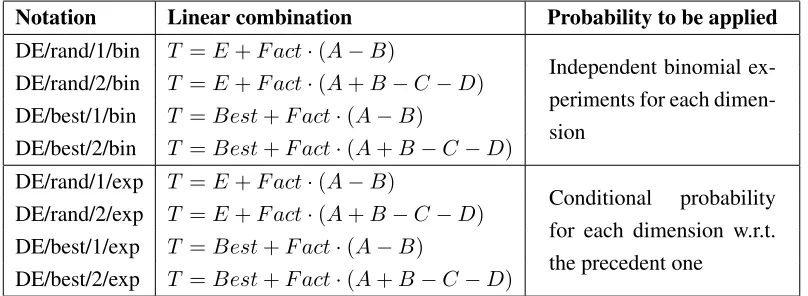
DE is basically a scheme for generating trial parameter vectors, commonly denoted as individuals. We can see an individual as a vector of coordinates in the objective function domain, thus denoting a point in which the function can be evaluated. A group of individuals is called apopulation. DE generates new individuals by linearly combining two or more existing population individuals. The various different procedures of vector recombination are usually encoded in differentoperators.
Algorithm 3 outlines the basic DE when an operator using a single differ-ence vector is chosen, that applies the recombination with a probability that is independent for each dimension. Here D is the number of dimensions (param-eters) of the objective functionf;randis a real number generated uniformly at random in the interval[0. . .1[; next(j) gives the element that comes next to j
in a vector like it was a circular list. By calling applyOperator a new param-eter (dimension value) is generated by linearly combining the d-th parameters ofA, B and C. This happens for each dimension with a probability that is less than CR, a user given real value in [0. . .1], or always for the latest dimension that is considered. This way, we are sure that the new individualT differs from
I at least for one parameter. Finally, the variable Best records the individual having the best fitness, i. e. the vector of coordinates in the function domain whose value is optimal.
Different operators realize different DE variants. Table 2.1 summarizes the most common operators. They are usually classified according to the notation proposed in [127], that isDE/x/y/z where:
x specifies the vector to be mutated;
y is the number of difference vectors used;
Notation Linear combination Probability to be applied
DE/rand/1/bin T =E+F act·(A−B)
Independent binomial ex-periments for each dimen-sion
DE/rand/2/bin T =E+F act·(A+B−C−D)
DE/best/1/bin T =Best+F act·(A−B)
DE/best/2/bin T =Best+F act·(A+B−C−D)
DE/rand/1/exp T =E+F act·(A−B)
Conditional probability for each dimension w.r.t. the precedent one
DE/rand/2/exp T =E+F act·(A+B−C−D)
DE/best/1/exp T =Best+F act·(A−B)
DE/best/2/exp T =Best+F act·(A+B−C−D)
Table 2.1: The most common DE operators. T is the new individual generated by the combination of other individuals. A, B, C, D, Eare individuals chosen at random within the current population, while
Best is the individual representing the current optimal solution. F act ∈ [0. . .2]is a user defined real constant factor that controls the amplification of the differential variation.
DE algorithms try and find the optimal value of an objective function by repeatedly applying one or more operators to a given population. No global probability distribution is required to generate candidate solutions (individuals) while moving toward the optimum (being it a maximum or a minimum), thus the algorithm is completely local and self-organizing. It is easy to see that, provided a way to properly distribute the overall population, DE is a suitable candidate to distributed optimization tasks.
Distributed computing partially isolates populations from each other, allow-ing them to explore different portions of the search space. It has been frequently proved that distributed evolutionary algorithms can improve the results of the sequential version at the same computational effort measured in number of func-tion evaluafunc-tions. That is why there is an ever growing research about the ways the local populations can be made interact with each other in order to improve the final result. A way has to be found of designing DE algorithms so that di-versity is preserved, if not enhanced, to avoid a premature convergence of the local populations to sub-optimal solutions [35].
begin
Initialize a populationP;
foreachindividualI ∈ P do
Evaluatef(I);
Best←J ∈ Psuch thatf(J)is optimal;
whilespecific termination criteria is not metdo foreachindividualI ∈ P do
A=Random pick fromPr{I};
B=Random pick fromPr{I, A};
C=Random pick fromPr{I, A, B};
d=Random pick from[1. . . D]; // start from a dimension chosen at random
forj←1to Ddo
ifrand < CRkj=Dthen
Td←applyOperator(d, A, B, C); // T is the new individual
else
Td←Id;
d←next(d)in[1. . . D]; // round-robin scan the parameter vector
if f(T)is better thanf(I)then // f is the objective function to optimize
PutTin the new populationPnew;
iff(T)is better thanf(Best)then Best←T;
else
PutIin the new populationPnew;
P ← Pnew;
Algorithm 3:Basic DE algorithm
succeed in approximating the optimum. The size, of course, but also the speed at which the population changes need to be carefully investigated for each spe-cific problem, in order to achieve good results. Thus a number of dynamic or adaptive way to pro-actively tune these parameters have been proposed. This is an issue DE shares with all the evolutionary algorithms, thus we refer here to a broader literature without loss of specificity [97].
been recently devised to serve this purpose can be found in [9]. Using population-based algorithms, computation can be parted in many different ways. The main three we may recall are:
farming evaluations of members of the local population are farmed out to other computing nodes [126];
island model in which every node run its own evolutionary algorithm, regularly exchanging information with the others [139];
diffusion the population is endowed with a spatial structure that restricts the application of the various operators [4, 133].
It is quite interesting to note the island and the diffusion models can be used from the point of view of a pure algorithmic design, even in absence of physical parallelization.
Dynamic population size adaptivity has been devised in [93] and shown to have a good impact in reducing the number of function evaluation needed for a given solution quality. Hierarchically organized approaches have obtained good results in preventing populations from prematurely converging to suboptimal solutions [11]. The main issue is that they have to be tune against a specific situation as well. Recently some adaptive mechanisms to tailor the step length of the evolution of the individuals have been devised [12]. But these ways to optimize optimization heuristics actually belong to the next section.
2.2.2 Meta-techniques
creative [117]. Considering a general framework, optimization heuristics are sometimes called meta-heuristics because they are considered to be a general skeleton of an algorithm applicable to a wide range of problems. Following this approach, a meta-heuristic may evolve to a particular heuristic when it is specialized to solve a particular problem.
Taillard et al. (2000) [130] and Birattari et al. (2001) [25] offer some more speculations about this. Part of the literature seems more keen to associate the so-calledunguided search paradigm, in which memoryless methods are used to find a better solution value, with what we called simple heuristics. Thus meta-heuristics are mainly considered those algorithms who implements the guided search paradigm, i.e. using some memory of the past to incorporate rules and hints on where to search. For instance, in GA and DE the population represents the memory of the recent search experience; in ACO the pheromone matrix represents an adaptive memory of previously visited solutions; in TS the tabu list provides a short term working memory.
Following the most common terminology, meta-heuristics are made up by different components and if components from different meta-heuristics are as-sembled we obtain a hybrid meta-heuristic. From this point on, it is easy to imagine how huge is the number of novel algorithms that have already been proposed and how many are just yet to come. The construction of hybrid meta-heuristics is motivated by the need to achieve a good tradeoff between the ca-pabilities of a heuristic to explore the search space and the possibility to exploit the experience accumulated during the search. We just mention here that the studies about restart policies [51, 99] can be also considered as examples of meta-techniques applied to basic heuristics.
briefly re-formulate the problem from a different perspective.
Many computational problems that arise in the world are NP-hard, and thus likely to be intractable from a worst-case point of view. However, the particular instances of these problems that are actually encountered can often be solved effectively using heuristics that do not have good worst-case guarantees. As we have seen, there are a number of heuristics available for solving any particular NP-hard problem. Unfortunately, there is no heuristic that performs best on all problem instances [141]. Thus, when solving a particular instance of an NP-hard problem, it is not clear a priori how to best make use of the available CPU time.
Algorithm portfolios
Another approach to algorithm portfolio design is to use features of instances to predict which algorithm will be the fastest on another instance, and then simply allocate all the CPU to that algorithm. Moreover, existing heuristics can be successfully combined into a new and faster heuristic by collecting some tens of training instances, that are used to compute a schedule for the interleaving execution of the existing heuristics. Exploiting instance-specific features it is possible to generate an optimal schedule for a particular problem instance.
This view, often called “off line portfolio composition” does not address all possible aspects of the algorithm portfolio design problem. It is possible to make scheduling decisions dynamically based on the observed behavior of the heuristics. Basically this means that one attempts to predict a heuristic’s remaining running time based on its current state and adapt the schedule ac-cordingly. For example, Gagliolo and Schmidhuber [50] presented an approach for allocating CPU time among heuristics in an online setting, based on statis-tical models of the behavior of the heuristics, although their approach has no rigorous performance guarantees. Also, in [17] the authors describe advanced reactive strategies to tune some of the portfolio parameters based on fresh online information.
As soon as we start the topic of choosing on the fly the best algorithm among a pool of running instances, we meet other broadly used categories of meta-techniques: racing strategies and hyper-heuristics. As usual, it is practically impossible to draw a clear line between the two. It is also arguable that several portfolio schemes could be called hyper-heuristics and viceversa.
Racing
the best in solving the optimization task, an online evaluation based on user de-fined criteria is performed while the optimization task is running. Depending on how each competing algorithm is scoring, the allocation of resources is dy-namically modified in such a way to be sure the best performing algorithm will be given, for instance, the larger amount of CPU time to perform the task.
The racing strategy can be also used offline, as a learning tool to find out the best configuration for an algorithm. This way the race between the competitors is not the main optimization task, but is part of a prodromic parameter tuning phase, that lead to discover the most promising heuristic for solving a given problem. In [17] several examples are detailed.
Hyper-heuristics
The notion of hyper-heuristics (HH) overlaps the one of racing strategies, in-cluding them as a subset. According to a very recent classification [33] they can be defined as search or learning mechanisms whose aim is to generate and/or select heuristics to solve a given problem.
HH are high level problem independent heuristics that work with any set of problem dependent heuristics and adaptively apply and combine them to solve a specific problem [32]. They are similar to meta-heuristics; the difference is that meta-heuristics are not off-the-shelf methods that can be readily applied to any problem; they are schemes that have to be instantiated and tuned to specific problems. As opposed to this, HH do work off-the-shelf using any given set of operators and algorithms. The tradeoff is that HH are “good enough, soon enough, cheap enough” [31] approaches while meta-heuristics can achieve bet-ter performance although require significantly more investment.
that implement a master-slave model locally. In [94] a hybrid island model is applied in which a central coordinator decides which algorithm has to be applied by several interconnected islands, according to the feedback they periodically provide. In [111] and agent-based approach is proposed that is nevertheless also conceptually centralized involving a single HH agent. Finally, in [135] a Grid-based solution is proposed with a central HH server and slave nodes performing low-level search.
All these works can be considered as a successful effort towards the mit-igation of the drawbacks of both a pure centralized and a pure independent approach, by means of the combination of the two. All of them assign the fun-damental task of performing the evaluation of a pool of algorithms to a single component, thus falling, practically or conceptually, in a master-slave approach. We believe that emerging platforms such as cloud computing [61], as well as the more established peer-to-peer [10] and Grid [76] platforms all favor a coarse grained, decentralized approach that has no bottlenecks and that scales well and tolerates failure and dynamism. Our goal is to target such platforms.
2.2.3 P2P optimization algorithms
The field of distributed optimization has been widely investigated for years ei-ther as a specific case of distributed computing, or as a specific function op-timization technique. However, most of the existing research in this domain assumes a properly arranged architecture, like a parallel computing provision or clusters of networked machines, usually handled by a central coordinator. These kind of systems either have strict synchronization requirements or rely completely on a central server, which coordinates the work of clients and acts as a status repository [131].
cen-tralized mechanisms of GRIDs that include monitoring and control functions. For example, network nodes can distribute information via “gossiping” with each other and they can collectively compute aggregates of distributed data (av-erage, variance, count, etc) to be used to guide the search process [83]. This in turn increases robustness and communication efficiency, allows for a more fine-grained control over the parallel optimization process, and makes it possible to utilize large-scale resources without a full GRID control layer and without reliable central servers.
P2P heuristic optimization is quite a newborn branch of distributed opti-mization. As it happens in all the happy beginnings, researchers are extensively exploring the various issues this new field entails. We give here a brief overview of the recent publications, mostly related to P2P implementations of population-based algorithms.
In [103] the authors presented some preliminary evaluations of a parallel hybrid MO-EA (multi-objective evolutionary algorithm) deployed in a P2P en-vironment. Several results show that is possible to successfully parallelize such an evolutionary algorithm in a P2P fashion, exploiting the resources available in a network of 120 heterogeneous PCs.
In [63] an extensive experimentation was performed, to test the fault toler-ance of the island model on GA, when executing them on a distributed system. The results show that this model can be trusted when running experiments on a non-reliable parallel or distributed infrastructure, the quality of the outcomes being at most 2% worse (on average) than when a reliable infrastructure is em-ployed, without adding any special techniques required for dealing with faults.
is therefore viable.
Almost the same PSO distributed algorithm has been proposed by different authors in [123] to address multi-objective optimization problems, in which the main goal is to find a set of values lying on the Pareto-frontier that can be find for the objectives being tackled. In spite of the different experimental environment (simulated very large networks in the previous case, small real network in this case) results confirm the usefulness of the approach.
Recently, the same authors [124] proposed new models to substitute fail-ing particles of the same kind of multi-objective PSO algorithm, in such a way that the capability of the affected swarm to explore the search space can be enhanced. The initialization of the new particles is performed using a com-bination of binary search to fill the gaps in the space between the two known Pareto-front extremes and edge extension, to improve the exploration beyond the known Pareto-front.
Van Steen et al. [140] presented a fully decentralized evolutionary algorithm in which the population size is kept stable by locally adapting the surviving rate of the individuals according to global population estimations, performed by means of gossiping protocols. The parent and survivor selection can be done completely autonomously and asynchronously, without central control, yet avoiding the risk of population explosion or implosion.
In [89] the authors used the same algorithm to tackle hard problems whose computational time increase exponentially as they scale. Moreover, they com-pared their results with a sequential GA algorithm, outperforming this competi-tor thanks to the gossiping adaptive mechanism used to control the population.
confirm that P2P evolutionary algorithms are competitive with respect to not-distributed ones.
Finally, in [91] the authors presented an extensive evaluation of a generic P2P evolutionary algorithm with respect of different (simulated) network size and churning conditions, while tackling a known hard test function. Results show that the gossiping enabled small-world structure of the network makes the algorithm very robust even when very high churn rates are applied.
As a whole, existing literature about P2P heuristic optimization confirms that not only this approach to distributed optimization is viable, but moreover that can suit hard problems, provided that an adequate number of resources are available. The availability of many cheap and interconnected machines is an easy goal to obtain in many contexts nowadays and this new kind of algorithms show the capability to fruitfully exploit such a computational environment. As we detail in Chapter 6, our research fully confirm this conviction.
2.2.4 Optimization frameworks
To effectively produce a not trivial good, one needs to use appropriate tools that can help handling the small and basic issues, letting the user concentrate on the core task: to design, deploy, test and finally evaluate the product. Optimization tasks are not different. To improve the efficiency and the effectiveness of the scientists’ job several tools have been devised, whose general goal is to provide a set of facilities that can ease the optimization algorithm “production” chore. Such tools are commonly namedoptimization frameworks. Actually the term is not really univocal, because it is use in literature to name
– sets of conceptual engineering guidelines to algorithm specification;
– sets of tools for algorithm design and implementations;
Although clearly oriented towards the second semantics, we are interested in aspects that apply to all of these tools.
Among the existing frameworks, several address the same issues and have the same goals. Some of them are more renowned, most claim to be better than the others with respect of some feature. Talking about “successful” or “unsuc-cessful” frameworks is actually inappropriate, because it often happens that the most effective framework, according to one’s mind, is the framework whose usage one knows best. In the following we briefly describe the most recent and widely known optimization frameworks, characterizing them according to some objective features, without entering any discussion about practical evaluation. The expertise of the user and the correct choice of the most appropriate tool for the peculiarities of the task being tackled are the two key points that make one’s personal judgement in the everyday practice.
Most of the frameworks that have been proposed in the recent years are fo-cused on population-based heuristics. There is no general agreement about the fact that designing and tuning these kind of algorithms needs more guidelines and facilities than developing trajectory methods. It can be the case that evo-lutionary algorithms are simply more appealing at the present time. For sure population-based heuristics have given birth to an amount of variants, hybridiza-tions, cooperative versions etc. that patently outnumbers the counterparts. Thus the need of some means to have a unified and clean understanding of them all, characterizing and analyzing the main common aspects.
con-texts; on the other hand they often aims at being easily extendible. Thus a user should be able to add features and components with little or no effort. For those that provide distributed deployment facilities, a further key point is how trans-parently the parallelization of the algorithms is handled and how reliable the frameworks prove to be in this settings. In this case, it is also important that a framework supports different architecture and operative systems.
The first remarkable distributed computing facility we recall is the BOINC
project [7]. It is a set of distributed abstractions for applications, data and files that implements a client-server paradigm, allowing users to set up and configure their applications by exchanging XML description files with the central server. Computations are performed in a highly distributed way, generating several sets of results. Results are replicated and generally a consensus has to be achieved to determine their validity. Any machine can join the system and make a given set of resources (cpu, memory, bandwidth) available to users who need them. Participation is stimulated by means of a credit mechanism, that accords a larger access to the resources to the more generous contributors. Cheating detection schemes and automated resource probing prevent fraudulent user behavior. This system is not optimization-oriented and we believe it would require a great ef-fort to be effectively used for this purpose. Moreover, although distributing the applications among a large number of peer computational units, it ultimately re-lies on a client-server design that cannot be considered as a fully decentralized approach. Nevertheless, its extreme configurability and the potentially huge dimension of the distributed facilities are undisputed.
Another quite renowned platform to develop and deploy distributed compu-tational tasks is JADE (Java Agent Development Framework). 2 The goal of JADE is to simplify the development of multi-agent systems through a large set of system services and agents: naming service, yellow-page service, message transport and parsing service and a library of standardized interaction
cols ready to be used. All agent communication is performed through message passing, where ACL is the language to represent messages. The agent platform can be distributed on several hosts. The JVM executed on each host contains agents and provides a complete run time environment for their execution, also allowing several agents to concurrently execute on the same host. Agents are implemented as one thread per agent, but whenever they need to execute paral-lel tasks, JADE supports scheduling of cooperative behaviors, besides the usual multi-threaded execution environment that Java technology provides. A graphi-cal user interface (GUI) for the remote management is provided, that allow users to monitor and control the agents. JADE is actively supported and ever grow-ing. Not optimization oriented, it is a reliable and robust hybrid p2p networking environment to run distributed application that ease the task of deploying coop-erative agents.
Coming to something more specific and focused on the optimization algo-rithms and software production, EasyLocal++ [53] was proposed as a set of object-oriented tools to simplify the design and the development of local search optimizers. The set of classes and facilities it provides forces the user to think about a local search (meta-)heuristic as a set of interacting objects that serve each other during the computation. It also provides a textual output interface and it can produce simple plots. We think the conceptual model is good, though it lacks flexibility and needs some extension to fit different kind of algorithms. In our opinion, it is anyway not trivial and quite time consuming to get ac-quainted with both the set of classes to use while developing an algorithm and the script-based configuration module required to run experiments. More re-cently, a quite similar approach has brought different authors to present the
MOEAT [121] framework, written in C#.
proposes a multi-level description of the meta-heuristics as a set of agents that create, locally improve, exploratively search and dynamically interact to find the optimum. This concept translates directly in a set of methods and interfaces that guide the implementation of the algorithms. Besides providing a good set of already implemented heuristics, in our opinion the value of this framework consists in the devised classification of heuristic agents based on their goals, that effectively makes it possible to implement a wide range of meta-heuristics in a layered fashion. It does not provide any facility for the distributed deployment of the algorithms, nor for their mutual communication.
Very few frameworks are natively suited for distributed environments. One prominent example is ParadisEO [34]. It is an object-oriented framework ded-icated to the reusable design of parallel and distributed meta-heuristics. It embeds the implementations of widely used evolutionary algorithms and lo-cal searches algorithms, along with the most common parallel and distributed models and hybridization mechanisms. Their implementation is portable on distributed-memory machines as well as on shared-memory multiprocessors. The provided software architecture allows a good level of code re-usability, achieved anyway by means of a quite complex hierarchy of classes and tem-plates the user has to master. Although not P2P-oriented, this framework covers a large range of optimization techniques, enabling their active cooperation in a distributed fashion. A similar approach, but limited to evolutionary algorithms and to their master/slave coordinated execution has guided the design of Dis-tributedBeagle [52].
The Java Distributed Evolutionary Algorithms Library (JDEAL) [39] is an example of Java-based optimization framework that has lately evolved towards the distributed dimension. It uses JDS (Java Distribution Service) over Voy-ager 3 to perform parallel distributed computations. The various flavors of
ge-netic algorithms available in the framework are coordinated through a
slave configuration that enables effective operativity. Instances of algorithms can be dynamically added and removed at runtime, tolerating the most common types of failures. The amount of configuration required to set up a working instance is reasonably low and legacy code is smoothly adapted by extending appropriate framework components. This framework presents many remarkable features. However, its distributed computational model, though solid, is quite different from the one we target.
It is worth citing in this context also ECJ (Java-based Evolutionary Com-putation Research System) 4, even if its design goals are rather different from
the other framework we examine. It makes available a set of evolutionary al-gorithms and genetic programming techniques mainly designed for centralized execution. A distributed execution environment is also provided, that is based on the island model, whose communications are implemented by means of Java TCP/IP sockets. This architecture ensures limited scalability. The peculiarity of this framework consists in the way it interacts with the users. In a normal execution, either parameter files or a very basic graphic interface should be use to set up the initial configuration of the experiment and make it run.
MALLBA [3, 6] is a software tool for the resolution of combinatorial opti-mization problems using generic algorithmic skeletons implemented in C++. Skeleton classes implement the generic core functionalities of various opti-mization methods and devise three different implementations for any of them: sequential, parallel for Local Area Networks and parallel for Wide Area Net-works. The framework integrate several optimization techniques together and offers the possibility of both sequential and parallel environments to coexist transparently. The skeleton design is based on the separation between the fea-tures of the specific problem to be solved and the general resolution technique to be used. The user must fill in the required classes with an specific problem-dependent implementation, whereas the optimization and parallelization
nique is completely provided by the library. Communications handling is done via a light middleware layer that simplifies their tuning and provides easy ac-cess to message passing, broadcasting and coordination facilities. While we think this framework is a fine piece of engineering, we could not find any ex-plicit information about the differences between the WAN parallel execution of the algorithms and the LAN parallelization technique (that differs according to the algorithm, but always demand a faultless stable networking environment).
A remarkable framework that addresses both the issues of assisting the user in the algorithm design and helping the distributed execution is DREAM (Dis-tributed Resource Evolutionary Algorithm Machine) [10]. This peer-to-peer system is based on the island model, implemented through epidemic protocols. DREAM is targeted toward Wide Area Networks (WAN), where communica-tions rely on internet standard protocols. Moreover, various kind of user in-terfaces are provided to meet the needs of users with different skills, interests or commitment. The range of issues and the target that this framework aims to address are larger and slightly different from ours. DREAM is devoted to evolutionary algorithms, while we propose a framework which can suit any op-timization algorithm. Of course this means that the external interface are much less specialized, because they must not demand the user algorithms to comply with very specific constraints or design patterns. Then our tool is primarily meant to be used by those scientists who want to easily and quickly deploy and test their algorithms in a P2P distributed fashion. DREAM has been devised as a platform that can run virtually any agent-based distributed application and offers several different user interfaces, to suit the most different kinds of users.