Vol. 6, No. 2, 2018
GUASNR
Short Communication
The effect of drought in the source area of dust storms on
vegetation change (case study: western parts of Iran)
S. Haghighi1, D. Akhzari2*, B. Attaeian3, M. Bashir Gonbad3
1M.Sc. student of Rangeland Management, Department of Rangeland and Watershed Management,
Malayer University, Iran 2
Associate Professor, Department of Watershed and Rangeland Management, Malayer University, Iran 3
Assistant Professor, Department of Watershed and Rangeland Management, Malayer University, Iran
Received: March 2017 ; Accepted: February 2018
Abstract
Water scarcity is one of the factors limiting plant growth and development. More than one third of the global terrestrial ecosystems is located in arid and semi-arid regions. The most important limiting factor for plant growth is water shortage. Drought could significantly change the natural vegetation cover. Rainfall reduction in Iraq, Turkey and Syria has reduced vegetation cover so that dust storms have increased. Therefore, these areas have a high potential to increase dust particles in the environment. To investigate the temporal changes of vegetation, we focused on the source of dust particles between Tigris and Euphrates rivers and some parts of the west bank of these rivers in Iraq. The Normalized Difference Vegetation Index (NDVI) was used. In addition, the standard precipitation index was calculated to assess drought events in the region. The results show that the vegetation and rainfall indexes are inversely correlated in the study area.
Keywords: Dust Storm, Drought, Vegetation1
Introduction
In recent decades, the dust phenomenon, as an environmental problem, has affected the life in the Middle East. In fact, dust storms are considered an important environmental challenge in Iran (Rezazadeh and Azmi, 2013). Water scarcity is one of the factors limiting plant growth and development. Many physiological processes such as the total amount of chlorophyll fluorescence highly depend on water availability (Barker and Ressenquist, 2004). More than two-third of Iraq and one two-third of the world are arid and semi-arid struggling with water stresses which is the most important limiting factor in agricultural and natural ecosystems (Ghasryany, 1992). In Iran, particularly in western provinces, dust particles mainly originate from Iraq
(Bartyna et al., 2013; Partow, 2013). After
determining dust origin area, the prevailing environmental factors as well as human activities were evaluated in the area (Partow, 2013). The most significant factor is vegetation removal causing intense dust
storms (Gu et al., 2003). Intense dust
storms are the most important
environmental problems in arid and semi-arid regions (Darvishi Blorani, 2011). The main sources of aerosols are deserts, spreading across the world, mainly in Asia
and Africa. Solid particles in the
atmosphere originating from the deserts can be blown away across the world. As mentioned above, the total amount of rainfall below the global average in desert areas causes drought and consequently aerosol events. Continuous drought events besides war conflicts have led to drying of wetlands and marshlands and destruction of lakes in arid regions such as Syria, central and south-west Iraq. Furthermore, the decreasing trend of vegetation cover in Iran, Syria, and Iraq has accelerated dust storms in the region (Darvishi Blorani, 2011). Low soil moisture as a result of rainfall shortage, overuse of water resources, as well as vegetation loss has accelerated wind erosion in these parts of the world. Higher wind erosion increases dust storms (Efati
Kellermi et al., 2011). Overall, dust storms
closely correlate with regional weather conditions, including rain, wind, and
temperature (Nickling and Brazel, 1984). Dust storms occur in areas characterized by low soil moisture and vegetation cover. The intensity and frequency of dust storms negatively correlates with rainfall. A strong correlation between dust and drought
aerosol events has been suggested
(Prospero et al., 2002). In recent years,
drought events have caused a sharp reduction in vegetation cover and an increase in soil erosion (Tahmasebi Birgany
et al., 2009). In addition, water shortage
prevents chlorophyll formation
(Sarmadniya and Kochaki, 1994; Saeidian, 1996). As suggested in previous studies, with the increase of drought stress, root to shoot ratio could also increase (Bagheri Najaf Abadi, 1999; Saeidian, 1996). There is also a simple and direct relationship between the atmosphere and human caused desertification and climate fluctuation (Mc Common, 1997). This is evident in southern and northern China as solid dust particles make the southern and northern areas completely different in terms of climate. In fact, some human activities such as stock grazing have caused forest degradation in northern China exacerbating dust storms. Temperature and precipitation significantly affect the severity of dust storms. During hot days, soil surface particles shrink due to the direct solar radiation effects and are consequently blown away more quickly. Moreover, human induced climate changes in recent years have caused an increase in aerosols worldwide. The intensified drought conditions have caused higher aerosol amounts in Afghanistan and India. This is also the same in East Africa and partially in Canada (western and central areas) due to the circulation of hot and cold aerosols
(Menon et al., 2008). Overall, seasonal and
annual variations in climatic conditions influence dust particle concentrations (Ried and Coathor, 2003). In this study, we set our goal as assessing the relationship between natural land vegetation and drought in Iraq.
Materials and method
cases were investigated to determine dust
resources in these areas, including
agricultural areas in Turkey and Syria border, Ceylanpinar, and northern and eastern areas of Abolkamal city. The main focus was aerosols in the northwest of Iraq and eastern Syria. To study the temporal variability of desertification and drought events, vegetation and drought indices,
including Normalized Difference
Vegetation Index (NDVI) and Standard Precipitation Index (SPI) were used. Vegetation indices were introduced to evaluate vegetation density change in NDVI index according to plant reflection properties and the properties of near infrared bands. This was conducted
considering phenology of vegetation,
climatic conditions, and germination stage (Tucker, 1979). In this research, bands 3 and 7 of MODIS sensor were used for preparation of NDVI maps. This index can be calculated as follows:
NDVI=(NIR-RED)/(NIR+RED)
The SPI index was also used to assess droughts and wet periods in the area of origin in 2002 and 2009, comparing rainfall variation diagram (Moradi and Tolabi, 2011).
Results and discussion
The reduction in water resource availability in both surface and subsurface layers of the study area destroyed not only natural vegetation cover but also agricultural
productivity, consequently causing
economic and social ripples and developing new dust sources. Previous research (Trigo
et al., 2010.; Gibson, 2012) and monitoring
environmental data support the fact that the main cluster core has caused severe drought events in Iraq and Syria during the last decade, especially in 2007 and 2008. The cluster core precipitation data are presented in Figure (1) as a percentage fraction of the precipitation mean for the period from November 2000 to April 2002 in the first drought period observed in 2002 – 2002. In fact, the average rainfall decreased by 20 and in some areas even by 40% (Figure A-1) However, the situation was totally different in 2003 and 2004, with a higher
precipitation amount compared to the
regional average (Figure B,C-1).
Considering stifling dust storm swept from Iraq, Turkey, and Syria to the west of Iran in 2002 – 2004, a mild and local drought event followed by two subsequently wet years could be a reason. In 2005, a widespread drought event, affected the main cluster core area, causing a sharp precipitation decrease by almost 40 (Figure D-1). Overall, the 2005 drought event was much more severe and the
amount of precipitation was lower
compared with 2002, covering a large area in the region. Assessing precipitation fluctuation and dust storm events were clearly interrelated in the study cluster (Figure E-1). In fact, only one dust storm event was observed in 2006, when the precipitation amount was above average in
the region (Trigo et al., 2010). Despite
2006, a severe dust storm was observed in 2009, a year with the lowest precipitation amount since 1940. In 2007, decrease in
precipitation amount by 20 - 40 caused
the early signs of drought across the region, (Figure F-1), and consequently two dust storm events occurred in the west of Iran and its surroundings. The most evident decrease in precipitation amount occurred from November 2007 to April 2008 as shown in Figure G-1. Furthermore, a sharp 50 – 90 percent decrease in the amount of mean precipitation was observed in the region (Iraq, Turkey, Syria) from 2006 to 2007. This drought event continued with
lower intensity in 2009 (Trigo et al., 2010).
(Figure A-1).
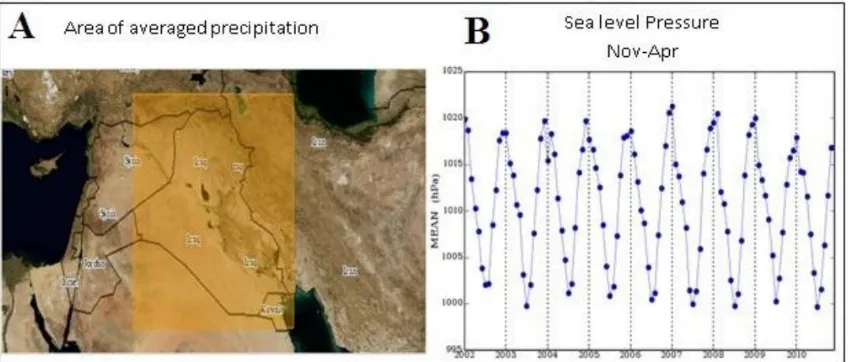
Furthermore, cyclone circulation
surroundings from 2007 to 2009. In other words, higher surface pressure and lower precipitation were evident during these years due to the low frequency of cyclonic circulations. On the other hand, higher (almost above average) cyclonic circulation in 2003 and 2006 enhanced the amount of precipitation and consequently decreased dust storm events in the region. Overall, dust storm events in Iraq and its neighbors were at their maximum when cyclonic frequency and rainfall events dropped, causing severe drought during the summer. In addition, local drought events in southeast Iraq, Turkey, Syria, and the rest of Iraq (e.g. during 2002, 2005, and 2008) as well as low surface flow suppressed vegetation growth causing a series of severe dust storms in recent years (Darvishi Blorani, 2013). Vegetation cover is one of the main resources of biosphere, efficiently
absorbing aerosol and dust particles (Gu et
al., 2003). In fact, dust is a destructive
element influencing photosynthesis process, stomatal conductance, leaf development, and consequently suppressing plant growth and productivity (Abdi Karamvand, 2011). In fact, lower vegetation cover could motivate dust storm events, posing a negative impact on plant growth.
Conclusion
Vegetation cover could influence drought severity and intensity in the study area. The decreasing trend of vegetation cover, intense human activities such as dam construction in Turkey as well as long-term
sanctions on Syria and Iraq have
accelerated dust sweeping and therefore the
desertification process. Hence, these
countries (Iraq, Turkey and Syria) could be considered as the main focus areas of dust, particularly affecting western provinces of Iran.
Figure 1. The cluster core data, changes in mean annual precipitation (percent) for the period November to April are drawn (Tehran University Research Center for Geo-Informatics)
Figure 2. The amount of precipitation and surface pressure (B) in Iraq and the neighboring regions (Tehran University Research Center for Geo-Informatics)
References
Abdi Karamvand, M. 2011. Dust adverse effects on growth and yield in the first international congress dealing with the phenomenon of dust and its harmful effects, Ramin Agriculture and Natural Resource, University of Tehran.
Barker, N.R. and Ressenquist, E. 2004. Applications of chlorophyll fluorescence can improve crop production strategies: an examination of future possibilities. Journal of experimental Botany. 55, 1607-1621.
Bagheri Najaf Abadi, A. 1999. The effect of drought and salinity on germination and seedling
establishment of three species of Euratia ceratoides, Kochia prostrate and Elymus junceus,
Range management Master's thesis, Department of Natural Resources, Tehran University.
Bartyna, E., Bahrami, H. and Darvishi Blorani, A. 2013. Finding the source of dust storms affecting the west and southwest of Iran, the first international conference on aerosols, management and outcome factors. Lorestan University.
Efati Kellermi, M., Bahrami, H. and Darvishi Blorani, A. 2011. MA thesis, Tarbiat Modarres University, Faculty of Agriculture.
Darvishi Blorani, A. 2011. Identifying the internal and external sources of dust and providing coping strategies. Tehran University center for remote sensing and Geographic information System (UT_RGC).
Gibson, G.R. 2012. War and Agriculture: Three Decades of Agricultural Land Use and Land Cover Change in Iraq. Dissertation submitted to the faculty of the Virginia Polytechnic Institute and State University in Partial Fulfillment of the requirements for the degree of doctor of Philosophy in Geospatial and Environmental Analysis.
Gu, L., Baldocchi, D.D., Wofsy, S.C., Munger, J.W., Michalsky, J.J., Urbanski, S.P. and Boden, T.A. 2003. Response of a deciduous forest to the eruption of Mount Pinatubo: enhanced photosynthesis, Science, 299, 2035–2038.
Mc Common, C. 1977. Perovskite as apossible sink for ferric iron in the lower mantle. Nature. 387, 694–696.
Menon, S., Hansen, J., Nazarenko, L., Yunfeng L. 2008. Climate Effects of Black carbon
Aerosols in China and India.
Nickling, W.G. and Brazel, A.J. 1984. Temporal and spatial characteristics of Arizona dust storms (1965-1980). J. Climatol, 4, 645-660.
Moradi, N. and Tolabi, M. 2011. Detection change of dust storm days with horizontal visibility
markers (HV) and Standard rainfall (SPI)., First international congress dealing with the phenomenon of dust and its harmful effects, Ramin Agriculture and Natural Resources, University of Tehran.
Partow, H. 2013. The Mesopotamian Marshlands: Demise of an Ecosystem Early Warning and Assessment Technical Report, UNEP/DEWA/TR. Rev. 3-1 Division of Early Warning and Assessment United Nations Environment Programme Nairobi, Kenya.
Prospero, J., Ginoux, P., Torres, O., Nicholson, S.N. and Thomas, E. 2002. Environmental Characterization of Atmospheric soil dust Identified with the NIMBUS 7 total Ozone
Mapping Spectrometer (Tomas) Absorbing Aerosol Product. Journal of American
Geophysical Union.
Ghasryany, F. 1992. Comparing the performance of Alfalfa perennial dry conditions
(Kurdistan), Research Bulletin No. 85 of pasture and forest genetics and plant breeding,
Research Institute of Forest and Rangelands.
Ried, J.S. and Coathor, P. 2003. Analysis of measurements of Saharan dust by airborne and ground-based remote sensing methods during the Puerto Rico Dust Experiment (PRIDE). J. Geophys. Res., 108, 85-86, doi:10.1029/2002JD002493.
Rezazadeh, F. and Azmi, A. 2013. Legal aspect of the fight against aerosols. First international conference on aerosols, management and outcome factors Lorestan University.
Sarmadniya, GH., and Kochaki, E. 1994. Crop Physiology, Astan Quds Razavi.
Saeidian, F. 1996. Drought resistance and water use efficiency in Eragrotiscurvula and Dactylis glomerat, range management graduate thesis, Department of Natural Resources, Tehran University.
Trigo, R.M, Gouveia, C., and Barriopedro, D. 2010. “The intense 2007-2009 drought in the Fertile Crescent. Impacts and associated atmospheric circulation”, Agricultural and forest Meteorology, 150, 1245-1257.
Tucker, 1979. Analysis of monotonic greening and browning trends from.