Time-sensitive Intermittent Computing
Meets Legacy Software
Vito Kortbeek
Delft University of Technology Delft, The Netherlands [email protected]
Kasım Sinan Yıldırım
∗ University of TrentoTrento, Italy
Abu Bakar
Northwestern University Evanston, IL, USA [email protected]
Jacob Sorber
Clemson University Clemson, SC, USA [email protected]
Josiah Hester
Northwestern University Evanston, IL, USA [email protected]
Przemysław Pawełczak
Delft University of Technology Delft, The Netherlands [email protected]
Abstract
Tiny energy harvesting sensors that operate intermit-tently, without batteries, have become an increasingly ap-pealing way to gather data in hard to reach places at low cost. Frequent power failures make forward progress, data preser-vation and consistency, and timely operation challenging. Unfortunately, state-of-the-art systems ask the programmer to solve these challenges, and have high memory overhead, lack critical programming features like pointers and recur-sion, and are only dimly aware of the passing of time and its e�ect on application quality. We present Time-sensitive Intermittent Computing System (TICS), a new platform for intermittent computing, which provides simple program-ming abstractions for handling the passing of time through intermittent failures, and uses this to make decisions about when data can be used or thrown away. Moreover, TICS provides predictable checkpoint sizes by keeping checkpoint and restore times small and reduces the cognitive burden of rewriting embedded code for intermittency without limiting expressibility or language functionality, enabling numerous existing embedded applications to run intermittently.
CCS Concepts.•Computer systems organization→
Em-bedded software;•Hardware→Emerging architectures;
Impact on the environment;•Software and its engineering
→Runtime environments;Source code generation.
∗Also with Ege University,İzmir, Turkey.
Permission to make digital or hard copies of all or part of this work for personal or classroom use is granted without fee provided that copies are not made or distributed for pro�t or commercial advantage and that copies bear this notice and the full citation on the�rst page. Copyrights for components of this work owned by others than the author(s) must be honored. Abstracting with credit is permitted. To copy otherwise, or republish, to post on servers or to redistribute to lists, requires prior speci�c permission and/or a fee. Request permissions from [email protected].
ASPLOS ’20, March 16–20, 2020, Lausanne, Switzerland
©2020 Copyright held by the owner/author(s). Publication rights licensed to ACM.
ACM ISBN 978-1-4503-7102-5/20/03...$15.00 https://doi.org/10.1145/3373376.3378476
Keywords.Legacy Code, Compiler, Source Transformation, Runtime, Energy Harvesting, Intermittent, Batteryless ACM Reference Format:
Vito Kortbeek, Kasım Sinan Yıldırım, Abu Bakar, Jacob Sorber, Josiah Hester, and Przemysław Pawełczak. 2020. Time-sensitive Intermittent Computing Meets Legacy Software. InProceedings of the Twenty-Fifth International Conference on Architectural Support for Programming Languages and Operating Systems (ASPLOS ’20), March 16–20, 2020, Lausanne, Switzerland.ACM, New York, NY, USA, 15 pages. https://doi.org/10.1145/3373376.3378476
1 Introduction
Tiny embedded computing systems and sensor networks have created a revolution [41]—changing how we monitor buildings and other infrastructure, treat disease, and protect endangered wildlife—but, the decades-old vision of ubiqui-tous computing (and now the Internet of Things [4]) are frustrated by energy storage issues. Today, most untethered devices rely on batteries—fragile, short-lived, bulky, rela-tively expensive chemical energy stores [24, 35]. Enabled by improvements in energy harvesting technologies and low-power circuit design, as well as the commercialization of byte-addressable non-volatile memories (like FRAM, MRAM, and ReRAM [8]), batteryless devices with minimal energy stor-age that run solely o�ambient scavenged energy, promise a more scalable and sustainable alternative [19, 40, 46, 47].
int data[N];
int activity, i=0; features_t f; activity_t aa
void main(){
while(1){ for(i=0; i<N; i++){ data[i] = sample(); }
transform(data); f= featurize(data); a = classify(data); send(a); } }
Activity Recognition Legacy Code
(Battery Powered)
No manual porting effort
MCU
Harvesting Circuitry RTC
Ideal Intermittent Computing System
Intermittent execution
Time (s)
On Time
sample transform featurize Off Time
On Time
featurize classify
Ener
gy
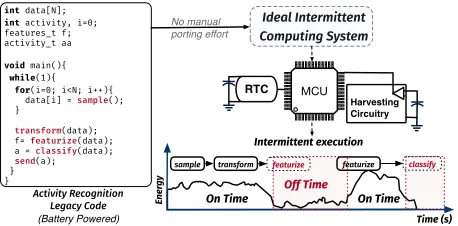
Figure 1. An ideal programming model for intermit-tent computing systems should remove the cognitive burden of porting legacy software.
motivated numerous approaches for building power failure resilient programs [27].
Today’s intermittent computing systems are either: (i) traditional standard C programs paired with automatic or manualcheckpointing, e.g. [28, 39, 45], where the volatile state of the processor is logged into non-volatile memory and upon recovery from a power failure the computation is continued from the latest logged volatile state, and (ii) task-based programs, e.g. [6, 23, 31, 46], where developers break
programs into idempotent and atomic tasks (that can be restarted when interrupted by a power outage) and describe the control and data�ow between tasks.
Unfortunately, with the aforementioned approaches, port-ing the massive set of legacy software that runs on continu-ous power to work with intermittent power, e.g. TinyOS [25] programs from the past two decades of wireless sensor net-work deployments, is cumbersome and requires massive re-engineering. First, task-based programming requires sig-ni�cant developer e�ort to transform a program to�t the programming model [10]—developers are forced to decom-pose logical operations (e.g. “classify activity”) into multiple sub-tasks which are executable with the available energy storage. This procedure is di�cult for developers, especially non-experienced ones—porting old code (or developing new code) becomes time-consuming and applications become incomprehensible and hard to debug due to task count ex-plosion. Second, task-based programming does not allow common programming language constructs, such as pointers since it enforces a static memory model [46]—making auto-matic (even non-autoauto-matic) transformation of legacy code into task-based model impossible. On the other hand, check-pointing systems remove the cognitive burden of porting, but have high memory overhead and performance penalties due to large checkpoints [9, 45]. Moreover, these systems cannot execute all C-programs: in particular, pointers and recursion might lead to checkpoints that will not�t into the available energy storage and prevent the progress of computation [10]— causing asystem starvation. Even worse,
checkpointing systems do not allow semantics to handle
elapsed timeand in turn they cannot handle time-sensitive
data that might be expired after a long power failure. De-velopers have no way to easily inject decision points into legacy software based on the time elapsed since failure can occur in-between any lines of the code.
These issues beg the question: is there a way to bridge the gap between time-sensitive intermittent computing and legacy software designed for continuously-powered sys-tems? As of now we are still far from anidealintermittent computing system that (i) removes the cognitive burden of porting legacy software and enables unaltered C programs (with standard programming constructs and any typical com-piler optimizations enabled) to be executed on intermittent power; (ii) provides semantic and syntactic mechanisms to handle data freshness (and passing of time in general) for
timely executionof the application; and (iii) introduces low
memory impact and little performance penalty. These re-quirements are necessary to enable widespread adoption of intermittent computing.
In this paper, we proposeTICS(Time-sensitive Intermit-tent Computing System), a new intermitIntermit-tent computing sys-tem designed with the goal of running time-sensitive code on intermittent platforms viaautomaticcheckpoints. TICS enables programmers to (i) execute any kind ofunaltered C program(including pointers and recursion) by greatly reduc-ing, as well as boundreduc-ing, the overhead of checkpoint/restore times—eliminating system starvation, and (ii) optionally an-notate the program with structures to specify customtiming requirements—protecting against timing errors that are never
seen in continuously-powered programs. The core scienti�c contributions of this work are:
• Time sensitivity semanticsfor checkpoint-based inter-mittent systems—enabling, for the�rst time, declara-tive annotations for intermittent applications to han-dle the passing of time in-between power failures and to eliminatetime consistency violationsparticular to intermittent systems;
• Memory consistency managementfor checkpoint-based
intermittent systems by combiningdata versioningand stack segmentationto bound checkpoint/restore times—
enabling, for the�rst time, execution of unaltered C-programs–including pointers and recursion–without system starvationand endangering memory
consis-tency, and providing foundation for memory isolation, I/O access and interrupt handling;
• An open source portable runtime for developers
(re-leased via [2])—enabling, for the�rst time, widespread adoption of intermittent computing by allowing port-ingof several unmodi�ed, as well time annotated legacy code, to the intermittent computing platforms.
2 Battery-free Intermittent Systems
wildlife tracking [15, 42, 48] to infrastructure monitoring [7, 14], health and human sensing [17, 26, 34], autonomous vehi-cles [13], and even space exploration [33]. Recently, wireless sensing devices that work without batteries have become vi-able [18, 40] due to advances in miniaturization of energy har-vesters for solar, RF, and kinetic energy, and energy-e�cient microcontrollers with non-volatile memory [44]. Making these devices work is challenging, because of power failures caused by unreliable and sporadic energy sources as shown in Figure 1. However, the bene�ts are well worth it—besides reduced cost, size, and weight, these devices promise decade long lifetimes in the�eld without requiring maintenance or replacement [19].
Batteryless platforms like WISP [40], Capybara [11], and Flicker [18] use ultra-low-power micro-controllers (MCUs); e.g. MSP430FR* [44], whose main architectural components; e.g. registers and main memory, arevolatile, while the code
and data retained from power failure to power failure are held in non-volatile byte addressable RAM (e.g. FRAM). These platforms harvest and then store energy in small capacitors for all tasks. When the energy stored is depleted, the device dies—computation cannot progress and output correct re-sults. The naive approach to solve this would be to save the entire volatile memory and registers to non-volatile right before a power failure, but this has high memory and perfor-mance penalty, requires reliable brownout detection and does not solve consistency issues described in prior work [28]. Instead, smaller checkpoints at compiler or programmer-de�ned boundaries like in Figure 1 reduce wasted computa-tion and allow programs to complete. Many systems have been explored [5, 6, 23, 28, 32, 39, 45] which checkpoint at statically de�ned or dynamically decided points. Of course, the main challenge is to determinewhatto backup andwhen. The alternative is to change the programming model com-pletely, asking programmers to decompose a C program into atomic and idempotent sections calledtasks1with de�ned control and data input and output variables that are shared by tasks connected in atask graph. Only the state of the active task is backed up at each task transition to ensure forward progress [9, 20, 31, 46].
2.1 The Big Jump to Legacy Software
In a perfect world, the developer of a battery-powered plat-form would just recompile the application for intermittent-power. However, so far no existing systems enable this. 2.1.1 Task Decomposition. There is a massive set of ex-isting applications and legacy code written e.g. TinyOS [25] or Contiki [12] in the past two decades of wireless sensor network deployment. Unfortunately, the existing corpus of applications is di�cult, or impracticable, to port to work with
1It should be noted that tasks in intermittent computing must not be
con-fused with the tasks in TinyOS [25]. Tasks of TinyOS de�ne self-contained
work to be undertaken, while tasks in intermittent domain de�ne a piece of code that isatomic and idemponent[9].
NV accel[N]; NV res,ndx=0; int main() {
for(;;) { while(ndx < N) { accel[ndx++] = sample(); }
transform(accel); featurize(accel); classify(accel); res=stats(accel);
send(res); }
return0; }
t1
t2
t3 t4 t5
t6 t7
t9
sample
t10
t12 t11 t8
t13
transform
feature
classify
t14 t15
stats
control flow (data flow not shown)
New Task Graph Legacy Code (C)
TinyOS / Contiki
Manual Porting
expir
es(5
s)
Timing Constraints
expir
es(5
s)
expir
es(
10s)
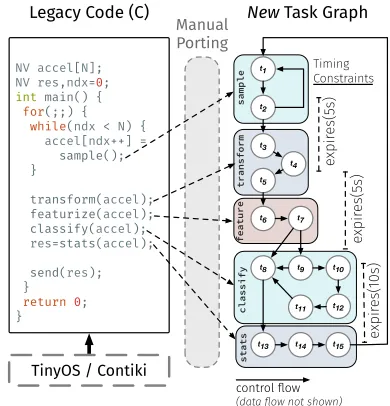
Figure 2. Porting legacy code to a task graph is not triv-ial.Left: an activity recognition program,Right: one possible
port to a task graph, with timing constraints de�ned. The �nal task graph does not always match the original program as tasks must be small enough to allow forward progress; reducing readability, and increasing graph complexity. Tim-ing constraints, control�ow, and data�ow must also be determined.
battery-free platforms and applications—especially when porting to a task-based programming model. Figure 2 il-lustrates these challenges. Task decomposition is hard [10], as task boundaries are not de�ned by logical breaks in a program (such as those shown on the left part of Figure 2:
classify(),transform(), etc.) but are best set based on the
energy cost of blocks of code, and/or data interconnections between code. Moreover, task-based programming models are static in their memory model, as they allow data
ex-change among the tasks by using only data interconnections to ensure memory consistency. This prohibits pointers. That is, porting programs with pointers is di�cult (or sometimes even impossible).
2.1.2 Automatic Checkpointing.Checkpointing systems do not occupy the programmer with the decomposition of legacy code into intermittent tasks, and there is no need to re-implement original libraries. However existing checkpoint-ing systems sacri�ce memory overhead, and language fea-tures to allow for automatic insertion of checkpoints [32, 45]. Current practice is to over-instrument a program with po-tential places to checkpoint, and these are triggered based on some signal, e.g. low energy interrupt. Storing copies of the stack and global data in multiple versions of checkpoints, as well as this over-instrumentation, leads tohigh memory impactfor resource-constrained MCUs [28]. What is worse,
Write-after-read
r1 = len len = r1+1
Checkpoint
Reboot
r1 = len len = r1+1
Timely Branching Time Misalignment Data Expiration
t1 = time() if(t1 < T) do_x()
✓ ✓
X
1 0 Correct X
value of len
Reboot
t1 = time() if(t1 < T) do_y()
X X
t1 = time() d = sense() ✓
Reboot
d = sense() classify(t1,d)
X
Violation: both branches are taken.
Violation: timestamp is older than implicitly associated data.
t1 = time() d = sense()
✓
Reboot hours later
r1 = classify(d) send(r1) X Violation: data is not useful hours later yet compute continues.
Violation: incorrect value of len.
(a) (b) (c) (d)
Figure 3. Four types of consistency violations encoun-tered with automatic checkpointing. These violations occur because of incorrect execution caused by bad check-point placement, leading to an execution that is not possible on a continuously powered device. With this work we in-troduce a new class of violations, i.e.time-based violations,
that have not been previously explored in checkpointing systems—refer to�gures (b)–(d).
determined at compile time, the whole main memory should be checkpointed after each pointer manipulation—the check-pointed state grows with the size of the main memory and unfortunately leads to asystem starvationsince it might not �t into the device’s energy reservoir. Supporting full C lan-guage functionality is non-trivial and crucial to port/reuse legacy software.
2.1.3 Time Consistency. Consistency violations identi-�ed in previous work [28] include only memory consistency violation; see Figure 3(a): after a checkpoint, non-volatile global variablelenis changed, but these actions are not
in-cluded in the checkpoint. When the checkpoint is restored,
lenis again updated, leading to an incorrect value oflen
due to the Write-After-Read (WAR) dependency. We identify
three other types of consistency violations, all having to do with time. The errors stem from the fact that clocks internal to the MCU are reset after each power failure, meaning that devices have di�culty tracking how long they have been o�[21, 37]; even when using external timekeepers, time-sensitive portions of a program must be handled di�erently in checkpointing systems by careful checkpoint placement or time management.
1. Timely Branching.If a checkpoint is placed in a line of code before a timestamp is gathered, and that times-tamp is used in a predicate statement, execution can execute both branches if the timestamp elapses; see Fig-ure 3(b);
2. Time and Data Misalignment.Often in embedded programs, a timestamp is gathered every time sensor data is obtained. If a checkpoint is placed between the timestamp and the data gathering, the timestamp will be inaccurate. After a power failure recovery at that checkpoint,newdata will be gathered associated with
Instrumentation
@expires_after=5 seconds int temp;
... temp @= read_sensor(); @expires(temp){ if(temp>30) blink_leds(); }
int temp;
int temp_timestamp; ... Checkpoint();
LOG(temp)= read_sensor(); if(temp_timestamp-time()<5) if(temp>30)
blink_leds(); Checkpoint();
Segment
size Target
Compiler
01010010101010101010 01010101011010101010 10011111011010101101 10101011101010110101 01010010101010101010 01010101011010101010 10011111011010101101 10101011101010110101
Intermittently Executable Time-annotated C source
Memory Mgmt.
Stack Segmentation
Timely Execution
Checkpoint
TICS Library
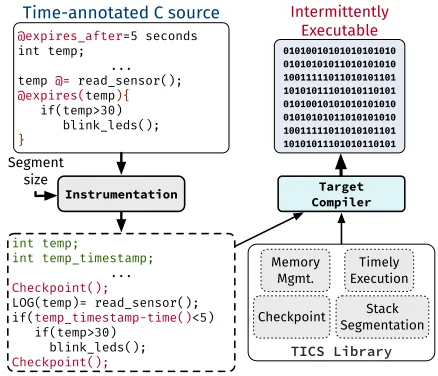
Figure 4. TICS overview:A runtime combined with code instrumentation ensures memory consistency viadata ver-sioningandstack segmentation; progress of computation via checkpointing; and timely execution viatime annotations.
anoldtimestamp—causing incorrect execution of the program; see Figure 3(c);
3. Data Expiration.Data gathered in one power cycle may not be fresh enough for the next power cycle. This phenomenon [20] has not been handled by any auto-matic checkpointing systems to date; see Figure 3(d).
3 TICS: System Design
TICS consists of a runtime combined with code instru-mentation for the C language—Figure 4 presents the logical �ow and the main components of the TICS system. The main motivation behind TICS is to provide the view of a continuously-powered system to the programmer—so that legacy C code can be run without any modi�cation to the pro-gram source. TICS allows the propro-grammer (i) to focus on the correct and timely execution of the application—eliminating the explicit need for intermittency handling, and (ii) to per-form few modi�cations to the original program, speci�cally, to annotate their codeonlyto de�ne timing constraints. Task-based versus Checkpointing. Conversion of a C program into a task-based program requires signi�cant man-ual labor (as discussed in Section 2); automatic transforma-tion of a pointer-based C program is incredibly di�cult due to memory burden created by a multitude of versions of memory locations/variables. Therefore, instead of task-based transformation, TICS uses checkpointing in order to get rid of manual code transformation and its limitations.
checkpoint the whole stack. TICS employs a novel strategy by segmenting the stack into�xed and predetermined size blocks. The stack segment that is directly manipulated at a time instant by the program is called theworking stack
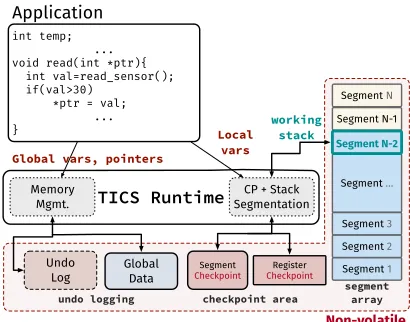
and it will be the only one among others that needs to be logged into asegment checkpoint—since other segments are not modi�ed. By segmenting the stack TICS can provide a �xed worst-case checkpoint time, as the variable stack size is�xed to the size of a stack segment. It is worth mentioning that the programmer is completely unaware of the underly-ing stack segmentation but the desired size of stack segments can be chosen at compile time for the sake of performance— see Section 5.
Pointer Handling.As pointer access cannot be determined at compile time, existing systems need to checkpoint the whole main memory in order to keep memory consistent— leading to huge checkpoints and in turnsystem starvation
due to limited energy reservoir. TICS implements a data versioning scheme to handle pointers and ensure memory consistency: it keeps track of only manipulated memory lo-cations by keeping the original values in a non-volatileundo log. The undo log is cleared upon a successful checkpoint,
otherwise TICS restores the original contents of the mem-ory using the undo log—ensuring the memmem-ory consistency despite power failures.
Memory Impact.Checkpointing the device’s volatile state requires an atomictwo-phase commitoperation to ensure its
consistency [31]: in the�rst phase the checkpointed data is copied to a temporary bu�er in non-volatile memory; then in the second phase the bu�ered data is committed to the original location. Existing checkpointing systems double bu�er the stack,.bssand.datasections—their memory
requirements increase with the volatile state. On the other hand, TICS only requires the segment checkpoint and the modi�ed memory locations in.bssand.datasections to be
double bu�ered—signi�cantly reducing the memory impact. Timely Execution.C does not provide any keyword/state-ment to express time constraints of the data and handle it—programmers must explicitly timestamp data and handle data expiration. This complicates application development as well as might lead to bugs due to manual timing and expi-ration checks, control�ow delivery and recovery due to data expiration—as given in Section 2.1.3. TICS provides annota-tions to relate data and time as well as special statements to change control�ow and perform recovery upon data expiration—all underlying time management is performed at run-time without programmer intervention.
3.1 E�cient Automatic Checkpoints
Existing works, e.g. [6, 22, 45] exploit architectural support and ensure constant and scalable checkpointing overhead. For example, Ratchet [45] uses non-volatile memory as the main memory so that stack and global variables are already
persistent—leading to constant checkpoint time since only the volatile registers of the processor are checkpointed. This requires decomposing programs into idempotent code sec-tions via the compiler usingstatic analysisat the instruction level and gluing them together with checkpoints. However, dynamic memory manipulations that cannot be determined at compile time, e.g. write operations via pointers, require a checkpoint after each instruction, leading to a considerable checkpointing frequency and, in turn, overhead. TICS tar-gets devices with non-volatile main memory—a checkpoint operation logsonlythe registers and the stack in a dedicated double-bu�ered area in non-volatile memory via a two-phase commit. Since stack grows/shrinks dynamically, checkpoint-ing overhead grows with the size of the stack. Moreover, recovery time, i.e. restoring the state after a power failure, is not�xed and might exceed the device’s energy budget— leading tosystem starvation. TICS remedies this withstack segmentationanddata versioning.
3.1.1 Stack Segmentation.The stack allocation within the execution of the applications might vary signi�cantly, in particular when a lot of memory space is allocated/deallo-cated at function entries/returns. The stack size requirement depends on dynamic program�ow (that might be unknown at compile time) and in turn, it is not possible to guaran-tee a worst-case checkpoint size. TICS segments the stack into blocks of�xed size selected at compile time—maximum stack frame in a program (determined during compilation) dictates the minimum block size. TICS maintains the seg-mented stack of a program as asegment arrayin non-volatile memory—see Figure 5. The size of the stack array is�xed at compile time by considering the stack requirements and exceeding the size at runtime leads to a stack over�ow. The program interfaces with the top segment of the segmented stack; so-called theworking stack: the program modi�es only
the working stack, and upon a checkpoint, only the work-ing stack is two-phase committed into the double-bu�ered
segment checkpoint—this enables a�xed checkpoint time. Moreover, recovering from a power failure only requires the working stack to be restored from the segment checkpoint, instead of restoring the whole stack.2
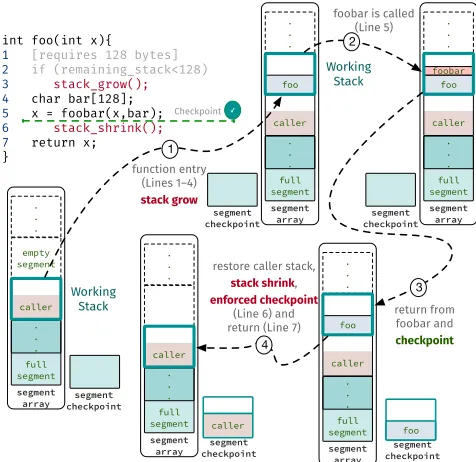
During program execution, the stack grows/shrinks make the working stack point to di�erent segments in the segment array. When a function is entered, the stack pointer is ad-justed: TICS inserts a check before the modi�cation of the stack pointer to determine whether there is enough space in the working stack to execute the function. When enough space is in the working stack, the execution resumes and the function interfaces with the working stack. Contrary, if there is not enough space left on the working stack, astack grow procedureis initiated so that the working stack points
2Di�erential checkpoints [3] log only modi�ed part of the stack—but they
Global vars, pointers
Non-volatile
int temp; ... void read(int *ptr){ int val=read_sensor(); if(val>30)
*ptr = val; ... }
Global Data Undo
Log
Application
Local vars
TICS Runtime Memory
Mgmt. SegmentationCP + Stack
Register
Checkpoint
Segment
Checkpoint
checkpoint area segment array
working stack
undo logging
Segment 1
Segment 2
Segment 3
Segment …
Segment N-1 Segment N
Segment N-2
Figure 5. TICS architecture.With TICS only the work-ing stack and the registers durwork-ing a checkpoint are logged— ensuring deterministic worst-case overhead. Previously checkpointed segments belonging to the lower parts of the stack are maintained in a segment array. The global vari-able and pointer access are handled by the memory manager which implements undo logging to keep memory consistent. to the next segment in the segment array. It is worth men-tioning that a checkpoint after this point requires only the new working stack to be saved into the segment checkpoint since the previous segments remain unmodi�ed. When a function that triggered a stack grow returns, astack shrink
is initiated so that the working stack points to the previous segment in the segment array. TICS can enforce an implicit checkpoint if the current working stack was not saved into the segment checkpoint yet. This is because if the currently checkpointed segment is out of program stack, the working stack should be checkpointed�rst so that the modi�cations can be rolled back upon power failures and the stack consis-tency is ensured.
It is worth mentioning that no special attention is needed when TICS executesrecursive functions. However, as in
gen-eral embedded systems, the depth of the recursive calls is limited by the size of the stack memory, which is represented by the�xed size of the segment array in TICS architecture. 3.1.2 Memory Management and Pointers. TICS main-tains global variables; i.e..dataand.bsssections in
non-volatile memory. Intermittent execution might create incon-sistencies if the application modi�es non-volatile memory directly and the modi�ed locations are not versioned, i.e. dou-ble bu�ered [28, 38]. TICS instruments non-volatile memory write operations and enables on-demand versioning:undo loggingis employed so that if any memory location outside of the working stack has been modi�ed, the original version is saved in an undo log. After a successful checkpoint, the undo log is cleared. Upon power failure, the contents of the undo log are written back to the original locations. Since the undo log is also�xed in size, TICS forces a checkpoint when
@expires_after=1 s /* data expires in 1 second */
int temperature [ WINDOW_SIZE ]; ...
/* data & timestamp alignment ( assign timestamp ) */
temperature [i] @= read_sensor () ; ...
/* catch data expiration */
@expires( temperature [i ]) {
if ( temperature [i] > max ) { max = temperature [i ]};
} ...
/* branch in time ( before the send deadline ) */
@timely( SEND_DEADLINE ){ send ( max ); } else {...}
...
Figure 6. An overview of TICS annotations for timely execution of intermittent applications.TICS supports timely branches, ensures data and time alignment and catches data expiration.
the undo log is full to eliminate the over�ow and ensure forward progress.
In TICS, pointer writes to global variables within the
.dataand.bsssections in non-volatile memory are
man-aged at runtime. Additionally,pointersto the stack can ma-nipulate memory locations, in particular, stack segments other than the working stack. A pointer to the working stack can directly modify its contents since the working stack is checkpointed separately. Conversely, if it points to other segments in the segment array or global variables in.data
and.bss, the memory manager employs undo logging.
3.2 Semantics for Timely Execution
TICS provides annotations; i.e.@expires_after, to
de-note the expiration constraints of the data and necessary keywords for checking if time constraints are met—see Sec-tion 6. A timestamp value is associated with each program-mer annotated variable and the write operations on these variables are instrumented by the compiler. TICS can up-date the value of the timestamp automatically upon writes using a persistent timekeeper which keeps track of time across power failures [20]—see Section 4 for details. Program-mers can check the expiration of the data using@expires
block—TICS compares the current time with the timestamp to identify if programmer-de�ned timing constraints are met. Programmers can also use@expires_after=0sstatement
for any variable that requires a timestamp associated with it but does not have any expiration constraint. It is the respon-sibility of the programmer to provide necessary logic within these syntactic structures.
3.2.1 Supporting Timely Branches. In order to prevent timely branch violations as depicted in Figure 3(b), TICS introduces@timely/elseblock that takes a time value as
at the end of the branch and automatic checkpoints are en-abled. Otherwise, the branch is not taken and automatic checkpoints are enabled.
3.2.2 Ensuring Data and Time Alignment.As depicted in Figure 3(c), if a checkpoint is placed between the times-tamp assignment and the data gathering (or vice versa), the timestamp can be inaccurate after a power failure. In particu-lar, this issue is problematic if checkpoints are done automat-ically, e.g. with a periodic timer. To remedy this, timestamp assignment and data gathering operations should form an atomic block. TICS ensures the atomicity by (i) disabling au-tomatic checkpoints so that timestamp assignment and data gathering cannot be split; and (ii) placing a checkpoint right after these operations (and enabling automatic checkpoints thereafter, if needed) so that the consistency of timestamp and data is guaranteed despite a power failure.
TICS introduces operator@=for the atomic assignment
of the data and timestamp—see Figure 4. TICS makes this assignment explicit via@=since there is no need to update
the timestamp of the associated data per each write, e.g. the sensed temperature value can be converted from the raw ADC value to the degree in Celsius and this conversion should not lead to the update of the associated timestamp. 3.2.3 Catching Data Expiration.In TICS,@expiresand @expires/catchblocks are used to work with the data
within a certain time frame and to catch data expiration— Figure 3(d). For the sake of implementation simplicity, we remark that these blocks consider only one variable. Conditional-based @expires.TICS implements@expires
block by using anifstatement at the beginning that checks if
the data is still valid; see Figure 4. If the condition is met, the rest of the operations will be executed within this block. Due to automatically-inserted checkpoints and arbitrary power failures,@expiresblock might not be atomic. If a checkpoint
is placed inside an@expiresblock, a power failure might
lead to data expiration—TICS disables automatic checkpoints at the beginning of the@expiresblock so that computation
starts from theifstatement after each power failure. TICS
places a checkpoint at the end of@expiresblock and enables
automatic checkpoints thereafter. It is worth mentioning that these operations ensure the atomicity, but data can still ex-pire since the instructions within the@expiresblock can be
long enough to violate data freshness constraints.
Exception-based @expires/catch.In order to catch data expiration while executing an@expiresblock, TICS sets a
timer at the beginning that�res when the data expires. Upon timer�re and in turn data expiration, TICS restores the orig-inal contents of the modi�ed variables inside the@expires
block by using the original values in undo log. TICS delivers the control�ow to thecatchblock that handles speci�c logic
to handle data expiration. Since undo logging is required for
✓
int foo(int x){ 1 [requires 128 bytes] 2 if (remaining_stack<128) 3 stack_grow(); 4 char bar[128]; 5 x = foobar(x,bar); 6 stack_shrink(); 7 return x; } Checkpoint function entry (Lines 1–4) stack grow return from foobar and checkpoint restore caller stack,
stack shrink, enforced checkpoint
(Line 6) and return (Line 7)
caller full segment segment array . . . . . . foo foo caller full segment segment array . . . . . . caller 4 caller full segment empty segment segment array . . . . . . Working Stack caller full segment segment array . . . . . . foo Working Stack caller full segment segment array . . . . . . foo foobar 2 1 3
foobar is called (Line 5)
segment checkpoint
segment
checkpoint checkpointsegment
segment
checkpoint checkpointsegment
Figure 7. TICS stack segmentation and checkpointing. In pseudocode: lines in light gray and red colors represent the code inserted during the compiler pass; the red lines only execute when the working stack needs to grow or shrink. exception-based implementation, its implementation is par-allel to the rest of TICS for the sake of memory consistency.
4 TICS: Implementation
TICS is built around the MSP430FR5969 [44] MCU with 64 KB non-volatile (FRAM) and 2 KB volatile (SRAM) mem-ory. The compiler back-end instrumentsthe assembly to support stack segmentation. The code instrumentation is done via the LLVM utility library LibTooling [1], which is in-tended for both static analysis and code transformations. We employedcode transformationrather than compiler support,
to allow for portability, enabling the use of multiple compil-ers, and in turn eliminating the need for re-implementing the instrumentation. In order to produce the target binary, we used MSP430-GCC version 7.
All these operations are depicted by steps 1–3 in Figure 7. To enable these operations, we modi�ed the compiler back-end to insert the required stack availability check and argument copying operations—the size of a stack segment is deter-mined at compile time and its minimum size depends on the minimal stack requirements of the functions in the source. Memory Consistency Management.To implement undo logging so that the changes in non-volatile memory locations (other than the working stack) can be undone, global variable and pointer manipulations are instrumented. Since pointers can point not only to global data but also to the working stack or segment checkpoint in non-volatile memory, the instrumentation is done by checking if the physical address is in the working stack or not. If so, the memory manager logs the contents of the memory cell in the undo log3.
Automatic Checkpoints.To keep consistency of check-pointed data—as the system can die while performing a checkpoint—the checkpoint data is double bu�ered in non-volatile memory. A�ag is used to provide an exact barrier af-ter which the checkpoint is ready to be used as a restore point. These enable checkpoint operations to be atomic. Checkpoint restoration happens when the system reboots due to a power failure. Current implementation supports: (i)timer-driven
checkpointing; where the runtime interrupts program ex-ecution and checkpoints the system state periodically at a given frequency; (ii)hardware-assistedcheckpointing, e.g. [5] where a voltage level based interrupt triggered upon a low-energy state to perform a checkpoint; and (iii) manual check-points. It is worth mentioning that TICS disables (automatic) checkpoints beforeinterrupt service routinesand places an
implicit checkpoint right afterreturn-from-interrupt(ISRs)
in-struction. This is su�cient to prevent memory inconsistency while servicing interrupts—if a power failure prevents the completion of an ISR, the system will continue as if interrupt did not occur (the corresponding ISR will not be executed again) right after the recovery from the power failure. Time Annotations.Each write to a time-annotated variable is instrumented so that the timestamp value associated with the variable is updated. To implement exception-based time annotations, we instrumented@expires/catch block so
that a timer is set considering the data expiration constraints. Moreover, we instrumented necessary instructions for undo-logging the memory modi�cations and changing the control �ow upon data expiration. TICS with time-sensitive pro-grams requires the ability to measure time across power outages using a remanence-based timer [21, 37] or a Real-Time Clock with a small capacitor [18]—persistent timekeep-ing is mandatory to update timestamps and to handle time annotated source�les.
3Memory management is implemented fully in software as microcontrollers,
e.g. MSP430FR59* [44], do not have a memory management unit.
‘Greenhouse monitoring’ routines
Sense Sense
Intermitt. Moisture Temp. Compute Send Consist.
4%
plain C 9 9 9 0 7
plain C+TICS 0 0 0 0 3
TinyOS 0 0 0 0 3
TinyOS+TICS 0 0 0 0 3
48%
plain C 29 29 29 20 7
plain C+TICS 20 20 20 20 3 TinyOS 29 29 29 20 7
TinyOS+TICS 20 20 20 20 3
100%
plain C 47 47 47 47 3 plain C+TICS 45 45 45 45 3 TinyOS 47 47 47 47 3 TinyOS+TICS 44 44 44 44 3 Table 1. Real-world program with TICS on intermit-tent power (4%, 48% and 100% intermittency rate).We ran four applications implementing greenhouse monitor-ing (GHM): in C and in TinyOS (with and without TICS instrumentation). We measured how many times each GHM routine executed. Only these programs that consistently exe-cuted the same number of routines were considered correct.
5 Evaluation
We investigate the execution overhead of TICS for various applications, comparing to the state-of-the-art intermittent runtimes. We demonstrate how TICS enables porting of arbi-trary C programs as well as TinyOS code—for the�rst time we demonstratesuccessful execution of legacy code for sensor networks into intermittently-powered domain. We also show results from a user study we conducted comparing TICS to task-based programming. We found that TICS has compa-rable overhead to state-of-the-art runtimes while providing a complete set of features available to the regular C programmer.
5.1 Porting Legacy Code: TinyOS to Intermittent World
To prove the claim that TICS enables automatic porting of existing/legacy C code for non-intermittently powered systems, we instrument an unmodi�ed TinyOS program for Greenhouse Monitoring (GHM). GHM executes in an in� -nite loopsense moistureof soil,sense temperatureof ambient,
Computemeasurement averages andSendover a wireless interface. We compare Plain C and TinyOS [25] versions of GHM with and without TICS instrumented checkpoints. Both apps were executed on the same microcontroller as be-fore (MSP430FR5969 [44] evaluation board) with arti�cially generated powerintermittency traces, i.e. MCU was brought
to hardware reset following a pre-programmed pattern. We compare the results of executing the Plain C and TinyOS ver-sions of GHM in Table 1 for varying levels of intermittency. We measured how many times each GHM routine executed successfully. Only these programs that consistently executed the same number of all routines were considered correct. Results.We observe that TICS allows to work atany
Sensed Data
AR Application Execution Trace
Time (ms) 100 250
1 2 3 4 56
500
1 2 3
Featurize ()
@expires(accel){ f = features(accel); }
Sense()
@expires_after=200ms unsigned int accel[6]; for(i=0;i<WINDOW<i++){ accel[i] @= read_acc(); }
Classify()
activity = classify(f); ...
@timely(200ms){ ALERT(activity); }
45 6
Expired Data (Discarded)
1000 Fresh Data
(Processed)
Activity Change Detection ALERT
200 ms
Timely Alert (Before 200 ms)
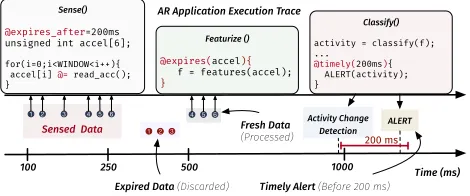
Figure 8. Timely execution of the sample AR applica-tion:TICS catches data expiration, discards stale data and ensures timely branches by following the programmer an-notations.
TinyOS programs without any manual program porting need. It is worth mentioning that TinyOS is an event-based op-erating system and porting event-based legacy code might require some manual modi�cations for the sake of the se-mantically correct execution of the application—in partic-ular, timely-sensitive handling of the events should be im-plemented by the time annotations provided by the TICS in order to guarantee semantically correct results. However, if the programmer omits such manual modi�cations, TICS still guarantees forward progress of the computation as well as the memory consistency of the event-based applications. In Section 5.3, we also demonstrate the porting of existing computation-based benchmarking applications. Apart from injecting time annotations (if required), all porting is han-dled by TICS automatically without any manual intervention. Therefore, the evaluation results later on support and com-plement this result.
5.2 Time-sensitive Intermittent Computation For the evaluation of time-sensitive execution of intermit-tent programs, we considered an existing activity recognition (AR) application used in prior work [9, 28, 31] (this appli-cation is also used for benchmarking in Section 5.3). The AR application obtains a window of three-axis accelerom-eter sensor readings and daccelerom-etermines whether the device is moving or stationary. In the training phase, the mean and standard deviation features of a window of samples are ex-tracted. Then, in the recognition phase, the activity is deter-mined by performing a nearest neighbor classi�cation. In order to observe the time consistency violations described in Section 2.1.3, we provided two versions of the AR applica-tion: (i) manual management of time (and using MementOS-like checkpoints); and (ii) TICS annotated application. We run these applications by powering our MSP430FR5969 [44] wirelessly with 915 MHz Powercast TX91501-3W transmit-ter [36]. The microcontroller was connected to a Powercast P2110-EVB receiver (with on-bard 10µF storage capacitor).
We tested the execution of these applications at the same distances resulting in almost the same (i) power failure rates,
Time Consistency Potential Count Observed Violations Violation (during experiment) w/o TICS w/ TICS
Timely Branch 256 327 03
Time Misalignment 870 787 03
Data Expiration 870 1737 03
Table 2. Time consistency violation statistics for the AR application running intermittently.Our results in-dicate that TICS eliminates these violations by demanding little modi�cations on the legacy software.
(ii) charging and (iii) o�-time. We observed the number of time consistency violations.
The lines of code where the accelerometer is sampled and the corresponding timestamp is assigned are the po-tential points for time misalignment violation. Speci�cally, a timestamp can be assigned to the sensed data relatively long time after the sensor sampling, due to a power failure and long charging time—in both applications there were 870 accelerometer sampling where time misalignment violations could potentially occur. The obtained samples are also sub-ject to data expiration violation while they are consumed for training and classi�cation. In these applications, we con-sidered data to be fresh and useful if it is consumed within 200 ms time window—it is considered to be stale otherwise (see Fig. 8). In order to keep track of the duration of the recognized activities, both applications maintain timestamp. A timely branch that uses this timestamp is required to alert about activity changes; e.g. if the duration of the activity is less than 200 ms this indicates an activity switch. There were 256 points in the execution where a potential timely branch violation could occur.
Results.Table 2 summarizes our results. We observed that TICS prevents all time consistency violations, thanks to eas-ily injected time annotations, where the other application led to 32 timely branch violations, 78 time misalignment violations and 173 data expiration violations. Our results indicate that TICS ensures timely intermittent execution by providing little modi�cations on the legacy software via its time annotations.
5.3 TICS System E�ciency
TICS supports all C language features—including pointers and recursion— thanks to its memory consistency manager. This implementation eliminates system starvation by allow-ing portallow-ing any kind of legacy software to the intermittent computing world—breaking the limitations of the prior work. Here we provide a performance comparison of TICS with the prior work to explore its execution overhead.
system that promotes all variables to global data and stati-cally logs these. Chinchilla was re-compiled from its GitHub source [32] with LLVM version 3.8 (the strict requirement for Chinchilla). InK, MayFly, and Alpaca were compiled with the standard GCC compiler (msp430-gcc version 6.2.1.16). Finally, for completeness, we compare all systems to plain C. Application Benchmarks.We chose three representative applications, used earlier by most studies on systems for intermittently-powered devices: (i)bitcount(BC), (ii)Cuckoo �lter (Cuckoo) and (iii)Activity Recognition(AR) (as indi-cated in Section 5.2) [16]. BC implements bit counting in a random string with seven di�erent methods (including recursion), later cross-verifying for correctness; Cuckoo im-plements cuckoo�lter over a set of pseudo-random num-bers, then performing sequence recovery using the same �lter; AR implements physical activity recognition based on machine learning with locally stored accelerometer data. For a fair comparison, the experiments were conducted us-ing a continuously-powered TI MSP-EXPFR5969 evaluation board [44]. Each application was veri�ed for correctness at the end of each execution. Cuckoo cannot be implemented in MayFly since loops are not allowed in a MayFly task graph. Also, BC used for the evaluation of Chinchilla, see e.g. [32, Fig. 8–10], was not the original one, as the authors have
manually removed the recursionto make it work with their system.
5.3.1 TICS against Chinchilla. Chinchilla converts each local variable of a function to a corresponding global vari-able in non-volatile memory at compile time. This conver-sion prevents stack manipulation via pointers and in turn checkpointing the whole stack due to pointer manipulations. Chinchilla must know in advance the local variables in order to allocate corresponding global variables in non-volatile memory—recursive function calls and in turn, existing ap-plications that exploit recursive implementations cannot be supported. Moreover, due to the local-to-global conversion via bypassing stack allocation of local variables, there is an explosion in the number of global variables—decreasing the scalability of memory requirements. Inline functions further complicate this issue: the corresponding global variables are needed to be allocated per every line where the function is inlined. As an example, if an inline function of one local vari-able is called 100 times, then 100 di�erent global variables need to be created. These issues are the major limitations of Chinchilla, making it an incomplete system. Inspecting our results presented in Figure 9, TICS is able to executeall
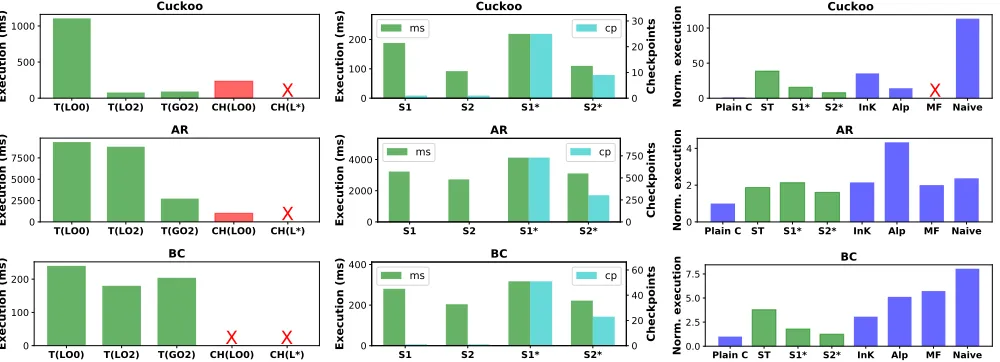
benchmarks, while Chinchilla cannot run recursion-based code, i.e. BC. Due to the dynamic memory logging employed by TICS, the execution time overhead will vary per bench-mark. Additionally, the compiler optimization level has a signi�cant e�ect because the runtime code is also a�ected by the lack of optimization.
InK Chinchilla TICS
.text .data .text .data .text .data AR 3442 4459 12870 8986 6878 1364
BC 2922 4433 10902 8658 5944 1488
CF 2648 4693 12128 9050 7178 1948
Table 3. The memory consumption (in B) for three ap-plications written in InK, Chinchilla and TICS.
5.3.2 Micro-benchmarking TICS.The execution time overhead of TICS with the number of checkpoints for dif-ferent working stack sizes is given in Figure 9 (center row). As working stack size gets bigger, the number of working stack change driven checkpoints decreases since on-demand stack requirement of the applications are ful�lled—S2 con� g-uration did not lead to a working stack changes and in turn checkpoints and S1 led to considerable number of working stack changes and therefore also more checkpoints. On the other hand, increasing the working stack size also increases the overhead of a single checkpoint since the logged data is bigger—there will be always a trade-o�. Among bench-marking applications, AR led to a considerable amount of working stack change driven checkpoints with con� gura-tion S1 due to its varying stack size requirements. We also enabled timer-driven checkpoints with a frequency of 10 ms that ensure the forward progress—con�gurations S1* and S2* indicate the con�gurations S1 and S2 with timer-driven checkpoints enabled. TICS checkpoints do not introduce sig-ni�cant overhead since only the working stack and registers are logged.
5.3.3 TICS Against Task-based Systems.We selected con�gurations S1* and S2* to asses the execution time perfor-mance of TICS considering the task-based runtimes—right column of Figure 9. For the fairness of comparison against task-based systems, apart from timer-driven checkpoints in S1* and S2*, we placed checkpoints to con�guration S2 at task-boundaries for TICS (shown as ST) and our naïve MementOS-like [39] implementations. We observed that se-lecting a reasonable working stack size, TICS reaches almost the performance of existing task-based systems.
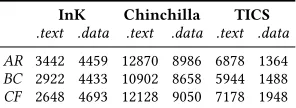
5.3.4 TICS Memory Overhead.Table 3 presents a com-parison of memory overhead of the benchmarking applica-tions implemented in InK (task-based system), Chinchilla (checkpoint-based system) and TICS. The.datasection
over-head of TICS depends on the size of the con�gurable stack segment array (which was 2048 B) and undo log (which was 2048 B) both are excluded from the.datasection. The code
size in selected applications is dependent on not only the application source but also on the stack segmentation and memory consistency management implementations in TICS. Overall, we see that for all benchmarks TICS hassigni�cantly lowermemory overhead than Chinchilla—more than twice .textand more than six times for.data. Comparing to InK,
Figure 9. Benchmark performance.Left column: TICS to Chinchilla comparison;Center column: micro-benchmarking of TICS;Right column: TICS to task-based systems comparison.T,CH,Alp,MF: TICS, Chinchilla, Alpaca, MayFly;LO0, LO2: LLVM-compiled code with –O0, and –O2 optimization.L*: all compilations options of GCC and all of LLVM except –O0.GO2: GCC-complied code with –O2 optimization.S1, S2: con�gurations with di�erent working stack sizes imposing a di�erent checkpoint frequency and checkpoint time—S1=50 B,S2=256 B;S1⇤, S2⇤: the same stack con�gurations asS1, S2but with
an additional timer checkpointing every 10 ms if there was no checkpoint due to the working stack.STdenotesS2with checkpoints at the task boundaries. Red cross (7) denotes the code did not compile with the chosen compiler/optimization.
Operation Con�guration Variables Duration(µs)
Stack grow/shrink max 345
Checkpoint logic 0 B seg. | 64 B seg. | 256 B seg. 264 | 464 | 656 Restore logic 0 B seg. | 64 B seg. | 256 B seg. 273 | 475 | 664
Pointer access no log | log 4 B (64 B) 13 | 308 (371)
Roll back from undo log 4 B | 64 B 234 | 294
Table 4. TICS overhead, split per runtime operation. Results obtained with GCC (optimization –O2) at 1 MHz.
5.3.5 TICS Point-to-point Overheads. Table 4 presents the detailed overhead of TICS runtime operations. The check-point and restore operations include saving registers and working stack in non-volatile memory using a two-phase commit operation—the working stack size has a direct impact on the checkpoint overhead. The constant checkpoint over-head without saving the working stack segment is depicted as 0 B size in the table. Thestack grow/shrink operations update the working stack to point another segment in the segment array. During pointer manipulation, TICS checks the pointer address to see if the working stack is targeted. If this is the case, there is no need for the undo logging and the working is stack directly manipulated. Otherwise, TICS logs the original value in undo log—the overhead of di�erent variable sizes are depicted in the table. The time it takes to recover the original value of a variable from the undo log depends on the variable sizes.
5.4 User Study and Developer E�ort
We have designed a large online user study. The goal was to objectively assess the time to design a TICS application.
Methodology.At the beginning of an online survey each participant was given an introduction to intermittent exe-cution and to TICS and InK [46]. Then, we have then asked participants to�nd bugs in three simple programs: (i)swap of two variables (with no use of a temporary variable), (ii)bubble sort, and (iii)program that considers variable expiration based on time. Each program was written separately in TICS and in InK and hadexactly the same type of bug, atexactly one line of the program. Users were asked to point to a line that contained that bug and specify the correct statement.
Each program with a bug was presented to a user on a separate page. Additionally,timespent on�nding a bug in
each of the programs was measured. No corrections of the given answers were possible once the answer was submitted. We randomized the order in which each program appeared at the respondent’s screen in order to remove presentation bias against one language and objectify bug�nding time. User Pool.At the time of writing this paper, a total of 90 responses were collected. 78% of all respondents had at least two years of programming experience. Almost 83% of respon-dents had average or below average knowledge of embedded systems powered by energy harvesting technologies. Result.Results are shown in Figure 10. We observe that in all cases it was (i)harder to�nd a bugand (ii)users were more prone to errorwhen exposed to a task-based language.
Figure 10. TICS user study results.For all three test pro-grams,Swap,BubbleandTimekeeping, users found that it is easier with TICS to identify a bug and were more accurate in correcting the TICS program than that of InK [46]. Whiskers in the right-hand side�gure denote standard deviation.
Runtime SupportPointer RecursionSupport Scalability ExecutionTimely PortingE�ort
May�y [20] No7 No7 Poor7 Yes3 High7
Alpaca [31] No7 No7 Poor7 No7 High7
Ratchet [45] Yes3 No7 Poor7 No7 High7
Chinchilla [32] Yes3 No7 Poor7 No7 None3
Ink [46] No7 No7 Poor7 Yes3 High7
TICS (this work) Yes3 Yes3 High3 Yes3 None3 Table 5. State of the art programming models.
user-friendly system than a task-based one. As the complexity of a program increased users had di�culty�nding a bug in an InK program (forBubble Sortin half of the cases users
were wrong). Regarding the subjective evaluation of TICS against InK, participants considered TICS to bemore intuitive, easier and conciserthan InK.
6 Related Work
In Table 5 key characteristics of TICS are compared to those of May�y [20], Alpaca [31], Ratchet [45], Chinchilla [32] and InK [46]. In this section we compare some of these char-acteristics from the state of the art to TICS.
Checkpointing Systems.Systems that automatically de-termine checkpoint placement at compile-time like [6, 32, 45] are most closely related to this work. HarvOS parses the con-trol�ow graph of a program and instruments with energy-aware checkpoints, requiring a small amount of programmer intervention to place e�ectively. Ratchet functions by plac-ing checkpoints at the boundaries of idempotent sequences of instructions. Chinchilla over-instruments programs with checkpoints by storing some variables in non-volatile mem-ory, and disabling/enabling checkpoints heuristically. Apart from the aforementioned studies, Mementos [39] was the �rst checkpointing scheme, using intermittent voltage checks to decide when to save state. QuickRecall [23] and Hiber-nus [5] extended this work with newer non-volatile mem-ories. DINO [28] laid out the memory consistency prob-lems that will arise with intermittent computing for mixed-volatility processors. TICS builds on these early techniques, however, these systems do not consider timely execution of the applications.
Task-based Programming Models.Alpaca [31] and re-lated works [9] focus on providing control�ow and data
�ow mechanisms while reducing the memory footprint from multi-versioning. May�y [20] provides explicit semantics for specifying timing constraints on sensor data in a task-based language. InK [46] provides a way to handle events and interrupts from clock sources, sensors, and energy in the environment, despite power failures. Task-based systems require a custom programming model, which leads to added programmer intervention and complexity. Task decomposi-tion is a manual process that is error-prone and not resilient to changes in the availability of energy in the environment. Non-volatile Processors.Integration of non-volatile com-ponents, e.g. non-volatile registers, to the processor architec-ture provides automatic management of forward progress and memory consistency [29, 30]. This eliminates the need for handling these properties explicitly by the programmer. However, non-volatile architectures consume more power, they have increased area and decreased frequency as com-pared to general-purpose volatile processors with SRAM-based�ip-�ops [22]. TICS targets o�-the-shelf processors with hybrid volatile and non-volatile memory in the market.
7 Conclusion and Future Work
TICS is a runtime for intermittently powered systems that enables full use of C features like pointers and recursion through a memory consistency management scheme (data versioning and stack segmentation) and provides semantics for easily porting time-sensitiveprograms to the intermittent
domain while maintaining correctness. Guarantees on worst case checkpointing time are provided, ensuring TICS scales as applications become more complex. We evaluated TICS against the state of the art, showing reasonable overhead nearly matching the performance of task-based systems. We conducted a user study, where participants found TICS more intuitive than the task-based approach. In the future, we anticipate exploring ways to automatically import or infer timing semantics and rules from legacy code in TinyOS or other systems. Virtualizing the I/O interface across power failures could also lead to better ported applications.
8 Acknowledgments
References
[1] Clang 7 libtooling. https://github.com/llvm-mirror/clang/blob/master/
docs/LibTooling.rst, March 2019. Last accessed: Jan. 20, 2020.
[2] TICS website. https://github.com/tudssl/tics, January 2020. Last
ac-cessed: Jan. 16, 2020.
[3] Saad Ahmed, Muhammad Hamad Alizai, Junaid Haroon Siddiqui, Naveed Anwar Bhatti, and Luca Mottola. Towards smaller check-points for better intermittent computing. InProc. IPSN, pages 132–133, Porto, Portugal, 2018. ACM/IEEE.
[4] Ala Al-Fuqaha, Mohsen Guizani, Mehdi Mohammadi, Mohammed Aledhari, and Moussa Ayyash. Internet of things: A survey on enabling technologies, protocols, and applications.IEEE Commun. Surveys Tuts., 17(4):2347–2376, Fourth Quarter 2015.
[5] Domenico Balsamo, Alex S. Weddell, Anup Das, Alberto Rodriguez Arreola, Davide Brunelli, Bashir M. Al-Hashimi, Geo�V. Merrett, and Luca Benini. Hibernus++: a self-calibrating and adaptive system for transiently-powered embedded devices.IEEE Trans. Comput.-Aided Design Integr. Circuits Syst., 35(12):1968–1980, 2016.
[6] Naveed Bhatti and Luca Mottola. HarvOS: E�cient code instrumenta-tion for transiently-powered embedded devices. InProc. IPSN, pages 209–219, Pittsburgh, PA, USA, 2017. ACM/IEEE.
[7] John Burgess, Brian Gallagher, David Jensen, and Brian Neil Levine. MaxProp: routing for vehicle-based disruption-tolerant networks. In
Proc. INFOCOM, Barcelona, Spain, 2006. IEEE.
[8] An Chen. A review of emerging non-volatile memory (NVM) tech-nologies and applications.Solid-State Electronics, 125:25–38, November 2016.
[9] Alexei Colin and Brandon Lucia. Chain: Tasks and channels for reliable intermittent programs. InProc. OOPSLA, pages 514–530, Amsterdam, The Netherlands, 2016. ACM.
[10] Alexei Colin and Brandon Lucia. Termination checking and task de-composition for task-based intermittent programs. InProc. Conference on Compiler Construction, pages 116–127, Vienna, Austria, 2018. ACM. [11] Alexei Colin, Emily Ruppel, and Brandon Lucia. A recon�gurable energy storage architecture for energy-harvesting devices. InProc. ASPLOS, pages 767–781, Williamsburg, VA, USA, 2018. ACM. [12] Adam Dunkels, Björn Grönvall, and Thiemo Voigt. Contiki - a
light-weight and�exible operating system for tiny networked sensors. In
Proc. LCN, pages 455–462, Tampa, FL, USA, 2004. IEEE.
[13] Salma Elmalaki, Huey-Ru Tsai, and Mani Srivastava. Sentio: Driver-in-the-loop forward collision warning using multisample reinforcement learning. InProc. SenSys, pages 28–40, Shenzhen, China, 2018. ACM. [14] Jakob Eriksson, Lewis Girod, Bret Hull, Ryan Newton, Samuel Madden, and Hari Balakrishnan. The pothole patrol: Using a mobile sensor network for road surface monitoring. InProc. MobiSys, pages 29–39, New York, NY, USA, 2008. ACM.
[15] A. Fioravanti-Score, Sarah V. Mitchell, and J. Michael Williamson. Use of Satellite Telemetry Technology to Enhance Research and Education in the Protection of Loggerhead Sea Turtles. InProc. Annual Symp. on Sea Turtle Biology and Conservation, South Padre Island, TX, USA, 1999. NOAA.
[16] Matthew R. Guthaus, Je�rey S. Ringenberg, Dan Ernst, Todd M. Austin, Trevor Mudge, and Richard B. Brown. MiBench: A free, commercially representative embedded benchmark suite. InProc. Workload Charac-terization Workshop, pages 3–14, Austin, TX, USA, 2001. IEEE. [17] Josiah Hester, Travis Petersy, Tianlong Yuny, Ronald Petersony, Joseph
Skinnery, Bhargav Golla, Kevin Storer, Steven Hearndon, Kevin Free-man, Sarah Lordy, Ryan Haltery, David Kotz, and Jacob Sorber. Amulet: An energy-e�cient, multi-application wearable platform. InProc. Sen-Sys, pages 216–229, Stanford, CA, USA, 2016. ACM.
[18] Josiah Hester and Jacob Sorber. Flicker: Rapid prototyping for the batteryless internet-of-things. InProc. SenSys, pages 19:1–19:13, Delft, The Netherlands, 2017. ACM.
[19] Josiah Hester and Jacob Sorber. The future of sensing is batteryless, intermittent, and awesome. InProc. SenSys, pages 21:1–21:6, Delft, The Netherlands, 2017. ACM.
[20] Josiah Hester, Kevin Storer, and Jacob Sorber. Timely execution on intermittently powered batteryless sensors. InProc. SenSys, pages 17:1–17:13, Delft, The Netherlands, 2017. ACM.
[21] Josiah Hester, Nicole Tobias, Amir Rahmati, Lanny Sitanayah, Daniel Holcomb, Kevin Fu, Wayne P. Burleson, and Jacob Sorber. Persistent clocks for batteryless sensing devices.ACM Trans. Embed. Comput. Syst., 15(4):77:1–77:28, August 2016.
[22] Matthew Hicks. Clank: Architectural support for intermittent com-putation. InProc. ISCA, pages 228–240, Toronto, ON, Canada, 2017. ACM.
[23] Hrishikesh Jayakumar, Arnab Raha, Woo Suk Lee, and Vijay Raghu-nathan. Quickrecall: A HW/SW approach for computing across power cycles in transiently powered computers.J. Emerg. Technol. Comput. Syst., 12(1):8:1–8:19, July 2015.
[24] Fredrik Larsson and Bengt-Erik Mellander. Abuse by external heating, overcharge and short circuiting of commercial lithium-ion battery cells. Journal of The Electrochemical Society, 161(10):A1611–A1617, 2014.
[25] Philip Levis, Sam Madden, Joseph Polastre, Rober Szewczyk, Kamin Whitehouse, Alec Woo, David Gay, Jason Hill, Matt Welsh, Eric Brewer, and David Culler. TinyOS: An operating system for sensor networks. In Werner Weber, Jan M. Rabaey, and Emile Aarts, editors,Ambient intelligence, pages 115–148. Springer, Berlin, Germany, 2005. [26] Hong Lu, Jun Yang, Zhigang Liu, Nicholas D. Lane, Tanzeem
Choud-hury, and Andrew T. Campbell. The jigsaw continuous sensing engine for mobile phone applications. InProc. SenSys, pages 71–84, Zürich, Switzerland, 2010.
[27] Brandon Lucia, Vignesh Balaji, Alexei Colin, Kiwan Maeng, and Emily Ruppel. Intermittent computing: Challenges and opportunities. In
Proc. SNAPL, pages 8:1–8:14, Alisomar, CA, USA, 2017.
[28] Brandon Lucia and Benjamin Ransford. A simpler, safer programming and execution model for intermittent systems. InProc. PLDI, pages 575–585, Portland, OR, USA, 2015. ACM.
[29] Kaisheng Ma, Xueqing Li, Karthik Swaminathan, Yang Zheng, Shuangchen Li, Yongpan Liu, Yuan Xie, John Jack Sampson, and Vi-jaykrishnan Narayanan. Nonvolatile processor architectures: E� -cient, reliable progress with unstable power.IEEE Micro, 36(3):72–83, May/Jun. 2016.
[30] Kaisheng Ma, Yang Zheng, Shuangchen Li, Karthik Swaminathan, Xueqing Li, Yongpan Liu, Jack Sampson, Yuan Xie, and Vijaykrishnan Narayanan. Architecture exploration for ambient energy harvesting nonvolatile processors. InProc. HPCA, pages 526–537, Burlingame, CA, USA, 2015. IEEE.
[31] Kiwan Maeng, Alexei Colin, and Brandon Lucia. Alpaca: Intermittent execution without checkpoints. InProc. OOPSLA, pages 96:1–96:30, Vancouver, BC, Canada, 2017. ACM.
[32] Kiwan Maeng, Alexei Colin, and Brandon Lucia. Adaptive dynamic checkpointing for safe e�cient intermittent computing. InProc. OSDI, Carlsbad, CA, USA, 2018. USENIX.
[33] Sujay Narayana, R. Venkatesha Prasad, Vijay S. Rao, and Chris Ver-hoeven. SWANS: sensor wireless actuator network in space. InProc. SenSys, pages 23:1–23:6, Delft, The Netherlands, 2017. ACM. [34] Anh Nguyen, Raghda Alqurashi, Zohreh Raghebi, Farnoush
Banaei-Kashani, Ann C. Halbower, and Tam Vu. A lightweight and inex-pensive in-ear sensing system for automatic whole-night sleep stage monitoring. InProc. SenSys, pages 230–244, Stanford, CA, USA, 2016. ACM.
[36] Powercast Corp. Powercast hardware development kits website. https: //www.powercastco.com/products/development-kits/, 2014. Last
ac-cessed: Jan. 20, 2020.
[37] Amir Rahmati, Mastooreh Salajegheh, Dan Holcomb, Jacob Sorber, Wayne P. Burleson, and Kevin Fu. TARDIS: time and remanence decay in SRAM to implement secure protocols on embedded devices without clocks. InProc. Security Symposium, pages 36–36, Bellevue, WA, USA, 2012. USENIX.
[38] Benjamin Ransford and Brandon Lucia. Nonvolatile memory is a bro-ken time machine. InProc. Workshop on Memory Systems Performance and Correctness, pages 5:1–5:3, Edinburgh, Scotland, 2014. ACM. [39] Benjamin Ransford, Jacob Sorber, and Kevin Fu. Mementos: System
support for long-running computation on RFID-scale devices. InProc. ASPLOS, Newport Beach, CA, USA, 2011. ACM.
[40] Alanson P. Sample, Daniel J. Yeager, Pauline S. Powledge, Alexan-der V. Mamishev, and Joshua R. Smith. Design of an RFID-based battery-free programmable sensing platform. IEEE Trans. Instrum. Meas., 57(11):2608–2615, November 2008.
[41] Mahadev Satyanarayanan, Wei Gao, and Brandon Lucia. The com-puting landscape of the 21st century. InProc. HotMobile, pages 45–50, Santa Cruz, CA, USA, 2019. ACM.
[42] Jacob Sorber, Alexander Kostadinov, Matthew Garber, Matthew Bren-nan, Mark D. Corner, and Emery D. Berger. Eon: A language and runtime system for perpetual systems. InProc. SenSys, pages 161–174, Sydney, Australia, 2007.
[43] Jethro Tan, Przemysław Pawełczak, Aaron Parks, and Joshua R. Smith. Wisent: Robust downstream communication and storage for compu-tational RFIDs. InProc. INFOCOM, San Francisco, CA, USA, 2016. IEEE.
[44] Texas Instruments. MSP430FR5994 launchpad development kit. http: //www.ti.com/tool/MSP-EXP430FR5994. Last accessed: Jan. 20, 2020.
[45] Joel Van Der Woude and Matthew Hicks. Intermittent computation without hardware support or programmer intervention. InProc. OSDI, pages 17–32, Savannah, GA, USA, 2016. ACM.
[46] Kasım Sinan Yıldırım, Amjad Yousef Majid, Dimitris Patoukas, Koen Schaper, Przemysław Pawełczak, and Josiah Hester. InK: Reactive ker-nel for tiny batteryless sensors. InProc. SenSys, pages 41–53, Shenzhen, China, 2018. ACM.
[47] Hong Zhang, Jeremy Gummeson, Benjamin Ransford, and Kevin Fu. MOO: A batteryless computational RFID and sensing platform (tech-nical report um-cs-2011-020). https://web.cs.umass.edu/publication/
docs/2011/UM-CS-2011-020.pdf, 2011. Last accessed: Jan. 20, 2020.