AUT J. Mech. Eng., 3(2) (2019) 165-172 DOI: 10.22060/ajme.2018.14359.5725
Experimental and Image Processing Investigation on the Diffusion of Dust Particles
in the Atmospheric Area
M.d Alipour Shotlou, M. T. Shervani-Tabar*, M. Jafari Department of Mechanical engineering, University of Tabriz, Tabriz, Iran
ABSTRACT: The diffusion and transfer of dust particles in the atmospheric area were investigated with experimental and image processing methods. In a flat field, the rising of dust particles into the air by plowing the field with a tractor and their spreading along the surrounding environment as a real model of dust diffusion in the atmospheric area. The experiments carried out for specifying the particle-size distribution of the bed dust and its density. The experimental photos of dust diffusion were analyzed by image processing. The intensity of the diffusion of dust particles in the atmospheric area at the different roughness of surfaces for the different speeds of the tractor movement was obtained. The roughness of the surface increases the impact threshold and reduce the number of splashing particles. As particles velocities increase, the particles height increases and the proportion slope decreases at the high velocities. A relative concentration parameter Cα was defined. The results of this study compared
with previous works based on this relative concentration. The concentration of dust particles decreases exponentially by increasing up to a certain height and after this height, changes in concentration are minor. Also, the role of mid-air collisions is significant, especially at high speeds.
Review History:
Received: 5 May 2018 Revised: 25 September 2018 Accepted: 17 November 2018 Available Online: 28 December 2018
Keywords:
Diffusion Dust particles Saltation Image processing Environment
1- Introduction
The spread of sand particles by wind has been causing many problems on the daily life of humans, such as sandstorm, soil erosion, environmental degradation, rail trains filling, flight disruptions and many other problems. The erosion and movement of dust particles are not limited to the earth, and this phenomenon happens in other planets like Mars and possibly Venus and Titan [1]. The motion of dust particles generally contains three transport processes: saltation, suspension, and surface creep. Saltation is very important because about 75% of total sand transport is done through this process [2]. Therefore, the main focus of the researchers is on the saltation.
The saltation is about particles of 100μm. These particles
after lifting from the ground, impact onto the surface and eject other particles in a chain reaction. The number of transported particles grows exponentially until the system reaches the saturation [3-5]. The suspension is about the
lighter (dust) particles smaller than 100μm. These particles
are lifted and transported higher and farther in comparison to saltation grains [6]. The heavy mass from particles larger than
500μm limits them only to creep or roll onto the surface [4].
Understanding the mechanism of the diffusion and transfer of dust particles is the first and the most important step to combat this phenomenon. Saltation is initiated by lifting a small number of particles with wind stress. The wind shear velocity
at the surface must be above the fluid or static threshold u_τ
to lift the first particles [7]. The calculating methods of the fluid threshold and the factors affect it, were studied. [5, 8-9]. The next step, after understanding the start of the process, is the recognition of the forces that affect the particle and
cause the particles to translate and rotate. The effective forces include the fluid drag and lift forces, the gravitational force, inter-particle forces, Magnus and Saffman forces. The effects of these forces on the motion of particles were investigated [9-14]. The trajectory of the motion of saltating particles was studied [5, 15]. A general pattern of the movement of particles was obtained as a stretched parabolic trajectory. Also, a saltation layer was introduced that includes 90% of transported particles [8].
After discussion about the lift and movement of the saltating particles, the particles’ impact onto the surface and the splashing of the particles into saltation process must be investigated. The splashing of surface particles by impacting particles is the main source of new saltating particles after saltation has been initiated [16]. Analytical and numerical treatments of the saltation need to account for the creation of these particles, but since the interaction of the impacting particles with the soil bed is complex and stochastic, this process is resistant to an analytical solution [17]. Instead, many laboratory [3, 16] and numerical experiments [18, 19] have been performed. The characteristics of steady-state saltation are determined largely by balancing between saltating particles lost through failure to rebound and saltating particles gained through splash [6]. Consequently, the probability that a particle does not rebound is a critical parameter in saltation models. Unfortunately, this critical parameter was considered in very few studies, which contrasts with the many published studies on particle splash [3, 20].
Numerous numerical models to predict the movement of dust particles have been presented in the last two decades. A numerical study was carried out on the simulation of Aeolian sand transport with the Euler-Lagrangian model by Liqiang Kang et al. [21]. Also, the same researchers investigated the
distribution of particle velocity in an Aeolian sand transport [22]. The movement of the sand in a 2.5 dimensional simulation with a discrete particle model has been analyzed. The results of this study are compared with the 2D simulation [23].
The most of experimental works in this field were carried out in the wind tunnels and by the assumption of ideal conditions. This ideal condition includes the wind in a one-way, fully turbulent, uniform and stable wind, the wall rule governs the wind profile when the movement of the sand particles occurs, Sands are smooth, dry and uniform in size; flat and unobstructed surface [24]. We rarely encounter in this situation. On the other hand, the process of transferring sand by wind is still unclear.
Authors in [25], have studied the size frequency distributions of particles in a wind tunnel containing a bed of non-uniform sand. The saltation of sand particles was investigated by an experimental work in an open-type subsonic wind tunnel and using an image processing method [26]. In the investigation of the mechanism of the diffusion and transfer of dust particles, it is important to consider the presence of mid-air collisions and their impact. M. V. Carneiro et al. [27] studied numerically the collisions of mid-air on the saltation process and compared with without mid-air collisions case.
In this study, a new model for the diffusion and transfer of dust particles were introduced. Previous works based on the assumption of ideal conditions and carried out in the wind tunnel. Unlike previous works, this model is in atmospheric air and in conditions close to the actual nature of this phenomenon. The other prominent features of this study are the analysis of all the microscopic processes of the diffusion and transfer mechanism of dust particles in a continuous and simultaneous model. Also, the effect of the roughness of surfaces and the velocity of dust particles were investigated. For model and results comparison, the concentration changes were obtained in terms of height and were compared with the previous work.
2- Experimental Model for Diffusion Particles
In this research, it was given a try to simulate the diffusion and the transfer of dust particles in the atmospheric area with a field study and laboratory work. The proposed model can cover fully the diffusion and transfer mechanism of the particles. On a planar ground, the dust particles that rise from the rear of the tractor plow into the air and spread along the plowing, as a real model of the diffusion and the transfer of dust particles was considered, as shown in Fig. 1. The dust particles risen from the rear of the tractor’s plow and their diffusion and transfer were imaged. We used picture techniques and appropriate equipment for filming. Then, the image processing techniques were applied to the provided images and results were analyzed.
3- Circumstances of the Experiments
The flat land which the experiment was done on it, is an agricultural field and set in the region of the Maku, northwest of Iran. It is a length of 800 meters and sufficient width. The selection of agricultural field has advantages and limits. In previous experimental works, the floor of the wind tunnels has been covered with a certain thickness of pre-sieved sand. The agricultural field was applied under the soil disk process and was plowed twice. In order to investigate the size of soil
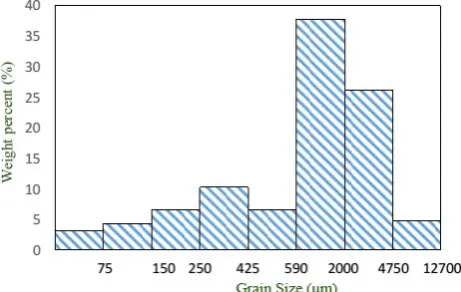
particles, samples from the different parts of the agricultural field were sampled. The grading experiment was performed on these samples in the soil laboratory of Tabriz University. The particle-size distribution of the soil surface was obtained which can be seen in Fig. 2. The size of the particles is different and non-uniform. By comparing the results of this experiment with the sampling of the Tengger Desert in China [25], it can be concluded that the distribution of particle size in this study have acceptable correspondence with the size of sand particles in nature. The sand density in the normal state is 2650 kg/m3 and the soil density of this area is 1800 kg/m3.
The length of the used agricultural field is long enough. There is a natural roughness on the floor. These roughness contribute to the close of the proposed model to the natural phenomenon. It should be noted that in most of the previous experiments carried out in the wind tunnel, the surface of the sand layer is smooth and in an ideal condition. In the some of these experiments, the tunnel floor covered with a certain thickness of the sand. When the particle starts to motion and saltation, the tunnel floor needs to be fed by fresh sands, and this is done with a sophisticated feeding system. Of course, the consideration of this issue has been ignored in many experiments. This problem doesn’t exist in rising dust particles on the agricultural field in tractor movement along the ground. It is the advantage of this model. The fundamental limitations of testing in the agricultural field and open environment are that the use of laboratory tools and control of parameters is very limited. The recognition of dust particles is difficult with the image processing method in the open environment. Some particles released as suspension may not be recognized, but this approximation is always there. Even previous experimental work has been carried out with this approximation and some particles have not been recognized.
Fig. 1. The proposed model for the diffusion and transfer of dust particles in the atmospheric area
The used plow in this experiment is 2.65 meters in length running to 14 nails that can go into the ground with about 22 centimeters. This type of plow is used in the agriculture of this area in the pre-cultivation stage. The purpose of its usage is softening the soil and pulling out a layer of soil on the seeds at the planting stage. It is a good choice for this experiment because of the fact that the soil improved superficially, has a symmetrical structure, and its low engagement with the ground does not create a problem in the tractor’s movement. Two types of cameras have been used to produce images. The first type is GoPro HERO3 + camera. This camera is holding the feature of a robust stabilizer and 12-Megapixel lens. It set on top of the car and Imaging performed with moving the vehicle and tractor simultaneously. The second type of camera is the 24.7-Megapixel Nikon D7100 camera. Since the open environment is effective in recognizing dust particles, films were recorded from another angle by this camera.
The experiment after selecting the appropriate agricultural field, sampling the soil for determining the size of dust particles and installing the equipment mentioned, was carried out on the basis of the proposed model. As the tractor started moving, dust particles risen from the rear of the tractor’s plow. Dust particles were diffused and transferred in the atmospheric area. The car moved with the same speed the tractor did. The images of the diffusion and transfer of the dust particles in a fixed image frame were filmed in two different angles. The tractor moved at three speeds of 8, 12 and 20 km/h during the test run. The motion of dust particles was captured at these speeds. Then the provided images were processed and analyzed by the image processing method. Aforementioned above, a particle size distribution experiment was carried out on sampling from different parts of agricultural land in the soil laboratory of Tabriz University.
4- Image Processing for Recognition of Diffusion Modes
The first step is to get an input image of the photos taken from camcorders. It is necessary to decompose the movie into its frames to access them. In the second step, the pre-processing of the frames were conducted. Better results were achieved by reducing the noise from image brightness. In the processing step, frames were converted from the Portable Network Graphics (PNG) format to grayscale. Then, for recognizing the dust particles in the images, the minimum gray value of pixels containing dust particles was determined and was set as a threshold. Dust particles in all of the images were recognized based on this threshold.
In image processing, segmentation is an operation to convert an image into a series of distinct regions, such as straight lines, curves, and curves in the image, and also to determine the location of the image components for easy image analysis. In this study, the region growing method was carried out using uniformity in the area. This method begins with the selection of one or more dots, and also the new areas equal to the number of selected dots are identified. Then, the degree of similarity between the pixels is formulated. In fact, we can say that this is a measure based on the gray values in pixels. Two pixels are called similar if the absolute difference between their gray values is less than the threshold value that we defined. Then, regional development or inspection and control of the points that are surrounded by dots start. If a point is sufficiently similar to the dots, it belongs to that region of the dots. For each region, the operation continues
to cover all of the image points. The segmentation of the images by the proposed method was performed on pixels containing dust particles, and the spectrum of intensity of particle diffusion in the atmospheric area was obtained in the different situations and times.
One of the factors studied in this research is to investigate the changes in the height of the diffusion dust particles in terms of the tractor’s different speeds. Edge detection was used for identifying the borders of dust particles mass. The number of zero pixels was calculated from the edge of dust particles’ mass to the surface of the field. It is necessary to determine the size of each pixel to calculate the height. In order to calculate the size of pixels, the tractor height was measured. Then, in each frame, the number of pixels covering this height was calculated. By dividing the actual height of the tractor according to this number, the side size of each pixel was calculated. In the end, the height of the dust particles was calculated at a specified distance with the number of pixels zero inside the boundary and the size of each pixel.
For validation and comparison of this study with previous works, changes in concentration with height were investigated. Investigating the changes in concentration with height can be an acceptable criterion. In particular, the profile of changes in the mass fluxes of particles with a height is very similar to the profile of changes in particle concentration with height. It is not possible to accurately calculate the concentration at any height in this study, but changes in height can be considered. The concentration of particles in terms of gray values at the desired heights can be obtained based on the interpolation of gray values of pixels at the desired height that containing dust particles. The concentration changes in previous studies reduce from the maximum value near the surface to a minimum value at the higher height. In order to proper comparison with previous works, the relative concentration of particles at the desired heights were obtained by Eq (1), it is a dimensionless parameter. The relative concentration is the ratio of the difference in the concentration at the desired height from the minimum amount of concentration obtained to the difference in the concentration of the maximum value obtained from the minimum concentration value. The relative concentration changes range from 0 to 1 including changes in the concentration from a minimum value at the highest height to the maximum value at the surface of the ground.
min max min C C C C C α − = − (1)
5- Results and Discussion
storms in the future works.
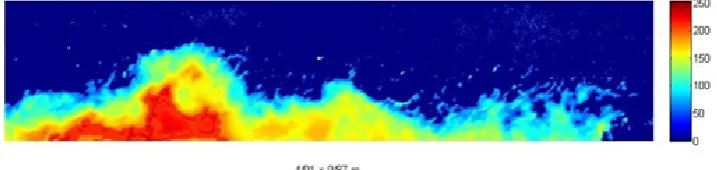
The proposed method for image processing of the provided images from laboratory and fieldwork was performed by using MATLAB software. The length of the agricultural field along the whole path is not uniform. For obtaining regions with relatively uniform roughness along their length, the length of the test run was divided into three regions. These three regions were named A, B, and C. All three regions are sufficiently spaced from the start of the tractor movement and the flow is fully developed. The difference between these three regions is their surface roughness. The roughness of region C is greater than region B and roughness of the region B is greater than region A. The reason for dividing the length of the test run into these three regions is that by this work, we can study the effect of surface roughness on the diffusion and transfer of dust particles. Results and analysis of the dust particles’ movement were presented in these three regions. The images provided from the entire length of the test run from both camera types have been processed. But in this paper due to limitations and contraction, the image processing results of images provided by the GoPro HERO3 + camera in regions A, B, and images provided by the Nikon d7100 camera in region C is presented. In each region, for each speed, more than 200 image frames were processed. Analytical results were obtained from the review of all the processed frames. Although due to the contraction, only the image processing of a sample frame as the representative of the diffusion and transfer of dust particles for each speed, in each region was presented. In each region, the conclusions were obtained from analyzing the results of processing the images of the entire frames of that region. The analysis of the results should be done in a logical and constant coordinate. In each frame with the proposed method, dust particles were recognized. Then the spectrum of the intensity of the diffusion and transfer of particles was obtained in each frame (In areas where dust particles do not exist, they were set to zero and The remaining areas for better analysis are segmented according to the amount of particles existing in that area in a wide range for better analysis, which 250 indicate the maximum amount of dust particles obtained from all the areas).
The spectrum of the intensity of the diffusion and transfer of particles in the region A, for the speeds of 12 and 20 km/h are shown in Figs. 3 and 4, respectively. At the speed of 8 km/h, the dust particles are less diffused and transferred, so recognizing particles is difficult with the proposed model
completely. In general, the image processing results of the speed of 8 km/h can be used to analyze the motion of dust particles.
The analysis of the results of the image processing all frames of the region A indicates that a wide part of the diffusion and transfer of dust particles in the atmospheric area is a saltation process. Dust particles are separated from the surface by a saltation and then by impacting onto the surface, the particles of the soil surface were splashed. The obtained result from comparing the results of image processing at the speeds of 12 and 20 km/h is that, if the impact velocity of particles exceeds the impact threshold, the particles of the soil surface would splash. In the region A, at the speed of 12 km/h, the impact velocity of particles is less than the impact threshold. The saltating particles lose their energy after a few jumps without splashing a significant amount of particles. Eventually, are descended and the smaller particles are spread at the end of the motion as a suspension. The impact threshold is considered to be the minimum velocity of particles impact which causes the particles to splash from the soil surface according to conditions of the soil of the surface. At the speed of 20 km/h, the impact velocity of particles is greater than the impact threshold. The saltating particles in each impact splash a number of particles of the surface soil and enter them into the saltation process. As shown in Fig. 4, the amount of saltating particles increases, but after many jumps, the velocity of all particles from the impact threshold abates, the dust particles descend, and eventually the smaller particles are spread as suspension. The number of the smaller particles that are spread at the speed of 20 km/h is more than the speed of 12 km/h. Also, by examining Figs. 3 and 4 and comparing with the results of M. V. Carneiro et al. [27] study, it can be concluded that mid-air collisions play an important role in the mechanism of the diffusion and transfer of particles. The saltating particles due to mid-air collisions continue their saltation motion for long periods of time in the air as they do not impact onto the surface of the soil and lose less energy. Mid-air collisions at the speed of 20 km/h are more important than the speed of 12 km/h. More particles splash from the soil surface at the speed of 20 km/h, so the mid-air collisions increase and particles are transferred too far.
Figs. 5 and 6, indicate the spectrum of the intensity of the diffusion and transfer of particles in the region B for the speeds of 12 and 20 km/h, respectively. By the analysis of the results of image processing of all the frames of region
Fig. 3. The sample from the spectrum of the intensity of the diffusion and transfer of particles in the region A for the speed of 12 km/h
B, we again conclude that a wide part of the diffusion and transfer of dust particles is a saltation process. In this region, the particles are also separated from the surface at the start with a saltation, and after a few jumps and loss of energy in each impact onto the surface, eventually are descended, and the smaller particles are spread as suspension. The comparing the speeds of 12 and 20 km/h, shows the distance and height of the transferred particles at the speed of 20 km/h are greater than 12 km/h. As compared with the results of the regions A and B, it is observed that the difference between the speeds of 12 and 20 km/h in the region B is much smaller than the region A. The impact threshold in the region B is greater than the region A, so the splashing of surface particles are less in the region B. The main reason for this is the existence of more roughness in the region B. Mid-air collisions have a lower role in the region B. The results of region B can be handy in providing a solution to deal with the phenomenon since the number of particles in the region B is much less than the region A. Also, the particles are descended in fewer distances, and much fewer particles are spread as the suspension at the end of the process.
The results of region B can be handy in providing a solution to deal with the phenomenon since the number of particles in
the region B is much less than the region A. Also, the particles are descended in fewer distances, and much fewer particles are spread as the suspension at the end of the process. In the region C, the processed frames of the images produced by the Nikon d7100 were used to express the results. This camera captures more zoomed images than the GoPro HERO3 + camera. In the region C, the spectrum of the intensity of the diffusion and transfer of particles for the speeds of 12 and 20 km/h was obtained as in Figs. 7 and 8, respectively. The analysis of the results of the region C again reveals that a wide part of the diffusion and transfer of dust particles is a saltation process. Investigating and analyzing the spectrum of the intensity of the diffusion and transfer of dust particles for all frames at the speeds of 12 and 20 km/h in the region C shows that in both cases, the particles impact velocity is greater than impact threshold. Particles after the initial saltation by impacting onto the surface of the soil, they splash the particles from the surface. The dust particles of the surface are splashed at the speed of 20 km/h more than 12 km/h. At the speed of 20 km/h, the concentration of the dust particles at a specific height is more. The particles concentration at the speed of 8 km/h is lower and particles after a few jumps are descended. As seen, the velocity of the saltating particles
Fig. 5. The sample from the spectrum of the intensity of the diffusion and transfer of particles in the region B for the speed of 12 km/h
Fig. 6. The sample from the spectrum of the intensity of the diffusion and transfer of particles in the region B for the speed of 20 km/h
Fig. 7. The sample from the spectrum of the intensity of the diffusion and transfer of particles in the region C for the speed of 12 km/h
is less than the impact threshold and the splashing does not occur at this speed. By analyzing the results of the three regions, we come to the conclusion that the impact threshold is variable. Also, the surface roughness can be considered as the main affecting factor.
The effect of the particles speed on the height of the dust particles was investigated. Since this speed is not available, the speed of the tractor has been used. If particles are pulled with more speed, they will also be separated from the surface with more speed. The height of the particles was obtained in the second jump due to the fact that the effect of the plow is high in the first jump. The second reason is that the consideration the height of dust particles along the diffusion and transferring axis of particles, especially due to the increasing or decreasing trend in the number of particles transferred based on the impact threshold is not very correct. The proposed method is very powerful in detecting borders. The results were obtained for all the three regions and at all the speeds (8, 12, and 20 km/h). For contraction, only a sample of the result of detecting the boundaries of the dust particle in the region of C for the speed of 8 km/h is shown in Fig. 10. The diagram of the changes of the particles height with speed in three regions A, B and C are illustrated in Fig. 11. As the speed increases, the height of the particles increases. By reviewing the graph, we find that initially, the slope of the changes of the height with the speed is more and then decreases.
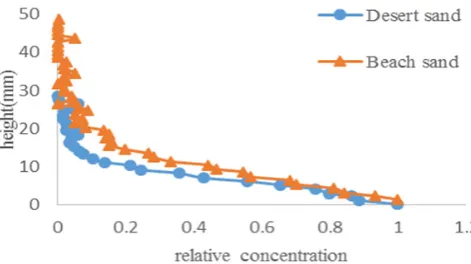
For comparison of this research with previous works, the relative concentration changes of dust particles in terms of height were calculated based on the proposed method. The changes of the relative concentrations in terms of height for two regions A and B at the speeds of 12 and 20 km/h is illustrated in Fig. 12. In [26], two types of natural sand, one collected from the Pohang beach in South Korea and the other from the Taklimakan desert in China, were investigated. Experiments were performed in an open-type subsonic wind tunnel with a test section of 6.75 m (length) × 0.72 m (width) × 0.6 m (height). A high-speed digital camera system was
used to capture images of the saltating sand particles. The image processing method was used for investigation of the saltation process. Obtaining the profiles of the particle mass concentration and the stream-wise mass flux is one the highlight results of this study by using the image processing method. The changes of the relative concentration in terms of height for the reference results [26] were obtained and shown in Fig. 13. The particles height in the reference study [26] is much lower because the size of the tunnel used is very small and limited. In order to achieve a better comparison, the results of the two studies are not presented in the same fig. As shown in Figs. 12 and 13, the relative concentration profile obtained in this study as well as the reference study [26] has a sudden transition at a certain height. The Relative concentration of particles in both studies, decreasing exponentially with increasing height up to transition point, then slightly decreases around the transition point. Of course, there are fluctuations around the transition point which can attribute to environmental fluctuations and atmospheric influences in this study. Based on this comparison, it can be concluded that our proposed model and method have sufficient validation.
Fig. 9. The sample from the spectrum of the intensity of the diffusion and transfer of particles in the region C for the speed of 8 km/h
Fig. 10. The sample from the result of edge detection for speed 8 km/h in the region C
Fig. 11. The changes of particles height with speed in the three regions A, B and C
The experimental method presented in this study can be applied for investigation on the diffusion of dust particles in the sparse vegetation area. The experimental method presented can also be applied for investigation on the diffusion of salt particles in the dried regions of the lake of Urmia.
6- Conclusions
The diffusion and transfer of dust particles are one of the most important environmental issues in the world, especially in Iran. Understanding the mechanism of the diffusion and transfer of dust particles to investigate and solve this problem is an important measure that was thoroughly investigated by presenting the proposed model and method. Unlike previous works which were carried out in an ideal condition in the wind tunnels, the proposed model simulates the diffusion and transfer of dust particles in a real situation of this phenomenon and in the atmospheric area. The most important results from this study are: A wide part of the diffusion and transfer of dust particles in the atmospheric area is the saltation. The dust particles after the initial saltation, as the impact velocity of particles exceeds the impact threshold, results in the splashing of the soil particles on the surface. The splashing particles of the soil surface play an essential role in the number of transferred particles. It can be concluded that in nature due to the presence of this splash, the dust particles after the start from the original source when they arrive at the destination, mass flux is very high. The impact threshold varies with respect to surface soil properties (such as surface roughness), which is very important to provide a proper solution to this phenomenon. As particles velocities increase, the particle height increases and the proportion slope decreases at the high velocities. The concentration of dust particles decreases exponentially by increasing up to a certain height. After this height, changes in concentration are minor. The role of mid-air collisions in the mechanism of diffusion and transfer of dust particles is significant, especially at high speeds. It is impossible to ignore its effect on the investigation of this phenomenon. The experimental method presented in this study is a suitable method for investigating the diffusion of salt particles and parameters such as the vegetation and the soil moisture in the real condition of the environment.
References
[1] R. Greeley, J. Iversen, Wind as a Geological Process, 333 pp, Cambridge Univ. Process, New York, (1985).
[2] H. Tsoar, Bagnold, RA 1941: The physics of blown sand and desert dunes. London: Methuen, Progress in physical geography, 18(1) (1994) 91-96.
[3] D. Beladjine, M. Ammi, L. Oger, A. Valance, Collision process between an incident bead and a three-dimensional granular packing, Physical Review E, 75(6) (2007) 061305.
[4] M.P. Almeida, J.S. Andrade Jr, H.J. Herrmann, Aeolian transport layer, Physical review letters, 96(1) (2006) 018001.
[5] M. Allen, D. Tildesley, Computer simulation of liquids, volume 18 of Oxford science publications, Oxford University Press, 45 (1989) 121.
[6] J.F. Kok, N.O. Renno, A comprehensive numerical model of steady state saltation (COMSALT), Journal of Geophysical Research: Atmospheres, 114(D17) (2009).
[7] H. Gould, J. Tobochnik, D.C. Meredith, S.E. Koonin, S.R. McKay, W. Christian, An introduction to computer simulation methods: applications to physical systems,
Computers in Physics, 10(4) (1996) 349-349.
[8] J.D. Iversen, K.R. Rasmussen, The effect of wind speed and bed slope on sand transport, Sedimentology, 46(4) (1999) 723-731.
[9] Y. Zhou, B.H. Xu, A.-B. Yu, P. Zulli, An experimental and numerical study of the angle of repose of coarse spheres, Powder technology, 125(1) (2002) 45-54.
[10] R. Di Felice, The voidage function for fluid-particle interaction systems, International Journal of Multiphase Flow, 20(1) (1994) 153-159.
[11] B. Xu, A. Yu, Numerical simulation of the gas-solid flow in a fluidized bed by combining discrete particle method with computational fluid dynamics, Chemical Engineering Science, 52(16) (1997) 2785-2809.
[12] B. Xu, A. Yu, S. Chew, P. Zulli, Numerical simulation of the gas–solid flow in a bed with lateral gas blasting,
Powder Technology, 109(1-3) (2000) 13-26.
[13] X.-Y. Zou, H. Cheng, C.-L. Zhang, Y.-Z. Zhao, Effects of the Magnus and Saffman forces on the saltation trajectories of sand grain, Geomorphology, 90(1-2) (2007) 11-22.
[14] L. Kang, X. Zou, Vertical distribution of wind– sand interaction forces in aeolian sand transport,
Geomorphology, 125(3) (2011) 361-373.
[15] D. Jackson, Potential inertial effects in aeolian sand transport: preliminary results, Sedimentary Geology, 106(3-4) (1996) 193-201.
[16] M.A. Rice, B.B. Willetts, I. McEwan, An experimental
study of multiple grain‐size ejecta produced by collisions
of saltating grains with a flat bed, Sedimentology, 42(4) (1995) 695-706.
[17] J. Crassous, D. Beladjine, A. Valance, Impact of a projectile on a granular medium described by a collision model, Physical Review Letters, 99(24) (2007) 248001.
[18] R.S. Anderson, P.K. Haff, Simulation of eolian saltation,
Science, 241(4867) (1988) 820-823.
[19] L. Oger, M. Ammi, A. Valance, D. Beladjine, Study of the collision of one rapid sphere on 3D packings: Experimental and numerical results, Computers & Fig. 13. The changes of relative concentration with height for
Mathematics with Applications, 55(2) (2008) 132-148.
[20] P. Nalpanis, J. Hunt, C. Barrett, Saltating particles over flat beds, Journal of Fluid Mechanics, 251 (1993) 661-685.
[21] L. Kang, L. Guo, Eulerian–Lagrangian simulation of aeolian sand transport, Powder technology, 162(2) (2006) 111-120.
[22] L. Kang, D. Liu, Numerical investigation of particle velocity distributions in aeolian sand transport,
Geomorphology, 115(1-2) (2010) 156-171.
[23] L. Kang, Discrete particle model of aeolian sand transport: Comparison of 2D and 2.5 D simulations,
Geomorphology, 139 (2012) 536-544.
[24] D.J. Sherman, D.W. Jackson, S.L. Namikas, J. Wang, Wind-blown sand on beaches: an evaluation of models,
Geomorphology, 22(2) (1998) 113-133.
[25] Z. Li, D. Feng, S. Wu, A. Borthwick, J. Ni, Grain size and transport characteristics of non-uniform sand in aeolian saltation, Geomorphology, 100(3-4) (2008) 484-493.
[26] W. Zhang, Y. Wang, S.-J. Lee, Two-phase measurements of wind and saltating sand in an atmospheric boundary layer, Geomorphology, 88(1-2) (2007) 109-119.
[27] M.V. Carneiro, N.A. Araújo, T. Pähtz, H.J. Herrmann, Midair collisions enhance saltation, Physical review letters, 111(5) (2013) 058001.
Pleasecitethisarticleusing:
M.d Alipour Shotlou, M. T. Shervani-Tabar, M. Jafari, Experimental and Image Processing Investigation on the Diffusion of Dust Particles in the Atmospheric Area, AUT J. Mech. Eng., 3(2) (2019) 165-172.

![fig. As shown in Figs. 12 and 13, the relative concentration profile obtained in this study as well as the reference study [26] has a sudden transition at a certain height](https://thumb-us.123doks.com/thumbv2/123dok_us/8955455.1864823/6.595.52.289.469.602/relative-concentration-profile-obtained-reference-sudden-transition-certain.webp)