M
M
U
U
L
L
T
T
I
I
-
-
B
B
A
A
N
N
D
D
W
W
I
I
D
D
T
T
H
H
D
D
A
A
T
T
A
A
P
P
A
A
T
T
H
H
D
D
E
E
S
S
I
I
G
G
N
N
F
F
O
O
R
R
M
M
U
U
L
L
T
T
I
I
S
S
T
T
R
R
E
E
A
A
M
M
I
I
N
N
G
G
I
I
N
N
5
5
G
G
W
W
I
I
R
R
E
E
L
L
E
E
S
S
S
S
M
M
O
O
B
B
I
I
L
L
E
E
I
I
N
N
T
T
E
E
R
R
N
N
E
E
T
T
S
S
L
L
a
a
l
l
S
S
a
a
i
i
d
d
,
,
S
S
y
y
e
e
d
d
A
A
l
l
i
i
H
H
a
a
i
i
d
d
e
e
r
r
,
,
S
S
a
a
i
i
r
r
a
a
C
C
h
h
a
a
r
r
a
a
n
n
,
,
M
M
e
e
h
h
m
m
o
o
o
o
d
d
U
U
l
l
H
H
a
a
s
s
s
s
a
a
n
n
Institute Of Space Technology, Islamabad, Pakistan
ABSTRACT: Wireless communication’s users are
increasing day by day as the people are most socially connected with each other. There are number of different issues which are integrated with wireless mobile Internets. Many research studies have been conducted in the areas of wireless communication to make it more efficient and delivery quality to the consumer. This paper explores future mobile systems with Multi-bandwidth data path design approach to enhance the experience of the 5G wireless mobile Internets. The proposed solution presented in this research helped in minimizing the Buzzing and lag during the processing of the video and audio streaming. The proposed solution can provide high streaming Speed by the help of the Multi-bandwidth data path design and help in overall minimizing the time delay. The presented solution has been tested on both technologies 4G and 5G.
KEYWORDS: Wireless communication, mobile, Internet,
Technology, Video and Audio streaming
I. INTRODUCTION
Demand of the communication and information systems (IS) are increasing day by day as these systems have the capacity to provide the information access and connecting the tasks from any location around the globe [M+14]. In today’s world of information and communication technology (ICT), the internet has become an important part of our life. So there are number of mobiles and Internet service provider throughout the globe which has been involved in adopting advance data communication systems and technologies so that the best quality of services and data connectivity can be provided to their consumers [M+12].
People use internet for different purposes such as information sharing, social media, marketing, Video Streaming, interaction including (business and social) and entertainment [LL04]. Much advancement has been made in the communication technology to address the gaps and barriers of data communication limits simulated on the data channel [Sta06]. The wireless networks, Wi-Fi, WI-MAX, 3G and 4G are considered as one of the advanced technologies in today’s world especially the 3G and 4G has gained much attention within the Mobile communication companies [F+06]. Security has being a critical issue in the communication networks such as
Internet [H+05]. However, it has been analysed from different surveys that the mobile internet demand is increasing day by day as on the other side the threat of the security and data privacy is also increasing [T+14]. Every organization, company, business and individual personal is concerned about the data privacy, security, protection, backup, Data connectivity and [MG98].
Many researches at academic and industrial level have been conducted for the design and implementation of a network based on wireless and mobile technologies to carry high capacity of data so that the consumer can perform number of multi-media tasks [R+13]. By the availability of the high data packet networks, the overall delay can be minimized and number of tasks specially interlinked with the video and image processes can be performed [Cho14].
transfer the high streaming bits parallel and the streaming bits will be provided high priority. Video and audio streaming require high data transfer channels thus, resulting overall load on the network but still it has been analysed that there are number of consumers which are facing the buzzing during the video and audio streaming. It has been believed that the buzzing issues have been minimized by integration of the Fifth Generation Cellular Mobile Networks. The objective of this research is to present a Multi bandwidth data path for carrying Multi-streaming in 5G wireless mobile Internets. Section II presents the related work, a brief introduction of the analysis of the different generation involved in the Cellular Mobile Networks and its communication elements directly linked with the video and audio streaming. Section III presents the detailed discussion of the proposed solution and identifies the benefits which can be simulated for Multi-streaming in 5G wireless mobile Internets. Section IV presents the verification and validation of the proposed solution and in the end of the research the conclusion and future is discussed.
II. LITERATURE REVIEW
The demand of wireless technologies and Cellular Mobile networks is increasing day by day [E+14]. Many research studies have been conducted in past on the academic and information industry to address challenges within the perspective of data streaming in Cellular and mobile technologies [Z+14a]. Currently, the wireless access points and Mobile networks are available in the number of locations and regions including home, building, and offices or anywhere the person is travelling [PZ10]. The consumers (internet user) are in need of the internet connectivity in shopping malls, airport bus stations and many other areas as the world has become a globe village [T+14]. Due to the high computing power now a day, the users have the capacity to surf the internet, email, and social media everywhere. The high computation devices let the user to transfer the high video and audio information [PR99]. As the numbers of the users are increasing, there is a high risk of the security and also the load on the Cellular Mobile networks are increasing thus there is a high probability that if the load in not managed properly the overall network delay may occur. There are number of different methodologies, tools and techniques has been utilized to manage the load of overall the mobile and internet network but still it has been analysed that consumer face difficulty in video and audio streaming. The video and audio streaming challenges can be addressed by the integration of advance networks such as 4G and 5G.
In this section, we have presented the related research studies which have been conducted for the analysis of the different generation involved in the Cellular Mobile Networks and its communication elements directly linked with the video and audio streaming. The study of the existing architecture will help us to identify their limitation and how the proposed solution can be mapped on the 4G, WI-MAX and 5G Cellular Mobile networks.
A. Wi-MAX Architecture
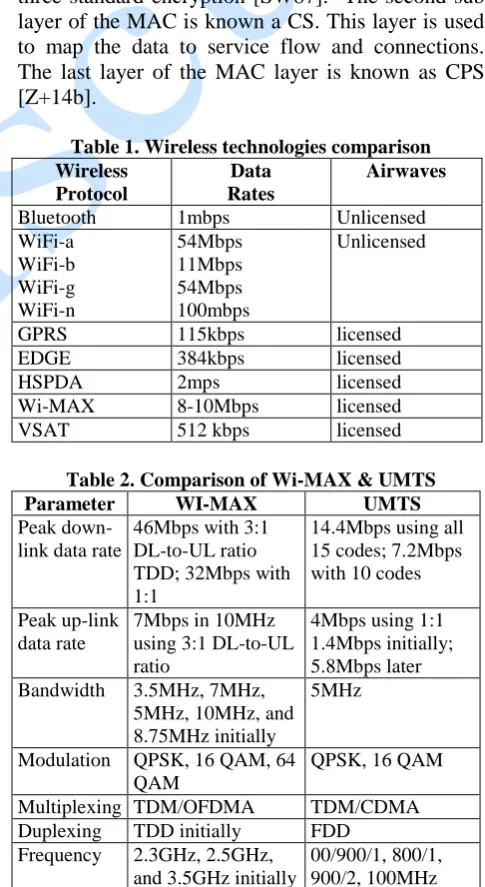
Wi-MAX architecture is made of two layers [LL04]. The two main layers are MAC layer and PHY Layers. The MAC layer is again divided into three sub layers. The first layer is Subscriber station (SS). This layer performs all the encryption and decryption of the data received or send from the PHY layer. The DES uses the data traffic of 56 bit for the encryption and the key exchanges use the three standard encryption [SW87]. The second sub layer of the MAC is known a CS. This layer is used to map the data to service flow and connections. The last layer of the MAC layer is known as CPS [Z+14b].
Table 1. Wireless technologies comparison Wireless
Protocol
Data Rates
Airwaves
Bluetooth 1mbps Unlicensed
WiFi-a WiFi-b WiFi-g WiFi-n
54Mbps 11Mbps 54Mbps 100mbps
Unlicensed
GPRS 115kbps licensed
EDGE 384kbps licensed
HSPDA 2mps licensed
Wi-MAX 8-10Mbps licensed
VSAT 512 kbps licensed
Table 2. Comparison of Wi-MAX & UMTS Parameter WI-MAX UMTS Peak
down-link data rate
46Mbps with 3:1 DL-to-UL ratio TDD; 32Mbps with 1:1
14.4Mbps using all 15 codes; 7.2Mbps with 10 codes
Peak up-link data rate
7Mbps in 10MHz using 3:1 DL-to-UL ratio
4Mbps using 1:1 1.4Mbps initially; 5.8Mbps later Bandwidth 3.5MHz, 7MHz,
5MHz, 10MHz, and 8.75MHz initially
5MHz
Modulation QPSK, 16 QAM, 64 QAM
QPSK, 16 QAM
Multiplexing TDM/OFDMA TDM/CDMA Duplexing TDD initially FDD
Frequency 2.3GHz, 2.5GHz, and 3.5GHz initially
B. 4G Technology
4G technology has highly been adopted by the number of mobile services provided company. 4G technology is more advanced as compared to the 3G [HCY07]. The channel has more bandwidth and can carry more data as compared to other existing solution. In Tokyo, Japan, in the year 2005, first field trail for the 4 G was accompanied. NTT Do Co Mo was very successful in the achievement of the 1Gbps time packet transmission in downlink with the moving speed of twenty km per hour. For the utilization of the 4G services, multimode terminals should have the capability of selecting the wireless target systems. Currently, GSM system and base stations routinely broadcasts the signalling messages for the service subscription to the mobile stations [Kum11].
Though, the complete procedure entered in the phase of complete complications in the presence of the 4G of the heterogeneous systems due to the presence of the wireless technologies differences as well as access protocols. The 4G infrastructure consisted of the terminal mobility to the providing of the facility of the wireless services at anywhere and anytime [R+13]. The terminal mobility allowed the clients to
move across geographic wireless network
boundaries. However, main two problems in the terminal mobility is the location management and the second problem is the handoff management. Location management can easily track as well as locate the mobile terminal for the possible connection. It revolves in the effective handling of the information related to the roaming terminals. Handoff management deals with the maintenance of the on-going communication when the terminal is roaming. Mobile IPv6 is a homogeneous IP-based protocol of mobility for the IPv6 wireless systems. The design consists of each of the terminal that has a home address of IPv6. When the terminal is moved out of local network, the home address converts invalidity, and obtains new IPv6 address in an address that is visited. The development as well as design of the techniques of radio access and evolution of existent system, the Third Generation Partnership Project lays down the future Long Term Evolution (LTE) foundation of advancements of standards 3GPP candidate for the 4G. The target value of the peak spectrum efficacy for the LTE systems were based on the30bps/Hz and 15 Bps/Hz in downlink as well as uplink for the transmission respectively.
C. 5G Conceptual Architecture
The 5G technology is assumed to be one of the enhanced communication standards as compared to the 4G and other existing network technology [T+14]. Currently, there is no official name provided to the 5G technology [T+14]. According to the different researches [MG98, Poi09, M+12] there will be no limitation and the people can communicate with each other through real world. The high speed of data transfer would be possible and the people will be able to send large multimedia files as high speed. The current web of standard of three WWW “World Wide Wireless Web” will be replaced with fore WWWW “World Wide Wireless Web”. The new protocol stack will be implemented in the 5G Conceptual Architecture. The architecture will have different feature such as high resolution, advance billing mechanism, better quality, multi user support, advance security mechanism and many other features [T+14].
The conceptual architecture of the 5G technology has been divided into layers. These layers have been presented within similar context of the ISO model [T+14]. In 5G technology the conceptual model contain five main layers. The sequence of the layer is provided as top to bottom “Application Layer, Open transport Protocol, Upper network layer,
Lower Network layer and Open Wireless
architecture”. It can be observed that the physical layer and Data link layer has been replaced with the Open wireless architecture layer. This layer could be one of the main approaches to introduce or integrate the real world of wireless information sharing and exchange. It has been analysed from different researches [HCY07] that Fifth Generation technology of mobile communication, is seen as consumer oriented. The customized priority of the data allocation can be set according to the user or application requirements.
Table 3. Comparison of All Generation Mobile Technology [T+14] Technology
Feature
1G 2G 3G 4G 5G
Start Deployment
1980 1990-2004 2004-2010 Currently Utilized by number of Cellular Companies
Soon
Data Bandwidth
2 Kbps 64 Kbps 2 Mbps 1 Gbps Higher than 1 Gbps
Technology Analogy Cellular Technology
Digital Cellular Technology
CDMA 2000 MAX LTE Wi-Fi
WWWW (Coming Soon) Services Mobile Telephony Digital Voice, SMS,
Higher Capacity Data Packets
Integrated high Quality audio,
Video, Data
Dynamic Information Access,
Wearable devices
Dynamic Information Access,
Wearable devices with AI capacity
Multiplexing FDMA TDMA,CDMA CDMA CDMA CDMA
Switching Circuit Circuit, Packets Packets All Packets All Packets
Core Network PSTN PST Packet N/W Internet Internet
III.LITERATURE REVIEW
System design for the Multi-bandwidth data path for Multi streaming in 5G wireless mobile Internets. The proposed solution will be simulated on the application (Services) to minimize the Buzzing and lag delay during the video and audio streaming. The multi-streaming mechanism has been integrated in so that the flow of the video and audio signal can be parallel executed on the data path channel. In this section, the detail discussion has been conducted on the Wireless Broadband Standards, System Architecture and Proposed Algorithm for multi transmission of the audio and video signalling in 5G wireless mobile Internets.
A. Wireless Broadband Standards
The industry name of the IEEE 802.16 standards is Wireless Broadband [HMD05]. Wireless Broadband is the wireless technology which mainly functions in the radio spectrum of “10-66 in the Line of Sight (LOS) and 2-11 GHz in the Non-LOS (Wi-MAX forum)” [ZH99]. It is a point to multi point technology [MG98]. Wi-MAX and 5G is developing broadband wireless entrance technology that conveys a “carrier-class, high speed” at a comparative lower-cost than the other cellular facilities or services while giving long distances as covered than Wi-Fi and other existing wireless communication standards [PR99].
The purpose of designing Next Generation networks was to provide “cost-effective technology” [MG98] with a theoretic data rate of “70 Mbps over a wide area up to 50km in the NLOS” [N+07], control of great quality voice, records and video services. LOS is required by the Wi-MAX for higher rate of frequencies. The Wi-MAX and 5G technology’s has compatibility benefit as compared to other wireless technologies which includes asynchronous transfer
mode (ATM), Internet Protocol (IP) etc. Wi-MAX is categorized as a “wireless metropolitan area network” (WMAN). The 802.16 standard was designed after the failures of security that subjected down the development of “IEEE 802.11 wireless networks” [Poi09].
The IEEE 802.16 Working Group is developed for a robust mechanism incorporated Data over Cable Service Interface Specification (DOCSIS) a solution to the last mile cable problem. Since the security was considered as main priority in the development of IEEE 802.16 [PR99]. On the other hand, the Working Group was very busy in the development of several mechanisms in order to defend theft of service and unapproved or unauthorized information, alteration and disclosure [www12].
B. System Architecture
The system architecture is presented in the following figure. The System Architecture presents the location of the deployed solution. Solution has been deployed on the Application services layer.
C. Proposed Algorithm
The proposed algorithm in the paper has provided a unified solution for setting the high priority of the audio and video signals and transferring the information to the designation node. The working mechanism of the proposed algorithm has been driven from the pipeline mechanism [PZB02]. The pipeline is the common mechanism which is utilized in the processing units for receiving the data simulate.
Data are access from the sources such as server. The data packets are transformed in the digital signal for the transmission. These signals are sending to the channel through open wireless architecture.
The pipeline is deployed at the application services
where the signals are transmitted with
simultaneously. The proposed solution in the research helps to minimize the Buzzing and lag during the processing of the video and audio streaming. The multi-data paths has been utilized to transfer the high streaming bits parallel and the streaming bits have been given high priority on the transmission channels.
IV.SYSTEM EVALUATION
The verification and validation (V&V) of the real time system is the critical and time consuming challenge. The performance and evaluation of any system is surrounded by number of different parameters i.e. response time, delay, data packet size and many other. The experiment has been set in the Netlogo environment. There are two main experiments which have been calculated for the verification and validation of the proposed solution.
1) Time Delay (Proposed Solution vs. Existing Solution),
2) Streaming Speed (Proposed Solution Vs. Existing Solution).
A. Time Delay
The experiment has been conducted to identify and analysis that how much the time delay has been improved by the integration of the proposed solution as compared to the existing solution. It has been analysed from the simulation results that proposed solution based on the Multi-bandwidth data path design has less delay as compared to the solution for audio and video streaming executed on the existing technologies. In the simulation environment we have utilized the 4G and 5G technology. It has been observed from the results that 20% to 30% of the time delay has been minimized by the integration of the proposed solution.
Figure 2. Time Delay
B. Streaming Speed
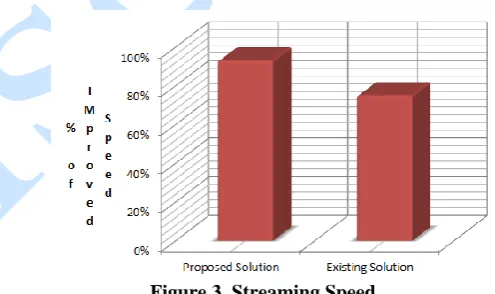
The main goal of the proposed solution is to improve the streaming speed thus this help in minimizing the Buzzing and lag during the processing of the video and audio streaming. It has been analysed from the results that the by the integration of the Multi-bandwidth data path approach the overall Streaming Speed thus resulting into the overall improvement in the audio and video signals.
Figure 3. Streaming Speed
C. Finding
controlled by PCF (Packets Control Function) in the CDMA2000 network and data reply will be controlled by PDIF (Packet Data Interworking Function) in WLAN. Data traffic is routed through PDSN from CDMA2000 network to WLAN network. The Multi-bandwidth data path scheme has been defined to do bandwidth reselection for rerouting so that all network resources can be used efficiently.
V. CONCLUSION
The demand of the communication technology within the context of the mobile and internet are increasing day by day. Cellular and internet services provided are looking forward for the adaptation of the new technologies and standard which can help them to enhance the data communication processes. In the research, we have presented a design approach based on the Multi-bandwidth data path design. The proposed approach presented in this research identify that Multi streaming can be improved by the development of multi-bandwidth data path design on the application layer of next generation technology. In has been concluded from the simulation results the proposed solution provide better audio and video streaming results on 5G technology.
REFERENCES
[Cho14] Ramya Ranjan Choudhury - A
Network Overview of Massive MIMO for 5G Wireless Cellular: System Model and Potentials, International Journal of Engineering Research and General Science, vol. 2, no. 4, pp. 338-347, 2014.
[C+13] Mark Cudak et al. - Moving towards
mmwave-based beyond-4g (b-4g)
technology, in Vehicular Technology Conference (VTC Spring), 2013 IEEE 77th, 2013, pp. 1-5.
[E+14] William Enck et al. - TaintDroid: an information-flow tracking system for
realtime privacy monitoring on
smartphones, ACM Transactions on Computer Systems (TOCS), vol. 32, no. 2, p. 5, 2014.
[F+06] Simone Frattasi, Hanane Fathi,
Frank H. P. Fitzek, Ramjee Prasad, Marcos D. Katz - Defining 4G technology from the users perspective, Network, IEEE, vol. 20, no. 1, pp. 35-41, 2006.
[HCY07] Jun-seok Hwang, Roy R. Consulta, Hyun-young Yoon - 4G Mobile Networks--Technology Beyond 2.5 G
and 3G, PTC (Pacific
Telecommunications Council)
Proceedings, Hawaii, 2007.
[HMD05] R. Han, S. Mishra, J. Deng -
Defending against Path-based DoS Attacks in Wireless Sensor Networks, In Proc. the 3rd ACM on the Security of Ad Hoc and Sensor Networks (SASN 2005), pp. 89-96, 2005.
[H+05] L. V. Hoesel, J. Doumen, P. Hartel, P. Havinga, Y. W. Law - Energy-efficient link-layer jamming attacks against wireless sensor network MAC protocols, ACM on the security of Ad Hoc and Sensor Nework, pp. 76-88, 2005.
[H+14] Fourat Haider et al. - Cellular architecture and key technologies for 5G wireless communication networks, IEEE Communications Magazine, p. 123, 2014.
[JPH02] D. Johnson, A. Perrig, Y. Hu - SEAD: secure efficient distance vector routing in mobile wireless ad-hoc networks, Proceedings of the 4th IEEE workshop on mobile computing systems and applications (WMCSA’02), pp. 3–13, 2002.
[Kum11] K. Kumaravel - Comparative Study of 3G and 4G in Mobile Technology, International Journal of Computer Science Issues, vol. 8, no. 5, pp. 256-263, 2011.
[KS13] John Krogstie, Nafiseh Shabib - A Conceptual Framework for Application of Group Recommendations Techniques in Information Systems, NOKOBIT, vol. 2013, 2013.
[K+14] Zaheer Khan et al. - Carrier
aggregation/channel bonding in next generation cellular networks: methods and challenges, Network, IEEE, vol. 28, no. 6, pp. 34-40, 2014.
[LL04] H. Luo, S. Lu - URSA: ubiquitous and robust access control for mobile ad-hoc
networks, IEEE/ACM Trans
[MG98] C. Madson, R. Glenn - The use of HMAC-MD5-96 within ESP an AH, in Internet Request for Comment, RFC 2403, 1998.
[M+12] Nicola Michailow, Rohit Datta,
Stefan Krone, Michael Lentmaier, Gerhard Fettweis - Generalized frequency division multiplexing: a flexible multi-carrier modulation scheme for 5th generation cellular
networks, in German Microwave
Conference (GeMiC), 2012.
[M+14] Stephanie J. Mitchell, Leandra
Godoy, Kanya Shabazz, Ivor B. Horn - Internet and mobile technology use
among urban African American
parents: survey study of a clinical population, Journal of medical Internet research, vol. 16, no. 1, 2014.
[Nob04] Dennis Nobelius - Towards the sixth generation of R\&D management, International Journal of Project Management, vol. 22, no. 5, pp. 369-375, 2004.
[N+07] A. Nadalin, M. Goodner, M. Gudgin,
A. Barbir - WSTrust 1.3. OASIS standard., 2007.
[Poi09] Richard A. Poisel - Modern
Communications Jamming Principles and Techniques.: USA, ISBN 1-58053-743- x, 2009.
[PB94] C. E. Perkins, P. Bhagwat - Highly dynamic destination sequenced distance vector routing (DSDV) for mobile computers, Comp. Commun.Rev., pp. 234-244., 1994.
[PR99] C. E. Perkins, E. M. Royer - Ad-Hoc On Demand Distance Vector Routing, Proceedings of the IEEE Workshop on
Mobile Computing Systems and
Applications (WMCSA), New Orleans, LA, pp. 90-100, 1999.
[PZ10] Papadimitratos Panagiotis, Haas J. Zygmunt - Secure message
transmission in mobile ad hoc
networks, Journal of Network, vol. 4, p. 03, Feb. 2010.
[PZB02] Thomas Phan, Zorpas George,
Rajive Bagrodia - An extensible and scalable content adaptation pipeline architecture to support heterogeneous clients, in Distributed Computing Systems, 22nd International Conference, pp. 507-516, 2002.
[R+13] Theodore S. Rappaport et al. -
Broadband millimeter-wave
propagation measurements and models using adaptive-beam antennas for
outdoor urban cellular
communications, Antennas and
Propagation, IEEE Transactions on, vol. 61, no. 4, pp. 1850-1859, 2013.
[Sta06] W. Stallings - Cryptography and network security: principles and practice, Pearson.: Prentice Hall, 2006.
[SW87] N. Schacham, J. Westcott - Future directions in packet radio architectures and protocols, Proceedings of the IEEE, 75(1), pp. 83–99, 1987.
[T+14] John Thompson et al. - 5g wireless communication systems: Prospects and challenges, Communications Magazine, IEEE, vol. 52, no. 2, pp. 62-64, 2014.
[VJ01] Upkar Varshney, Radhika Jain -
Issues in emerging 4G wireless networks, Computer, vol. 34, no. 6, pp. 94-96, 2001.
[ZH99] L. Zhou, Z. Haas - Securing ad hoc networks, IEEE Network Magazine 13(6):, pp. 24–30., 1999.
[Z+14a] Kuan Zhang, Xiaohui Liang, Xuemin
Shen, Rongxing Lu - Exploiting multimedia services in mobile social networks from security and privacy
perspectives, Communications
Magazine, IEEE, vol. 52, no. 3, pp. 58-65, 2014.
[Z+14b] Kyriakos Zarifis et al. - Diagnosing path inflation of mobile client traffic, in Passive and Active Measurement, 2014, pp. 23-33.
![Table 3. Comparison of All Generation Mobile Technology [T+14] 1G 2G 3G 4G](https://thumb-us.123doks.com/thumbv2/123dok_us/8959690.1869058/4.595.42.539.77.278/table-comparison-generation-mobile-technology-t-g-g.webp)