RIC
HA
RD
.
W
ALKE
R
Siderophile
Elements in Tracing
Planetary Formation
and Evolution
L
ianeG. B
enninGGFZ Potsdam, Germany University of Leeds, UK
Editorial Board
T
ime
LLioTTUniversity of Bristol, UK
e
ricH. o
eLkersUniversity College London, UK CNRS Toulouse, France
s
usanL.s. s
TippUniversity of Copenhagen, Denmark
Editorial Manager
marie-aude HuLsHoff
Graphical Advisor
J
uand
ieGor
odriGuezB
Lanco University of Copenhagen, DenmarkEach issue of Geochemical Perspectives pre-sents a single article with an in-depth view on the past, present and future of a field of geochemistry, seen through the eyes of highly respected members of our community. The articles combine research and history of the field’s development and the scientist’s opinions about future directions. We welcome personal glimpses into the author’s scientific life, how ideas were generated and pitfalls along the way.
Perspectives articles are intended to appeal to the entire geochemical community, not only to experts. They are not reviews or monographs; they go beyond the current state of the art, providing opinions about future directions and impact in the field.
Copyright 2016 European Association of Geochemistry, EAG. All rights reserved. This journal and the individual contributions contained in it are protected under copy-right by the EAG. The following terms and conditions apply to their use: no part of this publication may be reproduced, translated to another language, stored in a retrieval system or transmitted in any form or by any means, electronic, graphic, mechanical, photo-copying, recording or otherwise, without prior written permission of the publisher. For information on how to seek permission for reproduction, visit:
www.geochemicalperspectives.org
or contact [email protected]. The publisher assumes no responsibility for any statement of fact or opinion expressed in the published material.
ISSN 2223-7755 (print) ISSN 2224-2759 (online) DOI 10.7185/geochempersp.5.1
Principal Editor for this issue Tim Elliott, University of Bristol, UK Reviewers
Laurie Reisberg, CRPG Nancy, France Graham Pearson, University of Alberta, Canada Cover LayoutPouliot Guay Graphistes TypesetterInfo 1000 Mots PrinterDeschamps impression
ABOUT THE COVER
Upper mantle peridotite xenolith present in basalt from the Yangyuan locale, China. Two stages of Earth’s accretional history are recorded in mantle peridotites like this one. The moderately siderophile elements are present in abundances consistent with high pressure and temperature partitioning between metal and silicate, such as may have occurred at the bases of magma oceans over the course of the final 10-20% of Earth’s accretion. The highly siderophile elements
Janne BLicHerT-T
ofTCONTENTS
Acknowledgements . . . . III
Siderophile Elements in Tracing Planetary Formation and Evolution . . . . 1
Abstract . . . . 1
1 . Introduction . . . . 3
2 . Overview of Siderophile Elements . . . . 14
3 . Siderophile Elements in Chondrites and Iron Meteorites . . . . 21
3 .1 Chondrites . . . . 21
3 .2 Iron Meteorites . . . . 27
3 .3 Additional Observations Regarding Siderophile Elements in Meteorites . . . . 33
4 . Origin of Siderophile Elementsin the Silicate Portions of Differentiated Planetary Bodies . . . . 36
4 .2 Origin of Siderophile Elements in the Moon and Mars,
and Some Lesser Bodies . . . . 48
4 .2 .1 The Moon . . . . 49
4 .2 .2 Mars . . . . 54
4 .2 .3 Other differentiated bodies . . . . 59
4 .3 Putting the Planetary Data Together . . . . 61
4 .4 Genetics of Late Stages of Earth’s Accretion . . . . 65
5 . Siderophile Elements in the Depleted MORB Mantle . . . . 67
5 .1 Overview of the DMM . . . . 67
5 .2 Mid-Ocean Ridge Basalts . . . . 71
5 .3 Abyssal Peridotites . . . . 74
5 .4 Ophiolites . . . . 79
5 .5 Summary Observations regarding Siderophile Elements in the DMM . . . . 84
6 . Siderophile Elements in Subcontinental Lithospheric Mantle . . . . 90
7 . Siderophile Elements in the Mantle Sources of Ocean Island Basalts . . . . 95
7 .1 Siderophile Element Abundances and 187Os/188Os . . . . 95
7 .2 The Story of 186Os . . . . 102
8 . Tungsten Isotopes In The Mantle . . . . 110
9 . Concluding Remarks . . . . 117
References . . . . 119
ACKNOWLEDGEMENTS
I accomplished most of the writing of this article while on sabbatical. I thank the University of Maryland for providing sabbatical support, as well as the Carnegie Institution of Science’s Department of Terrestrial Magnetism, the Lunar and Planetary Institute, the University of Vienna, and the Tokyo Institute of Tech-nology’s Earth-Life Science Institute for hosting me during the sabbatical. The work described below by the UMd group has been supported by numerous NSF and NASA grants over the years, most recently by NASA grants NNX13AF83G and NNA14AB07A, and NSF-CSEDI grants EAR1160728 and EAR1265169. These
sources of funding are gratefully acknowledged. Mary Horan and Igor Puchtel
provided reviews of the first draft and are thanked for bravely wading into a manuscript containing so many words! I am especially grateful for the heroic
editing by Tim Elliott and the equally heroic reviewing done by Laurie Reisberg
and Graham Pearson. They all provided many great comments for improvements.
I also wish to acknowledge Marie-Aude Hulshoff for her important assistance in
assembling and proofing the manuscript.
Richard J. Walker
SIDEROPHILE ELEMENTS
IN TRACING PLANETARY
FORMATION
AND EVOLUTION
ABSTRACT
The siderophile, or iron-loving elements have many applications in the Earth and planetary sciences. In primitive meteorites, differences in the relative abundances of these elements are likely due to both nebular and parent body processes. In addition, some siderophile elements are also characterised by isotopically distinctive nucleosynthetic signatures. Thus, the relative abundances and isotopic compositions of these elements can be used to trace the genetics of primary planetary building blocks. Although these elements are largely concentrated in the metallic cores of differentiated planetary bodies, their absolute and relative abundances, as well as their isotopic compositions can also reveal important information regarding conditions of core formation and the chemical evolution of the silicate portions of the planetary bodies. The lithophile-siderophile nature
of the radiogenic 182Hf-182W system allow it to be used to place chronologic
The abundances of siderophile elements in the terrestrial mantle are used to assess primary and secondary melting processes, and resulting metasomatic interactions. In addition, the Re-Os isotope system can, in some instances, be used to place chronologic constraints on when these processes occurred. The
abundances of siderophile elements, and 187Os/188Os and 186Os/188Os ratios in
1.
INTRODUCTION
The siderophile, or Fe-loving elements, were defined by Goldschmidt as those
elements with a tendency to partition into metallic iron relative to the silicate Earth, the hydrosphere, or the atmosphere (Goldschmidt, 1937). Some of the siderophile elements are also chalcophile, and tend to strongly partition into sulphide melts and some sulphide minerals. Here, I provide an overview of siderophile elements in geochemical and cosmochemical systems, focusing on what I consider to be some of the more important and interesting applications of these elements to Earth and planetary science. There is, of course, no hope of covering all applications related to this extensive group of elements, or of even discussing all of these elements. Most of the focus will be on so-called highly siderophile elements (to be defined later), with some forays to moderately sidero-phile elements. Although slightly siderosidero-phile elements, such as Mn, V and Cr, are not unloved, they will largely be ignored here, due to space limitations, as well as my lack of expertise regarding them. Siderophile elements have been used to learn some important details about the origin of the Earth and Moon, and how our planet ended up the way it did. However, ambiguities in how siderophile element data are interpreted have also provided us with some “mysteries” that we will likely debate for years to come.
As has become a tradition in Geochemical Perspectives, I begin by explaining
how I managed to wind up in a career focused on geochemical research that has been largely centred on the generation and interpretation of siderophile element data. At the outset, I must admit that my entry into the world of siderophile elements did not occur as a result of a geochemical epiphany, or careful plan-ning. I simply blundered into this suite of elements as an unlikely outcome of the transition from my dissertation project to a postdoctoral project.
My doctoral dissertation project at the State University of New York at Stony Brook involved the study of strictly lithophile trace elements, including Sr, Nd and O isotopes, in granites and granitic pegmatites of the Black Hills, South
Dakota. My advisor, Jim Papike, who had moved to the Black Hills at the beginning
of my Ph.D. project, was directing much of his research energies towards these granitic rocks at the time. The original research plan for my Ph.D. project was to determine rare earth element (REE) and some other trace element concentrations in minerals and bulk samples (whatever that means when working with pegma-tites) of these rocks. To do this, I was to utilise the instrumental neutron activation analysis (INAA) technique at a distant facility. For this work, I drove off to the
northwestern portion of the U.S. to work with J.C. Laul at the Battelle Northwest
and textures, some of the granites and granitic pegmatites I worked on proved to be surprisingly challenging with respect to determining the concentrations of REE. To make a long story short, the quite low REE abundances in many of the rocks and minerals of interest, coupled with very high abundances of some elements that can swamp the signals of the REE when conducting INAA (like Ta and U), led to problems obtaining accurate data. I eventually returned to Stony Brook without the primary data needed for my dissertation. After discussing the
analytical problems I had with Stony Brook professor Gil Hanson, he suggested
that I could gather the data I needed by the more painful isotope dilution method, using his thermal ionisation mass spectrometry (TIMS) lab. Isotope dilution of these elements involves quite a bit of chemistry, as it requires dissolution of the rock or mineral, adding precisely determined amounts of enriched isotopes to the solution, and separating the REE through a series of cation exchange columns. I accepted the challenge, and over the next few years became inculcated in the joys and frustrations of chemistry labs and TIMS. The project eventually wended its way to completion in late 1984.
As the defense date of my dissertation neared, I began to look for gainful employment to follow my graduate career. Like many soon to be freshly minted Ph.D.’s, I was naturally looking to extend this same line of research of granites into a sixty year research career. This seemed like a good idea at the time. The rocks I was working on proved to be very interesting, and there was much left to learn from them about crustal evolution, and even about processes that can create
economically viable mineral deposits (Walker et al., 1986). But how and where
to find a follow-on research home that would allow me to continue this work? Sometimes jobs can be found where you least expect them. As a result of
working in Gil Hanson’s lab, I became particularly well versed in the care and
feeding of mass spectrometers built by the U.S. National Bureau of Standards (NBS), which has subsequently been renamed the National Institute of Standards and Technology (NIST). We had two such mass spectrometers at Stony Brook. These were not commercial mass spectrometers. The NBS would build and sell you a mass spectrometer…, but only if you were nice to them and convinced them the mass spectrometer would be put to good use. Younger readers are reminded that, at that time in the early 1980’s, commercially made thermal ionisation mass
spectrometers were still relatively rare, and most labs that did TIMS work (e.g.,
Caltech, MIT, Carnegie) utilised custom-built mass spectrometers, or commercial concoctions that operated with mixed success. The mere mention of the word
Nuclide may still bring smiles to some faces, and looks of abject horror to others.
necessary parts were hoisted into a van, and fellow graduate student Jay Banner (now a professor at the University of Texas) and I drove them down to the NBS in Gaithersburg, Maryland for the modifications. While there we received a tour that was akin to a James Bond briefing by Q. We got to see some of the newer versions of their mass spectrometers. One that was particularly intriguing was
introduced as a resonance ionisation mass spectrometer (RIMS). It consisted of a
rela-tively small TIMS combined with a tunable dye laser, which was, in turn, pumped by a Nd-YAG laser (pulsed at a very slow 10 Hz!). This was not laser ablation. The idea was to chemically separate and purify the element or elements of interest from matrix, just like with normal TIMS. The separated material was loaded onto a filament as with TIMS, however, for this measurement technique, the heat of the filament was used to atomise, rather than ionise the element. The laser light could be used to selectively photo-ionise atomic species of certain elements from the gas cloud in the source region of the mass spectrometer. The element-se-lective photo-ionisation would then take you from the atomised ground state to an excited state, then on to ionisation, whereby the mass spectrometer could do the rest with high voltage acceleration, focusing, and magnetic separation. The specificity of resonance ionisation would either allow you to do a bit less
chemistry on the samples, e.g., to selectively photo-ionise elements in order to
eliminate isobaric interferences from other elements present in the separate, or to ionise elements that were not amenable to efficient thermal ionisation. It was pointed out to me that there was currently no one at the NBS working full time on the experimental instrument, and that I might want to apply for a National Research Council postdoctoral fellowship to do this. Although this didn’t sound much like a follow up to a degree in geochemistry, the mass spectrometer was shiny, had flashing lights and looked really neat, so I applied and the proposal was selected for funding.
As I recall, my proposal primarily promised to use the new instrument to make more REE measurements on granites using simplified chemical separation methods, but also included a short section on measuring the siderophile elements Re and Os. I had included these two elements because they were on the list of elements that allegedly could be photo-ionised and analysed by RIMS. This was potentially handy because the very high first ionisation potentials of both elements made them unsuitable for standard TIMS measurements, using a hot
filament for ionisation. I had read the pioneering applications of the 187Re-187Os
isotopic system in several seminal papers published by Jean-Marc Luck and Claude
Allègre, of the University of Paris, a few years earlier (e.g., Allègre and Luck, 1980;
Luck et al., 1980; Luck and Allègre, 1983). This radiogenic isotope system seemed
for doing this was exacting, suffered from very low ion yields in the mass spec-trometer, and achieved relatively poor precision (ca. ±0.5 %). Maybe I could do better with RIMS.
I moved to Gaithersburg in January 1985 and began work on the new instrument. It was decided that I would first tackle the Re-Os isotope system, because Re and Os were perfect targets for photo-ionisation, and this might make a splash in the mass spectrometry world. I planned to conquer the system after maybe a few months of work. I then expected to get back to the more important measurements of the REE.
Development of the mass spectrometry was surprisingly straightforward.
With help from my NBS mentor, Jack Fassett, I was able to make nearly
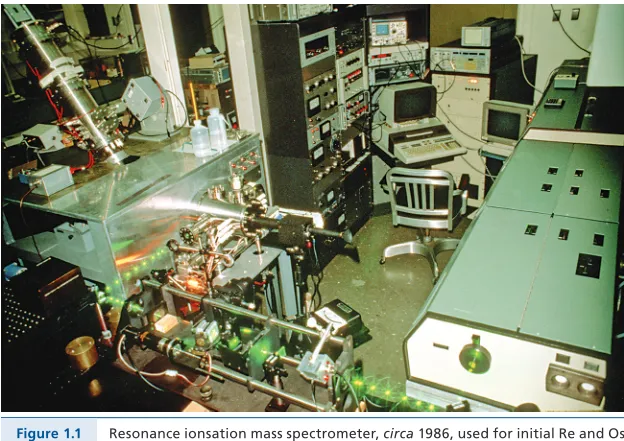
state-of-the-art isotope ratio measurements of these two elements after just a few months of methods development, using the six inch radius of curvature RIMS mass spec-trometer (Fig. 1.1). State-of-the-art, of course, was still only about ±0.5 to 1 % precision, and I never did top the precision of the Paris group’s technique using RIMS. Fortunately, such low precision is not a problem for some applications of this isotope system. Unlike for Nd isotope applications, for example, where the ability to make measurements at the parts per 10,000 level is critical, the atomic
abundance of 187Os present in different rocks and minerals vary by more than
1000 %. Consequently, measurement precision of ±1 % was not necessarily a major handicap. Due to the selectivity of the photo-ionisation schemes used,
I could alternately measure the isotopic compositions of Re and Os loaded onto the same filament, simply by turning a dial on the side of the dye laser! The technique was far from perfect, but it worked. Among the requirements was that tiny, custom Ta filaments had to be hand-crafted for each analysis. Eventually we even learned to pulse the temperature of the filament to crudely coincide with the pulse rate of the laser, gaining us a modicum of improved efficiency. Refinement
of equipment and methods led to the publication of a paper in Analytical Chemistry
(Walker and Fassett, 1986), partially fulfilling my contractual obligation to the project. This meant I could move on to geologic applications!
Unfortunately, getting a viable chemistry to work for the Re-Os system proved to be much more elusive than development of the mass spectrometry. At that time I didn’t understand that Os was easily volatilised from oxidising solutions, so the initial spikes I made (in nitric acid!) suffered rapid Os loss. Before I knew it, most of my two year postdoc had evaporated, along with the Os. I became sufficiently frustrated with the limited progress that I ultimately humbly
contacted Jean-Marc Luck, who at the time was working on Os at Yale with Karl
Turekian. He generously provided me with a manuscript that detailed his chemical
procedures. I ended up copying some parts of his methods, and adapted others for the RIMS method (Walker, 1988), and was beginning to obtain some reasonable numbers on USGS standard rock powders by the time my first postdoc ended.
By this time, I had applied for a number of assistant professor positions. Mapping out many failures with a virtually unknown isotope system and no geologically relevant results, however, was not a good strategy for acquiring a faculty position in the geosciences. I even have some humorous interview stories from this period. For example, one institution sent me a nice letter (yes, it was paper back then) that stated their department was very interested in my work and would soon be inviting me for an interview. I was told that I should prepare a talk for the interview. About a week later I received another letter that said the instrumentation I was using was very expensive, so they had changed their minds and decided not to invite me for an interview after all. I ultimately did interview for a number of faculty jobs, but selling myself based on the (theoretical) promise of good things to come did not get me a job. Fortunately, during my final few months as an NBS postdoc I was invited to give a talk at the nearby Carnegie Institution of Washington’s Department of Terrestrial Magnetism (DTM). I spoke about the RIMS technique and reviewed what I thought were some potentially exciting future applications of the Re-Os system. The talk interested staff
scien-tists Rick Carlson and Steve Shirey to a sufficient degree that they convinced DTM’s
then Director, George Wetherill, to hire me for a follow-on two year postdoc.
This turned out well for all of us. Both Rick and Steve had great ideas for initial
applications of the system, while I had the means to make the measurements. While continuing to use the mass spectrometer at NBS, I was able to produce the first Re-Os isochron for a terrestrial igneous system, the 2.7 Ga Pyke Hill
komatiites, in collaboration with Steve and Ole Stecher (Walker et al., 1988). I also
generated the first Re-Os isotopic data for mantle xenoliths, in this case from
For this study we found that the Os isotopic compositions of the xenoliths were quite variable and were able to correlate Os isotopic compositions with proxies for melt depletion. This led to the conclusion that some of the xenoliths had been
depleted in Re, along with melt, more than 3 Ga ago (Walker et al., 1989). This
in turn demonstrated that portions of the subcontinental lithospheric mantle (SCLM) underlying the Kaapvaal Craton formed at about the same time as the overlying Archean crust, strengthening the then nascent concept of long-lived lithospheric keels to continents. It also means that SCLM is commonly isolated from the convecting upper mantle for long periods of time. This study has led to considerable efforts by numerous labs around the world to date melt depletion in SCLM using Os isotopes. I’ll come back to this topic in a later section.
At around the same time, I received a phone call from a guy with a British
accent (with maybe a bit of Australian mixed in) who introduced himself as John
Morgan (Fig. 1.2). He worked at the U.S. Geological Survey in Reston, Virginia,
about 40 km away, and invited himself to visit the RIMS lab at the NBS. When he arrived, he made me aware that he had been working on Re, Os and some other siderophile elements in terrestrial and extraterrestrial rocks for “donkey’s years” (one of his favourite terms). He had been making these measurements by neutron activation analysis (both instrumental and radiochemical), since the early 1960’s, when he completed his Ph.D. dissertation at the Australian National University. During the early stages of his career, he
care-fully documented the trace element behaviours of Re and Os in terrestrial rocks and meteorites (Morgan and Lovering, 1967a,b), and subse-quently was heavily involved in the analyses of
Apollo samples (e.g., Morgan et al., 1972, 1974).
Figure 1.2 John Morgan was an innovator and
major player in the development of the Re-Os isotope system, and the study of siderophile elements in general. He is shown here in laboratory attire at the U.S.G.S in Reston, VA in the early 1990’s.
As later became obvious to me, John had been planning a range of
impor-tant applications of the Re-Os isotope system to geological and cosmochemical problems since the time of his dissertation, and was waiting for an analytical method to come along that would allow him to make the isotopic measurements he knew should be made. He proposed that we collaborate and begin work on
meteorites to build on the published results of Luck and Allègre. We also agreed
to do some work on one or two platinum group element (PGE)-rich systems that might be viewed as practical applications by his U.S.G.S. management, given that I was still looking for long-term employment. The deal was that he would do the
Ph
ot
o p
rov
id
ed
b
y R
ic
har
d Mar
ke
chemical separations and I would do the mass spectrometry. He used a different chemical processing method from mine. Instead of acid digestion, he used an alkaline fusion method, which had somewhat higher blanks, but completely dissolved a wider range of materials than my method (Morgan and Walker, 1989).
At the time John introduced himself to me, I thought iron meteorites were
possibly the least interesting topic one could think of, and that chondrites were not far behind on the list of sleeper topics. Nevertheless, I agreed to this
arrange-ment. Together with my wife Mary Horan (also a U.S.G.S. employee at the time)
we were able to quickly produce some papers that seem primitive by today’s standards, but nonetheless laid the groundwork for future applications of the Re-Os system and other siderophile elements to issues of planetary
differentia-tion and late stages of planetary accredifferentia-tion (e.g., Walker and Morgan, 1989; Horan
et al., 1992).
Collaborating with John Morgan was highly beneficial for me, as my career
research targets have forever after closely followed those promoted by him. It even turned out that his constant mantra, that lunar breccias are the key to understanding practically everything, really was true. Over the next few years we also turned out papers examining the Re-Os isotopic systematics of rocks from
the Stillwater Complex, Montana, in collaboration with David Lambert (Lambert
et al., 1989), and the Sudbury Igneous Complex, Ontario, in collaboration with
Tony Naldrett (Walker et al., 1991). The Stillwater Complex turns out to have
had a heterogeneous, but mantle-dominated Os isotopic composition when it formed. By contrast, in our study of Sudbury ores, we discovered that the initial Os isotopic composition of the complex was highly radiogenic, indicating that probably all of the PGE, as well as the Cu and Ni mined from the complex were concentrated from a crustal melt, rather than extracted from the mantle, or the meteoritic impactor that generated the complex.
After my Carnegie postdoc, I spent an additional two years working at
the U.S.G.S., where I continued to collaborate with John and Mary on the Re-Os
isotope system. Just before my temporary position at the U.S.G.S. ended in 1990, I saw an advertisement for an assistant professor job at the nearby University of Maryland (UMd), and applied. Although UMd was only about 10 km from where I lived, it was a place I had never previously visited. I was soon invited over for an interview, presumably because I was such a cheap date. I must not have done too poorly in the interview, because I was eventually hired by the Department of Geology, and still work there.
In order to dislodge me from their lab at NBS, where, after 5 years I was still conducting my mass spectrometric measurements, the Mass Spectrometry group there gave me the guts of their oldest, 12 inch radius of curvature, 68° sector TIMS. As part of my university start-up, I had the instrument upgraded with relatively modern electronics and some laser ports. The instrument was shipped the short distance to the UMd in the summer of 1990. Plans were made to turn it into a RIMS capable instrument via the acquisition of a laser system.
My new UMd colleague Erik Krogstad and I also planned to do Nd, Sr and Pb
with this instrument in a non-RIMS mode. We decided to name this mass spec-trometer Bobcat I for reasons that centre on the near theft of a stuffed bobcat during a geological field trip (Fig. 1.3a). We also submitted an instrumentation request to the National Science Foundation (NSF) for a laser system, as well as a new-generation, multi-collector TIMS.
Soon after the move to UMd, rumours began to circulate that Re and Os could be analysed as negatively-charged oxide species, eliminating the need for
an expensive set of lasers. In 1991, Rob Creaser published his now famous paper
detailing the negative thermal ionisation mass spectrometric (NTIMS) method for high sensitivity and high precision measurement of Re, Os and Ir (Creaser
et al., 1991). A few more papers on this topic from Klaus Heumann’s group in
Germany quickly followed (e.g., Völkening et al., 1991; Walczyk et al., 1991). At this
point, my plans for building a RIMS instrument were terminated. The NTIMS technique was clearly superior with respect to both sensitivity and absolute preci-sion, although it required a higher level of chemical purification of Os. I sent a letter to the NSF and asked them to forget about my request for a laser system, although we asked that the request for the multi-collector TIMS remain active. Fortunately, the TIMS proposal was subsequently funded. I quickly learned that my old NBS mass spectrometer had a “Frankenstein” switch (Fig. 1.3b), which when flipped, converted the instrument from positive to negative ion usage. We were almost immediately off and running with a far better mass spectrometric
Figure 1.3 (a) The Bobcat 1 NBS mass spectrometer at the University of Maryland was
technique than either RIMS or SIMS. In 1992, with NSF and UMd combined
funding, we added a VG Sector 54 TIMS to the lab. I have lived in a largely negative
ion world ever since. The Bobcat I mass spectrometer lived long and prospered at UMd. In 24 years of action, this 1966 vintage mass spectrometer churned out nearly 15,000 Re, Os, Sr, Pb, Ru and Mo isotopic measurements. In 22 years of
action, the VG produced an equivalent number of analyses. Both were donated
to other institutions in 2014.
I need to add a few additional words about chemical digestions and sepa-rations for siderophile elements. As with many scientific advances, chemical separation methods for siderophile elements can be traced back many decades. As noted above, my initial Re-Os chemistry was based mainly on the chemical
separation methods handed down to me from Jean-Marc Luck. This consisted of
a more or less standard acid dissolution of a rock using hydrofluoric, and hydro-chloric acids, but with a reductant added to maintain Os in a reduced form. Once the rock matrix was broken down, presumably leading to the equilibration of sample with isotopic spikes, we then added strong oxidants to the solution and distilled the Os out of the pot solution in large glass stills (Fig. 1.4). Most practi-tioners of Os distillation at the time used chromic acid as the oxidant, but all the chromic acid I could get my hands on had rather high background concentrations of Re that I could not purify from the solution. This one problem cost me several months. Ultimately, my main contribution to this technique was finding that ceric sulphate could also be used as an oxidant for Os, and that it could be purified of Re and Os by boiling it in concentrated sulphuric acid at about 270 °C. This is a rather exciting process that is not for the faint of heart.
My hybrid chemical method for Re-Os ultimately worked well for some rocks, such as the Pyke Hill komatiites, but appeared not to achieve sample-spike equilibration for other types of rocks. This was very troubling, especially after the advent of the NTIMS method for isotopic measurement. For the chemical separation method I was pursuing, I now had a much better mass spectrometric
method than chemistry. The alkaline fusion method of John Morgan’s worked
well, and enabled us to produce a number of papers, but it had blanks that were too high for some samples.
After going through the literature on the dissolution of noble metals, it became apparent that a high temperature oxidative digestion might be necessary to drive the Os of the sample and spike to the same valence (+8 is most desirable). This led to an analytical paradox. Osmium tetroxide is very volatile, so any oxida-tive, open-system digestion done at high temperatures would lead to the loss of the Os I wanted to capture and analyse. I conducted experiments with radioactive
191Os during my NBS postdoc that convinced me early on that Os tetroxide can
pass through Teflon, so even closed Teflon bombs would not work if the Os was
oxidised. Fortunately, I recalled that my colleague at the NBS, Bob Kelly, had
been conducting oxidative digestion of fuel oils using aqua regia in sealed Pyrex
vessels called Carius tubes. We discussed the application of the Carius tube to Os
Figure 1.4 Osmium purifications were originally accomplished by the author using a glass distillation apparatus. The volatile Os tetroxide was generated by mixing dissolved rock with ceric sulphate, then distilling through a water-cooled condenser. Osmium gas was trapped and reduced in an ethanol-hydrochloric acid mixture, chilled by ice. Photo shows mass production set-up in two hoods at the NBS, with 4 stills operating at one time, circa 1987.
In 1860 Georg Ludwig Carius invented a sealable tube to dissolve all sorts of stuff in acids, including noble metals. The technique had been updated
specifi-cally for noble metals at the NBS by Gordon et al. (1944) and Wichers et al. (1944).
So, in collaboration with Steve Shirey at DTM, in 1993 I had some tubes fabricated
and added sample powder to them. We also added spikes and aqua regia to the
tubes. We wanted to retain osmium tetroxide that might quickly form with the
addition of the aqua regia, so we naively added the acids and spikes to the tubes
with the tubes sitting in a liquid nitrogen bath, thinking this would keep the Os really cold and stable. Although details are hazy, we then probably went off and had some coffee and doughnuts to congratulate ourselves on a job well done. We eventually took the tubes to the glass shop at UMd where the glass blower,
Mike Trembly, sealed the tubes at their narrow end. It turns out that while we
were enjoying coffee and doughnuts, the liquid nitrogen was trying its utmost to freeze all the oxygen from the atmosphere above the state of Maryland into the tubes. Upon removal of the tubes from the liquid nitrogen and sealing the tubes, the oxygen quickly thawed, expanded, and caused the tubes to explode.
Mike expressed his extreme displeasure with our project, as the glass and aqua
regia flew around in his lab, and decided to train us to seal the tubes in our own
ice slurry for cooling the tubes. Steve and I published a short paper on the method (Shirey and Walker, 1995), and since then, this digestion method has been used by many labs around the world. The ease of our technique was greatly improved via the adaptation of liquid-liquid extraction methods to quickly and efficiently
separate Os from the other rock components (Cohen and Waters, 1996; Birck et
al., 1997), as well as the brilliant micro-distillation final clean-up step reported
by Birck et al. (1997). Rehkämper and Halliday (1997) subsequently developed
a nice column chemistry to separate the PGE and Re from one another, which could be added to the back end of our Re-Os chemistry.
2.
OVERVIEW OF SIDEROPHILE ELEMENTS
Most siderophile elements that accompany us here on top of the silicate Earth are in very low abundance. This is both bad and good, although mainly good. On the negative side, although the Earth is relatively rich in Au, ~98 % of it resides in the core. Thus, if you like objects made of Au, its highly siderophile nature is bad because the paucity of Au that is accessible to humans makes it relatively precious. Also, from an analytical standpoint, the low abundances of many of the siderophile elements, in common rocks, have made them challenging to measure. Further, in addition to low abundance, some are just downright ornery to measure by standard techniques. As discussed above, Os played a minimal early role in the application of isotope geochemistry to geological and cosmochemical problems, because it could not be measured by the conventional positive thermal ionisation mass spectrometric techniques employed in the 1950’s through 1980’s by isotope geochemists.
On the positive side, the preferential sequestration of siderophile elements into planetary cores makes them wonderful elements for examining a variety of global-scale issues, including primary planetary accretion, planetary differen-tiation, late stage planetary accretion, and mantle geodynamics. They are also valuable for examining smaller scale processes, such as melt depletion and melt-rock interactions in the mantle. Of course some siderophile elements, such as Au, W, Pt and Pd, are also considered to be valuable commodities by humans, so their abundances, and the potentially diagnostic relative abundances and isotopic compositions of fellow siderophile elements, can even serve as useful prospecting
tools (e.g., Walker et al., 2007).
The siderophile elements comprise a geochemically complex group of elements. There are several aspects of these elements that need to be recognised
(Table 2.1). First, they are not all equally siderophile. Quoting from Morgan et al.
(1981), “the siderophile elements are somewhat analogous to the occupants of Animal
Farm (Orwell, 1954) in that some are more siderophile than others…”. I was never
quite sure which siderophile elements John considered to be the oppressor-class
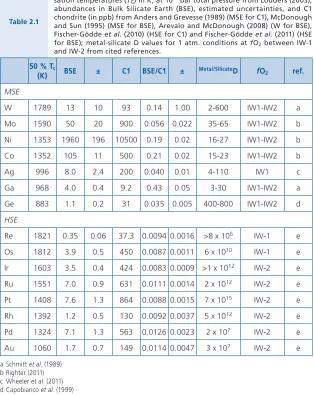
elements, equivalent to the pigs of Orwell’s Animal Farm, but I suspect the vaunted Os was one. At any rate, siderophile elements are often divided into subgroups commonly termed slightly siderophile (SSE: Mn, V, Cr), moderately siderophile (MSE: Ga, P, W, Co, Ag, Ni, Sb, As, Ge, Mo), and highly siderophile (HSE: Re, Os, Ir, Ru, Pt, Rh, Au, Pd) (Fig. 2.1). As the terms suggest, an element is classified as a SSE, MSE or HSE, depending on how strongly it preferentially partitions into metal relative to silicate melt, under 1 bar experimental
condi-tions. The Dmetal/silicate values (concentration ratios of the element between the
their sensitivity to pressure and temperature conditions, they are also strongly
controlled by fO2, and in some cases fS2. In Table 2.1, I provide a range of D
values appropriate for 1 bar systems that have been experimentally examined.
Table 2.1
Relevant data for moderately and highly siderophile elements. 50 % conden-sation temperatures (TC) in K, at 10-4 bar total pressure from Lodders (2003);
abundances in Bulk Silicate Earth (BSE), estimated uncertainties, and C1 chondrite (in ppb) from Anders and Grevesse (1989) (MSE for C1), McDonough and Sun (1995) (MSE for BSE), Arevalo and McDonough (2008) (W for BSE), Fischer-Gödde et al. (2010) (HSE for C1) and Fischer-Gödde et al. (2011) (HSE for BSE); metal-silicate D values for 1 atm. conditions at fO2 between IW-1
and IW-2 from cited references.
50 % Tc
(K) BSE ± C1 BSE/C1 ± Metal/SilicateD fO2 ref. MSE
W 1789 13 10 93 0.14 1.00 2-600 IW1-IW2 a
Mo 1590 50 20 900 0.056 0.022 35-65 IW1-IW2 b
Ni 1353 1960 196 10500 0.19 0.02 16-27 IW1-IW2 b
Co 1352 105 11 500 0.21 0.02 15-23 IW1-IW2 b
Ag 996 8.0 2.4 200 0.040 0.01 4-110 IW1 c
Ga 968 4.0 0.4 9.2 0.43 0.05 3-30 IW1-IW2 a
Ge 883 1.1 0.2 31 0.035 0.005 400-800 IW1-IW2 d
HSE
Re 1821 0.35 0.06 37.3 0.0094 0.0016 >8 x 10⁶ IW-1 e
Os 1812 3.9 0.5 450 0.0087 0.0011 6 x 10¹⁰ IW-1 e
Ir 1603 3.5 0.4 424 0.0083 0.0009 >1 x 10¹² IW-2 e
Ru 1551 7.0 0.9 631 0.0111 0.0014 2 x 10¹² IW-2 e
Pt 1408 7.6 1.3 864 0.0088 0.0015 7 x 10¹⁵ IW-2 e
Rh 1392 1.2 0.5 130 0.0092 0.0037 5 x 10¹² IW-2 e
Pd 1324 7.1 1.3 563 0.0126 0.0023 2 x 10⁷ IW-2 e
Au 1060 1.7 0.7 149 0.0114 0.0047 3 x 10⁷ IW-2 e
Figure 2.1 Abundances of moderately and highly siderophile elements in the bulk sili-cate Earth (BSE) normalised to CI chondrite abundances. Concentrations and uncertainties are from Table 2.1. For each category of siderophile nature, the elements are arranged from left to right from most to least refractory, based on their 50 % condensation temperatures (Lodders, 2003) (Table 2.1).
Second, the MSE and HSE range from moderately volatile to highly refrac-tory, with 50 % condensation temperatures as low as ~883 K (Ge), to >1800 K (Re and Os) (Lodders and Fegley, 1998; Lodders, 2003). This means that the elements can be significantly fractionated from one another in cosmochemical settings as a result of condensation and/or evaporation processes (Grossman, 1972).
Third, like most minor and trace elements, the partitioning behaviours of the siderophile elements vary as functions of the composition of the system, as well as pressure and temperature conditions. For most siderophile elements,
increasing temperatures and pressures leads to decreases in Dmetal/silicate values.
As will be discussed below, these changes have been well studied for most MSE
(e.g., Li and Agee, 1996), but because of analytical and experimental issues, the
partitioning characteristics of the HSE are much more difficult to determine and
are, therefore, more highly debated (e.g., Cottrell and Walker, 2006; Mann et al.,
2012; Bennett et al., 2014; Médard et al., 2015; Brenan et al., 2016).
Finally, most of the siderophile elements occur in nature as multivalent species with, in some instances, wildly different geochemical characteristics. For example, although a highly refractory element under reducing conditions, Re in
the form of ReO4 under highly oxidising conditions (boiling point of ~260 °C),
can be lost from subaerial volcanic systems as a gaseous phase (e.g., Krähenbühl
et al., 1992; Bennett et al., 2000; Lassiter, 2003). Valence can also be important
state of the system. In sum, despite the general tendency towards siderophile behaviour, this group of elements spans a broad range of geochemical charac-teristics, over a large spectrum of conditions.
In addition to serving as a very useful set of elements whose absolute and relative abundances can be used to study cosmochemical- and geochemical problems, some of the MSE and HSE are also actors in several radiogenic isotope
systems. These include the long-lived 187Re-187Os (t
½ = 42 Ga) and 190Pt-186Os
(t½ = 450 Ga) systems, as well as several short-lived 99Tc-99Ru (t½ = 0.21 Ma),
98Tc-98Ru (t
½ = 4.1 Ma), 97Tc-97Mo (t½ = 2.6 Ma), 107Pd-107Ag (t½ = 9 Ma), 60Fe-60Ni
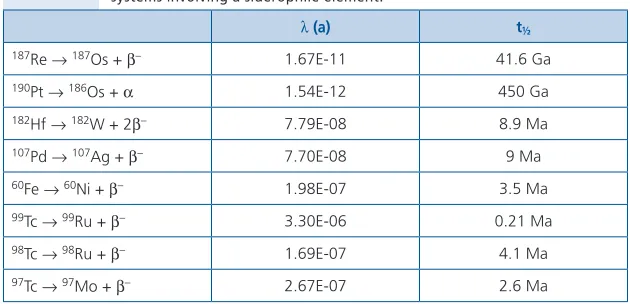
(t½ = 3.5 Ma) and 182Hf-182W (t½ = 8.9 Ma) systems (Table 2.2). Some relevant
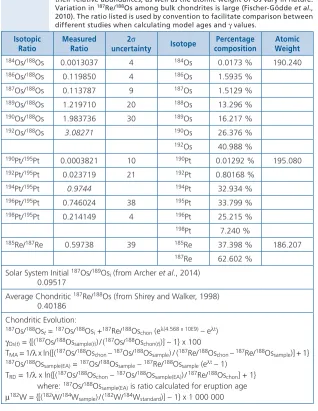
parameters and definitions of terms for the Re-Os, Pt-Os and Hf-W systems (with applications discussed below) are provided in Table 2.3. For the Hf-W system, the parent isotope Hf is a lithophile, not siderophile element. The systems with Tc as the parent isotope are currently not utilised. This stems from the fact that Tc is an element with no stable isotopes, and there is currently only limited evidence that the short-lived isotopes of Tc were extant in our earliest solar system. In order to discern possible effects in the isotopic compositions of the daughter elements, we need to know which early solar system materials may have been characterised by high Tc/Ru and Tc/Mo ratios. Our predictive abilities, however, are not very good with regard to Tc. Most prior workers have assumed that Tc behaves in a manner that is very similar to Re, which it sits directly above in the periodic table. Consequently, we and others originally assumed solid metal-liquid metal fractionation would lead to sizable fractionations between Tc and Ru or Mo
(Dauphas et al., 2002; Becker and Walker, 2003), as it does with respect to Re/Ru
and Re/Mo. In Lazar et al. (2004), however, we experimentally discovered that
Tc has a Dsolid metal/liquid metal value that is similar to the D values for Ru and Mo.
Thus, even if Tc were present in early-formed metal systems, it would not have been strongly fractionated from its daughter elements. It seems likely that very high precision measurements of Mo and Ru will be required if we are ever to observe the effects of Tc decay in early solar system materials.
There is considerable history relating to the analysis and application of siderophile elements. High quality concentration measurements for some of these elements go back at least as far as the 1960’s, so there is a long history of applications to geological and cosmochemical systems (Bate and Huizenga, 1963;
Hirt et al., 1963a,b; Fouché and Smales, 1967a,b; Morgan and Lovering, 1967a,b).
This is especially true for Re and Os, and to a limited degree, even with respect
to application of the 187Re-187Os isotope system (e.g., Hirt et al., 1963a,b; Herr
et al., 1967; Riley and Delong, 1970). Note too that some of the HSE, most notably
Au and Ir, can be measured to high precision with great sensitivity by neutron
activation analysis (e.g., Vincent and Crocket, 1960; DeGrazia and Haskins,
1964). Consequently, the basics of the geochemical behaviours of some of the siderophile elements were largely worked out using these methods by the time I
Table 2.2 Decay schemes, decay constants and associated half-lives for radiogenic isotope systems involving a siderophile element.
l (a) t½
187Re →187Os + b– 1.67E-11 41.6 Ga
190Pt →186Os + a 1.54E-12 450 Ga
182Hf →182W + 2b– 7.79E-08 8.9 Ma
107Pd →107Ag + b– 7.70E-08 9 Ma
60Fe →60Ni + b– 1.98E-07 3.5 Ma
99Tc →99Ru + b– 3.30E-06 0.21 Ma
98Tc →98Ru + b– 1.69E-07 4.1 Ma
97Tc →97Mo + b– 2.67E-07 2.6 Ma
Although INAA is still used for analysis of siderophile and other elements
(e.g., Korotev et al., 2009; Wasson et al., 2013), the advent of inductively-coupled
plasma mass spectrometry (ICP-MS) in the 1980’s has led to massive growth in the number of siderophile element data available for terrestrial and planetary materials. The capability of the plasma to ionise all of the siderophile elements with great efficiency has made analysis of most siderophile elements practical. This can be achieved through sample dissolution, followed by chemical
purifi-cation and injection of elements of interest into the mass spectrometer (e.g., Lee
and Halliday, 1995a; Plessen and Erzinger, 1998; Pearson and Woodland, 2000;
Schoenberg et al., 2000), or by using laser beams to directly ablate material from
solids for injection into the mass spectrometer. The latter method of laser ablation
allows in situ chemical and isotopic analysis of materials with sufficiently high
concentrations of siderophile elements (e.g., Campbell and Humayun, 1999; Alard
et al., 2000). In addition, because of the ability of ICP-MS to precisely measure
isotopic ratios, the isotope dilution method is now commonly applied to most non-monoisotopic siderophile elements. Alas, nature failed us when creating the monoisotopic Au and Rh, but even these elements can be measured well by
ICP-MS techniques through comparisons with other siderophile elements (e.g.,
Fischer-Gödde et al., 2010).
Given that some of the discussion that is to follow involves Os isotopes, and includes references to some early Os isotope applications, this is a good place to note that all studies before 1994 reported Os isotopic compositions in terms of
187Os/186Os ratios. This was convenient for those of us who like simplicity because
the modern chondritic (and mantle) ratio is ~1. However, in Walker et al. (1994)
we began to conduct isotopic analyses of materials with very high Pt/Os ratios
from Noril’sk, Russia. Some of these samples were enriched in both 187Os and
Table 2.3
Isotopic information relating to 187Re-187Os, 190Pt-186Os and 182Hf-182W isotope
systems. Isotopic data for Os, Pt and Re are from Walker (2012), Morgan et al. (2002), and Gramlich et al. (1973), respectively. Ratios used for fractionation corrections for Os and Pt measurements are shown in italics. * 187Os and 186Os are produced by radioactive decay of 187Re and 190Pt, respectively, so
their relative abundances, as well as the atomic weight of Os vary in nature. Variation in 187Re/188Os among bulk chondrites is large (Fischer-Gödde et al.,
2010). The ratio listed is used by convention to facilitate comparison between different studies when calculating model ages and g values.
Isotopic
Ratio Measured Ratio uncertainty2s Isotope compositionPercentage Atomic Weight
184Os/188Os 0.0013037 4 184Os 0.0173 % 190.240
186Os/188Os 0.119850 4 186Os 1.5935 %
187Os/188Os 0.113787 9 187Os 1.5129 %
189Os/188Os 1.219710 20 188Os 13.296 %
190Os/188Os 1.983736 30 189Os 16.217 %
192Os/188Os 3.08271 190Os 26.376 %
192Os 40.988 %
190Pt/195Pt 0.0003821 10 190Pt 0.01292 % 195.080
192Pt/195Pt 0.023719 21 192Pt 0.80168 %
194Pt/195Pt 0.9744 194Pt 32.934 %
196Pt/195Pt 0.746024 38 195Pt 33.799 %
198Pt/195Pt 0.214149 4 196Pt 25.215 %
198Pt 7.240 %
185Re/187Re 0.59738 39 185Re 37.398 % 186.207
187Re 62.602 %
Solar System Initial 187Os/189Os
i (from Archer et al., 2014)
0.09517
Average Chondritic 187Re/188Os (from Shirey and Walker, 1998)
0.40186 Chondritic Evolution:
187Os/188Os
t = 187Os/188Osi +187Re/188Oschon (el(4.568 x 10E9) – elt)
gOs(t) = {[(187Os/188Ossample(t)) / (187Os/188Oschon(t))] – 1} x 100
TMA = 1/l x ln{[(187Os/188Oschon – 187Os/188Ossample) / (187Re/188Oschon – 187Re/188Ossample)] + 1} 187Os/188Os
sample(EA) = 187Os/188Ossample – 187Re/188Ossample (elt – 1)
TRD = 1/l x ln{[(187Os/188Oschon – 187Os/188Ossample(EA)) / 187Re/188Oschon] + 1}
where: 187Os/188Os
sample(EA) is ratio calculated for eruption age
m182W = {[(182W/184W
in 186Os were the result of the decay of 190Pt. Consequently, we made the switch
to reporting 187Os/188Os, a ratio in which the denominator is not modified by
radioactive decay. Although this change met with some opposition, most other labs soon followed. This was not a big deal because most labs, like ours, had
previously been measuring 187Os/188Os, then converting to 187Os/186Os by
3.
SIDEROPHILE ELEMENTS IN CHONDRITES
AND IRON METEORITES
3.1
Chondrites
It is nearly impossible to discuss siderophile elements in major planetary bodies like the Earth, Moon and Mars without first discussing the general behaviour of these elements in meteoritic systems. A good place to start is with chondritic meteorites. Chondrites are often described as cosmic aggregates. This is because they consist of a variety of distinct components that may not have been made in
the same place (Shu et al., 1997), were probably not all made at the same time
(Amelin et al., 2002), and in some cases were not even made from the same
starting materials (Dauphas et al., 2002; Brandon et al., 2005). These components
can include chondrules, after which chondrites are named, refractory inclusions, metal, organics, and silicate-rich matrix. Chondrites are divided into three major classes, ordinary, enstatite and carbonaceous, plus some rare suites such as the Rumeruti, or R chondrites. The major classes are subdivided into different groups. These classes and groups are discriminated based on major element compositions
(e.g., Krot et al., 2003). Introductory meteoritics teaches us that the carbonaceous
chondrites, in particular the CI group, have chemical compositions most similar to the composition of the Sun’s photosphere (Anders and Grevesse, 1989).
When discussing siderophile elements in chondrites, it is important to recognise that no chondrites are pristine examples of their parent bodies on the day they formed. All chondrites have experienced the effects of thermal metamor-phism and/or aqueous alteration that occurred at some point(s) in the history of their respective parent bodies. Most studies assume these modifications occurred very early in solar system history, soon after parent body formation. In addition, many chondrites show the effects of shock resulting from impacts. Shock effects include heating and recrystallisation, and can occur at any time in solar system history. Finally, most chondrites, including falls, have been subtly or not so subtly modified by alteration processes that occur in space, or on the surface of the Earth. The effects of parent body modification, including shock, and terrestrial alteration on siderophile elements are still only partially understood. This means that before certain siderophile element characteristics can be attributed to nebular processes, they must first be considered within the context of modifications that
may postdate the formation of their parent bodies (e.g., Brearley, 2003).
Siderophile element data for chondrites began to proliferate during the
1960’s (e.g., Bate and Huizenga, 1963; Fouché and Smales, 1967a,b; Morgan and
Lovering, 1967b; Tandon and Wasson, 1968). Siderophile elements for which data were commonly reported at that time included Re, Os, Ir, Au, Pd, Ni, Ga, Ge. The data for these elements showed that absolute and relative siderophile element abundances varied moderately for bulk meteorites among the major
Wolf et al., 1980; Hertogen et al., 1983; Morgan, 1985). Thus, there is no one “chon-dritic” composition for siderophile elements. The differences are particularly well
established when considering the 187Re-187Os isotopic system.
Allègre and Luck (1980) and Morgan (1985) were among the first to note the utility of constraining the long-term Re/Os ratio of planetary materials through the use of Os isotopes. The Re/Os ratio of a specific chondrite over 4.57 Ga of solar
system history can be precisely defined by its 187Os/188Os isotopic ratio today, in
most instances, even for conditions in which the Re/Os ratio has been modified by recent processes. A compilation of published data for bulk samples of chondrites
shows an approximately 10 % range in 187Os/188Os ratios (Fig. 3.1a). Some of this
variation likely reflects chemical and isotopic heterogeneity among chondrite components, coupled with the heterogeneous distribution of these components within the meteorite. Most measurements of Os isotopic compositions, as well as siderophile element abundances, are for relatively small pieces of chondrite that are typically of only a few hundred milligrams, at most. The bulk sample data reported by many studies are, therefore, probably not very representative of true bulk compositions, due to the inherent petrologic heterogeneity that is common in primitive meteorites. In support of this claim, elemental abundances, and to a lesser extent, isotopic heterogeneity of siderophile elements among multiple
pieces of the same meteorite is well documented (e.g., Horan et al., 2003;
Fischer-Gödde et al., 2010).
Figure 3.1 (a) Ru/Ir versus Pd/Ir of bulk samples of chondrites. (b) 187Os/188Os versus Pd/Ir.
Note that there is considerable overlap of data between the chondrite classes, but on average, carbonaceous chondrites are offset to lower Pd/Ir, Ru/Ir and
187Os/188Os ratios, compared with ordinary and enstatite chondrites. Enstatite
chondrites are characterised by generally higher Pd/Ir than ordinary chondrites. The few R chondrites for which there are data range to much higher Ru/Ir ratios than other chondrites. Data are from Walker et al. (2002a), Horan et al. (2003), Brandon et al. (2005), Fischer-Gödde et al. (2010) and Van Acken et al. (2011).
Despite issues with representative sampling, there are broad differences in
187Os/188Os ratios among the chondrite classes (Fig. 3.1a). For example,
carbona-ceous chondrites have, on average, 187Os/188Os ratios ~2 % lower than ordinary
lower Re/Os ratios implied by the isotopic data are also evident in the measured Re/Os ratios of chondrites, although evidence for open-system behaviour of Re or Os long after formation makes the elemental ratio less diagnostic than the isotopic
ratio (Walker et al., 2002a). As with Re/Os, there are some broad differences in the
ratios of other HSE among chondrite classes and groups (Fig. 3.1a,b). For example, enstatite chondrites average higher Pd/Ir, and range to higher Ru/Ir, compared to
ordinary and carbonaceous chondrites (Horan et al., 2003; Fischer-Gödde et al.,
2010; Van Acken et al., 2011). When the HSE Rh and Au are added to the array
considered, differences between groups can potentially be better discriminated
(Tagle and Berlin 2008; Fischer-Gödde et al., 2010), but these elements cannot
be measured by isotope dilution, and one must be careful when blending data obtained by different methods.
If these variations in the relative abundances of the HSE are the result of nebular processes, such as condensation or evaporation, they may provide important information regarding the thermal regime and the stability of different presolar phases present in the protosolar nebula, as recorded in primitive mete-orites that formed at diverse distances from the proto-Sun. Alternately, if they were generated on a parent body, they may record more localised processes, such as selective aqueous transport and deposition of certain HSE. In order to examine this further, it is necessary to consider chondritic components. Progress has been made identifying the carriers of HSE and their fractionations in prim-itive meteorites. The origins of some of the fractionations are, however, still
poorly understood. For example, Horan et al. (2009) reported that non-magnetic
Figure 3.2 (a) Highly siderophile element patterns for coarse metal, fine metal and
non-magnetic fractions of the separated components from the H 3.8 chon-drite Ochansk, normalised to the composition of the bulk sample of Ochansk (modified from Horan et al., 2009). HSE are plotted from left to right in order of decreasing 50 % condensation temperature. (b) Highly siderophile element patterns for Group 1 calcium aluminum-rich inclusions separated from the Allende CV3 carbonaceous chondrite normalised to the CI chondrite Orgueil (data from Horan et al., 2003). Bulk Allende is shown for comparison. Note the major depletion in Pd. Data are from Archer et al. (2014).
The HSE in the bulk H chondrites studied are largely sited in metal grains, and so it is the metal phases with relatively unfractionated HSE abundances that primarily define the HSE characteristics of bulk samples. Nevertheless, it is easy to imagine that by sorting of distinct HSE carrier phases, prior to chondrite accretion, modest differences in HSE ratios could be produced in bulk samples. In this case, Re/Os and Pd/Ir would be most affected, consistent with variations
in these ratios observed among bulk chondrites (e.g., Fig. 3.1a,b). The observations
for the H chondrite components cannot, however, account for variations in Ru/ Ir among bulk chondrites.
As part of an M.S. degree thesis, my student Greg Archer examined the
HSE characteristics of chondrules, matrix and calcium aluminum-rich
inclu-sions (CAI) from the CV3 carbonaceous chondrite Allende (Archer et al., 2014).
This meteorite contains essentially no metal. In contrast to the H-chondrites, the only components examined that are characterised by strongly-fractionated HSE abundances (compared to CI chondrites in this case), are the CAIs, which show substantial depletions in Pd, the most volatile of the HSE examined (Fig. 3.2b). The Pd depletions most likely reflect condensation or evaporation processes that fractionated the more volatile HSE from the others. This interpretation is
consistent with prior studies of HSE in CAIs (e.g., Mason and Taylor, 1982) which
showed that Au, an even more volatile HSE than Pd, is also strongly depleted relative to the more refractory HSE. Despite the comparatively fractionated and high HSE abundances in the CAIs, the relative abundances of HSE in Allende matrix and chondrules, with only a few exceptions, are essentially unfractionated.
The study by Archer et al. (2014) was unable to identify the Pd-rich phase or
Both Horan et al. (2009) and Archer et al. (2014) also examined the Re-Os isotopic systematics of the chondrite components studied. In the case of the H-chondrites, some of the non-magnetic fractions appear to have gained modest amounts of Re (or lost Os), long after initial formation of the component. The open system behaviour may reflect a process that occurred on the parent body, or even on the Earth, although all of the meteorites examined by both studies
were observed falls. In the case of Allende CAIs, Archer et al. (2014), as with
Becker et al. (2001a), reported what appears to be a resetting of the Re-Os isotopic
systematics of some Allende CAIs at ~1.6 Ga. This may be due to the aqueous mobilisation of Re as a result of impact heating in the parent body at about that time. This putative event, however, does not seem to have affected the isotopic systematics of bulk samples of Allende. They are generally well-behaved, plotting
on or very near primordial Re-Os reference isochrons (Becker et al., 2001a; Walker
et al., 2002a; Fischer-Gödde et al., 2010; Archer et al., 2014). Despite this evidence
for minor late stage mobility of HSE, it is important to recognise that these effects were dwarfed by the much larger primordial fractionations that occurred between HSE components in metal and non-magnetic fractions.
The study of MSE in chondrites has commonly focused on the distributions of these elements between metals and silicate matrix, and what this can reveal about thermal conditions in the parent bodies. For example, Kong and Ebihara (1996) studied the concentrations of the MSE W and Mo in metals present in equilibrated and non-equilibrated ordinary chondrites. They found that mete-orites that are considered to be unequilibrated, based on petrological consider-ations, tend to have less W and Mo concentrated in the metal phases, compared to equilibrated meteorites in which metals contain a substantially greater share of the W and Mo. Further, they observed that W/Mo ratios remained constant in metals present in equilibrated chondrites. Based on this Kong and Ebihara (1996) concluded that the Mo and W concentrations of at least some ordinary chon-drite metals were initially established during melting and reduction of precursor materials that were eventually accreted to the parent bodies. Once the parent bodies formed, subsequent metamorphism led to the diffusive transport of Mo and W from the non-metal phases (mostly pyroxenes) into the surrounding the metals. Similarly, Humayun and Campbell (2002) also noted the extraction of W into metal with increasing metamorphic grade in H chondrites. Studies by both Humayun and Campbell (2002) and Kong and Ebihara (1996), concluded that equilibration of W was complete at a relatively low metamorphic grade (H4).
Temperature-time evolution paths for chondritic meteorites of different thermal metamorphic grade from the same parent body can potentially be used to constrain the thermal structure, and possibly the source of heat present in that parent body, yet the thermal structures and cooling histories of chondritic
parent bodies are still debated (e.g., Rubin, 2004; Amelin et al., 2005; Harrison
and Grimm, 2010; Henke et al., 2012; Ganguly et al., 2013; Scott et al., 2014). For
instance, the H chondrites experienced a large range of thermal-metamorphic conditions with isotopic closure ages obtained from different chronologic systems
(e.g., Rb-Sr, K-Ar, U-Pb) recording diverse temperature versus time paths for
individual meteorites (Wasserburg et al., 1969; Göpel et al., 1994; Trieloff et al.,
2003; Bouvier et al., 2007). An “onion-shell” structure of increasing temperature
with depth (heated by 26Al decay) has been proposed by some to account for
variable metamorphic grades and cooling rates of ordinary chondrites (e.g., Pellas
and Storzer, 1981). Impact-induced heating has also been proposed to have been responsible for thermal metamorphism and even minor partial melting in at least
some ordinary chondrites (e.g., Rubin, 2004; Hutson et al., 2007). Hybrid models
that may include cooling in an onion-shell body, but that also require impact
mixing and variable cooling within a rubble pile, have also been proposed (e.g.,
Davison et al., 2012; Scott et al., 2014).
The 182Hf-182W isotopic compositions of metals present in chondrites can
be used to obtain model closure ages. Closure ages following peak metamor-phic conditions can also be obtained from internal isochrons generated by
plot-ting 182W/184W versus180Hf/184W for separates of phases with different magnetic
susceptibilities (Lee and Halliday, 2000; Kleine et al., 2008). In such cases, the
slopes of the resulting trends can provide the 182Hf/180Hf at the time of system
closure, and by inferring the 182Hf/180Hf at the time of solar system formation, an
absolute closure age can be determined by comparison to decay models for 182Hf
(see Kleine et al., 2008 for a detailed overview of the application).
The H chondrites are particularly appropriate for 182Hf-182W isotopic
study of thermal chronology as it relates to metal-silicate equilibration. Several prior studies have investigated this system in H chondrites in order to advance
constraints on the thermal history of the parent body (e.g., Lee and Halliday,
2000; Kleine et al., 2008). For example, Kleine et al. (2008) reported what were
interpreted to be isochrons when plotting 182W/184W versus 180Hf/184W for
metal and non-magnetic fractions separated from individual H chondrites. The slope-derived ages ranged from 4566.0 ± 0.5 Ma for St. Marguerite (H4), to 4562.8 ± 1.0 Ma for Richardton (H5), to 4559.2 ± 1.0 Ma for Kernouvé (H6). The decrease in age with increasing metamorphic grade was interpreted to indicate
an inverse correlation between petrologic type and cooling rates. Kleine et al.
(2008), and later Henke et al. (2012) fit their data to calculated temperature versus
time cooling rate curves that included data for 207Pb-206Pb, 40Ar-39Ar and 244Pu
systems reported by other studies. They concluded that the collective results were most consistent with an onion-shell structure of a parent body heated by