1
Jibi Paul
2
Pradeep Balakrishnan
3
Mohd Izham
CORRESPONDING AUTHOR
1Jibi Paul, MPT, (PhD),
Lecturer, Physiotherapy Programme, School of Health Sciences, KPJ Healthcare University College, Kota Seriemas, Nilai, Malaysia.
Mail: [email protected]
Int J Physiother. Vol 1(4), 195-199, October (2014) ISSN: 2348 - 8336
ABSTRACT
Background: Stretching exercises have been routinely used in persons with hamstring tightness and
athletes to increase flexibility of muscle and to reduce joint injuries. Many studies have reported effect of static and dynamic stretching on flexibility of this muscle. Finding the best method to improve flexibility of hamstring muscle is important for athletes and individuals to reduce their injuries. Objective of the study was to find out the effect of static stretching exercise and dynamic stretching exercise on flexibility of hamstring muscle and also to compare the effect of static and dynamic stretching exercise on flexibility of hamstring muscle.
Methods: This was a comparative experimental study with seventy four female healthy subjects from
physiotherapy department of KPJ Healthcare University College, Malaysia. Convenient sampling method used to select the samples. The subjects were selected by inclusion criteria and randomly divided equally in to two with 37 subjects in each group. Static stretching exercise and dynamic stretching exercise were given as intervention program for four weeks respectively for experimental and control group. Pre and post data of restricted range of movement for knee extension was measured using goniometry and documented separately for both group.
Result: In experimental and control group, pre-post statistical analysis found significant effect in
increase of hamstring flexibility with P<0.0001, for right and left side. Comparative study between experimental and control group found that static stretching exercise have significant effect in increase of hamstring flexibility for right and left side with P<0.04.
Conclusion: This study concluded that static stretching exercise is more effective to improve hamstring
flexibility compared to dynamic stretching exercise.
Key words: Hamstring muscle, static stretching, dynamic stretching, hamstring flexibility.
2Lecturer, Physiotherapy Program,
School of Health Science, KPJ Healthcare University College, Nilai, Malaysia
3Lecturer, Physiotherapy Program,
School of Health Science, KPJ Healthcare University College, Nilai, Malaysia
Received 18th August 2014, revised 26th August 2014, accepted 09th September 2014
DOI: 10.15621/ijphy/2014/v1i4/54564
INTRODUCTION
Muscle flexibility has defined as the ability of a
muscle to lengthen, allowing one joint or more than one joint in a series to move through a range of motion (ROM) and a loss of muscle flexibility as a decrease in the ability of the muscle to deform, resulting in decreased ROM about a joint. Hamstring flexibility is important to prevent knee injuries among non athletes. Several authors have investigated the relationship between hamstring flexibility and hamstring injury, Christensen C, et al (1972).Worrell et al (1991) and Liemohn (1978) reported hamstring-injured subjects were less flexible than non injured subjects. Hamstring is an important muscle in the lower limb which helps for knee flexion and hip extension. Mann and Sprague (1980) described the function of the hamstrings in walking as active at the end of the swing phase until foot flat has been completed.
The hamstrings contract eccentrically to control knee extension in the swing phase. At heel strike, it provides stability and initiates flexion of the knee. During running, the hamstring muscle become active during the last third of the swing phase, at which time the tibia is being decelerated eccentrically and the hip flexes concentrically. Static stretching has been reported as a therapeutic tool in preventing injuries associated with lack of flexibility as well as in treatment of sports injuries.
1, 2, 3 Objective of the study was to find out the effect
of static and dynamic stretching exercise on flexibility of hamstring muscle and also to compare the effect of static and dynamic stretching exercise on flexibility of hamstring muscle.
MATERIALS AND METHODOLOGY
This was an experimental study with Random Control Trial (RCT). The population for this study were selected from physiotherapy students of KPJ Healthcare University College, Nilai, Malaysia for the year 2013. This study conducted in Physiotherapy skill lab of KPJ University College, Nilai, Malaysia. Sample size were calculated and confirmed by n=74 with 37 subjects each group (experimental and control). All the subjects were female with hamstring tightness (above 20 degree)
and aged between 18 to 25years. Subjects with diagnosed musculoskeletal disorders/ injured
lower limbs, traumatic and neurological
conditions, multiple chronic disorders and who doesn’t sign the informed consent were excluded from the study. Selected subjects were randomly divided in to two groups equally by lottery method. Study materials used for this study were couch and informed consent. Clinical goniometer was used as study tool for this study.
Data collection: Subjects were evaluated hamstring tightness in supine lying. Hip in flexed position at 90 degree followed by passive extension of knee
joint.4,5,6 Goniometric measurement was taken and
recorded at knee joint at the level of tissue resistance. Data collected before and after the
prescribed exercise program by qualified
physiotherapist from KPJUC, Nilai, Malaysia.
Exercise intervention
Exercise performed once in a day for five days in a week and continued for four weeks. Each team performed static and dynamic stretching actively for 04 minutes in a day.
In static stretching, subjects were in standing position with one hip flexed for 90 degree and knee extended with supported in a couch. Hamstring muscle stretched to the maximum by reaching both hands towards big toe and hold for 30 seconds followed by 10 seconds rest; this exercise repeated 6 times for 04 minutes in a day.
In dynamic stretching subjects were in lying position; knee maintained in full extension followed by maximum flexion of hip joint. Each movement followed by 5 second rest; this exercise repeated for 04 minutes in a day. Both exercises performed for right and left side.
STATISTICS ANALYSIS
Dependent t’ test used to compare the effect within the group. Independent t’ used to compare the difference between the independent variables of two groups and to find the significance. P< 0.05 was considered as significant effect on the study.
Table 1: Experimental group hamstring tightness in degree at knee joint; significant difference in effect found in both sides within the group.
Experimental Group static stretching
Hamstring tightness in degree at knee Joint Pre Intervention
(Mean ± SEM)
Hamstring tightness in degree at knee Joint Post Intervention
(Mean ± SEM)
T value P-Value
Right 31.54 ± 1.47 20.32 ± 1.09 t=10.53 df=36 P< 0.0001
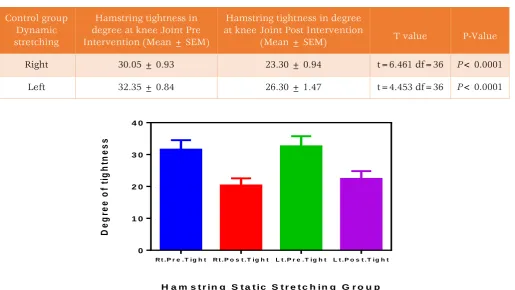
Table 2: Control group hamstring tightness in degree at knee joint; significant difference in effect found in both sides within the group.
Control group Dynamic stretching
Hamstring tightness in degree at knee Joint Pre Intervention (Mean ± SEM)
Hamstring tightness in degree at knee Joint Post Intervention
(Mean ± SEM) T value P-Value
Right 30.05 ± 0.93 23.30 ± 0.94 t=6.461 df=36 P< 0.0001
Left 32.35 ± 0.84 26.30 ± 1.47 t=4.453 df=36 P< 0.0001
D
e
g
re
e
o
f
ti
g
h
tn
e
s
s
R t . P r e . T i g h t R t . P o s t . T i g h t L t . P r e . T i g h t L t . P o s t . T i g h t 0
1 0 2 0 3 0 4 0
H a m s t r i n g S t a t i c S t r e t c h i n g G r o u p
Graph: 1 - Experimental group hamstring tightness in degree at knee joint; significant difference in effect found in both sides within the group.
H a m s t r i n g D y n a m ic S t r e t c h i n g G r o u p
D
e
g
re
e
o
f
ti
g
h
tn
e
s
s
R t . P r e . T i g h t R t . P o s t . T i g h t L t . P r e . T i g h t L t . P o s t . T i g h t 0
1 0 2 0 3 0 4 0
Graph: 2 Control group hamstring tightness in degree at knee joint; significant difference in effect found in both sides within the group.
Right side
Hamstring tightness in degree at knee Joint
Experimental group (Mean ± SEM)
Hamstring tightness in degree at knee Joint Control group (Mean ±
SEM)
T value P-Value
Pre
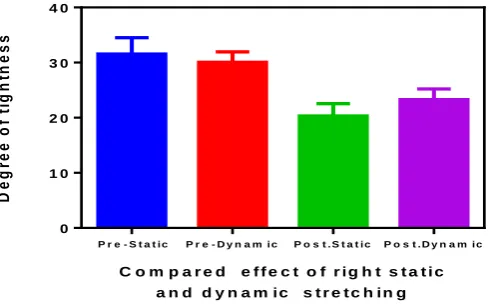
Intervention 31.54 ± 1.47 30.05 ± 0.93 t=0.86, df=72 0.40
NS
Post
Intervention 20.32 ± 1.09 23.30 ± 0.94 t=2.06, df=72 P<0.04
Left side
Hamstring tightness in degree at knee Joint Experimental group
(Mean ± SEM)
Hamstring tightness in
degree at knee Joint Control group (Mean ± SEM)
T value P-Value
Pre Intervention 32.57 ± 1.57 32.35 ± 0.84 t=0.12, df=72 0.90NS
Post Intervention 22.38 ± 1.20 26.30 ± 1.47 t=2.07, df=72 P<0.04
Table 4: Compared experimental and control group for hamstring tightness in degree at knee joint; significant difference in effect found in Post Intervention of left side between the groups.
C o m p a r e d e f f e c t o f r i g h t s t a t i c a n d d y n a m i c s t r e t c h i n g
D
e
g
re
e
o
f
ti
g
h
tn
e
s
s
P r e - S t a t i c P r e - D y n a m i c P o s t . S t a t i c P o s t . D y n a m i c
0 1 0 2 0 3 0 4 0
Graph: 3 Compared experimental and control group for hamstring tightness in degree at knee joint; significant difference in effect found in Post Intervention of right side between the groups.
C o m p a r e d e f f e c t o f l e f t s t a t ic a n d d y n a m ic s t r e t c h i n g
D
e
g
re
e
o
f
ti
g
h
tn
e
s
s
P r e .S t a t ic P r e .D y n a m ic P o s t .S t a t ic P o s t .D y n a m ic 0
1 0 2 0 3 0 4 0
Graph: 4 Compared experimental and control group for hamstring tightness in degree at knee joint; significant difference in effect found in Post Intervention of left side between the groups.
RESULT
Control group hamstring tightness in degree at knee joint; significant difference in effect found with P< 0.0001. in right and left sides within the group Experimental group hamstring tightness in degree at knee joint; significant difference in effect found with P< 0.0001 in right and left sides within the group. Compared experimental and control group for hamstring tightness in degree at knee joint; significant difference in effect found with P<0.04 in Post Intervention of right and left side between the groups.
Discussion
This study has accepted the alternative hypothesis that there was a difference in knee extension range
training within and between the groups of dynamic (controlled group) and static (experimental group) stretching.
In this study, the static stretching and dynamic stretching appears to be equally effective in improving the flexibility of hamstring muscles. There was a significant difference in flexibility of hamstring muscle in static stretching group compared to dynamic stretching group after the intervention.
significantly greater gains in flexibility than the controlled group. Bandy et al compared the effects of 30 seconds of static stretching with dynamic range of motion. Although both methods were effective in increasing range of motion, the gain made with static stretching was 11.42°, but the gain with dynamic stretching was only 4.26°.
The groups that performed static hamstring stretching for 4 weeks showed significantly greater gains in flexibility than the control group. The results support the hypothesis theory that static stretching provides significant increase in the range of motion of knee joint 7, 8, 9, 10, 11.
Limitations
The intervention program was not performed under the supervision of researcher. Health and activities other than specified intervention program of subjects were not supervised during the study period.
Recommendation
This study is recommended to do for both genders to find the effect. This study can also recommended to evaluate the hamstring tightness using electronic goniometer for accuracy in degree of tightness at knee joint
CONCLUSION
This study concluded that static and dynamic stretching can significantly reduce the tightness of hamstring muscle at knee joint. And also found that static stretching has significant effect over dynamic stretching in reduction of hamstring muscle tightness at knee joint.
Future Research
Apart from the outcome of flexibility of hamstring muscle gained through active knee extension (AKE), the functional performance of hamstrings with static and dynamic stretches also can be measured in future research.
Acknowledgement
The authors would like to thank the management of KPJ Healthcare University College, the chairman and members of research and development committee KPJUC, Nilai, Malaysia,
for their valuable suggestions and support to complete this study successfully.
REFERENCES
1. Johnagen S, Nemeth C, Griksson F. Hamstring
injuries in sprinters: the role of concentric arid eccentric hamstring muscle strength and flexibility. Am J Sports Med. 1994; 22(2):262-266.
2. Worrell TM, Perrin DH, Gansneder B, Gieck J.
Comparison of isokinetic strength and flexibility measures between hamstring injured and non-injured athletes. J Orthopaedic Sports Phys. Ther.1991; 13(3):118-125.
3. Hubley CL, Kozey JW. Can stretching prevent
athletic injuries? Journal musculoskeletal medicine, 1984; 19: 25-32.
4. Norris CM, M Matthews. Inter-tester reliability
of a self-monitored active knee extension test. Journal of Bodywork and Movement Therapie. 2005; 9(4):256–259.
5. William D Bandy, Jean M. Irion, Michelle
Briggler. The Effect of Time and Frequency of Static Stretching on Flexibility of the Hamstring Muscles.Phys .Ther. 1997; 77(10):1090-1096.
6. Etnyre B R, Lee EJ. Chronic and acute
flexibility of men and women using three
different stretching techniques Iksenrch
Quarterly, 1988; 59(3):222-228.
7. Sady SP, Wortman M, Blanke D. Flexibility
training: ballistic, static or proprioceptive neuromuscular facilitation? Arch Phys Med. Rehab. 1982; 63(6):261-263.
8. Odunaiya NA, Hamzat TK., Ajayi OF. The
Effects of Static Stretch Duration on the Flexibility of Hamstring Muscles. African Journal of Biomedical Research. 2005; 8(2):79-82.
9. Bandy WD., Irion JM and Briggler M. The effect
of static stretch and dynamic range of motion training on the flexibility of hamstring muscles. J. Orthop Sports Phys Ther.1998; 29(4):295-300.
10.WD Bandy. The effect of time on static stretch on
the flexibility of the hamstring muscles. Comment in Phys Ther. 1995; 75(3):238-9.
11. R Larsen, H Lund, R Christensen. Effect of
static stretching of quadriceps and hamstring
muscles on knee joint position sense. Br J Sports
Med. 2005; 39(1):43-46.
Citation
Jibi Paul, Pradeep Balakrishnan & Mohd Izham. (2014). COMPARATIVE EFFECT OF STATIC AND DYNAMIC STRETCHING EXERCISE TO IMPROVE FLEXIBILITY OF HAMSTRING MUSCLES