The Thirty-Third AAAI Conference on Artificial Intelligence (AAAI-19)
Embedding Uncertain Knowledge Graphs
Xuelu Chen, Muhao Chen, Weijia Shi, Yizhou Sun, Carlo Zaniolo
University of California, Los AngelesLos Angeles, CA, 90095, USA
{shirleychen, muhaochen, swj0419, yzsun, zaniolo}@cs.ucla.edu
Abstract
Embedding models for deterministic Knowledge Graphs (KG) have been extensively studied, with the purpose of cap-turing latent semantic relations between entities and incor-porating the structured knowledge they contain into machine learning. However, there are many KGs that model tain knowledge, which typically model the inherent uncer-tainty of relations facts with a confidence score, and em-bedding such uncertain knowledge represents an unresolved challenge. The capturing of uncertain knowledge will bene-fit many knowledge-driven applications such as question an-swering and semantic search by providing more natural char-acterization of the knowledge. In this paper, we propose a novel uncertain KG embedding modelUKGE, which aims to preserve both structural and uncertainty information of rela-tion facts in the embedding space. Unlike previous models that characterize relation facts with binary classification tech-niques,UKGElearns embeddings according to the confidence scores of uncertain relation facts. To further enhance the pre-cision ofUKGE, we also introduce probabilistic soft logic to infer confidence scores for unseen relation facts during train-ing. We propose and evaluate two variants ofUKGEbased on different confidence score modeling strategies. Experiments are conducted on three real-world uncertain KGs via three tasks, i.e. confidence prediction, relation fact ranking, and re-lation fact classification.UKGEshows effectiveness in captur-ing uncertain knowledge by achievcaptur-ing promiscaptur-ing results, and it consistently outperforms baselines on these tasks.
1
Introduction
Knowledge Graphs (KGs) provide structured representa-tions of real-world entities and relarepresenta-tions, which are catego-rized into the following two types: (i)Deterministic KGs, such as YAGO (Rebele et al. 2016) and FreeBase (Bol-lacker et al. 2008), consist of deterministic relation facts that describe semantic relations between entities; (ii) Uncer-tain KGsincluding ProBase (Wu et al. 2012), ConceptNet (Speer, Chin, and Havasi 2017) and NELL (Mitchell et al. 2018) associate every relation fact with a confidence score that represents the likelihood of the relation fact to be true.
KG embedding models are essential tools for incorporat-ing the structured knowledge representations in KGs into
Copyright c2019, Association for the Advancement of Artificial Intelligence (www.aaai.org). All rights reserved.
machine learning. These models encode entities as low-dimensional vectors and relations as algebraic operations among entity vectors. They accurately capture the similar-ity of entities and preserve the structure of KGs in the em-bedding space. Hence, they have been the crucial feature models that benefit numerous knowledge-driven tasks (Bor-des, Weston, and Usunier 2014; He et al. 2017; Das et al. 2018). Recently, extensive efforts have been devoted into embedding deterministic KGs. Translational models, e.g., TransE (Bordes et al. 2013) and TransH (Wang et al. 2014)), and bilinear models, e.g. DistMult (Yang et al. 2015) and ComplEx (Trouillon et al. 2016), have achieved promising performance in many tasks, such as link prediction (Yang et al. 2015; Trouillon et al. 2016), relation extraction (We-ston, Bordes, and others 2013), relational learning (Nickel, Rosasco, and Poggio 2016), and ontology population (Chen et al. 2018).
While current embedding models focus on capturing de-terministic knowledge, it is critical to incorporate uncer-tainty information into knowledge sources for several rea-sons. First, uncertainty is the nature of many forms of knowledge. An example of naturally uncertain knowledge is the interactions between proteins. Since molecular reac-tions are random processes, biologists label the protein in-teractions with their probabilities of occurrence and present them as uncertain KGs called Protein-Protein Interaction (PPI) Networks. Second, uncertainty enhances inference in knowledge-driven applications. For example, short text un-derstanding often entails interpreting real-world concepts that are ambiguous or intrinsically vague. The probabilis-tic KG Probase (Wu et al. 2012) provides a prior probabil-ity distribution of concepts behind a term that has critically supported short text understanding tasks involving disam-biguation (Wang et al. 2015; Wang and Wang 2016). Fur-thermore, uncertain knowledge representations have largely benefited various applications, such as question answering (Yih et al. 2013) and named entity recognition (Ratinov and Roth 2009).
sub-tle uncertainty of unseen relation facts, as they assume that all the unseen relation facts are false beliefs and minimize the plausibility measures of relation facts. One major chal-lenge of learning embeddings for uncertain KGs is to prop-erly estimate the uncertainty of unseen relation facts.
To address the above issues, we propose a new embed-ding model UKGE (Uncertain Knowledge Graph Embeddings), which aims to preserve both structural and uncertainty information of relation facts in the embedding space. Embeddings of entities and relations on uncertain KGs are learned according to confidence scores. Unlike pre-vious models that characterize relation facts with binary classification techniques,UKGElearns embeddings accord-ing to the confidence scores of uncertain relation facts. To further enhance the precision ofUKGE, we also introduce probabilistic soft logic to infer the confidence score for un-seen relation facts during training. We propose two variants of UKGE based on different embedding-based confidence functions. We conducted extensive experiments using three real-world uncertain KGs on three tasks: (i)confidence pre-diction, which seeks to predict confidence scores of unseen relation facts; (ii)relation fact ranking, which focuses on re-trieving tail entities for the query(h, r,?t)and ranking these retrieved tails in the right order; and (iii)relation fact clas-sification, which decides whether or not a given relation fact is astrongrelation fact. Our models consistently outperform the baseline models in these experiments.
The rest of the paper is organized as follows. We first re-view the related work in Section 2, then provide the problem definition and propose our modelUKGEin the two sections that follow. In section 5, we present our experiments. Then we conclude the paper in Section 6.
2
Related Work
To the best of our knowledge, there has been no previous work on learning embeddings for uncertain KGs. We hereby discuss the following three lines of work that are closely re-lated to this topic.
Deterministic Knowledge Graph Embeddings Deter-ministic KG embeddings have been extensively explored by recent work. These models encode entities as low-dimensional vectors and relations as algebraic operations among entity vectors. There are two representative families of models, i.e. translational models and bilinear models.
Translational models share a common principlehr+r≈ tr, wherehr,tr are the entity embeddings projected in a relation-specific space. The forerunner of this family, TransE (Bordes et al. 2013), layshr andtrin a common space as handt with regard to any relationr. Variants of TransE, such as TransH (Wang et al. 2014), TransR (Lin et al. 2015), TransD (Ji et al. 2015), and TransA, (Jia et al. 2016) dif-ferentiate the translations of entity embeddings in different language-specific embedded spaces based on different forms of relation-specific projections. Despite its simplicity, trans-lational models achieve promising performance on knowl-edge completion and relation extraction tasks.
Bilinear models (Jenatton et al. 2012) model relations as the second-order correlations between entities, using the
scoring functionf(h, r, t) =hTWrt. This function is first
adopted by RESCAL (Nickel, Tresp, and Kriegel 2011), a collective matrix factorization model. DistMult (Yang et al. 2015) constrainsWras a diagonal matrix which reduces the
computing cost and also enhances the performance. Com-plEx adjusts the corresponding scoring mechanism to a com-plex conjugation in a comcom-plex embedding space.
There are also other models for deterministic KG em-bedding, such as neural models like Neural Tensor Net-work (NTN) (Socher et al. 2013) and ConvE (Dettmers et al. 2018), and the circular-correlation-based model HolE (Nickel, Rosasco, and Poggio 2016).
Uncertain Knowledge Graphs Uncertain KGs provide a confidence score along with every relation fact. The de-velopment of relation extraction and crowdsourcing in re-cent years enabled the construction of large-scale uncer-tain knowledge bases. ConceptNet (Speer, Chin, and Havasi 2017) is a multilingual uncertain KG for commonsense knowledge that is collected via crowdsourcing. The con-fidence scores in ConceptNet mainly come from the co-occurrence frequency of the labels in crowdsourced task re-sults. Probase (Wu et al. 2012) is a universal probabilis-tic taxonomy built by relation extraction. Every fact in Probase is associated with a joint probability PisA(x, y). NELL (Mitchell et al. 2018) collects relation facts by read-ing web pages and learns their confidence scores from semi-supervised learning with the Expectation-Maximum (EM) algorithm. Aforementioned uncertain KGs have enabled nu-merous knowledge-driven applications. For example, Wang and Wang (2016) utilize Probase to help understand short texts.
One recent work has proposed a matrix-factorization-based approach to embed uncertain networks (Hu et al. 2017). However, it cannot be generalized to embed uncertain KGs because this model only considers the node proximity in the networks with no explicit relations and only generates node embeddings. As far as we know, we are among the first to study the uncertain KG embedding problem.
Probabilistic Soft Logic Probabilistic soft logic (PSL) (Kimmig et al. 2012) is a framework for probabilistic rea-soning. A PSL program consists of a set of first-order logic rules with conjunctive bodies and single literal heads. PSL takes the confidence from interval[0,1]as thesoft truth val-uesfor every atom. It usesLukasiewics t-norm(Lukasiewicz and Straccia 2008) to determine to which degree a rule is satisfied. In combination with Hinge-Loss Markov Random Field (HL-MRF), PSL is widely used in probabilistic rea-soning tasks, such as social-trust prediction and preference prediction (Bach et al. 2013; 2017). In this paper, we adopt PSL to enhance the embedding model performance on the unseen relation facts.
3
Problem Definition
We define the uncertain KG embedding problem in this sec-tion by first providing the definisec-tion of uncertain KGs.
over a set of entities (E). It consists of a set of weighted triples G = {(l, sl)}. For each pair(l, sl),l = (h, r, t)is a triple representing a relation fact whereh, t ∈ E (the set of entities) andr ∈ R(the set of relations), andsl ∈[0,1] represents the confidence score for this relation fact to be true.
Note that we assume the confidence score sl ∈ [0,1] and interpret it as a probability to leverage probabilistic soft logic-based inference. The range of original confidence scores for some uncertain KG (e.g., ConceptNet) may not fall in[0,1], and normalization will be needed in these cases. Some examples of weighted triples are listed below.
Example 3.1. Weighted triples.
1. (choir,relatedto, sing): 1.00 2. (college,synonym, university): 0.99 3. (university,synonym, institute): 0.86 4. (fork,atlocation, kitchen): 0.4
Definition 2. Uncertain Knowledge Graph Embedding Problem.Given an uncertain KGG, the embedding model aims to encode each entity and relation in a low-dimensional space in which structure information and confidence scores of relation facts are preserved.
Notation wise, boldfacedh,r,tare used to represent the embedding vectors for headh, relationrand tailt respec-tively.h,r,tare assumed lie inRk.
4
Modeling
In this section, we propose our model for uncertain KG em-beddings. The proposed modelUKGE encodes the KG struc-ture according to the confidence scores for both observed andunseenrelation facts, such that the embeddings of rela-tion facts with higher confidence scores receive higher plau-sibility values.
We first design relation fact confidence score modeling based on embeddings of entities and relations, then intro-duce how probabilistic soft logic can be used to infer con-fidence scores for unseen relations, and lastly describe the joint modelUKGEand its two variants.
4.1
Embedding-based Confidence Score
Modeling for Relation Facts
Unlike deterministic KG embedding models, uncertain KG embedding models need to explicitly model the confidence score for each triple and compare the prediction with the true score. We hereby first define and model the plausibility of triples, which can be considered as a unnormalized confi-dence score.
Definition 3. Plausibility. Given a relation fact triple l, the plausibilityg(l) ∈ Rmeasures how likely this relation fact holds. The higher plausibility value corresponds to the higher confidence scores.
Given a triplel = (h, r, t)and their embeddingsh,r,t, we model the plausibility of(h, r, t)by the following func-tion:
g(l) =r·(h◦t) (1)
where◦is the element-wise product, and·is the inner prod-uct. This function captures the relatedness between embed-dings handtunder the condition of relationrand is first adopted by DistMult (Yang et al. 2015). We employ this triple modeling technique for three reasons: (i) This tech-nique has represented the state-of-the-art performance for modeling deterministic KGs (Kadlec, Bajgar, and Kleindi-enst 2017), (ii) It agrees with the nature of our model to quantify the confidence of an uncertain relation fact by com-paring the relation embeddings with the pair of head and tail embeddings, (iii) It does not introduce additional parame-ter complexity to the model like other techniques, such as TransH (Wang et al. 2014), TransR (Lin et al. 2015), ConvE (Dettmers et al. 2018) and ProjE (Shi and Weninger 2017). Nevertheless, this scoring function can be further explored in future work.
From plausibility to confidence scores In order to trans-form plausibility scores to confidence scores, we consider two different mapping functions and test them in the experi-mental section. Formally, let a triple beland its plausibility score beg(l), a transformation functionφ(·)mapsg(l)to a confidence scoref(l).
f(l) =φ(g(l)), φ:R→[0,1] (2)
Two choices of mappingφare listed below.
Logistic function. One way to map plausibility values to confidence score is a logistic function as follows:
φ(x) = 1
1 +e−(wx+b) (3)
Bounded rectifier.Another mapping is a bounded rectifier (Chen et al. 2015):
φ(x) = min(max(wx+b,0),1) (4)
wherewis a weightbis a bias.
4.2
PSL-based Confidence Score Reasoning for
Unseen Relation Facts
In order to better estimate confidence scores, both observed and unseen relation facts in KGs should be utilized. Deter-ministic KG embedding methods assume that all unseen re-lation facts are false beliefs, and use negative sampling to add some of these false relations into training. One major challenge of learning embeddings for uncertain KGs, how-ever, is to properly estimate the uncertainty of unseen triples, as simply treating their confidence score as0can no longer capture the subtle uncertainty. For example, it is common that a Protein-Protein Interaction Network KG may have no interaction records for two proteins that can be potentially binded. Ignoring such possibility will result in information loss.
Probabilistic Soft Logic A PSL program consists of a set of first order logic rules that describe logical dependencies between facts (atoms). One example of logical rule is shown below:
Example 4.1. A Logical Rule on Transitivity of Synonym Relation.
(A,synonym,B)∧(B,synonym,C)→(A,synonym,C)
This logical rule describes the transitivity of the re-lation synonym. In this logical rule, A, B and C are placeholders for entities, synonym is the predi-cate that corresponds to the relation in uncertain KGs, (A,synonym,B)∧(B,synonym,C) is the body of the rule, and (A,synonym,C) is the head of the rule.
A logical rule serves as a template rule. By replacing the placeholders in a logical rule with concrete entities and re-lations, we can get rule instances, which are calledground rules. Considering Example 4.1 and uncertain relation facts from Example 3.1, we can have the following ground rule by replacing the placeholders with real relation facts in KG.
Example 4.2. A Ground Rule on Transitivity of Syn-onym.
(college, synonym, university) ∧ (university, synonym, institute)→(college,synonym, institute)
Different from Boolean logic, PSL associates every atom, i.e., a triplel, with asoft truth valuefrom the interval[0,1], which corresponds to the confidence score in our context and enables fuzzy reasoning. The assignment process of soft truth values is called aninterpretation. We denote the soft truth value of an atomlassigned by the interpretationIas I(l). Naturally, for observed relation facts, their observed confidence scores are used for assignment; and for unseen triples, the embedding-based estimated confidence scores will be assigned to them:
I(l) =sl, l∈ L+
I(l) =f(l), l∈ L− (5)
whereL+ denotes the observed triple set, L− denotes the
unseen triples,sldenotes the confidence score for observed triplel, andf(l)denotes the embedding-based confidence score function forl.
In PSL, Lukasiewicz t-norm is used to define the basic logical operations, including logical conjunction (∧), dis-junction (∨), and negation (¬), as follows:
l1∧l2= max{0, I(l1) +I(l2)−1} (6)
l1∨l2= min{1, I(l1) +I(l2)} (7) ¬l1= 1−I(l1) (8)
For example, according to Eq. (6) and (7),0.8∧0.3 = 0.1
and0.8∨0.3 = 1. For a ruleγ≡γbody →γhead, as it can be written as¬γbody∨γhead, its valuepγ can be computed as
pγbody→γhead= min{1,1−I(γbody) +I(γhead)} (9)
PSL regards a ruleγassatisfiedwhen the truth value of its headI(γhead)is the same or higher than its bodyI(γbody), i.e., when its value is greater than or equal to 1.
dγ= 1−pγ= max{0, I(γbody)−I(γhead)} (10)
Consider Example 4.2. Let (college,synonym, university) be l1, (university, synonym, college) be l2, and (college, synonym, institute) bel3. Assuming thatl1andl2are
ob-served triples in KG, andl3is unseen, according to Equation
(5), (6), and (9), the distance to satisfaction of this ground rule is calculated as below:
dγ= max{0, I(l1∧l2)−I(l3)} = max{0, sl1+sl2−1−f(l3)} = max{0,0.85−f(l3)}
wheresl1 andsl2 are the ground truth confidence scores of corresponding relation facts in the uncertain KG.
This equation indicates that the ground rule in Example 4.2 is completely satisfied whenf(l3), the estimated
confi-dence score of (college,synonyminstitute), is above 0.85. Whenf(l3)is under 0.85, the smallerf(l3)is, the larger loss
we have. In other words, a bigger confidence score is prefer-able. In the above example, we can see that the embedding-based confidence score for this unseen relation fact, f(l3),
will affect the loss function, and it is desirable to learn em-beddings that minimize these losses. Note that if we sim-ply treat the unseen relationl3as false and use MSE (Mean
Squared Error) as the loss, the loss would bef(l3)2, which
is in favor of a lower confidence score mistakenly.
Moreover, we add a rule to penalize the predicted confi-dence scores of all unseen relation facts, which can be con-sidered as a prior knowledge, i.e., any unseen relation fact has a low probability to be true. Formally, for an unseen re-lation factl= (h, r, t)∈ L−, we have a ground ruleγ
0:
γ0:¬l (11)
According to Eq. (8) and (10), its distance to satisfaction dγ0 is derived as:
dγ0 =f(l) (12)
4.3
Embedding Uncertain KGs
In this subsection, we present the objective function of un-certain KG embeddings.
Loss on observed relation facts Let L+ be the set of
observed relation facts, the goal is to minimize the mean squared error (MSE) between the ground truth confidence scoresland our predictionf(l)for each relationl∈ L+:
J+= X
l∈L+
|f(l)−sl|2 (13)
Loss on unseen relation facts LetL−be the sampled set
of unseen relations, andΓlbe the set of ground rules withl as the rule head, the goal is to minimize the distance to rule satisfaction for each triplel. In particular, we choose to use the square of the distance as the following loss (Bach et al. 2013):
J−= X
l∈L−
X
γ∈Γl
|ψγ(f(l))|2 (14)
whereψγ(f(l))denotes the weighted distance to satisfac-tionwγdγ of the ruleγas a function off(l)wherewγ is a hand-crafted weight for the ruleγ.
Note that when l is only covered byγ0 : ¬l, we have P
γ∈Γl|ψγ(f(l))|
2=|f(l)|2, which is essentially the MSE
Dataset #Ent. #Rel. #Rel. Facts Avg(s) Std(s) CN15k 15,000 36 241,158 0.629 0.232 NL27k 27,221 404 175,412 0.797 0.242 PPI5k 4,999 7 271,666 0.415 0.213
Table 1: Statistics of the extracted datasets used in this pa-per.Ent.denotes entities andRel.stands for relations. Avg(s) and Std(s) are the average and standard deviation of the con-fidence scores.
The Joint Objective Function Combining Eq. (13) and (14), we obtain the following joint objective function:
J = X
l∈L+
|f(l)−sl|2+ X
l∈L−
X
γ∈Γl
|ψγ(f(l))|2 (15)
Similar to deterministic KG embedding algorithms, we sam-ple unseen relations by corrupting the head and the tail for observed relation facts to generateL−during training.
We give two model variants that differ in the choice of f(l). We refer to the variant that adopts Equation (3) as
UKGElogiand name the one using Equation (4) asUKGErect.
5
Experiments
In this section, we evaluate our models on three tasks: confi-dence prediction, relation fact ranking, and relation fact clas-sification.
5.1
Datasets
The evaluation is conducted on three datasets named as CN15k, NL27k, and PPI5k, which are extracted from Con-ceptNet, NELL, and the Protein-Protein Interaction Knowl-edge Base STRING (Szklarczyk et al. 2016) respectively. CN15k matches the number of nodes with FB15k (Bordes et al. 2013) - the widely used benchmark dataset for determin-istic KG embeddings (Bordes et al. 2013; Wang et al. 2014; Yang et al. 2015), while NL27k is a larger dataset. PPI5k is a denser graph with fewer entities but more relation facts than the other two. Table 1 gives the statistics of the datasets, and more details are introduced below.
CN15k CN15k is a subgraph of the commonsense KG ConceptNet. This subgraph contains 15,000 entities and 241,158 uncertain relation facts in English. The original scores in ConceptNet vary from 0.1 to 22, where 99.6% are less than or equal to 3.0. For normalization, we first bound confidence scores to x ∈ [0.1,3.0], and then applied the min-max normalization onlogxto map them into [0.1, 1.0].
NL27 NL27k is extracted from NELL (Mitchell et al. 2018), an uncertain KG obtained from webpage reading. NL27k contains 27,221 entities, 404 relations, and 175,412 uncertain relation facts. In the process of min-max normal-ization, we search for the lower boundary from 0.1 to 0.9. We have found out that normalizing the confidence score to interval[0.1,1]yields best results.
PPI5k The Protein-Protein Interaction Knowledge Base STRING labels the interactions between proteins with the probabilities of occurrence. PPI5k is a subset of STRING
that contains 271,666 uncertain relation facts for 4,999 pro-teins and 7 interactions.
In an uncertain KG, a relation fact is consideredstrong if its confidence score slis above a KG-specific threshold τ. Here we setτ = 0.85for both CN15k and NL27k. We follow the instructions from (Szklarczyk et al. 2016) and set τ = 0.70for PPI5k. Under this setting, 20.4% of relation facts in CN15k, 20.1% of those in NL27k, and 12.4% of those in PPI5k are considered strong.
5.2
Experimental Setup
We split each dataset into three parts: 85% for training, 7% for validation, and 8% for testing. To test if our model can correctly interpret negative links, we add the same amount of negative links as existing relation facts into the test sets.
We use Adam optimizer (Kingma and Ba 2014) for train-ing, for which we set the exponential decay ratesβ1 = 0.9
and β2 = 0.99. We report results for all models
respec-tively based on their best hyperparameter settings. For each model, the setting is identified based on the validation set performance. We select among the following sets of hyper-parameter values: learning ratelr ∈ {0.001, 0.005, 0.01}, dimensionality k ∈ {64, 128, 256, 512}, batch size b ∈ {128, 256, 512, 1024}, The L2 regularization coefficient
λis fixed as 0.005. Training was stopped using early stop-ping based on MSE on the validation set, computed every 10 epochs. The best hyper-parameter combinations on CN15k and NL27k are {lr = 0.001, k = 128} and b = 128
for UKGErect, b = 512 for UKGElogi. On PPI5k they are {lr= 0.001, k= 128, b= 256}for both variants.
5.3
Logical Rule Generation
Our model requires additional input as logical rules for PSL reasoning. We heuristically create candidate logical rules by considering length-2 paths (i.e., (E1,R1,E2)∧(E2,R2,E3)
→(E1,R3,E3)) and validate them byhit ratio,i.e. the
pro-portion of relation facts implied by the rule to be truly exis-tent in the KG. The higher ratio implies that the rule is more convincing. When grounding out the logical rules, to guar-antee the quality of the ground rules, we only adopt observed strong relation facts in our rule body. We eventually create 3 logical rules for CN15k, 4 for NL27k, and 1 for PPI5k. Ta-ble 2 gives some examples of the logical rules and their hit ratios. How to systematically create more promising logical rules will be considered as future work.
5.4
Baselines
Three types of baselines are considered in our compari-son, which include (i) deterministic KG embedding mod-els TransE (Bordes et al. 2013), DistMult (Yang et al. 2015) and ComplEx (Trouillon et al. 2016), (ii) an uncer-tain graph embedding model URGE (Hu et al. 2017), and (iii)UKGEn− andUKGEp− that are two simplified versions
of our model.
Dataset Logical Rules Hit Ratio
CN15k (A,relatedTo(A,causes, B), B)∧(B,∧(B,relatedTocauses, C), C)→→(A,(A,causesrelatedTo, C) , C) 37.0%35.6%
NL27k (A,atheletePlaysForTeam,B)∧(A,athletePlaysSport, C)→(B,teamPlaysSport, C) 42.9% PPI5k (A,binding, B)∧(B,binding, C)→(A,binding, C) 80.8%
Table 2: Examples of logical rules.Hit ratiomeans the proportion of relation facts that have already existed in the KG
Dataset CN15k NL27k PPI5k
Metrics MSE MAE MSE MAE MSE MAE
URGE 10.32 22.72 7.48 11.35 1.44 6.00 UKGEn− 23.96 30.38 24.86 36.67 7.46 19.32
UKGEp− 9.02 20.05 2.67 7.03 0.96 4.09
UKGErect 8.61 19.90 2.36 6.90 0.95 3.79 UKGElogi 9.86 20.74 3.43 7.93 0.96 4.07
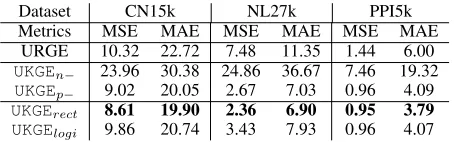
Table 3: Mean squared error (MSE) and mean absolute error (MAE) of relation fact confidence prediction (×10−2).
metrics CN15K NL27k PPI5k Dataset linear exp. linear exp. linear exp. TransE 0.601 0.591 0.730 0.722 0.710 0.700 DistMult 0.689 0.677 0.911 0.897 0.894 0.880 ComplEx 0.723 0.712 0.921 0.913 0.896 0.881 URGE 0.572 0.570 0.593 0.593 0.726 0.723 UKGEn− 0.236 0.232 0.245 0.245 0.514 0.517
UKGEp− 0.769 0.768 0.933 0.929 0.940 0.944
UKGErect 0.773 0.775 0.939 0.942 0.946 0.946 UKGElogi 0.789 0.788 0.955 0.956 0.970 0.969
Table 4: Mean normalized DCG for global ranking task. Here linearstands for linear gain, andexp. stands for ex-ponential gain.
have a KG-specific confidence score thresholdτ to dis-tinguish the high-confidence relation facts from the low-confidence ones, which will be discussed later in Section 5.7. These models cannot predict confidence scores. We compare our methods to them only on the ranking and the classification tasks. For the same reason, the early stop-ping is based on mean reciprocal rank (MRR) on the vali-dation set. We adopt the implementation given by (Trouil-lon et al. 2016) and choose the best hyper-parameters fol-lowing the same grid search procedure. This implementa-tion uses (Duchi, Hazan, and others 2011) for optimiza-tion. The best hyper-parameter combinations on CN15k and NL27k are b = 1024,{lr = 0.01, k = 128} for TransE and{lr= 0.05, k= 256}for DistMult and Com-plEx. On PPI5k they arelr = 0.1,{k = 128, b = 512} for DistMult and{k = 256, b = 1024}for TransE and ComplEx.
• Uncertain Graph Embedding Model. URGE is proposed very recently to embed uncertain graphs. However, it can-not deal with multiple types of relations in KGs, and it only produces node embeddings. We simply ignore rela-tion types when applying URGE to our datasets. We adopt its first-order proximity version as our tasks focus on the edge relations between nodes.
• Two Simplified Versions of Our Model. To justify the
use of negative links and PSL reasoning in our model, we propose two simplified versions ofUKGErect , called
UKGEn−andUKGEp−. InUKGEn−, we only keep the
ob-served relation facts and remove negative sampling, and inUKGEp−, we remove PSL reasoning and use the MSE
loss for unseen relation facts.
5.5
Confidence Prediction
The objective of this task is to predict confidence scores of unseen relation facts.
Evaluation protocol For each uncertain relation fact
(l, sl)in the test set, we predict the confidence score of l and report the mean squared error (MSE) and mean absolute error (MAE).
Results Results are reported in Table 3. Both our variants
UKGErect and UKGElogi outperform the baselines URGE,
UKGEn−, andUKGEp−, since URGE only takes node
prox-imity information and cannot model the rich relations be-tween entities, andUKGEn− does not adopt negative
sam-pling and cannot recognize negative links. The better re-sults ofUKGErect thanUKGEp− demonstrate that
introduc-ing PSL into embeddintroduc-ing learnintroduc-ing can enhance the model performance. Between the two model variants,UKGErect re-sults in smaller MSE and MAE thanUKGElogi. We notice that all the models achieve much smaller MSE on PPI5k than CN15k and NL27k. We hypothesize that this is because the much higher density of PPI5k facilitates embedding learning (Pujara, Augustine, and Getoor 2017).
5.6
Relation Fact Ranking
The next task focuses on ranking tail entities in the right order for the query(h, r,?t).
Evaluation protocol For a query(h, r,?t), we rank all the entities in the vocabulary as tail candidates and evaluate the ranking performance using the normalized Discounted Cu-mulative G ain (nDCG) (Li, Liu, and Zhai 2009). We define the gain in retrieving a relevant tail t0 as the ground truth
confidence scores(h,r,t0). We take the mean nDCG over the test query set as our ranking metric. We report the two ver-sions of nDCG that use linear gain and exponential gain re-spectively. The exponential gain version puts stronger em-phasis on highly relevant results.
Dataset head relation true tail confidence predicted tail predicted confidence true confidence
CN15k
rush relatedto
fast 0.968 fast 0.703 0.968
motion 0.709 move 0.623 0.557
rapid 0.709 hour 0.603 0.654
urgency 0.709 time 0.601 0.105
hotel usedfor
sleeping 1.0 relaxing 0.858 N/A
rest 0.984 sleeping 0.849 1.0
bed away from home 0.709 rest 0.827 0.984 stay overnight 0.709 hotel room 0.797 N/A
NL27k Toyota competeswith
Honda 1.0 Honda 0.942 1.0
Ford 1.0 Hyundai 0.910 0.719
BMW 0.964 Chrysler 0.908 N/A
General Motors 0.930 Nissan 0.896 0.859
Table 5: Examples of relation fact ranking (global) results usingUKGElogi. Top 4 results are shown. N/A denotes relation facts that are not observed in KG.
Metrics CN15k NL27k PPI5k Dataset F-1 Accu. F-1 Accu. F-1 Accu.
TransE 23.4 67.9 65.1 53.4 83.2 98.5 DistMult 27.9 71.1 72.1 70.1 86.9 97.1 ComplEx 18.9 73.2 63.3 53.4 83.2 98.9 URGE 21.2 86.0 83.6 88.7 85.2 98.6
UKGEn− 23.6 86.1 64.4 65.5 92.7 99.3
UKGEp− 26.2 88.7 89.7 93.4 94.2 99.3
UKGErect 28.8 90.4 92.3 95.2 95.1 99.4
UKGElogi 25.9 90.1 88.4 93.0 94.5 99.5
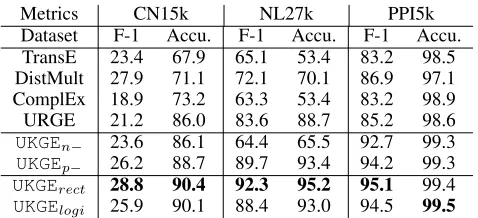
Table 6: F-1 scores (%) and accuracies (%) of relation fact classification
high. We observe that DistMult and ComplEx have con-siderably better performance than TransE, as TransE does not handle1-to-Nrelations well. ComplEx embeds enti-ties and relations in the complex domain and handles asym-metric relations better than DistMult. It achieves the best results among the deterministic KG embedding models on this task. AsUKGEn− removes negative sampling from the
loss function, it cannot distinguish the negative links from existing relation facts and results in the worst performance.
UKGEp− yields slightly worse performance thanUKGErect.
Besides ranking the existing relation facts highly, our mod-els also preserve the order of the observed relation facts and thus achieve higher nDCG scores. BothUKGErect and
UKGElogi outperform all the baselines under all settings, while UKGElogi yields higher nDCG on all three datasets than UKGErect. Considering the confidence prediction re-sults of UKGElogi in Section 5.5, we hypothesize that the easy saturation of logistic function allowsUKGElogito bet-ter distinguish negative links from true relation facts, while this feature compromises its ability to fit confidence scores more precisely.
Case study Table 5 gives some examples of relation fact ranking results by UKGElogi. Given a query (h, r,?t), the top 4 predicted tails and true tails are given, sorted by their scores in descending order. The predictions are consistent with our common-sense. It is worth noting that some quite reasonable unseen relation facts such ashotel is used for
re-laxing, can be predicted correctly. In other words, our pro-posed approach can be potentially used to infer new knowl-edge from the observed ones with reasonable confidence scores, which may shed light on another line of future study.
5.7
Relation Fact Classification
This last task is a binary classification task to decide whether a given relation fact l is a strong relation fact or not. A relation fact is considered strongif its confidence scoresl is above a KG-specific threshold τ. The embedding mod-els need to distinguish relation facts in the KG from neg-ative links and high-confidence relation facts from low-confidence ones.
Evaluation protocol We follow a procedure that is sim-ilar to (Wang et al. 2014). Our test set consists of relation facts from the KG and randomly sampled negative links equally. We divide the test cases into two groups, strong and weak/false, by their ground truth confidence scores. A test relation factlis strong whenlis in the KG andsl> τ, oth-erwise weak/false. We fit a logistic regression classifier as a downstream classifier on the predicted confidence scores.
Results F-1 scores and accuracies are reported in Table 6. These results show that our two model variants consistently outperform all baseline models. The deterministic KG mod-els can distinguish the existing relation facts from negative links, but they do not leverage the confidence information and cannot recognize the high-confidence ones. URGE does not encode the rich relations. AlthoughUKGEn−fits
confi-dence scores in the KG, it cannot correctly interpret nega-tive links as false. Consistent with the previous two tasks, the performance ofUKGEp−is worse thanUKGErect.
6
Conclusion and Future Work
To the best of our knowledge, this paper is the first work on embedding uncertain knowledge graphs. Our modelUKGE
promising. For future work, we will study how to systemati-cally generate reasonable logical rules and test its impact on embedding quality. We are interested in extendingUKGEfor uncertain knowledge extraction from text.
Acknowledgements
This work is partially supported by NSF III-1705169, NSF CAREER Award 1741634, Snapchat gift funds, and PPDai gift fund.
References
Bach, S.; Huang, B.; London, B.; and Getoor, L. 2013. Hinge-loss markov random fields: Convex inference for structured prediction. Uncertainty in Artificial Intelligence.
Bach, S. H.; Broecheler, M.; Huang, B.; and Getoor, L. 2017. Hinge-loss markov random fields and probabilistic soft logic. JMLR.
Bollacker, K.; Evans, C.; Paritosh, P.; Sturge, T.; and Taylor, J. 2008. Freebase: a collaboratively created graph database for struc-turing human knowledge. InSIGMOD.
Bordes, A.; Usunier, N.; Garcia-Duran, A.; Weston, J.; and Yakhnenko, O. 2013. Translating embeddings for modeling multi-relational data. InNIPS.
Bordes, A.; Weston, J.; and Usunier, N. 2014. Open question an-swering with weakly supervised embedding models. In ECML-PKDD. Springer.
Chen, M.; Weinberger, K. Q.; Xu, Z.; and Sha, F. 2015. Marginal-izing stacked linear denoising autoencoders.JMLR.
Chen, M.; Tian, Y.; Chen, X.; Xue, Z.; and Zaniolo, C. 2018. On2vec: Embedding-based relation prediction for ontology pop-ulation. InSDM.
Das, R.; Dhuliawala, S.; Zaheer, M.; Vilnis, L.; Durugkar, I.; Kr-ishnamurthy, A.; Smola, A.; and McCallum, A. 2018. Go for a walk and arrive at the answer: Reasoning over paths in knowledge bases using reinforcement learning. InICLR.
Dettmers, T.; Minervini, P.; Stenetorp, P.; and Riedel, S. 2018. Convolutional 2d knowledge graph embeddings. InAAAI. Duchi, J.; Hazan, E.; et al. 2011. Adaptive subgradient methods for online learning and stochastic optimization.JMLR12(Jul). He, H.; Balakrishnan, A.; Eric, M.; and Liang, P. 2017. Learning symmetric collaborative dialogue agents with dynamic knowledge graph embeddings. InACL.
Hu, J.; Cheng, R.; Huang, Z.; Fang, Y.; and Luo, S. 2017. On embedding uncertain graphs. InCIKM.
Jenatton, R.; Roux, N. L.; Bordes, A.; and Obozinski, G. R. 2012. A latent factor model for highly multi-relational data. InNIPS. Ji, G.; He, S.; Xu, L.; Liu, K.; and Zhao, J. 2015. Knowledge graph embedding via dynamic mapping matrix. InACL.
Jia, Y.; Wang, Y.; Lin, H.; Jin, X.; and Cheng, X. 2016. Locally adaptive translation for knowledge graph embedding. InAAAI, 992–998.
Kadlec, R.; Bajgar, O.; and Kleindienst, J. 2017. Knowledge base completion: Baselines strike back. InACL.
Kimmig, A.; Bach, S.; Broecheler, M.; Huang, B.; and Getoor, L. 2012. A short introduction to probabilistic soft logic. In Proceed-ings of the NIPS Workshop on Probabilistic Programming: Foun-dations and Applications, 1–4.
Kingma, D. P., and Ba, J. 2014. Adam: A method for stochastic optimization.ICLR.
Li, H.; Liu, T.-Y.; and Zhai, C. 2009. Learning to rank for informa-tion retrieval.Foundations and TrendsR in Information Retrieval. Lin, Y.; Liu, Z.; Sun, M.; Liu, Y.; and Zhu, X. 2015. Learning entity and relation embeddings for knowledge graph completion. InAAAI.
Lukasiewicz, T., and Straccia, U. 2008. Managing uncertainty and vagueness in description logics for the semantic web. Web Semantics: Science, Services and Agents on the World Wide Web. Mitchell, T.; Cohen, W.; Hruschka, E.; Talukdar, P.; Yang, B.; Bet-teridge, J.; Carlson, A.; Dalvi, B.; Gardner, M.; Kisiel, B.; et al. 2018. Never-ending learning.Communications of the ACM. Nickel, M.; Rosasco, L.; and Poggio, T. 2016. Holographic em-beddings of knowledge graphs. InAAAI.
Nickel, M.; Tresp, V.; and Kriegel, H.-P. 2011. A three-way model for collective learning on multi-relational data. InICML.
Pujara, J.; Augustine, E.; and Getoor, L. 2017. Sparsity and noise: Where knowledge graph embeddings fall short. InEMNLP. Ratinov, L., and Roth, D. 2009. Design challenges and misconcep-tions in named entity recognition. InCoNLL.
Rebele, T.; Suchanek, F.; Hoffart, J.; Biega, J.; Kuzey, E.; and Weikum, G. 2016. Yago: A multilingual knowledge base from wikipedia, wordnet, and geonames. InISWC.
Shi, B., and Weninger, T. 2017. Proje: Embedding projection for knowledge graph completion. InAAAI.
Socher, R.; Chen, D.; Manning, C. D.; and Ng, A. 2013. Reasoning with neural tensor networks for knowledge base completion. In NIPS.
Speer, R.; Chin, J.; and Havasi, C. 2017. Conceptnet 5.5: An open multilingual graph of general knowledge. InAAAI.
Szklarczyk, D.; Morris, J. H.; Cook, H.; Kuhn, M.; Wyder, S.; Si-monovic, M.; Santos, A.; Doncheva, N. T.; Roth, A.; Bork, P.; et al. 2016. The string database in 2017: quality-controlled protein– protein association networks, made broadly accessible. Nucleic acids research.
Trouillon, T.; Welbl, J.; Riedel, S.; Gaussier, E.; and Bouchard, G. 2016. Complex embeddings for simple link prediction. InICML. Wang, Z., and Wang, H. 2016. Understanding short texts. InACL. Wang, Z.; Zhang, J.; Feng, J.; and Chen, Z. 2014. Knowledge graph embedding by translating on hyperplanes. InAAAI. Wang, Z.; Wang, H.; Wen, J.-R.; and Xiao, Y. 2015. An inference approach to basic level of categorization. InCIKM.
Weston, J.; Bordes, A.; et al. 2013. Connecting language and knowledge bases with embedding models for relation extraction. InEMNLP.
Wu, W.; Li, H.; Wang, H.; and Zhu, K. Q. 2012. Probase: A prob-abilistic taxonomy for text understanding. InSIGMOD.
Yang, B.; Yih, W.-t.; He, X.; Gao, J.; and Deng, L. 2015. Embed-ding entities and relations for learning and inference in knowledge bases. ICLR.