59
Copyright © 2011-15. Vandana Publications. All Rights Reserved.
Volume-5, Issue-3, June-2015
International Journal of Engineering and Management Research
Page Number: 59-66
Government Acceptance of Social Media in India
Prof. (Dr.) L.P. Pateriya1, Ashish Chauhan2
1 Professor, Department of Management Studies, Guru GhasidasVishwavidyalaya, Bilaspur(C.G.), INDIA 2 Research Scholar, Department of Management Studies, Guru GhasidasVishwavidyalaya, Bilaspur(C.G.), INDIA
ABSTRACT
Purpose: The purpose of this paper is to find out and put the clear picture of Government acceptance of Social Media in India.
Design/methodology/approach: This is a micro-level exploratory research paper focusing on the Central Government and State Government presence on three social media websites i.e. Facebook, Twitter and YouTube, in India with the help of few selected Search Keywords and is based on secondary data.
Findings: This paper provide the present Indian scenario of Government acceptance of Social Media in two phases i.e. Central government as well as State Government.
Originality/value – This paper provides insight to anyone who is interested in researching level of dispersion and utilization of social media in Government usage. It will be particularly helpful to have a look on the present Indian scenario of Government social media usage.
Paper type: Research Paper
Keywords---- Government usage, Government social media, Indian Government, Web 2.0, social media, social networking sites, SNS.
I.
INTRODUCTION
During the past 50 years, information technologies have become increasingly networked and more powerful. Recent improvements in user interfaces for social tools and increased use of mobile wireless computing have created social networks that are immediate, highly distributed, largely uncontrolled and pervasive(Power, 2012). India has the world's second-largest mobile phone user base with over 919 million users as of March 2012. It has the world's third-largest Internet users with over 121 million as of December 2011. Social media in India reaches out to 60 per cent of the online Indian audience (Srivastava, 2013).Social Media is the biggest shift since the industrial revolution(Qualman, 2012).The revolution called Social Media has actually taken the world by storm. Its growth has been exponential where Radio took 38 years to reach
60
Copyright © 2011-15. Vandana Publications. All Rights Reserved.
many forms (Bertot, Jaeger, Munson and Glaisyer, 2010).
A 2006 study of 14 countries found that countries with dedicatedtransparency laws werethree times more likely to respond torequests for information, with countrieslackingtransparency lawsacknowledged less than half of the requests(Bertot, Jaeger and Grimes, 2010).Case studies andstatistical analyses indicate that ICTs hold a great deal of potential for – and arealready demonstrating benefits in – anti-corruption, particularly by enhancingthe effectiveness of internal and managerial control over corrupt behaviours and bypromoting government accountability and transparency. Implementing e-governmentsignificantly reduces corruption, even after controlling for any propensity for corruptgovernments to be more or less aggressive in adopting e-government initiatives(Bertot, Jaeger and Grimes, 2012).To promote government social media usage and to increase public engagement in India, Ministry of Information Technology and Communications, in 2011, drafted a document - Framework and Guidelines for Use of Social Media by Government Organisations.This provided a fast, cost-effective, interactiveand dynamic online platform forgovernmentofficials/organisations and common people/citizens that can help government to serve efficiently by making effective policies with public engagement and their far-reach implementation.
In this paper, we have tried to explore the acceptance level of government social media usage in India. We took selected social media platforms and proper keywords to find out government authorized/official accounts and the study ended up showing the welcoming acceptance of government to social media but with a surprise that on one hand, Central Government is excelling day by day in social media usage, on the other hand, State Government merely seems to know what social media is and what could it achieve letting the gates open to other researchers to conduct in-depth research.
II.
SOCIAL MEDIA
Social Media is a very complex terminology to explain at first place, but to begin with, it is online interactive mass communication platform. Various authors have defined social media in their own meanings and approaches. (Wikipedia, 2011) definition of social media is “Social media are media for social interaction, using highly accessibleand scalable communication techniques. Social media is the use of web-based andmobile technologies to turn communication into interactive dialogue.” A little technological definition is given by (Kaplan and Haenlein, 2010).They have defined social media as “a group of Internet-basedapplications that build on the ideological and technological foundations of Web 2.0,which allows the creation and exchange of user-generated content.” One of the main reasons of complexity in defining social Media is its ever-evolving and updating nature. This
frequently changes the overall meaning of the term social media making individuals confused though core element remaining the same i.e. Web 2.0. In 2008, one blogger and CEO of ThornleyFallis,Joseph Thornleydefined “Social media are online communications in which individuals shift fluidly and flexibly between the role of audience and author. To do this, they use social software that enables anyone without knowledge of coding, to post, comment on, share or mash up content and to form communities around shared interests.” By 2011, he defined“Social media are online communications in which we shift instantly and easily between the role of audience and creator – without needing to know how to code. We do this by using social software that incorporates functions like publishing, sharing, friending, commenting, linking and tagging” just to keep his definition updated and more understandable to his followers and fans.
Just like its definition, Social media is too complex to be classified into concrete and unique sets. One or more social media types may exhibit properties of one or more other social media types. Large number of online/offline sources has categorizedthe social media into their own different ways e.g.
(Cavazza,2011) divided the Social Media Landscape into 10 categories:
Publication tools with blogs (Typepad, Blogger…), wikis (Wikipedia, Wikia, Wetpaint…) and citizen journalism portals (Digg, Newsvine…)
Sharing tools for videos (YouTube…), pictures (FlickR…), links (del.icio.us, Ma.gnolia…), music (Last.fm, iLike…), slideshows (Slideshare), products reviews (Crowdstorm, Stylehive…) or products feedbacks (Feedback 2.0, GetSatisfaction…)
Discussions tools like forums (PHPbb, vBulletin, Phorum…), video forums (Seesmic), instant messaging (Yahoo! Messenger, Windows Live Messenger, Meebo…) and VoIP (Skype, Google Talk…)
Social networks (Facebook, MySpace, Bebo, Hi5, Orkut…), niche social networks (LinkedIn, Boompa…) and tools for creating social networks (Ning)
Micropublication tools (Twitter, Pownce, Jaiku, Plurk, Adocu…) and alike (twitxr, tweetpeek)
Social aggregation tools like lifestream (FriendFeed, Socializr, Socialthing!, lifestrea.ms, Profilactic…)
Platforms for livecast hosting (Justin.tv, BlogTV, Yahoo! Live, UStream…) and there mobile equivalent (Qik, Flixwagon, Kyte, LiveCastr…)
Virtual worlds (Second Life, Entropia Universe, There…), 3D chats (Habbo, IMVU…) and teens dedicated virtual universes (Stardoll, Club Penguin…)
Social gaming platforms (ImInLikeWithYou, Doof…), casual gaming portals (Pogo, Cafe, Kongregate…) and social networks enabeled games (Three Rings, SGN)
61
Copyright © 2011-15. Vandana Publications. All Rights Reserved.
(Kaplan and Haenlein, 2010) identified six differenttypes of social media: Collaborative projects; Blogs and Micro-blogs; Content communities; Social networking sites; Virtual game worlds; and Virtual social worlds.
On account of major players of social media,
(Stelzner, 2011) revealed that Facebook significantly leads all the other social media tools, in terms of percentage of users, followed impressively by Twitter, LinkedIn, Blogs and YouTube. Rest of the social media types/tools are insignificantly following these Top-Five i.e. 6% to 26% users.
III.
GOVERNMENT OF INDIA
(Oxforddictionary.com) has defined government as“The system by which a state or community is governed.”In our study, we are considering India and hence the Government of India.
(Wikipedia) defines “The Government of India (GoI), officially known as the Union Government, was established by the Constitution of India, and is the governing authority of the union of 29 states and 07 union territories , collectively called the Republic of India”. The key role players in the Government of India are the President and the Prime Minister and are nominal and executive Heads of Country, respectively. So, the President is the Head of the State/country and the Prime Minister is the Head of Government. As described by
(The Constitution of India, 2007) “The executive power is vested mainly in the President of India, as per Article 53 (1) of the constitution. The President is to act in accordance with aid and advice tendered by the Prime Minister, who leads the Council of Ministersas described in Article 74 of the Constitution of India”. Power is divided between union government and state governments. “State governments in India are the governments ruling States of India and the chief minister heads the state government” (Wikipedia).
IV.
GOVERNMENT AND SOCIAL
MEDIA
Social networking has almost become the top most activity on the web. Every global brand has a social media presence; it is new marketing tool at their disposal and the hitherto not very supportive governments have also started using social media platform (Srivastava, 2013). Government employment of social media offers several key opportunitiesfor the technology(Bertot, Jaeger and Hansen, 2011):
• Democratic participation and engagement, through which social media technologies are used to involve the public in government decision processes to foster participatory dialog and policy development and implementation. • Co-production, through which governments and
the public jointly develop, design, and deliver government services to improve service quality, deliver, and responsiveness.
• Crowdsourcing solutions and innovations, through which governments seek innovation through public knowledge and talent to develop innovative solutions to large-scale societal issues. To facilitate crowdsourcing, the government shares data and other inputs so that the public has a foundational base on which to innovate.
• Transparency and accountability, through which government is open and transparent regarding its operations to build trust and foster accountability.
Social media and government go hand in hand now-a-days in almost all the countries of the world including India which is yet a laggard. The primary intention/purpose of accepting social media by various governments is the inclusion of its citizen. Government want citizen engagement in their working so as to seek feedback and provide tailor-made policies & actions with transparency and accountability to receive trust and support of common people. Apart from this, there are number of purposes that are fulfilled by social media for the government like activities and registration to boost participation, emergency alerts and severe weather updates, driving traffic, public service announcements, job applications, police assistance and so forth.As per a blogger Shamanth Rao, earlier of September 2011, the Government of India’s Ministry of IT & Communications released a social media strategy framework draft. Given the Government of India’s reputation as a laggard when it comes to technology, this was a bit of a surprise.Some of the content of the document, though, is very pertinent and well-researched. In particular, it lists out common etiquette practices that can be very useful for first-timers and comprises following 6 elements (Ministry of Information Technology and Communications, 2011):
62
Copyright © 2011-15. Vandana Publications. All Rights Reserved.
• Platform: Which platform/s to use for interaction
• Governance: What are rules of engagement • Communication Strategy: How to interact • Pilot: How to create and sustain a community • Engagement Analysis: Who is talking about wh
at, where and what are the main points of conversations
• Institutionalisation: How to embed social media in organisation structure
So, the Government of India is, no doubt, a laggard in the field of government acceptance of social media but it, surely, is making up fast. The present political scenario of India has witnessed the tremendous power of social media for which the best example can be the election campaign of present Prime Minister Mr.NarendraModi. He is the most powerful and dominant personality on social media and large contribution to his success can, no doubt, be given to the emphasizeduse of social media in his election campaign which he still is harnessing after becoming the Prime Minister of India. Prime Minister Office`s official account, PMOIndia, is the account that is most active and liked/followed by citizens ofIndia. There are other cases too, like Indian Diplomacy, Planning Commission, Delhi/Bangalore/Chandigarh Traffic Police, Various politicians and political parties etc. which show and clarify the active presence and government usage of social media.
V.
RESEARCH METHODOLOGY
Definition of Government of India
We have defined the Population, i.e. Government of India, in two phases in accordance to their existence in Indian Governance System:
1. Central government 2. Local/State Government
Justification: if we try to seek government usage of social media as a whole i.e. the presence of Indian government on any social media, it may depict wrong scenario of actual situation. The results obtained with
that approach may be superficial because of Federal type of Indian Government system.Itmay be correct and justified for countries like China, France, United Kingdom etc.but not for India where power is divided into Union and State Government. So, it is advisable and better to study government social media acceptance in two phases i.e. the central and the local government, so as to depict a correct and clear picture.
Selection of Social Media
As far as Social Media is concerned, we have included only three social media types for our research i.e.
1. Facebook 2. Twitter 3. YouTube
Justification: The large platform of social media is dominated by only a chunk of social media types/tools. Top-five social media types of all the platforms are Facebook, Twitter, LinkedIn, Blogs and YouTube standing at first to fifth position respectively. Out of these five, LinkedIn is a professional networking website and blogs are personal networking social media type which is excellent to an Individual but government. So, in spite of including all of these top-five social media platforms, we have selected only Facebook, Twitter and YouTube excluding LinkedIn and Blogs that facilitates selection of effective and appropriate social media types.
Search Keywords/Scanning
To check the presence of central government on social media platforms, each of these social media types were scanned with search keywords “Government of India”, “President” and “Prime Minister” for any kind of authorized/official account. For State Government, We scanned these social media types with search keywords “XYZ Government” and “CMO XYZ”where XYZ represents name of each and every 29 states of India.While remaining 7-Union Territories were scanned with combination of both the search keywords used for central as well as state government i.e. “government of India” and “XYZ Government” where XYZ represents individual Union territory name.
VI.
ANALYSISAND INTERPRETATION
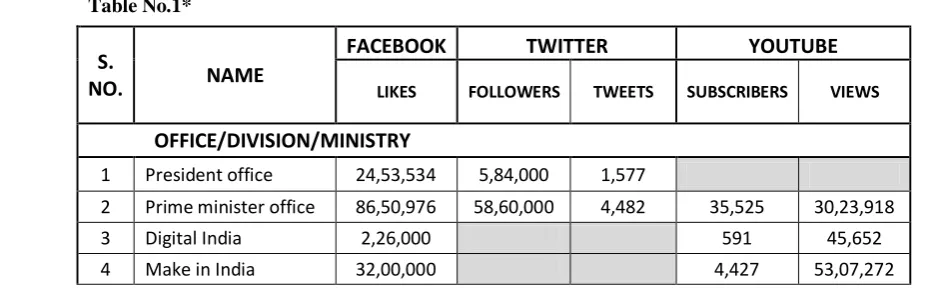
Table No.1*
S.
NO. NAME
FACEBOOK TWITTER YOUTUBE
LIKES FOLLOWERS TWEETS SUBSCRIBERS VIEWS
OFFICE/DIVISION/MINISTRY
1 President office 24,53,534 5,84,000 1,577
2 Prime minister office 86,50,976 58,60,000 4,482 35,525 30,23,918
3 Digital India 2,26,000 591 45,652
63
Copyright © 2011-15. Vandana Publications. All Rights Reserved.
5 MyGov 1,06,000 401 218 13,989
6 Ministry of Information &
Broadcasting 8,40,000 3,41,000 14,400 18,987 30,73,590
7 Ministry of Finance 7,02,000
8 Ministry of railways 2,78,000 3,15,000 1,251
9 Indian Diplomacy 3,71,000 7,991
10 Indian Revenue Services 3733
11 Indian Army (ADGPI) 25,00,000
12 ISRO 9,24,000
13 Press Information Bureau 5,06,000 45,500
14 NITI Aayog 12,00,000 6,20,000 1,080
15 Ministry of External Affairs 8,77,727 3,33,000 8,669
16 MHRD 1,39,000 763
17 Ministry of Health and Family Welfare 73,800 2,473
18 National e-Governance Division 12,300 1,439
19 Ministry of Textile 26,900 251
20 Ministry of Road Transport and
Highways 26,300 262
UNION TERRITORIES
1 ANDAMAN & NICOBAR ISLANDS
2 CHANDIGARH
3 DADRA AND NAGAR
HAWELI
4 DAMAN & DIU
5 NCR#
6 LAKSHWADEEP
7 PONDUCHERY
Not Present on that Social Media Type * Data Period: upto April 2015
# Excluded (Covered in Central Government division)
As seen in Table No.1, more than 20 divisions/ministries of Central Government show presence on one or more social media type which indicate that Central Government of India has significantly accepted the social media. Few of these like Prime Minister Office (PMO) and Ministry Of Information and Broadcasting (MIB) are heavily using social media to improve their efficiency and effectiveness which is clear by their presence on all the three social media types included in our study. PMO clean sweeps all the government divisions in Twitter usage with 5,860,000 followers and 4,482
64
Copyright © 2011-15. Vandana Publications. All Rights Reserved.
harnessing social media at fullest by accepting all of these three social media types i.e. Facebook, Twitter and YouTube.
On the contrary, State Government has accepted social media insignificantly. Only six out of twenty nine States of India show presence on one or more social media
types and in that also, Arunachal Pradesh is the only state accepting all three social media types, rest of the states are using only one type of social media except Telangana state which has presence on Facebook as well as Twitter (Table No.2).
Table No.2*
S.
NO. STATES OF INDIA
FACEBOOK TWITTER YOUTUBE
LIKES TALKING ABOUT
(APR-2015) FOLLOWERS TWEETS SUBSCRIBERS VIEWS
1 ANDHRA PRADESH 28,768 731 5,84,000 1,577 1,552 2,82,325
2 ARUNACHAL PRADESH
3 ASSAM
4 BIHAR
5 CHHATTISGARH 31,690 13,574
6 GOA
7 GUJRAT
8 HARYANA
9 HIMACHAL PRADESH
10 JAMMU & KASHMIR
11 JHARKHAND
12 KARNATAKA
13 KERALA
14 MADHYA PRADESH 13,700 650
15 MAHARASTRA 16,279 3,946
16 MANIPUR
17 MEGHALAYA
18 MIZORAM
19 NAGALAND
20 ODISHA
21 PUNJAB
22 RAJASTHAN
23 SIKKIM
24 TAMILNADU
25 TELANGANA 2,02,114 11,349 20,600 855
26 TRIPURA
27 UTTAR PRADESH 29,600 3,536
28 UTTARAKHAND
29 WEST BENGAL
Not Present on that Social Media Type * Data Period: upto April 2015
Facebook is single-handedly leaded by Telangana Government with 202,114 likes as compared to 31,690
65
Copyright © 2011-15. Vandana Publications. All Rights Reserved.
followers without any competition from its followers Uttar Pradesh Government and Telangana Government having 29,600 and 20,600 followers respectively. YouTube has received the attention of only one state government i.e. Andhra Pradesh Government with 282,325 views and 1,552 subscribers. So, Andhra Pradesh Government is the only State Government that understand the power of social media and has accepted every possible social media platform included in study; otherwise the acceptance of social media in second phase i.e. State/Local Government is far beyond the expectations and needs urgent attention.
VII.
FINDINGS AND CONCLUSION
Despite of being a laggard in accepting social media in government use, India has open-heartedly accepted and welcoming government social media usage; and, also, is trying to make up with it at a rapid and steady rate.
Central Government has fully understand the potential of social media and most of its divisions/ministries have accepted the government social media usage but Local/State Government is still a way too far from exploring and accepting the potential of social media and its government use. Only 6 out of 29 states (20.69%) have accepted government social media usage. Apart from this, even when Central Government is excelling the acceptance of government social media usage, Union Territories, despite being part of Central Government only, ignores social media completely i.e. 0 out of 7 union territories (0%) have accepted the government usage of social media.
As found in study, the main purpose of accepting social media by the government are: Awareness, Education and Announcement of Public Policies; Public interaction; Public Relation and Image Building; and Citizen Feedback but overall focus was on public awareness and engagement.
So to conclude, Indian government has accepted social media, though still it has a long way to go, and is quickly making up to implement social media at its fullest. Government social media usage is sufficiently accepted on national-level in India but on grass-root-level it is still awaiting to be accepted. It needs more research to find out reason behind reluctance of state government to accept social media and provide them solution at this level to encourage government social media acceptance and its proper utilization by inclusion of public engagement in formulation and implementation of public service rather than just showcasing its citizen what government is doing and how. When this will happen, and it is happening at a really good pace, then only can we say government acceptance of social media is truly achieved in India.
VIII.
FUTURE RESEARCHES AND
LIMITATIONS
With no doubt, need and acceptance of social media is not a subject to be questioned anymore. Every country and its government, now or later, is or have to
accept social media. Government of India too, though recently, understand this and is accepting the blessings of social media with open hands wherever possible. It is, though, very surprising to see the difference of level of acceptance of government social media usage by Central Government and State Government. It is a large gap that cannot be ignored and left unfilled now. This leads a foundation to researchers to find out the reason behind state government`s ignorance towards social media when Government of India has already accepted it and how to overcome those reasons to facilitate government acceptance of social media on grass-root level and nation-wide.
There are few limitations in our research which may, easily, be delimitated but due to the time-constraint and resources at our hand, we limited our research to a particular level. Social media is highly dynamic in nature where changes take place at a very fast pace. We have considered data up to April 2015 for our research which may not depict a true picture even in next quarterly. Indianscenario of government social media is such that where statistical value of social media facts is changing every month and week; government usage of social media being a very new thing to India; which is another major reason limiting the results of this study. Apart from this, research was limited to only few of the social media platforms, though those are appropriate at the time, and keywords. Only initial 50-100 searches were scanned and individual political presence on any social media platform was completely excluded.
REFERENCES
[1] Agostino, Deborah. (2012). The Effectiveness of Social Software for Public Engagement. International Journal of Engineering Business Management, Vol 4. [2] Bertot, John Carlo, Jaeger,Paul T., Munson, Sean et al. (2010). Engaging the Public in Open Government: Social Media Technology and Policy for Government Transparency. Technology Mediated Social Participation (TMSP) Reports.
[3] Bertot, John Carlo, Jaeger,Paul T., & Hansen, Derek. (2012). The impact of policies on government social media usage: Issues, challenges, and recommendations. Government Information Quarterly 29, 30–40.
[4] Bertot, John Carlo, Jaeger,Paul T., & Grimes, Justin M. (2010). Using ICTs to create a culture of transparency: E-government and social media as openness and anti-corruption tools for societies.Government Information Quarterly 27, 264–271.
[5] Bertot, John Carlo, Jaeger,Paul T., & Grimes, Justin M. (2012). Promoting transparency and People, accountability through ICTs, social media, and collaborative e-government. Transforming Government: Process and Policy, Vol. 6 Issue: 1, 78 – 91.
66
Copyright © 2011-15. Vandana Publications. All Rights Reserved.
[7] Cavazza, Fred. (2008). Social Media Landscape.
Fetched from
http://www.fredcavazza.net/2008/06/09/social-media-landscape/
[8] Department of Electronics and Information
Technology. (2012). Framework & Guidelines for Use of Social Media for Government Organisations. Ministry of Communications & Information Technology, Government of India, 10-11.
[9] Hansen Derek L., Shneiderman, Ben &Smith, Marc A. (2011). Analyzing social media networks with nodexl: Insights from a connected world. Elsevier Inc., 12.
[10] http://www.wikipedia.com [11] http://www.oxforddictionary.com [12] http://www.facebook.com [13] http://www.twitter.com [14] http://www.youtube.com [15] http://www.plus.google.com [16] http://www.linkedin.com
[17] Kaplan,Andreas M., &Haenlein,Michael. (2010). Users of the world, unite! The challenges and opportunities of Social Media. Business Horizons, Vol. 53, 61-62.
[18] Media Hypes. (2014). Social Media. Fetched from http://media-hypes.com/social-media/
[19] Mickoleit, A. (2014). Social Media Use by Government: A Policy Primer to Discuss Trends, Identify Policy Opportunities and Guide Decision Makers. OECD Working Papers on Public Governance, No. 26.
[20] Ministry of Law and Justice, (2007). The Constitution of India. Government of India.
[21] Power, Daniel J., and Wren, Gloria Phillips. (2012). Impact of Social Media and Web 2.0 onDecision-Making. Journal of Decision Systems, Vol. 20, Issue 3.
[22] Qualman,Erik. (2012). Socialnomics: How Social Media Transforms the Way We Live and DoBusiness.Wiley Publications, second edition.
[23] Rao, Shamanth. (2011). Indian Government Releases Social Media Strategy Framework Draft. Fetched from http://www.nextbigwhat.com/indian-government-social-media-framework-297/
[24] Stelzner, Michael A. (2011). How Marketers Are Using Social Media to Grow Their Business. SocialMedia Marketing Industry Report, Social Media Examiner, 21. Srivastava, Meetika. (2013). Social Media and its Use in
Government fetched from
http://unpan3.un.org/paconnect/Blogs/ID/16/SOCIAL-MEDIA-AND-ITS-USE-BY-THE-GOVERNMENT [25] Thornley,Joseph. (2008). What is "social media?”. Fetched from http://propr.ca/2008/what-is-social-media/ [26] Thornley, Joseph. (2011). Social Media Defined.
Thornley Fallis. Fetched from https://thornleyfallis.ca/social-media-defined/
[27] Wolfe,Michael. (2014). 10 Ways Local Government Can Use Social Media. Fetched