Using Knowledge Transfer Partnership Projects
to Reveal Latent Dynamics in the
Knowledge-Based View of Strategy
PhD Candidate: Serkan Ceylan Original Submission Date: 16/07/2018
Submitted in partial fulfilment for the Doctor of Philosophy of the requirements of both Nottingham Trent University and Solent University
ii | P a g e
IPR Statement
This work is the intellectual property of Serkan Ceylan. You may copy up to 5% of this work for private study, or personal, non-commercial research. Any re-use of the information contained within this document should be fully referenced, quoting the author, title, university, degree level and pagination. Queries or requests for any other use, or if a more substantial copy is required, should be directed in the owner of the Intellectual Property Rights
Statement of Original Authorship
I certify that this dissertation reports original work by me during my University project.
iii | P a g e
Abstract
The Knowledge-Based View (KBV) is a well-regarded theory that places knowledge as the most strategically significant resource of the firm. Grant’s (1996) paper: Towards
a Knowledge-Based Theory of the Firm triggered a wave of research and was one of
the most cited papers in subsequent years. Yet, just over 20 years after the appearance of the KBV, there are still academic disputes on what the KBV has contributed to the competitive strategic management literature. The reason for prolonged debate stems from the nature of the theory itself. In short, that which is held to make the approach effective renders it as unclear to researchers seeking to explain it as it is to competitors seeking to replicate it. Researchers have tried to overcome the problem of causal ambiguity by isolating individual themes which consequently, makes them only partially useful in explaining both the overall strategy formulation of the firm and its subsequent effects.
This thesis makes its contribution by deliberately seeking a context where KBV would be most evident. The goal is to analyse how different KBV-themes are interlinked with each other and hence, this study will enable insight into holistic KBV strategy formulation. Special focus will be given to the role of knowledge among firms that engage in knowledge production and knowledge coordination. The chosen context to unveil the KBV as an act of strategy is knowledge transfer partnerships (KTP) since the main purpose of a KTP is to fill a strategically important knowledge-gap to achieve competitive advantage by using knowledge production and integration mechanisms. The overall goal is to unveil, ex-post and through a newly constructed knowledge-based value chain, how the different KBV-themes, as a holistic view, explain the achievement of competitive advantage and how such advantage could be sustained. The individual, project-based nature of KTPs require a qualitative, case-based research method which is applied to four KTP projects.
iv | P a g e
Acknowledgements
My particular PhD journey has been demanding to say the least. The uncertainty and the stress during so many years of full-time work and part-time studies were often hard to endure. At times, my learning process made me feel unsure about my writing skills, academic capability, and myself as a person. I almost gave up many times over the years and had strengthened parts of this thesis I thought were already quite strong. I understand the value in critically analysing the work of others but had to learn that the same is true for my own work. My PhD experience has been one of the most enriching experiences of my entire life. As I am approaching the end, I would like to thank the people who supported me and helped me through this journey. I would like to start my acknowledgements by thanking Professor Dr Steven Henderson, my Director of Studies, whose support and academic rigour has been invaluable throughout the years. You already earned my academic respect during my MBA years, and over recent years, you have also earned my respect as a friend (very critical friend).
I am also very deeply grateful to my doctoral supervisors over the years: Dr Whysnianti Basuki, Dr Martyn Polkinghorne and Dr Andy Earwaker. I thank them for their support, understanding, and willingness to help. .
v | P a g e
Table of Contents
IPR Statement ... ii
Statement of Original Authorship ... ii
Abstract iii Acknowledgements ... iv
Table of Contents ... v
List of Figures ... ix
List of Tables ... ix
Abbreviations ... x
Chapter 1: Introduction ... 1
1.1 - Scope of this Study ... 7
1.2 - Research Design and Rhetorical Assumption ... 9
1.3 - Research Question and Objectives ... 11
1.4 - Contribution to Knowledge ... 13
Chapter 2: Literature Review ... 16
2.1 - Introduction ... 16
2.2 – Types of knowledge ... 17
2.3 - The Firm Theoretical Perspective ... 25
2.3.1 – Resource-Based View ... 27
2.4 - Knowledge-Based View (KBV) ... 30
2.4.1 - KBV: The Assumptions ... 33
2.4.1.1 - Four Main KBV Assumptions ... 33
2.4.1.2 - Subsequent assumptions ... 34
2.4.1.3 - Specific Theme Assumptions ... 35
2.4.2 - KBV: A View of Strategy ... 38
2.4.3 - KBV: Sustainable Competitive Advantage ... 40
2.4.4 - KBV: The Themes ... 43
2.4.4.1 - Transferability ... 46
2.4.4.2 - Capacity of Aggregation ... 48
2.4.4.3 - Appropriability ... 49
2.4.4.4 - Specialisation in Knowledge Acquisition ... 51
2.4.4.5 - Coordination within the Firm ... 53
2.4.4.6 - Integration of Specialised Knowledge ... 55
2.4.4.7 - The Role of Common Knowledge ... 60
2.4.4.8 - Organisational Capability ... 63
vi | P a g e
2.4.4.10 - Role of Hierarchy in Decision-making ... 69
2.4.4.11 - Location of Decision-making ... 72
2.5 - Knowledge Transfer Partnership (KTP) ... 75
2.5.1 - KTP Background ... 76
2.5.2 - Main KBV Assumptions and KTPs ... 77
2.5.3 - Causal Ambiguity and KTPs ... 79
2.5.4 - Mapping the KBV against KTP ... 81
2.5.4.1 - Transferability ... 82
2.5.4.2 - Capacity of aggregation ... 83
2.5.4.3 - Appropriability ... 83
2.5.4.4 - Specialisation in Knowledge Acquisition ... 84
2.5.4.5 - Coordination within the firm ... 85
2.5.4.6 - Integration of Specialist Knowledge ... 86
2.5.4.7 - The role of common knowledge ... 87
2.5.4.8 - Organisational Capability ... 87
2.5.4.9 - Organisational structure and design ... 88
2.5.4.10 - Role of Hierarchy of Decision-making ... 88
2.5.4.11 - Location of Decision-making ... 89
2.6 - Value Chains ... 91
2.6.1 - Knowledge-Based Value Chain Construct ... 95
2.7 - Literature Review Conclusion ... 102
Chapter 3: Methodology ... 105
3.1 - Introduction ... 105
3.2 - Research Stance ... 106
3.2.1 - Ontology, Epistemology and Axiology ... 106
3.2.2 - Research Philosophy... 108
3.2.3 - Research Approach ... 118
3.2.4 - Research Strategy ... 120
3.2.4.1 - Case Study Level ... 124
3.2.4.2 - Case study selection ... 126
3.2.4.3 - Pilot Study ... 129
3.3 - Data Collection Method and Ethical Considerations ... 130
3.3.1 - Participants Selection ... 132
3.3.2 - Research Ethics ... 134
3.4 - Research Instrument: Interview Protocol ... 135
3.5 - Analysis Method ... 141
3.6 – Researcher’s Positionality ... 144
vii | P a g e
4.1 - Introduction ... 146
4.1.1 - Assumptions ... 147
4.1.2 - Case Study Overview ... 148
4.1.2.1 - Case Study - Crystal ... 148
4.1.2.2 - Case Study - Simulation ... 150
4.1.2.3 - Case Study- E-PLATFORM ... 151
4.2 - KBV value chain – analysis of supporting knowledge themes ... 154
4.2.1 - Transferability ... 155
4.2.1.1 - Crystal Case Study ... 156
4.2.1.2 - Simulation Case Study ... 159
4.2.1.3 - E-PLATFORM ... 165
4.2.1.4 - Conclusion ... 167
4.2.2 - Capacity of Aggregation ... 170
4.2.2.1 - Crystal Case Study ... 170
4.2.2.2 - Simulation Case Study ... 172
4.2.2.3 - E-PLATFORM ... 176
4.2.2.4- Conclusion ... 178
4.2.3 - Appropriability ... 183
4.2.3.1 - Crystal Case Study ... 183
4.2.3.2 - Simulation Case Study ... 184
4.2.3.3 - E-PLATFORM ... 185
4.2.3.4 - Conclusion ... 186
4.2.4 - Specialisation in Knowledge Acquisition ... 188
4.2.4.1 - Crystal Case study ... 188
4.2.4.2 - Simulation Case Study ... 191
4.2.4.3 - E-PLATFORM ... 195
4.2.4.4 - Conclusion ... 199
4.2.5 - Coordination within the firm ... 202
4.2.5.1 - Integration of specialist knowledge ... 203
4.2.5.2 - The Role of Common Knowledge ... 218
4.2.5.3 - Organisational Capability (Scope of Knowledge Integration) ... 235
4.2.6 - Organisational Structure/Design ... 240
4.2.6.1 - Role of Hierarchy in Decision-making ... 240
4.2.6.2 - Location of Decision-Making ... 252
Chapter 5 - KBV value chain conclusion - three primary knowledge processes... 269
5.1 - Main and Subsequent KBV Assumptions ... 270
5.2 - Holistic View with Focus on Knowledge Production and Knowledge Transfer ... 274
viii | P a g e
5.4 - Holistic View with Focus on Organisation Structure for Decision-Making ... 286
Chapter 6: Conclusion and Contribution to Knowledge ... 290
6.1 - Introduction ... 290
6.2 - Contribution to knowledge ... 293
6.2.1 - Practical Recommendations (Implications and Emerging KBV-Principles) ... 297
6.2.1.1. - A Knowledge-Based Project Management View ... 302
6.3 - Limitations and Future Research - PhD Level ... 304
References ... 307
Appendix A – Example of Interview Transcript (short) ... 349
ix | P a g e
List of Figures
Figure 1: Research Design Outline ... 10
Figure 2: Complexity of knowledge diagram (Serkan Ceylan) ... 23
Figure 3: Past impact of Original Work (Google Scholar Citation 2017) ... 30
Figure 4: Context, Knowledge Elements and Output in KTP environment (Serkan Ceylan) ... 96
Figure 5: Knowledge-Based Value Chain Construct (Serkan Ceylan) ... 99
Figure 6: KBV value chain model (Serkan Ceylan) ... 100
Figure 7: Big-tent criteria based on Tracy (2010) ... 114
Figure 8: KTP Criteria Matrix ... 128
Figure 9: Knowledge-based value chain construct and KBV value chain ... 141
Figure 10: Nodes Overview ... 147
Figure 11: KBV value chain model (Serkan Ceylan) ... 154
Figure 12: KBV value chain focus on knowledge production ... 274
Figure 13: Problem solving circle effect (in high complexity of knowledge environments) ... 276
Figure 14: KBV value chain focus on knowledge coordination ... 279
Figure 15: KBV value chain focus on decision-making ... 286
List of Tables
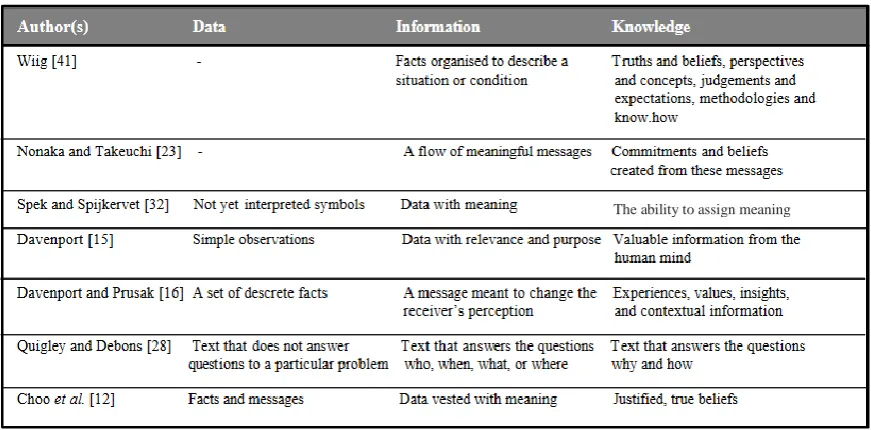
Table 1: Data, Information and knowledge ... 21Table 2: Key Knowledge-Based View Themes ... 45
Table 3.Interview Question Justification ... 137
Table 4. Specific Interview Question Justification ... 140
Table 5: KBV Assumptions ... 147
x | P a g e
Abbreviations
AC: Associate
AL: Academic Leader
CA: Competitive Advantage
CS: Company Supervisor
IP: Intellectual Property
IT: Information Technology
KBV: Knowledge-Based View
KE: Knowledge Elements
KT: Knowledge Transfer
KTP: Knowledge Transfer Partnership
KTPs: Knowledge Transfer Partnerships
RBV: Resource-Based View
SCA: Sustainable Competitive
Advantage
sKTP: Shorter Knowledge Transfer Partnership
1 | P a g e
Chapter 1: Introduction
The aim of this chapter is to give an outline view of a knowledge-based perspective of the firm. It will further outline the study justification and argue that a technology focus of knowledge may be challenged from a knowledge-based view perspective. This introductory chapter will pinpoint specific areas of the knowledge-based perspective and identify a gap in the respective literature that needs further critical discussion within the literature review chapter. Following this, the introduction chapter will have sub-sections including an outline discussion about the overall scope of the study, the overall research design, the research question and objectives as well as an outline section on the contribution of knowledge.
Since the 1990s the term ‘knowledge economy’ is increasingly used to stress the change in the ‘productive paradigm’ whereby developed countries move from manufacture to service industries. The Financial Times reported that the service industry in the UK accounts to almost 80 per cent, showing its 12th consecutive
quarter of growth by the 31 March 2016 (Cadman 2016). In today’s economy, there is a similarity with the role of knowledge compared to the role of land in the agrarian economy and the role of capital in the industrial economy, until the early twentieth century (Grant 2002; Drucker 1993). There is also an increased focus on intangibles compared to tangibles (Zambon 2017; Stewart 1997) with predominance of services over goods (Rust and Kannan 2014; Grant 2002).
2 | P a g e Barney 1982; Teece et al. 1997) and enhance efficiency and capacity by advancing the firm’s knowledge base (Wiklund and Shepherd 2003; Eisenhardt and Santos 2002; Grant 1996; Argote and Ingram 2000). Consequently, a common assumption in the strategy literature is for firm boundaries to encompass valuable competencies and core knowledge (Drucker 2017; Argyres 1996; Prahalad and Hamel 1990).
The question of efficient production and protection of knowledge linked to SCA has led to a peak interest in the mid-1990’s in new forms of organisations (Spender 1996, Stacey 1995, Nonaka and Takeuchi 1995, Wheatley 1994) including a resource- or knowledge-based perspective (Nickerson and Zenger 2004). Some researchers argue that any knowledge-based perspective is an extended arm of the Resource-Based View (RBV) (Curado 2006; De Carolis 2002) adding little to understanding SCA. The RBV argues that firm’s performance and ultimately success and failure lies within the firm’s ability to understand the strategically relevant resources and capabilities that link to their competitive advantage (Lin and Wu 2014; Barney 1991; Peteraf 1993) by ensuring that they are valuable, rare, inimitable, and non-substitutable (VRIN). Eisenhardt and Santos (2002) argue, that by viewing a knowledge-based perspective as a strategy, knowledge becomes a resource that can be acquired, transferred, or integrated supporting the RBV in achieving SCA rather than a unique theory of strategy. Hence, there is a need to further explain the link between superior competitive performance and the RBV in the literature review (section: 2.3.1) as well as the contribution of a knowledge-based perspective to explain SCA (section: 2.4).
3 | P a g e transaction cost logic and its behavioural assumption of opportunism (Ding et al. 2009; Nickerson and Zenger 2004).
One of the most cited papers, with over 17000 citations on Google Scholar (April 2018), linking the knowledge perspective to firm performance, is the paper by Grant (1996): Towards a Knowledge-Based Theory of the Firm. Grant’s (1996) paper is perhaps one of the most exciting and influential papers within a knowledge-based perspective and argues that most knowledge-based resources are intangible and therefore, placing idiosyncratic knowledge and its ambiguous causal nature, as the source of SCA.
Kakabadse et al. (2003) reviewed the knowledge management literature and established that the challenges of ‘knowledge’ have lasted as a constant debate and have been recorded since the fourth century BC by scholars such as Plato and Aristotle. Considering this long-lasting debate around knowledge, it is not surprising then, that the knowledge-based view (KBV) discussion has also lead to disputes within the field of strategy (Kamasak 2017; Håkanson 2010; Sousa and Hendriks 2006; Eisenhardt and Santos 2002; Spender 1996). Lack of clarity remains over whether research supports the KBV (Patriotta and Pettigrew 1999, cited in Eisenhardt and Santos 2002), or in fact strengthens other theories of strategy (Eisenhardt and Santos 2002). Scholars have linked strategy and the knowledge perspective to a range of different research topics, including organisational learning (North and Kumta 2018; Wang and Ahmed 2003; Kogut and Zander 1996) capability transfer (Jimenez 2014; Szulanski 1996; Zander and Kogut 1995), alliances (Ko and Joo 2013; Gomes-Casseres et al. 2006; Badaracco 1991), organisational performance (Mosconi and Roy 2013) and acquisitions (Pattinson and Preece 2014; Hébert et al. 2005; Singh and Zollo 1998; Bresman et al. 1999).
4 | P a g e challenges of knowledge, which will be further discussed in the literature review (section: 2.2). Hence, this study will have a focus on idiosyncratic knowledge and its ambiguous causal nature as the source of SCA (Mors 2010; Nonaka 1994). In the context of this thesis, knowledge ambiguity will refer to the lack of understanding of the linkages between action and outcomes (Lee et al. 2007; Simonin 1999) that are related to the know-how as a process of knowledge production, coordination and decision-making.
In the pursuit to manage knowledge, academic literature has focused on knowledge management (KM) (Heisig et al. 2016) building effective information technology (IT) systems (Omotayo 2015; Donate and Pablo 2015) often using the term ‘information’ and ‘knowledge’ interchangeably. Based on KM principles, firms have developed and implemented KM initiatives to increase the efficiency of business processes and productivity of their services (Donate and Pablo 2015; Nguyen & Mohamed, 2011). Moreover, innovation and SCA have been linked closely together and seen as a direct outcome of KM initiatives (Martin-de Castro 2015; Du Plessis 2007; Darroch & McNaughton 2002; Nonaka & Takeuchi, 1995).
5 | P a g e The goal of the thesis is not to contribute to the initiatives of IT-based KM discussion but instead to understand idiosyncratic knowledge as well as how and why the KBV is an adequate explanation for the firms SCA. Since knowledge, which may be linked to SCA must be VRIN (Meyer et al. 2015) and has an ambiguous causal nature, knowledge creation and firm performance is not well supported by empirical research (Su et al. 2016; Collins et al. 2001). Hence, this thesis will further investigate the KBV of the firm and shed light into knowledge processes of the firm and its management that are yet not fully understood.
The KBV has further implications for the basis of organisational capabilities and is aspiring to explain the SCA of one firm over another. Grant (1996) describes his contribution as follows: “The primary contribution of the paper is in exploring the
coordination mechanisms through which firms integrate the specialist knowledge
of their members.” (Grant 1996, p. 109). Although, existing literature including the
KBV, contributes to the current understanding of the firm, there is limited understanding within the literature on how to place the KBV as an act of strategy formulation, leaving a gap in the firm’s role of efficiently producing knowledge (Nickerson and Zenger 2004) while also considering coordination of knowledge.
6 | P a g e academic discussions but to understand how and why knowledge elements and possible mechanisms achieve SCA as a holistic construct, remains unclear, and hence, the literature review (section: 2.4.4) will identify KBV-themes that could be further investigated to help the KBV explain SCA.
7 | P a g e
1.1 - Scope of this Study
This research explicitly centres on identified KBV-themes to introduce overarching KBV strategy concepts. There has been some previous work in related areas such as Social Networks (Borgatti and Cross 2003), Knowledge Integration (Guinery 2006), Knowledge Assimilation (Nemanich et al. 2010), Knowledge Transformation (Hotho et al. 2011) and Knowledge Sharing/Transfer (Siemsen et al. 2008), Alliances (Ko and Joo 2013; Gomes-Casseres et al. 2006; Badaracco 1991), Organisational Performance (Mosconi and Roy 2013), Acquisitions (Pattinson and Preece 2014; Singh and Zollo 1998; Bresman et al. 1999; Hébert et al. 2005) Organisational Learning (Kogut and Zander 1996; Kogut and Zander 1992), Capability Transfer (Szulanski 1996; Zander and Kogut 1995) and learning as a Dynamic Capability (Kale and Singh 2007).
Firstly, this thesis appreciates all previous work and their phenomena and processes within it and will draw upon some of the debates to aid the discussion in line with the research objectives. However, this thesis will limit its focus on a strategic KBV by using the KBV-themes as an interlinking holistic construct. Hence, gather a deeper understanding of possible links between the KBV and SCA.
8 | P a g e Thirdly, this research explicitly centres on Knowledge Transfer Partnership (KTP) projects between a university and industry as a favourable context to understand how identified knowledge-elements support or hinder the achievement of an SCA for the firm. The KTPs used in this thesis will create a somewhat specific and controlled environment and aid to minimise the possible ambiguous nature for this kind of study (further discussed in section 2.5). Moreover, this study will assume that not one KBV-theme on its own is enough to explain an SCA but instead cross-reference knowledge processes and KBV-themes to understand a more holistic view of the KBV.
Fourthly, recent academic literature seems to be focusing on building effective information technology. This technology focus results in traditional management models viewing the firm as information processing machines whereby problem-solving is centred on what is input to the organisation, not what is created by it (Nonaka, Konno and Toyama 2001). This focused view, however, risks diluting different types of knowledge. As this research study is centred on the understanding of tacit knowledge, and since tacit knowledge is embedded deeply within individuals, IT systems will not play a part in this study. Furthermore, any artificial intelligence research, although fascinating and likely to have an increasing impact in future knowledge management debates (Hanako 2016), is also outside the scope of this research study.
9 | P a g e
1.2 - Research Design and Rhetorical Assumption
This thesis will extract the knowledge-based view themes from Grant’s (1996) original paper named ‘Toward a knowledge-based theory of the firm’. Once, the KBV-themes are understood, some key assumptions will be formed for each theme to place an anchor point from which discussions and analysis can focus upon.
Any rhetorical assumption is concerned with the chosen language of research. Hyland (2001) highlights the danger of authors eradicating themselves from their thesis to gain acceptance for their work. Any rhetorical assumption will influence the impression writers make on their readers and the first-person pronoun is a powerful rhetorical strategy for emphasising any contribution made (Hyland 2001) and will add tenor to their academic writing (Harwood 2006). Hu and Cao (2015) analysed 120 research articles and highlighted that intensity of using pronouns will also be affected by the choice or focus of research approaches such as qualitative versus quantitative research. As such, qualitative researchers tend to embrace themselves in rhetorical strategies of using an informal style while using personal voice (Creswell 2012). Hence, considering the methodology chapter (chapter 3), I may use analogy or refer to myself in the first-person pronoun, ‘I’, with exception of the literature review.
10 | P a g e and hence, places KTP as a good research fit environment for subsequent research objectives.
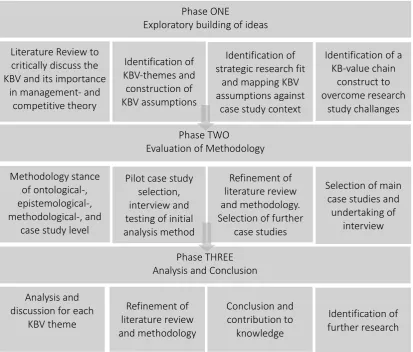
Figure 1: Research Design Outline
After identifying the KBV-themes, a total of four different case studies will be selected, and 11 in-depth interviews with the key knowledge actors will be undertaken. However, one of the case studies is a shorter KTP and was mainly used as a pilot study to inform the main research study. In-depth interviews were undertaken, and Nvivo was used to help structure and identify patterns in the individual responses. This research was subsequently used to understand why and how the KBV-themes interact with each other and if the SCA achieved within the KTPs could be explained by the KBV-themes. In doing so, the analysis could satisfy the research question and add to the contribution of knowledge by giving new insight into the field of KBV and strategy formulation.
Phase ONE
Exploratory building of ideas
Literature Review to critically discuss the KBV and its importance
in management- and competitive theory
Identification of strategic research fit
and mapping KBV assumptions against
case study context
Identification of a KB-value chain
construct to overcome research
study challanges
Phase TWO
Evaluation of Methodology
Methodology stance of ontological-, epistemological-, methodological-, and
case study level
Refinement of literature review and methodology. Selection of further
case studies
Selection of main case studies and
undertaking of interview Pilot case study
selection, interview and testing of initial analysis method
Phase THREE Analysis and Conclusion
Analysis and discussion for each
11 | P a g e
1.3 - Research Question and Objectives
To contribute to the KBV discussion, this thesis aims to investigate the previously highlighted absence of a holistic KBV study. In doing so, KBV-themes will be identified and linked to a firm’s SCA. To formulate company strategy of decision-making, the degree of knowledge - while investigating the knowledge-elements and their role within knowledge production, knowledge coordination, and the aspects of organisational structure and design - will be considered.
The aim of this thesis, within the perspective of competitive theory, is to understand the causes for a firm’s performance which are related to the KBV-themes and the function of strategic choice in the decision-making process. To further explore this research area, the goal of this thesis is to investigate how and why the different KBV-themes are interlinked with different knowledge processes, to enable a discussion around a holistic knowledge-based theme strategy.
The following research question is identified as essential for research success. The research question will determine the most appropriate research design while establishing and considering the research philosophy, further discussed in the methodology chapter. The following confirms the research questions of this thesis:
How (if at all) can the Knowledge-Based View be used to enact strategy formulation to achieve a sustainable competitive advantage?
12 | P a g e this thesis has developed a further four research objective to satisfy the research aim. The first objective is:
To specify and critically evaluate the KBV as an act of strategy formulation and associate themes key to a KBV
In order to advance the KBV as an act of strategy formulation, the literature review needs to understand different types of knowledge and subsequent discussions about the SCA of the firm. A firm theoretical perspective needs to be discussed and linked to the KBV. Furthermore, for the KBV to be used as an act of strategy formulation, it is vital to gain a deeper understanding of knowledge elements that can be linked to SCA. Therefore, the KBV should be broken down into specific KBV-themes as well as understanding their theme assumptions and possible mechanisms that may inform knowledge processes.
The second objective is:
To situate the KBV in a context favourable to unveil SCA for the firm
The KBV holds that knowledge is the key determinant to achieve a competitive advantage for the firm. Knowledge that is rare, valuable, inimitable, non-substitutable and in-transferable will lead to knowledge ambiguity which in turn will hinder knowledge leakage to competitors but sustain the advantage. Adversely, this ambiguous nature of knowledge makes empirical study somewhat problematic, and the literature review has to critically discuss this and identify such research challenges. Hence, there is a need for the literature review to identify and critically discuss a research context that has the ability to overcome or minimise identified research challenges.
The third objective is:
13 | P a g e Once, a context to minimise the challenges for empirical research is introduced, the next challenge will be to develop a research construct that can be used to gather enough data to satisfy the main research question. The value of specific knowledge elements within the knowledge production, knowledge coordination and decision-making process should be understood, and henceforth, any research construct should be in line with the identified research context, the knowledge processes and a robust link to the SCA of the firm.
The last objective to satisfy the research question is:
To understand, how and why, the identified knowledge elements (if at all) explain SCA and how such knowledge elements can be used to recommend a
holistic KBV strategy
Once, the research construct is developed, this thesis will link the research construct to the research methodology while making sure that the research construct can be used in line with the chosen research methodology. The goal of the primary research is to fill some of the literature review gaps by gaining a fuller understanding of the knowledge elements by explaining how the research context achieved an SCA. This will then help to close the loop to the research aim, to formulate the KBV as an act of strategy formulation for decision makers, within the competitive strategy literature.
1.4 - Contribution to Knowledge
This thesis will explicate the Knowledge-Based View (KBV) as an act of firm strategy. In doing so, it is expected that the literature review will show that this is the first study to use a unique context to gather research data on the KBV as a holistic approach that could be used to formulise a KBV strategy for decision makers.
14 | P a g e Therefore, the majority of studies only give access to certain elements of the KBV but do not address the KBV as a full concept for strategy formulation. Moreover, most studies are challenged to pinpoint specific details that are essential to the firm’s achievement of SCA. Since the KBV argues that the knowledge that could lead to SCA is tacit and embedded deeply within individuals, there is a challenge of knowledge ambiguity. More broadly speaking, current studies do not unveil whether the KBV, as a holistic theme, results in a sustained or even temporary competitive advantage.
Another knowledge contribution is made towards organisational capability which is mainly linked to ‘broad-scale’ integration in the literature. The challenge is to identify knowledge elements and possible mechanisms for SCA when many individuals within a firm setting may not contribute to the achievement of a capability that is then linked to SCA. This thesis will unveil a context that has the ability to overcome challenges to link one stream of capability to an SCA using a limited number of knowledge actors responsible for the SCA. This will allow untangling and further understand knowledge transfer, specific knowledge production within individuals, individual absorptive capabilities, individual specialisation in knowledge acquisition, knowledge enablers that can be linked to specific knowledge mechanisms, the impact of the role of hierarchy and the impact of decision-making. Although challenging from a research study perspective, such a holistic view is necessary to gain a fuller understanding of the KBV to then either strengthen or weaken assumptions in order to enact the KBV as more than a theoretical “view”.
15 | P a g e (or group of individuals) in which the context of the performance activity is somewhat specific, structured, isolated and controlled from the outset.
All four case studies are based within a controlled ‘Knowledge Transfer Partnership’ environment which was set up to achieve a particular strategic benefit (competitive advantage) to fill a predefined knowledge gap. This allows the research study to have an unprecedented insight, through the use of ex-post in-depth analysis, that can explain the achievement of a particular SCA by explaining success and failure through the investigation of the KBV-themes. Hence, there is also a further contribution to knowledge within the overall understanding of KTP project in line with the KBV and explanation of SCA. From a KBV perspective, another contribution to knowledge is to have found an environment that can be used as a ‘strategic research fit’ to unveil how the identified KBV-themes explain an SCA. Hence, it is hoped that this insight into the details of the KBV-themes will trigger new discussions into in the field of the KBV and strategy formulation. The word ‘strategic research fit’ is used to express the high degree to which the case study environment can contribute to the understanding of the firms’ processes and mechanisms to achieve an improved competitive position.
16 | P a g e
Chapter 2: Literature Review
2.1 - Introduction
The aim of this chapter is to satisfy the first three research objectives in pursuit of answering the main research question. In doing so, this chapter will summarise the various theories, perceptions and discussions around the Knowledge-Based View (KBV) to provide solid theoretical foundation for the KBV and its implications on SCA of the firm.
The following two sections of this chapter will have a critical discussion around types of knowledge and their links to SCA. Furthermore, a firm theoretical perspective will be discussed to understand effective ways of utilising a knowledge perspective to explain firm performance.
The fourth section of this chapter will critically discuss the KBV and challenges of empirical research. Furthermore, it will identify KBV assumptions and provide a view of strategy before linking the discussion towards the KBV and SCA. Lastly, this section will identify the KBV-themes important for this research study and provide a critical debate on each identified KBV-theme, in line with research objective one.
To bridge the gap between theoretical understanding and practical strategy formulation, the fifth section of this thesis will explain how KTP projects have the potential to unveil the ambiguous causal nature and hence, are fit for purpose for an empirical research study. To do so, the unique nature of a KTP project will be further explained and linked to main KBV assumption and the causal ambiguity discussion. Once, such links are understood, the KTP will be mapped against all eleven identified KBV-themes as well as their assumptions to further strengthen KTPs as a case study.
17 | P a g e
2.2 – Types of knowledge
Knowledge has multi-layered meanings, and the history of philosophy can be regarded as a continuous search for the meaning of knowledge (Dancy 1985; Halis 1985).
Georg von Krogh (1998) identified two major perspectives on the nature of knowledge. The revolution in computer science, systems theory, and neuroscience in the early 1950s provided insights to view knowledge from a “cognitivist perspective”. From this perspective, knowledge is universal, and the key task of the brain or any form of cognitive system is to represent or model a number of objects or events as accurately as possible. Hence, two cognitive systems should represent the same object or event, meaning that knowledge from the cognitivist point of view was able to be encoded and stored, is explicit, and easy to transmit. On the other hand, the “constructionist perspective” views cognition as an act of construction or creation rather than representation. Hence the cognitive system works when knowledge brings effective action. Krogh (1998) argues that knowledge is not universal and that knowledge resides within individuals who have senses and previous experience, hence, making the world that are unique to himself or herself.
“To the constructionist, some knowledge is explicit, but some is also tacit, highly
personal, not easily expressed, and therefore not easy to share with others” (Krogh
1998, p. 132)
18 | P a g e a “justified true belief” to a “justified personal believe toward the truth (p.58). Takeuchi’s (2013) argues that a justified true believe suggest that knowledge is something that is objective and context-free. The Introduction Chapter already identified the importance of idiosyncratic knowledge within this study. Hence, knowledge is driven by human beings in an interactive process that is likely to be subjective and context specific.
However, to position a knowledge-based strategy, it is essential to appreciate potential types of knowledge and understand how various knowledge types could influence and improve a competitive position. Within the general knowledge-based discussions, two types of knowledge are defined, namely, explicit and tacit knowledge. The knowledge-based literature, almost always, links the organisational knowledge creation process as a dialogue between explicit and tacit knowledge (Nonaka 1994).
After Nonaka’s papers in the 1990s, the second most cited author is Michael Polanyi (1958 and 1966). The main view of knowledge in this thesis is based on Polanyi’s (1958) concept of knowledge that describes complete objectivity as a false idea and a delusion. Polanyi also distinguishes between learning a skill and acquiring knowledge. His riding a bicycle analogy is widely used as an example of tacit knowledge. Polanyi does not claim that tacit knowledge cannot be transferred but suggests that some types of knowledge may be more limited to transfer than others.
19 | P a g e
"the tacit cooperates with the explicit, the personal with the formal" (Polanyi, 1958,
p 87).
Polanyi would describe tacitness as something personal such as a skill or ability to perform something or to resolve a problem that could be based on the individual’s experiences and learning. With the appropriate use of language, much, but probably not all, of this knowledge can be shared between individuals who share a mutually agreed language and meaning (Grant 2007). Polanyi refers to a predominantly tacit knowledge base that cannot be articulated as "ineffable" knowledge. (E.g. ask Ronaldo how he hits the ball on a free kick).
Grant (2007) examined some 60 papers from three major knowledge management journals and concluded that Polanyi’s work has frequently been misquoted or misinterpreted. Grant (2007) concluded that 42 percent were unlikely to have read the original work, based on the authors’ use of the related concepts. Moreover, around 23 percent seem to significantly misrepresent Polanyi’s work. Typical misinterpretations include:
The most frequent occurrence is the suggestion that Polanyi identifies two types of knowledge --tacit and explicit -- and that this is an either/or state. This is really in direct contradiction to his view that all knowledge has a tacit element and that the degree of tacitness varies
The suggestion that Polanyi was writing about knowledge in a corporate or organisational context
That it is impossible to convert tacit knowledge to explicit knowledge; or that tacit knowledge is embedded in corporate processes and routines
20 | P a g e However, Nonaka (1994) clearly distinguishes between tacit and explicit knowledge and describes it as: “the epistemological dimension to organizational knowledge
creation” (Nonaka 1994, p.15). Nonaka recognises that ideas are formed in the minds
of individuals but also stresses the importance that interaction between individuals equally plays a key role in developing ideas. Hence, the organisational role in articulating, processing and possibly amplifying knowledge is of particular interest of this study.
Furthermore, Nonaka argues that ‘communities of interaction’ contribute not only to amplification but also development of new knowledge. He also acknowledges that such interaction might span departmental or organisational boundaries (Nonaka 2000, 1994) which is also of specific importance to this thesis. The extent of social interaction between individuals that share and develop knowledge is presented as a further dimension of organisational knowledge creation and referred to as: “the
ontological dimension of knowledge creation” (Polanyi, 1958, p. 87).
This research is particularly concerned with a knowledge perspective as an act of strategy formulation hence, a further differentiation between ‘information’ and ‘knowledge’ is important. The terms knowledge and information are often used interchangeably but have a very clear distinction, as such “information is a flow of
messages, while knowledge is created and organized by the very flow of information, anchored on the commitment and belief of its holder” (Nonaka 1994, p.15).
21 | P a g e Table 1: Data, Information and knowledge
Kogut and Zander imply that information is a form of knowledge by defining its quality as “knowledge that can be transmitted without loss of integrity” (Kogut and Zander 1992, p.20). It could be argued that this definition does not sufficiently separate information from knowledge as information may be described as a flow of messages, whereby knowledge is created by a flow of information. Others argue that information is more factual whereas knowledge includes beliefs and commitment (Matzler 2011; Nonaka 1994). Hence, essentially knowledge is related to human action (Habermas 2015; Nonaka and Takeuchi 1995).
For the purpose of this thesis, data (e.g. blue; this is; chair) is said to be simply existing (usable or not) and has no significance beyond its very existence. Information is more factual (e.g. this chair is blue) and its data has a specific perception which also means that there is some sort of meaning embedded. However, information on its own still lacks the subjective interpretation of the information. Compared to the individual who could not apply the information to action, another person may use the same information and understand and interpret it through past experience to make business decisions. Yet, the third person may be able to apply the information in a different context by using lessons learned from past experience which the other two individuals would have never considered (Lee and Yang 2000).
22 | P a g e If one individual is colour blind, then the information that the chair is ‘blue’ will be different to an individual who is not colour blind. Knowledge is the more complex cognitive model behind this and other bits of information and has a higher degree of meaning. Hence, tacit knowledge is informed by action and involvement in a specific context.
Nonaka (1994) describes two models, namely: (1) ‘technical elements’ identified as concrete know-how, crafts and skills that apply to a specific context and (2) ‘cognitive elements’ which include mental models such as schemata, beliefs, and viewpoints to create perspectives of the individual involved. The cognitive element of tacit knowledge refers to his or her image and reality and vision for the future (Nonaka 1994).
From a knowledge-based perspective, it may be important for a decision maker to understand the degree of complexity of knowledge. It is already widely accepted that information can be easily transferred within a firm. Hence, the integration of information that the organisation has ablue chair available is not a real challenge.
23 | P a g e particular formulation of knowledge has a higher degree of tacitness than the previous example.
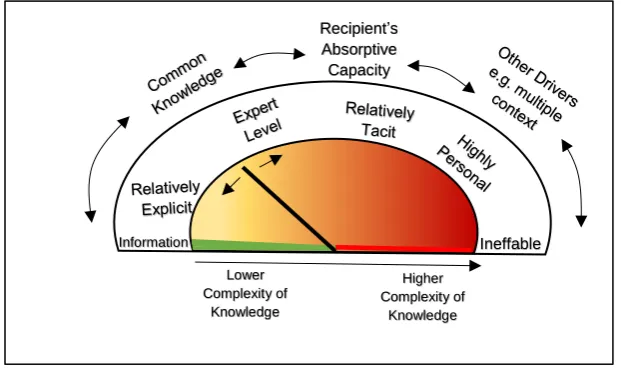
Considering the types of knowledge discussion so far, this thesis accepts the belief that explicit and tacit knowledge are not two distinct types of knowledge and almost all knowledge has tacit components (Chuang et al. 2016; Leonard and Sensiper 1998, Polanyi 1958). Hence, this thesis will refer to knowledge as a continuum in which the degree of the complexity of knowledge changes dependent on the amount of tacitness involved. The figure below is constructed to illustrate this degree and highlights some preliminary drivers that may influence knowledge production, integration and transferability.
Figure 2: Complexity of knowledge diagram (Serkan Ceylan)
The complexity of knowledge diagram (Figure 2) illustrates the complexity of knowledge as a simple continuum diagram. The diagrams lowest complexity of knowledge is assumed to be transferable without any loss of information. The diagram continues with the level of ‘relatively explicit’ and ‘expert level’ in which it assumes that the main enablers are common knowledge and common language respectively. With higher complexity of knowledge, the scale moves to be relatively tacit before it becomes highly personal. Ineffable knowledge is characterised as being un-transferable. This complexity of knowledge diagram will be used throughout the thesis to differentiate between lower and higher levels of knowledge complexity.
Lower Complexity of
Knowledge
Ineffable Recipient’s
Absorptive Capacity
Information
Higher Complexity of
24 | P a g e Nonaka and Takeushi (1995) argue in their SECI knowledge conversion model that an organisation creates new knowledge through the interaction between tacit and explicit knowledge. The four modes of knowledge conversion are widely discussed (Jaleel and Verghis 20015; Popadiuk and Choo 2006; Lee and Yang 2000) and are:
(1) Socialisation – from tacit knowledge to tacit knowledge. (2) Internalisation – from explicit knowledge to tacit knowledge (3) Externalisation – from tacit knowledge to explicit knowledge (4) Combination – from explicit knowledge to explicit knowledge.
Understanding the relationship between these two kinds of knowledge is key to understand the knowledge production, knowledge coordination and decision-making processes which are identified as one of the three primary knowledge processes within this study and viewed as a social process between individuals (Popadiuk and Choo 2006).
25 | P a g e
2.3 - The Firm Theoretical Perspective
The firm is the organisational framework of a business enterprise which includes human activity with the aim to satisfy customer needs at a profit.
The goal of this subchapter is not to have a detailed discussion of the history of the theory of the firm. Strategic management theories are usually based on both economic and organisational theory. Economic theories of the firm are mainly concerned with predicting firm’s behaviour in external markets whereas organisational theory investigates behavioural aspects of the firm, overlooked by neoclassical economics.
This thesis will position itself based on the theories of competitive advantage (Porter 1980). Although, alternative positioning towards classical microeconomics (Ricardo 1817) or evolutionary economics (Nelson and Winter 1982) could have presented valid positions. However, the former two strands would generate different insights. While all three theories share a common set of assumptions that resources and capabilities may be heterogeneously distributed across firms and emphasise on understanding why some firms consistently outperform others, they also emphasise very different implications of those assumptions and show significant differences in, for example, adopting different definitions of performance (Barney 2001).
Organisational theory recognises the firm as a complex entity and tries to shed light into the internal structure of the firm construct and the relationships between its departments (Spender 1996). The goal of strategic management theories or indeed competitive theory is to understand firm performance and the causes of strategic choice.
26 | P a g e has focused on segregating a firm’s opportunities and threats (Leih et al. 2014; Porter 1980), describing a firm’s strength and weaknesses (Sirmon et al. 2010; Hofer and Schendel 1978; Penrose 1958), and its competitive environment (Prajogo and Oke 2016; Lamb 1984) and analysing how these can be used together to choose strategy. Environmental models of competitive advantage, such as Porter’s (1980) five forces model, described external analysis of attractive industries based on attributes suggesting that attractive industries show higher opportunities and lesser threats.
Such environmental models placed less emphasis on the impact of idiosyncratic firm attributes (Porter 1990) due to its emphasis on analysing competitive positioning based on the firm’s environment. Hence, Barney (2001; 1991) suggests that this organising framework results in two simplifying assumptions:
Assumption one: Environmental models of competitive advantage assume that firms
within an industry pursue the same strategies and have identical strategically relevant resources they control (Porter 1981; Rumelt 1984; Scherer 1980)
Assumption two: even if within a given industry, resource heterogeneity develops
through, e.g. new entry, it will be short-lived due to their highly mobile nature (Barney 1986)
27 | P a g e
2.3.1 – Resource-Based View
At the heart of the resource-based view is the notion that a firm has different resources and internal capabilities (Hitt at al 2016; Petegraf 1993). The classic approach to strategy formulation may appraise organisational competencies and resources as a basis for competitive advantage if they are distinctive or superior to rivals and matched appropriately to environmental opportunities (Andrews 1971; Thomson and Strickland 1990). The Resource-Based View (RBV) builds on the work of Penrose (1959) and one of the most essential contributions occurred from Wernerfelt (1984) with a notable research stream following Rumelt (1984), Barney (1986; 1991), Dierickx and Cool (1989), Conner (1991), Mahoney and Pandian (1992), Connar and Prahald (1996), Kogut and Zander (1992) and Teece et al. (1997). Furthermore, the RBV includes a number of review studies such as Armstrong and Shimizu (2007) or Lockett, Thomson, and Morgenstern (2009).
The RBV of the firm suggest two alternative assumptions to the earlier mentioned organising framework assumptions and argues that a superior competitive performance derives from the heterogeneity and immobility of a firm's resources also described as ‘sticky’ resources (Barney 1991, Grant 1991, Curado and Bontis 2006) and hence, heterogeneity can be long-lasting. The RBV developed as a complement to Brain’s (1968) and Porter’s (1997; 1980; 1985) ‘Industrial Organisation’ view, which put the determinants of firm performance into the industry structure outside the firm. Instead, the RBV focuses on internal resources of SCA in the pursuit of explaining why different firms in the same industry show different performances. Another strand of research emphasises the necessity of change in capabilities underpinning these sticky resources under a ‘dynamic capabilities’ view (Teece, Pisano and Shuen 1997) in which the development of a firm-specific resource rather than the exploitation is focused upon (Mowery, Oxley and Silvermann 1996).
28 | P a g e suggest that competitive advantage can only be sustained by acquiring and controlling resource that possess four attributes:
Valuable Resources: such resources enable a firm to implement strategies that improve firm efficiency and effectiveness
Rare Resources: A firm can only achieve an SCA through an implementation of a value creating strategy not simultaneously implemented by many other firms
Imperfect Imitable Resources: valuable and rare resources are only a source of SCA if other firms cannot obtain them
Non Substitutable Resources: For a firm to achieve SCA other firms should not have access to strategically equivalent resources which are not rare and imitable but have the ability to achieve the same benefit
The above mentioned four attributes are often referred to as VRIN resources and capabilities (Ketokivi 2016).
“The resource-based view perceives the firm as a unique bundle of idiosyncratic
resources and capabilities where the primary task of management is to maximise
value through the optimal deployment of existing resources and capabilities, while
developing the firm’s resource base for the future” (Grant 1996, p.110)
29 | P a g e This thesis considers the RBV as an important framework for explaining the basis of a firm’s competitive advantage (Barney et al. 2011; Vorhies and Morgan 2005) and will use the understanding of VRIN attributes and their impact on SCA. However, the aim and objectives of this study have a particular focus in explaining the basis of a firm’s SCA by understanding how and why knowledge elements inform knowledge production, and organisational structure of decision-making. Henceforth, the knowledge perspective of VRIN would explain, for example, the imperfect imitation attribute through causal ambiguity. Causal ambiguity only exists when the link between knowledge controlled by a firm and a firm’s SCA is at best only understood imperfectly. Hence, the firm cannot know the actions the firm should take to duplicate strategies of the firm with the SCA (Barney et al. 2011; Barney 1991).
30 | P a g e
2.4 - Knowledge-Based View (KBV)
The early 1990s established a stream of research convergent to create what is now known as the ‘Knowledge-Based View of the Firm’. Some of the main streams for this view has been the analysis into resource/capability (Barney 1986; Barney 1991; Prahalad and Hamel 1990), epistemology (Polanyi 1962; Krogh et al. 1994) and organisational learning (Huber 1991; Levitt and March 1988) as well as key contributions in terms of a knowledge-based analysis of firm boundaries (Demsetz 1991), examination of knowledge-based organisations (Brown and Duguid 1991), view of the firm as a knowledge-processing institution Kogut and Zander (1992), and analysis of knowledge creation within the firm (Nonaka 1994).
Since the 1990s, the Knowledge-Based View (KBV) is a widely discussed view of the firm. Grant (1996): Towards a Knowledge-Based Theory of the Firm.
Figure 3: Past impact of Original Work (Google Scholar Citation 2017)
Figure 3 above shows the number of scholars citing Grant’s (1996) paper: Towards a Knowledge-Based Theory of the Firm between 1999 and 2018 (last update April 2018). The number of citation, when the paper first published in 1996, was considerably low and it was not until the early 2000s when the KBV contribution from Grant really established itself. A search on Google Scholar Citations reveals that Grant’s original papers were cited 1,242 times in 2016. However, many of the current citations result from the necessity to quote Grant on any article remotely relating to knowledge in a firm setting. Furthermore, there is limited holistic empirical research done on the KBV as an act of strategy which is in need of further attention. Holistic, in this research context, is defined as viewing the knowledge elements as an
Num
b
e
r of
ci
tat
ions
1448
500
31 | P a g e intimately interconnected entity that is crucial in placing the KBV as an act of strategy formulation. Thus, not to view specific knowledge elements in isolation but as a holistic view of strategy formulation. Current research mainly concentrates on either specific knowledge elements, e.g. knowledge transfer (Wei and Miraglia 2017; Argote and Ingram 2000) or is linked to a specific knowledge process, e.g. Knowledge production (Machlup 2014; Matzler et al. 2011). The literature review could not identify any empirical study which highlighted all of the main knowledge elements and explained how and why knowledge elements link to the primary knowledge processes of knowledge production, knowledge coordination and organisational structure of decision-making, which are identified in the following subchapter. This gap in empirical research has resulted in a lack of explanation of how knowledge elements can be best utilised to achieve an SCA as an act of a KBV strategy formulation for the firm.
Krogh, Nonaka, and Aben argue that:
“in the knowledge-based economy a key resource of SCA and superior profitability
within an industry is how a company creates and shares knowledge” (Krogh,
Nonaka, and Aben 2001, p. 421).
The knowledge management (KM) literature distinguishes mainly between knowledge transfer and knowledge production (Krogh et al. 2001; Davenport and Prusak 1998). This thesis views knowledge transfer as one out of eleven knowledge themes (see Table 2) and knowledge production as one of the knowledge processes (see Figure 5). Knowledge creation typically happens in ‘communities of practice’ or other small sized groups. Knowledge transfer (KT) should be used selectively: ‘not
everybody in the company needs to know everything at all times’ (Krogh et al. 2001,
p. 425).
32 | P a g e Baden-Fuller 2004), knowledge protection (Hallwood 1997), absorption (Cohen and Levinthal 1990), creation (Nonaka 1994), and replication (Osterloh and Frey 2000). This thesis argues that the KBV and its identified themes could encompass all clusters and should not be viewed in isolation as they are incomplete and collectively often contradictory. Based on the aim and objectives of this thesis, the research study would be particularly interested to understand how and why such knowledge capabilities come into play within a specific organisational context and how such capabilities might affect the knowledge elements and knowledge processes.
In the context of knowledge creation, Simon (1991) addresses where knowledge is stored and who the ‘knowledge benefiter’ is. Krogh (2009) linked the individualist perspective on the locus of knowledge to cognitive psychology to describe learning mechanisms and processes. Krogh (2009) points out two major issues within cognitive theories. First, individual knowledge is limited as a problem representation; and second, the neglecting in cognitive science indicating, for instance, implicit learning and tacit knowledge. However, Simon’s contribution triggered discussions in differences and links between individual and collective knowledge in which Grant (1996) accepts assumptions on the locus of knowledge and further assumes that the role of firms is the application of existing knowledge, which is embedded within individuals, to the production of goods and services. Therefore, an objective of research should be to unveil the knowledge themes, enablers and context in which the knowledge of the individual is coordinated by the firm to produce new capabilities.
33 | P a g e
2.4.1 - KBV: The Assumptions
For the KBV to be relevant to the aim and objectives in this thesis, it needs a consensus set of assumptions that can be validated and then followed as an act of strategy consideration. Furthermore, based on the aim and objectives of this thesis and in order to achieve any valid research study, any identified research context needs to be in-line with such assumptions. Hence, the following will highlight the main assumptions based on Grant (1996; 1996b; 2002). Subsequent sections may also pick up on assumptions highlighted in this section to show transferability of particular thought processes.
2.4.1.1 - Four Main KBV Assumptions
The KBV has four ‘main’ assumptions which need to be considered (Grant 1996b). Hence, it is important that any strategic research fit environment will satisfy and share light into the following assumptions:
The first assumption is that ‘knowledge’ is considered to be the most strategically
important resource of the firm. This assumption is advocated by scholars like Spender (1996), who argue that organisations have two predominant goals, the generation and application of knowledge (Spender 1996). Knowledge-based capabilities are recognised to be one of the most strategically important capabilities for creating a sustainable competitive advantage (Ahmed et al. 2014; Weerawardena and O'Cass 2004; Camisón and Villar-López 2011; Simonin 2004; Nonaka 1994).
The second assumption is the differentiation between explicit and tacit knowledge
34 | P a g e
The third assumption is that tacit knowledge is acquired and stored in a ‘highly
specialised form’ within individuals (Nonaka 1994; Lam 2000; Nonaka and von Krogh 2009). This assumption will be further discussed in the theme: specialisation in knowledge acquisition (Section 2.4.4.4).
The final assumption is that production needs a widespread range of knowledge
(Grant 1996b). Grant links this assumption mainly to the imperfect imitability attribute and argues that a wider scope of integration creates greater causal ambiguity. However, this assumption will be further discussed within the organisational capability theme (Table 2 and section 2.4.4.8).
2.4.1.2 - Subsequent assumptions
Building on the four main assumptions, Grant (2002) introduced another assumption that knowledge is subject to economies of scale. Grant argues that decisions based on explicit knowledge should be centralised as it is transferred at low costs and achieves economies of scale in decisions (Grant 2002). Furthermore, Grant characterises that all knowledge has higher creation costs than subsequent replication. Economies of scale for knowledge and in particular explicit knowledge is ‘costly’ to produce and cheap to reproduce (Shapiro and Varian 1999). On the other hand, tacit knowledge tends to be costly to produce and costly to reproduce, but Winter (1995) argues that the replication cost will still be lower than those incurred in its original creation and therefore, all knowledge is subject to economies of scale.
35 | P a g e
2.4.1.3 - Specific Theme Assumptions
The following are all the eleven KBV theme-specific assumptions. The purpose is to identify the KBV theme assumptions made by Grant (1996) to explain later how and why (if at all) the assumptions are in line with the findings. The following subchapter (section 2.4.4) ‘KBV: The Themes’ will critically discuss the themes in more detail. This subsection and is merely for the purpose of listing the KBV theme-specific assumptions.
Some of the following assumptions may be criticized as being true by definition and hence, tautological, since some assumption may be argued as a central assertion of the KBV and therefore, could be argued as not needing any special attention within a research study. However, this thesis will use Barney (2001) defence that, at this level of definition, most strategic management theories become tautological. For example, Porter’s (1980) assertions of firm performance and industry attractiveness can be reduced to tautology. By observing that firms will outperform firms in attractive industries compared to unattractive industries and by linking industry attractiveness with the ability of firms to perform well. Of course, Porter specifies certain conditions that make an industry more or less attractive independent of firms in that industry. Transferability theme assumption is:
Explicit knowledge has high transferability whereas tacit knowledge shows low transferability
Capacity of Aggregation theme assumption is:
36 | P a g e Appropriability theme assumption is:
Tacit knowledge cannot be directly transferred which makes it in turn not directly appropriable
Specialisation in Knowledge Acquisition theme assumption is:
KBV requires individuals to specialise in particular areas of knowledge while considering their absorptive capacity to increase the success of knowledge integration
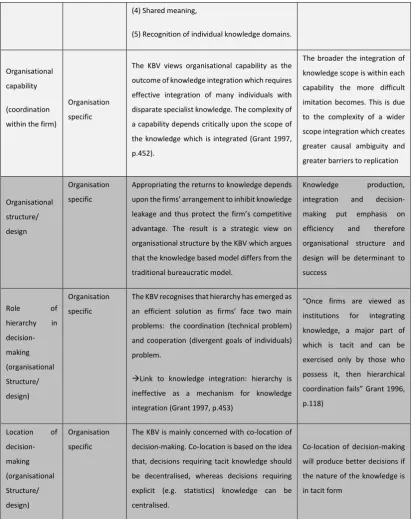
The Overall Coordination within the Firm theme assumption is:
Minimising knowledge transfer but emphasising on absorptive capacity and henceforth coordination of people’s specialised knowledge will increase efficiency and success
The Integration of Specialist Knowledge theme assumption is:
Problem-solving and decision-making in groups are reduced to unusual, complex and important tasks as the firm is maximising efficiency through the other formal integration mechanisms.
The Role of Common Knowledge theme assumption is:
There is increased organisational gain in knowledge production if integration mechanisms involve common knowledge between individuals
The Role of Organisational Capability theme assumption is:
37 | P a g e The Role of Organisational structure and design theme assumption is:
Knowledge production, integration and decision-making put emphasis on efficiency, and therefore organisational structure and design will be determinant of success
The Role of Hierarchy in Decision-making theme assumption is:
If a firm is integrating knowledge which is possessed by individuals in tacit form, then hierarchical coordination will fail
Location of Decision-making theme assumption is:
38 | P a g e
2.4.2 - KBV: A View of Strategy
As mentioned earlier, there is a continuing debate, whether the KBV can actually be used as a theory of the firm. However, by shifting the focus from institutions to internal context and knowledge elements, much of the debates in the introduction chapter over the nature of the firm and the KBV contribution to the firm theory lose critical strength.
“Whether the firm is viewed as a solution to transaction costs, a nexus of contracts,
a bundle of property rights, or a device for reallocating risk, is of secondary import”
(Grant 2011, p. 547)
Grant himself argued, in one of his later publications, that the KBV is a set of ideas about the existence and nature of the firm.
“The emerging knowledge based view of the firm is not a theory of the firm in any
formal sense” (Grant 2002, p. 135)
Furthermore, the debate around placing the KBV as a theory of the firm does not impact the research question. On the other hand, the view as an act of strategy does. Eisenhardt and Santos (2002) argued that a ‘knowledge focus’ and its impact on the field of strategy has yet to emerge. There is a vast amount of empirical research based on the knowledge perspective reaching from knowledge sharing, knowledge leaking and relative innovation performance (Ritala et al. 2015) to the impact of profound knowledge on leadership and strategy (Watson 2017). This scattered approach of the literature has resulted in the lack of empirical research of a holistic KBV-theme perspective to shed light into knowledge processes and possible connections between those two to strengthen the KBV as an act of strategy formulation.