RESEARCH REPOSITORY
This is the author’s final version of the work, as accepted for publication following peer review but without the publisher’s layout or pagination.
The definitive version is available at:
http://dx.doi.org/10.1016/j.jcs.2014.01.020
Rasheed, A., Xia, X., Yan, Y., Appels, R., Mahmood, T. and He, Z. (2014)
Wheat seed storage proteins: Advances in molecular genetics, diversity
and breeding applications. Journal of Cereal Science, 60 (1). pp. 11-24.
http://researchrepository.murdoch.edu.au/21682/
Wheat seed storage proteins: Advances in molecular genetics, diversity and breeding applications
Awais Rasheed, Xianchun Xia, Yueming Yan, Rudi Appels, Tariq Mahmood, Zhonghu He
PII: S0733-5210(14)00044-7
DOI: 10.1016/j.jcs.2014.01.020
Reference: YJCRS 1818
To appear in: Journal of Cereal Science
Received Date: 12 November 2013 Revised Date: 28 January 2014 Accepted Date: 29 January 2014
Please cite this article as: Rasheed, A., Xia, X., Yan, Y., Appels, R., Mahmood, T., He, Z., Wheat seed storage proteins: Advances in molecular genetics, diversity and breeding applications, Journal of Cereal Science (2014), doi: 10.1016/j.jcs.2014.01.020.
M
A
N
U
S
C
R
IP
T
A
C
C
E
P
T
E
D
Wheat seed storage proteins: Advances in molecular genetics, diversity and 1
breeding applications 2
Awais Rasheed1,2, Xianchun Xia1, Yueming Yan3, Rudi Appels4, Tariq Mahmood2, 3
Zhonghu He1, 5* 4
1
Institute of Crop Science, National Wheat Improvement Center, Chinese Academy of 5
Agricultural Sciences (CAAS), 12 Zhongguancun South Street, Beijing 100081, China 6
2
Department of Plant Sciences, Quaid-i-Azam University, Islamabad 45320, Pakistan 7
3
College of Life Science, Capital Normal University, Beijing 100048, China 8
4
Veterinary and Life Sciences, Murdoch University, Perth, WA 6150, Australia 9
5
International Maize and Wheat Improvement Center (CIMMYT) China Office, c/o 10
CAAS, 12 Zhongguancun South Street, Beijing 100081, China 11
*Author for correspondence: Z.H. He, Email: [email protected] 12
13
14
15
16
17
18
19
20
M
A
N
U
S
C
R
IP
T
A
C
C
E
P
T
E
D
Abbreviations:::: 22
HMW-GS,high molecular weight glutenin subunit;LMW-GS, low molecular weight 23
glutenin subunit; SDS-PAGE, sodium dodecyl sulfate poly-acrylamide gel electrophoresis; 24
HPCE, high performance capillary electrophoresis; RP-HPLC, Reversed-phase high-25
performance liquid chromatography; 2-DE, two-dimensional electrophoresis; MALDI-TOF-26
MS, matrix-assisted laser desorption/ionization time-of-flight mass spectrometry; RP-UPLC, 27
reversed-phase ultra performance liquid chromatography; AS-PCR, allele-specific PCR; SNPs, 28
single nucleotide polymorphisms; NILs, Near-isogenic lines; GMP, glutenin macro polymers; 29
CD, coeliac diseases; WDEIA, wheat-dependent exercise induced anaphylaxis; IWGSC, the 30
international wheat genome sequencing consortium; GWAS, genome wide association studies. 31
32
33
34
35
36
37
38
39
M
A
N
U
S
C
R
IP
T
A
C
C
E
P
T
E
D
Abstract 41
Wheat seed storage proteins, especially glutenins and gliadins, have unique functional 42
properties giving rise to a wide array of food products for human consumption. The wheat 43
seed storage proteins, however, are also the most common cause of food-related allergies and 44
intolerances, and it has become crucially important to understand their composition, variation 45
and functional properties and interface this knowledge with the grain handling industry as 46
well as the breeders. This review focuses on advances in understanding the genetics and 47
function of storage proteins and their application in wheat breeding programs. These include: 48
(1) The development and validation of high-throughput molecular marker systems for 49
defining the composition and variation of low molecular weight glutenin subunits (LMW-GS) 50
genes and a summary of the more than 30 gene-specific markers for rapid screening in wheat 51
breeding programs; (2) The identification of more than 100 alleles of storage proteins in wild 52
species provide candidate genes for future quality improvement; (3) The documentation of 53
quality effects of individual LMW-GS and HMW-GS for improving end-use quality; and (4) 54
The analysis of α-gliadin genes on chromosomes 6A and 6D with non-toxic epitopes as 55
potential targets to develop less toxic cultivars for people with celiac disease. Genomic and 56
proteomic technologies that will continue to provide new tools for understanding variation and 57
function of seed storage proteins in wheat are discussed. 58
Keywords: Bread wheat; Glutenins; Gliadins; Breadmaking quality; Coeliac disease 59
M
A
N
U
S
C
R
IP
T
A
C
C
E
P
T
E
D
1. Introduction 61
Bread wheat (Triticum aestivum L.) is one of the most important food crops, with current 62
annual global production of over 680 million tonnes providing approximately one-fifth of 63
the total calorific input of the world population. Meeting the multitude of quality 64
demands for a wide range of products in various countries has to be combined with the 65
needs of an increase in population, constraints of land and water availability, and global 66
climatic changes. The improvements in wheat grain quality has to accompany high yield 67
potential, resistance to biotic and abiotic stresses, and broad adaptation, particularly in 68
environments undergoing the largest effect of climate change. In the most rapidly 69
growing markets of South Asia and China, grain quality improvement has become much 70
more important largely due to rapidly increasing incomes and food diversity. The 71
traditional quality aspects of wheat also need to evolve as new processing technologies 72
are established, and as concerns on health issues increase significantly. The integration of 73
various disciplines such as functional genomics, proteomics, bioinformatics, genetic 74
transformation, breeding and exploitation of new genetic resources, is rapidly promoting 75
our understanding of the genetic and biochemical bases of quality traits in wheat. 76
Ongoing activities for quality improvement are also capturing information from other 77
crops and model organisms, such as rice and Arabidopsis, in order to define genes that 78
underpin the unique quality attributes. The large datasets generated from these responses 79
need to be incorporated into breeding programs in conjunction with high-throughput 80
screening technology in order to efficiently combine traits for wheat cultivars with 81
M
A
N
U
S
C
R
IP
T
A
C
C
E
P
T
E
D
Wheat seed storage proteins are important quality determinants because they are 83
responsible for dough elasticity and extensibility, and thus for determining the processing 84
qualities in the production of a range of end-products. Biochemical and molecular studies 85
in the past three decades have provided the basis for understanding the genetics, structure 86
and composition of storage proteins (Ma et al. 2009). The development and utilization of 87
functional markers or gene-specific markers for high molecular weight glutenin subunit 88
(HMW-GS), low molecular weight glutenin subunit (LMW-GS), and gliadin alleles have 89
dramatically improved the selection efficiency of breeding materials with desirable genes 90
(Liu et al. 2012). However, most LMW-GS and gliadin genes comprise complex 91
populations of genes (Anderson et al. 2013) with high allelic variation, and thus their 92
contributions to qualities still need to be resolved. 93
Wheat storage proteins also confer dietary intolerances, such as coeliac diseases (CD) 94
and various allergies (baker’s asthma and wheat-dependent exercise induced anaphylaxis 95
(WDEIA). Understanding the mechanisms of such diseases from gluten structures and 96
searching for genetic variants conferring reduced intolerances have therefore become 97
crucially important objectives for wheat breeding programs, particularly in developed 98
countries. Juhasz et al. (2012a) proposed a method to define epitope toxicity in wheat 99
proteins, especially the prolamins, by combining database resources, computational tools 100
and proteomic diagnostics. However, much effort is still needed to integrate this 101
information into applied wheat breeding programs. 102
Previously, Gianibelli et al. (2001) and Shewry et al. (2003a) reviewed the genetics, 103
biochemistry and molecular characterization of glutenin and gliadins in bread wheat, and 104
M
A
N
U
S
C
R
IP
T
A
C
C
E
P
T
E
D
molecular weight glutenins. Bonomi et al. (2013) reviewed the structural features of 106
water-insoluble gluten proteins and highlighted the modifications in gluten structure 107
during various processing stages. Similarly, Ribeiro et al. (2013) reviewed the impact of 108
proteomics on the study of gluten proteins and use of transgenesis to improve the quality 109
of gluten. The objectives of this paper are to review the recent advances in defining the 110
nature and properties of wheat storage proteins, focusing on molecular genetics, 111
proteomics, and practical breeding aspects, as well as summarize progress in 112
understanding the health issues of storage proteins. 113
114
2. Genetics, molecular characterization and diversity of storage proteins 115
2.1 HMW-GS 116
2.1.1 Genetics and polymorphism
117
HMW-GS accounts for around 12% of the total seed storage protein corresponding to 118
about 1.0-1.7% of the flour dry weight. In the last 20 years, the functional and structural 119
aspects of HMW-GS in relation to dough strength have been defined. HMW-GS genes 120
located at Glu-1 loci on the long arms of homoeologous group 1 chromosomes are named 121
as Glu-A1, Glu-B1 and Glu-D1, respectively (Payne et al. 1980). Each locus produces 122
two subunits of different size, called x-type and y-type subunits (e.g., 1Ax and 1Ay), with 123
comparatively higher and lower molecular weights, respectively. All bread wheat 124
cultivars express 1Bx, 1Dx, and 1Dy subunits while some cultivars express 1By and 1Ax 125
subunits as well. Due to wheat domestication syndrome, the gene encoding the 1Ay 126
subunit usually remains silent in bread and durum wheats. HMW-GS has a lot of allelic 127
variation among wheat germplasm. The Glu-A1 locus has three common allelic variants 128
M
A
N
U
S
C
R
IP
T
A
C
C
E
P
T
E
D
wheat and durum genotypes. More than 69 alleles at Glu-B1 and 29 alleles at Glu-D1 130
have been reported in bread wheat (McIntosh et al. 2013). The AACC glutenin allele 131
database contains the glutenin compositions of over 8,500 wheat genotypes from around 132
the world (http://www.aaccnet.org/initiatives/definitions/Pages/Gluten.aspx). The recent 133
versions of the database also predict the quality of genotype in terms of dough strength 134
(Rmax) and extensibility based on both HMW-GS and LMW-GS alleles (Bekes and
135
Wrigley 2013). 136
Genetic diversity in the Triticeae gene pool can provide much information in 137
understanding the variation of HMW-GS, and can also be an important source of genes 138
for quality improvement. Several A-genome wild species and wild tetraploid species (T. 139
dicoccoides and T.turgidum subsp. dicoccon) express the Glu-Ay gene (Waines and
140
Payne et al. 1987), and a Swedish bread wheat cultivar was also found to express a Glu-141
Ay gene (Margiotta et al. 1996). This could be very useful for expanding the narrow
142
allelic diversity at the Glu-A1 locus in both bread wheat and durum wheat where only a 143
limited number of x-type and virtually no y-type subunits are expressed, despite the 144
presence and expression of novel allelic variants in T. urartu and T. monococcum 145
(Gutierrez et al. 2011). Durum and bread wheat genotypes with four and six subunits, 146
respectively, were also developed by replacing the silenced subunit of Glu-A1 with 147
expressed ones, and they show an incremental increase in polymeric glutenin quantity, 148
expressed as better dough strength (Alvarez et al. 2009). There are extensive studies on 149
identification and characterization of allelic variation for Glu-Dt1 loci from Ae. tauschii
150
and D-genome synthetic hexaploids since variation at this locus plays a more significant 151
M
A
N
U
S
C
R
IP
T
A
C
C
E
P
T
E
D
2008). Niu et al. (2011) analyzed HMW-GS in Thinopyrum bessarabicum, Th. 153
intermedium, Lophopyrum elongatum, Aegilops markgrafii and their addition lines in
154
bread wheat. The genes coding for HMW-GS were identified from several genera of the 155
Triticeae, including Hordeum, Secale, Taeniatherum, Thinopyrum, Aegilops, Crithopsis, 156
and Dasypyrum. Recently, a superior dough and breadmaking quality allele from Ae. 157
longissima was identified by analysis of a Chinese Spring substitution line, CS-1SI(1B) 158
(Wang et al. 2013). These novel HMW-GS alleles may serve as new genetic resources 159
for quality improvement if the potentially positive contributions to processing quality can 160
be confirmed. 161
2.1.2 Molecular characterization and structural features
162
The complete coding sequences of 10 HMW-GS alleles including Ax1, Ax2*, the silent 163
Ay subunit, Bx7, Bx14, Bx17, By9, Dx2, Dx5, Dy10, and Dy12 are known (Forde et al.
164
1985; Halford et al. 1987, 1992). This has facilitated structure prediction and design of 165
primers to sequence the other alleles used in breeding programs. The x- and y-type 166
subunits share the same structure, signal peptide, N-terminal region, repetitive region and 167
C-terminal region, but x-type subunits are characterized by the presence of a unique tri-168
peptide motif (GQQ), whereas in y-type subunits, the second proline is replaced by a 169
leucine in the GYYPTSPQQ repeat motif (i.e., GYYPTSLQQ). Moreover, the majority 170
of x-type subunits possess four conserved cysteine residues, while y-type subunits usually 171
have seven cysteine residues. It is likely that in HMW-GS, differences in the number of 172
cysteine residues are associated with variation in bread-making quality. For example, Dx5 173
associated with superior bread-making quality, has an extra cysteine residue located at the 174
M
A
N
U
S
C
R
IP
T
A
C
C
E
P
T
E
D
cysteine residue occurs in the middle of the domain of the Ax2*B subunit, a variant of 176
Ax2*, that shows positive effects on gluten properties (Juhász et al. 2001). In contrast,
177
fewer cysteine residues are present in the N-terminal domains of Bx14 and Bx20 that have 178
negative effects on dough strength (Shewry et al. 2003b). Over-expression of a Bx7 179
(Bx7OE) subunit resulted in increased dough resistance compared to normal Bx7 gene. It 180
may possibly be due to the insertion of 18 bp in the central repetitive domain without 181
affecting number of cysteine residues (Butow et al. 2003). 182
Several alleles from Ae. tauschii and D-genome synthetic hexaploids were 183
characterized at the molecular level, including 1Dx1.5t (Lu et al. 2005a), 1Dx2.1t (Lu et
184
al. 2005b), and Dx3t and Dx4t (Wang et al. 2012a). Compared with the 1Dx5 subunit, 185
1Dx3t has a six amino acid insertion at 146-151 whereas 1Dx4t has a nine amino acid 186
deletion compared with the 1Dx3t subunit. Wang et al. (2012a) also predicted that the 187
secondary structure of the 1Dx3t subunit has a significantly higher α-helix and β-strand 188
contents, indicating it might have positive effects on dough quality. Feng et al. (2011) 189
isolated and characterized a novel chimeric HMW-GS, Dx5/, from wheat line W985. This 190
subunit has six helices and one strand, including four helices in the repetitive domain 191
capable of enhancing the dough properties, and possibly having a high potential for 192
quality improvement. In summary, molecular characterization of HMW-GS genes and 193
deduced amino acid structures help to predict the protein structure and any potential value 194
in improving dough properties. 195
2.1.3 Proteomic and molecular diagnosis
196
Sodium dodecyl sulfate poly-acrylamide gel electrophoresis (SDS-PAGE) has been 197
M
A
N
U
S
C
R
IP
T
A
C
C
E
P
T
E
D
some subunits, and difficulty in detecting differences in expression levels, led to 199
inaccurate identification of alleles that differ in functional properties. In order to 200
overcome these problems, more powerful separation techniques have been used for 201
HMW-GS separation. For example, high performance capillary electrophoresis (HPCE), 202
a method with various electrophoretic modes, is capable of rapid separation of HMW-GS 203
with high resolution from small samples. HPCE was used to identify new allelic variants 204
of HMW-GS in bread wheat and related species (Li et al. 2006, Gao et al. 2010). 205
Reversed-phase high-performance liquid chromatography (RP-HPLC), that separates 206
proteins based on surface hydrophobicities, provides automated separation, and also 207
allows quantitative analysis of wheat proteins (Gao et al. 2010). Along with the 208
development of wheat proteomics over the past 20 years, two-dimensional 209
electrophoresis (2-DE) and various mass spectrometry techniques, such as matrix-assisted 210
laser desorption/ionization time-of-flight mass spectrometry (MALDI-TOF-MS), were 211
developed, and these permit high resolution and accurate molecular mass determinations 212
of different protein components and HMW-GS with similar molecular sizes (Zhang et al. 213
2008a). 214
Gao et al. (2010) performed a comparative analysis for HMW-GS identification by 215
SDS-PAGE, RP-HPLC, HPCE and MALDI-TOF-MS. Overestimation of molecular mass 216
and low resolution was the main limitation of SDS-PAGE; however, it is still the simplest 217
and cheapest technique suitable for large-scale and high-throughput HMW-GS screening 218
for wheat genotypes in breeding programs, especially when the glutenin composition is 219
clear. MALDI-TOF-MS has several technical advantages including high throughput, high 220
M
A
N
U
S
C
R
IP
T
A
C
C
E
P
T
E
D
intermediate between MALDI-TOF-MS and SDS-PAGE. They also show significant 222
advantages in resolving some HMW-GS, such as Bx14+By15 and Bx20 that cannot be 223
easily discriminated by SDS-PAGE. HPCE is used only for specific studies when 224
stringent characterization of novel alleles is required. Both techniques demonstrated 225
higher resolution and reproducibility than SDS-PAGE, but lower detection power than 226
MALDI-TOF-MS. Moreover, there are no significant differences in throughput sample; 227
100 samples can easily be handled per day with all these techniques. Thus, SDS-PAGE is 228
still the most widely used method, but is rapidly being replaced by PCR methods in 229
routine breeding programs as DNA is available at any stages of crop development. 230
MALDI-TOF-MS is an efficient and accurate method, and HPLC and RP-HPLC serve as 231
complementary methods that can be used to characterize novel alleles. 232
Advances in molecular biology have enabled protein-based limitations of HMW 233
glutenin allele resolution to overcome by the use of specific PCR markers. Development 234
of these markers is based on DNA polymorphisms among the glutenin subunit genes and 235
once available they can be considered as perfect or functional markers for HMW-GS 236
alleles. The major advantages are high-throughput capability for assessing different 237
alleles in breeding materials, and genotyping can be performed during the vegetative 238
growth stages (Liu et al. 2008). Allele-specific PCR (AS-PCR) markers are available for 239
the three most common x-type subunits at the Glu-1 locus i.e. 1Ax2*, 1Ax1 and 1Ax Null 240
(Ma et al. 2003; Liu et al. 2008). At Glu-B1, allele specific markers are available for x-241
type subunits Bx7, Bx14, Bx17 (Xu et al. 2008), Bx6 (Schwarz et al. 2004), Bx7OE 242
(Ragupathy et al. 2008; Butow et al. 2003), and y-type subunits By8, By16 and By18 243
M
A
N
U
S
C
R
IP
T
A
C
C
E
P
T
E
D
1Dy12 (Liu et al. 2008). AS-PCR provides a fast and efficient tool for screening
245
desirable HMW-GS for maintenance and improvement of quality parameters in breeding 246
programs. However, these markers are not replacements for other detection techniques 247
such as SDS-PAGE, especially in regard to related wild species because these PCR 248
methods are redundant when unknown subunits are present. It is important to validate the 249
presence of specific alleles with diagnostic molecular and biochemical techniques when 250
characterizing wild species and their derivatives. 251
2.2. LMW-GS 252
2.2.1 Genetics and polymorphism
253
LMW-GS represents about 60% of total glutenins and about one third of the storage 254
proteins. The genes encoding LMW-GS, named Glu-A3, Glu-B3 and Glu-D3, are located 255
on the short arms of group 1 chromosomes (Sreeramulu and Singh 1997). In addition, 256
three new loci Glu-2, Glu-4 and Glu-5 (McIntosh et al. 2013) located on chromosomes 257
1B, 1D and 7D, respectively, have also been reported. Biochemical classification revealed
258
three classes of LMW-GS; B, C and D types based on SDS-PAGE mobility (Jackson et 259
al. 1983), with the B type LMW-GS further divided into three classes, LMW-m, LMW-s 260
and LMW-i based on the first amino acid residue that may be methionine, serine and 261
isoleucine, respectively (Muccilli et al. 2010). Genes at the Glu-A3 locus encode mainly 262
LMWi type subunits (Zhang et al. 2004). 263
In early studies, 20 LMW-GS alleles were identified in 222 bread wheat cultivars 264
from 32 countries (Gupta and Shepherd 1990), including six alleles at Glu-A3, nine at 265
Glu-B3 and five at Glu-D3 locus. McIntosh et al. (2013) list 17, 26 and 11 alleles at the
266
Glu-3 loci. However, this does not include allelic variants reported in wheat wild relatives
M
A
N
U
S
C
R
IP
T
A
C
C
E
P
T
E
D
within the Triticeae. Allelic richness at Glu-A3 is relatively low, whereas Glu-B3 shows 268
the highest levels of polymorphism. There is a close genetic linkage between gliadins 269
encoded by Gli-1 loci and LMW-GS encoded by Glu-3 loci (Gianibelli et al. 2001). This 270
linkage helps in diagnosis of several Glu-B3 and Glu-D3 alleles in wheat genotypes. 271
Several gliadins are reliable markers for diagnosing LMW-GS alleles due to their easy 272
detection (Jackson et al. 1996). 273
Many genes encoding LMW-GS have been isolated and analyzed in cultivated and 274
wild species of the Triticeae. Ae. tauschii, an important species for genetic studies of 275
LMW-GS (Rehman et al. 2008), exhibits greater variation than wheat in the coding 276
sequence of LMW-GS. Other species studied in detail include T. monococcum, T. urartu 277
(Tranquilli et al. 2002), T. turgidum var. dicoccoides (Ciaffi et al. 1993) and var. 278
polonicum (AABB) (Liu and Shepherd 1996), Ae. umbellulata, Ae. comosa, Ae.
279
markgrafii and Ae. speltoides (Li et al. 2010). The variability found for LMW-GS genes
280
in wild relatives indicates a large potential for improving dough properties in wheat. 281
Other studies of Glu-3 genes have extended to more distant relatives, including Elytrigia 282
(Gupta and Shephard 1990), Dasypyrum (Blanco et al. 1991), Hordeum (Atienza et al. 283
2002), polyploid Aegilops spp. (Li et al. 2008a), Agropyron elongatum (Luo et al. 2005), 284
Crithopsis delileana (Guo et al. 2008), Hordeum chilense, and H. brevisubulatum
285
(Piston et al. 2005). Comparative analyses of nucleotide sequences of LMW-GS revealed 286
some important differences among species. For example, Hordeum chilense and A. 287
elongatum lack the N-terminal regions in the predicted mature proteins (Piston et al.
288
M
A
N
U
S
C
R
IP
T
A
C
C
E
P
T
E
D
over that of desirable alleles available in current elite wheat germplasm can now be 290
achieved by facilitating their transfer into bread wheat. 291
2.2.2 Genomic organization and complexities of LMW-GS
292
Unlike the two copies of genes in HMW-GS, the exact gene copy numbers of LMW-GS 293
genes remain unknown, which is a major bottleneck to distinguishing most of the 294
members in bread wheat. Copy numbers of LMW-GS genes were estimated to range 295
from 10–20 to 30–40 (Ikeda et al. 2002; D’Ovidio and Masci 2004; Huang and 296
Cloutier 2008; Dong et al. 2010; Zhang et al. 2011a, b). In the past 10 years, significant 297
progress has been made in understanding the structural complexities of LMW-GS by 298
analyzing orthologous sequences in a wide array of wheat genetic resources. BAC library 299
resources, in particular, provided impetus for identifying and cloning multi-gene families 300
of LMW-GS (Wicker et al. 2003; Johal et al. 2004; Gao et al. 2007; Huang and 301
Cloutier, 2008; Dong et al. 2010). Complete ORF sequences for LMW-GS genes in four 302
wheat cultivars, i.e., Norin 61 (Ikeda et al. 2002, Ikeda et al. 2006), Glenlea (Huang 303
and Cloutier 2008), Xiaoyan 54 (Dong et al. 2010), and Chinese Spring (Zhang et al. 304
2011b), and their comparative analyses successfully discriminated members of the 305
LMW-GS gene family. Ikeda et al. (2002) isolated LMW-GS genes from Norin 61, and 306
classified them into 12 groups on the basis of sequences from N-, C-terminal domains 307
and deduced amino acids sequences. Huang and Cloutier (2008) screened a BAC library 308
to study the genomic organization of LMW-GS and identified 82 positive BAC clones 309
from Glenlea, and 12 unique active LMW-GS genes were identified and all contained 310
eight cysteine residues. Dong et al. (2010) dissected the LMW-GS genes in Xiaoyan 54 311
M
A
N
U
S
C
R
IP
T
A
C
C
E
P
T
E
D
LMW-GS genes, 11 active genes were identified, three at Glu-A3, two at Glu-B3 and six 313
at Glu-D3. Recently, Zhang et al (2013a) reported that at least 15 LMW-GS genes were 314
present in individual accessions from Chinese core collections, 4-6 of which were located 315
at Glu-A3, 3-5 at Glu-B3, and 8 at the Glu-D3 loci. Expression and sequence analysis 316
confirmed the presence of 9-13 active LMW-GS genes in each accession. Thus, it is 317
reasonable to say that the number of active LMW-GS genes in bread wheat is less than 15. 318
A consistent finding among these studies was that Glu-D3 locus contains a higher number 319
of active genes than the other loci, but the diversity of LMW-GS genes at Glu-D3 was the 320
lowest (Zhang et al. 2013a). 321
BAC clones derived from the durum wheat cultivar Langdon revealed that five 322
gliadin and gliadin-like genes (pseudo or inactive gliadin genes) and two typical LMW-323
GS genes were present in a 265 kb BAC contig derived from the short arm of 324
chromosome 1AS, and eight gliadin genes and one typical LMW-GS gene were found in 325
a 140 kb genomic DNA fragment derived from chromosome 1BS (Gao et al. 2007). The 326
gliadin genes are more clustered than LMW-glutenin genes which are separated from 327
each other by much larger distances (Anderson et al. 2013). The dispersion of LMW-328
glutenin genes is the result of both insertion of large blocks of repetitive DNA owing to 329
the rapid amplification of retrotransposons and even the presence of genetic loci between 330
them. Moreover, small gene clusters were found in the contigs of each prolamin family. 331
These small clusters were scattered with the longer DNA stretches generally preventing 332
assembly of complete contigs of LMW-GS genes. 333
2.2.3 Molecular characterization and structural features
M
A
N
U
S
C
R
IP
T
A
C
C
E
P
T
E
D
Several hundreds of LMW-GS gene sequences have been deposited in GenBank and used 335
to predict primary protein structures. This has provided a basis for designing gene- or 336
locus-specific primers for subsequent isolation and cloning. LMW-GS genes at the Glu-337
B3 and Glu-D3 loci in bread wheat were identified using gene-specific primers, and
338
molecular markers were subsequently developed for specific haplotypes (Zhao et al. 339
2006, 2007a, b). Subsequently, a LMW-GS gene marker system was developed based on 340
conserved sequences and length polymorphisms among the LMW-GS genes and was 341
used to characterize a core collection of Chinese wheats (Zhang et al. 2011a, 2013a). 342
More than 15 genes, including 9 to 13 active genes, were successfully separated from 343
each accession, greatly enhancing our understanding of the molecular structure of LMW-344
GS. However, very few breeding programs have the facilities (a 3730 DNA analyzer) to 345
survey their germplasm using the marker system, and it will be very difficult to establish 346
associations between these genes and dough quality as well as end-use product quality. 347
At a more applied level, seven allele-specific markers were designed based on single 348
nucleotide polymorphisms (SNPs) among allelic variants at the Glu-A3 locus (Wang et 349
al. 2010), and 10 allele-specific markers were designed at the Glu-B3 locus (Wang et al. 350
2009). These markers were validated and successfully used to characterize LMW-GS 351
composition in Chinese and CIMMYT wheat accessions, and the results were in 352
agreement with those from SDS-PAGE (Jin et al. 2011; Liu et al. 2010). The Glu-D3 353
locus displayed less variation and only six active LMW-GS genes were present in all 354
bread wheat cultivars (Zhao et al. 2006, 2007a). These six active LMW-GS genes were 355
extremely conserved among accession in the Chinese core collection (Zhang et al. 356
M
A
N
U
S
C
R
IP
T
A
C
C
E
P
T
E
D
variation at the Glu-D3 locus. 358
LMW-GS gene sequences are intronless, similar to other prolamin genes. More 359
than 200 nucleotide sequences and cDNA clones from LMW-GS genes have been 360
reported in wheat and wild species (An et al. 2006; Ikeda et al. 2002; Long et al. 2005; 361
Zhao et al. 2006, 2007a, b). In most of these cases, only a few LMW-GS genes were 362
isolated from a cultivar due to the complex composition of genes. Collectively, more than 363
100 LMW-GS genes have been characterized and sequenced from bread wheat, including 364
several partial and pseudo genes (Cloutier et al. 2001; Zhang et al. 2004). Sequence 365
analysis suggested that the deduced proteins contain a signal peptide, a central repetitive 366
region rich in proline and glutamine, and N and C terminal non-repetitive domains, 367
similar to other prolamins (Colot et al. 1989). The N-terminal amino acid sequence of 368
LMW-s type subunits generally start with SHIPGL-, and LMW-m subunits are more 369
variable starting with METSHIPGL-, METSRIPGL- or METSCIPGL- (Masci et al. 370
1993). LMW-i type subunits actually lack an N-terminal region and start directly with the 371
repetitive domain ISQQQQ- being the deduced N-terminal sequence. Besides those three 372
types of subunits, a new LMW-l type subunit was identified in Aegilops species with the 373
first amino acid residue being leucine (Wang et al. 2011). 374
2.2.4 Proteomic and molecular diagnosis
375
SDS-PAGE is considered one of the simplest techniques to identify LMW-GS; however, 376
few laboratories in the world have the expertise to conduct it for large numbers of 377
samples in breeding programs. More recently, reversed-phase ultra performance liquid 378
chromatography (RP-UPLC) has been developed to separate LMW-GS in a more 379
M
A
N
U
S
C
R
IP
T
A
C
C
E
P
T
E
D
columns, can be used and high column performance (100,000-300,000) can be 381
undertaken. Compared with the fastest high-performance liquid chromatography analysis 382
currently available, RP-UPLC analysis is nine times faster in speed, two times higher in 383
resolution, and three times higher in sensitivity, and thus provides a powerful tool for 384
rapid separation and characterization of LMW-GS. 385
SDS-PAGE, 2-DE, MALDI-TOF-MS and PCR based markers were developed to 386
detect the Glu-3 allelic variation. Liu et al. (2010) compared the four techniques to assess 387
their suitability for use in breeding programs. They indicated that PCR-based markers are 388
the simplest, most accurate, lowest cost technique and therefore recommended it for the 389
identification of Glu-A3 and Glu-B3 alleles in breeding programs. MALDI-TOF-MS 390
showed great potential in separation of LMW-GS, but much more effort is needed before 391
it can be used routinely in breeding program. Considering the Glu-D3 locus, it should be 392
noted that its effect on quality variation among wheat cultivars is very small compared to 393
the Glu-A3 and Glu-B3 loci (Zhang et al. 2012). A total of 17 allele-specific markers for 394
Glu-A3 and Glu-B3 loci have been reported and used, and multiplex PCR protocols have
395
been developed to reduce costs of screening in practical breeding programs (Wang et al. 396
2009, 2010). Application of functional markers for identification of LMW-GS in various 397
types of wheat germplasm has also been reported by others (Jin et al. 2011; Ram et al. 398
2011). 399
A combination of different techniques was required to identify certain alleles of 400
LMW-GS and these combinations are especially useful when characterizing new alleles 401
from genetic resource materials. As more alleles are reported at Glu-A3 and Glu-B3 in 402
M
A
N
U
S
C
R
IP
T
A
C
C
E
P
T
E
D
germplasm. Liu et al. (2010) recommended a standard set of 30 cultivars to represent all 404
known LMW-GS allelic variants in future studies. Among them, Chinese Spring, Opata 405
85, Seri 82 and Pavon 76 were recommended as a core set for use in SDS-PAGE gels. 406
Use of the standard cultivar set was recommended to promote and facilitate information 407
sharing on LMW-GS, ultimately enhancing universal quality improvement efforts in 408
wheat. 409
In addition to HMW-GS and LMW-GS, gliadins account for 40-50% of total wheat 410
seed storage proteins and have impacts both on processing and nutritional quality, but 411
their effects on processing quality is less significant than the HMW- and LMW-GS. 412
Gliadins can be separated into α-/β-, γ-, and ω-gliadins in acid-PAGE based on 413
differences in mobility, while α- and β-gliadins are structurally very similar (Kasarda et 414
al. 1984). All ω- and many γ-gliadins are encoded by Gli-1 loci on the short arms of 415
group 1 chromosomes, and all α-, many β-, and some γ-gliadins are encoded by Gli-2 loci 416
on the short arms of homoeologous group 6 chromosomes. In the wheat gene catalogue, 417
23, 24 and 15 alleles are listed for Gli-A1, Gli-B1 and Gli-D1 in bread wheat and durum 418
wheat, respectively. Similarly, among Gli-2 loci, Gli-A2 encodes 36 alleles, Gli-B2 419
encodes 47 alleles, and Gli-D1 encodes 31 alleles. The main factors preventing the 420
participation of gliadins in polymeric glutenin structure is lack of free cysteines and the 421
ability to form inter-molecular S-S linkages, hence they have small effect on processing 422
quality. Qi et al. (2009) analyzed 170 γ-gliadin genes from bread wheat and closely 423
related species and found a wide range of amino acid compositions in γ-gliadins, and 424
those γ-gliadins from subgroups SG-10 and SG-12 and γ-gliadins with a short repetitive 425
M
A
N
U
S
C
R
IP
T
A
C
C
E
P
T
E
D
been little progress during the last 10 years in understanding the structure and function of 427
gliadins. Therefore, no further details will be presented here, although associations of 428
gliadins with health issues will be discussed in a following section of this paper. 429
3. Integrated genomics, functional analysis and evolution of wheat storage proteins 430
3.1 Genomic resources and databases to understand prolamin-omics 431
Recent progress in understanding the genomic organization and in resolving the structural 432
complexities of prolamins are largely due to the establishment of genomics resources and 433
database such as bacterial artificial chromosome (BAC) libraries, availability of saturated 434
physical maps, and expressed sequence tags (ESTs) (Feuillet et al. 2012). The choice of 435
database to be searched is critical, particularly in organisms where a completely 436
annotated genome sequence is not available. In addition, new sequences are constantly 437
being added to gene and protein databases. In the past few years, several hundred new 438
glutenin and gliadin gene sequences were added at the National Center for Biotechnology 439
Information (NCBI) non-redundant database. 440
A large number of EST collections derived from developing seed cDNA libraries 441
have allowed identification of new classes of prolamin genes and novel seed storage 442
proteins (Anderson et al. 2001; Anderson et al. 2012). The use of large insert BAC 443
libraries permits study of the complex structural organization of prolamin gene families 444
(Gu et al. 2004; Johal et al. 2004). Characterization of wheat BAC clones using an α -445
gliadin gene probe revealed that positive BAC clones carried one to five copies of the α -446
gliadin gene per BAC (Gu et al. 2004). In contrast, when the BAC clones were used to 447
characterize LMW-GS genes, no single BAC clone was found to carry more than one 448
M
A
N
U
S
C
R
IP
T
A
C
C
E
P
T
E
D
of a LMW-GS gene in Ae. tauschii, the D genome donor of bread wheat (Johal et al. 450
2004). The cultivar Glenlea BAC library (Nilmelgoda et al. 2003) is an important source 451
for gene discovery, providing the template for genome organization studies of LMW-GS. 452
Eighty two positive clones were identified to have LMW-GS genes, of which 12 were 453
unique and 7 were pseudogenes (Huang and Cloutier 2008). The genomic organization 454
of several LMW-GS and gliadin genes was similarly studied using the BAC library 455
database of durum wheat cultivar Langdon (Gao et al. 2007). The EST databases from 456
bread wheat cultivar Butte 6 also provided substantial information for understanding the 457
structural complexities of α-gliadins (Altenbach et al. 2010a) and γ-gliadins (Altenbach 458
et al. 2010b; Anderson et al. 2013). Now, the available whole genome shotgun draft 459
sequences of T. urartu (Ling et al. 2013) and Ae. tauschii (Jia et al. 2013) will accelerate 460
deeper and more systematic studies to meet future challenges in understanding wheat 461
processing qualities. Database enhancement by inclusion of cultivar-specific prolamin 462
gene sequences maximizes the number and quality of peptide identifications and 463
increases sequence coverage of storage proteins by proteomic diagnosis. This approach 464
makes it possible to distinguish closely related proteins, to associate individual proteins 465
with sequences of specific genes, and to evaluate proteomic data in a biological context to 466
better address their effect on flour quality. 467
3.2 Gene cloning and functional analysis 468
Integrated approaches in the modern genomics era have facilitated cloning and functional 469
analysis of new genes for HMW-GS (Butow et al. 2003; Li et al. 2008a; Zhang et al. 470
2008b), LMW-GS (Jiang et al. 2008; Li et al. 2008b, c), and gliadin (Wang et al. 471
M
A
N
U
S
C
R
IP
T
A
C
C
E
P
T
E
D
encoding storage protein is presented in Figure 1. The initial step is usually the 473
identification of the new storage protein that requires validation by multiple proteomic 474
diagnostic platforms. The aforementioned genomic databases provide templates to design 475
primers to isolate full-length open reading frames (ORF) of the encoding genes, which 476
are then analyzed through sequencing and functional investigations. Functional analysis 477
of the encoding genes indicates that storage proteins evolve by unequal crossing over and 478
slip-mismatching (Zhang et al. 2008b). Translation of nucleotide fragments into deduced 479
peptides helps in demonstrating the structural basis of differences between subunits. 480
Similarly, expression of fragments in E. coli is useful for prediction of possible 481
mechanisms of duplication and deletion of large fragments (Zhang et al. 2008b). 482
3.3 Phylogeny and evolutionary studies in wheat storage proteins 483
It is thought that tandem gene duplication in globulins gave rise to the prolamins (Xu and 484
Messing 2009). The ancestral prolamin gene in wheat progenitors gave rise to the HMW-485
GS, which constitute the group III prolamins and are unique to the subfamily Pooideae. 486
During evolution of the grasses, prolamin genes were copied and inserted either in 487
tandem or dispersed to different chromosomal locations, which in turn gave rise to further 488
amplifications. Donor copies were either maintained or lost by unequal crossing over (Xu 489
et al. 2012). Genome-wide dispersal gave rise to new groups of prolamins, the largest of 490
which is group II, including the LMW-GS, α-, γ-, and ω-gliadins in wheat and the β- and 491
ω-zeins in maize. Group I represents the youngest prolamins that include the α- and ω -492
zeins in sorghum and maize that are unique to the Panicoideae (Zhang et al. 2013b). 493
Within the wheat seed prolamins, two evolutionary lines resulted in the major 494
M
A
N
U
S
C
R
IP
T
A
C
C
E
P
T
E
D
the super family of related seed proteins. The LMW-GS and gliadins, which share enough 496
similarities to establish a common origin, emerged from one line. Phylogenetic analysis 497
showed that α-, γ-, and β-gliadins from barley, and LMW-GS genes from wheat were 498
closely related, and they differentiated at a relatively late stage. In contrast, ω-gliadins 499
and HMW-GS genes are separated by a much larger genetic distance compared to other 500
storage protein genes, indicating that differentiation of these two kinds of genes occurred 501
very early (approximately 74 million years ago, MYA) (Zhu et al. 2010). Among LMW-502
GS, LMW-m type genes could be considered to be the most primitive forms than other 503
LMW-GS genes, and LMW-s and LMW-i type genes were variant forms among the 504
LMW-GS gene families (D’ Ovidio and Masci 2004). 505
The second evolutionary line of wheat prolamins contains only the HMW-GS, and 506
likely arose as a tandem duplication of a globulin gene, with one of the resulting genes 507
evolving into a HMW-GS (Kong et al. 2004). A subsequent tandem duplication of a 508
chromosome fragment containing an ancestral HMW-glutenin and globulin genes 509
resulted in the x- and y-type HMW-GS. The two HMW-glutenin genes remained as two 510
conserved genes, whereas the gliadins and LMW-glutenin genes radiated into large multi-511
gene families with highly variable copy numbers of member. All HMW-GS genes 512
encoded by Glu-1 loci from different Triticum species are homologous, and x-type alleles 513
show greater variation than the y-type alleles. Therefore, both x- and y-type subunit genes 514
could have diverged from an ancestral sequence prior to separation of the wheat 515
genomes, and the discrepancy is probably due to relatively rapid variation of the x-type 516
genes. Network analysis of Glu-D1-1 HMW-GS from Ae. tauschii demonstrated common 517
M
A
N
U
S
C
R
IP
T
A
C
C
E
P
T
E
D
that there were at least four independent origins of bread wheat (Zhang et al. 2008b). In 519
addition to unequal homologous recombination, duplication and deletion of large 520
fragments occurring in Glu-D-1-1 and Glu-3 alleles were attributed to illegitimate 521
recombination (Zhang et al. 2008b; Li et al. 2008; Wang et al. 2011). The time of the 522
duplication event of x- and y-type subunits could extend to 17 MYA, suggesting that 523
during the origin of cultivated wheat the A and B genomes did not evolve simultaneously, 524
and that they might have been introgressed into hexaploid at different times and rates 525
(Blatter et al. 2004). By analyzing haplotype variation at the Glu-D1 locus, Dong et al. 526
(2013) established that the Glu-D1d allele was likely already differentiated in ancestral 527
hexaploid wheat and T. spelta around 10,000 years ago and was subsequently transmitted 528
and domesticated. 529
4. Quantifying prolamin allelic effects on processing qualities 530
The quality effects of HMW-GS and LMW-GS have been well studied to facilitate 531
incorporation of desirable quality genes into bread wheat germplasm. Usually two types 532
of populations have been used to study the effects of glutenin alleles on dough properties 533
and end-use qualities: viz., mapping populations developed from biparental crosses of 534
parents having different glutenin alleles (recombinant inbred lines and doubled haploid 535
lines), and non-structured populations, general collections of cultivars, biotypes from a 536
cultivar, and breeding lines. Near-isogenic lines (NILs) differing by single glutenin 537
alleles in a common genetic background were developed and they proved to be the best 538
genetic stocks to study effects of single alleles on quality. In some recent studies, an array 539
of NILs derived in cultivar Aroona were used to determine quality effects (Jin et al. 540
M
A
N
U
S
C
R
IP
T
A
C
C
E
P
T
E
D
sophisticated and high-throughput (AS-PCR markers and MALDI-TOF) greatly 542
improved such studied (Liu et al. 2010). 543
4.1 Individual allelic effects and interactions of glutenin on processing quality 544
The allelic effects of HMW-GS on dough properties and bread-making quality are well 545
investigated because the alleles are relatively easy to identify. It is generally agreed that 546
Glu-D1 has more profound effects on processing quality than Glu-A1 and Glu-B1 (Zhang
547
et al. 2009). Among HMW-GS, x-type subunits are much more important than y-type 548
subunits and their contributions are much larger (Wieser and Kieffer 2001). The 549
presence and amount of subunit Dx5 is particularly significant due to its special disulfide 550
structure. 551
Previously, Payne (1987) proved that the subunits Ax1 or Ax2* at Glu-A1, Bx7+By8, 552
Bx17+By18, and Bx13+By16 at Glu-B1, and Dx5+Dy10 at Glu-D1 were desirable
553
subunits for bread-making quality. Several groups later confirmed this in different 554
germplasm pools (Brönneke et al. 2000; He et al. 2005). Recently, ion beam-induced 555
mutants of bread wheat cultivar Xiaoyan 81 were used to understand the effect of 556
mutations at Glu-1 loci on gluten functionality (Yang et al. 2014). Based on the glutenin 557
macro polymers (GMP) contents and elastic and viscous moduli, the Glu-1 loci can be 558
ranked as Glu-D1>Glu-B1>Glu-A1. According to the contributions of individual glutenin 559
subunits to dough strength and pan bread making quality, different glutenin subunits at 560
each of the three loci were ranked as: 1>2*>N at Glu-A1, 7+8≥13+16>17+18=7+9 at Glu-561
B1, and 5+10>2+12>4+12 at Glu-D1 (He et al. 2005; Wrigley et al. 2009). However,
562
much more work is needed to understand the associations between HMW-GS and 563
M
A
N
U
S
C
R
IP
T
A
C
C
E
P
T
E
D
found that variation in subunits at Glu-A1 had a significant effect on the shape of steamed 565
bread, while Glu-B1 made significant contribution to stress relaxation of steamed bread. 566
LMW-GS also contributes significantly to dough strength and extensibility. At Glu-567
A3, the ranking of alleles for dough strength is
Glu-A3d>Glu-A3b>Glu-A3c>Glu-568
A3f>Glu-A3a>Glu-A3e, whereas ranking for dough extensibility is slightly different,
569
viz., Glu-A3c>Glu-A3b≥Glu-A3f>Glu-A3e (Zhang et al. 2012). There are controversies 570
regarding different kinds of populations or collections. For example, Cane et al. (2008) 571
reported that Glu-A3e was correlated with inferior dough resistance and extensibility, 572
whereas Zheng et al. (2009) found that Glu-A3e was a favorable allele for dough-mixing 573
properties. The contribution of Glu-A3 was the highest among all LMW-GS loci, 574
especially Glu-A3f which had a strong positive effect on end-use quality against the 575
backgrounds of all HMW-GS combinations. He et al. (2005) reported that Glu-A3d was 576
slightly better than others for dry white Chinese noodle quality, and Glu-B3j associated 577
with the 1B/1R translocation, had strong negative effects on all quality traits. At Glu-B3, 578
alleles were ranked Glu-B3b=Glu-B3d=Glu-B3g>Glu-B3h>Glu-B3a>Glu-B3c for 579
dough strength, whereas ranking for dough extensibility was Glu-B3i>Glu-B3f=Glu-580
B3g>Glu-B3h>Glu-B3a≥Glu-B3b>Glu-B3d (Zhang et al. 2012). At Glu-D3, the effect 581
of alleles on most traits were not reported; alleles were ranked Glu-D3d=f>Glu-582
D3e>Glu-D3a=Glu-D3c=Glu-D3b with respect to dough strength (Cornish 2007;
583
Zhang et al. 2012). It is generally agreed that the effects of Glu-D3 alleles on processing 584
qualities are less significant in comparison with those at Glu-A3 and Glu-B3. 585
M
A
N
U
S
C
R
IP
T
A
C
C
E
P
T
E
D
The complex genetic structure, linkage with LMW-GS and inheritance in blocks (not 587
individual alleles) are the main bottlenecks to dissecting the functional properties of 588
individual gliadin genes in wheat. Cysteine residues in gliadins facilitate interchain cross 589
links with glutenins that influence flour characteristics. Moreover, certain proteins with 590
amino acid sequences very similar to gliadins, contain an extra cysteine residue that 591
enables them to be incorporated into the glutenin polymer group (D’Ovidio and Masci 592
2004). These proteins are structurally similar to gliadins, but functionally similar to 593
LMW-glutenin subunits. It has been hypothesized that these proteins serve as chain 594
terminators of the glutenin polymer thereby limiting its size and influencing the quality of 595
the flour. Gliadin proteins contribute little to resistance and extension in dough and are 596
mainly related to dough cohesiveness (Uthayakumaran et al. 2000). The gliadin fraction 597
reportedly contributes to viscosity properties. Piston et al. (2011) analyzed transgenic 598
lines with γ-gliadins silenced by RNAi technology. Mixograph testing revealed that 599
silencing increased the contents of other gluten proteins and quality parameters were 600
thereby slightly affected. Similar findings were obtained when γ-gliadins were silenced in 601
three different cultivars, and it was concluded that reduction in γ-gliadins had no direct 602
effect on mixing and bread-making properties, and the compensatory effects on the 603
synthesis of the other prolamins may result in stronger dough with improved over-mixing 604
resistance. 605
4.3 Quality effects of “interaction and relative proportion” of different gluten 606
fractions 607
Both HMW- and LMW-GS are important factors in determining dough properties and 608
M
A
N
U
S
C
R
IP
T
A
C
C
E
P
T
E
D
LMW-GS more important for dough extensibility. Actually, interactions between 610
glutenins and gliadins, and between HMW-GS and LMW-GS are considered as important 611
variables (Bekes et al. 2006). Therefore, it is not a simple matter of recommending a 612
desirable combination of HMW-GS and LMW-GS for quality improvement although 613
selection of desirable subunits/alleles will generally benefit breeding efforts for quality 614
improvement. On a qualitative basis, ranking of glutenin fractions have been well 615
described by Jin et al. (2012) and Zhang et al. (2012). Based on data collected from 616
global publications, Bekes et al. (2006) reported that for dough strength, the interaction 617
among glutenin fractions can be ranked as HMW-HMW>HMW-LMW>LMW-LMW, 618
while for gluten extensibility, HMW-LMW>LMW-LMW>HMW-HMW. Similarly, the 619
contribution of individual loci for gluten strength was ranked as Glu-D1>Glu-B1>Glu-620
A1>A3=B3>D3, whereas for gluten extensibility, the ranking was
Glu-621
A3>Glu-B3≥Glu-D3>Glu-A1=Glu-B1=Glu-D1. Overall, the contributions of protein
622
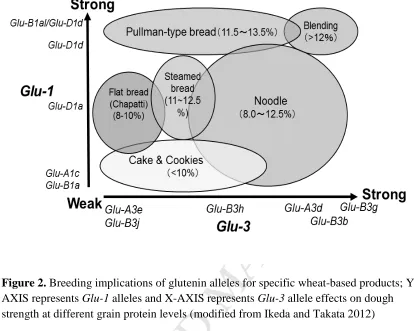
alleles can be summarized in a pictorial model modified from Ikeda and Takata (2012) 623
in Figure 2 by plotting the gluten strength effect of individual glutenin alleles in breeding 624
implications. 625
In quantitative terms, the relative proportion of gluten fractions (glutenins and 626
gliadins) and their sub-fractions (x- and y-type HMW-GS) are important determinants of 627
bread-making quality. There is still a debate as to the role of the various protein classes 628
on bread-making parameters such as dough properties, loaf volume, and crumb 629
characteristics. For example, gliadin proteins were reported to be closely related to loaf 630
volume in some studies (Khatkar et al. 2002), but in other studies gliadin proteins had 631
M
A
N
U
S
C
R
IP
T
A
C
C
E
P
T
E
D
responsible for loaf volume (Uthayakumaran et al. 2002). Zhang et al. (2007b) also 633
found that gliadin/glutenin ratios showed significant and negative associations with 634
dough properties and Chinese steamed bread quality. Alteration of this ratio had a 635
complex effect on the dough extensibility, indicating the different rheological properties 636
of glutenins and gliadins (Uthayakumaran et al. 2000). 637
HMW-GS/LMW-GS weight ratios vary between 0.18 and 0.74, suggesting the 638
amount of LMW-GS (55 to 85%) may vary from only slightly higher to an almost six 639
fold that of HMW-GS (15 to 45%) (see review from Veraverbeke and Declour 2002). 640
HMW-GS/LMW-GS ratios determined dough extensibility (Zhang et al. 2007a) and 641
were correlated with farinograph development time and stability (Zhang et al. 2007b). 642
Synthetic dough comprising homopolymers of HMW-GS were found to be stronger than 643
that those composed of LMW-GS homopolymers (Beasley et al. 2002). The mixing time, 644
peak resistance, maximum resistance to extension, and loaf height increased with 645
increases in HMW/LMW ratio, whereas resistance to breakdown and extensibility 646
decreased with the incorporation of glutenin subunits (Uthayakumaran et al. 2000). The 647
contribution of different glutenin subunits to the molecular properties of dough is directly 648
related to the polymeric structure of the glutenin protein. Both variations in structure and 649
in relative amounts of HMW-GS correlated strongly with dough strength, whereas 650
alteration in LMW-GS and gliadin composition affected dough extensibility. 651
5. Health related aspects of storage proteins 652
Wheat protein is one of the most extensively utilized proteins in the human diet, and it is 653
also one of the most common causes of food-related allergens and intolerances. The 654
terms wheat-related intolerance (sensitivity) and wheat allergy are often used 655
M
A
N
U
S
C
R
IP
T
A
C
C
E
P
T
E
D
rapidly following exposure to macro-molecules such as proteins. Several recent reviews 657
address different aspects of the role of storage proteins in allergies and their clinical and 658
pharmaceutical applications. Tatham and Shewry (2008) reviewed the cereal proteins 659
responsible for dietary and respiratory allergies in relation to their structural and 660
biological properties. Sapone et al. (2012) summarized the current knowledge about the 661
main forms of gluten reactions which may be allergic and autoimmune (coeliac disease, 662
dermatitis herpetiformis, and gluten ataxia). They also outlined the pathological, clinical 663
and epidemiological differences and proposed new nomenclature and classifications for 664
gluten related disorders. Mamone et al. (2011) presented an in-depth review on the 665
proteomics of allergens in wheat storage proteins and their derived products. Juhasz et 666
al. (2012a) proposed a method to identify the “epitope toxicity” by analyzing the number 667
and composition of epitopes on a single protein. The use of knowledge about the 668
composition and level of epitopes present in a cultivar is restricted due to the absence of 669
an efficient prediction methodology. In this regard, the “epitope toxicity” value obtained 670
by utilizing wheat proteome data is a significant measure and can be applied to wheat 671
improvement and food industry for development of gluten-free or less toxic products. 672
Moreover, the published genome of Brachypodium distachyon, a diploid wild grass with 673
low prolamin content, can be effectively utilized to study allergen potential of prolamin 674
and non-prolamin proteins (Juhasz et al. 2012b). Given the recent publication of these 675
reviews, we will only provide an overview of toxic prolamin-related epitopes in different 676
wheat genetic resources. A summary of prolamin-related toxic epitopes in wheat is given 677
in Table 1. Allelic variation for toxic prolamin epitopes is also reviewed in order to 678
M
A
N
U
S
C
R
IP
T
A
C
C
E
P
T
E
D
5.1 Coeliac disease 680
Coeliac disease (CD) is the most important disease resulting from gluten intolerance. It is 681
an intestinal T cell-mediated disease caused by an uncontrolled immune response to 682
gluten, which contains several peptides that constitute the main toxic component in CD 683
(van de Wal et al. 1998). It causes a medium to severe chronic inflammatory condition 684
that is characterized by injury to the lining of the small-intestine on exposure to the 685
gluten. CD affects 0.5-2.0% of the human population (Rewers 2005). In CD patients, 686
CD4+ T cells are present in the lamina propria that secrete interferon-gamma upon 687
recognition of gluten-derived peptides bound to HLA-DQ2 or HLA-DQ8 molecules 688
present on antigen presenting cells. Strikingly, most of the gluten peptides implicated in 689
CD require modification by the enzyme transglutaminase before they can bind to the 690
disease-predisposing HLA-DQ molecules and trigger T cell responses (Koning 2003). In 691
addition to the adaptive CD4+ T cell response to gluten, CD is characterized by 692
upregulation of IL-15, an intraepithelial T cell infiltrate expressing the NKG2D receptor, 693
and the overexpression of a ligand for NKG2D (MICA) (Meresse et al. 2004). 694
A variety of studies have been conducted to identify the gluten peptides responsible 695
for CD. These peptides have been identified in α-, ω-, and γ-gliadins (van de Wal et al. 696
1998; Arentz-Hansen et al. 2002; van Herpen et al. 2006) as well as in HMW and 697
LMW glutenins (Kooy-Winkelaar et al. 2011; Bodd et al. 2012). The α-gliadins are 698
considered to be the most relevant components of glutens causing CD (Vader et al. 699
2003; van Herpen et al. 2006; Vaccino et al. 2009). Alpha-gliadin genes on 700
chromosome 6A in bread wheat almost invariably contain epitopes glia-α9 and glia-α20, 701