Is it time to require the Training for Instructors course to become
mandatory under STCW?
Captain Quentin N Cox Senior Lecturer Warsash Maritime Academy Southampton Solent University
Newtwon Road Warsash Southampton UK SO31 9ZL
Fax +44 1489576908 Tel +44 1489 556292
Abstract
Pick up almost any shipping related newspaper or journal published currently and there will inevitably be included a tragic tale of a shipping casualty. The efforts to reduce the casualty statistics are immeasurable as are the theories and approaches to the management of safety in our industry.
There has already been much debate about the purpose, function and effectiveness of the IMO’s STCW code and convention but whatever our individual opinions, it is the code by which the industry must abide. In its foreword it mentions “minimum global standards of knowledge, understanding, experience and professional competence”.
The current status of the Training for Instructors course is that as mentioned as a reference in Section A-I/6 of the STCW Code, it “may be of assistance in preparation of courses”.
The existing requirements of trainers and educators of the code might be loosely interpreted as having knowledge of a subject and have received guidance on how to deliver training.
Is this requirement sufficient? In the trade press, alongside the tales of woe relating to avoidable accidents, there are almost as many articles associated with apparently innovative approaches to training and management, directed not only at reducing these accidents but also endeavouring to improve performance.
So can we ask the question, to which standards are our seafarers trained? Is it a standard which merely complies with the regulatory standard, inducing a ‘culture of compliance’? Or is it a standard well over and above mere regulatory requirements, where tasks are completed efficiently and cost-effectively, as well as safely, in order to present a commercially competitive organisation.
This paper discusses, argues and counter-argues the contention and concludes with the proposal that at very least, the debate should be re-opened.
Is it time to require the Training for Instructors course to become
mandatory under STCW?
Introduction
Pick up almost any shipping related newspaper or journal published currently and there will inevitably be included a tragic tale of a shipping casualty. The efforts to reduce the casualty statistics are immeasurable as are the theories and approaches to the management of safety in our industry.
There has already been much debate about the purpose, function and effectiveness of the IMO’s STCW code and convention but whatever our individual opinions, it is the code by which the industry must abide. In its foreword it mentions “minimum global standards of knowledge, understanding, experience and professional competence”.
The current status of the Training for Instructors course is that as mentioned as a reference in Section A-I/6 of the STCW Code, it “may be of assistance in preparation of courses”.
The existing requirements of the code might be translated loosely as having knowledge of a subject and have received guidance on how to deliver training.
Is this requirement sufficient? In the trade press, alongside the tales of woe relating to avoidable accidents, there are almost as many articles associated with apparently innovative approaches to training and management, directed not only at reducing these accidents but also endeavouring to improve performance.
So can we ask the question, to which standards are our seafarers trained? Is it a standard which merely complies with the regulatory standard, inducing a ‘culture of compliance’? Or is it a standard well over and above mere regulatory requirements, where tasks are completed efficiently and cost-effectively, as well as safely, in order to present a commercially competitive organisation.
Industry Trends
As I write, let me offer some examples of publications on my desk at this very moment, merely to illustrate my point
In the January 2012 edition of Seaways, the Nautical Institute journal, Chris Houghton ponders the effect of leadership training, now implicit in the STCW post Manila Amendments.
The same month’s Petroleum Review, from the Energy Institute, includes an article entitled ‘Delivering good practice and professionalism’. (Maeso 2012)
Whilst this article is more closely associated with a specific accident, it bemoans the message that a particular hazard of supposedly dry bulk cargoes, is “still not getting through”. It’s not that the training isn’t being given, it’s that the training is not being implemented.
Indeed the Nautilus Telegraph incorporates an entire page discussing the STCW Manila Amendments (Smith 2012). As you can see from the date, all media channels are as I write, saturated with the aftermath of the tragic Costa Concordia incident. It’s astonishing, isn’t it, how everyone outside of the industry, on the TV and radio and letters to the newspapers, suddenly becomes an expert on captaining a modern cruise liner. It is not the right time for me to add to the nonsense spouted by the ignorant. Time will tell what training issues can come out of the appalling incident.
So what are we to interpret from these publications? I would suggest that there is little concern about the level and variety of training that’s available. As Chris Houghton points out;
“The key to successful leadership training starts with understanding the difference between ‘training’ and ‘development’. The industry tends to be quite good at training.”(Houghton 2011)
What seems to be the area of concern is that the training is not always applied to most benefit the industry. There are numerous regulations for the trainee, the prospective seafarer to follow yet few to be followed by the trainers.
Would better training benefit the industry?
When we consider the task of seafarers collectively, we are looking toward the achievement of an objective. The task is not simply to transport goods from one port to another. It is to do so, safely, efficiently, without incident, economically, cost-effectively, commercially competitively and to deliver the cargo in an acceptable condition, amongst maybe further demands. Training will help expedite the tasks and maybe the argument is that effective training is more likely to be applied and implemented than ineffective training.
So what does the STCW regulation require from our trainers presently?
“Qualifications of instructors, supervisors and assessors”.
There is specific detail in paragraph one of the section when requiring that “all training and assessment of seafarers for certification under the Convention (STCW) is:
structured in accordance with written programmes, including such methods and media of delivery, procedures and course material as are necessary to achieve the prescribed standard of competence and
Paragraphs 4, 5 and 6 refer to persons having an appreciation of the training programme, an understanding of training objectives and be qualified in the task for which the training is being given. The Code requires assessors to have similar qualifications and guidance and practical experience in assessment. There are further but similar requirements of familiarity and experience for those involved in training and assessment using simulators.
So, these requirements of the code might be translated loosely as having knowledge of a subject and have received guidance on how to deliver training.
Let us examine some of these terms more closely. What does ‘having an appreciation’ mean exactly. Is this a subjective impression or can it be specified and identified with a certificate to declare this appreciation is real? How does an understanding of a training programme manifest itself. The STCW Code does not tell us specifically tell us but does elaborate slightly;
“Each Party should ensure that instructors and assessors are appropriately qualified and experienced for the particular types and levels of training or assessment of competence of seafarers”.
As far as in-service training and assessment are concerned, they;
“should have received appropriate guidance in instructional techniques”
where they use the IMO Model Course 6.09 Training Course for Instructors, as an example which may be of assistance.
Furthermore, supervisors of in-service training;
“should have appropriate knowledge of instructional techniques and of training methods and practice”.
Likewise, assessors should have similar experience in assessment methods and practice and;
“gained practical assessment experience under the supervision and to the satisfaction of an experienced assessor”.
At this point the IMO Model Course 3.12 Assessment, Examination and Certification of Seafarers, is mentioned.
Supervisors of in-service assessment;
“should have a full understanding of the assessment system, assessment methods and practice”.
Many maritime training and educational establishments form part of a university, whilst others are not able to make such a claim. Perhaps this is why we have an International Association of Maritime Universities and separate International Association of Maritime Institutions. Traditional research oriented universities will not even consider hiring an academic unless they possess a Doctorate, yet how many staff at our Maritime Universities or Institutions actually possess that level of qualification? I suspect the answer is that many do not, yet they have been hired, quite rightly, as a result of their significant industrial experience, which may not be the case with career academics and researchers.
So who are likely to be the best teachers, the academics and researchers or the seasoned former seafarer? Either could be and there is little on that basis alone to distinguish the more successful teacher. What is important however, is that they are given the opportunity to be guided and to practice their craft of teaching and training. Whilst the current STCW regulations prefer this to be the case, there doesn’t appear to be any mandatory requirement, merely for appreciation and understanding.
Current apparent good practice and voluntary policy
As is often the case where there is a clear distinction between regulatory requirement and preferred good practice, several employers regard the Training for Instructors course as obligatory in their own company policies and not just shipping companies for staff involved in training ashore or on board. Many educational and training institutions, universities or otherwise, require teaching staff to have successfully completed the Training for Instructors course at very least. In fact, even if a Doctorate is not feasible for experienced former seafarers coming into training and education, it is common for the institution to require staff to embark on a Certificate of Education of Postgraduate Certificate. Extravagant educational institutions may even sponsor favoured staff to embark on Masters level degrees and for the ultimate compliment, a PhD, though many will also encourage staff to do so at their own expense.
Still, there is no international requirement for any individual trainer or educator to possess even so much as a Training for Instructors course certificate. If we are to believe the trade press, maybe the weak link between knowledge and the application of training in industry, is the delivery of the material. Perhaps it is therefore time to enshrine the course into the mandatory sections of the STCW Code. This will be explored in more detail later.
Counter arguments
At the recent InterManager AGM in Manila, in November 2011, their General Secretary Capt Szymanski declared;
“Educate do not regulate”
as an observation on the magnitude of mandatory regulation within the industry,
“vowing to ensure InterManager members will work to self-regulate to ensure mandatory regulation is minimised”. (Tanker Operator November 2011).
It is clear when we consider the content of the above heading, relating to voluntary good practice, many practitioners are perfectly able to be self-regulated and do not need the impetus of a change in regulation to practice to high standards. However, as in any discussion regarding legislation, the industry is not seeking to change the practice of the responsible operator, or educators and trainers, in this case. It is the large group of mediocre and average practitioners which require the motivation.
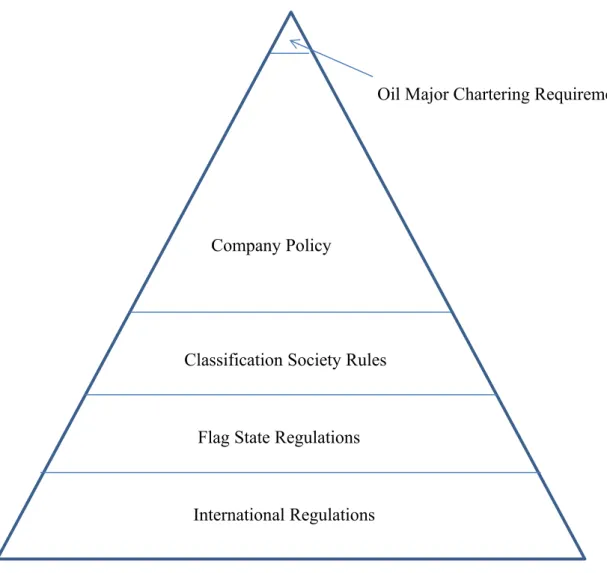
Oil Major Chartering Requirements
Company Policy
Classification Society Rules
Flag State Regulations
International Regulations
The figure above represents nothing other than my own perception, though having gained broad agreement through casual conversation with several peers. By adopting this point of view, there is a very compelling argument to leave existing legislative requirements as they are, since there are the options available, in terms of focussed training, for any operator to enhance their own operating standards if they so wish. The fact is that many choose to do exactly that and the livelihoods of maritime educational and training establishments across the world depend on operators availing themselves of training which is above and beyond the bare minimum legislative need.
It might be said that this is what distinguishes the responsible operator from the rest, that they voluntarily take the option of enhancing their staff training, rather than stick purely to the minimal requirement. Even then, if they want to remain competitive and the chartering marketplace, then they'll need to enhance their reputation and commercial appeal by acceding to additional options, frequently required by charterers and in many cases this does not mean additional ship equipment and procedures but additional, optional training as well. A glance through BP Shipping’s Safety and Environment section of their web site and in particular, the Safe Ship publication, will give you an indication of the detail of their ship vetting routine, which in part, explains the arrow toward the apex, in figure 1.
IMO Model Courses
As Chris Houghton perceptively notes;
“Some model courses are –apparently-intended to motivate and encourage some of the less energetic companies and flag states by giving them minimum standards to work to – standards which are at the threshold of what is acceptable. However, one unintended consequence is that they actually give average-performing organisations and excuse for not doing anything substantive. So training gets relegated to a relatively junior manager or superintendent” (Houghton 2012).
So by making our Training for Instructors course mandatory, one school of thought appears to be that the industry is merely advocating mediocrity and that such a move will by no means enhance or increase standards.
The argument supporting inclusion the statute
The discussion and referencing above leads to a fairly clear impression that in a global industry such as shipping, there will always be the more responsible and less responsible operators. Whilst the more worthy operators arguably do not even need the motivation of legislation at all, it is probably the irresponsible and less scrupulous outfits which do need the net of regulation behind them.
Put another way, the responsible operators are commonly at least one step ahead of the required regulatory standards both in terms of timing of a change of practice in anticipation of a change in regulation and in terms of quality of procedure. Whereas the less motivated will use the regulations as a benchmark, may be a benchmark to which to aspire and if by some miracle they do comply, then adopt a ‘culture of compliance’ in which the approach is that if they comply with the regulations then no more effort is required, there is no higher standard for which to aim.
So in order to formulate a more well founded argument for inclusion of mandatory teaching of the Training for Instructors course, within STCW requirements, let us consider a few case studies of incidents and endeavour to draw some conclusions.
The Commodore Clipper 16th June 2010 suffered a fire from a refrigerated trailer unit powered from the ships own electrical supply. Before the watch keepers came to terms with the fact that a fire was indeed burning,
“The fire detection system ceased to function at 0249:12; 6 minutes and 54 seconds after the first alarm. During this period, 16 sensors detected smoke, activating a combined total of 81 times. The system had been silenced 11 times and reset 7 times by the combined inputs from the bridge and ECR control stations”(MAIB 2011).
There was nothing other an utmost conviction amongst the staff, after the initial alarms, that they were anything other than spurious. It is clear that the staff, from this reputable operator, will have been trained extensively yet for some reason they were reluctant to respond appropriately, initially anyway. The reasons for this response are less clear but it would be apposite to know how the individuals felt about the training in the area they had received. From the report, 6 minutes may not seem a long time but when a fire is starting, the early 6 minutes are probably the most crucial in terms of handling an outbreak.
The fatality during a mooring operation on the Freemantle Express in Mexico on 15th July 2011 was summarised as follows;
“The MAIB investigation found that: the combined effect of the vessel’s movement astern and her bow paying off the berth had resulted in a snatch loading on the mooring rope; the rope had previously suffered abrasion damage that had lowered its residual strength to less than 66% of its original strength; the OS had stepped into the snap-back zone of the rope; and no warning had been given to him by other members of the mooring party”(MAIB 2011).
Once again, there can be little doubt that each of the crew had been well trained in mooring operations and made well aware of the hazards involved. As well as an undetected movement of the Ordinary Seaman back into snap-zone, another unaddressed contributory factor to the incident was the existing damage to the mooring rope. As the report goes on to explain, there was more than sufficient experience amongst the officers and rating present at the mooring operation, to warn the OS of the dangers involved. Similarly, the company had a mooring rope retirement policy in place, which should have seen the mooring line in question withdrawn from service, yet it had not been withdrawn. There were several other factors involved but just using these two issues as examples, once again, the training had been carried our but not applied.
Is it appropriate to conclude that had the trainers involved in the transfer of knowledge, whether shore based or in-service based, undertaken a Training for Instructors course these incidents may have been prevented? It is not an obvious or exclusive conclusion but I believe it is a question worth asking.
“Much of the current training around the world, whether done at sea or ashore, already fails to deliver genuinely competent seafarers that can consistently perform at best industry practice standards. Part of the problem is that there are too many trainers with good technical expertise who are incompetent teachers and others who lack the technical expertise to teach”.
“Poor trainers fail because they cannot motivate trainees or pass on their expertise and experience in a way that optimises student learning”. (Wilson 2005)
My own experience
The list does not just include learning theories, systems and alternative methods but assessment, evaluation and opportunities to practice teaching sessions that they have developed themselves. There are a number of other topics covered by the IMO Model Course 6.09 but these are amongst what I would consider the essentials. Naturally, I have encountered some sceptics and naysayers along the way but almost invariably the delegates leave the course with a much more confident demeanour than with which they joined.
There is, alarmingly, a very clear trend that some delegates relate at the outset of our courses. That is that their companies give them teaching material, such as scripts and pre-prepared presentation slide software, which they are told to deliver as given. Their employers do not permit their staff to amend or adapt the presentations.
need to start a develop a course from scratch. Their timing is almost regimented, so that if someone to stand outside the teaching room and burst in at a precise time, then they’d know exactly which slide and which part of the script was due to be delivered. This type of regime is, to my mind, counter – productive. Whilst appreciating what we’re endeavouring to acquaint them with, these staff appear to feel disillusioned that they will not be given the opportunity to practice what they have learned with us, once they return to their field, so to speak. In a sense, it is up to their employers to decide if they wish to implement what has been gained from our course, since they have paid for it. This again implies the tick-box mentality, cited by Chris Houghton, as mentioned earlier.
Conclusion
It is always tempting to think that as soon as legislation is passed in relation to a problem, then that problem will be immediately solved. Experience tells us this is simply not the case. However, amongst the plethora of motivational techniques in order to improve the efficiency of the industry and to reduce its accident statistics, maybe the proposal has some mileage. The problem is not, as I perceive, that training doesn’t occur, it’s just that it is not implemented appropriately. By ensuring our trainers and educators come up to a “minimum global standard of knowledge, understanding, experience and professional competence” maybe the trainees will benefit.
References
BP Shipping web site, Safety & Environment, Safe Ship.
http://www.bp.com/liveassets/bp_internet/bp_shipping/bp_shipping_english/STAGING/ local_assets/downloads_pdfs/b/BP_Shipping_SafeShips.pdf
[Viewed 17th January 2012]
Corbett, A. (2012) Tragedy sparks testing debate. Trade Winds. The International Shipping Newspaper. 23 (01). January 6th 2012. 38-39.
Houghton, C. (2012) Is leadership training a waste of money? Seaways, The International Journal of the Nautical Institute. January 2012. 15-16.
Maeso, M. (2012) Delivering good practice and professionalism. Petroleum Review. 66 (780) January 2012. 42-43.
Marine Accident Investigation Branch (2011) Report on the investigation of the fire on the main vehicle deck of Commodore Clipper while on passage to Portsmouth 16 June 2010.
http://www.maib.gov.uk/cms_resources.cfm?file=/CommodoreClipper_Compiled.pdf
[Viewed 17th January 2012]
Marine Accident Investigation Branch (2011) MV FREMANTLE EXPRESS Fatality during mooring operation Veracruz (Mexico) 15 July 2011.
http://www.maib.gov.uk/cms_resources.cfm?file=/Fremantle-Express_Report.pdf
[Viewed 17th January 2012]
Smith, D. (2012) Just the ticket? Nautilus Telegraph..45(01) January 2012.19.
The International Convention on Standards of Training, Certification and Watchkeeping for Seafarers. STCW Code Section A-I/6, Section B-I/6.
Szymanski, K. (2011) InterManager calls for crew care in addition to environment. Tanker Operator newsletter. November 18th 2011.
http://www.tankeroperator.com/news/todisplaynews.asp?NewsID=3113
[Viewed 17th January 2012]
Tang, L. & Sampson, H. (2011).New shipboard technology and training provision for seafarers. Seafarers International Research Centre. October 2011.Executive Summary. Page vii.
Wilson, T. (2005). Training the Trainer. Alert, The International Maritime Human Element Bulletin. (6) January 2005. 6.
http://he-alert.org/documents/bulletin/Alert!_6.pdf