http: // www.gjesrm.com © Global Journal of Engineering Science and Research Management
[197]
APPLICATIONS OF NEURAL NETWORK RECOGNIZED AS
INTERDISCIPLINARY STREAM BY DATA MINING
Sen, Umesh Kumar*1 Smt. Bhawna Malviya2
*1Faculty Dept. of Comp. Application Govt. NMV PG College, Hoshangabad. 2Faculty, Dept. of Comp. Sc. & Application Govt. MGM PG College, Itarsi (M.P.).
KEYWORDS
:
Neural Network (ANN), Neuron, Hidden Layer, Perceptron, Data Mining.ABSTRACT
Neural networks have emerged as advanced data mining tools in cases where other techniques may not produce satisfactory predictive models. As the term implies, neural networks have a biologically inspired modeling capability, but are essentially statistical modeling tools. Neural networks represent a brain metaphor for information processing. These models are biologically inspired rather than an exact replica of how the brain actually functions. Neural computing refers to a pattern recognition methodology for machine learning. The resulting model from neural computing is often called an artificial neural network (ANN) or a neural network. Neural networks have been used in many business applications for pattern recognition, forecasting, prediction, and classification. Neural network computing is a key component of any data mining tool kit. Applications of neural networks abound in finance, marketing, manufacturing, operations, information systems, and so on.
INTRODUCTION
Application of Neural Network Recognized as Interdisciplinary by Data Mining in the field of research and technology. Neural networks have emerged as advanced data mining tools in cases where other techniques may not produce satisfactory predictive models. As the term implies, neural networks have a biologically inspired modeling capability, but are essentially statistical modeling tools. Neural networks represent a brain metaphor for information processing. These models are biologically inspired rather than an exact replica of how the brain actually functions. Neural networks have been shown to be very promising systems in many forecasting applications and business classification applications due to their ability to “learn” from the data, their nonparametric nature (i.e., no rigid assumptions), and their ability to generalize. Neural computing refers to a pattern recognition methodology for machine learning. The resulting model from neural computing is often called an artificial neural network (ANN) or a neural network. Neural networks have been used in many business applications for pattern recognition, forecasting, prediction, and classification. Neural network computing is a key component of any data mining tool kit. Applications of neural networks abound in finance, marketing, manufacturing, operations, information systems, and so on. Therefore, we devote this paper to developing a better understanding of neural network models, methods, and applications in various states, which is enumerated as under.
DEFINITION AND BACKGROUND
Neural network research can be traced back to a paper by McCulloch and Pitts3 in 1943. In 1957 Frank Rosenblatt invented the Perceptron4. Rosenblatt proved that given linearly separable classes, a perceptron would, in a finite number of training trials, develop a weight vector that will separate the classes (a pattern classification task). He also showed that his proof holds independent of the starting value of the weights. Around the same time Windrow and Hoff5 developed a similar network called Adeline. Minskey and Papert6 in a book called "Perceptrons" pointed out that the theorem obviously applies to those problems that the structure is capable of computing. They showed that elementary calculation such as simple "exclusive or" (XOR) problems cannot be solved by single layer perceptrons.
Rosenblatt4 had also studied structures with more layers and believed that they could overcome the limitations of simple perceptrons. However, there was no learning algorithm known which could determine the weights necessary to implement a given calculation. Minskey and Papert6 doubted that one could be found and recommended that other approaches to artificial intelligence should be pursued. Following this discussion, most of the computer science community left the neural network paradigm for twenty years7. In early 1980s Hopfield was able to revive the neural network research.
APPLICATIONS OF NEURAL NETWORK IN VARIOUS FIELD
http: // www.gjesrm.com © Global Journal of Engineering Science and Research Management
[198]
Problem-
Today’s customer is confronted with variety of options regarding what he or she drinks. A drinker’s choice depends on various factors, such as mood, venue, and occasion. The goal of Coors is to ensure that the customer chooses a Coors brand every time. According to Coors, creativity is the key to being successful in the long term. To be the customer’s choice brand, Coors needs to be creative and anticipative about the customer’s ever-changing moods. An important issue with beers is the flavor; each beer has a distinctive flavor. These flavors are mostly determined through panel tests. However, such tests take time. If Coors could understand the beer flavor based solely on its chemical composition, it would open up new avenues to create beer that would suit customer expectations. The relationship between chemical analysis and beer flavor is not clearly understood yet. Substantial data exists about its chemical composition and sensory analysis. Coors needed a mechanism to link those two together. Neural networks were applied to create the link between chemical composition and sensory analysis.
Solution-
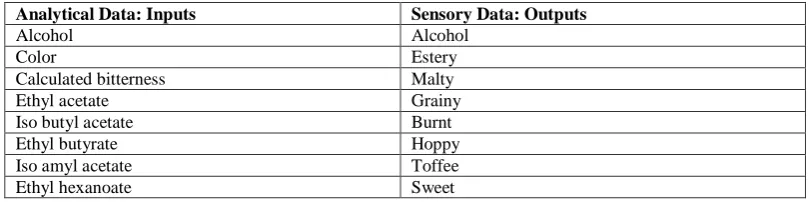
Over the years, Coors Brewers Ltd. has accumulated a significant amount of data related to the final product analysis, which has been supplemented by sensory data provided by the trained in-house testing panel. Some of the analytical inputs and sen-sory outputs are shown here:
Table. I
Analytical Data: Inputs Sensory Data: Outputs
Alcohol Alcohol
Color Estery
Calculated bitterness Malty
Ethyl acetate Grainy
Iso butyl acetate Burnt
Ethyl butyrate Hoppy
Iso amyl acetate Toffee
Ethyl hexanoate Sweet
A single neural network, restricted to a single quality and flavor, was first used to model the relationship between the analytical and sensory data. The neural network was based on a package solution supplied by Neuro Dimension, Inc. (nd.com). The neural network consisted of a multilayer perceptron (MLP) architecture with two hid-den layers. Data were normalized within the network, thereby enabling comparison between the results for the various sensory outputs. This technique produced poor results, due to two major factors. First, concentrating on a single product’s quality meant that the variation in the data was pretty low. The neural network could not extract useful relationships from the data. Second, it was probable that only one subset of the provided inputs would have an impact on the selected beer flavor. Performance of the neural network was affected by “noise” created by inputs that had no impact on flavor.
A more efficient method of searching for the relevant inputs was required. A genetic algorithm was the solution to the problem. A genetic algorithm was able to manipulate the different input switches in response to the error term from the neural network. The objective of the genetic algorithm was to minimize the network error term. When this minimum was reached, the switch settings would identify the analyti-cal inputs that were most likely to predict the flavor.
RESULT
http: // www.gjesrm.com © Global Journal of Engineering Science and Research Management
[199]
Sources: C.I. Wilson and L. Threapleton, “Application of Artificial Intelligence for Predicting Beer Flavors from Chemical Analysis, “Proceedings of the 29th European Brewery Congress, Dublin, May 17–22, 2003,neurosolutions.com/resources/apps/beer.html(accessed April 2006).
Application of Neural Network in Biological Science-
The human brain is composed of special cells called neurons. These cells do not die when a human is injured (all other cells reproduce to replace themselves and then die).This phenomenon may explain why we retain information. Information storage spans sets of neurons. The estimated number of neurons in a human brain is 50 to 150 billion, of which there are more than 100 different kinds. Neurons are partitioned into groups called networks. Each network contains several thousand highly interconnected neurons. Thus, the brain can be viewed as a collection of neural networks. The ability to learn and react to changes in our environment requires intelligence. The brain and the central nervous system control thinking and intelligent behavior. People who suffer brain damage have difficulty learning and reacting to changing environments. Even so, undamaged parts of the brain can often compensate with new learning.
A portion of a network composed of two cells is shown in Figure 1. The cell itself includes a nucleus (the central processing portion of the neuron). To the left of cell 1, the dendrites provide input signals to the cell. To the right, the axon sends output signals to cell 2 via the axon terminals. These axon terminals merge with the dendrites of cell 2. Signals can be transmitted unchanged, or they can be altered by synapses. Asynapse is able to increase or decrease the strength of the connection from neuron to neuron and cause excitation or inhibition of a subsequent neuron. This is where information is stored.
Fig.1: Portion of a Network: Two Interconnected Biological Cells.
Application of Neural Network to Reduce the Telecommunication
Fraud-The Forum of International Irregular Network Access (FIINA) estimates that telecommunications fraud results in a loss of US$55 billion per year worldwide. South Africa’s largest telecom operator was losing over US$3 million per year to fraud. Subscription fraud in which a customer either provides fraudulent details or gives valid details and then disappear was the company’s biggest cause of revenue leakage. By the time the telecom provider is alerted about the fraud, the fraudster has already moved to other target victims. Other types of fraud include phone card manipulation, which involves tampering and cloning of phone cards. In clip-on fraud, a fraudster clips on to customers’ telephone lines and then sells calls to overseas destinations for a fraction of normal rates.
http: // www.gjesrm.com © Global Journal of Engineering Science and Research Management
[200]
individual basis using specific knowledge about the subscriber’s usage, and on a global basis, using generic knowledge about subscriber usage and known fraud patterns.
In the first three months of installation of this neural network based software produce following results: 1. The average fraud loss per case was reduced by 40 percent.
2. The detection time was reduced by 83 percent.
3. The average time taken to analyze suspected fraud cases was reduced by 75 percent. 4. The average detection hit rate was improved by 74 percent.
The combination of neural, rule-based, and case-based technologies provides a fraud detection rate superior to that of conventional systems. Furthermore, the multi stream analysis capability makes it extremely accurate.
Sources: Combating Fraud: How a Leading Telecom Company Solved a Growing Problem,neuralt.com/iqs/dlsfa.list/ dlcpti.7/downloads.html; A. Shukla, Neural Technologies and Sevis Partner to Eliminate Fraudulent Calls in Fixed and Mobile Networks, February 3, 2006, news.tmcnet.com/news/-neural-sevis-fraud-mobile/2006/02/03/1340423.htm(accessed April 2006); P.A. Estévez, M.H. Claudio, and C.A. Perez,
Prevention in Telecommunications Using Fuzzy Rules and Neural
Networks,cec.uchile.cl/~pestevez/RI0.pdf(accessed April2006).
ELEMENTS OF ANN
A neural network is composed of processing elements organized in different ways to form the network’s structure. The basic processing unit is the neuron. A number of neurons are organized into a network. There are many ways to organize neurons; they are referred to as topologies. One popular approach, known as the feed forward back propagation paradigm (or simply back propagation), allows all neurons to link the output in one layer to the input of the next layer, but it does not allow any feedback linkage (Haykin, 1999).This is the most commonly used paradigm.
PROCESSING ELEMENTS
The processing elements (PE) of an ANN are artificial neurons. Each of the neurons receives inputs, processes them, and delivers a single output, as shown in Figure 2. The input can be raw input data or the output of other processing elements. The output can be the final result (e.g., 1 means yes, 0 means no), or it can be inputs to other neurons.
Fig2: Processing Information in an Artificial Neuron.
NETWORK STRUCTURE
http: // www.gjesrm.com © Global Journal of Engineering Science and Research Management
[201]
hidden layers can be placed between the input and output layers, although it is quite common to use only one hidden layer. In that case, the hidden layer simply converts inputs into a nonlinear combination and passes the transformed inputs to the output layer.
Fig.3: Neural Network with One Hidden Layer.
Application of Neural Networks for Breast Cancer Diagnosis
Breast cancer is the second cause of dead among women. Early detection followed by appropriate cancer treatment can reduce the deadly risk. Medical professionals can make mistakes while identifying a disease. The help of technology such as data mining and machine learning can substantially improve the diagnosis accuracy. Artificial Neural Networks (ANN) has been widely used in intelligent breast cancer diagnosis. However, the standard Gradient-Based Back Propagation Artificial Neural Networks (BP ANN) has some limitations. There are parameters to be set in the beginning, long time for training process, and possibility to be trapped in local minima. In this research, we implemented ANN with extreme learning techniques for diagnosing breast cancer based on Breast Cancer Wisconsin Dataset. Results showed that Extreme Learning Machine Neural Networks (ELM ANN) has better generalization classifier model than BP ANN. The development of this technique is promising as intelligent component in medical decision support systems.
Sources: R. W. Brause, “Medical Analysis and Diagnosis by Neural Networks,” in Proceeding ISMDA ’01 Proceedings of the Second International Symposium on Medical Data Analysis, 2001.
CONCLUSION AND FUTURE RESEARCH WORK
This research paper recognize the various application of neural network in various field. This paper includes Business applications of neural networks, finance, firm failure prediction, time series forecasting. Neural computing involves a set of methods that emulate the way the human brain works. The basic processing unit is a neuron. Multiple neurons are grouped into layers and linked together. In a neural network, the knowledge is stored in the weight associated with each connection between two neurons. New applications of neural networks are emerging in health care, security, and so on.
REFERENCES
http: // www.gjesrm.com © Global Journal of Engineering Science and Research Management
[202]
2. Fadlalla, A., and C. Lin. (2001). “An Analysis of the Applications of Neural Networks in Finance.” Interfaces, Vol. 31, No. 4.
3. Lee, P.Y., S.C. Hui, and A.C.M. Fong. (2002, September/October). “Neural Networks for Web Content Filtering.”IEEE Intelligent Systems.
4. Zahedi, F. (1993).Intelligent Systems for Business: Expert Systems with Neural Networks. Belmont, CA:Wadsworth.
5. Hill, T., T. Marquez, M. O’Connor, and M. Remus. (1994). “Neural Network Models for Forecasting and Decision Making,”International Journal of Forecasting, Vol. 10.
6. Surkan, A., and J. Singleton. (1990). “Neural Networks for Bond Rating Improved by Multiple Hidden Layers.” Proceedings of the IEEE International Conference on Neural Networks, Vol. 2.
7. Rochester, J. (ed.). (1990, February). “New Business Uses for Neurocomputing.”I/S Analyzer.
8. Mighell, D. (1989). “Back-Propagation and Its Application to Handwritten Signature Verification,” in D. S. Touretsky (ed.),Advances in Neural Information Processing Systems. San Mateo, CA: Kaufman. 9. G. B. Huang and H. A. Babri, “Upper bounds on the number of hidden neurons in feedforward networks
with arbitrary bounded nonlinear activation functions.,” IEEE Trans. Neural Netw., vol. 9, no. 1, Jan. 1998.
10. E. D. Übeyli, “Implementing automated diagnostic systems for breast cancer detection,” Expert Syst. Appl., vol. 33, no. 4, Nov. 2007.
11. McCulloch, W.S., and W.H. Pitts. (1943). “A Logical Calculus of the Ideas Imminent in Nervous Activity.” Bulletin of Mathematical Biophysics, Vol. 5.
12. Minsky, M., and S. Papert. (1969) . Perceptrons. Cambridge, MA: MIT Press.
13. Haykin, S.S. (1999).Neural Networks: A Comprehensive Foundation, 2nd ed. Upper Saddle River, NJ: Prentice Hall.