Suryanto
School of Nursing and Midwifery, Monash University,
Frankston, Victoria, Australia. School of Nursing,
Brawijaya University,
Malang, Jawa Timur, Indonesia. Malcolm Boyle
School of Medicine, Griffith University,
Southport, Queensland, Australia. Virginia Plummer
School of Nursing and Midwifery, Monash University,
Frankston, Victoria, Australia. Peninsula Health,
Frankston, Victoria, Australia. Correspondence:
[email protected]; [email protected]
Healthcare Workforce in Indonesia
Suryanto, M Boyle and V Plummer
ARtIClE
Discussion: Nurses and midwives account for the largest proportion of healthcare providers in Indonesia. The ratio of healthcare providers in Indonesia is lower than the average of South-East Asian and other lower-middle income countries. More than half of the healthcare providers in Indonesia provide care in community health centres. Several regulations have been proclaimed to improve the imbalanced proportion of healthcare providers across the country.
Conclusion: Indonesia continues to develop strategies towards successful distribution of healthcare providers across the country. A study investigating the impact of the programs reducing the imbalanced distribution of healthcare providers on health outcomes is essential for Indonesia.
Key words: healthcare providers; health workforce; human resources; developing country; Indonesia. Abstract
Introduction: Imbalanced distribution of healthcare providers between urban and rural areas is one of the difficulties facing health service provision in Indonesia. Several regulations have been made by the government to solve the problem. The objective of this paper is to describe the provision of human resources for healthcare services in Indonesia.
Methodology: A review of medical related electronic databases, CINAHL and Ovid MEDLINE, was undertaken from their commencement date until the end of January 2017. The grey literature from the Indonesian government, the World Health Organisation and the World Bank websites was also searched.
Results: There were 92 articles identified from the CINAHL and 222 articles from the Ovid MEDLINE databases. Five articles were included from the two databases and five documents from grey literature with ten articles to be reviewed.
Introduction
(PTT) program, or contract staff. It was compulsory for newly graduated doctors to be contracted staff and to provide healthcare in remote areas. [4] However, due to dissatisfaction among medical graduates, which was mainly because only 40% of them were recruited as civil servants, the PTT program was terminated in 2007, [4] but then was reintroduced with a new scheme, which has been in place until the recent years.
The imbalanced proportion of healthcare providers remained until the implementation of Indonesia’s health policy, “Healthy Indonesia 2010”, which had a positive influence in improving the healthcare provider distribution in Indonesia, especially in remote and rural areas. [4] This health policy increased the community’s interest in pursuing a healthcare profession as a career. In 2008, there were about 10,000 midwives and 34,000 nurses graduating every year from 465 and 682 midwifery and nursing schools respectively; whereas, the medical school received 80,000 applications for new students, which only had a 4,700 capacity. [4] This demand was associated with an increasing number of private institutions which was greater compared to state institutions, with most doctors graduating from private education institutions. However, the graduates were mostly considered less-qualified due to lack of government oversight of the private institutions’ education process. [4]
The decentralisation implemented by the Indonesian government influenced the distribution of healthcare in the country. Decentralisation allows for a more efficient recruitment system of healthcare providers for rural areas because the recruitment can be based on local needs and priorities. [4] This article describes the provision of human resources for healthcare services in Indonesia focusing on the distribution public and private health workers.
Methodology
Design
A review of medical related electronic databases, Indonesian Government websites and international organisation publications to examine healthcare providers in Indonesia was undertaken.
Process
A search was undertaken using two electronic databases, CINAHL and Ovid MEDLINE from their commencement date until end of January 2017. The search strategy used the following keywords: “healthcare providers”, “health
workforce”, “human resources”, and “Indonesia”. The search used the keywords individually and in combination. The Indonesian government, the World Health Organisation (WHO), and the World Bank websites were also searched for information about Indonesian healthcare providers. Articles or documents were included if they reported on the human resources associated with the provision of health services in Indonesia including the quantity, the distribution, and the implementation to overcome the distribution problems. Articles were excluded if they were in languages other than English or Bahasa Indonesia and letters to the editor.
Results
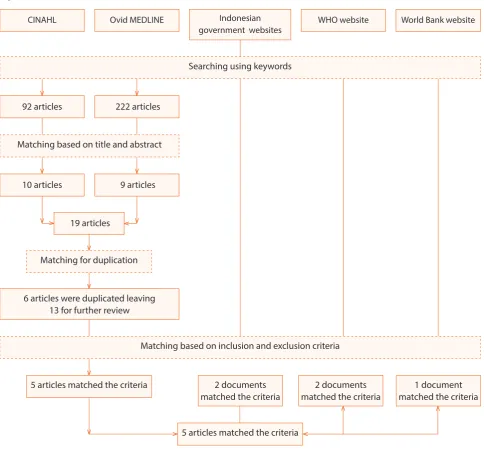
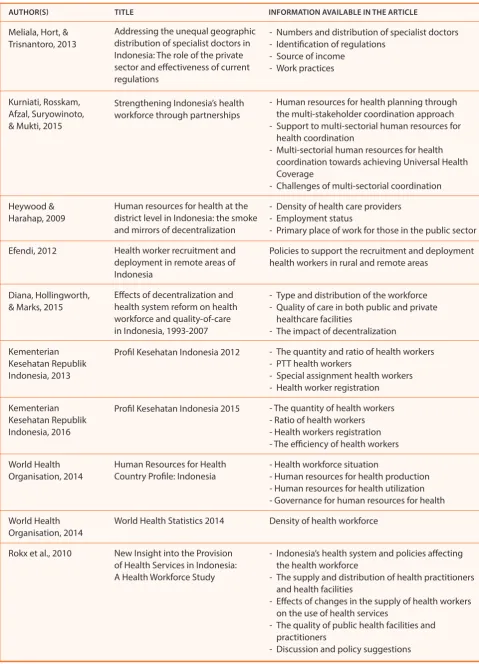
There were 92 articles identified from the CINAHL and 222 articles from the Ovid MEDLINE search. Based on the title and abstract, there were 10 articles from the CINAHL and nine articles from Ovid MEDLINE, total of 19 articles that met the inclusion criteria. There were six duplicated articles leaving 13 articles to be further reviewed. Following further review, eight articles were excluded, as they did not contain relevant information about the healthcare resources in Indonesia, leaving five articles for inclusion in the review. There were five documents identified which met the inclusion criteria from the search of the Indonesian government, the WHO, and the World Bank websites. In total, there were ten articles reviewed for this paper (Figure 1 and Table 1).
Discussion
the number of healthcare providers
Despite the inequitable distribution of the health workforce in Indonesia, data from the Indonesian Ministry of Health shows that in 2015 there were 876,984 healthcare providers working in public and private sectors in Indonesia with nurses the majority, 233,910 (34.6%). [3] Healthcare providers in Central Java (76,819), East Java (69,405), and West Java (66,152) provinces accounted for the highest number compared to other provinces. The number of specialist doctors was higher than general physicians; this is because general physicians working independently or in management are not counted in the medical service sector. [3] The details of the healthcare providers can be seen in Table 2.
CINAHL Ovid MEDLINE Indonesian WHO website World Bank website government websites
Searching using keywords
92 articles 222 articles
Matching based on title and abstract
10 articles 9 articles
19 articles
Matching for duplication
6 articles were duplicated leaving 13 for further review
Matching based on inclusion and exclusion criteria
5 articles matched the criteria 2 documents
matched the criteria
2 documents matched the criteria
1 document matched the criteria
5 articles matched the criteria
V V
V V
V V V V
V
V
V
V V V
V V
Figure 1. Articles and documents retrieved from databases and websites
the same period. [6] However, Thailand had a higher medical practitioner to population ratio compared to Indonesia. The report shows that the ratio of medical practitioners to population in Indonesia was 0.15 per 1,000 population in both 2009 and 2010, where it was 0.33 and 0.41 per 1,000 population in Thailand for 2009 and 2010 respectively. Similar trends also occurred for other healthcare professionals. [6]
A study by Kurniati et al [7] shows an increase in health workforce ratio (doctors, nurses and midwives) in Indonesia from 0.95 per 1,000 population in 2006 to 2.63 per 1,000 population in 2014. Despite this development, based on the 2016 World Health Statistics from the WHO, the ratio of skilled health professionals (physicians, nurses and midwives,
Table 1. Articles and documents retrieved for review
AuTHOr(S) TITLE INFOrMATION AvAILABLE IN THE ArTICLE
Meliala, Hort, & - Numbers and distribution of specialist doctors
Trisnantoro, 2013 - Identification of regulations
- Source of income - Work practices
Kurniati, Rosskam, - Human resources for health planning through
Afzal, Suryowinoto, the multi-stakeholder coordination approach
& Mukti, 2015 - Support to multi-sectorial human resources for
health coordination
- Multi-sectorial human resources for health coordination towards achieving Universal Health Coverage
- Challenges of multi-sectorial coordination
Heywood & - Density of health care providers
Harahap, 2009 - Employment status
- Primary place of work for those in the public sector
Efendi, 2012 Policies to support the recruitment and deployment
health workers in rural and remote areas
Diana, Hollingworth, - Type and distribution of the workforce
& Marks, 2015 - Quality of care in both public and private
healthcare facilities
- The impact of decentralization
Kementerian - The quantity and ratio of health workers
Kesehatan Republik - PTT health workers
Indonesia, 2013 - Special assignment health workers
- Health worker registration
Kementerian - The quantity of health workers
Kesehatan Republik - Ratio of health workers
Indonesia, 2016 - Health workers registration
- The efficiency of health workers
World Health - Health workforce situation
Organisation, 2014 - Human resources for health production
- Human resources for health utilization - Governance for human resources for health
World Health Density of health workforce
Organisation, 2014
Rokx et al., 2010 - Indonesia’s health system and policies affecting
the health workforce
- The supply and distribution of health practitioners and health facilities
- Effects of changes in the supply of health workers on the use of health services
- The quality of public health facilities and practitioners
- Discussion and policy suggestions Addressing the unequal geographic
distribution of specialist doctors in Indonesia: The role of the private sector and effectiveness of current regulations
Strengthening Indonesia’s health workforce through partnerships
Human resources for health at the district level in Indonesia: the smoke and mirrors of decentralization
Health worker recruitment and deployment in remote areas of Indonesia
Effects of decentralization and health system reform on health workforce and quality-of-care in Indonesia, 1993-2007
Profil Kesehatan Indonesia 2012
Profil Kesehatan Indonesia 2015
Human Resources for Health Country Profile: Indonesia
World Health Statistics 2014
higher compared to Timor Leste, Bangladesh and Myanmar, but lower compared to Sri Lanka and Thailand, which can be seen in Table 3.
Despite the differences between healthcare providers to population ratio, the number of medical-related schools (medical, nursing, and midwifery) in Indonesia was higher (1,199) than other Southeast Asian countries including Brunei (3), Singapore (5), Malaysia (120), Philippines (824), Vietnam (28), Laos (7), Cambodia (14) and Myanmar (47). [10] Thus, there are more medical-related students graduating in Indonesia, but, with a population of more than 255 million and a population growth rate of 1.49% per annum, Indonesia continues to face a crisis with adequate health workers. [7] However, Indonesia and the Philippines are the two countries exporting many doctors and nurses compared Table 2. Healthcare Providers in Indonesia
HEALTHCArE PrOvIDErS QuANTITy rATIO*
Specialist doctors 47,849 18.7
General physicians 41,026 16.1
Specialist dentists 1,054 0.4
Dentists 11,686 4.6
Nurses 233,910 87.6
Midwives 111,736 51.6
Pharmacists 30,329 11.9
*per 100,000
Table 3. Comparison of Healthcare Provider ratio between Indonesia and other Countries
CATEgOry PHySICIANS* NurSES AND PHArMACIST* MIDWIvES*
DENTIST*
Indonesia 2.0 13.8 1.0 1.0
Bangladesh 3.6 2.2 0.3 0.6
Myanmar 6.1 10 0.7
-Sri Lanka 6.8 16.4 0.8 0.4
Thailand 3.9 20.8 2.6 1.3
Timor Leste 0.7 11.1 0.4 1.1
South-East Asian countries (average) 5.9 15.3 1.0 3.8
Lower-middle income countries (average) 7.8 17.8 1.2 4.2
Global (average) 14.1 29.2 2.7 4.3
*(per 10,000 population)
to other Southeast Asian countries. [10] This situation may exacerbate the health worker crisis in Indonesia both in hospitals and puskesmas.
The puskesmas and hospital are the two major types of
health facilities in Indonesia. The puskesmas is a community health centre, which is established at the sub-district level and organised by the district government. [11] There were 9,754 puskesmas and 2,488 hospitals in Indonesia in 2015 with 258,568 healthcare providers in the puskesmas and 493,856 healthcare providers in the hospitals. [3] The details of the distribution of the healthcare providers in the hospitals and puskesmas can be seen in Table 4.
As Table 4 demonstrates, the number of midwives and nurses were almost equal in the puskesmas. Both professions account for the largest number of healthcare professionals in
the puskesmas. However, the number of nurses was highest
among healthcare providers in hospitals in Indonesia and the number of midwives was one-fifth of the number of nurses. While the number of specialist doctors was not available for the puskesmas, these professionals accounted for the second largest number of healthcare providers in hospitals.
Distribution of healthcare providers in Indonesia
Yogyakarta, Central Java, DKI Jakarta, Bengkulu, and North Sumatera, the results could be considered representative of Indonesia as the samples were varied and from less-developed to less-developed provinces. The study showed that provinces of Java Island had higher health provider ratios compared to provinces in eastern Indonesia. [1] Similarly, unequal distribution of healthcare providers also occurred in Cambodia up to 2010, especially for medical doctors and midwives. [12] More than half the medical doctors (54%) worked in the capital city of Cambodia where only 9.3% of the population lives. [12]
The imbalanced distribution of the Indonesian healthcare workforce was not only for specialist doctors, but also for other healthcare providers such as nurses, midwives, nutritionists, and sanitarians. [13] Most of the health workers were not willing to serve in rural areas due to communication problems, inadequate basic and social facilities, decreased remuneration and no further reward, security issues due to living in a rural area, and career uncertainty. [13] However, the decentralisation implemented in Indonesia allowed local governments to manage their human resources including healthcare providers which tended to reduce the gap between urban and rural areas in Indonesia. [14] Furthermore, dual sector practice among specialist doctors is common in Indonesia with specialist doctors working in both public and private sectors, even though they are government employees. [1] The dual sector practice may increase access to health services, including in rural areas due to the availability of additional health professionals. [4] Several regulations had been implemented to manage dual sector practice among doctors including tighter contract arrangements, raising public sector salaries, and regulation within professional organisation. [1]
Cambodia also had a similar situation where staff shortages in rural areas arose due to inadequate salaries, lack of security, medical and drugs supplies, and inadequate government management. [12] This staff shortage in rural areas had several impacts on healthcare services in Cambodia. Due to the belief that the government had a low quality health service, people in Cambodia tend to go to private health facilities when seeking help. [12] Almost half of the people (48.2%) sought treatment from the private sector, 21.6% from the public sector and 20.8% from the non-medical sector. [15] This included the high use of informal health services where some of the personnel were untrained, such as traditional healers. [12] However, the health worker shortage is also one of the problems faced by a more developed country like Singapore. Even though the average of nurse to patient ratio in Singapore was better (1:200) [16] than Cambodia (1:4,875), [12] there was an imbalance between graduate nurses and the demand for nurses in Singapore; therefore, Singapore recruited nurses from other countries such as China, England, India, Malaysia, Myanmar and Philippines. [16]
There have been several programs implemented by the Ministry of Health of Indonesia in order to minimise the imbalanced distribution including compulsory service regulation, the PTT program, and special assignment for strategic health workers including nurses, sanitarians and nutritionists, [13] as well as providing additional incentives for healthcare providers who are willing to serve in rural areas. [1] The additional incentives were provided by the Ministry of Health (central government) or from local government where healthcare providers are given an allowance from the Ministry of Health of up to USD$750 per month for specialist doctors and USD$500 per month for general practitioners.
Table 3. Healthcare Providers in Puskesmas and Hospitals in Indonesia
CATEgOry PusKesMas HOSPITALS
QuANTITy rATIO* QuANTITy rATIO**
Midwives 79,314 8.1 30,561 12.3
Nurses 73,311 7.5 147,264 59.2
General Physicians 16,656 1.7 23,130 9.3
Dentists 6,537 0.7 4,831 1.9
Specialist doctors N/A N/A 47,605 19.1
The additional incentives from local government are varied and range between USD$500 to USD$2,500 per month. [1] In comparison, in Thailand, an incentive program was given to the doctors serving in rural areas along with an annual award from a renowned organisation or foundation for healthcare providers working in rural areas to reinforce their commitment. [17] Additionally, personal career advancement has been in place since 2007 for those working in rural areas where they can be promoted to achieve level 9 in their professional career position, which previously was only up to a level 8. [17] Level 11 is the highest-ranking position in the professional career in Thailand with a level 9 position equivalent to a deputy director general. [17]
The compulsory deployment service in Indonesia was instigated from 1961 to 2003. During this time all graduates, including health institution graduates, had to serve at least five years after completing their study with the timing and location dictated by the Ministry of Health. [13] However, this regulation ceased in 2003 and all graduates have the same right to choose their job without any discrimination. [18] As a result, a disproportionate number of healthcare providers elect to serve in urban areas compared to rural areas. [13] Thailand had a similar program of mandatory service in rural areas for new medical and nursing graduates, which has been in place since 1974 where it is compulsory for new graduates to work in rural areas for three years. [17]
The PTT or hiring contracted staff was another effort of the government to minimise the unequal distribution of the health work force in Indonesia. This program was launched in 1991, based on the President Decree No. 37 of 1991, which states that doctors, dentists, and midwives have an obligation to work as contract staff for a minimum of three months and up to three years after graduation. [13] Since the contracted staff can choose the area where they want to serve, in 2006 the Ministry of Health determined that contracted staff would work at remote or very remote areas for minimum of six months and up to two years. [13] Starting from 2007, the mandatory program of PTT was changed to a voluntary program, however, the PTT program was still favored by healthcare graduates. [13] By the end of 2012, there were 45,777 PTT staff across Indonesia [19] and these numbers remained the same in 2015, 44,449 PTT staff consisting of 29 specialist doctors, 1,659 general practitioners, 803 dentists, and 41,958 midwives. [3]
Another program implemented by the Ministry of Health to reduce the distribution gap in healthcare providers’ locations in Indonesia is the special assignment. This program was
started in 2009 with the objective of increasing access and quality of health services in disadvantaged areas, border areas and small islands, areas with health difficulties, and small hospitals. [19] The number of healthcare providers who participated in the program during 2012 was 658 general practitioner residents, 1,009 nurses, 228 dieticians, 196 sanitarians, 114 health analysts, 17 midwives, 52 pharmacists, 21 dental nurses and one psychiatrist, radiologist, and medical recorder. [19] The Indonesian Ministry of Health implemented a team-based special assignment in May 2015, called Nusantara Sehat program, where healthcare providers were dispatched to targeted areas. [3]
As part of the government program to increase the health status of all Indonesians, a program called Jaminan
Kesehatan Nasional (JKN) was implemented with the launch
of the universal health insurance, the Badan Penyelenggara
Jaminan Sosial (BPJS) in January 2014. [20] The BPJS aimed
to ensure health maintenance and protection for all Indonesians. However, the implementation of the BPJS was not linked to the distribution of health workers. Almost four years after the implementation, the distribution of health workers remains concentrated on Java Island. [21] Indonesians who have been unable to access health facilities or health workers within their areas have been offered compensation by BPJS through fund reimbursement, deploying healthcare providers, or providing a special health facility. [22]
involved in the programs passed the comprehensive and the national license examination and they had better clinical competencies than graduates with a normal track. [23]
Imbalanced distribution of health workers is an international issue. The WHO has issued a global strategy on human resources for health to ensure the equitable access to health workers within strengthened health systems. [24] One of the objectives of the global strategy is to align investment in human resources for health to address shortages and improve distribution of health workers. For Indonesia, as the fourth largest country by population in the world, regulation to manage workforce maldistribution may be more appropriate. Graduates of health professions may be in over-supply on Java Island, but not in other rural areas of Indonesia. For example, there were 22,263 graduate nurses in 2014 but only 13,528 (39%) had been employed. [25] East Java province has the highest numbers of nursing schools, 55 Diploma of Nursing and 53 Bachelor of Nursing schools, producing around 12,000 nurses every year, with only 10% employed. [26] On the other hand, the 2015 annual report of the Indonesian Ministry of Health shows that the ratio of nurses to population was 87.65 per 100,000 population which was below the target, 180 per 100,000 population. [3] This demonstrates a need for regulation of graduates’ education so that all health professional graduates, mainly from Java Island, can be well distributed to all areas of Indonesia.
The WHO global strategy on human resources for health emphasises the strengthening of integrated aspects of health workers including planning, financing, education, regulation, and management. [24] The 2015 annual report of the Ministry of Health of Indonesia shows that the regulations in distributing health workers in Indonesia include PTT, special assignment, both residents and internship programs, and team-based assignment. [3] The report shows that during 2015, there were 44,449 health workers, mostly midwives, involved in the PTT program; 748 health workers engaged with resident special assignment; 8,312 health workers involved in the internship special assignment program; and 695 health providers for the
Nusantara Sehat program. [3] The Nusantara Sehat program is
still being implemented in 2017 by dispatching 1,422 health workers to the 28 provinces and 91 districts of targeted areas. [21] Evaluation and re-planning of the programs based on WHO global strategy on human resources is important to overcome the unequal distribution of human resources on health in Indonesia.
This study was potentially limited by a paucity of evidence covering health workers in Indonesia within the online medical related databases. Grey literature such as that found on Indonesian, WHO, and World Bank websites has been utilised to enhance the analysis of the paper.
Conclusion
Indonesia continues to develop strategies towards a successful distribution of healthcare providers. The ratio of healthcare providers to the population in Indonesia is lower compared to the average of South East Asian countries (the same as the average for dentists) and lower-middle income countries. Several programs have been established including a compulsory service for medical graduates to staff remote areas. The PTT program, contracted program, and special assignment are other programs designed to staff health facilities in rural and remotes area of Indonesia. A study investigating the impact of the programs reducing the imbalanced distribution of healthcare providers on health outcomes is essential for Indonesia. Also, an evaluation of the number and location of education institutions for health professions is needed which may also require a national regulation regarding the distribution of the graduates.
Acknowledgments
None.
Competing interests
The authors declare they have no competing interests.
References
1. Meliala A, Hort K, Trisnantoro L. Addressing the unequal geographic distribution of specialist doctors in Indonesia: The role of the private sector and effectiveness of current regulations. Soc Sci Med. 2013;82:30-4.
2. Rokx C, Schieber G, Harimurti P, Tandon A, Somanathan A. Health financing in Indonesia: a reform road map. 2009. Available from: https://openknowledge.worldbank.org/handle/10986/2710. 3. Kementerian Kesehatan Republik Indonesia. Profil Kesehatan
Indonesia 2015. 2016. Available from: http://www.depkes.go.id/ resources/download/pusdatin/profil-kesehatanindonesia/ profil-kesehatan-Indonesia-2015.pdf.
4. Rokx C, Giles J, Satriawan E, Marzoeki P, Harimurti P, Yavuz E. New insight into the provision of health services in Indonesia: a Health Workforce Study. 2010. Available from: https:// openknowledge.worldbank.org/handle/10986/2434.
5. World Health Organisation. Human Resources for Health Country Profile: Indonesia 2014. Available from: http://www.who.int/hrh/ resources/country_profiles_searo/en/.
6. World Health Organisation. Human Resources for Health Country Profile: Thailand 2010. Available from: http://www.who.int/hrh/ resources/country_profiles_searo/en/.
8. World Health Organisation. World Health Statistics 2016: Monitoring Health for the SDGs. 2016. Available from: http://www.who.int/ gho/publications/world_health_statistics/en/.
9. World Health Organisation. World Health Statistics 2014. 2014. Available from: http://www.who.int/gho/publications/world_ health_statistics/2014/en/.
10. Kanchanachitra C, Lindelow M, Johnston T, Hanvoravongchai P, Lorenzo FM, Huong NL, et al. Human resources for health in southeast Asia: shortages, distributional challenges, and international trade in health services. Lancet. 2011;377:769-81. 11. Heywood P, Choi Y. Health system performance at the district level
in Indonesia after decentralization. BMC Int Health Hum Rights. 2010;10:12p.
12. Chhea C, Warren N, Manderson L. Health worker effectiveness and retention in rural Cambodia. Rural Remote Health. 2010;10(3):1-14. 13. Efendi F. Health worker recruitment and deployment in remote
areas of Indonesia. Rural Remote Health. 2012;12(2):1-6.
14. Heywood P, Harahap N. Human resources for health at the district level in Indonesia: the smoke and mirrors of decentralization. Hum Resour Health. 2009;7:6.
15. Ozawa S, Walker DG. Comparison of trust in public vs private health care providers in rural Cambodia. Health Policy Plan. 2011;26(suppl_1):i20-9.
16. Gantz NR, Sherman R, Jasper M, Choo CG, Herrin-Griffith D, Harris K. Global nurse leader perspectives on health systems and workforce challenges. J Nurs Manage. 2012;20(4):433-43.
17. Tangcharoensathien V, Limwattananon S, Suphanchaimat R, Patcharanarumol W, Sawaengdee K, Putthasri W. Health Workforce Contributions to Health System Development: A Platform for Universal Health Coverage. Bulletin of the World Health Organization. 2013;91(11):874-80.
18. Republik Indonesia. Undang Undang Republik Indonesia Nomor 13 Tahun 2003 tentang Ketenagakerjaan. 2003. Available from: http://www.esdm.go.id/regulasi/uu/cat_view/64-regulasi/75- undang-undang/174-tahun-2003.html.
19. Kementerian Kesehatan Republik Indonesia. Profil Kesehatan Indonesia 2012 2013 Available from: http://www.depkes.go.id/ resources/download/pusdatin/profil-kesehatanindonesia/ profil-kesehatan-indonesia-2012.pdf.
20. Republik Indonesia. Undang Undang Republik Indonesia Nomor 24 Tahun 2011 tentang Badan Penyelenggara Jaminan Sosial. 2011. 21. Jaminan Sosial Indonesia. Dokter Spesialis, Menkes: Tenaga Medis
Masih Terpusat di Jawa. 2017. Available from: http://www.
jamsosindonesia.com/newsgroup/selengkapnya/dokter-spesialis- menkes-tenaga-medis-masih-terpusat-di-jawa_10533.
22. Badan Penyelenggara Jaminan Sosial. Panduan Praktis: Penjaminan di Wilayah Tidak Ada Faskes Penuhi Syarat ND. Available from: https://bpjs-kesehatan.go.id/bpjs/dmdocuments/ bd4db53eb930e15ea68f89ff6f583bad.pdf.
23. Nithiapinyasakul A, Arora R, Chamnan P. Impact of a 20-year collaborative approach to increasing the production of rural doctors in Thailand. International Journal of Medical Education. 2016;7:414-6.
24. World Health Organization. Global strategy on human resources for health: workforce 2030. 2016. Available from: http://who.int/ hrh/resources/pub_globstrathrh-2030/en/.
25. Humas BP3TKI Padang. Nusron Wahid Sayangkan Indonesia Belum Bisa Memenuhi Permintaan Tenaga Perawat. 2016. Available from: http://www.bnp2tki.go.id/read/11171/Nusron-Wahid-Sayangkan- Indonesia-Belum-Bisa-Memenuhi-Permintaan-Tenaga-Perawat-. 26. Bapedda Jatim. 12 Ribu Perawat Masih Menganggur. 2012.