Volume 2, Issue 4, 2015
8 Available online at www.ijiere.com
International Journal of Innovative and Emerging
Research in Engineering
e-ISSN: 2394 – 3343 p-ISSN: 2394 – 5494
A Survey on Methodologies for E-Learning Recommender System
Mamta Jain
a, Nikhila Gupta
b, Reema Mehta
cand Swapnali Kurhade
da,b,cStudent, Information Technology Department, Sardar Patel Institute of Technology, Mumbai, India. dAssistant Professor, Information Technology Department, Sardar Patel Institute of Technology, Mumbai, India.
ABSTRACT:
A huge amount of study material is available on web. The amount of online study material is growing exponentially which makes it difficult for users to choose a proper subset of it. Much of the time is spent on browsing and filtering information instead of using it. To overcome the issue, recommender systems are used. A recommender system in e-learning context is a software agent that “intelligently” recommends topics/ course material based on user history and actions taken by similar kind of users. The aim of recommender system is to select a useful study material which the learner/ users actually need to study. Our aim in this paper is to study various recommendation methodologies, compare and to study their usefulness.
Keywords: Collaborative filtering, Content based filtering, E-learning, Hybrid filtering, Knowledge based filtering, Recommender System
I.INTRODUCTION
In the near future, E-learning will be used by the wider audience for studying in comparison to traditional face to face learning method. Now a day, the traditional model of class room education is changing to new model i.e. e-learning model [1]. Apart from having common interests, users with different levels of expert knowledge have different needs and hence they cannot be treated in the same way. So it becomes important to provide personalized system which can adapt according to the user. . Recommendation systems proved to be the appropriate solution of the above discussed problem.
Recommendation Systems provides prediction based on the data available. This data includes user profile like age, gender, user likes/ dislikes, ranking given to a resource, information about the resources features that were preferred by users in the past [2]. The recommender system dataset may be amalgam of more than one of the information mentioned above. The datasets needed for recommender system in e-learning is collected by maintaining and collecting user’s browser history, his/ her profile information, and asking feedback.
The key elements which form a recommender system are event, session and recommendation process. When a user clicks on a hyperlink an event is occurred. Recommender system furnishes user with an appropriate recommendation i.e. topic related to event or some study material. An item indicates to the recommendation made to the user by the system. The essential components of a recommendation event are the items available to be recommended, a recommendation window is generated for an event then a filter is applied to get the items related to the event and displayed in the window so that user may choose from the recommended items [3]. History of Recommendation Systems goes back since 1990’s. Netnews used software GroupLens to help people search relevant news article that will interest them among huge number of articles available on Web . Ringo on the basis of similarities between interest profile of that user and other user gives personalized recommendation. Another such system is mentioned in PloyLens[2]. Extensive work in relation to recommender system is already been done in e-commerce domain, but less of it is achieved in e-learning domain.
II.TYPES OF RECOMMENDER SYSTEM
The two approaches used for recommender system are top down and bottom up approach. In top down approach; the domain professionals maintain learning materials whereas in bottom up approach the user interacts with the learning materials [4]. The other approaches which commonly used in recommendation techniques are – content based filtering, collaborative based filtering; hybrid based filtering [3]. Further knowledge based technique is also widely used [18].
A. Content Based Filtering
Volume 2, Issue 4, 2015
9 To describe the features of items (topics/ courses in case of e-learning), item presentation algorithm such as Vector Space Model [7] is used. To manage user profile, recommendation system mostly trusts upon history which user had shared with system and user’s preferences. Various techniques such as Bayesian Classifiers, Decision trees, Cluster analysis are used to estimate the probability that user is going to like the recommendation. Feedback mechanism is implemented to improve the predictions.
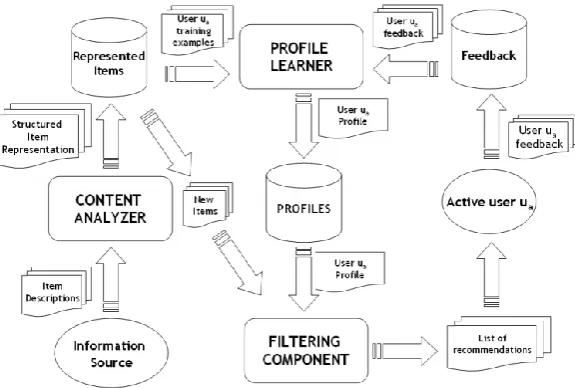
Pasquale Lops, Marco de Gemmis and Giovanni Semeraro [6] have described a high level architecture of content based recommender system which is shown below:
Figure 1. High level Architecture of a Content based Recommender
Some examples of content based recommender system are described as follows: Yan developed SIFT [8] recommends News Article using a simple content-based text filtering. User Profiles are created manually and it recommends 20 news articles in ranked format. Stevens developed Info Scope [8] uses automatic profile learning to recommend news along with content. It makes suggestions based on time spent on reading and whether news is saved for future reference. PRES [5] content based filtering system makes recommendation by comparing user profile and document contents. The content of document is represented by sets of items and user profile is also characterized by similar sets of words. Then by analyzing the profile and content recommendations are made. Feedbacks are taken to check whether or not the user found the recommendation useful. Explicit feedback requires user to evaluate the examined documents on a scale whereas implicit feedback calculates user interest by observing user’s action. Letizia [5] [Lieberman 1995] is a user interface that assists users browsing the web. The system tracks the browsing behavior of a user and tries to anticipate what pages may be of interest to the user. Syskill & Webert [5] [Pazzani et al. 1996] is a software agent uses a naive Bayesian classifier that tries to determine which web pages might interest a user. A user provides training instances by rating explored pages as either hot or cold. On-line Social Networks [9] system enforces content-based message filtering which allows OSN users to have a direct control on the messages posted on their walls. This is achieved through a flexible rule-based system, that allows a user to customize the filtering criteria to be applied to their walls, and a Machine Learning based soft classifier automatically producing membership labels in support of content-based filtering. Ghauth and Abdullah [10] developed an e-learning content based recommendation system. They used Vector Space Model and good learners’ average rating strategy in their research.
Content based filtering has its own pros and cons as compared to collaborative filtering. Talking about advantages, recommendations are solely based on active user. Collaborative needs rating from other users as well to find the nearest neighbor. It is more transparent as we can explicitly list the reasons as to why the course was recommended. It also does not suffer from first-rater [6] problem. It can recommend item even if that item is not used by any other user yet. There are few shortcomings as well. Domain knowledge is needed, items under consideration need enough features to make the decision that whether user will like the item or not. It can also not find something unexpected. It suffers from New User [6] problem. System cannot provide reliable recommendation for a new user because few ratings are available.
B. Collaborative Based Filtering
Volume 2, Issue 4, 2015
10 The information domain for a collaborative filtering system consists of users which have given preferences for various items.[16] A preference given by a user for an item is known as rating and is frequently represented as a (User, Item, Rating) triple. These ratings can be in any form depending on the context for recommendation. Some systems use real- or integer-valued rating scales such as 0–5 stars, while others use binary or ternary (like/dislike) scales. In E-commerce deployments, unary ratings such as “purchased” are often used as they express well the purchasing history of user. Rating matrix is a term used for set of all rating triples. If the user has not rated any item, there will be unknown values in the matrix.
Various kinds of collaborative filtering technologies have been proposed in order to make quality recommendation. All of them make a recommendation based on the same data structure as user-item matrix having users and items consisting of their rating scores. There are two methods in collaborative filtering as user based collaborative filtering and item based collaborative filtering. In user based collaborative filtering, it is believed to find a certain user’s item of interest by looking into the interest of other similar users. At first, with the help of similarity weighted averaging it finds the user’s neighbor on the basis of user similarities and then combines the neighbor users’ rating scores. If the user similar to him liked the resource/item then it can be concluded that the resource may be of some value to the target user. And item based CF technique is same as user based CF with the only difference is it looks into a set of items which the user has already rated and decides how similar they are to the target item under recommendation. Along with this user preferences is also considered while recommendation.
Challenges of Collaborative Filtering
1. Sparsity: Most users don’t rate the items. Since the collaborative filtering algorithm is based on similarity measures calculated over the co-rated set of items, the sparsity will lead to less accurate results.
2. Scalability: CF algorithms needs calculations that are time consuming when the number of users and items in a database. 3. Cold-start: Some items are not rated by any of the users.
On an E-learning website, the learner may need suggestions about which location to visit or which test or example will provide the maximum benefits. The learner’s profile is compared to the other learner’s profile to find similar profiles. These similar profiles are then used to generate recommendations. They generate recommendations with the help of good and trusted ratings entered by the learners. The learners are prompted to give ratings after they have read a topic. If the learner refuses to give ratings, the system uses history logs of similar learners as input for his profile [17]. The system tracks navigation patterns of learners and uses these patterns for creating a recommendation list according to the ratings of frequent sequences
C. Hybrid Based Filtering
To improve the recommendations both techniques earlier discussed i.e. content based as well as collaborative based should be combined. Hence nowadays hybrid based filtering is used. Apart from technique discussed above there are various other techniques such as knowledge based, rule based, demographic information based etc. which could be combined to improve the recommendation thus forming hybrid filtering. To improve the recommendations several systems incorporate hybrid approach by combining content and collaborative systems. There are different ways to combine content and collaborative methods which are classified as [11]: implement content and collaborative differently and then combine the results, incorporate content based characteristics in collaborative or vice versa or construct some unified model which has both the features. Hybrid commonly solves following problem i.e. cold start and sparsity problem. A common example which uses hybrid approach is Netflix. IT makes recommendations by comparing the searching and watching habits of similar users (i.e. collaborative filtering) as well as by offering movies that share characteristics with films that a user has rated highly (content-based filtering).
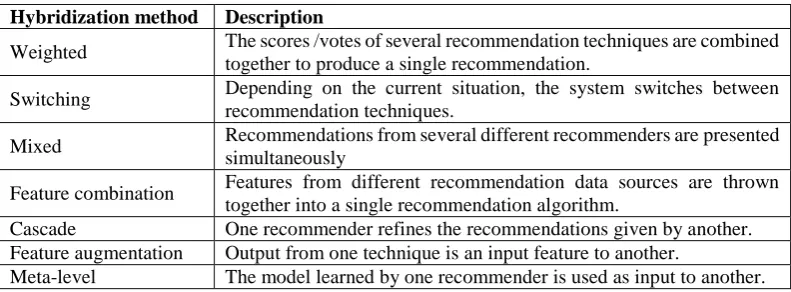
Burke (2002) introduced taxonomy for the hybrid recommendation systems. He classified them into seven categories [15].
Table I. Types of Hybrid Recommendation
Hybridization method Description
Weighted The scores /votes of several recommendation techniques are combined together to produce a single recommendation.
Switching Depending on the current situation, the system switches between recommendation techniques.
Mixed Recommendations from several different recommenders are presented simultaneously
Feature combination Features from different recommendation data sources are thrown together into a single recommendation algorithm.
Cascade One recommender refines the recommendations given by another. Feature augmentation Output from one technique is an input feature to another.
Volume 2, Issue 4, 2015
11 Good et al. [13] use collaborative filtering along with a number of personalized information filtering agents. Prem Melville and Raymond J. Mooney and Ramadass Nagarajan suggest that Content-Boosted Collaborative Filtering [14] performs better than a pure content-based predictor, pure collaborative filter, and a naive hybrid approach. Michael J. Pazzani discusses an approach to combine recommendations from multiple sources viz., CF, CB and demographic information. CF and CB methods can also be combined under a single unifying model. Hydra: A Hybrid Recommender System [12] discusses the combination of CF and CB approaches in the context of web-based recommendations. This hybrid approach is special in that rating data as well as content information are joined in a unified model, which leads to less parameters and more reasonable prediction results. For E- Learning domain too hybrid technique [14] could be used. It puts forward an approach to recommend right learning resources for users with different learning needs by hybrid filtering method. A text analysis is done and learning resources are organized accordingly. Users having similar learning interests are searched out to form other common interest groups by user behavior tracing and recording. Then, two-level user profiles are created based on common interest group detection and text analysis. Later learning resources are introduced to users according to user profiles by collaborative filtering and content-based filtering respectively. While building the user profiles a time factor is also added which makes user profiles adapt to user's interest shifting with time. Many researchers have shown that hybrid gives better results as compared to content/ collaborative or any other technique alone. Hence it is always better to combine more than one technique to improve the predictions.
D. Knowledge Based Filtering
Knowledge Based filtering technique uses knowledge about subject/ course and users and uses knowledge based approach to generate a recommendation. Unlike other recommender systems, it does not depend on large bodies of statistical data about particular rated items or particular users [18]. Users are an integral part of the knowledge discovery process. Knowledge based approach can be applied in domains where the items under consideration are less frequently viewed or purchased, has few ratings or time span plays an important role. It is also used when user demands some explicit requirement. IT uses a knowledge base and to develop a base is difficult, expensive, requires specialized graphical tools, etc. It also needs constant use involvement for feedback and to gather his/ her preferences. It does it by asking user to fill out forms, maintain session independent user profiles, etc. Few examples where knowledge based system were used are as follows: Personal Logic [19] recommender system offers a dialog that effectively walks the user down a discrimination tree of product features and then makes a recommendation. The restaurant recommender EntreeI [19] (Burke, Hammond & Cooper, 1996) makes its recommendations by finding restaurants in a new city similar to restaurants the user knows and likes. The system allows users to navigate by stating their preferences with respect to a given restaurant, refining their search criteria. To make a system efficient, system must understand what features of the course would matter to users the most. Like every approach it too has its limitations. Firstly to acquire a knowledge base is expensive, and then the model that is used for recommendation might not be accurate. It can be used as a complement to other approaches, i.e. to use a hybrid approach.
III.CONCLUSION
The study provides an introduction to recommendation systems. Emphasis was given on the prominent approaches applied in the area of e-learning till now. All the approaches discussed has its pros and cons which are discussed in the table below:
Table II. Types of Recommender System
Content Collaborative Hybrid
Definition
It recommends topics based on a comparison between the content of the topic and a user profile.
It is the method and process to match data of one user with data for similar users, based on the browsing pattern.
It is combination of both content and collaborative filtering.
Pros It compares between
various items
It does not requires a knowledge base to generate recommendations
No Cold start problem
Cons
Cold start for new users, no
surprises in
recommendations
Requires rating feedback, cold start problem
Requires knowledge engineering efforts to bootstrap
Volume 2, Issue 4, 2015
12
IV. REFERENCES
[1] R Sikka, A Dhankhar, C Rana,”A Survey Paper on E-Learning Recommender System”, presented at International Journal of Computer Applications (0975 – 888), Volume 47– No.9, June 2012
[2] Rubina Parveen, Anant Kr. Jaiswal, Vibhor Kant,” E-Learning Recommendation Systems – A Survey”, presented at International Journal of Engineering Research and Development, Volume 4, Issue 12 (November 2012) [3] Dr.K.Anandakumar, K.Rathipriya, Dr.A Bharathi,”A Survey on Methodologies for Personalized E-learning
Recommender Systems” presented at International Journal of Innovative Research in Computer and Communication Engineering, Vol. 2, Issue 6, June 2014
[4] Olga C. Santos and Jesus G. Boticario,” Requirements for Semantic Educational Recommender Systems in Formal E-Learning Scenarios”, published in 20 July 2011
[5] Robin van Meteren and Maarten van Someren, “Using Content-Based Filtering for Recommendation”
[6] Pasquale Lops, Marco de Gemmis and Giovanni Semeraro, “Content-based Recommender Systems: State of the Art and Trends “
[7] Saman Shishehchi, Seyed Yashar Banihashem, Nor Azan Mat Zin, “A Proposed Semantic Recommendation System for E Learing”
[8] Refer to URL, “http://hcil2.cs.umd.edu/trs/96-10/node7.html”
[9] Vanetti, E. Binaghi, B. Carminati, M. Carullo and E. Ferrari,”Content-based Filtering in On-line Social Networks” [10]K.I.B. Ghauth and N. A. Abdullah, "Building an E-learning Recommender System Using Vector Space Model and Good Learners Average Rating," icalt, pp.194-196, 2009 Ninth IEEE International Conference on Advanced Learning Technologies, 2009
[11]Gediminas Adomavicius and Alexander Tuzhilin ,”Toward the Next Generation of Recommender Systems: A Survey of the State-of-the-Art and Possible Extensions” presented at IEEE transactions on knowledge and data engineering, vol. 17, no. 6, June 2005
[12]Stephan Spiegel, Jerome Kunegis, Fang Li, “Hydra: a hybrid recommender system [cross-linked rating and content information]”
[13]Meenakshi Sharma and Sandeep Mann, “A Survey of Recommender Systems: Approaches and Limitations”, presented at International Journal of Innovations in Engineering and Technology
[14]Prem Melville, Raymond J. Mooney and Ramadass Nagarajan, ”Hybrid Filtering Recommendation in E-Learning Environment”, Appeared in Proceedings of the SIGIR-2001 Workshop on Recommender Systems, New Orleans, LA, September 2001
[15]Robin Burke, “Hybrid Recommender Systems: Survey and Experiments”
[16]Michael D. Ekstrand, John T. Riedl and Joseph A. Konstan, “Collaborative Filtering Recommender Systems”, published at Foundations and TrendsR in Human–Computer Interaction Vol. 4, No. 2 (2010) 81–173
[17]Boban Vesin, Aleksandra Klaˇsnja-Mili´cevi´c , “Applying recommender system and adaptive hypermedia for e-learning personalization” presented at Computing and Informatics, Vol. 32, 2013, 629–659
[18]Robin Burke, “Knowledge-based recommender systems”