Introduction
Falls and their consequences are common problems associated with aging. Twenty-five to 35 percent of people over the age of 65 years fall at least once a year and that number rising to
50 percent for people over the 80 years of age [1,2].
The postural instability has been identified as a potential precursor of falls. Adequate postural control depends on temporal and spatial inte-gration of vestibular, as well as visual and
so-Test-retest reliability and minimal detectable change for center of
pressure measures of postural stability in elderly subjects
Reza Salehi, MSc.1Ismaeil Ebrahimi-Takamjani, PhD,2, Ali Esteki, PhD,3Nader Maroufi, PhD4, Mohammad Parnianpour, PhD5
Faculty of Rehabilitation Science, Iran University of Medical Science, Tehran, Iran.
Abstract
Background: Postural instability has been identified as a potential precursor of falls in elderly subjects. Postural stability in quiet stance is commonly assessed with center of pressure (COP) measures. The purpose of this study was to determine test-retest reliability and minimal detectable change (MDC) for the center of pressure (COP) measures in the elderly subjects.
Methods:Eighteen healthy elderly people over the age of 60 years participated in this study. For each subject the COP was recorded during quiet upright stance on dif-ferent levels of postural difficulty (eyes open versus eyes closed, firm surface versus foam surface) and lean condition (forward and backward). All measurements were done on two sessions with 7 days interval. These indices: mean velocity, standard de-viation of amplitude, standard dede-viation of velocity, phase plane parameter and area (95% confidence ellipse). Intraclass correlation coefficient (ICC), standard error of measurement (SEM) and coefficient of variation (CV) were used to quantify test-retest reliability. The MDC for each measure was calculated to quantify intervention effects.
Results: In general, test-retest reliability of COP measures in the elder subjects was increased whenever postural difficulty of task increased in quiet standing. In standing conditions, mean velocity and phase plane parameter were the most sensi-tive and the most reliable measures. The lean range was the most sensisensi-tive and the most reliable measure, in the lean conditions.
Conclusion:Center of pressure measures in the quiet standing especially in diffi-cult postural conditions demonstrated high sensitivity in the older subjects. These re-sults may be useful in quantification and assessment of balance performance and treatment efficacy.
Keywords:reliability, minimal detectable change, center of pressure, balance, elder People
1.Corresponding author, Master of Physical Therapy, School of Rehabilitation Science, Iran University of Medical Science. Address: Phys-ical Therapy Department, Faculty of Rehabilitation Science, Shahnazari Street, Mirdamad boulevard, Tehran, Iran Tel:+9821 22220947 Email: [email protected]
2. Professor of Physical Therapy, Iran University of Medical Science, Tehran, Iran.
3. Associate Professor of Biomechanics, Shahid beheshti University of Medical Science, Tehran, Iran. 4. Assistant Professor of Physical Therapy, Iran University of Medical Science, Tehran, Iran.
Medical Journal of the Islamic Republic of Iran.Vol. 23, No. 4, February, 2010. pp. 224-232
the risk of falling [3]. At this viewpoint, relia-bility represents a required key for all measur-ing devices to insure that any observed differ-ence in measures between test sessions reflect the real changes in postural stability, rather than producing systematic or random error in the measurement protocol. Reliability refers to the extent by which the measurement is inherently reproducible, or the degree to which the meas-urement influenced by measmeas-urement errors [4,5].
The postural stability in quiet stance is com-monly assessed with center of pressure (COP) measures [3]. Like many biological measure-ments, the COP has an intrinsic variability af-fecting the reliability of postural control out-comes [6,7]. Therefore, the reliability of postur-al stability measures should first be established before they used to monitor balance problem and over the course of a clinical intervention [5].
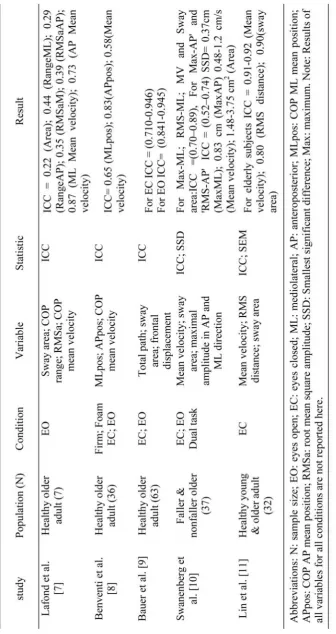
In the older subjects, few studies have inves-tigated the test-retest reliability of COP meas-ures in different sensory conditions (table1). However, most of them did not considered dif-ferent sensory environments in postural control measurements. Since the results of one testing condition (e.g. standing on force platform with eyes open) can not be generalized to other situa-tions, incorporating different levels of postural difficulty by manipulating sensory information is crucial in reliability studies.
Although, reliability and consistency of out-come measures is important, Haley and Fra-gala-Pinkham suggested that "Measures to
de-been defined as the ability of an instrument to detect a small but important change in health status over time. Recent authors have empha-sized the importance of responsiveness at the level of the individual patient [12,13]. The Min-imum Detectable Change (MDC) also known as reliable change or smallest real difference re-flects true change rather than measurement er-ror. The MDC is the smallest threshold of change scores that are detectable and beyond random error at a certain level of confidence (usually 95%). Both clinicians and researchers can use the MDC as a threshold to determine whether the changed score on a measure of an individual patient has reached a real improve-ment (or deterioration) or is due to the measure-ment error [12-14]. Thus, the MDC of a meas-ure is critical for interpretation of data in clini-cal or research settings. Nevertheless, few stud-ies in the elderly reported the MDC for postural sway measures [13].
Therefore, the objectives of this study were to determine test-retest reliability and MDC of some COP measures in a group of elderly sub-jects at different levels of postural difficulty over two sessions.
Methods
Subjects:Eighteen older healthy adults were (6 males and 12 females, age: 67.07±2.78 years, height: 159.78±6.33 cm, body mass: 66.71±8.48 kg) voluntarily participated in the experiment. Subjects gave their informed con-sent to the experimental procedure, and the study was approved by the Iran Medical
T
able 1. Summary of related literatures for reliability of the COP
measures used to assess postural st
ability in elderly subject
s.
clusion criteria were acute or subacute disease of the cardiovascular or respiratory systems, neurological or musculoskeletal impairments (such as history of CVA or Parkinson or joint re-placement) and cognitive impairment that was quantified with the Mini-Mental State Exami-nation (MMSE score of <24).
Instrumentation:The COP data for subjects were obtained using strain gauge Bertec 4060-10 force platform and Bertec AM-6701 amplifi-er. The amount of noise presented in the force platform measurements determined by apply-ing a calibrated static load between 10 to 40 kg on the center of force platform [15]. The calcu-lated COP displacement of force platform was less than 1 mm, which represented an accept-able amount of noise [15]. All data were collect-ed with the sample frequency of 100 Hz.
sway was assessed in six different conditions and levels of difficulty. Quiet stance conditions included: 1) standing with eyes open on a firm surface, 2) standing with eyes closed on a firm surface, 3) standing with eyes open on a foam surface and 4) standing with eyes closed on a foam surface. Lean conditions included: 1) standing with eyes open on a firm surface and maximum forward lean and 2) standing with eyes open on a firm surface and maximum backward lean.
Subjects stood barefoot with their heels sepa-rated by 50% of pelvic width and their arms resting at their sides. Subjects were instructed to "stand as still as possible" for data collection period [5]. In eyes-open condition, subjects were instructed to look at a fixed target approxi-mately 2m in front of their faces. In eyes-closed condition, subjects were a blindfold to
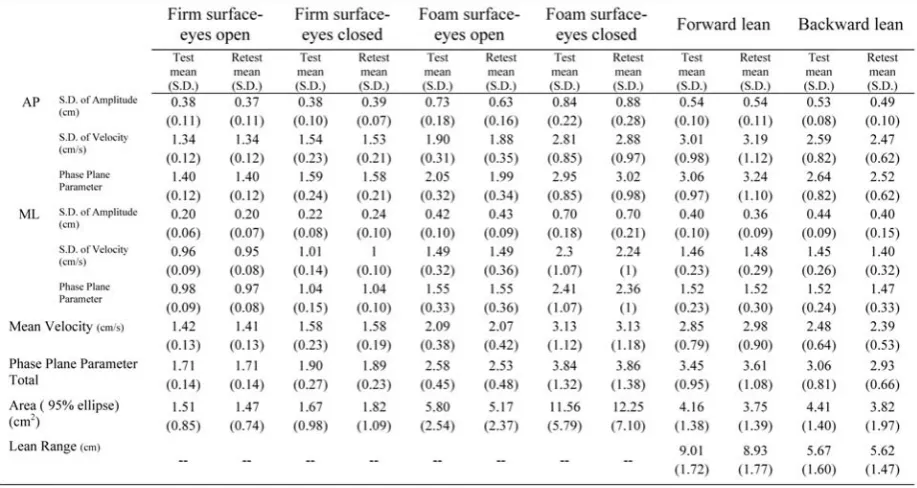
elimi-Table 2. Descriptive data for the COP measures in different level of postural difficulty and orientation (N=18).
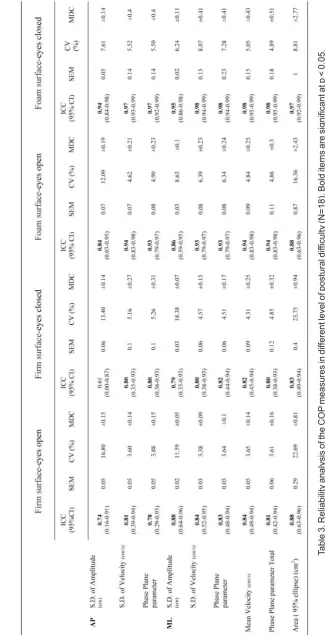
T
able 3. Reliability analysis of the COP
measures in dif
ferent level of postural dif
ficulty (N=18). Bold items are significant a
t p < 0.05.
For the maximum lean trials, a feedback sys-tem (a monitor at an approximately 2m dis-tance) for the subjects, was used to indicate how far the subject leaned. The subjects executed the leaning movement at their own pace until they reached their maximal range [6]. The sub-jects received continuous verbal feedback from the experimenter until the appropriate position was reached. Maximal leaning position was maintained until the end of the trial. During this time, subjects were instructed not to raise their heels or fingers while performing the task. To avoid the fatigue effect, a rest period of 1 minute between each test was given.
with cut-off frequency of 15 Hz) and then ex-ported to the Microsoft Excel to calculate the COP parameters. The anteroposterior (AP) and mediolateral (ML) displacement of COP were measured along the y-axis and x-axis, respec-tively. Parameters calculated from the COP da-ta were: (1) mean velocity, (2) sda-tandard devia-tion (S.D.) of amplitude in AP and ML direc-tions, (3)standard deviation (S.D.) of velocity in AP and ML directions, (4) phase plane pa-rameter in AP-ML (combined), AP and ML di-rections, (5) sway area (95% confidence el-lipse) [16], (6) lean range for the lean condi-tions (position of COP between the maximal
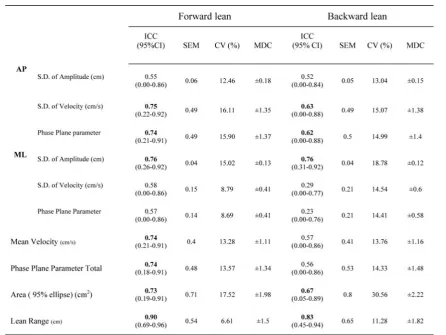
Table 4. Reliability analysis of the COP measures in different postural orientation (N=18). Bold items are significant at p < 0.05.
COP parameters in each condition was used for statistical analysis. Paired t-test between test and retest scores was calculated to verify the absence of systematic bias and alpha level set at 0.05 for all statistical analyses.
Relative reliability was assessed using two-way random model of intraclass correlation co-efficient (ICC2,3). According to Fleiss' classifi-cation: ICC
“
0.75 which indicate as "excel-lent" reliability; ICC value contained between 0.41 and 0.74 "fair to good" reliability; and ICC value < 0.40 "poor" reliability [18]. For each ICC, 95% confidence interval (CI) was calcu-lated to take the sampling distribution into ac-count. To assess absolute reliability, the stan-dard error of measurement (SEM) was calculat-ed as the square root of the mean square error term derived from the analysis of variance table [4]. In addition, the coefficient of variation (CV) was determined for comparison of ab-solute reliability between the COP measure of test and retest sessions (S.D./mean100). This was achieved by calculating mean of CV from individual CVs [4]. The SEM is useful for com-puting the minimal detectable change (MDC) or change that could be considered clinical dif-ference between two measurements. The MDC was defined as 95% CI of SEM of the COP measure ( 1.96 2SEM). The multiplier of 2 was used to account for the additional uncer-tainty introduced by using difference scores from measurements at 2 points in time [14].Results
Table 2 shows the descriptive summaries of the COP measures for test and retest sessions. Table 4 and 5 demonstrate ICC and its 95% CI, SEM, CV, and MDC.
Overall, results showed that the ICC general-ly tend to increase as levels of difficulty in-crease. There was no significant difference be-tween test and retest mean scores for any COP measures in all conditions, which indicates ab-sence of any systematic bias (p > 0.05). In the
lean conditions, excellent reliability was found for lean range with ICC levels of 0.90 and 0.83 for forward and backward lean, respectively.
Discussion
The purpose of present investigation was to assess the reliability and MDC of the COP measures in the elderly subjects. Reliability of the COP measures has previously been ad-dressed. Previous research into reliability of COP measures has not been as conclusive and comprehensive as the present study due incor-poration of different levels of postural difficul-ty manipulated by sensory information. It is dif-ficult to compare our results specifically with the previous studies due to different setting such as; sample duration, feet stance, eyes open versus eyes closed and firm surface versus foam surface.
Our results showed that whenever level of task difficulty increased, test-retest reliability increased. All parameters demonstrated excel-lent reliability when subjects were asked to close their eyes while standing on the foam sur-face. In general, a high ICC value indicated that most of the observed variance is attributed to difference between subject measurements and proportionately little variance generated due to error related to repeated measurement. Bauer et al. found that the reliability of the COP meas-ures increased when subjects were asked to close their eyes while maintaining the narrow stance position [9]. Our results suggested that foam surface could be used in assessment of postural stability in the elderly subjects.
Our findings demonstrated good to excellent reliability in quiet standing conditions for eld-erly subjects. Demura et al. found that the relia-bility in a static upright posture is also consid-ered to be high in the elderly [19]. Lin et al. re-ported that older participants exhibit better rela-tive reliability in comparison with young par-ticipants [11].
The mean velocity showed excellent relative reliability and high absolute reliability in all
230
locity [7]. Samson and Crowe used CV to as-sess the reliability of mean velocity across 3 days and reported mean CVs of 8.5% and 10.6% for closed eyes and opened eyes condi-tions, respectively [21]. However, those results were based on the coefficient of variation (CV), not on measurement error. Our results were consistently better in the ML direction com-pared to AP direction with the similar previous works. This results shows agreement with the results of Swanenburg et al. [10] but not with Corriveau et al reports. [22]. This difference could be due variation in protocol such as feet distance.
As Horak suggested, the primary purposes of the clinical balance assessment are to identify whether or not a balance problem exists in order to predict risk of a fall or to determine whether treatment is needed or has been effective and identify the underlying cause of the balance problem in order to manage or treat it effective-ly [23]. Reliable measurements are not neces-sarily sensitive to detect differences. Minimal detectable change values are useful to thera-pists in rehabilitation and intervention pro-grams in determining whether change during or after intervention is clinically significant. [12]. A more reliable measure with lower MDC mon-itors the results of intervention with more sensi-tivity [13]. Our findings indicates that, the mean velocity and phase plane parameter were the most sensitive and the most reliable meas-ures, in standing conditions.
In the lean conditions only one COP parame-ter showed excellent reliability (lean range with
the COP variability [6].
The lack of reliability of postural stability measures in lean condition decreases the power of a study to detect differences between groups in the same test condition because of the ran-dom measurement errors that may cause an in-crease in the variance. Two potential sources of error contribute to the lack of reliability: The lack of precision of the instrument and the vari-ability of the phenomena measured [24]. The accuracy of the COP measured in this study was 1 mm. Such precision is satisfactory, but good precision dose not necessarily mean that the measure is reliable. The second source was variability of the outcome variable being meas-ured. This is related to the elected procedure chosen and the phenomena being measured [24]. Whereas sex differences have been found in COP parameters [25], the results of the pres-ent study could be more applicable to female subjects, who constituted the majority of in-cluded participants.
Conclusion
The center of pressure measures in the quiet standing (especially in difficult postural condi-tions) demonstrated high sensitivity in the older subjects. This suggests that these measure-ments can be used to assessment balance among older subjects and to evaluate the effec-tiveness of intervention program.
Acknowledgments
This research was supported by grants from the Iran University of Medical Sciences. The
References
1. Rubenstein LZ. Falls in older people: epidemiolo-gy, risk factors and strategies for prevention. Age Ageing 2006;35:37-41.
2. Shumway-Cook A, Brauer S, Woollacott M. Pre-dicting the probability for falls in community-dwelling older adults using the Timed Up & Go Test. Phys Ther 2000;80(9):896-903.
3. Blaszczyk JW, Michalski A. Aging and postural sta-bility. Studies in Physical Culture and Tourism. 2006;13:11-14.
4. Bruton A, Conway JH, Holgate ST. Reliability: What is it, and how is it measured? Physiotherapy 2000;86:94-9.
5. Pinsault N, Vuillerme N. Test-retest reliability of centre of foot pressure measures to assess postural con-trol during unperturbed stance. Medical Engineering & Physics 2009;31(2):276-286.
6. Van Wegan EEH, Van Emmerik REA, Riccio GE. Postural orientation: Age-related changes in variability and time-to-boundary. Human Movement Science 2002;21:61-68.
7. Lafond D, Corriveau H, He´bert R, Prince F. In-trasession reliability of center of pressure measures of postural steadiness in healthy elderly people. Arch Phys Med Rehabil 2004;85(6):896-901.
8. Benvenuti F, Mecacci R, Gineprari I, Bandinelli S, Benvenuti E, Ferrucci L, Baroni A, Rabuffetti M, Hallett M, Dambrosia JM, Stanhope SJ. Kinematic characteris-tics of standing disequilibrium: reliability and validity of a posturographic protocol. Arch Phys Med Rehabil 1999;80(3):278-87.
9. Bauer C, Gr, Ager I, Rupprecht R, Gaumann KG. In-trasession reliability of force platform parameters in community-dwelling older adults. Arch Phys Med Reha-bil 2008;89(10):1977-82.
10. Swanenburg J, Bruin ED, Kathrin Favero K, Ue-belhart D, Mulder T. The reliability of postural balance measures in single and dual tasking in elderly fallers and non-fallers. BMC Musculoskeletal Disorders 2008; 9:162.
11. Lin D, Seol H, Nussbaum MA, Madigan ML. Reli-ability of COP-based postural sway measures and age-re-lated differences. Gait & Posture 2008;28:337-342.
12. Haley SM, Fragala-Pinkham MA. Interpreting change scores of tests and measures used in physical ther-apy. Phys Ther 2006;86:735-743.
13. Copay AG, Subach BR, Glassman SD, Jr DWP, Schuler TC. Understanding the minimum clinically im-portant difference: a review of concepts and methods The Spine Journal 2007;7:541-546.
14. Steffen T, Seney M. Test-retest reliability and min-imal detectable change on balance and ambulation tests, the 36-Item Short-Form Health Survey, and the Unified Parkinson Disease Rating Scale in people with parkin-sonism. Phys Ther 2008;88:733-746.
15. Rabuffetti M, Ferrarin M, Benvenuti F. Spot check of the calibrated force platform location. Med Biol Eng Comput 2001;39(6):638-43.
16. Raymakers JA, Samson MM, Verhaar HJJ. The as-sessment of body sway and the choice of the stability pa-rameter(s). Gait and Posture 2005;21:48-58.
17. Juras G, S.omka K, Fredyk A, Sobota G, Bacik B. Evaluation of the Limits of Stability (LOS) Balance Test. Journal of Human Kinetics 2008; 19: 39-52.
18. Fleiss JL. Reliability of measurement. The design and analysis of clinical experiments. New York: Wiley; 1986. p. 1-32.
19. Demura S, Kitabayashi T, Aoki H. Body-sway characteristics during a static upright posture in the elder-ly. Geriatr Gerontol Int 2008;8:188-197.
20. Salavati M, Hadian MR, Mazaheri M, Negahban H, Ebrahimi I, Talebian S, et al. Test-retest reliability of center of pressure measures of postural stability during quiet standing in a group with musculoskeletal disorders consisting of low back pain, anterior cruciate ligament injury and functional ankle instability. Gait Posture 2009;29:460-4.
21. Samson M, Crowe A. Intra-subject inconsistencies in quantitative assessment of body sway. Gait Posture 1996;4:252-7.
22. Corriveau H, Hebert R, Prince F, Raiche M. Pos-tural control in the elderly: an analysis of test-retest and interrater reliability of the COP-COM variable. Arch Phys Med Rehabil 2001;82:80-5.
23. Horak F B. Clinical assessment of balance disor-der. Gait Posture 1997;6:76-84.
24. Corriveau H, Hebert R, Prince F, Raiche M. In-trasession reliability of the "center of pressure minus cen-ter of mass" variable of postural control in the healthy elderly. Arch Phys Med Rehabil 2000;81:45-8.
25. Nolan L, Grigorenko A, Thorstensson A. Balance control: sex and age differences in 9- to 16-year-olds. Dev Med Child Neurol 2005;47(7):449-54.