The Irregularity and Total Irregularity of Eulerian
Graphs
R. NASIRIa,, H. R. ELLAHIa, A. GHOLAMIa AND G. H. FATH−TABARb
aDepartment of Mathematics, Faculty of Science, University of Qom, Qom, I. R. Iran bDepartment of Pure Mathematics, Faculty of Mathematical Sciences, University of Kashan, 87317−53153, Kashan, I. R. Iran
ARTICLE INFO ABSTRACT
Article History:
Received 27 November 2015 Accepted 11 January 2016 Published online 30 May 2018 Academic Editor: Ivan Gutman
For an arbitrary graph G, the irregularity and total irregularity of G are defined as irr(G) = ∑ ∈ ( )|d (u)−d (v)| and irr (G) = 1/2∑ , ∈ ( )|d (u)−d (v)|, respectively, where d (u) is the degree
of vertex u. In this paper, we characterize all connected Eulerian graphs with the second minimum irregularity, the second and third minimum total irregularity, respectively.
© 2018 University of Kashan Press. All rights reserved
Keywords:
Eulerian graphs Irregularity Total irregularity Vertex degree
1.
I
NTRODUCTIONThroughout this paper, G is a simple and connected graph with the vertex and edge sets V(G)
and E(G), respectively. For a graph G, there is a novel notion named third Zagreb polynomial, defined as M (G, x) =∑ ∈ ( )x| ( ) ( )|. Astaneh-Asl et al. [7] studied M (G, x) of
Cartesian product of two graphs and a type of dendrimers. In special case, the value of derivative of this polynomial at point x = 1 is well known as the irregularity of G and denoted by irr(G), which was already proposed by Albertson [6]. In the other words
irr(G) = ∑ ∈ ( )|d (u)−d (v)| (1)
In [6], Albertson gave some upper bounds on irregularity for trees, bipartite, and triangle-free graphs. Recall that the first Zagreb index M and the second Zagreb index M of are defined as M (G) =∑ ∈ ( )d (u) and M (G) = ∑ ∈ ( )d (u). d (v), respectively. These indices were introduced in [16] and reflect the extent of branching of the molecular carbon-atom skeleton and can be viewed as molecular structure-descriptors [8,25]. Moreover, the values of these indices are computed for a class of nanostar dendrimers in [26]. Fath-Tabar
Corresponding Author (Email address: [email protected]) DOI: 10.22052/ijmc.2018.44232.1153
[14] named the sum in (1) the third Zagreb index, and established new bounds on the first and second Zagrab indices that depend on irr(G). Zhou and Luo obtained the relationship between irregularity and first Zagreb index of graphs, and also they determined the graphs with maximum irregularity among trees and unicyclic graphs with given matching number and number of pendent vertices [19, 29]. Hansen and Melot determined the maximum irregularity of graphs with n vertices and m edges [17]. Moreover, Abdo and Dimitrov considered the irregularity of graphs under several graph operations [5]. Previously, we characterized all graphs with the second minimum of the irregularity in [20]. Also, we studied in [15, 21], trees and unicyclic graphs whose irregularity is extremal. More works about this graph invariant have been reported in [2, 9, 18, 22−24].
Recently, Abdo et al. [1] introduced a new measure of irregularity of a graph, so-called the total irregularity, as irr (G) = 1/2∑ , ∈ ( )|d (u)−d (v)|. For a connected graph G, the irregularity indices irr and irr were compared in [12], where it was shown that irr (G)≤ n /4irr(G). Furthermore, they proved that if G is a tree, then irr (G)≤ (n−2) × irr(G). Abdo and Dimitrov [4] gave the upper bounds on of graphs under several graph operations including lexicographic, Cartesian, strong, direct, and corona products, also join, disjunction and symmetric difference. In [1], graphs with maximal total irregularity were characterized and the upper bound on the total irregularity of graphs was obtained. In special classes of graphs, such as trees, unicyclic and bicyclic graphs, this invariant has been studied in [13, 27, 28].
An Eulerian circuit is a closed walk in a graph that visits every edge of the graph once and only once. A graph containing an Eulerian circuit is called an Eulerian graph. The study of these graphs was initiated in 1736. Their study is a very fertile field of research for graph theorists. Although, in the graph theory, the term Eulerian graph has two common meanings, i.e. a graph with an Eulerian circuit, or a graph with every vertex of even degree. Note that in the case of connected graph, these definitions are equivalent [10].
The aim of this paper is to study the irregularity and total irregularity of connected Eulerian graphs. In Section 2, we show that the irregularity of an Eulerian graph is a multiple of 4, and by using it, we characterize all Eulerian graphs with the second minimum irregularity value. Finally in Section 3, we determine graphs with the second and third minimum of total irregularity value over the class of all connected Eulerian graphs.
2.
T
HES
ECONDM
INIMUMI
RREGULARITY OFE
ULERIANG
RAPHSLemma 2.1. [10] A connected graph is Eulerian if and only if each of its vertices has even degree.
Theorem 2.2. Let be an Eulerian graph with vertices, then ( ) = 4 , for some non-negative integer .
Proof. We prove the theorem by induction on n. Obviously, for n = 1, we have irr(K ) = 0. Suppose that for any Eulerian graph H on less than n vertices, irr(H) = 4k, for some non-negative integer k. Now, we shall show that if G is an Eulerian graph on n vertices, then there exists a non-negative integer k′ with irr(G) = 4k′. To show this, we shall use induction on
the number of edges. For m = 0, it is obvious that irr K = 0. By induction on m, suppose that for any n-vertex Eulerian graph H, which has less than m edges, we have irr(H) = 4k, for some non-negative integer k. Let G be an n-vertex Eulerian graph with m edges. Let
C = v v ⋯v v be the smallest simple cycle in G, and H = G−E(C ). If H = K , then
G = C , and therefore irr(G) = 0. If H ≠K , then either H is an n-vertex Eulerian graph with less than m edges, or each of connected components of H is an Eulerian graph on less than n vertices. Therefore, by inductions’ hypotheses, there is some k ≥0 such that irr(H) = 4k. For convenience, we use the following notations:
E = xv∈E(H)∶v∈V C & ∈ (G)∖V C ,
d (v) = |{xv∈ E′ ∶d (x) ≤d (v)}|,
d (v) = |{xv∈ E′ ∶ d (x) > d (v)}|,
sign(s) = 1 ; s = l −1 ; s = g.
Assume that v = v . With above notations, one can immediately see that for any vertex v of C , d (v ) = d (v ) + d (v ). Note that by the choice of C , there is no non-consecutive indices i and j such that v v ∈E(G). Moreover, for any edge xv∈ E′, if d (x)≤ d (v), then
|d (x)−d (v)|−|d (x)−d (v)| = 2 = 2 sign(l).
Moreover, if d (x) > d (v) then
|d (x)−d (v)|−|d (x)−d (v)| =−2 = 2 sign(g).
Now, we have:
irr(G)−irr(H) = ∑ ∈ |d (u)−d (v)| +∑ ∈ (|d (x)−d (v)|−|d (x)−d (v)|)
= ∑ ∈ |d (u)−d (v)|+ 2∑ ∈ d (v)−d (v)
such that for any i = 1,2, … , q,
r = |d (v )−d (v )| + d (v )−d (v ) + d (v )−d (v ).
One can easily check that if d (v )≤ d (v ), then
r = 2d (v )−2 d (v ) = 2 sign(l)d (v ) + 2 sign(g)d (v ),
and if d (v ) > d (v ), then
r =−2 d (v ) + 2d (v ) = 2 sign(g)d (v ) + 2 sign(l)d (v ).
Hence, for some suitable s , s ∈{l, g}, where 1≤ i≤ q, we can write the following:
irr(G)−irr(H) =∑ r = 2 sign(s )d (v ) + 2 sign(s )d (v )
+ 2 sign(s )d (v ) + 2 sign(s )d (v ) +⋯
+ 2 sign s d v + 2 sign(s )d (v )
= ∑ 2 sign(s )d (v ) + 2 sign(s )d (v )
= 2∑ sign(s )d (v ) + sign(s )d (v )
= 2∑ t .
For each i = 1,2, … , q, there exist three cases as follow:
1) If s = s = l, then t = 2 d (v ).
2) If s = s = g, then t = −2 d (v ).
3) If s ≠s , then t = d (v )−d (v ).
Since d (v ) = d (v ) + d (v ) is even, d (v )−d (v ) is even, too. Therefore, in all of the above cases, t is even. Thus,
irr(G)−irr(H) = 2∑ t = 4∑ t = 4k′′
where k′′ is an integer. Hence, the theorem is proved by induction. □
Obviously, for a connected graph G, irr(G) = 0 if and only if it is a regular graph. Therefore, we have the following result:
Corollary 2.3. For a non-regular connected Eulerian graph of order , irr( )≥4.
second minimum of the irregularity of Eulerian graphs is 4. In the following theorem we characterize connected Eulerian graphs with the second minimum irregularity.
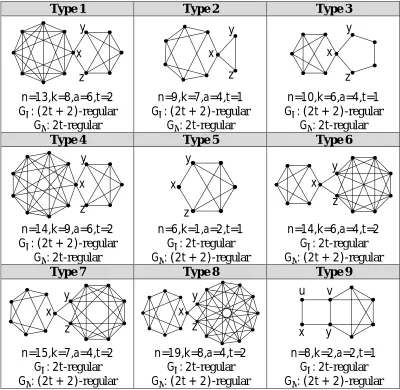
Theorem 2.4. There are 12 types of connected Eulerian graphs with irregularity value 4, where the general forms and examples of them are shown in Figure 1 and Table 1, respectively.
Proof. Let G be a connected Eulerian graph with irr(G) = 4. For each edge uv of G, set
irr(uv) = |d (u)−d (v)|, so we can write irr(G) =∑ ∈ ( )irr(uv). The proof continues in three separate cases as follows:
Case 1. Let xy be an edge of G such that irr(xy) = 4. Since G is a connected Eulerian graph, there is a cycle xyv v ⋯v x in G containing edge xy. Clearly, since irr(G) = irr(xy) = 4, then irr(yv ) = irr(v v ) =⋯= irr(v x) = 0 and we deduce that d (y) = d (v ) = d (v ) =⋯ = d (v ) = d (x), which is a contradiction. Therefore, this case does not occur.
Case 2. There are two edges xy and xz such that irr(xy) = irr(xz) = 2. It is clear that yxz is a path from vertex y to vertex z. Suppose U = {u , u , … , u } and V = {v , v , … , v } are subsets of vertices of G such that x, y, z∉U, V. Also assume that
yu u ⋯u xz and yxv v ⋯v z are two paths in G from vertex y to vertex z containing vertex x. Since irr(G) = irr(xy) + irr(xz), then
irr(yu ) = irr(u u ) =⋯= irr(u x) = irr(xv ) = irr(v v ) =⋯ = irr(v z) = 0. Consequently, d (x) = d (y) = d (z), which is a contradiction . Thus, two subcases will be considered as:
( ) There are two paths from vertex y to vertex z such that vertex x belongs to only one of them. Assume that yu u ⋯u z is a path in G, so d (y) = d (z). Therefore, G is constructed of two separated components G and G that are connected by edges xy and
xz, which x∈ V(G ) and y, z ∈V(G ). Let |V(G )| = k and |V(G )| = n−k. Thus, we may consider two different parts as follows:
(i) d (x) = a, d (y) = d (z) = a−2 ;
(ii) d (x) = a, d (y) = d (z) = a + 2.
In part(i), for any u in V(G )\{x}, d (u) = a, d (x) = a−2, and for any vertex
u in V(G )\{y, z}, d (u) = a−2, d (y) = d (z) = a−3. Therefore, 2|E(G )| = ka−2, 2|E(G )| = n(a−2)−ka + 2(k−1), G is a (2t + 2)-regular graph, and G
is a 2t-regular graph, for some t≥ 1. Consequently, ka and n(a−2) are even. Since a is even, k and n can be odd or even. Thus, four types will occur (see Table 1, types 1-4).
types 5−8). Note that in these types, G is a 2t-regular graph and G is a (2t + 2)-regular graph, for some t ≥1.
( ) There is only one path, say yxz, joining vertices y and z which contains vertex x. Suppose
xu u ⋯u y and xv v ⋯v z are two paths in G, where u ≠z and v ≠y. Since
irr(G) = irr(xy) + irr(xz), then by above assumptions, d (x) = d (y) = d (z), which is a contradiction to irr(xy) = irr(xz) = 2. Therefore, G is composed of three separate components G , G and G where G and G are connected by edge xy, G and
G are connected by edge xz, x∈V(G ), y∈V(G ), z∈V(G ), V(G) = V(G )∪ V(G )∪V(G ) and E(G) = E(G )∪E(G )∪E(G )∪{xy, xz}. Obviously,
2|E(G )| + 1 =∑ ∈ ( )d (u) but d (u) is even, for any vertex u of G. Therefore,
this subcase does not occur.
Case 3. There are two distinct edges xy and uv such that irr(xy) = irr(uv) = 2. As case 2, we may again check this case in two subcases as follows:
( ) vertices y and u belong to all paths from vertex x to vertex v;
( ) There are two paths from vertex x to vertex v such that vertices y and u belong to only one of them.
Similar to case 2, in subcase ( ), G is constructed of three separate components G , G and G , where G and G are connected by edge xy, and G , G are connected by edge uv,
x∈V(G ), y, u∈ V(G ), v∈V(G ), V(G) = V(G )∪V(G )∪V(G ) and E(G) = E(G )∪ E(G )∪E(G )∪{xy, uv}. Obviously, 2|E(G )| + 1 =∑ ∈ ( )d (w) but d (w) is even, for any vertex w of G. Therefore, this case does not occur.
In subcase ( ), we can see that G is composed of two separate components G , G
where G and G are connected by edges xy and uv, also x, v∈ V(G ) and y, u∈V(G ). Let
d (x) = a, |V(G )| = k and |V(G )| = n−k. Without loss of generality, in the case ( ), we can consider following two parts:
(i) d (x) = d (v) = a, d (y) = d (u) = a + 2 ;
(ii) d (x) = d (v) = a, d (y) = d (u) = a−2.
A similar argument as case 2, in part(i), k and n can be odd or even . Thus we have another four types (see Table.1, types 9−12). Note that, the graphs in parts(ii) and (i) are identical, where G is 2t-regular, and G is (2t + 2)-regular, for some t≥1. □
Note that, in generally, the irregularity of a graph is equal to the summation of its connected components’ irregularities. Therefore, if G is an n-vertex (not necessary
General form of types 1−8 General form of types 9−12
Figure 1. General forms of Eulerian graphs with the second minimum irregularity.
Type 1 Type 2 Type 3
n=13,k=8,a=6,t=2 n=9,k=7,a=4,t=1 n=10,k=6,a=4,t=1 G : (2t + 2)-regular G : (2t + 2)-regular G : (2t + 2)-regular
G : 2t-regular G : 2t-regular G : 2t-regular
Type 4 Type 5 Type 6
n=14,k=9,a=6,t=2 n=6,k=1,a=2,t=1 n=14,k=6,a=4,t=2 G : (2t + 2)-regular G : 2t-regular G : 2t-regular
G : 2t-regular G : (2t + 2)-regular G : (2t + 2)-regular
Type 7 Type 8 Type 9
n=15,k=7,a=4,t=2 n=19,k=8,a=4,t=2 n=8,k=2,a=2,t=1 G : 2t-regular G : 2t-regular G : 2t-regular
G : (2t + 2)-regular G : (2t + 2)-regular G : (2t + 2)-regular
Table 1. Examples of Eulerian graphs with the second minimum irregularity.
x y u v
x z y x
z y
x z y x
z y
x
z y
x
z y
x
z y
x
z y
xy u v
G G
z y
Type 10 Type 11 Type 12
n=13,k=5,a=4,t=2 n=9,k=2,a=2,t=1 n=14,k=5,a=4,t=2 G : 2t-regular G : 2t-regular G : 2t-regular
G : (2t + 2)-regular G : (2t + 2)-regular G : (2t + 2)-regular Table 1. (Continued).
3.
T
HES
ECOND ANDT
HIRDM
INIMUMT
OTALI
RREGULARITYF
ORE
ULERIANG
RAPHSIn this section, first we express some initially basic definitions and a prominent proved result of [3], and then investigate the second and third minimum total irregularity of connected Eulerian graphs.
If V(G) = {v , v , . . . , v }, then the sequence d (v ), d (v ), . . . , d (v ) is called a degree sequence of G [11]. Without loss of generality, we may assume that
d (v ) ≥d (v )≥. . .≥ d (v ). A bicyclic graph is a simple connected graph in which the number of edges equals to n + 1. A basic bicyclic ∞-graph, denoted by ∞(p, q, l), is obtained from two vertex-disjoint cycles C and C by connecting one vertex of C and
one of C with a path P of length l−1 (in the case of l = 1, identifying the above two
vertices) where p, q ≥ 3 and l ≥ 1.
Clearly, a graph G has total irregularity zero if and only if G is a regular graph. Note that the connected 2r-regular graph, is an Eulerian graph with irr = 0. Hence,the first minimum total irregularity of Eulerian graphs is zero. Moreover the corresponding extremal Eulerian graphs with total irregularity 0 are exactly all 2r-regular Eulerian graphs, where r ≥0, and if r > 0 then the graph is connected. In [3], the authors characterized the non-regular graphs with the second and the third smallest total irregularity.
Lemma 3.1. [3] Let G be a simple connected graph with vertices. If is a non-regular graph, then ( )≥ 2 − 4.
In the following result, we show that the second minimum of the total irregularity of Eulerian graphs is 8 and determine the unique Eulerian graph with irr = 8.
u v
x y u v
x y u
v
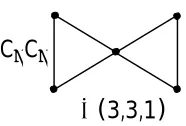
Theorem 3.2. Let be a connected non-regular Eulerian graph of order , then irr ( )≥ 8, and the equality holds if and only if ≅ ∞(3,3,1), where the bicyclic graph ∞(3,3,1) is shown in Figure 2.
∞(3,3,1)
Figure 2. Unique Eulerian graph with the second minimum total irregularity.
Proof. By Lemma 3.1, if n≥7, then irr > 8. If n = 6, then the degree sequence of G can be one of the following cases: (4,4,4,4,4,2), (4,4,4,4,2,2), (4,4,4,2,2,2), (4,4,2,2,2,2), and
(4,2,2,2,2,2). By a simple calculation, one can easily see that in these cases, irr (G) > 8. If n = 5, then the degree sequence of G may be either (4,4,2,2,2) or (4,2,2,2,2). Note that the cases (4,4,4,4,2) and (4,4,4,2,2) do not occur. Also, the total irregularity of graph G
with degree sequence (4,4,2,2,2) is equal to 12 and with degree sequence (4,2,2,2,2) is equal to 8. Additionally, the graph G with degree sequence (4,2,2,2,2) is the bicyclic graph ∞(3,3,1). Clearly, regular graphs C and C are the only Eulerian graphs with 3
and 4 vertices, which have total irregularity 0. □
Theorem 3.3. Let ≇ ∞(3,3,1) be a connected non-regular Eulerian graph of order , then ( )≥ 10, and the equality holds if and only if ≅ ∞(4,3,1) or , where graphs ∞(4,3,1) and are shown in Figure 3.
∞(4,3,1) H
Figure 3. Eulerian graphs with the third minimum total irregularity.
Proof. By Lemma 3.1, if n≥ 8 then irr > 10. If n = 7, then the degree sequence of G
may be the following cases:
(6,6,6,6,6,6,4), (6,6,6,6,6,6,2), (6,6,6,6,6,4,4), (6,6,6,6,6,4,2), (6,6,6,6,6,2,2), (6,6,6,6,4,4,4), (6,6,6,6,4,4,2), (6,6,6,6,4,2,2), (6,6,6,6,2,2,2), (6,6,6,4,4,4,4), (6,6,6,4,4,4,2), (6,6,6,4,4,2,2), (6,6,6,4,2,2,2), (6,6,6,2,2,2,2), (6,6,4,4,4,4,4), (6,6,4,4,4,4,2), (6,6,4,4,4,2,2), (6,6,4,4,2,2,2), (6,6,4,2,2,2,2), (6,6,2,2,2,2,2), (6,4,4,4,4,4,4), (6,4,4,4,4,4,2), (6,4,4,4,4,2,2), (6,4,4,4,2,2,2), (6,4,4,2,2,2,2), (6,4,2,2,2,2,2), (6,2,2,2,2,2,2), (4,4,4,4,4,4,2), (4,4,4,4,4,2,2), (4,4,4,4,2,2,2),
(4,4,4,2,2,2,2), (4,4,2,2,2,2,2), (4,2,2,2,2,2,2).
C C
By a simple calculation, one can easily see that in these cases, irr (G) > 10. If
n = 6, then the degree sequence of G can be the following cases:
(4,4,4,4,4,2), (4,4,4,4,2,2), (4,4,4,2,2,2), (4,4,2,2,2,2), (4,2,2,2,2,2).
The total irregularity of graph G with degree sequence (4,4,4,4,4,2) or (4,2,2,2,2,2) is equal to 10 and with the other degree sequences is more than 10. Note that if (4,4,4,4,4,2)
is degree sequence of graph G, then G≅ H, and if (4,2,2,2,2,2) is degree sequence of graph G, then G≅ ∞(4,3,1). Finally, if n ≤5, then by referring to the proof of Theorem 3.2, we see that the total irregularity value of G is not equal to 10. □
Corollary 3.4. The second and third minimum value of the total irregularity of Eulerian
graphs are 8 and 10, respectively.
R
EFERENCES1. H. Abdo, S. Brandt and D. Dimitrov, The total irregularity of a graph, Discrete Math. Theor. Comput. Sci. 16 (2014) 201−206.
2. H. Abdo, N. Cohen and D. Dimitrov, Graphs with maximal irregularity, Filomat 28 (7) (2014) 1315−1322.
3. H. Abdo and D. Dimitrov, Non-regular graphs with minimal total irregularity, arXiv:1407.1276v1.
4. H. Abdo and D. Dimitrov, The total irregularity of graphs under graph operations,
Miskolc Math. Notes 15 (1) (2014) 3−17.
5. H. Abdo and D. Dimitrov, The irregularity of graphs under graph operations,
Discuss. Math. Graph Theory 34 (2) (2014) 263−278.
6. M. O. Albertson, The irregularity of a graph, Ars Comb. 46 (1997) 219−225.
7. A. Astaneh-Asl and G. H. Fath-Tabar, Computing the first and third Zagreb polynomials of Cartesian product of graphs. Iranian J. Math. Chem. 2 (2) (2011) 73−78.
8. A.T. Balaban, I. Motoc, D. Bonchev and O. Mekenyan, Topological indices for structure-activity connection, Topics Curr. Chem. 114 (1983) 21−55.
9. F. K. Bell, A note on the irregularity of graphs, Linear Algebra Appl. 161 (1992) 45−54.
10. N. L. Biggs, E. K. Lloyd and R. J. Wilson, Graph Theory, Clarendon Press,
Oxford, 1976.
11. J. A. Bondy and U. S. R. Murty, Graph Theory with Applications, MacMillan, London, 1976.
13. M. Eliasi, The maximal total irregularity of some connected graphs. Iranian J. Math. Chem. 6 (2) (2015) 121−128.
14. G. H. Fath-Tabar, Old and new Zagreb index, MATCH Commun. Math. Comput. Chem. 65 (2011) 79−84.
15. G. H. Fath-Tabar, I. Gutman and R. Nasiri, Extremely irregular trees, Bull. Acad. Serbe Sci. Arts (Cl. Sci. Math. Natur.) 38 (2013) 1−8.
16. I. Gutman and N. Trinajstić, Graph theory and molecular orbitals total π-electron energy of alternant hydrocarbons, Chem. Phys. Lett. 17 (1972) 535−538.
17. P. Hansen and H. Melot, Variable neighborhood search for extremal graphs. 9. bounding the irregularity of a graph, DIMACS Ser. Discrete Math. Theoret. Comput. Sci. 69 (2005) 253−264.
18. M. A. Henning and D. Rautenbach, On the irregularity of bipartite graphs, Discrete Math. 307 (2007) 1467−1472.
19. W. Luo and B. Zhou, On the irregularity of trees and unicyclic graphs with given matching number, Util. Math. 83 (2010) 141−147.
20. R. Nasiri and G. H. Fath-Tabar, The second minimum of the irregularity of graphs,
Electronic. Notes Discrete Math. 45 (2014) 133−140.
21. R. Nasiri, A. Golami, G. H. Fath-Tabar and H. R. Ellahi, Extremely irregular unicyclic graphs, Kragujevac J. Math. 43 (2) (2019) 281−292.
22. T. Reti and D. Dimitrov, On irregularities of bidegreed graphs, Acta Polytechn. Hung. 10 (7) (2013) 117−134.
23. M. Tavakoli, F. Rahbarnia and A. R. Ashrafi, Some new results on irregularity of graphs, J. Appl. Math. Inform. 32 (2014) 675−685.
24. M. Tavakoli, F. Rahbarnia, M. Mirzavaziri, A. R. Ashrafi and I. Gutman, Extremely irregular graphs, Kragujevac J. Math. 37 (1) (2013) 135−139.
25. R. Todeschini and V. Consonni, Handbook of Molecular Descriptors, Wiley-VCH, Weinheim, 2000.
26. Z. Yarahmadi and G. H. Fath-Tabar, The Wiener, Szeged, PI, vertex PI, the first and second Zagreb indices of N-branched phenylacetylenes dendrimers, MATCH Commun. Math. Comput. Chem. 65 (1) (2011) 201−208.
27. L. You, J. Yang and Z. You, The maximal total irregularity of unicyclic graphs,
Ars Comb. in press.
28. L. You, J. Yang and Z. You, The maximal total irregularity of bicyclic graphs, J. Appl. Math. (2014) Article ID 785084, 9 pages.