ISSN: 2334-2986 (Print), 2334-2994 (Online) Copyright © The Author(s). 2014. All Rights Reserved. American Research Institute for Policy Development 42 Monticello Street, New York, NY 12701, USA. Phone: 1.347.757.4901 Website: www.aripd.org/jea
Distance Learning Approach in Engineering – Pluses and Minuses
Adeel Khalid1
Abstract
Outsourcing is seen from various points of views by individuals in different industries. When it comes to educating science and technology students, and for that matter, students of any discipline, up until recently, outsourcing was not a possibility. With the recent advances in computer and network technology, it is now possible to teach a live online distance-learning course from anywhere around the world. The need for the instructor and the students to be physically present in a common classroom is eliminated. In an on-line course, students and teacher get the opportunity to interact with each other. The computer-based distance learning approach is still in its relative infancy. But since the teaching and learning is done online, via the use of computers connected to inter-connected networks and satellites, the need to be geographically co-located does not exist any longer. The instructor and the students can be physically distributed at various locations, around the city, around the country, or around the world and still be able to teach and learn from each other as if they were present together in the same classroom. Since the medium of instruction is computers, the instructors and students can be outsourced. The flip side of the argument is that since the instructor is not physically present in the same room with the students, they do not get to interact with each other face to face. The instructor can continue to derive a complex mathematical equation without realizing that a student has walked away from their computer. This paper explores the positives and negatives of distance learning distributed education. Advantages and disadvantages of DL are discussed and a few solutions to the challenges, experienced by the instructors, are addressed. The research is based on the author’s experience of teaching online courses from within the city, across the states, and finally across the continents. Amongst other findings, the author discovered that when teaching an online distance learning class, distance is not a factor. While teaching online classes, the author travelled across different cities, states, and internationally and the students did not realize that the instructor was out of town and could not meet with them in the office after class.
Motivation and Background
The author had the opportunity to travel extensively while teaching. The travels included those within a large metropolitan city, across states, across countries, and across continents.
1 Assistant Professor, Systems Engineering, Southern Polytechnic State University, USA.
The goal of an online instructor is to continue the class instruction and to stay on the semester long schedule, while traveling. Traveling could be for a variety of reasons including conferences, professional development, workshops, grants, seminars, short courses, and other academic and non-academic activities. With the global internet connectivity, continuation of online courses is feasible during these extensive travels. The new technology of the Web offers unique prospects for promoting a reflective and collaborative learning environment (Bates, Duffy &
Cunningham, Eastmond, Tobin,)1.
In electronic text based communities of learners, our geographically and socially isolated students have the opportunity to establish communicative relationships with each other and to reflectively co-construct their knowledge by
engaging in open and critical discourse (Maor, Taylor et al.,)2.
Jegede recounts that the "distance learner, who is usually an adult in some form of employment, is characterized, amongst other qualities, by autonomy,
persistence, independence, self-direction and flexibility"3, while Schrum and
Luetkehans4 specify that "the great majority of adults learning at a distance were
reported to be in the 20-40 age range and studying on a part-time basis from their homes while maintaining full-time jobs".
Furthermore, Wedemeyer and Childs5 assign self-motivation, organizational
skills, and the ability to concentrate well as ideal qualities a distance student should possess, while the educational program itself should maintain clear goals and objectives, manageably sized lessons, and rapid feedback from the instructor in order to coincide with the qualities of the students.
Additional requisite qualities include a comfort level with the delay in
engagement and with the loss of control (Raths)6. Sherry and Wilson7 see a
relationship between the loss of instructor’s control with a corresponding awakening within students; students come to the "realization that the instructor is not the sole authority or repository of answers, and that the answers to real problems aren't as simple as they might seem!"
Underlying these, qualities such as the ability to articulate oneself through a textual means, and the ability to thrive in a group learning environment by
participating fully assume importance8.
The author got a chance to travel across the continents and stay in Pakistan while teaching full semester load of online distance learning course at Southern Polytechnic State University (SPSU). The courses were taught using WebCT and online live interactive module known as Horizon Wimba. The classes were conducted from Lahore University of Management Sciences (LUMS) School of Science and Engineering. One of the concerns that the author had was the bandwidth available in Pakistan to conduct a synchronous class. The class material is shared with students and the instructor and students correspond synchronously. The LUMS campus was chosen because of the uninterrupted broad band Internet access. The power outage, which is prevalent in most developing countries, was not an issue on LUMS campus because the campus has its own power generation system.
Figure 1: Snapshot of the synchronous online class environment using Horizon Wimba
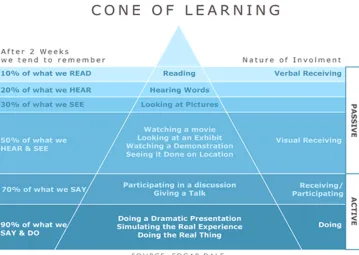
While at LUMS, the author also taught an on-campus ‘Operations Optimization’ course to the local students. Figure 2 shows a snapshot of the on-campus class at LUMS. In author’s experience, one of the best ways to learn is by experiencing or doing it. The author encourages students to actively participate and present material in class. The student learning increases significantly if they have to research material and present it in class in front of their peers.
Confucius once said:
“If all I do is hear, I will forget. If I hear and see, I will remember. If I hear, see and do, I will understand”
The online environment allows for active student participation. Edgar Dale9 in
Figure 3: Cone of Learning9
Faculty Surveys
A faculty survey was conducted to collect instructor’s impression of the plusses and minuses of on-line teaching and learning. The survey included faculty from SPSU, LUMS and Georgia Institute of Technology campuses. The simple survey asked for positives and downsides of teaching online and any other appropriate feedback. The positives and negatives listed in this paper are not intended to be all-inclusive. The list of positives and negatives are a collection of points that the author deemed most appropriate for synchronous graduate level classes.
Positives of Online Teaching
Several researchers have identified a number of positives of online teaching.
Buchanan8 points out that through the content, in the various forms of text, images,
Buchanan further asserts that the asynchronous nature of the course enables class members the time to examine an issue before responding, but the omnipresent availability of the course permitted and fostered a sense of immediacy and presence. This duality is unsustainable elsewhere, and lends to a pedagogical model that offers "the best of both worlds:" Time and engagement with the learning process and with the content, as well as the ability and availability to participate in this process at any time. Because the learning environment is unlimited in time and space, perspectives are not disregarded. The constraints of the classroom often forbid us from hearing from everyone. With the openness of the Web forum, multiplicitous voices emerge.
The "lattice" of the Web classroom is comforting and encouraging8.
With peers and their expertise at each other’s omnipresent disposal, the formation of a learning community grounded in professional discourse appears to grow naturally. Students, "attending" class each day, come to know each other more thoroughly than their weekly counterparts.
The author experienced that the online environment provides the opportunity to the working professionals and mature students to bring their knowledge back to the classroom. The instructor can leverage that knowledge to add value to the class. In a typical undergraduate classroom, it is unlikely to get students with real world experiences. Often times, the graduate students are the top 15% of their undergraduate class. They are mature and bring value to the class. It is the responsibility of the instructor to exploit that knowledge so everyone can seek benefit from it.
Since a number of students were affected due to flooding, they were not able to attend the live classes. Horizon Wimba allows the classes to be archived. The students were able to listen to the archived lectures at their convenience at a later point. The lecture archive is a big advantage of online classes. It does not only help students to catch up with missed classes, but it also provides a useful platform for them to go back and review the course at their convenience. The archives are available anywhere, anytime. The archives can also be saved in portable media format. Students can download the lectures and listen to them on their personal phones or other audio devices. The entire online course is modularized. So a student does not have to sit through the entire lecture to understand one concept. They have the controls to play and stop the lecture at their discretion. This helps them review and focus on the point that they did not understand in the class without having to review the entire lecture. This flexibility is not necessarily available by default in an on-campus classroom environment.
The instructors surveyed also thought that although it is hard to develop an online course, but once developed, it is highly reusable. A number of modules in an online course can be re-used. This includes the reuse of archived lectures. The voice-over lectures are helpful for qualitative and quantitative material.
One of the greatest advantages of online classroom is the ability to simultaneously teach large number of students all over the world. Students do not have to commute or travel to go to school. They could seek admission in the universities of their choice around the world and take classes without having to step out of their home. This helps reach out to students in remote area who might otherwise not be able to get quality education and in some cases any education at all. This helps reduce the cost of education. Students do not have to pay to live on or near campus. The commute cost is eliminated. The same flexibility is available to instructors. An instructor can be in any part of the world where they have access to the online class material, and they can conduct the class without worrying about going to campus.
The online class is also green. It requires fewer or no papers. The white or blackboard is not used. In long run, that also helps reduce the cost of education.
The above is not an all-inclusive list of positives of on-line teaching. These points are a summary of a few observations that the author had during the course of distance online teaching. Some of these points were collected from the earlier mentioned survey results from the online instructors from various universities.
Downsides of Online Teaching
While there are lots of advantages of online teaching, there are still some drawbacks or limitations that need to be considered. The following list of cons of online teaching is not intended to be an all-inclusive list. It is a list of few points that the author observed. There are also a few points that were gathered from the faculty survey.
Any faculty member teaching online needs to understand that not all courses can be taught online with the same level of effectiveness. Some courses are better suited for online environment than others. Even with the latest advances in technology, there are still certain courses that are more effective when taught in an on-campus environment. Lab courses like biology, chemistry, and physics, where students need to interact with apparatus e.g. flasks, chemicals, Bunsen burner etc. are not feasible online. Similarly engineering labs where students get involved in hands-on activities are not feasible in online environment.
They are also hesitant to discuss the course material or assignments online with each other. This hinders the student’s ability to present their work in groups. In the author’s experience, most students prefer on-campus classroom environment for presentations – despite knowing that everyone can see them. When asked to present online, they are often either reluctant or do not perform as well as they would otherwise. This may have to do with the ‘fear of unknown.’ This also makes the environment more formal than an on-campus class.
From an instructor’s perspective, there is a lot of intensive preparation required. Preparing for an online course may take significant amount of time and effort from the instructor compared to an on-campus class. Delivering an online lecture also presents a set of challenges. The instructor cannot write on the board or walk around in the room. The instructor is usually stuck in the chair looking at a computer screen. That decreases the dynamism that some instructors enjoy in a classroom environment.
There is also a lot of administrative work required from the instructor in an online class. This includes uploading, and downloading lectures, archiving lectures, keyboard activities, and other secretarial work. This requires extra effort and time from the instructor and sometimes may even distract the instructor from the objectives of the course.
Grading homework and assignments also poses certain challenges. The instructor cannot mark on the student’s work unless if they are using a touch sensitive screen. The other alternative is to print the student work, mark it, and then scan it back for student review. This also causes lots of extra work and time commitment from the instructor. The re-grading may take even more work and may be very difficult to do. The alternative is to design the homework and quizzes in such a manner that they do not require marking e.g. multiple choice questions, short answer questions, true false questions etc. But some of these techniques may not be applicable depending on the type of course being taught.
The instructor argues that the personality buildup process is missing in an online classroom environment. Students do not get a chance to meet with other students, faculty, and colleagues in person. The inter-personal and communication skills may not develop or may not be at par in an online environment when compared to traditional on-campus classes. The general perception of the online programs in the industry is still not as favorable as the traditional on-campus programs. This may have to do with the fact that there are still not very many online programs available. With the advances in technology, it is expected that in a few decades, if not a few years, the online distance learning will become a norm. The negative stigma attached with the online degrees will hopefully go away because of that. The graduate level online classes are relatively more acceptable in the industry.
Engineers are process / algorithm based learners. They do not learn well with bullet-points in a slideshow. A typical engineering class will show the process or evolution of a theory or a mathematical concept. This becomes second nature to engineering students after years of learning and practice. They do not need to see words or final equations, but instead the evolution of those equations. Unfortunately Power-Point takes that away. When engineering students are shown bullet-points, it becomes rather difficult to grasp the concept. The online environment sometimes forces the instructor to show the final result or final equation, as opposed to deriving the equation or showing the flow, or process of evolution. This makes the online teaching and learning even more challenging. Sometimes, publishers jack-up prices and instructors are bought into it because they sell the entire course material together including the online material as a package. With the advent in technology, instructors will be able to write on the board, just like in an on-campus class, and the notes will be digitized. Students will be able to follow the evolution / flow of engineering concepts. Students need to see the charts, flow charts, and figures.
Another challenge in an online class is proctoring exams for undergraduate and graduate students. Students may be tempted to cheat due to the absence of a proctor. Often times, students are asked to take the exam in front of an external proctor. The proctor has to be paid for their time, which causes additional over-head.
Long-term online teaching can cause health issues including back pain and eye problems. This may be true for older faculty. As discussed earlier, the advent in technology, may allow the faculty to move around the room, write on the board and not have to stare at a computer screen for extended periods of time. This may help alleviate the long-term health issues.
The biggest concern that the author has with online teaching and learning is the lack of first hand feedback from students. If the instructor does not get that feedback, it is very difficult to improve the online teaching. Any system that does not continuously strive to improve itself, will get left behind and will eventually perish.
Other Feedback
In addition to the above pros and cons of online distance teaching, there were a few comments received from the faculty survey that are worth addressing.
Online teaching is becoming more and more common. Georgia Institute of Technology offers several online courses including a Masters degree in Aerospace Engineering. Aerospace Engineering is often considered a very difficulty degree to obtain. Georgia Tech is one of the leading universities in Aerospace Engineering. When graduates from this program go in the industry, it will gradually change the industry’s perspective towards online degree programs. Southern Polytechnic State University offers online Masters in Systems Engineering. Like Georgia Tech and SPSU, there are several other top universities across the U.S. and around the world that are beginning online degree programs. With this new thrust, the technology to support online programs will be developed and the cons discussed will be eliminated.
Several survey respondents indicated that online classes are better suited for graduate students. Graduate students have higher level of maturity. The cheating concerns are reduced. Students are more responsible and serious towards their education. Typically only the top 15% of an undergraduate class goes to seek a graduate degree.
Recommendations
There are ways to improve online teaching and learning. Online classes are not suitable for all levels of students. A technically savvy student is more likely to do well online, than a novice. Students can do a self-evaluation to see whether they are
ready for an online class. Buchanan8 recommends that to avoid failure and
inefficacious pedagogy in online Web-based environments, potential students should respond formally to a set of criteria. This criterion may include a survey instrument developed by each institution and distributed before admission to a Web-based program or course; this survey may include such questions as:
1. Are you able to work independently?
2. Will you sacrifice personal time to complete assignments and readings?
3. Can you write clearly and articulate your thoughts coherently?
4. Are you a self-starter?
5. Are you able to manage time?
6. Do you have strong study skills?
7. Do you need direct lecture to understand materials?
8. Are you comfortable asserting yourself in a group?
9. Will you divulge personal information and be comfortable hearing others'
information?
10. Are you computer literate?
Similarly some instructors do better in online teaching than others. Instructors
need to be trained for effective online teaching. Furthermore, Buchanan8 asserts that
Conclusion
In this paper, the author reviews the positives and the negatives of online teaching and learning. Several online instructors were surveyed and their feedback was analyzed. The online teaching offers plethora of advantages including the schedule flexibility, re-usability of course material, reduced cost of education, use of latest technology, ability to archive lectures, ability to tap on resources from around the world, ability to travel and still be able to attend the classes from any part of the world etc. On the flip side, there are several disadvantages or shortcomings of online teaching. These include the lack of face-to-face interaction, lack of teamwork, intensive preparation required from the instructor, poor industry perception of online degrees, inability to teach lab courses online, difficulty associated with proctoring online exams, little or no feedback received from the students etc. The online education is still far from perfect. With the rapid advances in technology, it can be expected that in a few years, all the cons of online education can be eliminated. Until then, the instructor and the student need to do a self-evaluation to determine whether online education is right for them.
Acknowledgements
References
Duffy, T.M. & Cunningham, D.J. (1996). Constructivism: Implications for the design and delivery of instruction. In D.H. Jonassen (Ed.), Handbook of research for educational communications and technology. New York: Simon & Schuster Macmillan.
Maor, D. (1999). A professional development program to enhance teachers' understanding of the use of a constructivist multimedia learning environment. Learning Environment research: An International Journal.
Holmberg, B. (1995). Theory and practice in distance education. New York: Routledge. Jegede, O. (1989).
Schrum, L. and Luetkehans, L. (1997). A primer on distance education: Considerations for decision makers. Washington, DC: AECT.
Wedemeyer, C. and Childs, G. (1961). New perspectives in university correspondence study. Chicago: Center for the Study of Liberal Education for Adults.
Raths, D. (1999, June). Is anyone out there? Inside Technology Training, 32-34.
Sherry, L. and Wilson, B. (1997). Transformative communication as a stimulas to Web innovations. In Khan, B. (Ed.) Web-Based Instruction. (pp. 67-73). Englewood Cliffs: Educational Technology Publications.
EA Buchanan, ‘Assessment measures: Pre-Tests for successful distance teaching and learning,’ Online Journal of distance learning administration, 1999