Construction, Validation, and Application of a
Teacher Status Scale (TSS): A Case of Iranian
Junior High School Teachers
Reza Pishghadam
Associate Professor, Ferdowsi University of Mashhad, Iran
Fahimeh Saboori
Ph.D. Candidate of TEFL, Ferdowsi University of Mashhad, Iran
Received: June 12, 2013; Accepted: September 24, 2013
Abstract
The role of teachers in the educational context could go beyond simply teaching the subject matter. It is not uncommon for some students to be greatly influenced by certain teachers and even consider them as their role models. An interesting and novel way of inferring the impact a teacher has on the students is through revealing the status of the teacher as perceived by the students. The present study pursued two goals: first, to construct and validate a teacher status scale (TSS); and second, to reveal the relative status of English language teachers as compared to other school teachers in students‟ perceptions. Regarding the first goal, an 18-item teacher status scale was designed and, using the data collected from 200 students, its construct validity was substantiated through Rasch model. As for the second goal, 650 junior high school students rated their 300 teachers. The data was then analyzed using Chi-square test. In addition, 135 students participated in short interviews and a total of 530 minutes of recorded interviews constituted the qualitative data. Based on the results, English teachers were found to have the highest status of all school teachers as perceived by the students. Finally, statistical results were discussed, and implications were provided for English language teaching in the formal context of education.
Keywords: teacher status, Rasch model, validation, English language teacher
INTRODUCTION
An undeniable fact in education is the great effect the teacher has on the students‟ progress (Rice, 2003; Swandee, 1995) and sometimes the teacher‟s effect on students‟ learning is larger than that of the actual subject being taught. It is, however, naïve to consider such an effect to be unilateral and confined only to the learning faculties of the students. Clearly enough, a teacher can influence a student‟s whole worldview and identity, and this is not an uncommon experience. We all have had teachers who have, to different degrees, changed our ways of thinking, feeling, and acting. Seemingly, when it comes to language teachers, the issue of teacher‟s influence becomes of still higher importance because language is closely interwoven with culture and identity (Norton & Gao, 2008).
Therefore, language teachers in general (due to teaching a new language and culture), and English language teachers in Iran in particular (due to the special status of English language and special nature of English classes), tend to be very influential in the personality and identity formation of the students. Still, another noteworthy point is the critical time English language is introduced to students in the formal system of education –it is included in the school curriculum from grade 6 on, i.e. age 13. Clearly enough, teen ages are the critical moments in a person‟s identity formation, and accordingly, this timing can intensify the effects of the likely changes in the learner‟s identity and worldview caused by a new language and culture contact.
All in all, the higher status of English teachers in students‟ perceptions would result in two possible scenarios: one is that English teachers, more than anyone else, could lay the foundations for the deculturation and loss of identity of their students by highlighting, praising, and imitating English culture and thus acting, even though unintentionally, as agents of linguistic imperialism. Unfortunately, the status quo in Iran especially in the informal context of education testifies the high likelihood of this scenario (Pishghadam & Navari, 2009; Pishghadam & Saboori, 2011b). An alternative scenario, on the other hand, could be what Applied ELT (the application of ELT in other sciences) argues for (Pishghadam, 2011). That is, making most of such special merit (high status and influential position), English teachers could act as conscious agents of change and use it for their own benefit by enhancing life qualities, especially national and cultural identities of the learners in their classes. The importance of possible ramifications of each of these two scenarios reflects the need for a body of research to investigate English teacher‟s status and calls for great attention to be devoted to appropriate, conscience-raising, pre and in-service teacher training courses.
To our knowledge, no studies have been conducted in Iran examining this issue. Therefore, the present study is aimed at revealing the relative status and influentiality of English teachers compared to other school teachers in Iranian junior high school students‟ perceptions.
LITERATURE REVIEW
the perspective of the mainstream ELT. In this section, we first take a look at the evolution of the role of language teacher since the recognition of ELT, as a legitimate field of study, up to now. Next, we discuss the place the Iranian English teachers stand.
Theoretical Background
Before the 20th century, language teaching was in fact teaching literature mainly through difficult literary texts. However, when applied linguistics, which was then synonymous to language teaching (Strevens, 1992), managed to gain the stance of a scientific field of study in the 1950s, the heavy dominance of literature in ELT was replaced by that of linguistics (Pishghadam & Mirzaee, 2008). This shift defined the role of the first generation of language teachers as complete conformers to the linguistic findings and standards and sheer consumer of their theories. Thus, linguists would form theories and teachers would precisely apply them in their classes (Schmitt, 2002) so that the same theory would be applied in a variety of different local teaching contexts. Playing such a mechanical and passive role in following the prescribed initiatives by linguistics, the teacher was supposed to know the „whats‟ and „hows‟ of teaching while having no idea about the „whys‟.
impact on and defined new assumptions of the role of the second generation of language teachers.
First, teachers were given a sense of plausibility, with two aspects of having freedom to make local decisions and to take the responsibility for the decisions they made (Prabhu,1990). In addition, teachers were supposed to be reflective, meaning that they needed to reflect on a teaching activity before and after they did it – self-observation – and also while doing it in the class – self-monitoring (Kumaravadivelu, 1999; Schon, 1983; Williams & Burden, 1997). In this sense, reflective teaching demanded teachers to constantly evaluate and criticize their own teaching practice. What is more, teachers were considered as researchers and theorizers (Argyris & Schon, 1974; Gordon & Schwinge, 2009; Hui & Grossman, 2008; Noffke, 1997; Schon, 1983; Zeichner & Liston, 1996). That is, they were expected to observe their own teaching and local context, and through conducting action research, develop educational theories and, hence, act as practitioners of their own – rather than others‟ – theories. All in all, this second generation of language teachers represented informed and enlightened teachers whose knowledge transcends the „whats‟ and „hows‟ of teaching, including an awareness of the „whys‟ as well.
1999, 2003; Mena-Marcos, Sanchez & Tillema, 2011; Schmuck, 2006; Wallace, 1993).
Finally, a new wave in ELT (Douglas, 2012; Fox, 2012; Ghadiri, Tavakoli, & Ketabi, in press; Mahmoodzadeh, 2012; Pishghadam & Adamson, 2013) which seems to have quite recently been set in motion by Pishghadam‟s (2011) controversial theory of Applied ELT promotes a third generation of language teachers. Claiming that ELT, as a full-fledged and independent field of study, has the potentiality to be applied to other fields, Applied ELT calls for educational language teachers as its practitioners. The argument is that during postmethod period, a confluence of interdisciplinary and transdisciplinary studies were conducted by ELT researchers resulting in the expansion of the domain of ELT. The findings of these studies in fact injected to ELT a bulk of fresh ideas from other disciplines appropriated and modified for ELT and this way they broadened its perspective and led to the formation of lots of new theories in language teaching and learning. This trend has over years enriched ELT in theory and practice so much that it can now announce both its independence from applied linguistics and its readiness to be applied to other domains of knowledge and, hence, take on a more contributing role.
teachers become educational language teachers who, in addition to having a thorough command of language, are at the same time educational experts with sufficient knowledge of the non-linguistic features of learners which can be improved through language teaching, of the domains these features belong to, and of the possible ways to do it. In fact, language learning seems to be more than just learning a language, emanating from life interactions, and so it can be heavily interwoven with life issues. The transdisciplinary knowledge gains more importance here since the teacher who so far appropriated the findings of other fields such as linguistics, sociology, psychology, neurology, etc. for ELT is now expected to reverse this direction and repay to these fields by playing the role of a producer and trying to contribute to them through language teaching (Pishghadam, Zabihi, & NorouzKermanshai, 2012). It goes without saying that accomplishing such a role cannot be expected from a typical teacher on his/her own and that it calls for appropriate teacher training courses. These training courses would empower teachers to gain expertise, constructing professional identities in different other disciplines they wish to enrich and in so doing, become more of an educational teacher, a critical and proactive educator rather than merely a language instructor. Seemingly, an educational teacher can improve the quality of life for language learners, leading them to be more successful in life and education. Table 1 presents the main changes in the role of language teacher across the three generations of ELT.
Table 1: role of language teacher across the three generations of ELT First generation of
ELT
Second generation of ELT
Third generation of ELT
Consumer Autonomous Producer/contributor
Transmitter Transformative Agent of change
Passive Reflective Educational
Iranian Formal System of Education
To better understand the role of English teacher in the Iranian educational system, we present an overview of the nature of the system itself and its ELT. The formal system of education in Iran is a conservative centralized system with “a one-size-fits-all policy” (Pishghadam & Mirzaee, 2008, p. 103). This policy is evident in the exertion of the prescribed textbooks all over the country, the administration of national tests, and demanding full conformity from teachers in an attempt to unify their instructions and, hence, the students from all around the country. Therefore, the system gains itself the control over not only the input, through the prescribed curriculum, but the output, through the national testing scheme (Ostovar-Namaghi, 2006).
creative instruction and being a slave to their texts (Garinger, 2002). However, there is another problem which impedes the teachers‟ freedom to do so and that involves the second factor. One point which needs to be mentioned is that the system of language education has just started to change towards more communicative classes, focusing more on enhancing all skills of language proficiency. In this regard, new textbooks are being developed for the students in junior high schools to meet the aforementioned aims.
The other factor guaranteeing the implementation of the educational systems‟ policies is an external pressure in the form of the administration of national examinations. The importance of such exams lies in the great negative washback effect they produce (Ghorbani, 2011; Jahangard, 2007; Ostovar-Namaghi, 2006). That is, by focusing basically on grammar, vocabulary, and reading, such exams, in practice, promote a trend of English instruction in the formal system of education which puts a premium on these areas of language knowledge and disregards the other skills which are equally important. So, due to the common view which considers a high score equal to high achievement, the grade pressure from students and parents gains the upperhand and leads the way for the process of English instruction in schools. This situation leaves teachers no choice but to surrender, mostly despite their will and standards of teaching, to the strong negative washback effect of such exams and shape their teaching practices based on the demands of these exams.
However, if English teachers are found to have special status in students‟ perceptions, the system can easily use such merit at the service of the right education by making a paradigm shift towards applied ELT and training educational English teachers. With that in mind, the present study seeks to present a vivid picture of the status of the English teacher as compared to other school teachers at junior high school.
PURPOSE OF THE STUDY
The main purpose of this study is to first, construct and validate a teacher status scale (TSS) and second, reveal the relative status and influential stance of English teachers as compared to other teachers in Iranian junior high school students‟ perceptions. It, therefore, seeks to answer the following questions:
1. Does the designed Teacher Status Scale (TSS) enjoy an acceptable index of reliability and validity?
2. Is there any significant difference between the status of English language teacher and that of other school teachers in junior high school students‟ perceptions?
METHOD
Participants
This study was conducted on 650 female students who rated their 300 teachers in Mashhad, Iran. They studied at junior high school and their ages ranged from 12 to 15 years old. Approximately, one fifth of these students (135 participants) were randomly selected to be interviewed. The 300 teachers whom our participants rated were all female teachers of junior high school – in Iranian school system there is no male teacher in junior high schools for girls – aged between 20 and 50 (M = 25) with a range of between 2 to 27 (M = 12.5) years of teaching experience.
for the data to be as representative as possible, it was collected from three educational districts of low, middle, and high social classes. In each of these districts, three schools, and in each school, three classes–with distinctive English teachers – were selected for the data collection.
Instrumentation
Two instruments were used in this study: 1. Teacher Status Scale. 2. Structured interview.
Teacher Status Scale
The first instrument was a status scale designed and validated by the researchers. The intended meaning of the term status in developing this questionnaire was the relative position and rank one holds in others‟ perceptions; thus, the higher this position, the more being looked up to and also the more likelihood of being consciously or subconsciously adopted as a model to follow. Naturally, then, one‟s status in other‟s perceptions alludes to how much that person can be influential for them. Having this sense of the word in mind, the researchers hold the view that one‟s status is affected and determined by at least three types of identity, i.e. personal (personality types), cultural (social issues), and educational (professional issues) identities. Accordingly, the teacher status questionnaire was built on these three categories.
Structured Interview
In order to obtain a more comprehensive picture of the teachers‟ status, students‟ qualitative evaluation of them was also taken into account through conducting a number of short structured interviews. The interviews consisted of one main question, namely, “If you were to be a teacher, what teacher would you choose to be?” and some follow up questions asking them to explain the reasons for their choices.
Data Collection Procedure
The data collection took place in the last month of school year (May) 2012. It took an average of 20 minutes for each class to answer the scale. Before starting to answer, and in order to unveil what they truly thought of their teachers, the students were assured that their answers were confidential and that none of the school staff would get to see them. The instruction asked the students to mark the adjectives which were more prominent for each teacher. There was no limitation in marking so that students could mark all or none of the adjectives for each teacher and it totally depended on their view about the teacher.
In the process of collecting the data, first, the study was conducted on 200 students in order to assess the construct validity of the scale. Next, an additional 450 students rated their teachers and the whole data (gathered from 650 students) was then used in revealing the relative status of each teacher as perceived by the students.
Data Analysis
To analyze the data, Rasch measurement was utilized to substantiate the construct validity of the scale. Rasch analysis was conducted using Winsteps version 3.74. The entire dataset with 18 items and 200 persons was subjected to Rasch analysis to evaluate the fit of data to the model and assess the unidimensionality of the instrument. If these tests are satisfied and the assumptions hold, the scale is a unidimensional. Moreover, Chi-square (using SPSS version 19) was employed to see whether the differences between the statuses of the teachers were significant.
each taking an average of 4 minutes, were recorded and then transcribed to be analyzed for the possible common themes.
RESULTS
Teacher Status Scale
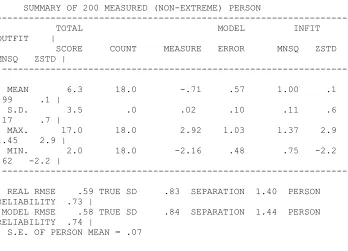
With regard to the first research question, Rasch measurement was utilized to substantiate the construct validity and reliability of the scale. As the results in Table 2 show, the separation index of the persons is 1.40. Person strata index indicates the number of distinct ability levels which can be identified by the test (Stone & Wright, 1988). A reliability index of at least 0.50 is required for a separation index of 1. It should be noted that the moderate reliability (.73) separation, and strata indices for this test is due to the low standard deviation of person abilities. If another sample with a wider spread of abilities were to be tested, these statistics would improve.
Table 2: summary of 200 measured person
---
SUMMARY OF 200 MEASURED (NON-EXTREME) PERSON
--- | TOTAL MODEL INFIT OUTFIT |
| SCORE COUNT MEASURE ERROR MNSQ ZSTD MNSQ ZSTD |
|---|
| MEAN 6.3 18.0 -.71 .57 1.00 .1 .99 .1 |
| S.D. 3.5 .0 .02 .10 .11 .6 .17 .7 |
| MAX. 17.0 18.0 2.92 1.03 1.37 2.9 1.45 2.9 |
| MIN. 2.0 18.0 -2.16 .48 .75 -2.2 .62 -2.2 |
|---|
| REAL RMSE .59 TRUE SD .83 SEPARATION 1.40 PERSON RELIABILITY .73 |
|MODEL RMSE .58 TRUE SD .84 SEPARATION 1.44 PERSON RELIABILITY .74 |
| S.E. OF PERSON MEAN = .07 |
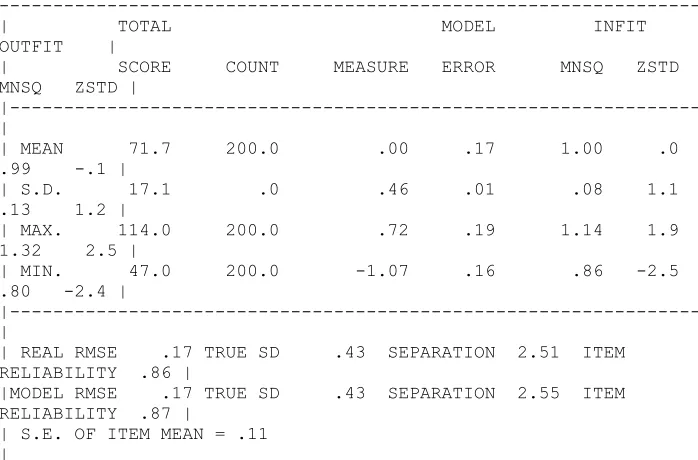
As Table 3 demonstrates, the reliability for the items is relatively high (.86). That is, the chances that the difficulty ordering of the items be repeated if the test were given to another group is extremely high. This is because there is a wide spread of difficulty in the items as the standard deviation of item difficulty estimates is .46 logits and the separation is 2.51.
Table 3: summary of 18 measured item
--- | TOTAL MODEL INFIT OUTFIT |
| SCORE COUNT MEASURE ERROR MNSQ ZSTD MNSQ ZSTD |
|---|
| MEAN 71.7 200.0 .00 .17 1.00 .0 .99 -.1 |
| S.D. 17.1 .0 .46 .01 .08 1.1 .13 1.2 |
| MAX. 114.0 200.0 .72 .19 1.14 1.9 1.32 2.5 |
| MIN. 47.0 200.0 -1.07 .16 .86 -2.5 .80 -2.4 |
|---|
| REAL RMSE .17 TRUE SD .43 SEPARATION 2.51 ITEM RELIABILITY .86 |
|MODEL RMSE .17 TRUE SD .43 SEPARATION 2.55 ITEM RELIABILITY .87 |
| S.E. OF ITEM MEAN = .11 |
---
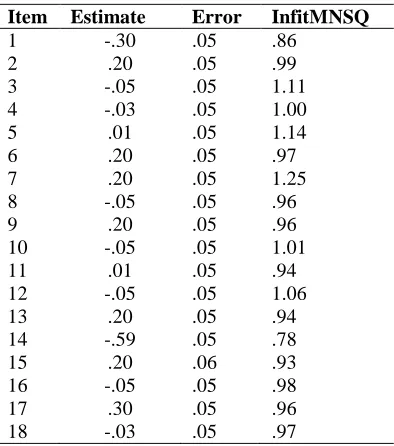
Table 4: item estimates and fit statistics Item Estimate Error InfitMNSQ 1 2 3 4 5 6 7 8 9 10 11 12 13 14 15 16 17 18 -.30 .20 -.05 -.03 .01 .20 .20 -.05 .20 -.05 .01 -.05 .20 -.59 .20 -.05 .30 -.03 .05 .05 .05 .05 .05 .05 .05 .05 .05 .05 .05 .05 .05 .05 .06 .05 .05 .05 .86 .99 1.11 1.00 1.14 .97 1.25 .96 .96 1.01 .94 1.06 .94 .78 .93 .98 .96 .97
MEASURE PERSON - MAP - ITEM <more>|<rare>
3 . + # | | | | . | | 2 + | | . | | | | ## T| V12 | | 1 . + |T | ## | V2 | V4 .## |S | S| V18 ## | V6 |
0 ##### +M V3 V5 |
######## | V8 V7 |
|
########## |S V16 V14 V1 V10 |
.###### M| V15 V11 V13 | |T -1 ##### + | V17 | .##### | V9 | | | # S| | | -2 + | | | | T| | -3 + <less>|<frequent>
All in all, the above-mentioned Rasch statistics reveal the fact that the newly-developed scale is valid for determining the status of teachers at junior high schools, and this scale can be employed for gathering data accordingly.
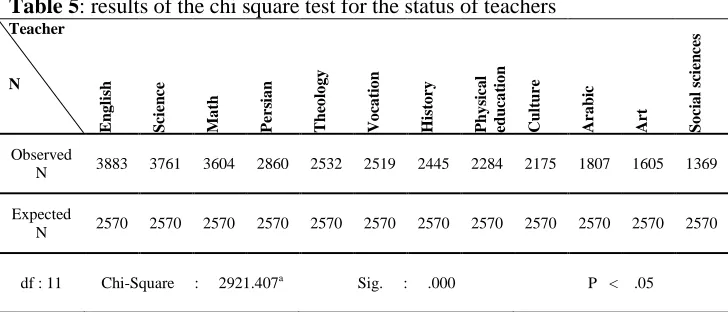
To answer the second research question based on the quantitative data, a Chi-square test was run on the data. As illustrated in Table 5, there is a significant difference between the status of school teachers as rated by the students ( = 2921.407, p<.05). Table 5 also revealed that English teachers are perceived by the students as having the highest status (n=3883) and the second and third ranks are those of science (n=3761) and math (n=3604) teachers. The ranks of other teachers are evident in the table and the lowest status rank belongs to social sciences teacher (n=1369).
Table 5:results of the chi square test for the status of teachers
Teacher N E n g li sh S ci en ce M a th Pe rs ia n T h eo lo g y V o ca ti o n Hi st o ry Phy si ca l ed u ca ti o n C u lt u re A ra b ic A rt S o ci a l sc ie n ce s Observed
N 3883 3761 3604 2860 2532 2519 2445 2284 2175 1807 1605 1369 Expected
N 2570 2570 2570 2570 2570 2570 2570 2570 2570 2570 2570 2570 df : 11 Chi-Square : 2921.407a Sig. : .000 P < .05
Interviews
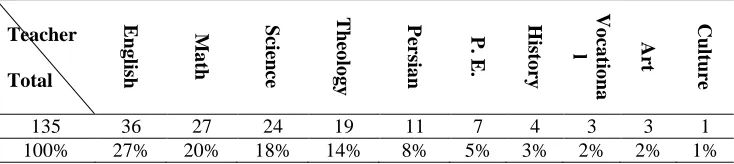
of the interview, namely, “If you were to be a teacher, what teacher would you choose to be?”
Table 6: results of the major interview question
Teacher
Total
E
ng
lis
h
M
a
th
Science Theo
lo
g
y
P
er
sia
n
P
. E
.
H
is
to
ry
Vo
ca
tio
na
l Art
Culture
135 36 27 24 19 11 7 4 3 3 1
100% 27% 20% 18% 14% 8% 5% 3% 2% 2% 1%
The explanations students provided for their choices could all be encapsulated into two categories: teacher-related and subject-related reasons. The gist of the teacher-related category, which constituted more than 75% of the reasons, may well be observed in the statements such as “because I love our teacher and want to be like her” and “since I want to be just as nice as my teacher”. The other 25% of the reasons belonged to the subject-related group and was expressed through such statements as “because it is a very important subject and is very useful in life” and “because I am very good at this subject and I like it a lot”. All in all, these explanations further confirm and illuminate the superiority of the status of the English teacher from the perspective of the students.
DISCUSSION
As already mentioned, this study set itself two goals: first, to construct and validate a teacher status scale (TSS); and second, to reveal the relative status of English teacher as compared to other school teachers from the perspective of students.
our hope that this newly-made scale can be utilized to shed more light on the status of teachers at different levels of education.
As for the second goal, the results of the quantitative data were indicative of the fact that English teachers are perceived by students as having the highest status of all school teachers. Also, the qualitative results were quite in line with those of the TSS in indicating that the teacher who is most likely to be looked up to as a model, whose words carry most weight, and who can be most influential for the students is the one who is, in turn, most under the influence of English language and culture. This finding is quite remarkable in the Iranian educational system since it subtly unveils a discrepancy between the expected conditions and the actual status quo. In this system, there are certain subjects (such as theology and culture) the reason behind whose inclusion in the curriculum is to provide students with the culturally and religiously desired ideology and way of thinking and behaving. So, based on the purpose of these subjects, their teachers are more or less supposed to be agents of change and the requisite to accomplishing this role is to possess a high status and be influential for the students. So, the system expects and claims these teachers to have the most influential stance among students. But, surprisingly enough, TSS and interview results revealed that this position is in practice occupied by English teachers whose role as defined by the system is quite different and the ranks of theology and culture teachers are not even close to that of the English teacher in the status scale. This discrepancy alludes to the important fact that the system has apparently invested in the wrong teacher for the stated purpose.
At the local level, the reason which makes this finding of particular importance in the context of Iran could be the country‟s anti-western policies. That is to say, it seems that the country‟s main policies against the U.S. and its culture have not achieved the expected results. This contrast calls to mind Bakhtin‟s (1981) distinction between authoritative discourse and internally persuasive discourse (Lin & Luke, 2005). Based on this distinction, authoritative discourse, as the name suggests, is the "language or discourse imposed on person", and internally persuasive discourse, is the one "hybridized and populated with one's own voices, styles, meanings, and intentions" (Lin & Luke, 2005, p. 93-94). As for the case in point, the anti-American authoritative discourse in this country has apparently resulted in an opposite internally persuasive discourse for the students. In this regard, the findings of this study seem to be in line with Pishghadam and Saboori‟s (2011b) findings denoting the fact that most Iranian teachers and learners highly appreciate American accent, looking up to its native speakers inwardly.
CONCLUSION AND IMPLICATIONS
As the outcomes of this study demonstrate, English language teachers are perceived by students as more influential and prestigious, and having more credit than the other junior high school teachers. This implies that students prefer to follow their English language teachers. In fact, English language teachers seem to be very effective at school and their words carry more weight among students.
these accents, and great efforts to sound native-like while, according to Kirkpatrick (2007), "accents are closely bound up with feelings of personal and group identity" (p. 37) and thus such a view among Iranian learners is in fact a threat to their local identity (Pishghadam & Kamyabi, 2008; Pishghadam & Navari, 2009). Therefore, it becomes evident that ignoring the great influence English teachers have on the students and leaving this source of power unsupervised is, in effect, using it at the service of linguistic imperialism, though unintentionally, through fostering cultural derichment and fading local identities. A second way of dealing with this potential source of power, on the other hand, could be taking it under control and using it to the benefit of the educational purposes. That is, having acknowledged this special merit of English teachers, the system can make most of it by using it both to resist linguistic imperialism, which is integral to teaching English (Phillipson, 1992), and at the same time to enhance life qualities in students and thus educate them for life. To this end, the system needs to make a paradigm shift in its ELT towards Applied ELT and redefine the role of English teacher –from passive transmitter of the first generation to the conscious agent of change of the third generation –through training educational language teachers.
Acknowledgments
We gratefully acknowledge the project reported here was supported by a grant-in-aid of research from Ferdowsi University of Mashhad in 2012 without which this research would not have been possible. Besides, we announce the study has been a part of research which has been conducted in Mashhad, Iran, in 2012.
Bio-data
Reza Pishghadam has a Ph.D. in Teaching English as a Foreign Language (TEFL) from Allameh Tabataba‟i University. He is currently on the English faculty of Ferdowsi University of Mashhad, Iran. He is associate professor of TEFL and teaches first language theories, socio- psychological aspects of language education, and applied linguistics.
Fahimeh Saboori is a Ph.D. candidate of TEFL in Ferdowsi University of Mashhad. She has published several articles on different domains of TEFL. Her main research interests include psychology and sociology of language education and cultural studies.
References
Altrichter, H., Posch, P., & Somekh, B. (1993). Teachers investigate their work: An introduction to the methods of action research. London: Routledge. Allami H., Jalilifar A., & Hashemian, M. (2009). Are Iranian school students'
language needs taken into consideration? Iranian Journal of Language Studies,3(1), 125-142.
Allwright, D. (1992). Exploratory teaching: Bringing research and pedagogy together in the language classroom. Revue de Phonetique Appliqee, 103, 101-117.
Argyris, C., & Schon, D. A. (1974). Theory in practice: Increasing professional effectiveness. San Francisco: Jossey-Bass.
Bakhtin, M. (1981). The dialogic imagination. Austin, Texas: University of Texas Press.
Bond, T. G., & Fox, C. M. (2007). Applying the Rasch model: Fundamental measurement in the human sciences. London: Lawrence Erlbaum.
Brown, H. D. (2001). Teaching by principles: An interactive approach to language pedagogy. Englewood Cliffs, NJ: Prentice Hall Regents.
W. A. Renandya (Eds.), Methodology in language teaching: An anthology of current practice (pp. 9-18). Cambridge: Cambridge University Press. Brown, H. D. (2007). Teaching by principles: An interactive approach to
language pedagogy (5th ed.). New York: Pearson Education.
Curry, M. J. (1996). Action research for preparing reflective language teachers. In Zuber-Skerritt O (Ed.), New directions in action research. London: Falmer Press.
Cutforth, N. (1999). Reconciling the moral and technical dimensions of teaching: Moving beyond notions of good and bad pedagogy. Journal for a Just and Caring Education,5(4), 386-405.
Douglas, D. (2012). Commentary on establishing a life-language model of proficiency: A new challenge for language testers. Iranian Journal of Language Testing, 2(2), 109-111.
Fox, J. (2012). Commentary on establishing a life-language model of proficiency: A new challenge for language testers. Iranian Journal of Language Testing, 2(2), 112-115.
Garinger, D. (2002). Textbook selection for the ESL classroom. Retrieved from http://www.cal. org/resources/digest/0210garinger.html
Ghadiri, M., Tavakoli, M., & Ketabi, S. (in press). Introducing culturally-adaptive English language pedagogy (CELP): Integrating critical cultural awareness through the „little-c‟ culture in Iran‟s EFL curriculum.
International Journal of Scoiety, Culture, and Language.
Ghorbani, M. R. (2011). The impact of phonetic instruction on Iranian students‟ listening ability enhancement. Asian EFL Journal,52, 24-34.
Ghorbani, M. R. (2009). ELT in Iranian high schools in Iran, Malaysia and Japan: Reflections on how tests influence use of prescribed textbooks.
Journal of RELT, 8(2), 131-139.
Gordon, D, & Schwinge, D. (2009). Action research in teacher preparation: Scaffolding reflective practitioners. National Language Teacher Education Conference, Washington D.C.
Halliday, M. A. K., McIntoch, A., & Strevensm, P. D. (1964). The linguistic sciences and language teaching. Harlow: Longman.
Hosseini, S. M. H. (2007). ELT in higher education in Iran and India – A critical view. Language in India,7, 1-11.
Hui, M. F., & Grossman, D. L. (2008). Improving teacher education through action research. New York: Routeledge.
Jahangard, A. (2007). Evaluation of EFL materials taught at Iranian public high schools. The Asian EFL Journal, 9(2), 130-150.
Kirkpatrick, A. (2007). World Englishes: Implications for international communication and English language teaching. Cambridge: Cambridge University Press.
Kumaravadivelu, B. (1994). The post-method condition: Emerging strategies for second/foreign language teaching. TESOL Quarterly,28(1), 27-48. Kumaravadivelu, B. (1999). Theorizing practice, practicing theory: Critical
classroom observation. In H. Trappes-Lomax & A. McGrath (Eds.), Theory in language teacher education (pp. 33-45). London: Prentice-Hall.
Kumaravadivelu, B. (2003). Beyond methods: Macrostrategies for language teaching. New Haven, CT: Yale University Press.
Lin, A. M. Y., & Luk, J. C. M. (2005). Local creativity in the face of global domination: Insights of Bakhtin for teaching English for dialogic communication. In G. K. Hall, G. Vitanova, & L. Marchenkova, (Eds.),
Dialogue with Bakhtin on second and foreign language learning: New perspectives. (pp. 77-98). Mahwah, NJ: Lawrence Erlbaum.
Mahmoodzadeh, M. (2012). Towards an understanding of ecological challenges of second language teaching: A critical review. Journal of Language Teaching and Research, 3, 1157-1164.
Mena-Marcos, J. J., Sanchez, E., & Tillema, H. (2011). Promoting teacher reflection: What is said to be done. Journal of Education for Teaching, 37(1), 21-36.
Noffke, S. (1997). Professional, personal, and political dimensions of action research. In M. Apple (Ed.) Review of research in education. (pp. 305-343).Washington, DC: American Educational Research Association. Norton, B., & Gao, Y. (2008). Identity, investment, and Chinese learners of
English. Journal of Asian Pacific Communication,18(1), 109-120.
Ostovar-Namaghi, S. A. (2006). Forces steering Iranian language teachers‟ work: A grounded theory. The Reading Matrix,6(2), 90-105.
Phillipson, R. (1992). Linguistic imperialism. Oxford: Oxford University Press. Pishghadam, R. (2011). Introducing applied ELT as a new approach in
second/foreign language studies. Iranian EFL Journal,7(2), 8-14.
Pishghadam, R., & Adamson, B. (2013). Educational language learning textbooks: A new outlook on materials development. In N. Bakić-Mirić & D. E. Gaipov (Eds.), Building cultural bridges in education (pp. 93-102). Newcastle: Cambridge Scholars Publishing.
Pishghadam, R., & Kamyabi A. (2008). On the relationship between cultural attachment and accent mimicry. Unpublished manuscript, Ferdowsi University of Mashhad.
Pishghadam, R., & Navari, S. (2009). Cultural literacy in language learning: Enrichment or derichment. Paper presented at International Conference on Languages, Malaysia.
Pishghadam, R., & Saboori, F. (2011a). A quantitative survey on Iranian English learners' attitudes toward varieties of English: World English or world Englishes? English Language and Literature Studies,1(1), 86-95. Pishghadam, R., & Saboori F. (2011b). A qualitative analysis of ELT in the
language institutes of Iran in the light of the theory of „World Englishes‟.
Journal of Language Teaching and Research,2(3), 569-579.
Pishghadam, R., & Sadeghi, M. (2011). Culture and identity change among Iranian EFL teachers. Ozean Journal of Social Sciences, 4(3), 147-162. Pishghadam, R., & Zabihi, R. (2012). Life syllabus: A new research agenda in
English language teaching. Perspectives,19(1), 23-27.
Pishghadam, R., Zabihi R., & Norouz-Kermanshahi, P. (2012). Educational language teaching: A new movement beyond reflective/critical teaching.
Life Science Journal, 9(1), 892-897.
Prabhu, N. S. (1990). There is no best method-why? TESOL Quarterly, 24(2), 161-176.
Razmjoo, S. A., & Riazi, M. (2006). Is communicative language teaching practical in the expanding circle? A case study of teachers of Shiraz high schools and institutes. Journal of Language and Learning,4 (2), 144-171. Rice, K. J. (2003). Teacher quality: Understanding the effectiveness of teacher
attributes. Retrieved 7 June 2007 from
http://www.epinet.org/content.cfm/books_teacher_quality_ execsum_intro
Schmuck, R. (2006). Practical action research for change. Thousand Oaks, CA: Corwin Press.
Schon, D. A. (1983). The reflective practitioner: How professionals think in action. New York: Basic Books.
Sheldon, L. (1988). Evaluating ELT textbooks and materials. ELT Journal, 42(4), 237-246.
Schmitt, N. (2002). An introduction to applied linguistics. London: Arnold. Stone, M., & Wright, B. (1988). Separation statistics in Rasch measurement
(Research Memorandum No. 51). Chicago, IL.: MESA.
Strevens, P. (1992). Applied linguistics: An overview. In W. Grabe & R. B. Kaplan (Eds.), Introduction to applied linguistics (pp. 13-31). London: Addison-Wesley Publishing Company.
Swandee, A. (1995). Students' perceptions of university instructors' effective teaching characteristics. SLLT Journal,5, 6-22.
Wallace, M. (1998). Action research for language teachers. Cambridge: Cambridge University Press.
Williams, M., & Burden, R. L. (1997). Psychology for language teachers: A social constructivist approach. Cambridge: Cambridge University Press. Zeichner, K. M., & Liston D. P. (1996). Reflective teaching: An introduction.
Mahwah, NJ: Lawrence Erlbaum.
Appendix Teacher Characteristic Vo ca ti o n S cien ce Art S o cial sc ien ce s Th eo lo g y P ersia n P h y sic al ed u ca ti o n Histo ry Ara b ic Cu lt u re M ath En g li sh Kind Open-minded Knowledgeable