IRANIAN JOURNAL OF
VETERINARY SURGERY
(IJVS)
WWW.IVSA.IR
Modeling the Effect of Lameness on Culling of
Dairy Cows in Tehran Province
Alireza Bahonar 1, PhD Hamid Sharifi ∗2,5 PhD
Saied Bokaie1, PhD Mehdi Vodjgani3, DVSc Abbas Rahimi Foroushani4, PhD
Ali Akbar Haghdoost5, PhD
1
Department of Food Hygiene and Quality Control, Faculty of veterinary medicine, University of Tehran, Tehran, Iran.
2
Department of Food Hygiene and Public Health, Faculty of Veterinary Medicine, Shahid Bahonar University of Kerman, Kerman, Iran.
3
Department of Clinical Science, Faculty of veterinary medicine, University of Tehran, Tehran, Iran.
4
Department of Epidemiology & Biostatistics, School of Hygiene, Tehran University of Medical Sciences, Tehran, Iran.
5
Research Center for Modeling in Health, Kerman University of Medical Sciences, Kerman, Iran.
Abstract
Objective-To assess the effect of lameness on culling of dairy cows in Tehran province.
Design- Historical cohort study.
Study population and procedures- 7067 first- and second-parity Holstein dairy cows that calved from March, 21 2007 to March, 20 2008 were until next calving or culling. Logistic regression was conducted data.
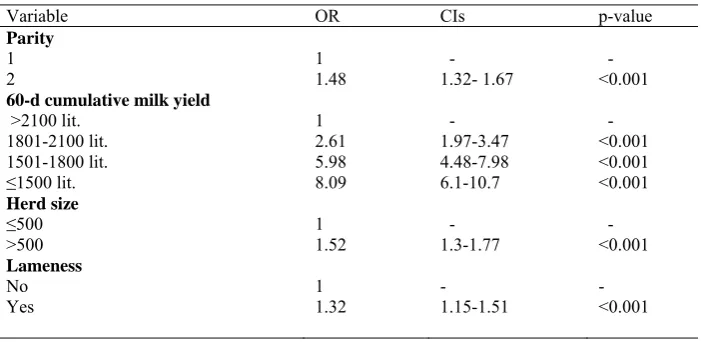
Results-The overall lactational culling rate for eligible cows in the study was 22.09% (95% CI: 19.26-24.9%). Lameness was an important factor in the model and increased odds of culling (OR= 1.32; 95% Confidence interval = 1.15-1.51). Moreover, parity, 60-day cumulative milk yield, and herd size increased culling odds. We did not find evidence for a significant effect of calving season on culling.
Conclusion- Lameness is an important factor in culling decision in dairy herds in this area.
Keywords: culling, dairy cow, logistic regression, Tehran province.
∗
Corresponding author: Hamid Sharifi, DVM, PhD
Department of Food Hygiene and Public Health, Faculty of Veterinary Medicine,
Introduction
Culling in dairy cows is not only complex, but also expensive and challenging.1 Culling is a technique to improve the herd; however, incorrect timing of culling might lead to a suboptimal use of limited replacement resources. Replacement costs are considered as being the second, after feed costs, largest expense for the dairy enterprises. Both biological and managerial factors can affect the culling decision in general. When making a decision, the dairy farmer may consider several major aspects such as illness, milk yield status, conception status, availability of replacements, stage of lactation, and parity.2-3 In other words, the decision to remove a cow from the herd is mainly based on economic considerations and the farmer expects to secure more profit by replacing a cow.4-5
A number of diseases play a role in culling decision and lameness may be one of the most important ones. Lameness is a prevalent disease that affects milk production and reproduction performance.6 Lameness compromises the welfare of affected animals severely and may be the most frequent cause of distress in dairy cattle.7 Therefore, the ultimate cost of a case of lameness is substantially greater than treatment costs alone. For example, the overall cost of lameness is predicted to be £246.22 per case in the United Kingdom.7-9 Although several studies have evaluated the relationship between lameness and culling risk, this effect is a matter of controversy. Studies have shown that the risk of being culled is increased 6-7,10-11, decreased 12, or not affected by lameness or the presence of foot lesions.13-14
Although the effects of lameness on culling have been investigated in several countries
15-16, there is an absence of relevant studies in Iran. Factors identified in other countries can
be used as indicators but cannot be directly extrapolated to Iran due to possible managerial and industrial differences. It the present study, we conducted a historical cohort study with logistic regression analysis to assess the effect of lameness on the odds of culling in dairy herds in Tehran province.
Materials and Methods
Study population and data collection
We gathered data from 32 randomly selected commercial dairy herds located in Tehran province. Commercial dairy herds in this area are predominately comprised of Holstein-Friesian cattle that calve throughout the year and re-breed using artificial insemination. Cows are housed in open-shed barns and milked 2 or 3 times a day. Herds are fed on total mixed rations; diets are based primarily on corn silage, alfalfa hay and concentrates including corn, soya meal, bone meal and mineral supplements.17-18
Only herds with >50 cows and under continuous veterinary supervision (at least one veterinarian visiting as full or part time) were selected. In these herds, only first- and second-parity cows, which calved between March, 21th 2007 and March, 20th 2008 (beginning of the Persian year) were followed up until next calving or culling.
September 21th to December 20th and winter: December 21th to March 20th). Milk classes were chosen as >2100 liter, 1801 to2100 liter, 1501 to 1800 liter and ≤1500 liter. We only considered the inclusion of data on first- and second-parity cows because we were interested in the impact of health disorders on premature culling.8 In addition, the distribution of cows in the first and second lactation accounted for about two-thirds of the animals in each herd.19 Although pregnancy status is also an important factor in culling decisions, we did not include it in the model due to its role as an intervening variable in the disease-culling association.7,20
Statistical Analysis
We utilized logistic regression model through a three-stage model building approach, in order to assess the effect of lameness and other parameters on the odds of culling. The dependent variable was culling status.In the first stage, correlation analysis of independent variables was conducted to identify pairs of variables that essentially contained the same information and had to be removed due to collinearity. In the second stage, univariable analysis was carried to identify variables that were associated with time to culling. During this screening phase, a significance level of 0.20 was used. In the third stage, all variables with P<0.20 were simultaneously offered to a full model which was subsequently, reduced by backwards elimination. The reduced model was compared to the full model by means of the likelihood ratio test. The procedure was repeated until all the remaining variables were significant at P≤0.05. Finally, a stepwise forward selection process was done by offering previously excluded variables to the final model one at a time and retained if significant.21 Data management and analysis were performed using Stata statistical software (StataCorp. 2007. Stata Statistical Software: Release 10.1 College Station, TX: StataCorp LP.).
Results
A total of 7067 cows were included in the analysis. Twenty one out of the 32 herds (65.6%) had a herd size ≤ 500, while 11 (34.4%) had a herd size > 500 cows. The corresponding number of cows was 1459 cows (20.7%) and 5608 cows (79.3%) in each herd category. Overall, there were 3904 (56.4%) and 3163 (43.6%) first and second lactation cows, respectively.
In total, 22.09% (95% CI: 19.26-24.9%) cows were culled during the study; culling in first- and second-parity was18.4% (95% CI: 16.02-20.82%) and 26.58% (95% CI: 23.16-29.99%), respectively.
Table 1: Estimated Odds ratio (OR) and 95% confidence intervals (CIs) for the effect of lameness on culling, under a logistic regression. Estimations were based on data of 7067 Iranian dairy cows reared in 32 dairy herds that calved between 21st March 2007 and 20th March 2008
Variable OR CIs p-value
Parity 1 2
60-d cumulative milk yield >2100 lit.
1801-2100 lit. 1501-1800 lit. ≤1500 lit. Herd size ≤500 >500 Lameness No Yes
1 1.48
1 2.61 5.98 8.09
1 1.52
1 1.32
- 1.32- 1.67
- 1.97-3.47 4.48-7.98 6.1-10.7
- 1.3-1.77
- 1.15-1.51
- <0.001
- <0.001 <0.001 <0.001
- <0.001
- <0.001
Discussion
We employed a logistic regression model to investigate the effect of lameness on the hazard of culling in dairy cows in Tehran province. We realized that lameness is an important factor on culling decision in this area.
A critical step in study design and subsequent model development was the identification of potential intervening and confounding variables.6,21 The role of health disorders as possible risk factors for culling was sometimes investigated without considering any other individual criterion.22 In most studies, however, other individual characteristics of a cow were included in the analysis. These characteristics were analyzed as main effect or confounders with the hypothesis that they may be related both to diseases and to culling. In this way, different variables may be considered as relevant.23 On these grounds, we have excluded pregnancy status from the analysis. Other studies considered pregnancy status to be a confounder 4,24 or an intervening variable.7,11,20,25 Milk yield could also be considered as an intervening variable.26 However, we preferred to treat milk yield as a potential
confounder and also included a 60-day cumulative individual milk yield in the analysis. This milk productivity index is known to better express the productivity potential of a cow and is less affected by the occurrence of most health disorders.1,27 Moreover, use of the 60-day milk yield had the benefit of including more time to culling observations in the analysis without loss of information on the productivity potential compared to more general milk yield indices such as the 305-day cumulative milk yield.28 Additionally, we considered herd size, calving season and parity as potential confounders.
As expected, the odds of culling increased noticeably with parity. Dairy cows have age dependent risk of being culled. The end of the first lactation represents a major decision point with respect to culling. Culling risk for other diseases and injuries also increase with
age.29 Moreover, age and parity were associated with an increase in risk of health
include a herd effect in the analysis. Cows in different herds with identical individual risk factors may not have the same probability of culling.23 Individual culling decisions may be highly dependent on the specific environment of the herd. Furthermore, culling of a particular cow may not only depend on her own characteristics but also on the characteristics of the other cows in the herd and on events occurring at the herd level.23 Within-herd characteristics (availability of heifers, farmer’s attitude towards risk and uncertainty, milk and beef market…) modify the risk for a cow to be culled for a given health disorder.1
Lameness was associated with culling. In accordance with previous reports, we found a positive association between lameness and culling 6-7,10,22 while few authors have reported no association between lameness and culling.13,32 It should be taken into account that the term “feet and leg problems” was not defined consistently and included many different types of afflictions, which made it difficult to relate specific disorders to culling. This generalization could contribute to the discrepancies found in the literature.29
Several aspects should be kept in mind when comparing the results of different studies. The statistical methods used vary among studies as do the model variables; the inclusion of mediating factors, such as milk yield and reproductive performance, can alter the magnitude of the effect of some diseases on culling. Definition of diseases may also vary among studies as well as the number of observations analyzed. The exclusion of particular cows from the analysis (e.g., those with missing milk records) may alter the effect of some diseases on culling. Target populations and breeds of cows vary among studies.2
Conclusions and recommendations
The results of this study show lameness is an important factor on culling in Iranian dairy cows and factors relating to lameness management must be improved in Iranian dairy herds to increase reproductive performance and reduce the risk of culling.
References
1. Beaudeau F, Seegers H, Ducrocq V, et al. Effect of health disorders on culling in dairy cows: a review and a critical discussion. Ann Zootech 2000;49:293-311. 2. Gröhn Y, Eicker S, Ducrocq V, et al. Effect of diseases on the culling of Holstein
dairy cows in New York State. Journal of dairy science 1998;81:966-978.
3. Hultgren J, Svensson C. Heifer rearing conditions affect length of productive life in Swedish dairy cows. Preventive veterinary medicine 2009;89:255-264.
4. Schneider M, Strandberg E, Emanuelson U, et al. The effect of veterinary-treated clinical mastitis and pregnancy status on culling in Swedish dairy cows. Preventive veterinary medicine 2007;80:179-192.
5. Rajala-Schultz PJ, Grohn YT. Culling of dairy cows. Part I. Effects of diseases on culling in Finnish Ayrshire cows. Preventive Veterinary Medicine 1999;41:195-208.
6. Cramer G, Lissemore K, Guard C, et al. The association between foot lesions and culling risk in Ontario Holstein cows. Journal of dairy science 2009;92:2572. 7. Booth C, Warnick L, Gröhn Y, et al. Effect of lameness on culling in dairy cows.
8. Esslemont R, Kossaibati M. Culling in 50 dairy herds in England. The Veterinary Record 1997;140:36.
9. Rajala-Schultz PJ, Gröhn YT. Culling of dairy cows. Part II. Effects of diseases and reproductive performance on culling in Finnish Ayrshire cows. Preventive veterinary medicine 1999;41:279-294.
10. Rajala-Schultz PJ, Gröhn YT. Culling of dairy cows. Part I. Effects of diseases on culling in Finnish Ayrshire cows. Preventive veterinary medicine 1999;41:195-208. 11. Dohoo I, Wayne Martin S. Disease, production and culling in Holstein-Friesian
cows V. Survivorship. Preventive veterinary medicine 1984;2:771-784.
12. Barkema H, Westrik J, Van Keulen K, et al. The effects of lameness on reproductive performance, milk production and culling in Dutch dairy farms. Preventive veterinary medicine 1994;20:249-259.
13. Beaudeau F, Ducrocq V, Fourichon C, et al. Effect of disease on length of productive life of French Holstein dairy cows assessed by survival analysis. Journal of dairy science 1995;78:103-117.
14. Beaudeau F, Frankena K, Fourichon C, et al. Associations between health disorders of French dairy cows and early and late culling within the lactation. Preventive veterinary medicine 1994;19:213-231.
15. Fetrow J, Nordlund K, Norman H. Invited review: Culling: nomenclature, definitions, and recommendations. Journal of dairy science 2006;89:1896-1905. 16. Lee E, Wang J. Statistical methods for survival data analysis: Wiley-Interscience,
2003.
17. Bahonar A, Azizzadeh M, Stevenson M, et al. Factors Affecting Days Open in Holstein Dairy Cattle in Khorasan Razavi Province, Iran; A Cox Proportional Hazard Model. Journal of Animal and Veterinary Advances 2009;8:747-754.
18. Sakha M, Ameri M, Sharifi H, et al. Bovine subclinical ketosis in dairy herds in Iran. Veterinary research communications 2007;31:673-679.
19. Warnick L, Janssen D, Guard C, et al. The effect of lameness on milk production in dairy cows. Journal of dairy science 2001;84:1988-1997.
20. Gröhn YT, González RN, Wilson DJ, et al. Effect of pathogen-specific clinical mastitis on herd life in two New York State dairy herds. Preventive veterinary medicine 2005;71:105-125.
21. Dohoo I, Martin W, Stryhn H. Veterinary epidemiologic research: AVC Inc., 2003. 22. Milian-Suazo F, Erb H, Smith R. Descriptive epidemiology of culling in dairy cows
from 34 herds in New York state. Preventive veterinary medicine 1988;6:243-251. 23. Beaudeau F, Henken A, Fourichon C, et al. Associations between health disorders
and culling of dairy cows: a review. Livestock Production Science (Netherlands) 1993; 35: 213-216.
24. Rajala-Schultz PJ, Gröhn YT. Culling of dairy cows. Part III. Effects of diseases, pregnancy status and milk yield on culling in Finnish Ayrshire cows. Preventive veterinary medicine 1999;41:295-309.
25. Oltenacu P, Frick A, Lindhé B. Epidemiological study of several clinical diseases, reproductive performance and culling in primiparous Swedish cattle. Preventive veterinary medicine 1990;9:59-74.
27. Gröhn Y, Ducrocq V, Hertl J. Modeling the effect of a disease on culling: An illustration of the use of time-dependent covariates for survival analysis. Journal of dairy science 1997;80:1755-1766.
28. Leblanc S. Assessing the Association of the Level of Milk Production with Reproductive Performance in Dairy Cattle. Journal of Reproduction and Development 2010;56:1-7.
29. Monti G, Tenhagen B, Heuwieser W. Culling Policies in Dairy Herds. A. Review. Journal of Veterinary Medicine Series A 1999;46:1-12.
30. Sargeant J, Wayne Martin S, Lissemore K, et al. Associations between milk-protein production and reproduction, health, and culling. Preventive veterinary medicine 1998;35:39-51.
31. Weigel K, Palmer R, Caraviello D. Investigation of factors affecting voluntary and involuntary culling in expanding dairy herds in Wisconsin using survival analysis. Journal of dairy science 2003;86:1482-1486.
32. Beaudeau F, Frankena K, Fourichon C, et al. Associations between health disorders during two consecutive lactations and culling in dairy cows. Livestock Production Science (Netherlands) 1994; 38: 207-216
هﺪﻴﻜﭼ
ناﺮﻬﺗ
نﺎﺘﺳا
يﺎﻫ
يرادوﺎﮔ
رد
يﺮﻴﺷ
يﺎﻫوﺎﮔ
فﺬﺣ
ﺮﺑ
ﺶﮕﻨﻟ
ﺮﺛا
يرﺎﻣآ
لﺪﻣ
ﻲﺳرﺮﺑ
ﺮﻨﻫﺎﺑﺎﺿﺮﻴﻠﻋ 1
ﻲﻔﻳﺮﺷﺪﻴﻤﺣ، 2
و
5 ﻲﻧﺎﮕﺟويﺪﻬﻣ، 3
، ﻲﺋﺎﻜﺑﺪﻴﻌﺳ 1
، ﻲﻧﺎﺷوﺮﻓﻲﻤﻴﺣرسﺎﺒﻋ 4
،
ﺖﺳوﺪﻘﺣﺮﺒﻛاﻲﻠﻋ 5
1
ﺖﺷاﺪﻬﺑهوﺮﮔ ،ﻲﻳاﺬﻏداﻮﻣلﺮﺘﻨﻛو
ناﺮﻳا،ناﺮﻬﺗ،ناﺮﻬﺗهﺎﮕﺸﻧاد،ﻲﻜﺷﺰﭙﻣادهﺪﻜﺸﻧاد
2
ناﺮﻳا،نﺎﻣﺮﻛ،نﺎﻣﺮﻛﺮﻨﻫﺎﺑﺪﻴﻬﺷهﺎﮕﺸﻧاد،ﻲﻜﺷﺰﭙﻣادهﺪﻜﺸﻧاد،ﻲﻳاﺬﻏداﻮﻣوﺖﺷاﺪﻬﺑهوﺮﮔ
3
ناﺮﻳا،ناﺮﻬﺗ،ناﺮﻬﺗهﺎﮕﺸﻧاد،ﻲﻜﺷﺰﭙﻣادهﺪﻜﺸﻧاد،ﻲﻫﺎﮕﻧﺎﻣردمﻮﻠﻋهوﺮﮔ
4
ناﺮﻳا،ناﺮﻬﺗ،ناﺮﻬﺗﻲﻜﺷﺰﭘمﻮﻠﻋهﺎﮕﺸﻧاد،ﺖﺷاﺪﻬﺑهﺪﻜﺸﻧاد،ﻲﺗﺎﻴﺣرﺎﻣآويژﻮﻟﻮﻴﻣﺪﻴﭘاهوﺮﮔ
5
ﺪﻣتﺎﻘﻴﻘﺤﺗﺰﻛﺮﻣ ناﺮﻳا،نﺎﻣﺮﻛ،نﺎﻣﺮﻛﻲﻜﺷﺰﭘمﻮﻠﻋهﺎﮕﺸﻧاد،ﺖﻣﻼﺳرديزﺎﺴﻟ
فﺪﻫ
-ناﺮﻬﺗنﺎﺘﺳايﺎﻫيرادوﺎﮔرديﺮﻴﺷيﺎﻫوﺎﮔفﺬﺣيورﺮﺑﺶﮕﻨﻟﺮﺛاﻲﺳرﺮﺑ .
ﻪﻌﻟﺎﻄﻣحﺮﻃ
-ﻲﺨﻳرﺎﺗﻲﻫوﺮﮕﻤﻫﻪﻌﻟﺎﻄﻣ .
رﺎﻛشوروﻪﻌﻟﺎﻄﻣﺖﻴﻌﻤﺟ
-7067 ﻪﻠﺻﺎﻓردﻪﻛﻦﻳﺎﺘﺸﻠﻫداﮋﻧيﺮﻴﺷوﺎﮔ 1 / 1 / 1386 ﺎﺗ 29 / 12 / 1386 ﺷادﺶﻳاز ﺪﻨﺘ . ﻦﻳا
ﺪﻨﺘﻓﺮﮔراﺮﻗﻪﻌﻟﺎﻄﻣدرﻮﻣفﺬﺣﺎﻳيﺪﻌﺑﺶﻳازﺎﺗﺎﻫوﺎﮔ .
ﺪﺷﻪﺘﻓﺮﮔرﺎﻛﻪﺑﺎﻫهدادﺰﻴﻟﺎﻧآﺖﻬﺟﻚﻴﺘﺴﺠﻟنﻮﻴﺳﺮﮔر .
ﺞﻳﺎﺘﻧ
-ﻪﻌﻟﺎﻄﻣ درﻮﻣ يﺎﻫوﺎﮔﺖﻬﺟ ﻲﻫدﺮﻴﺷ هرود ﻚﻳ رد ﻲﻠﻛ فﺬﺣ ناﺰﻴﻣ 09 / 22 ﺪﺻرد ) نﺎﻨﻴﻤﻃاﻪﻠﺻﺎﻓ 95 ﺪﺻرد : 9 / 24 -26 / 19 ( ﺪﻣآﺖﺳد ﻪﺑ .
ﻣ ردﻢﻬﻣ رﻮﺘﻛﺎﻓﻚﻳ ﺶﮕﻨﻟ ار فﺬﺣﺲﻧﺎﺷ ودﻮﺑقﻮﻓ لﺪ
32 / 1 ) نﺎﻨﻴﻤﻃاﻪﻨﻣادﺎﺑ 95 % ; 51 / 1 -15 / 1 ( دادﺶﻳاﺰﻓاﺮﺑاﺮﺑ .
ﺮﻴﺷﺪﻴﻟﻮﺗناﺰﻴﻣ،ﺶﻳازﻢﻜﺷ،هوﻼﻋﻪﺑ 60
ﺪﻧدادﺶﻳاﺰﻓاارفﺬﺣﺲﻧﺎﺷﻪﻠﮔهزاﺪﻧاوهزور .
ﺪﺸﻧاﺪﻴﭘفﺬﺣوﺶﻳازﻞﺼﻓﻦﻴﺑيرادﻲﻨﻌﻣﻪﻄﺑارﺎﻣا . يﺮﻴﮔﻪﺠﻴﺘﻧ -ﺎﻓﺶﮕﻨﻟ ﻤﻬﻣرﻮﺘﻛ ﻲ
ﺪﺷﺎﺑﻲﻣﻪﻘﻄﻨﻣﻦﻳارديﺮﻴﺷوﺎﮔيﺎﻫﻪﻠﮔردفﺬﺣﺖﻬﺟيﺮﻴﮔﻢﻴﻤﺼﺗرد .
نﺎﮔژاوﺪﻴﻠﻛ