Task-based Collaborative Interaction in a CMC
Environment: A Form-Focused Perspective
Azizullah Mirzaei
1Associate Professor, Shahrekord University, Iran
Farzaneh Taheri
MA in TEFL, Shahrekord University, Iran
Abstract
The study explored the effect of task-based collaborative interactions in a Synchronous Computer-mediated Communication (SCMC) environment on English as a Foreign Language (EFL) learners' development of grammatical knowledge and accuracy of a specified structure, that is, conditional clauses. To this end, at first, two intact EFL-grammar classes from an Iranian university were randomly assigned to control and experimental groups. A grammar test focusing on the above-mentioned structure was used at the pretest and posttest times. The control group learners were exposed to mainstream noncollaborative instruction in which they performed a number of tasks individually within the context of a teacher-fronted classroom. The learners of the experimental group, however, carried out the same planned tasks through peer-peer and teacher-student collaborative interactions in the form of text chats in an SCMC environment (i.e., Skype). Secondly, to trace learners' trajectories of grammatical accuracy, their L2 written outputs produced during the task performance were analyzed, employing the error-free T-unit ratio. The SCMC participants were also interviewed to elicit their attitudes towards employing the approach to grammar instruction. As to grammatical knowledge test, ANCOVA results revealed that the experimental group outperformed the control group in the posttest. In terms of grammatical accuracy, subsequent t-test results indicated significant gains for the SCMC group. Furthermore, learner interviews indicated that most learners had generally positive attitudes toward CMC-oriented grammar instruction. The findings suggested that collaborative interactions in form of text-based exchanges in CMC learning environments can be a useful platform for L2 grammar instruction and learning.
Keywords: Synchronous Computer-mediated Communication, Collaborative interactions, Skype, Grammatical knowledge, Grammatical Accuracy Received on May 6, 2016
Accepted on December 11, 2016
1. Introduction
Since the advent of (social) constructivism as an interesting learning theory within the field of second and foreign language (L2) education, the concept of collaboration has received considerable attention from many researchers and educators. According to Kumar (1996), collaborative learning involves instructional methods that try to facilitate the learning process through collaborative efforts among leaners who work on a given learning task. In essence, it provides an environment in which a learner interacts with his or her collaborative peers to solve a specified problem. Therefore, it can be perceived that peer-peer collaborative interaction is of considerable significance not only in collaborative learning, when viewed from a narrow perspective, but, as Swain (2000) states, in L2 learning process from a broader point of view.
Nonetheless, one of the greatest challenges, which the educators of English as a foreign language (EFL) have to tackle, is how to provide opportunities for peer-peer interactions in the target language and for meaningful purposes. It becomes even more difficult when the instructors also attempt to have learners notice linguistic forms and constructions. In other words, as Meskill and Anthony (2005) state, the practical limitations of teacher-fronted classrooms prevent teachers from providing learners with adequate instructional supports at appropriate moments and engaging them in collaborative interaction while carefully raising their awareness of language forms and structures.
networking sites, and virtual realities which can be used synchronously or asynchronously. These two CMC modes (i.e., synchronous & asynchronous) contain various numbers of modules which, according to AbuSeileek and Qatawneh (2013), can help instructors and administrators in providing ample opportunities for communication among language learners. In fact, the various available affordances of CMC environments, as Abrams (2008) mentions, set the scene for learners to interact, negotiate, and collaborate with each other and, therefore, develop their communicative competence. In addition, the written nature of the dialogues and the interactions carried out in CMC offers learners a "greater opportunity to attend to and reflect on the form and content of the communication" (Kern & Warschauer, 2000, p. 15). This characteristic of CMC, thus, serves a considerable advantage to L2 instructors, helping them attain their goal of attracting learners' attention to L2 forms.
In the same vein, Task-based Language Teaching (TBLT) has been undeniably well recognized by many scholars as one of the most effective and successful approaches to language teaching (e.g., Ellis, 2003; Nunan, 2004). In SLA research, tasks have been widely employed to trigger language production, interaction, collaboration, and focus on form which are all admitted to facilitate L2 learning (Van den Branden, 2006).
capability of sending and receiving feedbacks both among themselves and between the learners and the instructor, and screen sharing. Their grammatical knowledge of the specified structure was, then, compared with that of the learners who were exposed to a noncollaborative task-based approach in a teacher-fronted context. In addition, learners’ probable grammatical ability development with conditional clauses was measured and compared in the two groups mainly by analyzing their L2 written outputs and through a well-known developmental measure of grammatical accuracy, that is, error-free T-unit ratio. Finally, the participants of the SCMC group were interviewed after the treatment in order to express their opinion on employing a task-based collaborative approach to grammar instruction in an SCMC environment.
2. Theoretical Background
2.1 Computer-Supported Collaborative Learning
As a reaction against the development of a software application that promoted an isolated noncollaborative learning environment, Computer-supported Collaborative Learning (CSCL) became increasingly popular in the last decade of the 20th century (Stahl, Koschmann, & Surthers, 2006). CSCL is a burgeoning branch of learning sciences, mainly dealing with how people can learn together with the mediation of computers. Although the concept has a seemingly simple definition, as Stahl et al. (2006) state, it conceals considerable complexity. In fact, the inclusion of such variables as collaboration and computer mediation into any learning processes can make the situation problematic enough, making it even more difficult to apply it to the SLA process.
their ideas and information with other users, to access information and documents, and to give and receive feedback on collaborative problem-solving activities.
There are various types of CSCL environments, and they may include 'groupware' which are particularly developed for CSCL, various CMC tools which are employed for collaborative purposes, or a set of CMC tools simultaneously used in a collaborative objective (Lehtinen, Hakkarainen, Lipponen, Rahikainen, & Muukkonen, 1999). The current study employed an SCMC environment via Skype to trigger task-based collaborative interactions among EFL learners themselves and between the learners and the instructor.
2.2 Peer-Peer Interaction, CMC, and Sociocultural Theory
Generally, CMC-based studies, as Cheon (2008) states, have been shaped within the framework of the Interactionist theory. Recently, though, due to suggestions from a number of scholars (e.g., Chapelle, 2001; Kern & Warschauer, 2000) to approach CMC from a sociocognitive perspective, there have been attempts to carry out CMC-oriented research inspired by sociocultural-theory premises (Lee, 2004; O'Rourke, 2005; Thorne, 2003).
Another important concept within sociocultural theory is Vygotsky's (1978) Zone of Proximal Development (ZPD). What he meant by ZPD can be defined as the gap between a child's "actual developmental level as determined by independent problem solving" and the higher level of "potential development as determined through problem solving under adult guidance or in collaboration with more capable peers" (p. 86). Learning within ZPD, as Aljaafreh and Lantolf (1994) mention, is usually assumed to be based on expert-novice interaction in which an expert (i.e., a parent or a teacher) assists a novice (i.e., a child or a learner) incessantly and contingently. Recently, nonetheless, there has been growing interest (e.g., Foster & Ohta, 2005; Ohta, 2000; Storch, 2002) in extending the scope of ZPD to peer-peer interaction in SLA. According to Lantolf (2000), ZPD is "more appropriately conceived as the collaborative constructions of opportunities for individuals to develop their abilities" (p. 17). This was also properly indicated by Vygotsky himself where he emphasized the role of collaborative learning in helping learners develop through their ZPD. Overall, the sociocultural approach stresses the collaborative effort for the coconstruction of knowledge and meaning in an interpersonal and interactive environment, a fact which highlights the importance of dialogic and dynamic nature of peer-peer interaction.
forms, all of which together can enhance various aspects of learners' L2 knowledge and ability.
2.3 Form-Focused Instruction and CMC
Grammar is conceived as an integral part of any languages without which learning a new language is almost impossible. However, it is considered as one of the most controversial issues within the field of language teaching. The way grammar should be taught to language learners, whether implicitly or explicitly, has been the locus of great controversy (Ellis, 2001). Looking back through the past century, one can get a better grasp of the very fact that along with all ups and downs of different language teaching methods popularity, the position conceived of grammar and the way it should be instructed have been constantly changing.
Grammar instruction, as Richards and Reppen (2014) state, primarily centers on distinguishing between grammatical knowledge and grammatical ability. Grammatical knowledge involves the knowledge of rules which identify the grammaticality of a language. It is an idiosyncratic feature of traditional approaches to grammar instruction in which "learners are provided with opportunities for repetition of the target feature and are expected to perform the grammatical feature correctly" (Ellis, 2003, p. 168). On the other hand, grammatical ability, as Jones (2012) puts it, accounts for learners' ability in using grammar to help them communicate in various spoken and written discourse and, therefore, calls for a different pedagogical approach. This ability enables learners to make accurate grammatical choices in different communicative events such as having an online chat with a friend, writing an e-mail to a colleague, or conversing with someone.
pleasure of fulfilling meaningful and authentic purposes while at the same time focusing on language forms (Larsen-Freeman, 2011).
The burgeoning area of CMC technology, as stated earlier, seems promising for achieving the above-mentioned aim. CMC can create unique learning conditions for L2 learners and present them with communicative opportunities together with useful affordances that were once unimaginable and well beyond their reach. It is suggested that, as a result of such increased opportunities for interaction, the learners be forced to retrieve appropriate forms and functions from their cognitive repository and, therefore, produce more language output which, according to Swain's (1985) Output Hypothesis, 'is a necessary mechanism of acquisition' (p. 252). The role of comprehensible output, according to Swain, is "to provide opportunities for contextualized, meaningful use, to test out hypothesis about the target language, and to move the learner from a purely semantic analysis of the language to a syntactic analysis of it" (p. 252).
Recently, there have been a growing number of studies investigating the efficiency of CMC tools in providing more collaborative learning environments, enhancing learners' interactions, increasing language output, and drawing L2 learners' conscious attention to language forms, all of which seem to promote and facilitate L2 learning. Significant among them are the studies carried out by Appel and Mullen (2000), Kötter (2002), and O'Rourke (2005) which demonstrated that employing collaborative e-mail exchanges and MOOs (object-oriented multiuser domains) affordances were influential in drawing learners' attention to language forms.
language errors personally, and finally enhance interlanguage communication and interaction among L2 learners.
Moreover, Nagata (1996) compared the effect of a computer-mediated instruction with a traditional workbook one on enhancing L2 Japanese learners' morphosyntactic knowledge. The results of the study revealed that the computer-mediated instruction was more influential than the other intervention in learners' internalizing L2 Japanese particles and structures.
Nagata's (1998a, 1998b) following studies also confirmed the findings of her previous one. Nagata (1998a), for instance, examined the efficiency of the two computer-mediated instructional programs, an input-focused and an output-oriented one, on enhancing L2 learners’ knowledge of Japanese honorifics by comparing the performance of two group learners in an achievement, a retention, and an oral test. Nagata (1998b) focused mainly on L2 learners' internalization of Japanese nominal modifiers through the two above-mentioned interventions. The results of both studies revealed that computer-mediated instruction was influential in recognition of the target forms. Nonetheless, the learners in output-based group outperformed the ones in input-based group in the production of the two mentioned structures.
However, the current literature also contains some studies whose findings are not very encouraging. Whereas the findings of some studies report participants’ reduced grammatical accuracy (e.g., Kern, 1995) during computer-mediated instruction, others either suggest the ineffectiveness of CMC in enhancing SLA (e.g., Loewen & Erlam, 2006) or indicate no differences between the grammatical knowledge of the learners being exposed to traditional instruction and the ones who received a hybrid intervention, that is a mixture of class meetings and online computer-mediated instruction (e.g., Chenoweth & Murday, 2003).
3. Purpose of the Study
The results of earlier research have confirmed the positive effect of CMC on peer-peer interaction (e.g., Blake, 2000; Smith, 2003, 2005). Most of the related studies have focused on the L2 learners' meaning negotiation and its effect on developing L2 learners' communicative competence during the interactions (e.g., Lee, 2002; Pellettieri, 2000). Little attention, though, is paid to learners' collaborative efforts, dialogues, and knowledge building in CMC-oriented environments. Even fewer studies have examined this issue in EFL contexts. Due to the significant role of computer technology and especially CMC in SLA and considering the potentials of TBLT for setting the scene for learners’ collaboration and interaction, the study intends to identify the role of CMC in improving EFL learners' grammatical knowledge and ability by exposing the learners to CMC-oriented task-based collaborative interactions and comparing their performances with those who were instructed through a task-based noncollaborative approach in a teacher-fronted context. In particular, the study addressed the following research questions:
1. What is the effect of task-oriented collaborative instruction in an SCMC environment on EFL learners' development of grammatical knowledge and grammatical accuracy?
2. What are Iranian EFL learners' attitudes towards employing a task-based CMC-oriented collaborative approach to grammar instruction?
4. Methodology
4.1 Participants
passed a course in English Grammar (I), they now registered for the course in Grammar (II). From among the whole participants, 60 students from a university in center of Iran, namely, University of Isfahan, took part in different stages of test construction and validation, and the remaining 60 ones from a university in southwest of Iran (i.e., Shahrekord University) constituted the main participants of the current study. In fact, due to institutional constraints, random selection was not possible. However, two intact classes, each consisting of 30 male and female learners, were randomly assigned to experimental (SCMC) and control groups. Although the participants were informed that they were participating in a study, they did not know about the instructional differences involved. The participants fully agreed to take part in the study with anonymous identities.
4.2 Instrumentation
Four types of instruments were employed in the study as follows: a) a general language proficiency test, b) a researcher-made grammar test, c) a developmental ratio measure of accuracy for gauging the participants’ grammatical ability, and d) an open-ended question for interview. The collected data from the last instrument together with the data obtained from the same participants' written diaries during the treatment were examined to answer the last research question of the current study, that is, the participants’ attitudes on employing task-based CMC-oriented collaborative interaction to grammar instruction.
4.2.1 The proficiency test
items, arranged in two sections of structure and written expression (40 items) and reading comprehension (50 items). The estimated reliability of the test (in this study) was α = .93, using Cronbach's Alpha.
4.2.2 The grammar test
A 20-item multiple-choice grammar test was developed by the researchers to be used as the pretest and posttest. The test was used for evaluating the participants' grammatical knowledge of a specific English structure, that is, conditional clauses. To attain the above-mentioned aim, first, a blueprint of a 30-item, multiple-choice test containing detailed item specifications was developed. It was, then, examined by two experts (i.e., two grammar instructors) to ensure its content validity. Upon receiving expert judgment, the test underwent the pilot-testing stage through being administered to 15 EFL freshmen students. It was, then, reduced to 20 items and was confirmed for its content validity. The test, further, went through the succeeding stages to ensure its reliability and concurrent validity. To this aim, a group of 60 undergraduate EFL students, who were all freshmen and at similar proficiency level to the main participants, took the test. The test enjoyed a satisfactory reliability estimate (α = .78), using Cronbach's Alpha.
Moreover, in order to ensure for the test’s concurrent validity, the (Pearson product-moment) correlation between the participants' scores on the grammar test and their performance on the structure section of TOEFL was computed. The results indicated a strong positive correlation (r = .89, p < .01), indicative of a satisfactory concurrent validity.
4.3.3 Measure of accuracy
a well-known developmental measure of grammatical accuracy (i.e., error free T-unit ratio), deemed as a hypothetical anchor of language development by Wolfe-Quintero, Inagaki, and Kim (1998). According to Hunt (1970), T-unit is described as "a main clause plus all subordinate clauses and nonclausal structures attached to or embedded in it" (p. 4).
In language testing and SLA empirical studies, measures of grammatical accuracy are reported from two perspectives of global accuracy, that is, identifying any and all types of error, and specific types of error (Iwashita, Brown, McNamara, & O'Hagan, 2008). In the study, the second perspective, that is, specific types of errors, was employed. Accordingly, an error-free T-unit was defined as a T-unit containing the correct form of the special syntactic structures, that is, conditional clauses.
Additionally, to ascertain the significance of the findings, the study had to provide appropriate estimates of reliability for the chosen measure. Therefore, from the entire data set (i.e., The three final tasks) designated for tracing and appraising the development of learners' grammatical ability, one task was randomly chosen to be scored twice by a second expert scorer in order to check the interrater reliability. To this end, Pearson product-moment correlation coefficients (adjusted-for-two-raters) were calculated, the result of which is summarized in Table 1.
Table 1
Adjusted Interrater Reliability of Grammatical Accuracy Measure
Feature Measure (Adjusted) Reliability
Grammatical Accuracy Error-free T-unit Ratio
(EFT/T) .894
**
**p < .01
4.3 Instructional Materials
4.3.1 The grammatical structure
For the study, an English grammatical structure, that is, conditional clauses, was employed as the target of instruction. To this aim, a frequently-used grammar coursebook at Iranian universities, that is, English Grammar Digest (Aronson, 1984), was employed as the basis for introducing and representing the conditional clauses in English. The reason behind choosing this grammatical structure derives from the results of corpus studies (e.g., Biber, Conrad, & Cortes, 2004) on lexical bundles in academic prose and conversation. According to Biber et al. (2004), conditional clauses together with that clauses, WH-clauses, and causative adverbial clauses are among the most frequently occurring structures in English lexical bundles.
4.3.2 The Software Application
An instant messaging web application called Skype was employed as the SCMC tool for the study. It is a freemium voice-over-IP service which was mainly developed by Zennstrom and Friis in assistance with three programmers named Heinla, Kasesalu, and Tallinn and was finally released in 2003 (Thomann, 2006). Skype provides users with an opportunity to communicate with their peers by voice via a microphone, by video through a webcam, and by instant messaging over the Internet. In this study, instant messaging was chosen as the preferred medium for communication among the peers themselves and between the learners and the instructor.
4.3.3 Tasks and Activities
them to work within it. To this purpose, therefore, a number of three preparatory activities were first selected by the instructor (one of the researchers) to be shared among the learners in the two groups (i.e., SCMC and control) and were then adjusted to meet the requirements of the two learning environments, that is, SCMC and traditional classroom. Examples of these activities included unscrambling words to make meaningful sentences using the appropriate forms of conditional clauses, playing a digital game with a focus on the specified structure, and describing images by making conditional sentences (Appendix A).
The second group, however, included instructor-made tasks which were subsumed under the broader category of structure-based production tasks. The latter involves the kind of grammar tasks through which learners carry out various production exercises and thereby internalize specific target structures (Nassaji & Fotos, 2011). Using the existing materials on the web and those within textbooks, the instructor developed three tasks to be employed in the final sessions of the treatment in the two groups. It is worth mentioning that the tasks were so adapted that they can be performed by the learners in the two learning environments (i.e., SCMC and classroom). In the following, two examples of these task types are explicated. In one task, the learners were provided with four pictures among which they were to choose one picture. They were, then, required to give an imaginary situation to the chosen picture and make as many conditional clauses as they could on the situation. In another task, they were provided with a number of single-paragraph short stories about several individuals, each explicating an event which had happened in their lives. The learners were, then, required to make a number of conditional clauses relevant to each story (Appendix B).
4.4 Procedure
and control groups in Shahrekord University. Then, the TOEFL was administered to the participants of the two groups. The results of an independent sample t-test indicated no significant difference between the mean scores of the two groups in terms of English language proficiency (t(50.7) = .291, p = .77, p > .05). In the next session, the grammar test was administered as the pretest to the learners of the two groups.
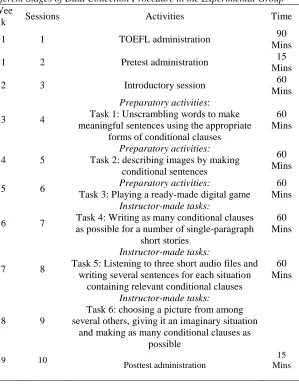
After taking the pretest, the control group learners were exposed to a task-based noncollaborative approach to grammar instruction in a traditional teacher-fronted context. In the first session of the instruction, the instructor illustrated the conditional clauses to the learners clearly. For all subsequent sessions, they were presented with six relevant tasks and activities to be performed individually during a definite time span in the classroom. The first three activities were of the preparatory type and the last three ones were instructor-made tasks designated to trigger learners' written L2 output. The control group treatment continued for a total of seven sessions (each for 60 minutes), excluding TOEFL, pretest, and posttest administration sessions.
group. Table 2 displays the different phases of data collection procedure in the SCMC group:
Table 2
Different Stages of Data Collection Procedure in the Experimental Group Wee
k Sessions Activities Time
1 1 TOEFL administration 90
Mins
1 2 Pretest administration 15
Mins
2 3 Introductory session 60
Mins
3 4
Preparatory activities: Task 1: Unscrambling words to make meaningful sentences using the appropriate
forms of conditional clauses
60 Mins
4 5
Preparatory activities: Task 2: describing images by making
conditional sentences
60 Mins
5 6 Preparatory activities:
Task 3: Playing a ready-made digital game
60 Mins
6 7
Instructor-made tasks:
Task 4: Writing as many conditional clauses as possible for a number of single-paragraph
short stories
60 Mins
7 8
Instructor-made tasks:
Task 5: Listening to three short audio files and writing several sentences for each situation
containing relevant conditional clauses
60 Mins
8 9
Instructor-made tasks:
Task 6: choosing a picture from among several others, giving it an imaginary situation
and making as many conditional clauses as possible
9 10
Posttest administration
15 Mins
perform the specified tasks. Furthermore, they had the instructor as the coordinator and the one who was ready to guide learners and help them by scaffolding various opportunities for active negotiation and collaboration. This, in turn, provided the learners with plenty of opportunities to use the particular structure for meaningful purposes, to notice the forms they were using, to enjoy the instructor immediate feedback on their output, and, finally, to enhance their learning processes through active collaboration and coconstruction of L2 forms. After the treatment, the learners in both control and experimental groups were given the aforementioned grammar test as the posttest.
data from the two groups underwent further statistical analysis to yield the intended results.
In the end, the participants of the SCMC group were interviewed with an open-ended question. The collected data from these interviews together with the data obtained from the same participants' written diaries during the treatment were examined qualitatively to reflect their perspectives on employing an approach to grammar instruction which involved task-based collaborative dialogues in an SCMC environment.
5. Results
The study pursued the three following main objectives: firstly, it examined the probable superiority of task-based computer-mediated collaborative interactions over a traditional noncollaborative approach in improving EFL learners' grammatical knowledge of conditional clauses, secondly, it traced, measured and compared the probable development of SCMC and control group learners in terms of grammatical ability of conditional clauses, and thirdly, it reflected EFL learners' attitudes towards employing task-based CMC-oriented collaborative interactions for improving their grammatical knowledge and ability.
5.1
Grammar Test Results
Table 3
Descriptive Statistics for Groups' Pretest and Posttest
As demonstrated in Table 3, the skewness and kurtosis values were well within a satisfactory range of ±2, implying, in turn, the normal distribution of the data. Furthermore, the groups' mean scores ranged from 6.60 with a standard deviation of 3.39 for the control group at the pretest to 16.03 with a standard deviation of 2.15 for the experimental group at the posttest. A closer look at the results revealed fairly similar mean scores for the two groups on the pretest including (M = 6.60, SD = 3.39) and (M = 7.60, SD = 2.76) for the control and the experimental groups, respectively. Over time, however, the mean scores came to be different on the posttest, a fact which could be due to the influence of the intervention, so that the control group yielded a mean of 8.30 with the standard deviation of 2.70 while the posttest mean score for the experimental group was 16.03 with a standard deviation of 2.15.
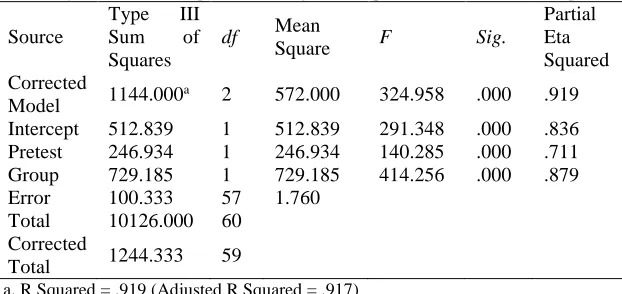
A one-way between-groups analysis of covariance (ANCOVA) was employed in order to evaluate the significance of the difference between the groups' posttest mean scores. The independent variable, being titled as Group in the analysis, was the type of pedagogical instruction (noncollaborative task performance & SCMC-based collaborative interactions). EFL learners’ posttest scores on the grammar test were labeled as the dependent variable and their pretest scores were included as the covariate in the analysis to control for preexisting grammatical knowledge differences between the groups. In order to make certain that there was no violation of underlying assumptions including normality, homogeneity of variance, linearity, and Group Test N Min Max Mean SD Skewness Kurtosis Control Pretest 30 1 13 6.60 3.39 .22 -1.03
Posttest 30 4 14 8.30 2.70 .46 -.62 Experimental Pretest 30 2 14 7.60 2.76 .39 .26
homogeneity of regression slopes, some preliminary checks were first conducted. Table 4 shows the ANCOVA results.
Table 4
One-Way Between-Groups ANCOVA for Groups' Grammatical Development
Source
Type III Sum of Squares
df Mean
Square F Sig.
Partial Eta Squared Corrected
Model 1144.000
a 2 572.000 324.958 .000 .919 Intercept 512.839 1 512.839 291.348 .000 .836 Pretest 246.934 1 246.934 140.285 .000 .711 Group 729.185 1 729.185 414.256 .000 .879 Error 100.333 57 1.760
Total 10126.000 60 Corrected
Total 1244.333 59
a. R Squared = .919 (Adjusted R Squared = .917)
As it is evident from Table 4, the results confirmed the existence of a significant difference among the two groups' post-intervention scores on the grammar test, F (1, 57) = 414.256, p = .000, p < 0.05. The partial eta squared value was found to be about 0.879, suggesting a large effect size for the posttest difference using Cohen's (1988) guidelines (.01 = small .06 = moderate .14 = large). Therefore, it can be safely claimed that there is a significant difference among the groups' posttest mean scores which was mainly due to the type of instruction employed for each group. That is to say, task-based collaborative dialogues in an SCMC environment positively influenced learners’ construction and development of L2 grammatical knowledge of conditional clauses.
5.2 Grammatical Ability Assessment Results
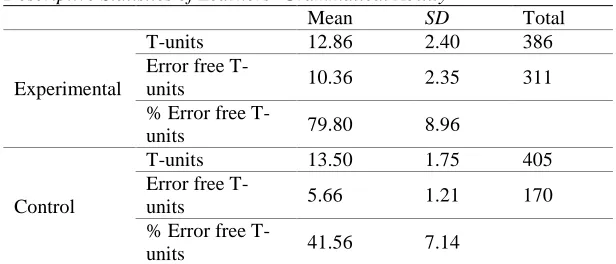
outputs, employing the grammatical accuracy measure, that is, error free T-unit ratio:
Table 5
Descriptive Statistics of Learners’ Grammatical Ability
Mean SD Total
Experimental
T-units 12.86 2.40 386
Error free
T-units 10.36 2.35 311
% Error free
T-units 79.80 8.96
Control
T-units 13.50 1.75 405
Error free
T-units 5.66 1.21 170
% Error free
T-units 41.56 7.14
According to Table 5, the means of error free T-units in experimental and control groups were 10.36 (SD = 2.35) and 5.66 (SD = 1.21), respectively, yielding the mean percentages of error free T-unit ratios which equaled to 79.80 (SD = 8.96) and 41.56 (SD = 7.14) for experimental and control groups, respectively. A closer look at the results revealed an apparent difference in the ratio means in favor of the experimental group, indicating a higher grammatical ability of its learners as compared with the control group ones. More inferential statistics, however, were required to confirm the significance of the mean difference.
Table 6
Independent Samples t-test for the Grammatical Ability between the two Groups
t df Sig.a Mean difference Grammatical ability 18.27 58 .000 38.23 a two-tailed at .05
As Table 6 shows, the ratio means difference between the experimental and control groups for the grammatical ability index was statistically significant (t(58) = 18.27, *p < .05). The magnitude of the differences in the means was large (mean difference = 2.09, 95% CI: 34.04 to 42.42) with an eta squared value of 0.85. In sum, it can be inferred that the experimental (SCMC) group learners displayed higher trajectories of development in terms of grammatical accuracy which, in turn, implied their superior grammatical ability as compared with the control group learners.
5.3 Diaries and Interviews: A Qualitative Analysis
As mentioned earlier, EFL learners in the CMC-oriented (i.e., experimental) group were interviewed after the treatment with an open-ended question. They were asked to express their attitudes and explain their rationale about employing task-based collaborative interactions in an SCMC environment for the very purpose of grammar instruction. In addition, they were requested to keep diaries during the treatment in order to put forward their views on learning experience in CMC-oriented virtual environment, to evaluate the quality of the presented tasks in each session, and, finally, to pinpoint the perceived problems and the existing challenges of a task-based computer-mediated instruction in the current educational system. Interpretative analysis was carried out to reflect the important relevant themes from the learners' comments in diaries and interviews.
5.2.1 Attitudes and perceptions
environment. They admitted that the computer-mediated project was an innovative, interesting, and beneficial experience through which they could put their grammatical knowledge into use. They believed that integrating technology into the educational system would help the learners to be up-to-date and to enjoy the affordances of one of the world's recent technological advancements in education. Moreover, some others enjoyed the very fact that they could notice the errors and mistakes in their output through the instructor’s and the peers' feedbacks and comments. More interestingly, some of them stated that when they could work together and comment on their peers' writing tasks, they would become aware of their own mistakes. In other words, collaborative work with the peers and commenting on their output had provided the learners with opportunities to improve their own learning process. As far as the SCMC tool was concerned, some of the learners were pleased that they could see their sentences while chatting, a fact which had made them notice the words they were using. In the following, a few typical examples of learners’ comments on the CMC project are presented:
• Mahtab, 22, female, the SCMC group:
I believe that the project was really helpful and beneficial. I already had learned the conditional clauses through the traditional methods, but in this project, we had a chance to do various tasks with the help of our classmates and we could use the structures in several situations.
• Ali, 21, male, the SCMC group:
I think it was so interesting that I could comment on my classmates' sentences when we were doing the tasks together. It was very helpful and useful for me because my grammatical knowledge improved in this way.
• Parvin, 22, female, the SCMC group:
5.2.2 Challenges and problems
A number of learners also pointed out the problems they experienced during the CMC project. Their primary challenges were mainly related to technological issues such as difficulty in having access to a high-speed Internet connection and sometimes a general lack of sufficient rudimentary computer knowledge. The following examples demonstrate the learner’s opinions on the issue:
• Amir, 19, male, the SCMC group:
I think it is a good way to learn the grammar but there were some problems about the low speed of Internet.
• Maryam, 20, female, asynchronous group:
I think it is a new program that need time to be used by everybody and everywhere. The users should be up-to-date and have good computer knowledge. But its variety is more than the traditional system of teaching and learning.
6. Discussion
The study was firstly an attempt to examine the possible effect of two instructional interventions (i.e., task-based CMC-oriented collaborative interaction & task-based noncollaborative instruction in a traditional classroom) on enhancing EFL learners’ grammatical knowledge of conditional clauses. In addition, it sought to trace, measure, and compare the probable development of learners' grammatical ability in terms of conditional clauses through the mentioned approaches in two specified groups (i.e., SCMC and control). Finally, the participants of the SCMC-oriented group were interviewed after the treatment to give their perspectives on employing a task-based computer-mediated collaborative approach to grammar instruction.
forms and encouraged collaborative knowledge construction among them. The findings seem to be consistent with those from previous studies in which CMC-oriented collaboration drew L2 learners' conscious attention to language forms (e.g., O'Rourke, 2005; Zeng & Takatsuka, 2009).
Several factors contribute to the efficiency of SCMC-oriented collaborative work within the current study. First, SCMC-based courses, as practical instances of computer-mediated instruction, integrate the benefits of traditional classroom-based instruction with various affordances of virtual environments and provide EFL learners with unique situations to use the target language for meaningful purposes through collaborative efforts and exchanges. Traditional classroom-based courses have the advantage of an expert L2 user called instructor who can teach the target language effectively and help learners improve their L2 proficiency by providing them with suitable situations to practice the target language. Various affordances of virtual environments, on the other hand, enable L2 learners to be in contact with each other anytime and anywhere, and, as Salmon (2003) states, give them an opportunity to create their own learning communities through which they can learn together, take advantage of other learners' ideas, have access to different information resources, and enjoy the assistance of skillful mediators and mentors.
discussion, learners are mainly concerned with getting their meaning across whereas during the interaction through the written form, they are inclined to zero in on language forms. Due to the very fact that SCMC shares the features of both written and oral contexts, it can create an optimal balance between form and meaning and, consequently, facilitate L2 learners' language development.
Finally, many SLA scholars (e.g., Anton, 1999; Belz, 2002; Cook, 2001) believe that learning an L2 is facilitated when L2 learners are provided with interactional opportunities in which the instructor guide and assist them in their communicative efforts and at the same time draw their attention to L2 forms. Distinctive characteristics of SCMC environment make it surpass many perceived limitations of teacher-fronted classrooms and set the scene for any FFI which is facilitated through instructor-scaffolded and also peer-scaffolded interactions and communication. According to Kern, Ware, and Warschauer (2004), the visual display of learners' utterances during the communication in CMC environments "allows greater opportunity to attend to and reflect on the form and content of the communication" (p. 244). It, therefore, enables the instructor or other peers to call the learners' attention to whatever structures, statements, or forms they intend.
The results of investigating the second concern of the study revealed that task-based collaborative interaction in an SCMC environment triggered EFL learners’ grammatical ability development more than a noncollaborative task-based approach in a traditional teacher-fronted classroom.
other words, as Stockwell mentions, learners prefer to draw on those grammatical forms and structures that they perceive to be accurate at the time and avoid using the structures they are not sure of. This very reason also prevents them from making more complex structures and make them to produce simpler and, therefore, shorter forms and structures which also give them a feeling of being more accurate.
Another explanation may relate to the presence of the instructor during the interactions and task performance processes within the study. In fact, the presence of the instructor may have had reduced the learners' risk-taking behavior which, in turn, have had prompted them to take care when producing their language outputs and, therefore, to avoid any probable embarrassment.
earlier, instructors cannot support their learners with instructional tips and corrections at appropriate moments which may render their feedback and comments inefficient for enhancing the accuracy of learners' L2 output as much as the instructor's or peers' immediate feedback can do in SCMC-oriented contexts.
Overall, as far as L2 learners' grammatical ability development is concerned, the results of the current study agree with the findings of Stockwell's (2010) study, on the one hand, and contrast with the results reported by Sotillo (2000) and Hwang (2008) on the other, in a way that language learning and interaction in an SCMC environment was influential in triggering EFL learners' grammatical accuracy, which, in turn, indicated their grammatical ability development in the current study. The finding also confirms the results of examining the first research question within the current study in which SCMC-based task performance and collaboration led to the development of EFL learners' grammatical knowledge compared with the traditional teacher-fronted context of the control group.
As far as the second research question of the study was concerned, the results of interviews from EFL learners in CMC-oriented group indicated that most of the learners had unanimously positive attitudes toward employing a task-based computer-mediated collaborative approach to grammar instruction.
interaction. Third, compared with the traditional teacher-fronted contexts, CMC-oriented approach provided learners with more interactive opportunities, which, in turn, helped them to notice their error, to be forced to modify their output, and finally to strengthen their existing linguistic knowledge. Finally, the learners reported that they felt a sense of being up-to-date and kept the same pace with the rest of the world when such a technology-mediated approach was integrated into their regular academic course.
7. Conclusion
Mostly influenced by the premises of sociocultural theory, the study set out to examine the effect of task-based CMC-driven collaborative interaction on EFL learners' grammatical knowledge development. The results indicated that learners' collaborative efforts and exchanges in form of text chats during the task performance in an SCMC environment indeed enhanced learners' grammatical knowledge of a specified English structure, that is, conditional clauses. The second aim of the study was to trace, measure, and compare the learners’ trajectories of grammatical ability development in terms of conditional clauses in the SCMC (i.e., experimental) and control groups. The results suggested higher levels grammatical ability on the part of EFL leaners in SCMC group compared with their counterparts in the control group. Finally, the results of the qualitative analysis carried out on learners' interviews and diaries revealed that almost all of the EFL learners within the study favored a task-based computer-mediated collaborative approach to grammar instruction.
of the classroom, to provide EFL learners with ample opportunities to put their L2 knowledge into use, to create supportive and collaborative learning environments for learners, to encourage them to form electronic learning communities, and, finally, to enhance the process of learners' L2 learning.
References
Abrams, Z. I. (2003). The effect of synchronous and asynchronous CMC on oral performance in German. The Modern Language Journal, 87(2), 157-167.
Abrams, Z. I. (2008). Sociopragmatic features of learner-to-learner computer-mediated communication. CALICO Journal, 26(1), 1-27.
AbuSeileek, A. F., & Qatawneh, K. (2013). Effect of synchronous and asynchronous computer-mediated communication (CMC) oral conversations on English language learners' discourse functions. Computer & Education, 62, 181-190.
Aljaafreh, A., & Lantolf, J. P. (1994). Negative feedback as regulation and second language learning in the zone of proximal development. Modern Language Journal, 78(4), 465-483.
Anton, M. (1999). The discourse of a learner-centered classroom: Sociocultural perspective on teacher-learner interaction in the second-language classroom. The Modern Language Journal, 83(3), 303-318. Appel, C., & Mullen, T. (2000). Pedagogical considerations for a web-based
tandem language learning environment. Computers & Education 34(3-4), 291-308.
Aronson, T. (1984). English grammar digest. Englewood Cliffs, NJ: Prentice-Hall.
Belz, J. A. (2002). Social dimensions of telecollaborative foreign language study. Language Learning & Technology, 6(1), 60-81.
Biber, D., Conrad, S., & Cortes, V. (2004). If you look at …: Lexical bundles in university teaching and textbooks. Applied Linguistics, 25(3), 371-405. Blake, R. (2000). Computer mediated communication: A window on L2
Spanish interlanguage. Language Learning & Technology, 4(1), 120-136. Chapelle, C. A. (2001). Computer applications in second language
acquisition: Foundations for teaching, testing, and research. Cambridge, England: Cambridge University Press.
Cheon, H. (2008). Sociocultural theory and computer-mediated communication-based language learning. Working Papers in TESOL & Applied Linguistics, 8(1), 1-3.
Cohen, J. W. (1988). Statistical power analysis for the behavioral sciences (2nd ed.). Hillsdale, NJ: Lawrence Erlbaum.
Cook, V. (2001). Second language teaching and learning. New York: Arnold.
Ellis, R. (2001). Investigating form-focused instruction. Language Learning, 51(Suppl. 1), 1-46.
Ellis, R. (2003). Task-based language learning and teaching. Oxford University Press.
Foster, P., & Ohta, A. S. (2005). Negotiation for meaning and peer assistance in second language classrooms. Applied Linguistics, 26(3), 402-430. Hsiao, J. W. D. L. (1996). CSCL theories. Retrieved from
http://viking.coe.uh.edu/~shwang/master_portfolio/social%20constructivi sm/Hsiao.doc
Hunt, K. W. (1970). Syntactic maturity in school children and adults. Monographs of the Society for Research in Child Development, 35(1, Serial No. 134).
Hwang, P. A. (2008). Linguistic characteristics in synchronous and asynchronous CMC. English Language & Literature Teaching, 14(2), 47-66.
Iwashita, N., Brown, A., McNamara, T., & O'Hagan, S. (2008). Assessed levels of second language speaking proficiency: How distinct? Applied Linguistics, 29(1), 24-49.
Jones, W. (2012). Assessing students’ grammatical ability. In C. Coombe, P. Davidson, B. O' Sullivan, & S. Stoynoff (Eds.), The Cambridge guide to second language assessment (pp. 247-256). Cambridge, England: Cambridge University Press.
Kelm, O. R. (1992). The use of synchronous computer networks in second language instruction: A preliminary report. Foreign Language Annals, 25(5), 441-454.
Kern, R. G. (1995). Restructuring classroom interaction with networked computers: Effects on quantity and characteristics of language production. The Modern Language Journal, 79(4), 457-476.
Kern, R., Ware, P., & Warschauer, M. (2004). Crossing frontiers: New directions in online pedagogy and research. Annual Review of Applied Linguistics, 24, 243-260.
Kötter, M. (2002). Tandem learning on the Internet: Learner interactions in virtual online Environments (MOOs). Frankfurt, Germany: Peter Lang. Kumar, V. S. (1996). Computer-supported collaborative learning: Issues for
research. Eighth Annual Graduate Symposium on Computer Science, University of Saskatchewan, Saskatchewan, Canada.
Lantolf, J. P. (2000). Introducing sociocultural theory. In J. Lantolf (Ed.), Sociocultural theory and second language learning (pp. 1–26). Oxford, England: Oxford University Press.
Larsen-Freeman, D. (2011). Teaching grammar versus teaching grammaring. Retrieved from http://www.cornelsen.de/shop/capiadapter/download/get/ file/%20pfu20110105.pdf?fileNr=1&sku=3-464-00072326-0&callerId= SBK3
Lee, L. (2002). Synchronous online exchanges: A study of modification devices on non-native discourse. System, 30 (3), 275-288.
Lee, L. (2004). Learners' perspectives on networked collaborative interaction with native speakers of Spanish in the US. Language Learning & Technology, 8(1), 83-100.
Lehtinen, E., Hakkarainen, K., Lipponen, L., Rahikainen, M., & Muukkonen, H. (1999). Computer supported collaborative learning: A review. Retrieved from http://comlab.hut.fi/opetus/205/etatehtava1.pdf
Loewen, S., & Erlam, R. (2006). Corrective feedback in the chatroom: An experimental study. Computer Assisted Language Learning, 19(1), 1-14. McQuail, D. (2005). McQuail's mass communication theory (5th ed.).
London: Sage.
Meskill, C., & Anthony, N. (2005). Foreign language learning with CMC: Forms of online instructional discourse in a hybrid Russian class. System, 33(1), 89-105.
Nagata, N. (1996). Computer vs. workbook instruction in second language acquisition. CALICO Journal, 14(1), 53-75.
Nagata, N. (1998a). Input vs. output practice in educational software for second language acquisition. Language Learning and Technology, 1(2), 23-40.
Nagata, N. (1998b). The relative effectiveness of production and comprehension practice in second language acquisition. Computer Assisted Language Learning, 11(2), 153-177.
Neumann, H. (2014). Teacher assessment of grammatical ability in second language academic writing: A case study. Journal of Second Language Writing,24(1), 83-107.
Nunan, D. (2004). Designing tasks for the communicative classroom. Cambridge University Press.
Ohta, A. S. (2000). Rethinking interaction in SLA: Developmentally appropriate assistance in the zone of proximal development and the acquisition of L2 grammar. In J. Lantolf (Ed.), Sociocultural theory and second language learning (pp. 51-78). Oxford, England: Oxford University Press.
O'Rourke, B. (2005). Form-focused interaction in online tandem learning. CALICO Journal, 22(3), 433-466.
Ortega, L. (2009, September). Task and technology in language learning: Elective affinities and (dis)encounters. Plenary delivered at the Third International Task-based Language Teaching Conference, Lancaster, UK. Pellettieri, J. (2000). Negotiation in cyberspace: The role of chatting in the
development of grammatical competence. In M. Warschauer & R. Kern (Eds.), Networked-based language teaching: Concepts and practice (pp. 59-86). New York: Cambridge University Press.
Quirk, R., Greenbaum, S., Leech, G., & Svartvik, J. (1985). A comprehensive grammar of the English language. New York: Longman.
Richards, J. C., & Reppen, R. (2014). Towards a pedagogy of grammar instruction. RELC Journal, 45(1), 5-25.
Salaberry, M. R. (2000). L2 morphosyntactic development in text-based computer-mediated communication. Computer Assisted Language Learning, 13(1), 5-27.
Salmon, G. (2003). E-moderating: The key to teaching and learning online (2nd ed.). London: Routledge.
Smith, B. (2003). Computer-mediated negotiated interaction: An expanded model. Modern Language Journal, 87(1), 38-57.
Smith, B. (2005). The relationship between negotiated interaction, learner uptake, and lexical acquisition in task-based computer-mediated communication. TESOL Quarterly, 39(1), 33-58.
Sotillo, S. M. (2000). Discourse functions and syntactic complexity in synchronous and asynchronous communication. Language Learning and Technology, 4(1), 82-119.
Stockwell, G. (2010). Effects of multimodality in computer-mediated communication tasks. In M. Thomas & H. Reinders (Eds.), Task-based language learning and teaching with technology (pp. 83-104). New York: Continuum.
Storch, N. (2002). Patterns of interaction in ESL pair work. Language Learning, 52(1), 119-158.
Swain, M. (1985). Communicative competence: Some roles of comprehensible input and comprehensible output in its development. In S. Gass & C. Madden (Eds.), Input in second language acquisition (pp. 235-252). Rowley, MA: Newbury House.
Swain, M. (2000). The output hypothesis and beyond: Mediating acquisition through collaborative dialogue. In J. Lantolf (Ed.), Sociocultural theory and second language learning (pp. 97–114). Oxford, England: Oxford University Press.
Thomann, A. (2006). Skype: A Baltic success story. Retrieved from http://archive.is/FrClU
Thorne, S. L. (2003). Artifacts and culture-of-use in intercultural communication. Language Learning & Technology, 7(2), 38-67.
Van den Branden, K. (2006). Task-based language teaching in a nutshell. In K. Van den Branden (Ed.), Task-based language education: From theory to practice (pp. 1-16). Cambridge University Press.
Vygotsky, L. S. (1978). Mind in society: The development of higher psychological processes. Cambridge, MA: Harvard University Press. Warschauer, M. (1997). Computer-mediated collaborative learning: Theory
and practice. The Modern Language Journal, 81(4), 470-481.
Wolfe-Quintero, K., Inagaki, S., & Kim, H. Y. (1998). Second language development in writing: Measures of fluency, accuracy, and complexity. Honolulu, HI: Second Language Teaching & Curriculum Center, University of Hawaii at Manoa.
Yates, S. J. (1996). Oral and written linguistic aspects of computer conferencing: A corpus based study. In S. C. Herring (Ed.), Computer-mediated communication: Linguistic, social, and cross-cultural perspectives (pp. 29-46). Amsterdam: John Benjamins.
Appendix A:
Two Example of Preparatory Web Activities
Adjusted for SCMC Environment
Adjusted for Classroom Setting
Conditional Clauses
Joe and Alex are talking on the phone. Alex has a girl problem. It's not a serious girl problem. They're not planning a wedding, and Alex doesn't have plans to buy matching tungsten rings just yet, but who knows what will happen if Alex follows Joe's advice, maybe it could lead to a search to buy tungsten wedding bands.
Each of conditional sentences is missing a verb. Use the italicized words after each sentence and type the correct form. Notice that some of the sentences are real conditionals and others are unreal. When you have finished, click “check.”
Joe: Hey, Alex, what's up?
Alex: Nothing... you know, I really like this girl, and I want to ask her out.
Joe: So, what's the problem?
Alex: Well, what if I --- her and she said no? (ask)
Joe: Why would she say no?
Alex: Well, maybe if I --- in a band, she'd go out with me. Do you want to start a band? (be)
Joe: No. You don't even play an instrument. That's crazy.
Alex: Yeah. Well, I think her last boyfriend had a really cool car. Maybe if I --- a nicer car, she'd say yes. (have)
Joe: You're lucky to have a car.
Alex: I don't know. She's really pretty. If I --- better-looking, she might say yes. (be) Joe: You look fine. You can't worry about that.
Alex: Well, if I --- more money, I could take her to a really nice restaurant. Hey,
Joe: No way, then she'd expect you to take her to nice restaurants all the time.
Alex: Yeah, you're right.
Joe: Look, maybe if you --- so nervous about it, she'd say yes. Just be yourself and ask her out. If she --- you, she'll go out with you. (be, like)
Alex: Yeah, you're right. I'll call her and ask her out.
Joe: Great. I'll see you later. Let me know what happens.
Alex: Okay... Wait Joe. Wait. What if she --- yes, but she really doesn't like me? Joe? Joe? (say)
Appendix B:
An Example of Structure-based Production Tasks Make conditional sentences for the stories below:
He won the lottery. He met a beautiful woman. They got married. She met someone else. They got divorced. She took half of his money
1. If he hadn't won the lottery ……… 2. If they hadn't met ………...… 3.……….………. 4. ………...…..
He had his first tennis lessons in primary school. He liked the lessons and he joined a tennis club. He trained at the club twice a week. He won the local tennis tournament. A talent scout spotted him at the tournament and offered him a tennis scholarship in America. He went to America. He became the best tennis player in the world.