*Corresponding author:[email protected]
TELL, Vol. 8, No. 2, Fall & Winter 2014, pp.91-117
Teaching requestive downgraders in L2: Can
learners’ MI modify the effects of focused
tasks?
1 Abdolhossein Ahmadi
Assistant Professor, Islamic Azad University, Larestan Branch
Reza Ghafar Samar
Associate Professor, Tarbiat Modares University
Received on March 25, 2013 Accepted on January 5, 2014
Abstract
92 TELL, Vol. 8, No. 2
Teaching requestive downgraders in L2
learners’ recognition ability. While the effects of MI were not significant on pragmatic measures, a significant interaction in favor of learners with an inclination to interpersonal and linguistic intelligences was respectively observed for the participants in the DIG and CR tasks.
Keywords: consciousness raising task, dictogloss task, input/output based tasks, interpersonal vs. linguistic intelligences, pragmatics, request, requestive downgraders
1. Introduction
Attaching the same significance to pragmatics as to the other SLA components, Kasper and Rose (1999) state that, from the interlanguage pragmatic (ILP) perspective, pragmatics is akin to morphosyntax, lexis and phonology with the same restrictions on learners’ knowledge, use and acquisition of second language pragmatics. Although Rose and Kasper (2001) attest to the paucity of research in L2 pragmatics, ILP researchers have recently shown their interest in the application of the principles of instructed SLA to the realm of pragmatics.
In this regard, Alcon-Soler and Martinez (2005) claim that pragmatic studies should be subjected to the same three conditions as any other types of knowledge in the target language, namely appropriate input, opportunities for output and feedback provision. Contrary to what Alcon-Soler and Martinez propose, the bulk of the studies have drawn their attention to the implicit and explicit teaching of pragmatic features (e.g., Alcon-Soler, 2005; House, 1996; Takahashi, 2001; Tateyama, 2001; Yoshimi, 2001) or examined the effects of input-based tasks on the learners’ enhancement of pragmatic competence (i.e., Takimoto, 2006, 2009). The instructed ILP studies have rarely compared the effects of input-based and output-based tasks on learners’ enhancement of pragmatic features.
TELL, Vol. 8, No. 2 93
Ahmadi and Ghafar Samar
oblivion. In this regard, Robinson (1997, 2005) argues for investigating the interaction of ID variables with specific learning processes such as attention and noticing. He states that similar to studies focusing on morphosyntactic features, it would be advisable to investigate the possible effect of ID variables on the processing of L2 pragmatic input.
In line with the foregoing discussions and as a follow-up to Ahmadi, Ghafar Samar, and Yazdani Moghaddam’s (2011) study, this study explores the role of MI as an individual factor in modifying the effects of the focused tasks on the EFL learners’ acquisition of L2 pragmatic features.
To fulfill the goal of the study, the researchers utilized consciousness raising (CR) as an input-based task and dictogloss (DIG) as an output based task to consider the interaction effects of these tasks and EFL learners’ MI on the development of requestive downgraders. Ahmadi et al. (2011) argue why they delimited the scope of their study to the request and, more specifically, to internal requestive downgraders. Inspired by Gardner’s (1993) definitions of the interpersonal and linguistic intelligences and its close relation to Leech’s (1983) division of pragmatics into sociopramatics and pragmalinguistics, the researchers consider the inclusion of these two intelligences to examine how they modify the effects of CR and DG tasks on the learning of requestive downgraders.
2. Literature Review
2.1 ILP Studies and Individual Differences
94 TELL, Vol. 8, No. 2
Teaching requestive downgraders in L2
more salient. Robinson (2005) also stipulates the necessity for the investigation of the influence of ID in studies implemented under different conditions of exposure or task types.
Despite its significance, the role of ID in the instructed ILP studies has not been deeply researched. In this regard, Takahashi (2005) unveiled a relationship between learners’ motivation and the noticing of pragmalinguistic features under the implicit input condition. In the current study, the researchers sought to uncover the awareness of pragmalinguistic features under the explicit conditions. Since the instructional treatments were implemented explicitly through an input-based and an output-based task, the researchers were interested in exploring whether learners’ inclination to linguistic or interpersonal intelligence can modify the results to the advantage of learners’ with a particular intelligence profile.
2.2 Form Focused Instruction (FFI)
Due to the EFL learners’ needs for more formal instruction on the internal requestive downgraders (Faerch & Kasper, 1989; Hassel, 2001), this pragmatic feature was subjected to FFI. Ellis (2001) defines FFI as, “any planned or incidental instructional activity that is intended to induce language learners to pay attention to a linguistic form” (pp.1-2). Nassaji and Fotos (2004) state that FFI can be designed through focused tasks to raise learners’ awareness of a particular target feature. In the current research, the effects CR and DIG as two types of focused task were considered in tandem with the role of MI in the improvement of learners’ pragmatic ability.
2.2.1 Consciousness Raising Task
TELL, Vol. 8, No. 2 95
Ahmadi and Ghafar Samar
the effectiveness of CR tasks in the learners’ development of L2 explicit knowledge (Fotos, 1993, 1994; Fotos & Ellis, 1991).
Originally devised for morphosyntactic studies, Ahmadi et al. (2011) revised the CR procedures cited in Ellis (2002, 2003) to meet pragmatic teaching purposes. As stated in Ahmadi et al., revisions included a focus on the specific pragmalinguistic features, providing data on the target features and expecting learners to deduce them and, finally, learners’ verbalization of the pragmalinguistic and sociopragmatic features of the target structures.
2.2.2 Dictogloss Task
To explore the relationship between production tasks and pre-selected language structures, Loschky and Bely-Vroman (1993, as cited in Skehan, 2004) argue while the incorporation of a particular target feature in a task design might enhance the naturalness and efficiency of the task, some tasks necessitate the use of a particular structure. This means that without the use of a particulars structure, these tasks cannot be completed (Ellis, 2003). He claims that Dictogloss (DIG) as a structure-based production task not only meets ‘the essential requirement’ of a task but also results in the very explicit attention that is the characteristic of CR tasks.
Swain and Lapkin (2001) define the DIG task as an activity in which students hear a passage twice and then work in pairs or groups to reconstruct it. As students try to reconstruct the text, they may not be able to accurately produce the forms realizing the intended meanings of the text. Therefore, focus on form occurs (Leowen, 2011). Past studies such as Swain (1998) and Swain and Lapkin (2001) reported the effectiveness of the DIG task in the production of the target features in their studies.
96 TELL, Vol. 8, No. 2
Teaching requestive downgraders in L2
reflections on their own and peer productions and metapragmatic discussion of the pramalingusitc and sociopragmatic features (i.e., reflection).
2.3 Empirical Interventional Studies
Relevant to this study, empirical studies on the instructed ILP can be reviewed from three perspectives: instructed ILP studies and ID, input-based and output-based tasks, and the implicit and explicit teaching of pragmatic features.
2.3.1 Instructed ILP Studies and ID
Takahashi (2005) examined the role of ID in constraining learners’ awareness about pragmatic features. He explored the relationship between motivation and proficiency as two ID variables and Japanese EFL learners’ awareness of L2 pragmalinguistic features under an implicit input condition. The analysis of retrospective awareness questionnaire administered after the treatment indicated that the awareness of pragmalinguistic features was different among learners and the awareness of target features was correlated with intrinsic motivation, but not proficiency.
2.3.2 Input-Based and Output-Based Tasks
Providing an opportunity for the learners’ production of requests through the role play tasks, Fukuya and Hill (2006) utilized the recast to give an implicit focus to the inaccurate and inappropriate requests. Discourse completion tests showed that the pragmatic recast group performed better than the control group.
TELL, Vol. 8, No. 2 97
Ahmadi and Ghafar Samar
Ahmadi et al. (2011) compared the effects of CR as an input-based task and DIG as an output-input-based task on the learners’ enhancement of pragmatic competence. They revealed that the effects of treatment and time were not significant on pragmatic measures. Findings demonstrated that both groups maintained the positive effects of the treatment in the delayed posttest on the production and perception measures. The participants in the DIG task significantly fell to a lower level in the delayed posttest on the recognition measure.
2.3.3 Implicit and Explicit Teaching of Pragmatic Features
Although the majority of instructed ILP studies have been conducted from the explicit and implicit perspectives, the results are not yet conclusive. Reporting a slight advantage of explicit instruction in the development of L2 pragmatics in their meta-analysis, Jean and Kaya (2006, as cited in Takimoto, 2009) noted that, due to limited available data, the seemingly superior effects of explicit pragmatic instruction should be explored in greater detail in future studies. In this regard, House (1996), Rose and Ng Kwai-fun (2001), Takahashi (2001) all attested to the effectiveness of explicit instruction in the development of pragmatic competence in their study. As opposed to these studies, Yoshimi (2001) revealed that the effects of the explicit instruction of the discourse markers was not significant on the comprehension and production of Japanese discourse markers.
Other studies might still add to the complexities of the results in this perspective. Alcon-Soler (2005) and Martinez-Flor and Fukuya (2005) revealed no significant differences between the implicit and explicit teaching of pragmatic features. Encouraging more studies in this perspective, Koike and Pearson (2005) and Tatayama’s (2001) study might illustrate that the interaction of test methods and implicit/explicit teaching of pragmatic features can be the focus of future research. In their studies, they uncovered that the explicit instruction might be more effective in the analyses required for the completion of the multiple choice tasks.
98 TELL, Vol. 8, No. 2
Teaching requestive downgraders in L2
specifically indicates the scarcity of research both on the effects of the focused tasks and the interaction effects of different ID and task types on the development of EFL learners’ pragmatic competence.
2.4 The Present Study
In the light of the above discussions, studies exploring the role of ID in pragmatic studies are urgently needed. To this end, this study examines the interaction between the effects of focused tasks and learners’ MI on the development of pragmatic competence. As an extension to our previous research (i.e., Ahmadi et al., 2011), we investigated how EFL learners’ MI could modify the effects of CR as an input-based task and DG as an output-based task on the development of learners’ production and recognition of requestive downgraders. To achieve this goal, the researchers need to consider the main effects of instruction, the main effects of MI and their interaction effects on pragmatic measures. Therefore, the following research questions are investigated in this study:
1. Are there are any significant differences between the effects of CR as an input-based task and DIG as an output-based task on the development of EFL learners’ recognition and production of requestive downgraders?
2. Are the main effects of linguistic and interpersonal intelligences significant on EFL learners’ recognition and production of requestive downgraders?
3. Are there any significant interactions between the effects of the focused tasks and EFL learners’ MI on the recognition and production of the requestive downgraders?
3. Method
3.1 ParticipantsTELL, Vol. 8, No. 2 99
Ahmadi and Ghafar Samar
age from 21 to 26. The participants had never experienced life in a second language environment and their exposure to the English language was only through formal education in high school and university.
To provide the baseline data for different phases of the study, 43 American native speakers of English were asked to take part. The participants in this phase were 34 males and 9 females ranging in age from 20 to 63. Native speakers were from different fields of the study e.g., physics, history, linguistics, etc and their education backgrounds ranged from B.A. to Ph.D. To obtain the most representative and natural answers, we did not restrict native speakers in terms of their age and education.
For the experimental phase of the study, 150 Iranian EFL learners (who had not taken part in the earlier phases of the study) sat for the Oxford Placement Test (2004) and a multiple intelligences survey. Based on their OPT scores and intelligence profiles, the researcher matched 60 students with two standard deviations (SD = 15) above and below the mean (M=120) in the two experimental groups. More specifically, there were five upper intermediate, 10 intermediate and 15 elementary learners in each group. In one group (i.e., CR), there were 13 learners with a better linguistic intelligence profile and 17 with a better interpersonal intelligence. In the other group (i.e., DIG), 12 learners had a better interpersonal intelligence and 18 had a better linguistic intelligence. Eight males and 22 females ranging in age from 18 to 26 comprised the participants in each group. They were mainly juniors and seniors but some freshmen and sophomores were also included.
3.2 Instruments
3.2.1 Oxford Placement Test
100 TELL, Vol. 8, No. 2
Teaching requestive downgraders in L2
The test comprising listening and grammar sections includes 100 items in each part. Yamini and Tahriri (2010) propose that the performance on the listening section is based on applying knowledge of sound and writing systems at a speed well within the native speakers’ competence. For the grammar section, they believe that the test measures grammar, vocabulary and reading skills together in contextualized items. Having utilized the OPT to determine proficiency level of participants, Birjandi and Sayyari (2010) also established the concurrent validity of the OPT with a retired paper-based TOEFL scores. The results revealed a very high correlation between the OPT and TOEFL subskills and total scores.
3.2.2 The Multiple Intelligences Checklist
A multiple intelligences survey (Armstrong, 1993) was utilized to collect information concerning the intelligence profiles of the participants. The checklist consists of eight sections representing the eight types of intelligence based on Gardner’s (1993) classification of intelligence types. Learners were required to read each section including 10 items very carefully and check the statement applied to them. The whole checklist was translated into Persian by the researchers to facilitate EFL learners’ understanding of the items. To ensure the reliability of the translation, two academics translated back the whole checklist into English. In this way, some ambiguous items were identified, reviewed and modified.
The MI checklist has been widely used in numerous studies dealing with multiple intelligences theory. For example, according to Han (2006), Cronbach alpha coefficient of the overall MI inventory was found to be 0.97. Based on the significant correlation between students’ Chinese academic scores and the related intelligences (e.g., gregariousness score and interpersonal intelligence or logical-mathematical intelligence and mathematics score), Han also reported an acceptable validity for this inventory.
3.2.3 Construction of the Scenarios
TELL, Vol. 8, No. 2 101
Ahmadi and Ghafar Samar
scenarios in the three phases of ‘the examplar generation stage’, ‘the likelihood situation’ and ‘the matapragmatic assessment’. These procedures helped researchers construct the scenarios which were typical of Iranian EFL learners’ daily lives and included sociolinguistic variables of power, social distance and the size of imposition in different combinations. In the subsequent combination, [±/-power, +social distance, + imposition], the scenario was a request to a person with equal or greater power than the speaker, who was unknown and for a relatively big favor. In the other combination, [±/+power, -social distance, - imposition], the scenario was a request to a person with equal or less power than the speaker, who was known, and for a relatively small favor. These scenarios served as the production and recognition tests.
3.2.4 Production Test
To explore the interaction between the effects of focused tasks and learners’ MI on the learners’ production of requestive downgraders, the researchers utilized the production test developed for Ahmadi et al’s. (2011) study. This test required EFL learners to write their requests for each situation. Prior to the study, two native speakers were requested to review the linguistic accuracy and the appropriacy of the situations. This instrument was pretested with a group of 20 EFL learners, which showed the reliability (i.e., Cronbach alpha) of 0.80.
Following Fukuya and Hill (2002), Koike and Pearson (2005) and Martinez-Flor and Fukuya (2005), the researchers used an analytic assessment to score the learners’ responses to the production test. When the participants could internally modify the target head acts in the appropriate context they were rewarded for their grammatical accuracy. On the contrary, if they used an accurate linguistic form in an inappropriate context, they received no points. If the employed form was pragmatically appropriate but linguistically inaccurate, half of the score was given.
102 TELL, Vol. 8, No. 2
Teaching requestive downgraders in L2
To fulfill the goal of the study, similar to the production test, the researchers took the advantage of the recognition test used in Ahmadi et al’s. (2011) study. Since the test construction procedure has been mentioned there, the details are not repeated. Following Farhady, Jafarpour, and Birjandi’s (1994) argument for functional approach to language testing, there were four options for each request scenario: linguistically accurate and pragmatically appropriate utterances; pragmatically appropriate but linguistically inaccurate utterances; pragmatically inappropriate but linguistically accurate utterances; and linguistically inaccurate and pragmatically inappropriate utterances. The design of the test required learners not only to select the best choices for the provided scenarios but to explain the shortcoming of other choices. Prior to the study, the recognition test was pretested (i.e., with the same groups employed to pretest the production test) and its reliability was shown to be 0.92.
3.3 Target Requestive Downgraders
In compliance with earlier studies such as Fukuya and Hill (2002), Takahashi (2005), and the data collected from the American native speakers of English, requestive downgraders such as I would be grateful…, Is there any way if…, would it be possible to…etc. were considered as appropriate to the scenarios possessing the subsequent contextual variables, [±/-power, +social distance, + imposition]. For this combination, the participants were required to make a request to a person with equal or greater power than the speaker and for a relatively big favor. The interlocutors were also socially distant from each other. Requestive downgraders such as would you mind… or do you think were also used for the scenarios having sociolinguistic variables of [±/+power, -social distance, - imposition]. For this combination, a request was made to a person with equal or less power than the speaker and for a relatively small favor. There was also no social distance between the interlocutors.
3.4 Instructional Treatments
TELL, Vol. 8, No. 2 103
Ahmadi and Ghafar Samar
MI on the development of requestive downgraders. Based on Takimoto (2009), the researchers operationalized CR in four stages: a pragmalinguisitc activity, a sociopragmatic focused activity, a pragmalinguistic-sociopragmatic connection activity and metapragmatic assessment. While learners compared the form of requestive downgraders in the pragmalinguistic activity, they rated both the interlocutors’ power and social distance relationship and the size of imposition the request on a five point scale in the second stage. In the pragmalinguisitc-sociopragmatic connection activity, the learners considered how the sociolinguistic variables could affect the use of more or less polite form of requestive downgraders. Finally, the participants and the teacher discussed the features of target structures.
Since DIG task provides opportunities for collaborative learning and production on the part of the learners (Leowen, 2011; Doughty & William, 1998), students with low proficiency level were paired with more proficient ones for this study. As stated in Doughy and William (1998), this task was unfolded in three phases of lesson, modeling and reflection. In the lesson phase, the teacher read a request letter written in the light of the sociolinguistic variables of power, social distance and the size of imposition of the request. Each pair took notes, shared their ideas and reconstructed a similar request letter. In the modeling phase, some of the pairs were required to read their letter. As they were reading the letters, the teacher provided some feedback on the linguistic accuracy of the students’ production and wrote different requestive forms on the board so that the student could compare them. In the reflection phase, the learners were given some time to reflect on their own and peer productions. At this stage, the teacher and the students explicitly discussed the pragmalinguistic and sociopragmatic features inherent in the requests.
3.5 Procedure
104 TELL, Vol. 8, No. 2
Teaching requestive downgraders in L2
checklist although the linguistic and interpersonal intelligences were the only concerns of this study. Having reviewed the checklist completed by the learners, the researchers learned that few students had equally checked the statements that applied to them from the linguistic and interpersonal intelligences. Therefore, the researchers, in an interview session, asked them to review the checklists again and decide which intelligence types they were more strongly connected to.
Prior to the experimental study, the OPT (2004) was also administered to Iranian EFL learners to ensure the homogeneity of the participants. Based on the learners’ OPT scores and their intelligence profiles, the researcher matched participants in two groups. They were so matched that, within each group, learners with a better interpersonal intelligence were not significantly different from those with a better linguistic intelligence in their OPT mean scores. The groups were then randomly assigned to different experimental conditions. About 6 weeks later, the participants took part in pretests which took place over two days. The production test lasting about 60 minutes was administered on the first day and the recognition test taking about 70 minutes was administered on the second day. This order of administration withheld learners form carrying any clues to the second test. Furthermore, the participants were not informed in advance about follow up tests. A week after the pretests, the instructional treatments started. The treatments were offered in eight sessions, each lasting 60 minutes. Right after the treatment, posttests with the same procedure and order of test presentations as the pretests were administered to the learners.
4. Results
TELL, Vol. 8, No. 2 105
Ahmadi and Ghafar Samar
participants with better linguistic and interpersonal intelligences on the OPT.
Table 1: OPT mean score comparison of learners with different intelligence profiles
Tasks MI N OPT M MD P
Both Tasks
Inter 29 122.24
Ling 31 118.61 -3.62 0.36
CR
Inter 17 119.70
Ling 13 121.00 1.29 0.82
DIG
Inter 12 125.83
Ling 18 116.88 -8.94 0.11
Note. * p<.05; M= Mean; MD=mean differences; MI= multiple intelligence;
Ling=linguistic intelligence; Inter= interpersonal intelligence
Descriptive statistics in Table 2 was presented to compare the effects of instructional treatments on the recognition and production measures. According to the post instructional results in this table, the participants in the DIG as an output-based tasks were better in both measures than those in the CR as an input-based task.
Table 2: Descriptive statistics on the pragmatic measures
Note: Inst. =instruction; N= number of subjects; M = mean
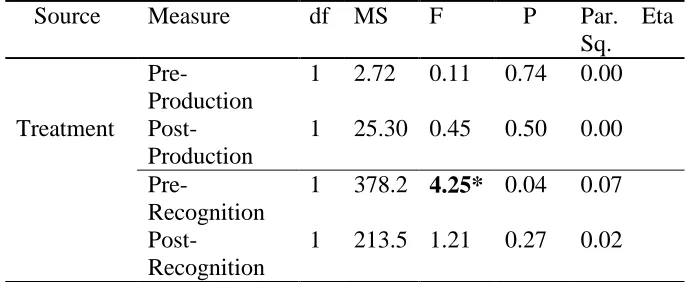
To examine whether mean differences were significant between participants in both tasks on the production and recognition measures, the researchers utilized the Univariate Test, yielded by the Multivariate Analysis of Variance (MANOVA). Findings in Table 3 demonstrate no significant differences between the participants in the CR and DIG tasks on the production measure.
Measure Inst. Tasks N Pretest M Posttest M
Production
CR 30 12.06 25.58
DIG 30 12.30 26.90
Recognition
CR 30 32.83 40.76
106 TELL, Vol. 8, No. 2
Teaching requestive downgraders in L2
Since mean differences in the pretest were not either significant between the participants in both tasks, findings suggest that participants in both tasks did almost the same on this measure although pretest-posttest mean differences for the DIG task (14.6) were slightly better than those for the CR task (13.52).
Table 3: Univariatetestshowing the effects of treatment on pragmatic measures
Note: *P<.05; MD=mean difference; MS=mean score; df=degree of freedom; Par. Eta Sq.= partial eta squared
For the recognition measure, findings in Table 3 similarly reveal that the mean differences between the participants in both tasks were not significant in the posttest. This means that participants in the CR and DIG tasks seem to be the same on this measure. Due to the initial differences on the recognition measure, the pretest-posttest mean differences demonstrate that the participants in the DIG (44.3 - 27.80 = 16.5) outperformed those in the CR task (40.80 – 32.83 = 7.97). This implies that the DIG task was more effective in the development of learners’ recognition ability than the CR task.
Although the discussions in the preceding paragraph imply that the DIG as an output-based task was more effective than the CR as an input-based task, the Repeated Measure Analysis in Table 4 displays that both were effective in the enhancement of learners’ performance on the measures of pragmatic competence from the pretest to the posttest. Findings in this table also demonstrate a
Source Measure df MS F P Par. Eta
Sq.
Treatment
Pre-Production
1 2.72 0.11 0.74 0.00
Post-Production
1 25.30 0.45 0.50 0.00
Pre-Recognition
1 378.2 4.25* 0.04 0.07
Post-Recognition
TELL, Vol. 8, No. 2 107
Ahmadi and Ghafar Samar
significant interaction between the effects of the treatment and instructional tasks on the recognition measure.
Table 4: Repeated measure analysis on the effects of treatment on pragmatic measures
Note: *P<.05; MD=mean difference; MS=mean score; SS=sum of squares; Par. Eta Sq.= partial eta squared
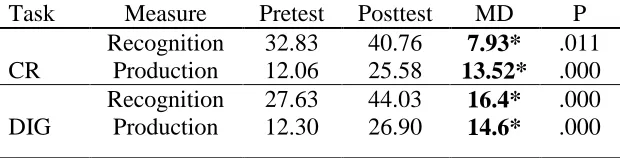
Since the repeated measure analysis did not display the results for each separate task, a pair-wise comparison was carried out to investigate the effects of treatment within each experimental group on different pragmatic measures. Table 5 reveals that both instructional tasks were effective in the improvement of learners’ pragmatic competence from the pretest to the posttest.
Table 5: Bonferroni pair-wise comparison on pragmatic measures
Note: *P<.05; MD = mean difference
Mean plots in Figures 1 and 2 further illustrate the improvement of the participants in both tasks from the pretest to the posttest on the recognition and production measures. Figure 1 also
Source Measure SS df MS F P Par.
Eta Sq.
Instruction
Recognition 4380.20 1 4380.2 60.3* 0.00 0.51 Production 5929.10 1 5929.1 211.1* 0.00 0.78 Instruction
× Task Type
Recognition 516.67 1 516.67 7.12* 0.01 0.10 Production 8.80 1 8.80 0.31 0.50 0.00
Task Measure Pretest Posttest MD P
CR
Recognition 32.83 40.76 7.93* .011 Production 12.06 25.58 13.52* .000
DIG
108 TELL, Vol. 8, No. 2
Teaching requestive downgraders in L2
testifies to the significant ‘task × instruction’ interaction in Table 4 for the recognition measure. While the learners in the DIG task had a lower mean in the pretest on the recognition measure, they showed a better performance in the posttest.
Posttest Pretest
45.00
40.00
35.00
30.00
25.00
dictogloss CR Ins. Task
Posttest Pretest
30.00
25.00
20.00
15.00
10.00
dictogloss CR Ins Task
Figure 1: Estimated marginal means of Figure 2: Estimated marginal means
recognition measure of production measure
The second research question explored the main effects of learners’ MIon pragmatic measures. Motivated by Gardner’s (1993) definition of the interpersonal and linguistic intelligences, the researchers delimited the focus of the study only to these two intelligences. In this regard, the descriptive statistics in Table 6 demonstrates how learners’ with linguistic and interpersonal intelligences performed on the pragmatic measures.
Table 6: Descriptive statistics for the effects of ‘MI’ and ‘MI× instructional task’ on pragmatic measures
Measure Inst. Task MI N Pretest M Posttest M
Recognition CR
Ling 13 33.76 43.61 Inter 17 32.11 38.58
DIG
Ling 18 26.77 40.44 Inter 12 28.91 49.41
Total
TELL, Vol. 8, No. 2 109
Ahmadi and Ghafar Samar
Production
CR Inter 17 11.88 23.58
DIG
Ling 18 11.38 25.66 Inter 12 13.66 28.75
Total
Ling 31 11.77 26.72 Inter 29 12.66 25.72 Note:. Inter: interpersonal; Ling=linguistic; Inst = instructional; M=mean
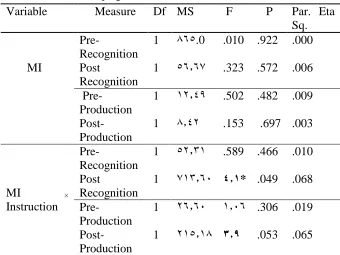
Despite the slight differences in the mean of learners with different intelligence profiles, findings in Table 7 reveal no significant differences between the participants with a better interpersonal and linguistic intelligence on the pragmatic measures. Therefore, it might be postulated that MI by themselves cannot be effective in the improvement of learners’ pragmatic competence.
Table 7: The univariate test showing the effects of ‘MI’ and ‘MI× instructional task’ on pragmatic measures
Note: *P<.05; MS=mean score; df =degree of freedom; Par. Eta Sq.= partial eta squared
Variable Measure Df MS F P Par. Eta Sq.
MI
Pre-Recognition
1 ٨٦٥ 0 .010 .922 .000 .
Post
Recognition
1 ٥٦٫٦٧ .323 .572 .006
Pre-Production
1 ١٢٫٤٩ .502 .482 .009
Post-Production
1 ٨٫٤٢ .153 .697 .003
MI ×
Instruction
Pre-Recognition
1 ٥٢٫٣١ .589 .466 .010
Post
Recognition
1 ٧١٣٫٦٠ ٤٫ * ١ .049 .068
Pre-Production
1 ٢٦٫٦٠ ١٫٠٦ .306 .019
Post-Production
110 TELL, Vol. 8, No. 2
Teaching requestive downgraders in L2
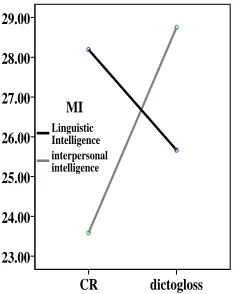
Findings in Table 7 also descriptively illustrated the interaction between the effects of instructional treatments and learners’ MIon pragmatic measures. As opposed to the mean of learners with different intelligences in the pretest, learners with a merit in interpersonal and linguistic intelligences had a better performance on pragmatic measures respectively in the DIG and CR tasks in the posttest. In this regard, the researchers utilized the univariate test, generated by MANOVA, to examine whether or not mean differences were significant. As observed in Table 7, the simultaneous effects of ‘instructional treatments and learners’ MI were shown to be marginally significant on the recognition and production measures. Figures 3 and 4 illustrate that learners with better interpersonal and linguistic intelligences were respectively better in the DIG as an output-based task and CR as an input-based task.
dictogloss CR
29.00
28.00
27.00
26.00
25.00
24.00
23.00
interpersonal intelligence Linguistic Intelligence
MI
dictogloss CR
50.00
48.00
46.00
44.00
42.00
40.00
38.00
interpersonal intelligence Linguistic intelligence
MI
Figure 3: The interaction of MI and Figure 4: The interaction of MI
Instructional Tasks on the Production and instructional Tasks on the Measure Recognition Measure
5. Discussion
TELL, Vol. 8, No. 2 111
Ahmadi and Ghafar Samar
measures. In this section, the results for each research question are firstly discussed and then the contributions of different factors to the development of learners’ pragmatic competence are discussed.
Regarding the first research question, findings showed that the participants in the DIG task were better, although not significantly, than those in the CR task on the production measure. Based on this finding, the explicitness of the task might be regarded as an overriding factor. This means that when the learners’ attention is explicitly drawn to the target features, input-based and output-based tasks can work successfully to improve learners’ pragmatic competence.
Findings also revealed that the DIG as an output-based task was much better than the CR task in the improvement of learners’ recognition of pragmatically appropriate and linguistically accurate utterances. Logically, it is expected that the DIG as an output-based task should improve learners’ production rather than recognition ability. In this regard, the better performance of the participants in the DIG task on the recognition measure can be explained in terms of the design of the test. The test required learners not only to select the best choice of the provided scenarios but to explain why they had not selected other choices. This means that behind the simple recognition, learners had to analyze, judge and identify the appropriacy and accuracy of each choice. Therefore, the participants in the DIG task who had both an opportunity for production and their attention was explicitly drawn to the target features gave a better performance on this measure than those in the CR as an explicit input-based task.
Closely related with the above mentioned findings, past studies (e.g., Rose & Ng Kwai-fun, 2001; Takahashi, 2001; Takimoto, 2006, 2009; Tateyama, 2001) also attested to the merits of the explicit teaching of pragmatic features.
112 TELL, Vol. 8, No. 2
Teaching requestive downgraders in L2
can be explained in the light of sample size effect. Since this study was part of a larger project in which the researchers compared the performance of the participants in four experimental groups, the number of learners with different intelligence profiles within each group was not entirely satisfactory. Therefore, studies with a larger sample can lead to more revealing findings. Secondly, the non-significant effect of MI can also be attributed to the interactive nature of different intelligences. Due to the lack of subjects, the researchers were solely concerned with the learners’ inclination toward the linguistic and interpersonal intelligences and other intelligence types were left out of consideration. This means that learners’ merits in other intelligences might have affected the outcome of the study.
Contrary to the above finding, the interaction effects of learners’ MIand the focused tasks were marginally significant on the pragmatic measures (the third research question). In this regard, the related mean plots illustrated that learners with better interpersonal and linguistic intelligences were respectively at an advantage in the DIG and CR on pragmatic measures. Since learners with interpersonal intelligences have capacity to discern and respond appropriately and pragmatically to the moods, motivation and desires of other people (Gardner, 1993), the relative merits of learners with interpersonal intelligence in the production task might be justifiable. Gardner also states that learners with the linguistic intelligence are more sensitive to the sound, structure, meaning and function of words and language. Therefore, it seems logical that such learners gave a better performance in the CR as an input-based task.
To sum up, the results revealed that unlike the main effect of instruction and MI, their interaction effect was marginally significant on the pragmatic measures. Therefore, it seems that the interaction effect overrode the main effects of instruction and MI on the pragmatic measures. In this regard, the partial eta squared might help us interpret how influential this interaction effect was on these measures.
TELL, Vol. 8, No. 2 113
Ahmadi and Ghafar Samar
should be figured out that other factors might also explain learners’ variances on this measure. In the current study, the researchers also carried out a repeated measure analysis to consider the effect of instruction on pragmatic measures from the pretest to the posttest. The partial eta-squared value of 51% implies that both instructional conditions were highly effective in the development of learners’ recognition ability from the pretest to the posttest. This is why the main effect of instruction was not significant on the recognition measure and the related partial eta-squared was low in Table 3.
Similarly for the production measure, the better partial eta squared of 6.5% might suggest that the interaction effect of ‘MI and the instructional task’ was greater the main effect of instruction (.08%) in accounting for learners’ variances. The partial eta squared value of 78.5% obtained through repeated measure analysis, however, reveals that both instructional conditions could almost equally improve the learners’ production ability from the pretest to the posttest. This explains why the main effect of instruction was not strong and the partial eta squared value was low on this measure. As a result, it might be postulated that instructional tasks had more profound impact on the pragmatic measures than the interaction effect of ‘MIand instructional tasks’.
6. Conclusion
Due to the rarity of studies exploring the interaction between the effects of focused tasks and learners’ MI on the learners’ development of L2 pragmatic ability, the justification and discussion reached here need to be validated in the light of findings in future studies.
114 TELL, Vol. 8, No. 2
Teaching requestive downgraders in L2
learners’ attention to target features explicitly and the other does the same implicitly.
Although the analyses demonstrated that MIdid not have any main effect on pragmatic measures after the treatments, future studies need to investigate both MI and other learner variables to more objectively discuss their roles in pragmatic studies. Based on the results, it may be also concluded that learners with a stronger tendency to the interpersonal intelligence might be at an advantage in output-based tasks. Although this result is worthy of attention, the interaction effect was not as great as the effect of instruction in accounting for the learners’ variances on pragmatic measures. Since this phase of the study is exploratory in nature, it is strongly suggested that these findings be validated by future studies with a larger sample size.
References
Ahmadi, A. H., Ghafar Samar, R., & Yazdani Moghaddam, M. (2011). Teaching requestive downgraders in L2: How effective are input-based and output-input-based tasks? Iranian Journal of Applied Linguistics
(IJAL), 14(2), 1-30.
Alcon-Soler, E. (2005). Does instruction work for learning pragmatics in the EFL context? System, 33, 417-435.
Alcon-Soler, E., & Martinez-Flor, A. (2005). Editors’ introduction to pragmatics in instructed language learning. System, 33, 381-384. Allen, D. (2004). Oxford placement test 1. Oxford: Oxford University
Press.
Armstrong, T. (1993). 7 kinds of smart: Identifying and developing your
many intelligences. New York: Plume, Penguin Group.
Ary, D., Jacobs, L. C., & Razavieh, A. (1996). Introduction to research
education (5th ed.). Orlando, Fl: Harcourt Brace College.
Backman, L. F., & Palmer, A. S. (1996). Language testing in practice.
Oxford: Oxford University Press.
TELL, Vol. 8, No. 2 115
Ahmadi and Ghafar Samar
Doughty, C., & William, J. (1998). Pedagogical choices on focus on form. In C. Doughty & J. Williams (Eds.), Focus on form in second
language acquisition (pp. 114-139). Cambridge: Cambridge
University Press
Ellis, R. (1994). Understanding second language acquisition. Oxford: Oxford University Press.
Ellis, R. (1997). SLA research and language teaching: Oxford: Oxford University Press.
Ellis, R. (2001). Introduction: Investigating form-focused instruction.
Language Learning, 51(Supplement 1), 1-46.
Elli, R. (2002). Grammar teaching- Practice or Consciousness raising? In J. C. Richards & W.A. Renandya (Eds.), Methodology in language
teaching: An anthology of current practice (pp.167-175). Cambridge:
Cambridge University Press.
Ellis, R. (2003). Task-based language learning and teaching. Oxford: Oxford University Press.
Ellis, R. (2005). Principles of instructed language learning. System, 33, 209-224.
Faerch, C., & Kasper, G. (1989). Internal and external modification in interlanguage request realization. In S. Blum-Kulka, J. House & G. Kasper (Eds.), Cross cultural pragmatics: Requests and apologies
(pp. 221-247). Norwood, NJ: Ablex.
Farhadi, H., Jafarpour, A., & Birjandi, P. (1994). Testing language skills:
From theory to Practice. Tehran: SAMT Publication.
Foto, S. (1993). Consciousness raising and noticing through focus on form: Grammar task performance vs. formal instruction. Applied
Linguistics, 14(4), 385-407.
Foto, S. (1994). Integrating grammar instruction and communicative language use through grammar consciousness-raising tasks. TESOL
Quarterly, 28(2), 323-351.
Foto, S., & Ellis, R. (1991). Communicating about grammar: A task based approach. TESOL Quarterly, 25(4), 605-628.
Fukuya, Y. J., & Hill, Y. Z. (2002). Effects of recasts on EFL learners’ acquisition of pragmalinguistic conventions of request. Second
Language Studies, 21(1), 1-47.
Fukuya, Y. J., & Hill, Y. Z. (2006). The effect of recasting on the production of pragmalinguistic conventions of request by Chinese learners of English. Issues inApplied Linguistics, 15(1), 59-91. Gardner, H. (1993). Multiple intelligences: The theory in practice. New
116 TELL, Vol. 8, No. 2
Teaching requestive downgraders in L2
Han, W. J. (2006). The correlation between elementary school students'
Multiple Intelligences and English reading proficiency. Retrieved
from http://nccur.lib.nccu.edu.tw/ bitstream/140.119/
33438/7/95101307.pdf
Hassell, T. J. (2001). Modifying requests in a second language.
International Review of Applied Linguistics, 39, 259-283.
House, J. (1996). Developing pragmatic fluency in English as a foreign language. Studies in Second Language Acquisition, 14, 1-23.
Kasper, G. (2001). Classroom research on interlanguage pragmatics. In K. R. Rose & G. Kasper (Eds.), Pragmatics in language teaching (pp. 33-60). Cambridge: Cambridge University Press.
Kasper, G., & Rose, K. (1999). Pragmatics and SLA. Annual Review of
Applied Linguistics, 19, 81-104.
Kasper, G., & Rose, K. (2001). Pragmatics in language teaching. In K. R. Rose & G. Kasper (Eds.), Pragmatics in language teaching (pp. 1-11). Cambridge: Cambridge University Press.
Koike, D. A., & Pearson, L. (2005). The effect of instruction and feedback in the development of pragmatic competence. System, 33, 481-501. Leech, G. (1983). Principles of pragmatics. London: Longman.
Leowen, S. (2011). Focus on form. In In E. Heinkle (Ed.), Handbook of
research in second language teaching and learning (pp. 576-593).
New York: Routledge.
Liu, J. (2007). Developing a pragmatic test for Chinese EFL learners.
Language Testing, 24(3), 391-415.
Martinez-flor, A., & Fukuya, Y. J. (2005). The effects of instruction on learners’ production of appropriate and accurate suggestion. System,
33, 463-480.
Nassaji, H., & Fotos, S. (2004). Current developments in research on the teaching of grammar. Annual Review of Applied Linguistics, 24, 126-145.
Robinson, P. (1997). Individual differences and the fundamental similarity of implicit and explicit adult second language learning, Language
Learning, 47(1), 45-99.
Robinson, P. (2005). Aptitude and second language acquisition. Annual
Review of Applied Linguistics. 25, 46-73.
Rose. K. R. (2005). On the effects of instruction in second language pragmatics. System, 33, 385-399.
Rose, K. R., & Kasper, G. (2001) (Eds.). Pragmatics in language
TELL, Vol. 8, No. 2 117
Ahmadi and Ghafar Samar
Rose, K. R., & Ng Kwai-fun, C. (2001). Inductive and deductive teaching of compliment and compliment responses. In K. R. Rose & G. Kasper (Eds.), Pragmatics in language teaching (pp. 145-171). Cambridge: Cambridge University Press.
Simiard, D., & Wong, W. (2001). Alertness orientation and detection: The conceptualization of attentional function in SLA. Studies in Second
Language Acquisition, 23, 103-124.
Skehan, P. (2004). Task based instruction. Language Teaching, 36, 1-14. Swain, M. (1998). Focus on form through conscious reflection. In C.
Doughty & J. Williams (Eds.), Focus on form in second language
acquisition (pp. 64-81). Cambridge: Cambridge University Press.
Swain, M., & Lapkin, S., (2001). Focus on form through collaborative dialogue: Exploring task effects. In M. Bygate, P. Skehan & M. Swain (Eds.), Researching pedagogic tasks: Second language
learning, teaching and testing (pp. 95-99). Harlow: Longman.
Takahashi, S. (2001). The role of input enhancement in developing pragmatic competence. In K. R. Rose & G. Kasper (Eds.),
Pragmatics in language teaching (pp. 171-200). Cambridge:
Cambridge University Press.
Takahashi, S. (2005). Pragmalinguistic awareness: Is it related to motivation or proficiency? Applied Linguistics, 26(1), 90-120.
Takimoto, M. (2006). The effect of explicit feedback and form-meaning processing on the development of pragmatic proficiency in
consciousness-raising tasks. System, 34, 601-614.
Takimoto, M. (2009). The effect of input-based tasks on the development of learners’ pragmatic proficiency. Applied Linguistics, 30, 1-25. Tateyama, Y. (2001). Explicit and implicit teaching of pragmatic routines.
In K. R. Rose & G. Kasper (Eds.), Pragmatics in language teaching
(pp. 200- 223). Cambridge: Cambridge University Press.
Yamini M, & Tahriri, A. (2010). On teaching to diversity: The effectiveness of MI-inspired instruction in an EFL context. The
Journal of language Teaching kill (JLTS). 2(1), 1-17.
Yoshimi, D. R. (2001). Explicit instruction and JFL learners' use of interactional discourse markers. In K. R. Rose & G. Kasper (Eds.),
Pragmatics in language teaching (pp. 223-245). Cambridge: