
Journal of Computing and Security
A Survey on Transformation Methods of XML Documents to
Ontologies
Mohammadereza Pourkhani
a,∗, Bita Shadgar
b, Alireza Osareh
b,
aAcademic Center for Education, Culture and Research (ACECR), Khouzestan, Ahvaz, Iran.
bCollege of Engineering, Computer Department, Shahid Chamran University, Khouzestan, Ahvaz, Iran.
A R T I C L E I N F O.
Article history:
Received:31 March 2017
Revised:03 October 2018
Accepted:22 October 2018
Published Online:02 December 2018
Keywords:
Survey, Semantic Web,
Transformation, XML Documents, Ontologies.
A B S T R A C T
Nowadays, the great amount of information is stored in many data resources such as relational databases, XML documents and so on. Semantic Web is aimed to make current Web information semantic. The information of data resources should be accessed semantically, to reach this goal, it should be organized and stored under the ontology. Ontology is a key and important concept in Semantic Web. Generally, ontology is a common understanding of a domain. On the other hand, completely manually ontology construction is a time-consuming, labor intensive and prone to errors process. Therefore, an approach is required to at least semi-automatically extract ontology from data resources. Transformation approach is a convenient one to extract ontologies from various data resources. Hence, Interoperability among extracted ontologies resulted from transformation approach via mediation ontology approaches is possible and false interpretations of information with regard to different conceptualizations of a given domain is solved. In this paper, we definitely explain the transformation approach, gather the most notable methods in this field and classify them under two categories. Subsequently, we surveyed the transformation methods and finally select the best one in each category.
c
2017 JComSec. All rights reserved.
1
Introduction
The aim of the Semantic Web, also known as Web of data [1], is to integrate various data resources and to make information which is available on the web semantic. One important aspect in ensuring the suc-cess of the Semantic Web is to acsuc-cess Semantic data which should be generated ontologies to produce these kinds of data. By using ontology, meaning of
infor-∗ Corresponding author.
Email addresses:[email protected](M. Pourkhani), [email protected](B. Shadgar),
[email protected](A. Osareh)
https://dx.doi.org/10.22108/jcs.2018.106872.0
ISSN: 2322-4460 c2017 JComSec. All rights reserved.
unfortunately, completely handy ontology construc-tion is a time-consuming, labor intensive and prone to errors process which needed to cooperate with domain experts. There are two general approachesi.e. map-ping and transformation to represent XML documents semantically. The main reason which causes the trans-formation approach more important than the map-ping approach is that many data resources have no ontology therefore the transformation approach could extract at least semi-automated local ontologies from these data resources. The transformation approach tries to use the similarities between ontology model and XML model by the definition of rules known as transformation rules to convert XML constructions to OWL ontology ones. The main purpose of this pa-per is to review the methods that have been proposed to transform XML documents to the ontologies and to determine what progress is made and what works should be done in the transformation process that transforming structures accompanied by transforming meanings. For example, transforming inverse, transi-tive and symmetric relations should be considered in the future researches.
In this paper, XML technology and ontology were briefly explained in Section 1 and then respectively in Sections 2 and 3, the transformation approach and points associated with it, as well as methods to transfer XML documents to ontologies reviewed in details. Finally in the Section 4, the reviewed methods were compared according to eight criteria and best methods were introduced in the terms of numbers of transformation rules as well as completeness and richness of extracted ontologies.
1.1 XML
In the late 90s, XML language was introduced by the W3C consortium as an easy and standard way to store self-description data. The self-description data are those that define both their own content and struc-ture. This language is separated content from presen-tation and provided different view of the contents of the documents without need to copy contents [2]. In addition, the content of XML documents can be used in other applications that depend on the definition of appropriate vocabularies by user. Generally, there are two ways, namely data type definition or DTD that is old and limited way and XML Schema that provide greater range of capabilities for defining data types, to specify the structure of XML documents. The DTD constructions could be defined in a separated DTD file (external DTD) or in the same XML document (inter-nal DTD). Usually, it is better to use an exter(inter-nal DTD, because definition is applicable in several documents and otherwise repetition is inevitable, also maintain consistency over time is difficult. XML schema
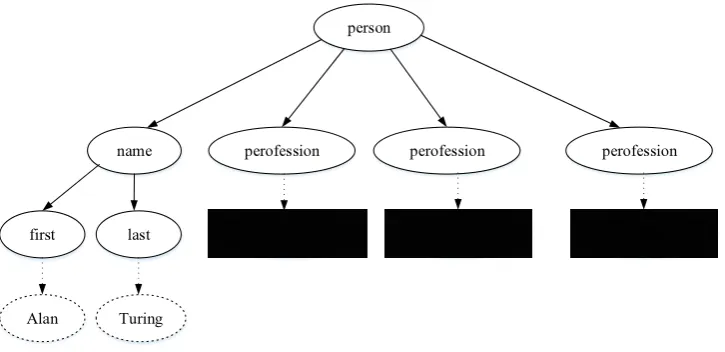
pro-vided the most appropriate structure for the definition of XML documents. XML Schema syntax is XML-based. This design features improved readability and more importantly reusability. So that, unlike DTD, writing a separated parser and convenient editor are no longer needed, because XML does this work by itself. Reusable and recoverable patterns are more im-portant features of XML. The ability to define new types by extending or restricting the values is pro-vided in the XML Schema. Thus, constructing model from other model made possible and reduced work-load. Also, XML Schema provided complex data types that could be used in other XML documents. XPath is a language for addressing parts of XML documents. This language was implemented on the tree model of XML data and had non-XML syntax. The tree view of a simple XML document is shown in Figure 1.
Figure 1. An XML Document Tree
for the computer as document user. For example, for user, generator concept could be expressed by creator or inventor vocabularies. In addition, XML has some semantic disadvantages. In general, XML focuses on grammar and syntax and does not provide any way for describing the meaning of the XML document. This problem occurs when an agent wants to understand and reason about XML data.
1.2 Ontology
Ontology in Semantic Web expresses terms and rela-tions between them in a given domain [2]. In others word, the main components of ontology consist of con-cepts, properties and the relationships between them. Ontology can reveal relationships between the con-cepts in any structure like Web documents, so that machines would be able to understand them and then do various processing on these documents. In general view, ontology is as follows [2]:
• Vocabularies + Structure = Taxonomy
• Terms + Rules + Restrictions + Constraints = Ontology
• Ontology + Instances = Knowledge Base Formally, Ontology is a quadrupleO(C, PC, R, H).
Here, O is ontology name with regard to domain of interest, C is a finite set of concepts or classes,
PC is a finite set of concept properties,Rrepresents relation between concepts andHis Hierarchy of classes and properties. Navigli et al. [3] divided ontology into three levels i.e.fundamental ontologies (FOs), core ontologies (COs) and specific domain ontologies (SDOs) (Figure 2).
Fundamental ontology or upper Ontology contains very few concepts and basic principles which are ex-isted in all domains. Core ontology contains elements of any given domain. Specific domain ontology
con-Figure 2. The General Three Levels of the Domain Ontologies [3]
sists of ontology elements that should be conceptual-ize for a given domain. Domain ontology is referred to core ontology with concepts existed in a given do-main. Ontology objectives and performance are based upon various ontology application types. The main objective of ontology construction can be outlined as follows:
• To agree on the understanding of the shared concepts of information structure among different communities
• To make a domain knowledge analyzable and reusable
• To specify domain assumption in an explicit man-ner
• To make a partition between operational knowl-edge and domain knowlknowl-edge
• To analyze domain knowledge
• RDF1 which is a data model for the resources
and the relationships between them. RDF data model creates a simple meaning on data model. This data model is represented by XML syntax.
• DAML2+ OIL3 is a semantic markup lan-guage. This language is an extension of RDF language trying to alleviate some of its short-comings through richer primitives. One of the main features of this language is that can for-mulate meanings of language terms by applying descriptive logic4 theory.
• RDF Schema or RDFS is the language to de-scribe properties and classes of RDF resources. It contains rules for producing the hierarchy of attributes and classes.
• OWL5 is a richer language to describe
proper-ties and classes rather than RDFS, for example, relation between classes (disjoint classes), cardi-nality (e.g. exactly one), equality, richer types of properties (symmetric or transitive) and enu-merative classes are easily expressible in this lan-guage. This language takes use of RDF vocab-ularies and XML syntax, but overcomes those deficits existed in other ontology languages like RDF and DAML+OIL. In the following, Table 1 shows a comparison between the three ontologi-cal languages and as well as limitations of RDF and DAML+OIL languages in contrast of OWL language.
As can be seen, OWL ontology language is the most powerful language in terms of expression power among other ontological languages. In logic, usually a profile called a sub-language. Selecting profile or sub-language depends upon ontology structure for program and also, the volume of reasoning operations that must be done on ontology. In general, the OWL 1 ontology language was categorized into three sub-languages i.e. OWL Lite, OWL DL and OWL Full where their expression power is increased from left to right respectively and computational cost would be in-creased proportional to increasing in expression power (Figure 3). In the OWL 1 language, there are two types of propertiesi.e.data type property and object property. Data type property shows relationships be-tween classes and literals while object property shows relationships between instances of two classes.
OWL 2 language has been developed OWL 1 lan-guage by a small but useful set of features developed by the user to achieve efficient reasoning algorithms. Generally, OWL 2 ontology language is categorized
1 Resource Description Framework
2 DARPA Agent Markup Language (DAML)
3 Ontology Inference Layer (OIL) 4 Description Logic (DL)
5 Web Ontology Language
Table 1. A Comparison Between the Capabilities of Ontologi-cal Languages [4]
The Expression RDF/RDFS DAML+OIL OWL
Class X X X
RDF: Property X X X
RDFs: SubClassOf X X X
RDFs: SubPropertyOf X X X
RDFs: Domain X X X
RDFs: Range × X X
Individual × X X
SameClassAs × X X
SamePropertyAs × X X
SameIndividualAs × X X
DifferentIndividualFrom × X X
InverseOf × X X
TransitiveProperty × X X
SymmetricProperty × X X
FunctionalProperty × X X
InverseFunctionalProperty × X X
AllValuesFrom × toClass X
SomeValuesFrom × hasClass X
MinCardinality X X X
MaxCardinality X X X
Cardinality X X X
OneOf X × X
DisjointWith × X X
ComplementOf × X X
Figure 4. The Hierarchy of the OWL 2 Ontological Language Versions
into five sub-languagesi.e.OWL 2-EL, OWL 2-QL, OWL 2-RL, OWL 2-DL AND OWL 2-Full [5] (Fig-ure 4). OWL 2-EL sub-language is particularly useful in applications employing ontologies that contain very large numbers of properties and/or classes. It captures the expressive power used by many these ontologies and is a subset OWL 2 DL for which the basic reason-ing problems can be performed in time that is poly-nomial with respect to the size of ontology [6]. OWL 2-QL sub-language is aimed at applications that use very large volumes of instance data and where query answering is the most important reasoning task. The expressive power of the sub-language is necessary quite limited, although it does include most of the main features of conceptual models such as UML class dia-grams and ER diadia-grams [6]. OWL 2-RL sub-language is aimed at applications that require scalable reason-ing without sacrificreason-ing too much expressive power. It is designed to accommodate both OWL 2 applications that can trade the full expressivity of the language for efficiency.
2
Transformation Process
Generally, ontology construction process consists of three steps i.e. namely generation, enrichment and population. In the case that there is no ontology, it should be generated directly by using predefined rules from the XML document. This process is called ontol-ogy generation process. This step must be performed automatically. In the ontology enrichment process by using the XML document, new constructions (such as classes, object and data type properties) would be added to existing ontology. This step should be performed at least semi-automatically. Other data re-sources such as relational database and so on could also be used in this process. Ontology population pro-cess is added instances from XML document data to
Figure 5. The Mapping of XML to Ontology
Figure 6. The Transformation of XML to Ontology
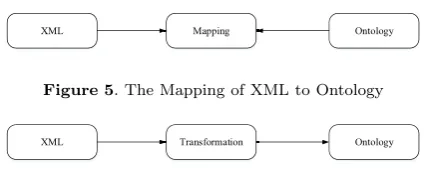
generated ontology. This step must be performed auto-matically. Generation and enrichment processes could be done by using XML document and XML schema or DTD. Ontology population process is usually done by using XML document data and ontology associ-ated to XML document. In the terms of ontology gen-eration and enrichment processes, approaches could be classified into two categories in order to semantic representation of XML document,i.e.mapping XML document to ontology and transformation of XML document to ontology.
2.1 Mapping of XML document to ontology
In the mapping approach, most efforts are associated with wrapper systems relating a XML document and its schema to domain ontology. Ontology may be global or local. In this approach, depending on the nature and objectives of each project, building wrapper con-sists of a range of manual programming to complex mapping languages and environments in which auto-matic reasoning is used to define mapping systems (Figure 5).
2.2 Transformation of XML Document to On-tology
In the transformation approach, XML document and its structure (DTD or XML schema) are used to con-vert XML constructions and its data to a semantic representation. In this approach, there is no local on-tology and XML constructions are converted to corre-sponding ones in the ontology by using transformation rules (Figure 6).
Output of transformation process based methods is always ontology, but these methods could be catego-rized into two groups based upon their input:
• DTD-based methods
• XML schema-based methods
Table 2. A Comparison of the Mapping and Transformation Approaches
Method Name Existence of
Source Model
Existence of Goal Model
Complexity of Rules
Complexity of Implementation
Losing of Information and
Meaning
Dependency to Domain
Mapping Yes Yes Complex Simple No Yes
Transformation Yes No Simple Complex Yes No
First, Source model i.e.XML documents or rela-tional databases may be available but its destination modeli.e.local ontologies may not be available. Sec-ond, developing a new ontology model for a domain is a lengthy process that involves identifying concepts, properties, relationships, constraints and restriction in a specific domain and validating the resulted model with domain experts. The ontology engineer needs expertise in the domain, knowledge in ontology model-ing and skills necessary in usmodel-ing an ontology language or ontology editing tool [7]. Moreover, depending on the domain, developing an ontology model can take several months to several years and may require con-tinuous involvement of domain experts. Since organi-zations tend to avoid engaging domain experts in long running endeavors and since some of this knowledge has already been encoded in computer applications and databases, several researchers have decided that it might be more practical to derive this knowledge from existing data models. This derived knowledge could then be used to generate a rudimentary ontological model which can then be revised or further augmented [7]. A comparison of the mapping and transformation approaches is shown in Table 2.
Some notes about the transformation process should be considered:
• The transformation rules should not be too com-plicated.
• The required time for the transformation process should be considered.
• User involvement level during the transformation process should not be exceeded from a certain threshold.
• Information and meaning losses should not be occurred as a result of the transformation process.
• The transformation rules should be able to con-vert almost all constructions of source model into destination model as much as possible.
• The transformation rules should not be dependent on certain domain that is, local ontology could be extracted from data resources with uniform format by using same transformation rules. All the XML to ontology transformation methods should be satisfy the following requirements [8]:
• Data integrity: The output of the
transforma-tion process should describe the original data as enough as possible.
• Semantic integrity: In some circumstances, the transformation process output i.e. ontology should describe accurately the information con-tained in the XML document, so the quality of the transformation process should be analyzed.
• Preserving the original structures: Along with mapping XML structures such as elements and attributes, transformation procedures should also support relationships between these construc-tions.
• Mapping data types: Each attribute should be mapped along with its data type.
• Using common syntax: output ontology should be expressed by using common syntax such as OWL ontology language otherwise it could not interact with other Semantic Web applications and ontologies in a given domain. In this case, the process suffers from the applicability problem.
• Automation of transformation process: The trans-formation process should be performed at least semi-automatically and fully manual operation should be avoided.
Generally, some notes should be considered to achieve an efficient and complete method for con-structing ontology from XML document [9]:
Table 3. The Mapping of the DTD Constraints to the OWL Constraints
DTD Constraints OWL Constraints
#FIXED value<!ENTITY entity-name “entity-value”> OWL:HasValue
#REQUIRED OWL:MinCardinality (=1)
#IMPLIED OWL:Cardinality (=0)
NOTATION RDFs:Comment
+ OWL:MinCardinality (=1)
? OWL:MinCardinality (=0)
* OWL:MinCardinality (=0) OWL:MaxCardinality (=unbounded )
documents used types defined locally and others used types defined globally. As a result, the method should be able to extract ontology from any XML documents with any designs. Fifth, the method should have a step to evaluate and refine structure of built ontology and mapping file. This step could be done manually by domain experts.
3
Transformation Methods
In this section, transformation methods are discussed to construct OWL ontology form the DTD and then the XML Schema. It is necessary to note that the methods are described chronologically.
3.1 Transformation From DTD to OWL
Pam et al. [8] presented an automatic method to ex-tract OWL ontology from DTD. In this method, first all of the DTD constructions would be converted into OWL ones by using transformation rules. Also, in the case that DTD of XML document is not avail-able, DTD would be created from related XML doc-ument making use of HiTSoftware6 tool. Then,
on-tology would be populated by using XML document data together with made OWL ontology. In this step, population procedure traverses from open-tag of root element and ends when it meets close-tag of root el-ement. Meanwhile, if an element in XML document is matched with a node in OWL ontology, then an ontology instance corresponding to a XML individual would be generated. The authors mentioned that one of drawbacks of other methods is during the ontology population phase. When in the transformation pro-cess of XML document data, the next element has the same name with the previous one, no solution to deal with this problem exist. In this method, element renaming procedure would be used. The proposed method framework is shown in Figure 7.
6 http://www.hitsw.com/xml_utilites
Figure 7. The General Framework of the DTD2OWL System [8]
Element defined by <!DOCTYPE> in DTD is mapped to the root class of OWL ontology which is the first class declared by owl:class. For element defini-tion<!ELEMENT element-name (element-content)>, if the element-content contains sequences of children, this element considered as OWL class. Each owl:class is represented by a unique identifier, rdf:ID and dis-joints with other classes. For the case, an element in DTD is described by<!ELEMENT>tag but it only contains data type (#PCDATA or #CDATA), it is mapped to an OWL data type property. The map-pings of DTD constraints are listed in Table 3.
Figure 8. The General Framework of the Extended DTD2OWL System [12]
choice and mixed DTD. These constructions are the most commonly used in the DTDs. Also, the Authors in their two previous works [10, 11] transferred DTD and XML schema to RDF schema. In these two works, extracting classes and sub-classes form related XML document is based on transformation rules and also user opinion (semi-automatic). But in this method, sub-classes were considered as object property for ex-pressing relationship between parent and child classes and as result transformation process is automatic and user opinion is no longer needed. Another disadvan-tage of these two works is to use RDF Schema lan-guage, because the language is less expressive power than OWL language.
Hacherouf et al. [12] developed the DTD2OWL sys-tem which is the best method for automatically trans-formation of XML document into OWL ontology in this category. In this method, like the DTD2OWL system, OWL ontology is generated from DTD file re-lated to XML document. If DTD file is not available, first it is created from XML document and then, on-tology would be populated by using XML document data together with made OWL ontology. The authors described difference of their method with method of Pam et al. [8] that, in proposed method, first it is checked that if DTD file is simple, then ontology would be generated by using transformation rules. But if DTD file is mixed one, DTD file and other related DTD files which are referenced each other would be merged and a simple DTD file would be formed and then OWL ontology would be generated. Also, the merging algorithm consisted of three phases. The pro-posed method framework is shown in Figure 8.
It could be said that such an idea to solve the prob-lem of references in the construction of the ontology of more than one XML Schema belonged to Lacoste et al.’s method [13]. In fact, it could be said that this method is a development of Pam et al.’s method [8]
and as well as the main idea of Lacoste et al.’s method [13]. In this method, more transformation rules than Pam et al.’s method [8] were provided that converted more DTD constructions to OWL ones, as a result ontology generated by the extended DTD2OWL sys-tem is more complete than the primary DTD2OWL system. The transformation rules with examples are listed in Table 4.
3.2 Transformation from XML Schema to OWL
Klein [14] presented a method for automatically trans-forming XML document data to RDF instances. In this method, the ontology that describes the XML document is already existed in RDF Schema therefore the aim of extracting RDF triples is to populate the ontology. All elements of the XML document tree are traversed in a depth-first order, starting from the root element. Only elements of the XML document are translated into RDF triples that are classes or proper-ties in the ontology, so all meanings of the XML docu-ment are not extracted. For example, name and value of tag properties are not converted to RDF triples. An ontology which is in the RDFS language cannot ex-press all meanings of a given domain, which regarding the publication date of the work, common languages for the expression of the ontology were RDFS and DAML + OIL.
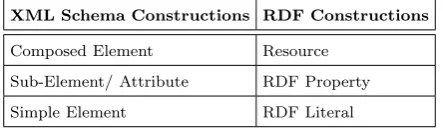
Ferdinand et al. [15] presented a method for au-tomatic transformation of XML schema into OWL ontology. In this method, XML document data are mapped to the RDF graph. The authors cited that the XML mapping into RDF can do efficient infer-ence and semantic validation of XML document data. Once translated into RDF, the data can be classified with an OWL reasoner. As a result, the classification could lead to discover implicit class membership or implicit relationships between objects. For naming all new constructions in the ontology, the compound of namespace with the # character and attribute names used in the XML Schema was used. The transforma-tion rules of XML schema to OWL ontology are listed in Table 5. Also, the transformation rules of XML schema to RDF are briefly listed in Table 5 and Ta-ble 6 respectively.
Table 4. The Transformation Rules of the Extended DTD2OWL System
DTD Constraints OWL Constraints
Complex Type Class
Simple Type/Attribute DataType Property
#FIXED value<!ENTITY entity-name ”entity-value”> OWL:HasValue
#REQUIRED OWL:MinCardinality (=1)
#IMPLIED OWL:Cardinality (=0)
NOTATION RDFs:Comment
+ OWL:MinCardinality (=1)
? OWL:MinCardinality (=0)
* OWL:MinCardinality (=0) OWL:MaxCardinality (=unbounded )
Enumeration Type OWL:OnOf
Attribute ID Type ObjectProperty
Attribute IDREF Type ObjectProperty
SEQUENCE Owl:IntersectionOf
Choice Owl:UnionOf
Table 5. The Transformation Rules of the OWLMAP System (XML to OWL)
XML Schema Constructions OWL Constructions
Complex Type/ Element Type/ Attribute Group OWL:Class
Simple Type/ Attribute OWL:DataTypeProperty
Element Of Complex Type OWL:ObjectProperty
Inheritance Restriction/Inheritance Extension RDFs:SubClassOf
Substitution Group OWL:SubPropertyOf
Element Type Local/ Attribute Type Local OWL:AllValuefrom
Min Occurs/ Max Occurs OWL:MinCardinality/ MaxCardinality/ Cardinality
Sequence/ All OWL:IntersectionOf
Choice Boolean Expression With OWL:IntersectionOf, OWL:UnionOf,
OWL:ComplementOf
Table 6. The Transformation Rules of the OWLMAP System (XML to RDF)
XML Schema Constructions RDF Constructions
Composed Element Resource
Sub-Element/ Attribute RDF Property
Simple Element RDF Literal
the element level and the structure level (Table 7). To achieve the reversible query translation process between the structural query and the semantic query in the framework, the authors extend the RDF vo-cabulary to represent not only the semantics but also the structure of the data. The user queries should be applied onto the global ontology. A Query is rewritten into sub-queries and applied on each XML documents
Table 7. The Transformation Rules of the Cruz et al. [16]
XML Schema Constructions
RDF Schema Constructions
Element Level Transformation Rules
Attribute Property
Simple Type Element Property
Complex Type Element Class
Structure Level Transformation Rules
Element Attribute Rela-tionship
Class to Literal Relation-ship
Element Sub-Element Re-lationship
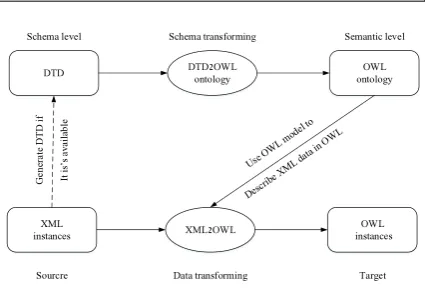
Figure 9. The general framework of the XML2OWL system [17]
then the results are aggregated and returned. The use of ontology in RDFS language because of the less ex-pressive power than the OWL ontology language and therefore the generation of primitive ontology is the main point of weakness of the method.
Bohering et al. [17] presented a method to transfer XML data model into OWL ontological model. In the case that XML schema is available, it is used to gen-erate ontology otherwise, XML schema is gengen-erated from related XML document. Also in this method, the used XML documents were made from relational databases. XML document and XSL style sheet were used to generate ontology instances. Halpern ’s algo-rithm [18] was used to create XSL style sheet from XML document. A XSL Style Sheet file which con-verts the XML individuals into the OWL ontology instances is created simultaneously. This style sheet will be configured automatically to adjust the trans-formation process of the instances to the OWL model. To support the separation of model and data, the OWL model will be stored separately from the OWL instances. The OWL instances will connected to their model using owl:import property, therefore each OWL instance which references the OWL model obtains an adjustable namespace prefix. The general framework of the proposed method is shown in Figure 9.
The authors noted that user does not have any con-trol over the transformation process. The transfor-mation algorithm is based upon heuristic method, so that possibly no optimal solution will be reached. As a result, the generated ontology will be a simple and el-ementary one that required handy work to refine and enrich and the instances generation is almost primitive because duplicate instances are created with distinct IDs. The transformation rules are listed in Table 8.
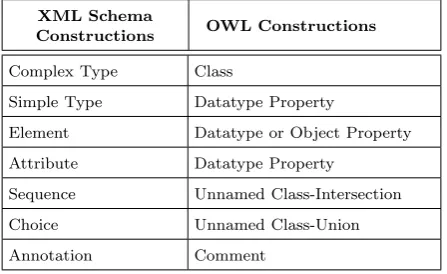
Tsinaraki et al. [19, 20] presented an algorithm to automatically transformation of XML schema into
Table 8. The Transformation Rules of the XML2OWL System
XML Schema
Constructions OWL Constructions
Elements, containing other el-ements or having at least one attribute
Owl:Class, coupled with Owl:Object Properties
Elements, with neither sub-elements nor attributes
Owl:Datatype Properties
Named complex Type Owl:Class
Named Simple Type Owl:Datatype Properties
MinOccurs, MaxOccurs Owl:MinCardinality,
Owl:MaxCardinality
Sequence, All Owl:intersectionOf
Choice Combination of
Owl:intersectionOf,
Owl:unionOf and
Owl:complementOf
Figure 10. The Transformation of the XML Document Into OWL Ontology [19, 20]
Figure 11. The Transformation of the OWL Ontology Into XML Document [19, 20]
OWL ontology (Figure 10) as well as an algorithm to automatically transformation of OWL ontology into XML schema (Figure 11).
Table 9. The Transformation Rules of the XML2OWL System
XML Schema
Constructions OWL Constructions
Complex Type Class
Simple Type Datatype Property
Element Datatype or Object Property
Attribute Datatype Property
Sequence Unnamed Class-Intersection
Choice Unnamed Class-Union
Annotation Comment
In this method, mapping of OWL ontology construc-tions corresponding to XML Schema ones would be stored in a file called mapping file. Because, this file is used to restore OWL ontology to XML schema. This method is composed of three parts. A main OWL on-tology or upper onon-tology that directly captures XML schema semantics. A data types XML schema which contains the simple XML schema data types defined in the source XML schema and are used in the main ontology. A mapping OWL ontology that keeps OWL ontology constructions corresponding to XML schema along with a unique identifier. In a valid OWL ontol-ogy, the different constructions should have unique identifier while the XML schema allows different con-structions to have the same name. Also, the mapping OWL ontology systematically captures the semantics of the XML schema constructions that cannot be di-rectly captured in the main ontology, since they cannot be represented by corresponding OWL constructions. Other classes in the mapping ontology are as follows [19, 20]:
• The DataTypePropertyInfoType class which maintains the mapping of the OWL data type properties with the corresponding XML schema constructions and specifies the possible default value and type of the XML schema constructions represented by a data type property.
• The ElementInfoType class which captures in-formation about the XML schema elements that cannot be directly represented by OWL construc-tions and maintains the mapping of the XML schema elements with the corresponding OWL constructions.
• The ComplexTypeInfoType class which captures information about the complex XML schema types that cannot be directly represented by OWL constructions and maintains the mapping of the complex XML schema types with the correspond-ing OWL constructions.
• The ChoiceType and SequenceType classes which captures information about the complex XML schema sequences and choices that cannot be
directly represented by OWL constructions. Xu et al. [21] presented a method to generate OWL ontology from XML document by using relational model. In this method, the relational model is used as an intermediate model in the process of ontology generation. They used two algorithms referred to as XTR7 to map XML document to relational database
and RTO8 to map relational database OWL
ontol-ogy. According to XTR algorithm to create relational database from XML document, the XML document is considered in the form of a tree with labeled nodes. In this tree, if the element is leaf it includes a literal value and has not attributes, such as an element is regarded as simple type. Each simple type is regarded as an attributes and it is mapped to table columns. Also, if an element has sub-element or attribute, such an element is regarded as complex type. Each com-plex type would be mapped to a class and its related sub-elements and attributes are regarded as proper-ties. Each class would be mapped to a table and its properties are regarded as table columns. The table name and table column name are respectively equaled to class name and class property name. It should be noted that the primary keys, foreign keys and other constraints of tables are defined manually. The au-thors mentioned that adding primary keys, foreign keys and other constraints of tables in a completely handy form, is not a good and correct idea. Also, no specific algorithm is cited for the RTO section, but the terms and constraints were defined manually for on-tology. Obviously, the methods without intermediate model which directly generating ontology are faster and have less overhead and avoid complexities of con-verting models into each other and losing information and semantics during these conversions.
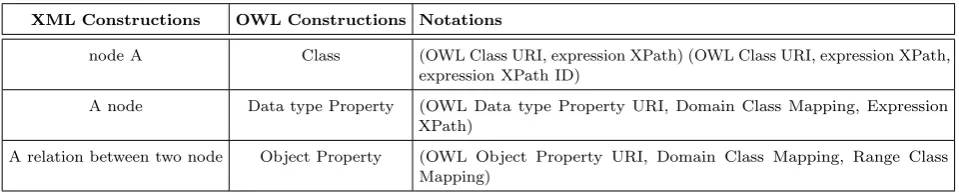
Rodrigues et al. [22] presented a semi-automatic tool called JXML2OWL to transform or map XML documents to OWL ontologies. The purpose of the tool is to develop a user-friendly and interactive tool that allows a user to transfer data in XML format to OWL ontology or to map to any existing ontology defined in OWL language with the purpose of easing and automating the semantic data integration process. The authors used some rules of Ferdinand et al. [15] and Bohering et al. [17], therefore the input of proposed tool can be either XML schema or DTD. Also, if an XML schema is not available, it is possible to load an XML document. So, the tool extracts a possible schema. XSLT is the used standard to transform XML documents. The XML document generated by the tool can be used by any XSL processor to automatically transform XML data into instances of the ontology. In
7 XML to Relational Database (XTR)
Table 10. The Transformation Rules of the JXML2OWL System With Related Notations
XML Constructions OWL Constructions Notations
node A Class (OWL Class URI, expression XPath) (OWL Class URI, expression XPath,
expression XPath ID)
A node Data type Property (OWL Data type Property URI, Domain Class Mapping, Expression
XPath)
A relation between two node Object Property (OWL Object Property URI, Domain Class Mapping, Range Class
Mapping)
this method, Xpath expression is used to distinguish multiple nodes with same name but with different tags. Also, if there is an existing ontology for the given domain which is richer than extracted ontology from XML document, the XML data is mapped to instances of existing ontology. The user has no control during transformation process but in the mapping process, the user has full control over process. The transformation rules of the method with notations are as below (Table 10).
Ghawi et al. [9] presented a tool called X2OWL for automatic extraction of OWL ontology from XML doc-ument. In this method, made ontology only includes concepts and properties but not instances. Individuals would be retrieved from XML document when answer-ing user queries and then translated into ontology in-stances. The reason for this is that the proposed tool is part of the framework to integrate data resources such as relational databases by using ontologies. In this method, XML schema was used to generate on-tology and if XML schema related to XML document is not available, XML schema is generated by using the Trang9 software. In the following, XML Schema would be evaluated and then its graph would be ob-tained by using the Xsom10 and Jung11 software. In
the next step, OWL ontology would be extracted by using Jena Framework12 and transformation rules.
Finally, generated OWL ontology as well as mapping file would be evaluated and refined. The authors noted that to insure independence of the schema design style, algorithms is based on an XML schema graph that describes the schema in the same way whatever its design style is. The Transformation rules and the gen-eral framework of the proposed method are shown in Table 11 and Figure 12 respectively.
The aim of the refinement step is to detect and re-move invalid mappings. Invalid mappings should be deleted because if they will be used in query resolu-tion, they will lead to invalid queries that return no results. A mapping is invalid, if it contains an invalid
9 http://www.thaiopensource.com/relaxng/trang.html
10https://xsom.dev.java.net 11http://jung.sourceforge.net
12http://jena.sourceforge.net
Table 11. The Transformation Rules of the X2OWL System
XML Schema Constructions OWL
Constructions
Global Named Complex Type Class
Local Anonymous Complex Type Class
Inheritance: Extension/ Restriction Class Inheritance: Rdfs:subClassOf
Element Group Class
Attribute Group Class
Element-Sub Element Relationship Object Property
Simple Type Datatype Property
Attribute Datatype Property
Figure 12. The General Framework of the X2OWL System [9]
docu-Figure 13. The General Framework of the Jeiping et al. [24]
ment is considered invalid. Furthermore, the mappings are rescanned to detect mappings that reference in-valid mappings. Those mapping are also considered invalid. If no typical XML document is provided, the process can be done by a human expert manually.
Breitling et al. [23] presented an automatic tool to translate XML data into RDF via XSLT. This method has three features. First, empty nodes in the RDF are avoided, therefore for each node, a unique identifier URI is considered. The reason is that such nodes are inaccessible in RDF database and decrease the perfor-mance of queries in SPARQL language. Second, the suggested transforming method is a bidirectional, so that XML schema transformed into RDF could be re-versed to primitive schema but inverse transformation is not yet implemented. Third, independence of XML schemai.e. Elements in some construction of XML documents have order such as Sequence, this order may be ignored in the reversed transformation process. So in the tool, an option to keep order of elements for such constructs is considered. The transformation rules are written in complicated XSLT language which requires the users to have sufficient knowledge of this language. If an Xpath expression is not suitable as URI for one node, then user manually inserted a unique URI.
Jeiping et al. [24] presented an automatic method to generate OWL ontology from XML schema. The authors based their proposed method on the Tsinaraki et al.’s method [19, 20]. The general framework of proposed method is shown in Figure 13.
After extraction of ontology, it would be populated by using the XML document data. Also, the transfor-mation rules of proposed method are listed in Table 12. Generally, XML schema does not provide Infor-mation about the structure and elements of a valid XML document. This information could be used to define Xpath expressions for selecting elements and attributes of the XML document. When the elements
Table 12. The Transformation Rules of the Jeiping et al. [24]
XML Schema
Constructions OWL Constructions
XML Schema DataTypes XML Schema DataTypes
Attributes DataType Properties
Simple Type Elements DataType Properties
Complex Type Elements Object Properties
Complex Types Classes
Sequence Unnamed
Class-Intersection Of
Choice Unnamed Class-Union Of
Attributes, Attribute Groups, Element Groups are referenced in Complex Type definitions
If they are contain At-tributes or Simple type El-ements DataType Proper-ties
If they are contain Com-plexes type Elements Ob-ject Properties
or attributes of the XML document is selected, their content is mapped to corresponding classes and prop-erties in the OWL ontology. In some cases, additional information is required to select an element or at-tribute by the Xpath expression. This occurs when some elements are in a same level in an XML docu-ment. Therefore, the variables used in the Xpath ex-pressions, and then at run time, the real values would be replaced variables.
[a-z][0-9]”/>, <xs:length value=”8”/>, <xs:minlength value=”5”/>, <xs:maxlength value=”5”/>, have no direct mapping into OWL ontology. Also in this method, the WordNet dictionary is used for normal-izing tags which extracted from XML Schema to produce semantically well-structured ontology.
Lacoste et al. [13] presented a fully automated method to generate OWL ontology from XML Schema. The name of purposed method is EXCOi.e.an Effi-cient XML to OWL Converter. In this method, the OWL ontology would be generated by using one or more XML Schema files that are associated with each other. Ontology extraction phase and ontology pop-ulation phase could be performed in parallel. Before the ontology extraction phase, there is a phase called schema consolidation. In this phase, Internal and exter-nal references problem would be solved. Interexter-nal refer-ences are those referrefer-ences referred to elements or data types in the same file but external references are those references referred to elements or data types belonged to another XML schema. The external references are made using either the ”include” or ”import” mecha-nisms. The ”include” mechanism of XML schema is similar to the ”import” mechanism, the only differ-ence being that in the case of ”include” the names-pace of the calling document is preserved, whereas in ”import” the child element has its own namespace. The schema consolidation phase is composed of three parts. In the first step, all of the files that are included and imported by the main XML schema are collected. Hash tables are used for this purpose. In this table, such information as file name, file location, names-pace, namespace pre-fix and so on would be stored. Also, in this step main schema could be specified. For example, main schema could be the schema having the most number of references. The first step also resolved potential issues such as resolving circular and multi-ple references. For exammulti-ple, it is possible for a schema to be referenced many times and to import schemas from which it was imported, which could lead to an infinite loop. The second step merges the collected schemas into one schema document. The second step also handles the namespaces. In the third step, the merged schema document is reorganized to remove all internal references. The transformation rules and ontology population phase of this method are similar to that of Bohering et al.’s method [17]. The ontology instances are generated from related XML documents, XML schema and also by help of a XSL style sheet file. The transformation rules of proposed method are listed in Table 13 and also, the general framework of proposed method is shown in Figure 14.
Yahia et al. [26] presented a method to automati-cally generate ontology from XML schema. The pro-posed method is approximately similar to Ghawi et
Table 13. The Transformation Rules of the Lacosti et al. [13] .
XML Schema
Constructions OWL Constructions
Elements, Containing other elements or having at least on attribute
Owl:Class, Coupled with
Owl:Object Properties
Elements, with neither sub-elements nor attributes
Owl:DataType Properties
Named Complex Type Owl:Class
Named Simple Type Owl:DataType Properties
MinOccurs, MaxOccurs Owl:MinCardinality,
Owl:MaxCardinality
Sequence, All Owl:IntersectionOf
Figure 14. The General Framework of the Lacosti et al. [13].
al.’s method [9] with this difference that this method has no phase to evaluate and refine generated ontology and revise mapping file through valid XPath expres-sion. The general framework of proposed method is shown in Figure 15.
Figure 15. The General Framework of the Yahia et al. [26].
Table 14. The Transformation Rules of the Shenoy et al. [27].
XML Schema Constructions OWL Constructions
Owl:Class Complex type
Owl:DataType Properties Simple type
Owl:DataType Properties Attribute
be return to user. The transformation rules of XML schema to OWL ontology are so simple and are as follow; each complex type is mapped to a concept, each simple type is mapped to a property and each attribute is mapped to a property, too. The authors defined no rule to create object property in the target ontology and only considered to create data type property. The transformation rules of proposed method are briefly listed in Table 14.
Tan et al. [28] presented a method to interact simu-lation systems in WISE1 platform. The simusimu-lation sys-tems use XML format to exchange information. XML format is a common and standard representation to exchange information but in a domain for two XML documents, this may lead to false interpretation of in-formation duo to different conceptualization. That is why it is better to exchange information among such systems in the platform via OWL ontology. It should also be noted that the architecture of the method is similar to methods of Ghawi et al. [9] and Yahia et al. [26]. The framework and transformation rules of the method mentioned as below (Table 15) (Figure 16):
In the method, a set of mappings are defined to gen-erate stylesheet for translating a schema to equivalent ontology. This stylesheet is used to translate XML documents that have the same schema. It is obvious that for different schema, different stylesheet is used. Like Ghawi et al.’s method, there is a configuration file to maintain all valid Xpath expressions for any kind of OWL ontology. If an Xpath expression is detected as valid, by using predefined mappings, the related
Table 15. The Transformation Rules of the Tan et al. [28] .
XML Schema Constructions
OWL FULL Constructions
Named XSD:Elements
(not within the elements
”datatypes”)
Class
<. . . XSD:Element name= ”Attribute” type=”X”>
ObjectProperty, Datatype-Property or AnnotationProp-erty (Detemined by the value of the type)
Named <XSD: Attribute type=”X” . . .>
ObjectProperty, Datatype-Property or AnnotationProp-erty (Detemined by the value of the type)
Named XSD: ComplexType on top level
RDFS:DataType
Named XS: Element within the Element ”DataType”
RDFS:DataType
XSD:MinOcurrs, XSD:MaxOcurrs
OWL: MinCardinality OWL: MaxCardinality
Figure 16. The General Framework of the Tan et al. [28].
stylesheet is created and then the OWL ontology is generated.
El hajjamy et al. [29] presented an automated method with 23 rules for transformation of XML schema to OWL2 ontology. The proposed method con-sists of three sections; XML schema is analyzed by using DOM1 parser and schema constructions are ex-tracted. Then, transformation process is done with the use of defined rules. The framework and rules of the method are as follows (Table 16) (Figure 17):
4
Discussion and Conclusion
Table 16. The Transformation Rules of the El hajjamy et al. [29] .
XML Schema
Constructions OWL2 Constructions
Global Named Complex Type Class
Element/Attribute Group Class
Local Anonymous Complex Type
DataType Property
SimpleType/Attribue DataType Property
Restriction on XML Schema
DataType Content using
xsd:pattern
Restriction on DataType
Property using xsd:pattern
Restriction on XML Schema
DataType Value using
xsd:min(max) Inclusive
Restriction on DataType
Property using xsd:min(max) Inclusive
Restriction on XML Schema
DataType Value using
xsd:min(max) Exlusive
Restriction on DataType
Property using xsd:min(max) Exlusive
Restriction on XML Schema
DataType Length using
xsd:min(max) Length
Restriction on DataType
Property using xsd:min(max) Exlusive
Restriction on Set of Values (Enumeration)
DataOneOf
Union Elements A New DataType using
DataUnionOf
Transitive Relation TransitiveObjectProperty
Xsd:Key HasKey
Xsd:KeyRef FunctionalObjectProperty
Binary Relation Two Pairs of ObjectProperty
N-ary Relation Chaing Axiom Propert and
Self Restriction ObjectHas-Self
Element with a unique Con-straint
Set DataMaxCardinality to 1
use=”required” Set DataMinCardinality to 1
use=”optional” Set DataMinCardinality to 0
minOccurs DataMinCardinality
maxOccurs DataMaxCardinality
minOccurs ObjectMinCardinality
maxOccurs ObjectMaxCardinality
no efficient and completely automatic solution that can transform all the constructs of XML model to the equivalent constructs of ontology by preserving semantic. The comparisons of the reviewed methods are difficult to specify the right transformation pro-cess. Each method overcomes the drawbacks of the others and each tried to solve a problem in this field. The generated ontology in the methods using RDF language to describe the ontology has less constructs and meanings than those describe by OWL language,
Figure 17. The General Framework of the El hajjamy et al. [29].
OWL ontology language type, transformation process type (automatic or semi-automatic), existence of in-stances generation phase, generation of ontology and instances, existence of integrity constraints and hier-archy in the target ontology. The ontology generated from XML instances contains primary structures like classes, data properties and object properties. In ad-dition, the ontology generated from schemas is more structured than that generated from XML instances, for example it contains restrictions, constrains and hierarchy in addition to the primary structures. As re-sults, the ontology generated from schemas is suitable for reasoning application. Also, there is no informa-tion loss in the methods transformed both schema and instances. Being automatic or semi-automatic of the reviewed methods was cited by the authors or inferred by the use of these two words from the main text. It should be noted that there is no formal factor(s) to closely determine boundary between being automatic or semi-automatic for the methods and the authors considered methods as automatic or semi-automatic depending upon extracted ontology needs how much handy work to be called complete. Also, it could be clearly understood that ontology extraction methods do not making use of intermediate model have better efficiency due to less overhead and also avoid com-plexity of turning models into each other and losing information and semantics during these conversions. Also, it should be finally noted that method of Ha-chouref et al. [12] is the best one in transformation methods based on DTD and method of bedini et al. [25] is the best one among transformation methods based on XML schema. In the XML schema category, Bedini et al. (2011) used 40 rules for their system while El hajjamy et al. [29] used only 23 rules, but method of El hajjamy et al. [29] has rules for conversion of transitive, binary and N-ary relations. In these three methods, it has been tried to translate maximum num-bers of XML constructions to the equivalent ontology constructions with preserving semantic and minimum interaction of users. The selection measures for the best method in the two categories are number of trans-formation rules, richness of the extracted ontology which is related to proper transformation of XML con-structions to equivalent ontology concon-structions with preserving semantic, automation of transformation process and also, lack of using intermediate model of that method. In Table 17, the reviewed methods with eight criteria are listed in chronological order from old to new. It is necessary noted that in the case that the name of proposed method was not mentioned in the paper, the authors names were used. The aim of each method and the constructions transformed by each method are mentioned in the Tables 18 and 19 respectively. In this paper, the transformation meth-ods of XML documents to ontologies were expressed.
Also in another article, the transformation methods of relational database to ontology were expressed [30]. In the future, the authors will aim to review ontology mediation methods so that extracted ontologies from data resources such as relational databases and XML documents could be interacted with each other.
References
[1] T. B. LEE, J. HENDLER, and O.
LAS-SILA. The Semantic Web.
Sci-entific American, 284(5):34–43, 2001. doi:https://www.jstor.org/stable/26059207. [2] B. Shˆadgˆar, A. Osˆareh, and A. H. Nezhˆadi.
Se-mantic Web: Concepts and Techniques. Tehran, Armaghˆan Pub, 2010.
[3] R. Navigli and P. Velardi. Learning Domain Ontologies for Document Warehouses and Ded-icated Web Sites. Computational Linguis-tics, 30(2):151–179, 2004. ISSN 0891-2017. doi:10.1162/089120104323093276.
[4] M. M. Taye. Web-Based Ontology Languages and its Based Description Logics. The Research Bulletin of Jordan ACM, 2:1–9, 2011. ISSN 2078 - 7952.
[5] Markus Kr¨otzsch, Bijan Parsia, Pascal Hitzler, Sebastian Rudolph, and Peter Patel-Schneider. OWL 2 Web Ontology Language Primer (Sec-ond Edition). W3C recommendation, W3C, December 2012. http://www.w3.org/TR/2012/ REC-owl2-primer-20121211/.
[6] B. Glimm. Using SPARQL with RDFS and OWL Entailment. InReasoning Web. Semantic Technologies for the Web of Data, pages 137–201.
Springer, Berlin, Heidelberg, 2011. ISBN 978-3-642-23032-5. doi:10.1007/978-3-642-23032-5 3. [7] K. M. Albarrak and E. H. Sibley. A survey of
methods that transform data models into Ontol-ogy models. In2011 IEEE International Confer-ence on Information Reuse & Integration, pages 58–65. IEEE, 2011. ISBN 978-1-4577-0965-4. doi:10.1109/IRI.2011.6009521.
[8] T. Pham, Y. K. Lee, and S. Lee. DTD2OWL: Automatic Transforming XML Documents into OWL Ontology. In 2nd International Con-ference on Interaction Sciences: Information Technology, Culture and Human, pages 125–
131. ACM, 2009. ISBN 978-1-60558-710-3. doi:10.1145/1655925.1655949.
[9] R. Ghawi and N. Cullot. Building Ontologies from XML Data Sources. In20th International Workshop on Database and Expert Systems
Table 17. The Overall Comparison of the Reviewed Methods
Method Name System
Name
Input
Output OWL Language
Type
Rules
Existence of Instances Generation
Phase
Generation of Ontology
and Instances
Intermediate Model
Existence of Integrity
Con-straints
Existence of Hierarchy XML
Schema XML Docu-ment
DTD
Klein [14] Klein X X × RDF - Automatic X Sequential × ×
Ferdinand et al. [15] OWLMAP X X × OWL DL Automatic RDF Graph Sequential × X X
Cruz et al. [16] Cruz et al. X X × RDFS - Semi-Automatic ×
Not
Available × X X
Bohering et al. [17] XML2OWL X X × OWL DL Automatic X Sequential × X
Tsinaraki et al. [19, 20] XS2OWL X × × OWL DL Automatic × AvailableNot × X
Xu et al. [21] Xu et al. X × × OWL DL Semi-Automatic ×
Not Available
Relational Model ×
Rodrigues et al. [22] JXML2OWL X X × OWL DL
Semi-Automatic X Sequential × X X Pham et al. [8] DTD2OWL × X X OWL DL Automatic X Sequential × X
Ghawi et al. [9] X2OWL X × × OWL DL Automatic × AvailableNot × × X
Breitling [23] XML2RDF X X × RDF -
Semi-Automatic × Sequential × × X Jeiping et al. [24] Jeiping et al. X X × OWL DL Automatic X Sequential × ×
Bedini et al. [25] Janus X × × OWL OWL 2 RL Automatic × AvailableNot × X X
Lacoste et al. [13] EXCO X X × OWL DL Automatic X Parallel × X X
Yahia et al. [26] Yahia et al. X × × OWL DL Automatic X AvailableNot × × X
Shenoy et al. [27] Shenoy et al. X × × OWL DL Automatic × Not
Available × ×
Hacherouf et al. [12] Extended
DTD2OWL × X X OWL DL Automatic X Sequential × X X
Tan et al. [28] Tan et al. X × × OWL FULL Semi-Automatic ×
Not
Available × × X
El hajjamy et al. [29] XSD2OWL2 X × × OWL OWL 2 Automatic X AvailableNot × X X
Table 18. The Aim of the Reviewed Methods
Method Name System Name Purpose
Klein [14] Klein Ontology generation to extract knowledge from XML data sources
Ferdinand et al. [15] OWLMAP Ontology generation to produce semantic data
Cruz et al. [16] Cruz et al. Semantic integration of heterogeneous XML data sources
Bohering et al. [17] XML2OWL Bridge the gap between XML and OWL
Tsinaraki et al. [19, 20] XS2OWL Ontology generation for interoperability among XML-based application
Xu et al. [21] Xu et al. Ontology generation to produce semantic data
Rodrigues et al. [22] JXML2OWL Move from syntactic to semantic data organization
Pham et al. [8] DTD2OWL Ontology generation to achieve semantic interoperability
Ghawi et al. [9] X2OWL Ontology generation for information integration
Breitling et al. [23] XML2RDF Ontology generation for semantic computing
Jeiping et al. [24] Jeiping et al. Ontology generation to obtain semantic mapping
Bedini et al. [25] Janus Ontology generation to create a reference knowledge base to simplify B2B
application integration
Lacoste et al. (2011) EXCO Ontology generation to achieve semantic interoperability
Yahia et al. [13] Yahia et al. Ontology generation for information integration
Shenoy et al. [27] Shenoy et al. Ontology generation to Resolve heterogeneity for data integration
Hacherouf et al. [12] Extended DTD2OWL Ontology generation to enhance quality of the search on the Web
Tan et al. [28] Tan et al. Ontology generation to exchange data in semantically uniform format
Table 19. The Constructions Transformed by Each Method
XML Constructions Declaration The Reviewed Methods
XML Schema DTD
Klein
et
al.
O
WLMAP
Cruz
et
al.
XML2O
WL
XS2O
WL
Xu
et
al.
JXML2O
WL
DTD2O
WL
X2O
WL
Breitling
Jeiping
et
al.
Jan
us
EX
CO
Y
ahia
et
al.
Sheno
y
et
al.
Extended
DTD2O
WL
T
an
et
al.
El
ha
jjam
y
et
al.
Element <!ELEMENT x. . . X X X X X X X X X X X X X X X X X X
Unique Element X
Attribute <!ATTLIST x att . . . X X X X X X X X X X X X X X X X X X
Attribute Group X X X X X X
Element Group X X
Enumeration X X
Attribute ID Type X X
Attribute IDREF Type X X
Substitution Group X X X
Complex Type <!ELEMENT x (y. . . X X X X X X X X X X X X X X X X X X
Simple Type <!ELEMENT x (#CDATA. . . X X X X X X X X X X X X X X X X X X
Group X X X X
Sequence X X X X X X X
Choice X X X X X X X
All X X X X
Union X X
Any X
Extension X X X X X
Restriction X X X X X
Simple Content X
Complex Content X
Import X X
Include X X
Max/Min Occurs REQUIRED/IMPLID/+/?/* X X X X X X X X
Mixed X X X
Annotation NOTATION X X X
Namespace X
#FIXED value<!ENTITY entity-name ”entity-value”> X X
Transitive Relation X
N-ary Relation X
Binary Relation X
Jeong. Exploiting XML Schema for Interpret-ing XML Documents as RDF. In Interna-tional Conference on Services Computing, pages 555–558. IEEE, 2008. ISBN 978-0-7695-3283-7. doi:10.1109/SCC.2008.93.
[11] P. T. T. Thuy, Y. K. Lee, S. Lee, and B. S. Jeong. Transforming Valid XML Documents into RDF via RDF Schema. InThird International Confer-ence on Next Generation Web Services Practices (NWeSP’07), pages 35–40. IEEE, 2007. ISBN
978-0-7695-3022-2. doi:10.1109/NWESP.2007.23.
[12] M. Hacherouf and S. N. Bahloul. DTD2OWL: A New Approach for the Transformation of the DTD to OWL. Procedia Computer Sci-ence, 62:457–466, 2015. ISSN 1877-0509. doi:10.1016/j.procs.2015.08.506.
[13] D. Lacoste, K. P. Sawant, and S. Roy. An Efficient XML to OWL Convertor. In 4th India Software Engineering Conference, pages 145–154. ACM, 2011. ISBN 978-1-4503-0559-4. doi:10.1145/1953355.1953376.
RDF schema ontology. In 13th International Workshop on Database and Expert Systems Ap-plications, pages 889–893. IEEE, 2002. ISBN 0-7695-1668-8. doi:10.1109/DEXA.2002.1046008. [15] M. Ferdinand, C. Zirpins, and D. Trastour.
Lift-ing XML Schema to OWL. In International Conference on Web Engineering, pages 354–358.
Springer, Berlin, Heidelberg, 2004. ISBN 978-3-540-27834-4. doi:10.1007/978-3-540-27834-4 44. [16] I. F. Cruz, H. Xiao, and F. Hsu. An ontology-based framework for XML semantic integration. In International Database En-gineering and Applications Symposium, pages 217–226. IEEE, 2004. ISBN 0-7695-2168-1. doi:10.1109/IDEAS.2004.1319794.
[17] H. Bohring and S. Auer. Mapping XML to OWL Ontologies. InLeipziger Informatik-Tage, pages 147–156. GI, 2005.
[18] Charlie Halpern-Hamu. Transform a Sample Instance to a Schema. http: //incrementaldevelopment.com/papers/ xsltrick/#instance-to-schema. Date Ac-cessed: 1 July 2015.
[19] C. Tsinaraki and S. Christodoulakis. Interoper-ability of XML Schema Applications with OWL Domain, Knowledge and Semantic Web Tools. InOTM Confederated International Conferences On the Move to Meaningful Internet Systems, pages 850–869. Springer, Berlin, Heidelberg, 2007. ISBN 978-3-540-76848-7. doi:10.1007/978-3-540-76848-7 57.
[20] C. Tsinaraki and S. Christodoulakis. XS2OWL: A Formal Model and a System for enabling XML Schema Applications to interoperate with OWL-DL Domain Knowledge and Semantic Web Tools. InDigital Libraries: Research and Development, pages 124–136. Springer, Berlin, Heidelberg, 2007. ISBN 978-3-540-77088-6. doi:10.1007/978-3-540-77088-6 12.
[21] J. Xu and W. Li. Using Relational Database to Build OWL Ontology from XML Data Sources. InInternational Conference on Computational In-telligence and Security Workshops (CISW 2007), pages 124–127. IEEE, 2007. ISBN 978-0-7695-3073-4. doi:10.1109/CISW.2007.4425461. [22] T. Rodrigues, P. Rosa, and J. Cardoso. Moving
from Syntactic to Semantic Organizations using JXML2OWL.Computers in Industry, 59(8):808– 819, 2008. doi:10.1016/j.compind.2008.06.002. [23] F. Breitling. A Standard
Transforma-tion from XML to RDF via XSLT. As-tronomische Nachrichten(Astronomical Notes), 330(7):755–760, 2009. ISSN 2008-1123. doi:10.1002/asna.200811233.
[24] J. Tan and Z. Huang. Discovering OWL Ontolo-gies from XML. In3rd International Conference
on Advanced Computer Theory and Engineer-ing(ICACTE). IEEE, 2010. ISBN 978-1-4244-6542-2. doi:10.1109/ICACTE.2010.5579194. [25] I. Bedini, C. Matheus, P. P. Schneider, A.
Bo-ran, and B. Nguyen. Transforming XML Schema to OWL using Patterns. In ICSC 2011 - 5th IEEE International Conference on Semantic Computing, pages 1–8. IEEE, 2011. doi:10.1109/ICSC.2011.77.
[26] N. Yahia, S. A. Mokhtar, and A. Ahmed. Auto-matic Generation of OWL Ontology from XML Data Source. Computer Science, 9(2), 2012. [27] M. Shenoy, K. Shet, and D. U. Acharya. OWL
based XML Data Integration.Computer Applica-tions, 68(2):15–19, 2013. doi:10.5120/11550-6827. [28] H. Tan, G. Barakat, and V. Tarasov. Translating XML models into OWL Ontologies for Interoper-ability of Simulation Systems. In3rd Workshop on Ontologies and Information Systems (WOIS 2015), pages 116–123. CEUR-WS.org, 2015. [29] O. E. Hajjamy, L. Alaoui, and M. Bahaj.
XSD2OWL2: Automatic Mapping from XML Schema into OWL2 Ontology.Theoretical and Ap-plied Information Technology), 95(8):1781–1796, 2017.
[30] M. Pourkhani, B. Shadgar, and A. Osareh. A Study on the Methods of Relational Databases Transfer to Ontology. Journal of Studies in Library and Information Science, 21(13):51–68, 2014.
Mohammadereza Pourkhani graduated in M.S. of software computer engineering from ACECR of Khouzestan. His areas of interest are Semantic Web, Database Technology and Networking. He currently cooperate in con-trol and maintenance of a data center in a governmental department and also deal with data analysis and statistics.
Bita Shadgargraduated in PhD of Web En-gineering from Bristol university of UK. Her areas of interest are Semantic Web, Database Technology and Machine Learning.
![Table 1. A Comparison Between the Capabilities of Ontologi-cal Languages [4]](https://thumb-us.123doks.com/thumbv2/123dok_us/38117.2004339/4.595.307.551.115.683/table-comparison-capabilities-ontologi-cal-languages.webp)
![Figure 9. The general framework of the XML2OWL system[17]](https://thumb-us.123doks.com/thumbv2/123dok_us/38117.2004339/10.595.315.536.101.428/figure-general-framework-xml-owl.webp)
![Table 12. The Transformation Rules of the Jeiping et al. [24]](https://thumb-us.123doks.com/thumbv2/123dok_us/38117.2004339/13.595.89.253.78.222/table-transformation-rules-jeiping-et-al.webp)
![Table 13. The Transformation Rules of the Lacosti et al. [13] .](https://thumb-us.123doks.com/thumbv2/123dok_us/38117.2004339/14.595.313.539.95.485/table-transformation-rules-lacosti-et-al.webp)