Original Article
Evaluation of Ground Water Fluoride Concentration in Hamadan Province West of IRAN (2012)
Lida Rafati1 Mehdi Mokhtari2 Fatemeh Fazelinia3 Seyed Mojtaba Momtaz4 *Amir Hossein Mahvi5
1-Ph.D Student of Environmental Health, ShahidSadoughi University of Medical Sciences. Yazd, Iran&Vice-Chancellor for Health, Hamadan University of Medical Sciences, Iran.
2-Department of Environmental Health engineering, School of Public Health, Shahidsadoghi University of Medical Sciences, Yazd, Iran. 3-M.S.C Environmental Health Department of Health, Arak University of Medical Sciences, Iran.
4-Ph.D Student of Environmental Health, ShahidSadoughi University of Medical Sciences. Yazd, Iran.
5-School of Public Health & Center for Solid Waste Research, Institute for Environmental Research & National Institute of Health Research Tehran University of Medical Sciences, Tehran, Iran.
Abstract
Background and purpose: Fluoride is one of the drinking water contaminants regulated by EPA. This ion, in low doses in the mouth reduces tooth decay without health risk and at much higher doses causes health complications and can be toxic. The major sources of exposure to fluoride are drinking water, food, dental products, and pesticides. The biggest contributor to exposure for most people in Iran is drinking water. This study was carried out to determine
groundwater fluoride concentration of Hamadan province located in the west of Iran in2012.
Materials and Methods: Ground water samples were collected from 192 sampling point, during dry and wet seasons. Fluoride concentration was determined in the water samples using UV-Spectrophotometry method (DR 5000) and SPADNS Fluoride Reagent Solution.
Results: The fluoride concentration of ground water of examined regions varied between 0 to 1.78 mg/l. Mean concentration of fluoride samples and standard deviation were 0.574 and 0.351 mg/l respectively. The results showed that 49% of fluoride concentration samples were less than the standard value according to National standards of IRAN and WHO guideline.
Conclusion: According to low level of fluoride concentration in this province, fluoride supplements such as mouth washes, consumption of fluoride containing foods and water fluoridation are recommended to reduce caries development.
[Rafati L. Mokhtari M. Fazelinia F. Momtaz M. *Mahvi A. Evaluation of Ground Water Fluoride Concentration in
Hamadan Province West of IRAN (2012). IJHS 2013;1(3): 71-76]http://jhs.mazums.ac.ir
Key words: Fluoride Concentration, Ground Water, Hamadan, Iran.
intake, many researchers have been done for evaluation of fluoride content of water and black tea (11,12). The normal concentration of fluoride in groundwater is related to the geological,
characteristics
rocks and soil,
other chemical elements, and depth of aquifer (9).In order to be able to make correct recommendation on the amount of required fluoride supplements for caries prevention and prevent fluorosis, the main objection of this study was to
determine fluoride concentration of
groundwater in Hamadan province, Iran.
2. Materials and Methods
This descriptive and cross-sectional study was carried in eight regions of Hamadan province in west of Iran in 2012. Study
regions included Hamadan, Malayer,
Nahavand, Asadabad, Razan, Bahar,
Kaboodarahang, Tuyserkan. Ground water
samples were collected in clean
polyethylene bottles of1L capacity (washed- up before sampling with deionized water and again prior to each sampling with the rinse of the sample)(13). Water samples were collected from 192 wells located in these eight regions during dry and wet
months. Totally, 384 ground water samples
were collected in this study. The samples were analyzed in the water and wastewater laboratory of Vice-Chancellor for Health, Hamadan University of Medical Sciences.
Fluoride concentration was analyzed
through SPADNS colorimetric method and UV-visspectrophotometery.
1. Introduction
Fluoride is a chemical element, known as a vital mineral, which exists naturall y within many rocks and the soil of the earth’s crust
(1-2). Invested fluoride during tooth
development incorporates into the dentin and enamel of unerupted teeth and makes them more resistant to acid attack. Fluoride also has post-eruptive effect on tooth structure: therefore it has a significant effect on reduction of dental caries. On the other hand, ingestion of excess fluoride, most commonly through drinking water, can
chemical and physical
of aquifer, porosity and temperature, acidity of
action of
and might
in moderate to potentially b y long-term
cause fluorosis of teeth
lead amounts
severe
to larger amounts (3). It is in skeletal problems
exposure accepted drinking
of fluoride a defined amount
water is essential and beneficial guideline,
(4). According to WHO
maximum concentration level (MCL) of
fluoride in drinking water is 1.5
mg/l(3).Also, the optimal fluoride range is considered to be between 0.7-1.2 mg/l. The range is based on average ambient air temperature of 50 to 90 F° (5). Since people drink more water in hot weather, higher annual average temperatures require lower dosages. In the areas with a high fluoride concentration, people tend to develop mottled teeth (6). Groundwater as the major source of fresh water on the earth contains dissolved ions such as fluoride (7,8). High fluoride concentrations have been observed in India, Pakistan, West Africa, Thailand, China, Sri Lanka, Southern Africa, Iraq, Iran, Sudan, Ethiopia, Uganda, Kenya and the United Republic of Tanzania (9,10) With regard to importance of daily fluoride
This approach of fluoride determination
involves reaction of fluoride with a red zirconium-dye solution. In this regard, 2 ml of the SPADNS reagent was added to 10 ml of sample and mixed completely (14). Fluoride reacts with zirconium to make a colorless complex; hence, bleaching the red color is in an amount proportional to the
fluoride value (14). Finally, a
spectrophotometer (Hatch-Long DR-5000, USA) set at wavelength of 580 nm is
utilized to determine the specific
concentration of fluoride. Temperatures of examined regions in this study was collected from synoptic (for Hamadan) and climatologic stations (for other regions) of Hamadan province. Collected data were analyzed by means of SPSS 16 software.
Table1. Fluoride concentration of ground waters in Hamadan province, Iran-2012 Fluoride concentration (mg/l)
Samples Maximum Minimum Mean SD
33 1.04 0 0.497 0.247
58 1.63 0.23 0.855 0.277
59 0.67 0.08 0.397 0.24
37 1.25 0 0.325 0.26
23 1.28 0.09 0.586 0.29
37 1.74 0.09 0.653 0.345
36 1.78 0.42 0.9 0.38
30 0.91 0.04 0.38 0.215
3. Results
Fluoride concentration of ground waters of eight regions in Hamadan province of Iran, in 2012 is shown in Table 1. From the 384 samples evaluated in this study, 51 percent of samples showed acceptable levels of fluoride and therefore were appropriate for
drinking water supply. Fluoride
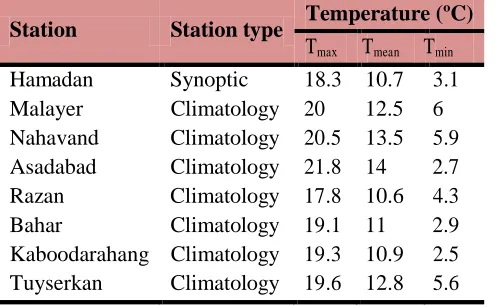
concentrations in the rest of the samples were lower than the acceptable range. Also, temperature of these eight regions is mentioned in Table 2, which can be useful
for estimation of optimal fluoride
concentration in drinking water on basis of
Annual Mean Maximum Temperature
(AMMT).
Number Number of high of low con. con. samples samples
0 25
0 10
0 28
0 30
0 12
0 17
0 9
0 23
Sampling region
Hamadan Malayer Nahavand Asadabad Razan Bahar
Kaboodarahang Tuyserkan
Table 2.Temperature of Hamadan province, Iran-2012 Temperature (ºC)
Station Station type
Tmax Tmean Tmin
Hamadan Synoptic 18.3 10.7 3.1
Malayer Climatology 20 12.5 6
Nahavand Climatology 20.5 13.5 5.9
Asadabad Climatology 21.8 14 2.7
Razan Climatology 17.8 10.6 4.3
Bahar Climatology 19.1 11 2.9
Kaboodarahang Climatology 19.3 10.9 2.5
Tuyserkan Climatology 19.6 12.8 5.6
4. Discussion
As it is shown in table 1, the fluoride al., in 2010, the amount of fluoride content
concentration of ground water of these eight in well water of four Serbian municipalities
regions varied between 0 to 1.78 mg/l. were shown to be 0.10, 0.15, 0.79 and 11
Mean concentration of fluoride samples and ppm. Actually in one of these regions,
standard deviation were 0.574 and 0.351 fluoride level in well water was above value
mg/l respectively. The highest concentration of 1 ppm, recommended by WHO (16). The
of fluoride in studied regions was observed status of fluoride in groundwater of
in Kaboodarahang with 1.78 mg/l where Qaemshahr city was assessed in a period
had low AMMT. While, Asadabad with 0 from 2006 to 2012 The results of this study
mg/l fluoride concentration had the lowest showed that the Fluoride level in 100% of
fluoride level and the highest AMMT deep well water samples were lower than
among investigated regions. According to standard (17). The fluoride concentration of
the Iranian standard organization, the the drinking waters was below the
acceptable range of fluoride concentration permissible limit of fluoride (18). In a study
in drinking water is from 0.5 to 1.5 mg/l by Maleki, the fluoride concentration of
(13). Thus, if the concentration of fluoride four groundwater resources in Sanandaj,
in ground water is less or more than this was determined. The results of this study
range, it is not suitable for drinking purpose showed that fluoride concentration in these
(15). Fifty one percent of samples evaluated resources (0.31 mg/l) tend to be less than
in this study showed acceptable levels of the recommended standard (19).
fluoride and therefore were appropriate for Groundwater fluoride level of four sub
drinking water supply. Fluoride regions in the Shush aquifer, Khuzestan,
concentrations in the rest (49%) of the was evaluated. Fluoride concentrations in
samples were lower than the acceptable this study tend to exceed WHO
range. The fluoride level of ground water recommended standard level (20).
has been evaluated in different areas in According to the biogeochemical influences
several studies. In a study by Mandinic et of fluoride on bones and teeth, water plays a
vital role to provide fluoride required by the
human body (6). Thus, the low and high levels of these ions in drinking water can cause discoloration of teeth and skeletal fluorosis whereas low levels output in decreasing caries reduction (15). Regarding to WHO, recommended daily concentration of fluoride intake is 0.05 mg/kg/day (3). The amount of recommended fluoride intake from drinking four cups of tea for an adult with an average weight of 70 kg is about 14.7% to 50.2% of the recommended daily dose of fluoride (21). Children receive a part of their daily fluoride intake from fluoridated water and a part from dietary sources which would include food and other beverages. Recently in developed countries shortage of fluoride in drinking water can be compensated through adding fluoride sodium to drinking water (6). Hence, according to low value of fluoride in groundwater in this area, we suggest to add fluoride to children’s diet and encourage them to use fluoride mouthwashes.
Acknowledgment
This research has been technically and financially supported by Vice -Chancellor for Health Hamadan University of Medical Sciences, Iran.
References
1. Apambire WM, Boyle DR, Michel
FA. Geochemistry, genesis and health
implications of fluoriferous
groundwater in the upper regions of Ghana. Environmental Geol 1997;35: 13-24
2. Chadha DK,Tamta SR. Occurrence and
origin of groundwater fluoride in phreatic zone of Unnao district, Uttar
Pradesh. J. Applied Geochemistry1999; 1: 21-26.
3. WHO. Guidelines for drinking-water
quality: second addendum, Vol(1). Recommendations- 3rd ed.2008. ISBN 978 92 4 154760 4.
4. Dobaradaran S, Mahvi AH, DehdashtiS.
Fluoride content of bottled drinking water available in Iran. Fluoride2008a; 41: 93-94.
5. Mahvi AH, Zazoli MA, Younecian M,
EsfandiariY. Fluoride content of Iranian black tea and tea liquor. Fluoride 2009; 39: 266-268.
6. Dobaradaran S, Mahvi AH, Dehdashti
S, RanjbarVakilAbadi D. Drinking water fluoride and child dental caries in Dashtestan, Iran. Fluoride 2008b; 41: 220-226.
7. Dobaradaran S, Mahvi AH, Dehdashti
S, Shoara R.Correlation of fluoride with
some inorganic constituents in
groundwater of Dashtestan, Iran.
Fluoride2009;42: 50-53.
8. Brindha K, Rajesh R, Murugan R,
Elango L. Fluoride contamination in groundwater in parts of Nalgonda district, Andhra Pradesh, India. Environ Monit Assess 2011; 172: 481-192.
9. Abdel-Ghani NT, Hefny M, El-
Chagbaby GAF. Removal of lead from aqueous solution using low cost abundantly available adsorbents. Int. J. Environ. Sci. Tech2007; 4: 67-73. 10. Kumar E and et al. Defluoridation from
aqueous solutions by granular ferric hydroxide (GFH). Water Res 2009; 43: 490-498.
11. Nouri J Mahvi AH, Babaei A,
Ahmadpour E. Regional pattern
distribution of groundwater fluoride in the Shush aquifer of Khuzestan County, Iran. Fluoride2006; 39: 321-325.
12. Msonda KWM, Masamba WRL,
Fabiano E. A study of fluoride
groundwater occurrence in
Nathenje,Lilongwe, Malawi. Physics and Chemistry of the Earth2007; 32: 1178-1184.
13. ISIRI (Institute of Standards and 18. Tokanoghlu S, Shahin U, kartal S.
Industrial Research of IRAN) Determination of Fluoride and Some
.5th.revision, Standard No.1053, 2009. Metal Ion Levels in the drinking waters
14. APHA/AWWA/WEF, Standard in Kayseri province. Turk J Chem 2001;
methods for the examination of water 25: 113 – 121.
and wastewater, 21stEd., Washington 19. Maleki A, Alavi N, Safari M, Rezaee R.
DC (2005) Determination of Fluoride in Sanandaj
15. Abdulrahmani A. Fluoride content in Drinking Water Resources. Jundishapur
drinking water supplies of Riyadh, Journal of Health Sciences 2012; 4 (1):
Saudi Arabia. Environmental 17-24.
Monitoring and Assessment 1996; 48: 20. Nouri J, Mahvi AH, Babaei A,
261-272. Ahmadpour E. Regional pattern
16. Mandic Z, Curcic M, Antoijevic B, distribution of groundwater fluoride in
Carevic M, Mandic J. Fluoride in the Shush aquifer of Khuzestan County,
drinking water and dental fluorosis. Iran. Fluoride2006;39:321-5.
Science of the Total Environment 2010; 21. Amanlou M, NabatiF, Azizian H,
408: 3507–3512 FarsamH. Assessment of fluoride
17. Boudaghimalidareh H, Alinezhad A, content and daily intake from different
Boudaghi P, Mahvi AH. Investigation of brands of tea bags in Iran. Research in
Fluoride Level in Drinking Water Pharmaceutical Sciences 2008; 3: 55-59.
Supplies of Qaemshahr City (North of IRAN) from 2006 to 2012. IJHS 2013; 1(2):19-27.