Special issue on Advancement in Engineering Technology
A Test Code Generation Method for Coding Standard Input
/
Out-put with Exception Handling in Java Programming Learning
As-sistant System
Ei Ei Mon1, Nobuo Funabiki*,1, Ryota Kusaka1, Khin Khin Zaw1, Wen-Chung Kao2
1Okayama University, Department of Electrical and Communication Engineering, Okayama, Japan 2National Taiwan Normal University, Department of Electrical Engineering, Taipei, Taiwan
A R T I C L E I N F O A B S T R A C T Article history:
Received: 30 October, 2017 Accepted: 13 December, 2017 Online: 30 January, 2018 Keywords:
Java programming JPLAS
Test code Test case
Automatic generation JUnit
To advance Java programming educations, we have developed the Java Programming Learning Assistant System (JPLAS) that provides the code writing problem. This problem asks a student to write a source code to satisfy the specification of a given assignment, where the correctness is verified by running test code on JUnit. For a novice student, a code of implementing the standard input/output with the exception handling should be mastered at the early stage as the first step programming for human interfaces. However, for a teacher, it is not easy to write the test code for it. In this paper, we propose a test code generation method to generate the test code using the reference source code for the assignment. In the evaluation of this proposal, all the students completed the codes using the generated test codes for exception handling, although the use of exception handling functions was sometimes insufficient or incorrect.
1
Introduction
Recently, the objected oriented programming language Javahas been widely used in various practical application systems in societies and industries due to the high reliabil-ity, portabilreliabil-ity, and scalability. Java was selected as the most popular programming language in 2015 [2]. There-fore, there have been strong demands from industries for Java programming educations. Correspondingly, a plenty of universities and professional schools are currently offering Java programming courses to meet this challenge. A typical Java programming course consists of grammar instructions in the class and programming exercises in computer opera-tions.
To advance Java programming educations, we have de-veloped the Web-basedJava Programming Learning Assis-tant System (JPLAS) [3]-[7]. JPLAS inspires students by offering sophisticated learning environments via quick re-sponses to their answers for self-studies. At the same time, it supports teachers by reducing loads of evaluating codes. JPLAS has several types of problems to cover a variety of students at different learning levels. Among them, thecode
writing problem[4] asks a student to write a source code to satisfy the specification of a given assignment.
Thecode writing problemis implemented based on the test-driven development (TDD) method[8], using an open source frameworkJUnit[9]. JUnitautomatically tests the codes on the server to verify their correctness using thetest codewhen they are submitted by students. Thus, students can repeat the cycle of writing, testing, modifying, and re-submitting codes by themselves, until they can complete the correct codes for the assignments.
To register a new assignment for the code writing prob-lem in JPLAS, a teacher has to prepare aproblem statement describing the code specification, areference source code, and a test codeusing a Web browser. It is noted that the reference source code is essential to verify the correctness of the problem statement and the test code. Then, a student should write a source code for the assignment while refer-ring the statement and the test code, so that the source code can be tested by using the given test code onJUnit.
However, teachers at schools are not accustomed to writing a test code that can run onJUnit. A teacher may spend much time in struggling to write a test code, and may
*Nobuo Funabiki, Department of Electrical and Communication Engineering, Okayama University, Okayama, Japan, [email protected]
This paper is an extension of work originally presented in 31st IEEE International Conference on Advanced Information Networking and Applications (AINA-2017) [1]
register an incomplete test code that does not verify some requirements described in the problem statement correctly. This incomplete test code must be avoided because it may produce inappropriate feedback to a student and undermine confidence to JPLAS. On the other hand, a commercial tool for generating a test code is usually expensive, and may not cover a test code that verifies the standard input/output with exception handling in a source code. The code of imple-menting the standard input/output with exception handling should be mastered by novice students at the early stage of Java programming educations as the first step programming for human interfaces.
In this paper, we propose atest code generation method for the code writing problem in JPLAS that generates a test code using a reference source code to test the standard in-put/output with exception handling. This method can gen-erate a test code through the following steps: 1) atest code template is provided by our proposal, 2) a set of standard inputs to be tested are made by a teacher, 3) by running the reference code with each input, the corresponding expected standard output is extracted correctly, and 4) this pair of the standard input and the standard output are embedded into the test code template. By repeating steps 3) and 4) for ev-ery test standard input, the test code can be completed. To run the source code using the test code onJUnit, it intro-duces the classes to handle the standard input/output func-tions as the memory access funcfunc-tions in [10].
To evaluate the proposed method, first, we applied it to 97 source codes in Java programming textbooks or Web sites that contain the standard input/output. It has been proved that the generated test codes could correctly verify the source codes except for one code using a random gener-ator. Then, we generated the test codes for three problems and asked five students who are currently studying Java pro-gramming to write the source codes using them. It was found that they completed the codes that can pass the test codes, whereas the use of exception handling functions was sometimes insufficient or incorrect.
The rest of this paper is organized as follows: Sections 2 and 3 introduce the TDD method and JPLAS respectively. Section 4 presents the test code generation method. Sec-tion 5 shows the evaluaSec-tion result. SecSec-tions 6 shows related works. Finally, Section 7 concludes this paper with some future works.
2
Test-driven Development Method
In this section, we introduce the test-driven development method along with its features.
2.1
Outline of TDD Method
In the TDD method, the test code should be written before or while the source code is implemented, so that it can ver-ify whether the current source code satisfies the required specifications during its development process. The basic cycle in the TDD method is as follows:
1) to write the test code to test each required specifica-tion,
2) to write the source code, and
3) to repeat modifications of the source code until it passes each test using the test code.
2.2
JUnit
In JPLAS, we adoptJUnitas an open-source Java frame-work to support the TDD method.JUnitcan assist the unit test of a Java code unit or aclass. BecauseJUnithas been designed with the Java-user friendly style, its use including the test code programming is less challenging for Java pro-grammers. InJUnit, a test is performed by using a given method whose name starts fromassert. This paper adopts the assertThatmethod to compare the execution result of the source code with its expected value.
2.3
Test Code
A test code should be written using libraries inJUnit. Here, by using the followingsource code 1forMyMathclass, we explain how to write a test code. MyMathclass returns the summation of two integer arguments.
source code 1 1 public classMath{
2 public intplus(inta,intb){
3 return( a+b );
4 }
5 }
Then, the followingtest code 1can test theplusmethod in theMyMathclass.
test code 1 1 import staticorg.junit.Assert.*;
2 importorg.junit.Test;
3 public classMathTest{
4 @Test
5 public voidtestPlus(){
6 Math ma=newMath();
7 intresult=ma.plus(1, 4);
8 assertThat(5, is(result));
9 }
10 }
The names in the test code should be related to those in the source code so that their correspondence becomes clear: • The class name is given by thetest class name+Test. • The method name is given by thetest+test method
name.
The test code importsJUnitpackages containing test meth-ods at lines 1 and 2, and declaresMathTestat line 3.@Test at line 4 indicates that the succeeding method represents the test method. Then, it describes the test method.
The test code performs the following functions: 1) to generate an instance for theMyMathclass, 2) to call the method in the instance in 1) using the given
arguments,
2.4
Features in TDD Method
In the TDD method, the following features can be observed: 1. The test code can represent the specifications of the source code, because it must describe the function tested in the source code.
2. The test process for a source code becomes efficient, because each function can be tested individually. 3. The refactoring process of a source code becomes
ef-fective, because the modified code can be tested in-stantly.
Therefore, to study the TDD method and writing a test code is useful even for students, where the test code is equivalent to the source code specification. Besides, students should experience the software test that has become important in software companies.
3
Java Programming Learning
Assis-tant System
In this section, we review the outline of our Java program-ming learning systemJPLAS.
3.1
Server Platform
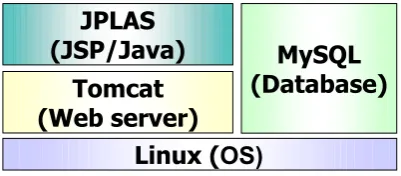
JPLAS is implemented as a Web application using JSP/ -Java. For the server platform, it adopts the operating system Linux, the Web serverApache, the application server Tom-cat, and the database systemMySQL, as shown in Figure 1. For the browser, it assumes the use ofFirefoxwithHTML, CSS, andJavaScript.
JPLAS
(JSP/Java)
Tomcat
(Web server)
MySQL
(Database)
Linux (
OS)
Figure 1: JPLAS server platform.
3.2
Teacher Service Functions
JPLAS has user functions both for teachers and stu-dents. Teacher service functionsinclude the registration of courses, the registration and management of assignments, and the verification of source codes that are submitted by students. To register a new assignment, a teacher needs to input an assignment title, a problem statement, a reference (model) source code, and a test code. After the registration, they are disclosed to the students except for the source code. Note that the test code must be able to test the model code correctly. Using the correspondence between a source code and a test code in Section 2.3, it is possible to automatically generate a template for the test code from the source code. Then, a teacher merely needs to specify concrete values for the arguments in each test method to complete the test code.
To evaluate the difficulty of assignments and the com-prehension of students, a teacher can refer to the number of submissions for code testing from each student. If a teacher finds an assignment with plenty of submissions, it can be considered as quite difficult for the students, and should be changed to an easier one. If a teacher finds a student who submitted codes in many times whereas other students did in a few times, this student may require additional assis-tance from the teacher.
3.3
Student Service Functions
Student service functions include the view of the ments and the submission of source codes for the ments. A student should write a source code for an assign-ment by referring the problem stateassign-ment and the test code. It is requested to use the class/method names, the types, and the argument setting specified in the test code. JPLAS im-plements a Web-based source code editor calledCodePress [11] so that a student can write codes on a Web browser. All submitted source codes will be stored in the database on the server as a reference for students.
4
Proposal of Test Code Generation
Method
In this section, we propose the test code generation method for coding the standard input/output with exception han-dling.
4.1
Scope of Source Code under Test
At the early stage of the Java programming education, the responsibility of a student is to master how to write a source code that contains the standard input/output with exception handling. Thus, a teacher in a Java programming course should prepare a considerable number of assignments for writing source codes containing them, where many Java programming textbooks offer such assignments for novice students.
The source code in this paper must contain the functions for the standard input/output and the exception handling. Then, if the proper data is given to the code from the stan-dard input, it must handle it correctly and outputs the mes-sage specified in the assignment to the standard output. On the other hand, if the improper data is given, it must handle it using the exception handling command without abortion and outputs the corresponding message.
4.2
Requirements in Test Code
Subsequently, the test code must satisfy the following re-quirements:
1. The input data from the standard input (keyboard) must be described in the test code to test the standard input in the source code.
3. The input data must be elaborated in the test code for the standard input.
4. The input data in the test code should cover any pos-sible one for the standard input, including the proper and improper ones.
5. The expected output data for each input data must be narrated in the test code correctly.
4.3
Solutions
for
Requirements
Test code generation method adopts following functions and commands to solve the above mentioned require-mentsbyreferringthetestcodeimplementationin[10]:
• To describe the standard input data to the source code, theInputlnmethod inStandardInputSnatcherclass is adopted in the test code. It is noted that Standard-InputSnatcher class is extended from InputStream class.
• To receive the standard output data from the source code, the readLine method in StandardOutput-Snatcherclass is adopted in the test code. It is noted that StandardOutputSnatcherclass is extended from PrintStreamclass.
• Any possible standard input data is prepared by a teacher beforehand. It is used in the argument of In-putln.
• To obtain the expected standard output data from the code for each input data, the reference source code is executed with this input data.
• Each pair of the standard input and output data is em-bedded into the test code.
4.4
Conditions of Source Code
Currently, to avoid the complexity, the proposed method confines the applicable source code that satisfies the follow-ing conditions:
1. it has themainmethod only.
2. it contains the standard input function.
3. it contains the standard output function for handling the proper input.
4. it contains the standard output function for handling the exception.
It is noted that a source code containing multiple standard input/output functions can be handled by increasing the number of Inputln or assertThat in the test code accord-ingly. Besides, if a code does not have themainmethod, it can be handled by describing the proper statements to ex-ecute the method for the standard input/output in the test code.
An example source code in this scope is as follows:
source code 2 1 importjava.util.Scanner;
2 public classSample{
3 public static voidmain(String args[]){
4 intnumber;
5 Scanner scan=newScanner(System.in);
6 try{
7 System.out.print("Enter an integer");
8 String actual=scan.nextLine();
9 number=Integer.parseInt(actual);
10 System.out.println(number+": is input number");
11 }catch(NumberFormatException e){
12 System.out.print("
NumberFormatException occurs!");
13 }
14 }
15 }
source2acceptsanintegerdatafromaconsoleand out-putsamessagewiththisdataonadisplay. In thissource code,1)ithasonlythemainmethodatline3,2)scan ob-jectofScannerclassisdefinedatline5asthestandard in-putfunction,3)System.out.printlniscalledatline10asthe standardoutputfunctionforhandlingtheproperinput,and 4)System.out.printlniscalledatline12asthestandard out-putfunctionforhandlingtheexception.
4.5
Test
Code
Template
Then,theproposedmethodprovidesthetestcodetemplate containingtherequiredfunctionsfortheabovementioned source code. The followingcode describes the corepart ofthetestcodetemplatestartingfrom@Test. Inadvance, severalimportstatementstouserelatedlibraries,andthe in-stancegenerationsfortheStandardInputSnatcherand Stan-dardOutputSnatcher classes are necessary. Besides, the definitionsoftheseclassesarealsorequiredtocompletethe testcodetemplate.
Inthistemplate,in.Inputlnatline29givesthestandard input data tothe source code, wherein isan instance of StandardInputSnatcherclass.Thestatementsatlines30-37 run thesourcecode andreadthe standardoutputdatafor thisinputdata,whereoutisaninstanceof StandardOutput-Snatcherclass. expectedatline38representstheexpected output dataof thesourcecode. Theblanks " " atlines 29 and 38 should be filled by the standard input and output data.assertThatatline39comparestheexpecteddatawith theoutputdataofthecode. Thewholestatementsatlines 25-40shouldbepreparedforeachinputdata.
testcodetemplate
1 import staticorg.hamcrest.CoreMatchers.is;
2 import staticorg.junit.Assert.assertThat;
3 import staticorg.junit.Assert.*;
4 importjava.io.InputStream;
5 importorg.junit.Before;
6 importorg.junit.Test;
7 importSnatcher.StandardOutputSnatcher;
8 importjava.io.BufferedReader;
9 importjava.io.ByteArrayOutputStream;
10 importjava.io.IOException;
11 importjava.io.InputStream;
12 importjava.io.PrintStream;
13 importjava.io.StringReader;
14
15 public classTemplateTest{
16 privateStandardInputSnatcher in=new
17 privateStandardOutputSnatcher out=new
StandardOutputSnatcher();
18
19 @Before
20 public voidsetUp(){
21 System.setIn(in);
22 System.setOut(out);
23 }
24
25 @Test
26 public voidtest1()throwsException{
27 StringBuffer bf=newStringBuffer();
28 String actual,line,expected;
29 in.Inputln("");//standard input 30 Sample.main(newString[0]);
31 System.out.flush();
32 while((line=out.readLine()) !=null){
33 if(bf.length()>0)
34 bf.append("\n");
35 bf.append(line);
36 }
37 actual=bf.toString();
38 expected="";//expected standard output 39 assertThat(actual,is(expected));
40 }
41 }
4.6
Test Code Generation Procedure
The test code generation procedure using thetest code tem-platein the proposed method is as follows:
1) Ateacherpreparesthereferencesourcecodeforthe assignment.
2) He/shepreparesasetofpossiblestandardinputdata tothesourcecode.
3) He/sherunsthesourcecodebyusingeachstandard input dataandobserves the corresponding standard outputdata.
4) He/sheembedsthestandardinputdatainto" "atline
29andtheobservedstandardoutputdatainto" "at line38inthetestcodetemplate.
As the possible standard input data in step 2), the fol-lowing five data types should be considered. Then, the teacher needs to select one value for each data type, which is used in step 3).
• positiveinteger:5 • negativeinteger:-14 • zerointeger:0
• floating-pointnumber:0.5 • one-bytecharacter:abc • two-bytecharacter:ABC
4.7
Generated Test Code Example
This subsection introduces an example of the test code gen-erated by applying the proposed method tosource code 2. The file name for the generated test code is given as Sam-pleTest.java. The followingtest code 2shows a part of the test code.
test code2
1 ...
2
3 @Test
4 public voidtest1()throwsException{
5 StringBuffer bf=newStringBuffer();
6 String actual,line,expected;
7 in.Inputln("5");//proper standard input data 8 Sample.main(newString[0]);
9 System.out.flush();
10 while((line=out.readLine()) !=null){
11 if(bf.length()>0)
12 bf.append("\n");
13 bf.append(line);
14 }
15 actual=bf.toString();
16 expected="Enter an integer"+
17 "5: is input number";
18 assertThat(actual,is(expected));
19 }
20
21 @Test
22 public voidtest2()throwsException{
23 StringBuffer bf=newStringBuffer();
24 String actual,line,expected;
25 in.Inputln("abc");//improper standard input data
26 Sample.main(newString[0]);
27 System.out.flush();
28 while((line=out.readLine()) !=null){
29 if(bf.length()>0)
30 bf.append("\n");
31 bf.append(line);
32 }
33 actual=bf.toString();
34 expected="Enter an integer"+" NumberFormatException occurs!";
35 assertThat(actual,is(expected));
36 }
37 ...
5
Evaluation
In this section, we evaluate the effectiveness of the pro-posedtest code generation methodin terms of generating test codes from existing source codes and writing source codes using the test codes by students.
5.1
Test Code Generation Results
First, we evaluate the method in generating test codes from source codes. For this purpose, 97 source codes were col-lected from Java programming textbooks or Web sites [12]-[16], and the test codes were generated by applying the pro-posed method. It is noted that some codes in [15] were modified to using the standard input/output through the con-sole instead of using the dialog box. Then, the correct-ness of each test code was examined by testing the original source code. It was found that our method generated the test codes that can pass original codes correctly except for one source code, which outputs a random number generated in the code. Thus, the effectiveness of the proposed method was confirmed.
source code 3 1 importjava.io.*;
2 classSample3{
3 public static voidmain(String[] args)throws
IOException{
4 try{
5 System.out.println("Enter two integers ");
6 BufferedReader br=
7 newBufferedReader(new
InputStreamReader(System.in));
8 String str1=br.readLine();
9 String str2=br.readLine();
10 intnum1=Integer.parseInt(str1);
11 intnum2=Integer.parseInt(str2);
12 System.out.println("The sum is "+( num1+num2)+".");
13 }catch(NumberFormatException e){
14 System.out.print("
NumberFormatException occurs!");
15 }
16 }
17 }
test code3 1 ...
2
3 @Test
4 public voidtest1()throwsException{
5 StringBuffer bf=newStringBuffer();
6 String actual,line,expected;
7 in.Inputln("2"); in.Inputln("7");//proper standard input data
8 Sample.main(newString[0]);
9 System.out.flush();
10 while((line=out.readLine()) !=null){
11 if(bf.length()>0)
12 bf.append("\n");
13 bf.append(line);
14 }
15 actual=bf.toString();
16 expected="Enter two integers"+"The sum is 9.";
17 assertThat(actual,is(expected));
18 }
19
20 @Test
21 public voidtest2()throwsException{
22 StringBuffer bf=newStringBuffer();
23 String actual,line,expected;
24 in.Inputln("0.5"); in.Inputln("-3");// improper standard input data 25 Sample.main(newString[0]);
26 System.out.flush();
27 while((line=out.readLine()) !=null){
28 if(bf.length()>0)
29 bf.append("\n");
30 bf.append(line);
31 }
32 actual=bf.toString();
33 expected="Enter two integers"+" NumberFormatException occurs!";
34 assertThat(actual,is(expected));
35 }
36 ...
5.2
Source Code Writing Results
Next, we evaluate the proposed method in writing source codes with generated test codes by five students who are currently studying Java programming and have same tech-nical levels. For this purpose, we prepared the following three problems, where all the students completed the source codes that pass the test codes for any problem.
5.2.1 Problem #1
In problem #1, the code accepts an integer data from a con-sole, and outputs a message with this data to a concon-sole, wheresource 2is the reference source code and test 2is the test code. The source code from a student is expected to useNumberFormatExceptionto check the input data for-mat. Then, three students use this class for the exception handling, and one usesException. However, one student does not use it where he implements the data format check-ing function.
5.2.2 Problem #2
In problem #2, the code accepts an integer index from a con-sole, and outputs the indexed data from the data array. The student code is expected to use ArrayIndexOutofBoundEx-ceptionto check the range of the index. Then, only one stu-dent uses this class. The other stustu-dents implement the index checking function in the codes. Two students use IOExcep-tion, and two students do not use any class for the exception handling. No student useNumberFormatExceptionto check the input data format, although the class was requested in problem #1. Unfortunately, many students cannot integrate the knowledge that has been studied sequentially.
5.2.3 Problem #3
In problem #3, the code accepts a file path from a con-sole, and outputs the string at the first line in the file. The student code is expected to useFileNotFoundExceptionor IOExceptionto check the file path. Then, three students use FileNotFoundException, one usesException, and one uses IOException.
5.2.4 Summary of Student Applications
This simple experiment of our proposal shows that the stu-dents can generally complete source codes using standard input/output with exception handling that can pass the gen-erated test codes. However, their use of the class for the exception handling is sometimes insufficient or incorrect. It has been observed that these students are not experts, which causes the difference in their source codes, although they have enough programming skills. To let them under-stand the correct use, it is necessary to improve the proposed method.
6
Related Works
In this section, we introduce some related works to this pa-per.
In [18], Rashkovits showed that most of college stu-dents understand the concept of Java exception handling at the basic level, and the majority of them have difficulty in understanding advanced properties such as use of multi-ple exceptions, flow of control in the context of exceptions, handling exceptions further up the calling chain, catching and handling hierarchically related exceptions, and overrid-ing methods that throw exceptions. They also provided a tutorial of exception handling, and quoted that exception handling is perceived as a relatively difficult task by novice programmers. In future works, we will consider to adopt their contributions.
In [19], J´unior presented a practical approach to pre-serve the exception policy in a system by automatically checking exception handling design rules. They are checked through executions of JUnit test cases with dy-namic mock objects that are generated by the supporting tool. Four versions ofMobile Media in SPLwere used to evaluate whether the policy was preserved or not. The re-sults show that the approach can effectively detect viola-tions on the policy of software product lines.
In [20], Nakshatri presented an empirical study of ex-ception handling patterns in Java projects. It forces develop-ers to think in sophisticated ways to handle the exceptions. In this study, empirical data was extracted from projects by analyzing data inGitHubandSourceForgerepositories. The results were compared with recommendations for best practices in exception handling presented by Bloch [21]. It has been observed that most programmers ignore checking exceptions, and higher classes in the exception class hierar-chy are more frequently used.
In [22], Brunet presented the concept ofdesign testthat automatically checks whether the code conforms to the spe-cificdesign ruleby using a test-like program. To support it, DesignWizard (DW)had been developed with a fully-fledged API that allows writing design tests for Java codes using JUnit. The proposal was applied to three software products in their group and student projects in the under-graduate course. The results showed that this approach was suitable to check conformance between the design rules and the code implementation. Moreover, it has been observed that both designers and programmers appreciated the de-sign tests as executable documents that can be easily kept up to date.
In [23], Akahane presented a Web-based automatic scoring systemfor Java programming assignments to reduce loads of teachers in verifying a huge number of codes and in giving feedbacks to students. The system receives Java application programs submitted by students, and immedi-ately returns the results ofJUnittests where theJava Reflect APIis adopted for testing private classes and methods that have been commonly found in introductory courses. The regular expression is used to compare the output texts of each student program and those of the reference program. Through use in an actual course in their university, it was confirmed that this system was very helpful for students to improve programming skills by correcting mistakes in their programs and repeating their submissions.
In [24], Kitaya presented a Web-based scoring system of programming assignments to students, which is similar to JPLAS. Their test consists of compiler check,JUnittest,
and result test. The result test verifies the correctness of a student code composed of only themainmethod that read-s/writes data from/to the standard input/output devices, by comparing the results of this code and of the reference code. However, the method has several disadvantages from our proposal: 1) it is only applicable to a code composed of themainmethod with the standard input/output, 2) it uses other programs to use the redirection for handling the stan-dard input/output, and 3) it needs several input files to check the correctness for different input data. On the other hand, our method is applicable to a code containing other than the mainmethod, it needs onlyJUnitwith a test code, and all the input data can be described in a single test code.
7
Conclusion
In this paper, we proposed thetest code generation method for the code writing problem in JPLAS that requires im-plementing a Java source code containing thestandard in-put/outputwithexception handling. To access the standard input/output from the test code onJUnit, thetest code tem-plateis first prepared with theinput/output snatcher classes. Then, the test code is completed by embedding the input and output extracted by running thereference source code into the template. This proposal is helpful in reducing the teacher load in writing the test code for the programming as-signment that requires the standard input/output with excep-tion handling, which is common for novice students. The effectiveness is evaluated through applying the method to 97 source codes in Java programming text books or Web sites, and asking five students to write source codes using the generated test codes for three problems. In future works, we will extend the proposed method to handle other in-put/output functions, other methods than themainmethod, and improve the readability of the generated test code to make it easier for novice students.
References
[1] N. Funabiki, R. Kusaka, N. Ishihara, and W.-C. Kao, ”A proposal of test code generation tool for Java programming learning assis-tant system,” Proc. IEEE Int. Conf. Adv. Inform. Netw. Appl., pp. 51-56, March 2017.
[2] S. Cass, The 2015 top ten programming languages,
http://spectrum.ieee.org/computing/soft- ware/the-2015-top-ten-programminglangua-ges/?utm_so.
[3] N. Funabiki, Tana, K. K. Zaw, N. Ishihara, and W.-C. Kao, ”A graph-based blank element selection algorithm for fill-in-blank problems in Java programming learning assistant system”, IAENG Int. J. Comput. Science, vol. 44, no. 2, pp. 247-260, May 2017.
[4] N. Funabiki, Y. Matsushima, T. Nakanishi, K. Watanabe, and N. Amano, ”A Java programming learning assistant system using test-driven development method”, IAENG Int. J. Comput. Science, vol.40, no.1, pp. 38-46, Feb. 2013.
[6] N. Ishihara, N. Funabiki, and W.-C. Kao, ”A proposal of statement fill-in-blank problem using program dependence graph in Java pro-gramming learning assistant system”, Inf. Eng. Express, vol. 1, no. 3, pp. 19-28, Sep. 2015.
[7] N. Ishihara, N. Funabiki, M. Kuribayashi, and W.-C. Kao, ”A soft-ware architecture for Java programming learning assistant system”, Int. J. Comput. Soft. Eng., vol. 2, no. 1, Sep. 2017.
[8] K. Beck, Test-driven development: by example, Addison-Wesley, 2002.
[9] JUnit,http://www.junit.org/.
[10] Diary of kencoba, http://d.hatena.ne.jp/kencoba/ 20120831/ 1346398388.
[11] CodePress,http://codepress.sourceforge.net.
[12] M. Takahashi, Easy Java, 5th Ed., Soft Bank Creative, 2013.
[13] H. Yuuki, Java programming lessen, 3rd Ed., Soft Bank Creative, 2012.
[14] Y. D. Liang, Introduction to Java programming, 9th Ed., Pearson Education, 2014.
[15] Java programming seminar, http://java.it-manual.com/ start/about.html.
[16] Kita Soft Koubo, http://kitako.tokyo/lib/Ja-vaExercise.aspx.
[17] C. Fu and B. G. Ryder, ”Exception-chain analysis: revealing ex-ception handling architecture in Java server applications”, Proc. Int. Conf. Soft. Eng., pp. 230-239, May 2007.
[18] R. Rashkovits and I. Lavy, ”Students’ understanding of advanced properties of Java exceptions”, J. Inform. Tech. Edu., vol. 11, pp. 327-352, 2012.
[19] R. J. S. J´unior and R. Coelho, ”Preserving the exception han-dling design rules in software product line context: a practical ap-proach”, Proc. Latin-American Symp. Depend. Comp. Work., pp. 9-16, 2011.
[20] S. Nakshatri, M. Hegde, and S. Thandra ”Analysis of exception handling patterns in Java projects: an empirical study”, Proc. IEEE/ACM Work. Conf. Mining Soft. Rep., pp. 500-503, May 2016.
[21] J. Bloch, Effective Java, 2nd Ed., Prentice Hall PTR, Upper Saddle River, NJ, USA, 2008.
[22] J. Brunet, D. Guerrero, and J. Figueredo, ”Design tests: an approach to programmatically check your code against design rules”, Proc. Int. Conf. Soft. Eng., pp. 255-258, May 2009.
[23] Y. Akahane, H. Kitaya, and U. Inoue, ”Design and evaluation of au-tomated Scoring Java programming assignments” Proc. Int. Conf. Soft. Eng., Art. Intel., Net. Para./Dist. Comp., pp.1-6, 2015. [24] H. Kitaya and U. Inoue, ”An online automated scoring system for