The application of multi - agent systems in the field of transport
Antoniu Ovidiu BALINT, PhD candidate ASE Bucharest
6, Romana Sq, Sector 1, 010374, Bucharest, Romania [email protected]
Abstract
This paper describes the application of multi-agent systems for improving the transport networks. The growth of international traffic has created new problems in managing the passengers flow. Complex systems are needed to improve the management of transport companies that require new ways for finding solutions on improving their costs such as applying new methods and technologies. The main question that is addressed in this paper is: can the performance and economic status of the transport companies be improved by using multi-agent systems? In order to respond to this question I have presented in this article the main strategies that are used in the present for improving transport systems and a personal interpretation of these strategies.
Key words: information systems, multi-agent systems, intelligent transport, innovative concepts
JEL Classification: A11, D84, L91, L96, M11, N70, Q40 and R42
1. Introduction
The multi-agent based methods that are used today by the transport companies and economic environment consists in practical applications that help improve these domains. If, initially, the agent-based systems were applied in areas such as: production, process control,
telecommunications systems, air traffic control, transport and road traffic management, e-commerce, business management, health care, etc., today more and more new areas of
applications are addressed in order to introduce the multi-agent systems. Gradually there were improved not only the systems and methodologies but also the techniques and tools that are used to create and implement them in practical fields. Philosophy and methodologies based on multi-agents systems have a tremendous impact not only on artificial intelligence and its applications, but also to other sciences and fields of application.
Luck, M.s.a. (2001) shows that the influences and applications of MAS19 and methods are classified in three main categories:
1) systems and methods for the design of complex distributed computing systems; 2) source of technology for the development of virtual systems;
3) models of real complex systems.
Multi-agent systems are very similar, from many perspectives, to a living organism – they are continually evolving, transforming and are permanently reinvented. The reasons behind these deviations are related with the economical context that is changing year over year.
19
2. The challenges that the multi-agent systems are facing
“A new approach: open systems - represent the most important application for multi-agent systems"20
Multi-agent systems can tackle problems that have multiple methods of solving different issues, multiple ways to structure or ways of problem solving, as in the case of distributed systems. The multi-agent systems have the advantage of resolving distributed and competing matters, but also the complex ways of the interaction representation. Interaction refers to cooperation, coordination and negotiation skills.
The multi-agent systems represent one of the most reliable approaches for supporting the development of new applications in many fields of the transport sector such as: industrial shipment, road traffic, transport management, rail transport, passenger and cargo transport, artificial intelligence present on all modern vehicles, etc.
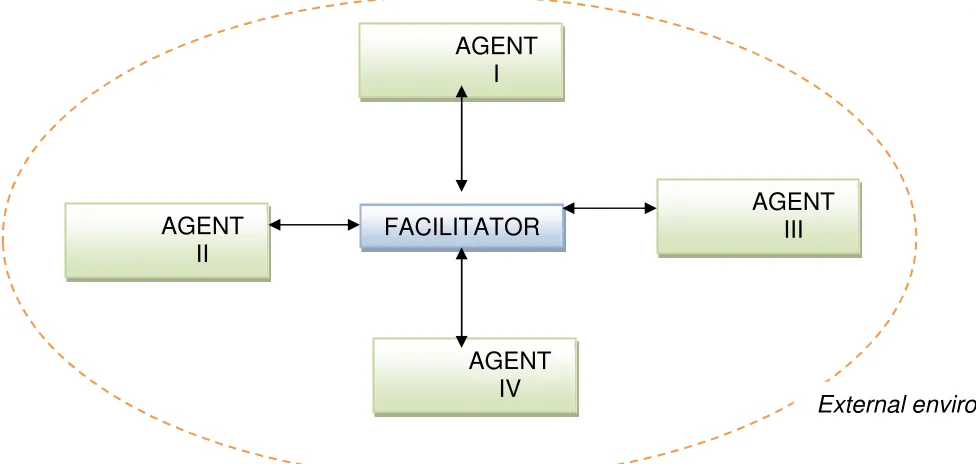
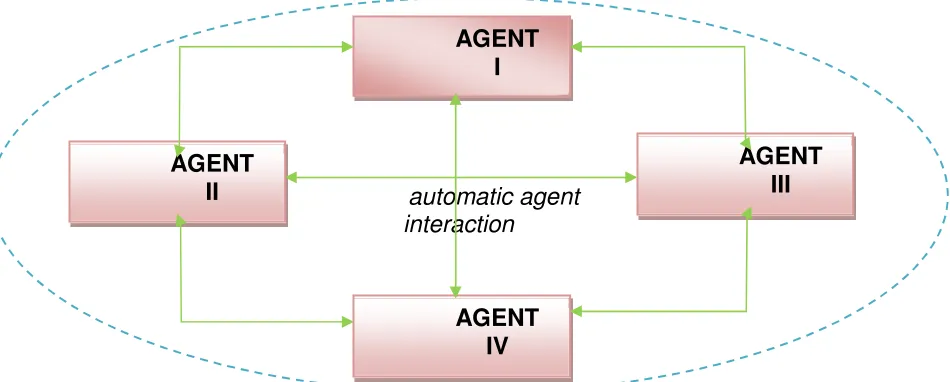
To meet all of these challenges that the MAS are facing I propose Figure 1 and Figure 2 to resolve all the communicating conflicts that intervene beside 2 or more systems that are working together and interact with the external environment which is influencing the “working agents”.
Figure 1: New model of a multi-agent system based on the traditional scheme Source: Balint A. O., Proposed model, 2013
All the multi-agent systems depend on a facilitator agent (main agent), which collects all the data from the “working agents”, interprets it and sends back to the agents new commands on how to interact with the external environment (Figure 1).
The main purpose of the facilitator is to collect all the data from the agents which can work all in the same time and in this way the costs are reduced considerably but most importantly the time in which they can react can be reduced in a very considerably manner. The interaction with the external environment is made only by the “working agents” after “talking” with the facilitator.
20
M. Wooldridge, N. R. Jennings, and D. Kinny, "A Methodology for Agent-Oriented Analysis and Design," presented at Proceedings of the Third Annual Conference on Autonomous Agents (AA-99), Seattle WA USA, 1999
AGENT I
AGENT II
AGENT III FACILITATOR
AGENT IV
The novelty item that is retrieved from the above presented figure is represents by the fact that without a proper and well establish communication channel between all of the “working agents” and the facilitator, the external environment cannot be influenced by a multi-agent system and in this way the transport systems will be no longer operable at a full capacity.
Figure 2: New model of a multi-agent system working scheme Source: Balint A. O., Proposed model, 2013
In Figure 2 I present an improved model of a multi-agent system compared to Figure 1. The element of novelty from this proposed scheme is represented by the interaction between the agents, which do not need any other moderator (or facilitator as is named in figure 1), who can “communicate” between them directly and more easy without the risk of losing any important information on the way.
All of the agents should be working separately but in the same time they have to collaborate one with the other to interact with the external environment.
3. The issue of a multi-agent system
Multi agent systems are commonly used in the design of new software systems which are based on a stimulus-response system. A MAS shapes an interactive scheme through a collection of specialized agents that produce and react to any type of stimuli that exist within the system.
Multi-agent systems, models an interactive system through specialized computational units called agents. An agent has a knowledge base and is able to initiate or respond to any type of actions.
A multi-agent system can be viewed as an evolving system in which each agent is engaged in a self-employed activity. In a multi-agent system, each agent operates, in theory, independent of the existence of any other agents. MAS are very useful tools for modeling distributed information systems with an interaction synchrony or asynchrony.
MAS theory is a logical consequence of the desire to develop intelligent systems. Currently, there is a methodology that allows a method of analysis, specification, design and implementation of a multi-agent system. For the full specification of a multi-agent system is necessary to define internal knowledge and behavior of agents and mode of interaction with
automatic agent interaction
AGENT I
AGENT II
AGENT III
AGENT IV
other agents which coexist in the MAS. In the multi-agent system, the “agent's” intentions may be defined as a goal to be attained in the implementation of a set of actions. The "knowledge" (know-how) of an “agent” is the ability or potential to execute an action or a set of actions and at the same time exudes intelligence as a result of the results obtained.
The key issues that regularly appear in the design and implementation of the MAS are:
• how should we decompose, formulate, describe and allocate the main issues that
appear when implementing MAS and how to synthesize the results offered by the intelligent agents?
• when and how the intelligent agents will communicate and interact one with each
other?
• how to ensure that the agents will take and implement the right decision? • in what manner will the action plans of a company be influenced by the agents? • How will the MAS be design and build regarding the methodologies and
technologies that are constantly changing?
The optimal combination between the current studies, based on MAS and the construction of a production and distribution entity, is to be able to offer at the right time, the most effective solutions to the most complex problems. From this perspective, I believe that this is only a first step on solving the key problems that the multi-agent systems encounter and we have to manage them with consistency and stability.
4. Conclusions
The multi-agent systems have become in the last decades a key factor in the development of the intelligent transport systems. By using a MAS we can improve the quality of services provided by companies which are supporting the development of new technologies.
Traditional methods that are applied inside the companies around the world cannot face the challenges of the XXI century and need to be permanently improved, develop and reinvented so that we can benefit from the progress of new technologies such as the multi-agent systems.
The proposed models (figure 1 and 2 presented in the second paragraph) have the meaning of resolving the current problems that multi-agent systems are facing. By using these schemes inside the transport companies on a small or large scale the communication between one or more “agents” can be reduced considerably therefore I consider that is necessarily to implement a new way of communication between “agents” and multi-agent systems.
References:
1. Angheluta A. (2012), “Contribution on complex transformation of Logistics – from traditional to smart solutions”, PhD thesis, A.S.E. Bucharest;
2. Angheluta A., Ungureanu A. (2011), “Innovative Road Freight Logistics”, CIRCLE Conference, International Journal of Management Cases, vol.13, Issue 4, Dubrovnik, April 27-29, pp. 42-53;
4. Ayres R. U. (1996), “Eco-Thermodynamics: Economics And The Second Law”, Elsevier, Volume 26, Issue 2, pp. 189–209;
5. Costea C., Angheluta A. (2010), “Contributions to the development of e-logistics as a smart process”, Rome Conference on Evolution And Complexity, Research Paper for DYSES Journal, Dynamics of Socio-Economic Systems, Vol.1, Nr. 2:63-80, ISSN 1852.379x., http://www.dyses.org.ar/IJ-DySES;
6. Ericsson, D. (2000), “E-logistics - Key to Success in the Digital Economy”, Conference Eurolog 2000, Athens;
7. Henesey L. and Törnquist J. (2002), “Enemy at the Gates: Introduction of Multi-Agents in a Terminal Information Community”, Third International Conference on Maritime Engineering and Ports, Rhodes, Greece: Wessex Institute of Technology, UK;
8. Hummels D. (2007), “Transportation costs and international trade in the second era of globalisation, American Economic Association – The Journal of Economic
Perspectives”, Vol.21, no.3, Pittsburgh, U.S.A.;
9. Klos T.B., (2000), Ph.D. Thesis: “Agent-based Computational Transaction Cost Economics”, Faculty of Management and Organization, University of Groningen: Groningen, The Netherlands. pp. 1-143;
10.Klos Tomas B, (2001), “Agent-based computational transaction cost economics”, Journal of Economic Dynamics & Control, 25(3-4): pp. 503-526;
11.Keen S. (2011), “Debunking Economics - Revised and Expanded Edition: The Naked Emperor Dethroned?”, Zed Books, 2nd Extended Rev Edition, ISBN-13:
978-1848139923;
12.Kummel R., Strassl W., Gossner A. and Eichhorn W. (1985), “Technical progress and energy dependent production functions”, National Oekonomie, Journal of Economics 45, pp. 285–311;
13.Naslund D. and Williamson S. (2010), “What is Management in Supply Chain Management? – A Critical Review of Definitions, Frameworks and Terminology”, Journal of Management Policy and Practice, Vol. 11, Issue 4;
14.Savonea R. and Angheluta A. (2009), “The knowledge generation process and conversion of research outputs into products and service”, Leadership, Change and Communication in Emerging Markets, CD Editor ASE, pp. 157-165, ISBN 978-606-505-068-6;
15.Vladimír M., Stepánková O., Krautwurmova H. and Luck M. (2002), “Multi-Agent-Systems and Applications”, Series: Lecture Notes in Computer Science, Springer, ISBN: 3-540-43377-5;
16.Wooldridge M., Jennings N. R. and Kinny D. (1999), "A Methodology for Agent-Oriented Analysis and Design", Proceedings of the Third Annual Conference on Autonomous Agents (AA-99), Seattle, USA;