
© Shiraz University
PRESENTING A NEW METHOD FOR IDENTIFYING FAULT LOCATION IN
MICROGRIDS, USING HARMONIC IMPEDANCE
*S. A. HOSSEINI1, H. ASKARIAN ABYANEH2**, S.H.H. SADEGHI3, F. RAZAVI4 AND M. KARAMI5
1,2,3Dept. of Electrical Engineering, Amirkabir University of Technology (Tehran Polytechnic), Tehran, I. R. of Iran
Email: [email protected]
4
Dept. of Electrical Engineering, Qazvin Islamic Azad University, Qazvin, I. R. of Iran
5Abrar Institute of Higher Education, Tehran, I. R. of Iran
Abstract– Microgrid presents an efficient and novel solution for integrating many new energy generating resources with traditional distribution networks. Having an appropriate protective scheme is a fundamental challenge in achieving microgrid plans. It is proven that traditional protective plans are not efficient for protecting microgrid, since the network is dynamic and the level of fault current changes continually. Accordingly, this paper presents a novel method to detect fault in microgrids. Presented plan of this paper is based on calculating harmonic impedance. Harmonic impedance can be calculated using linear analysis in frequency domain. Generally, in this plan, communicative equipment is applied to monitor the network, and a Supervisory Remote Control Unit is used for calculations and commanding. Using this controller, the proposed method would be able to use online calculation for fault detection and unlike studies which use offline data, the proposed method is not limited to a special structure. Using the proposed method, different type of faults, especially high impedance faults, are detectable and locatable. Consequently, the presented method provides many features for protective system such as selectivity and also ability to detect symmetrical, asymmetrical, and high impedance faults. In addition, fault detecting is independent from microgrid control system and hence reliability and flexibility of protection and control system increased. The presented method is applied to IEEE 14 buses test network. The obtained results are reported and discussed.
Keywords– Micro grid protection, supervisory unit controller, harmonic impedance, fault detection
1. INTRODUCTION
Microgrid is an active distribution network which consists of distribution generation (DG) resources, variety of loads in distribution level, and energy storing units. Microgrid can operate both in islanded mode or connected to the network. Operating in islanded mode increases reliability of the system and is one of the important advantages of the microgrid [1]. Despite all the advantages it presents, application of microgrid still remains at the experimental and investigative level due to different challenges such as protective issues which are the most important issue regarding microgrid usage[2].
Existence of DG resources in microgrid and their contribution in supplying fault current have caused complexities in analyzing direction and magnitude of fault [3]. In addition, microgrid capability of operation in two normal and islanded modes and their significant difference in fault levels have caused many problems for traditional protections of distribution networks some of which are explained in [4].
Different plans have accordingly been proposed to transform traditional protection of distribution networks and provide better fault identification in microgrids. Accordingly, studies [5] and [6] reviewed these different protective plans and analysis of fault detection for microgrids. Studies [7] and [8] suggest
adaptive protection based on local data. In this plan, setting associated to each protective relay is saved in the memory of relay for each operation mode. Thereby, the relay detects operation mode and selects new setting according to detected mode and operates accordingly. [9, 10] have challenged offline setting due to two reasons. First, this method calls for a lot of free memory to be able to save all possible situations of network, and second, since microgrid is dynamic, this method would not be able to cover all possible situations. So, using online methods provides the advantage of being able to deal with all possible situations of microgrid [11]. Therefore, in studies [12, 13] merging a new element called solid state transformer to microgrid and using its capabilities to detect fault online is proposed. These new transformers can isolate the primary and secondary windings of transformer and thus, a fault in each side can not affect the other side. This makes fault detection in microgrid easier. But, on the other hand, using these transformers increases exploitation cost and also these transformers are still under study. Thus, more practical methods for fault detection in microgrid are proposed. Authors in [14, 15] detect fault using error signal which is created by monitoring output voltage of DGs which is transformed into dq axis. In [16], Thevenin impedance of network is calculated periodically, and reduction in the amount of this impedance represents fault occurrence in network. In this method, only three-phase faults are detectable. Authors in [17] have detected fault using fault current of steady state network equivalent reduction. In this study, relays calculate fault current of steady state network equivalent reduction periodically and update their settings accordingly. Studies [18, 19] detect faults by extracting the transient components from network distortions using wavelet transform. The wavelet transform breaks the transients down into a series of wavelet components, each corresponding to a time domain signal which covers a specific frequency band containing more detailed information. In this method, fault is detected with respect to changes of frequency component behavior which are caused by wavelet transform. Another application of wavelet transform is in extracting data of traveling waves which was proposed in [20]. The main problem of using traveling waves is that protective devices malfunction when they energize the feeder or perform the switching operation. Study [21] detected faults using S-transform. The S-transform is an extension to the wavelet transform and has basis on a moving and scalable localizing Gaussian window. According to [22] using harmonic analysis is a powerful method to identify faults in traditional networks. Similarly, faults in microgrid are detected using harmonic analysis in studies [23, 24]. In [23] faults are detected by monitoring the total harmonics distortion (THD) of the terminal voltage of an inverter DG unit. In faulty situations the impedance at the inverter terminals increases because the low-impedance distribution network is disconnected, leaving only the local load. In consequence, current harmonics in the output current of the inverter will lead to an increase in the magnitudes of voltage harmonics in the terminal voltage. Another harmonic analysis to detect fault is presented in [24]. This study uses the proportion of zero sequence current to positive sequence current of fifth harmonic (
5 1
5 0
I I
) to detect fault. Since the applied method of this paper uses zero sequence current to detect fault, by this method, only phase to ground faults are detectible. Accordingly, with respect to studies [25, 26] the most important problem in all studies is that they are unable to detect High Impedance Faults (HIF). In addition, methods presented in [16, 24] are only able to detect three-phase faults and phase to ground faults respectively. And also, presented method of [20] is only able to detect distortions and it is unable to identify distortion type. In addition to these problems, many of these analyzed methods (such as studies [14, 15]) are appropriate for only a single operation mode of microgrid while microgrid itself is dynamic and is able of operating in different operation modes [26].
used differential energy level in order to detect such faults. But referring to [26], since fault current is low, such a methods would not be appropriate for detecting HIFs.
According to problems and defects in fault detection issues in microgrid and especially during HIF, developing a new method is essential. Thereby, this paper presents a novel method to identify location and type of fault in microgrids. The present method is based on calculating harmonic impedance in different buses, using Supervisory Remote Control Unit (SRCU) with linear analysis in frequency domain. This method requires communicative connection for calculating values of harmonic impedance in buses and issuing required commands by SRCU to associated switches for having a quick fault removal. The method proposed in this paper is capable of detecting all symmetrical, asymmetrical, and high impedance faults. Another feature of this paper is that it is independent from the network condition in a way that enables it to detect faults in any operation mode and any situation. This considerably improves reliability of proposed method. In addition, proposed method of this paper is independent of microgrid control system and is applicable without applying any changes to control system. To depict efficiency of proposed method, it is applied to IEEE 14 buses network. Results show the efficiency of proposed method in detecting faults.
The structure of this paper is as follows. In the second part, structure of protective systems and SRCU are presented. Formulation, new algorithm to calculate harmonic impedance and detect different faults of microgrid and sample network are presented in section 3. Finally, in the fourth part simulation results and identifying different faults, using presented method are analyzed.
2. PROTECTIVE SYSTEM WITH SRCU AND COMMUNICATION
Dynamic structure of microgrid and its flexible operation increases the necessity of applying a new protection plan. For this purpose, SRCU whose efficiency has been proven is applied [30]. Such a protective system is depicted in Fig. 1 [31].
Fig. 1. General topology of presented plan [31]
As depicted in Fig. 1, all switches, DGs, feeders, relays, and loads are connected through connective lines to SRCU. In this method, the information of each zone, including the number of DG units, the number and name of the buses, the amount of load existing in each bus of each zone, and characteristics of the power switches of each zone and its DG units should be given to the SRCU as input data [31]. These data are given to the system in the proposed method of this paper.
In this scheme, the SRCU first decides if the detected fault is in the network or in the DG unit. In the latter case, the SRCU waits for the protective system of the faulted DG unit to detect the fault and to disconnect the unit from the network. Then, the power switch of the DG unit sends a signal to the SRCU, requesting it to perform the analyses necessary for the new situation. The SRCU is capable of storing and
Utility Grid
Coupling Transformer
R1
DG1 Load1 DG2 Load2 DG3 Load3
Microgrid Microgrid
R7 R6
R5 R4
R3 R2
analyzing the short circuit online and can communicate with other devices such as the power switches of the zones and the relays of the DG units [32].
If fault is located at system buses, SRCU carries out linear analysis in frequency domain online, and indicates fault location calculating harmonic impedance which is seen from each bus, and issues breaking command to power switch of faulted location and power switches of DGs which are located near faulted location. Therefore, only faulted location is separated from the system and other parts of it continue their normal operation. Method of calculating harmonic impedance, which is a new method in identifying location and type of faults in microgrid is presented later.
It should be mentioned that according to the method presented in [30], such protective system requires strong communication infrastructure according to IEC61850. Another issue to mention is that data must be transferred to the SRCU synchronized. Since the purpose of this paper is developing a fault detecting method to solve microgrid protection problems, like similar studies such as [25, 33], it is assumed that data is transferred to the SRCU synchronized.
3. NEW METHOD AND TEST
a) New method of identifying faults in microgrids
The main problem of studies associated with microgrid protection and fault detection in this era is inefficiency of proposed methods in all exploitation situations of microgrid and inefficiency while the fault current is low. Accordingly, in the proposed method, presenting a method which is both practical in all microgrid situations and able to detect different faults is considered. Thereby, the presented method detects fault with respect to harmonic impedance calculation in all buses. Therefore, all calculations are done in the frequency domain. In this analysis, nonlinear loads in different harmonics are considered as sinusoidal current sources having frequency of associated harmonic [34].
Considering N buses network as depicted in Fig. 2 which has a harmonic source at kth bus, in this
figure the current flowing from the ki branch (Iki) is calculated using Eq. (1).
(1) )
( k i ki
ki y V V
I
where Vk and Vi are voltage of kth and ith bus respectively, and yki is the admittance of branch
connecting to these buses.
If buses of the network were numbered like 0,1,2,...,N and bus 0 referred to reference bus, then injected current harmonic (Iki) can be calculated using Eq. (2) and Kirchhoff rule. This current is equal to
all harmonic currents which are flowing thorough kth bus.
(2) N i N
i ki k i ki
k I Y V V
I
0 0
) (
Since system is considered linear in each harmonic, Eq. (3) is obtained.
Rewriting Eq. (3) for all network buses results in all functions which describe network. It is presented in Eq. (4).
(4) Nh kh h NN N N kN k k N kh V V V Y Y Y Y Y Y Y Y Y I 1 2 1 2 1 1 12 11 0 0
where Ykk and Yik are acquired using Eq. (5) and Eq. (6) respectively.
(5) N k i ki kk y Y 0 (6) Yki Yik
If number of harmonic sources is more than unit, Eq. (4) is rewritten as Eq. (7).
(7) h h bus h V Y
I .
In this equation,Ih is a column vector having dimension of N . Elements of this vector show current
harmonic sources in different buses of the network in hth harmonic.Ybush is admittance matrix of the
network in hth harmonic and it is a NN matrix. Vh is a column vector having N dimension. Elements of
this vector show voltage harmonic sources in different buses of the network in hth harmonic. Accordingly,
Eq. (7) can be rewritten as Eq. (8).
(8) h h bus h h bus h I Z I Y
V 1. .
where h bus
Z is the network impedance matrix in hth harmonic, having NN dimension. Extending Eq. (7) according to mth row results in Eq. (9).
(9) N k h k m h k N k h bus h
m z i v
v
mk 1 ,
1
.
Harmonic impedance of hth order from mth bus view (Zmh) can be obtained solving Eq. (10).
(10) h m h m h
m Z I
V .
Accordingly, injecting a current equivalent to 1pu in th
m bus, harmonic impedance from the view of this bus can be acquired using Eq. (11).
(3) N k i N k i ki i k
ki
k Y Y Y V
I
0 1
(11) h m h m V Z
Namely the value of the voltage which is acquired solving matrix presented in Eq. (8) is equal to harmonic impedance from the view of the same bus.
The fact that power network transformers show different phase shift depending on method of primary and secondary winding is an important issue to be considered. This is because phase angle between primary and secondary voltage and current depends on order of associated harmonic and phase difference of transformer between primary and secondary in main frequency. This issue makes h
bus
Y matrix asymmetrical, when transformer admittance ( h
T
Y ) is inserted in associated equation and thereby inversing methods become impractical for sparse and big matrices which are required in harmonic calculations of Eq. (8).
In [34] a changed harmonic model of transformer is presented to cope with this problem. Using this model and assuming that harmonic resources are independent of each other, superposition principal can be used and each sentence of Eq. (9) can be calculated separately to obtain h
m
v . To calculate each sentence, harmonic impedance matrix can be created ignoring transformer phase shift ( h*
bus
Z ). Accordingly, a part of harmonic voltage of bus m, which is created using current harmonic ikh, can be acquired using Eq. (12).
(12) h k h bus h
m z i
v
mk.
* *
where h*
busmk
z is the element associated with row m and column k of h*
bus
Z matrix.
Location of injecting current changes when calculating Eq. (9). Accordingly, h*
m
v should be appropriately phase shifted to calculate h
m
v . This can be done according to Eq. (13) [34].
(13) N k h k m h k m h
m v j
v
1 ,
*
, .exp( )
where h
k m,
is harmonic phase difference between bus m and bus k and is obtained using Eq. (14) [34].
(14) h T h T h k
m, 1 2
where h T1
and h T2
are harmonic phase shifts of T1 and T2 transformers respectively and their value is obtained using Eq. (15).
(15) basic
h h
( 1)
where basic is phase difference between primary and secondary voltages of transformer in main frequency.
Accordingly, voltage of each bus in hth harmonic can be calculated and using Eq. (11) harmonic
impedance of each bus in hth harmonic is obtained.
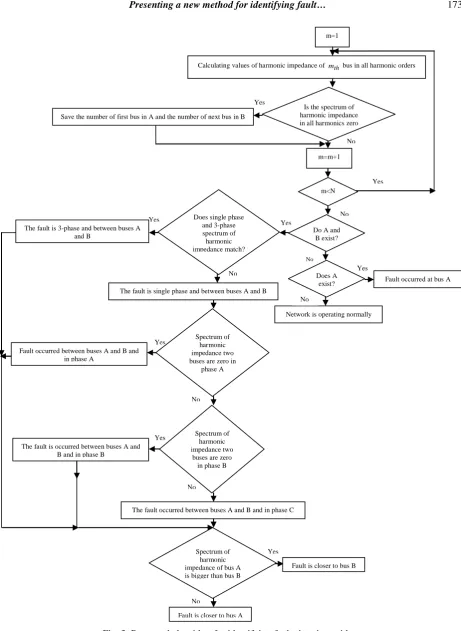
Acquired harmonic impedance of Eq. (11) for each bus equals value of Eq. (16) where h is harmonic order, l is inductance for length unit, and d is distance to fault location. Assuming l to be constant in different harmonic orders, parameter of d identifies harmonic impedance, seen from each bus, to fault location. Thereby, if for instance in Fig. 2 a fault occurs between k and i buses, and closer to bus k,
harmonic impedance which is seen from bus k would be smaller than harmonic impedance which is seen from other buses.
(16)
fhld Zmh 2
Fig. 3. Presented algorithm for identifying faults in microgrids
As it is clear, presented algorithm is capable of detecting symmetrical and asymmetrical faults and also high impedance faults. This algorithm finds single phase and three-phase spectrum of harmonic impedance separately. If these two spectrums match, either fault has not occurred or symmetrical fault has
No
The fault occurred between buses A and B and in phase C
Yes Yes
Yes
No
No No
Network is operating normally No
The fault is single phase and between buses A and B
m<N
Yes
Yes Yes
Yes
No
No m=1
Calculating values of harmonic impedance of mth bus in all harmonic orders
Yes
No
m=m+1 Is the spectrum of harmonic impedance in all harmonics zero Save the number of first bus in A and the number of next bus in B
Do A and B exist? Does single phase
and 3-phase spectrum of harmonic impedance match? The fault is 3-phase and between buses A
and B
Does A
exist? Fault occurred at bus A
Spectrum of harmonic impedance two buses are zero in
phase A Fault occurred between buses A and B and
in phase A
Spectrum of harmonic impedance two
buses are zero in phase B The fault is occurred between buses A and
B and in phase B
Spectrum of harmonic impedance of bus A is bigger than bus B
Fault is closer to bus A
occurred. Each of these probabilities should be analyzed using the presented method in algorithm. Otherwise, asymmetrical fault has occurred in one of the lines of the network.
One important advantages of the proposed method is that fault detection for high impedance faults is carried out using the same method as for solid faults. In order to detect high impedance faults previous studies mainly used different method of fault detection rather than the method of fault detection for solid faults. This issue challenges usage of these methods simultaneously in order to cover all kinds of faults. But, using the proposed method of this paper, there would be no problem considering the type of the fault.
b) Case Study
Fig. 4 depicts the case study used in this paper. This network consists of 9 bus bars and 5 DG units. This network has 11 load points the demand of which is 259 MW and 81.3 Mvar. More details associated to this network are available in [36]. This network is corrected by installing two harmonic sources. The first source is a 2400 HP medium voltage speed regulating system which is attached to bus 9. The second source is a 220 kVA harmonic generating furnace which is installed at bus 4 and generates harmonics which are multiple 6 [34].
DG
DG
DG
DG DG
1
2
3 4 5
6
7 8
9 10 11
12
13
14
Ih
Ih
Fig. 4. IEEE 14-bus test system [36]
4. SIMULATION RESULTS
a) Network without fault
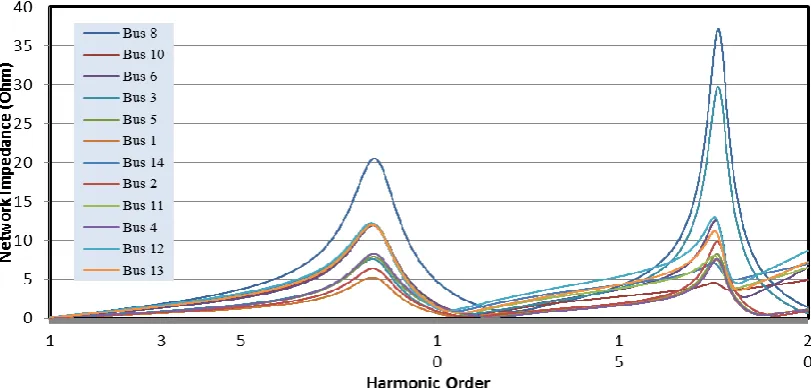
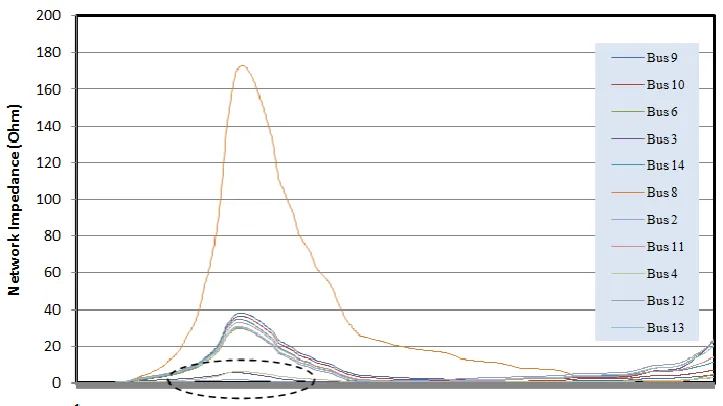
SRCU calculates single phase and three-phase harmonic impedance of each bus repeatedly to identify probable faults and issue the required command for clearing them. If there was no fault in the network, single phase and three-phase spectrum of harmonic impedance of different buses would be like Fig. 5 and Fig. 6. As is obvious, impedance spectrum of any of buses in any of harmonic orders is not zero. For example, despite spectrum of harmonic impedance of bus 1 is near zero, but it is not constant and in the next peak it increases to a value near 10 ohms. This indicates that there are no faults in the network. Another point to be considered is consistency of these figures. As mentioned in the presented algorithm, single phase spectrum of harmonic impedance in cases that there is no fault or there is a symmetrical fault is completely similar to spectrum of three-phase harmonic impedance. This issue is used to identify whether a fault is symmetrical or asymmetrical in this paper.
Fig. 5. Frequency spectrum of three-phase harmonic impedance in Cartesian coordinates
Fig. 6. Frequency spectrum of single phase harmonic impedance in Cartesian coordinates
b) Symmetrical faults
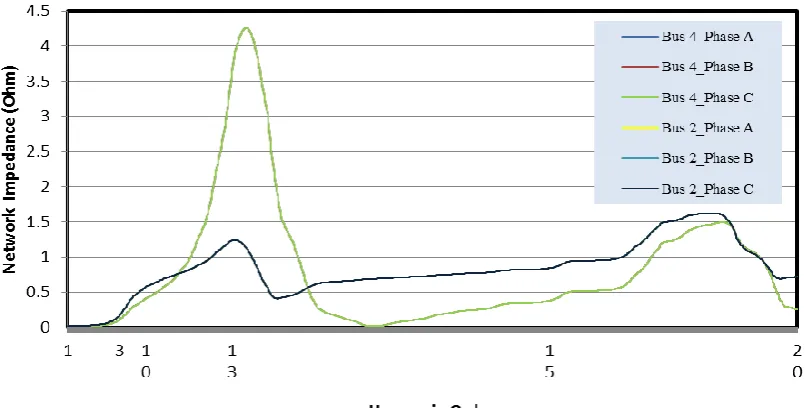
Fig. 7. Three-phase harmonic impedance of the network during a symmetrical fault between buses 2 and 4
Fig. 8. Situation of impedance spectrum of two buses which are located near symmetrical fault location
As it is clear from Fig. 8 harmonic impedance in buses 2 and 4 is almost zero in all orders of harmonic. Comparing this figure with Fig. 5, which presents situation of spectrum of harmonic impedance in normal situation, it can be concluded that fault has occurred in the line between buses 2 and 4. In addition, since harmonic impedance in all orders of harmonic is zero, the fault is permanent. Therefore, presented method can easily distinguish permanent faults from transient faults and switching and energizing feeders. SRCU sends cut off command to breakers which are located at the end of line between buses 2 and 4 as soon as it observes impedance spectrum of Fig. 8 and identified that fault is permanent.
After the presented method identified between which buses the fault is, it is able to identify whether fault is closer to each bus. So the exact location of fault is identified. As presented in the algorithm of Fig. 3, the least value of harmonic impedance in peak point is for bus closest to fault. Hence, according to Fig. 8, harmonic impedance of bus 2 has the least value in its peak, so fault is nearer to bus 2.
Fig. 9. Single phase harmonic impedance of the network during a symmetrical fault between buses 2 and 4
c) Asymmetrical faults
According to of Fig. 3, asymmetrical faults are detectable by calculating harmonic impedance in each phase of each bus in different harmonic orders. The method of detection is similar to the method presented in symmetrical faults.
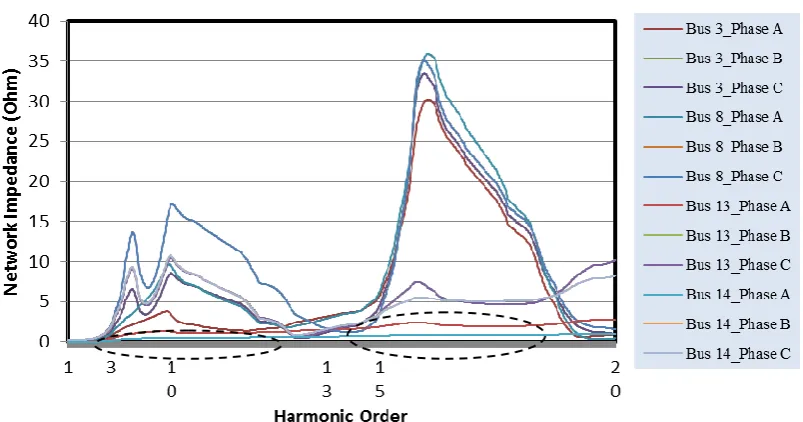
Figures 10 and 11 represent three-phase and single phase harmonic impedance respectively in different harmonics and during occurrence of an asymmetrical fault. As shown, unlike symmetrical faults and normal situation of the network, these figures are not identical. Therefore, it can be concluded that an asymmetrical fault has occurred. According to Fig. 11, harmonic impedance of buses 13 and 14 for phase A is almost zero in all harmonic orders. So fault occurred in phase A of the line between these buses. But comparing impedance of these buses at peak, the impedance of bus 14 in phase A is shown to be smaller. Hence the fault is certainly nearer to this bus.
Fig. 11. Single phase harmonic impedance of the network during an asymmetrical fault between buses 13 and 14
d) High impedance faults
Impedance of HIFs may vary from 0 to 300 Ohms [37]. Figure 12 depicts frequency spectrum for this kind of fault between buses 13 and 14 with impedance of 100 and 300 Ohms. This figure shows that this kind of fault can also be detected easily using the method presented in this paper. It is clear that harmonic impedances of buses 13 and 14 have the least value compared to other buses and their value is almost zero in all harmonic orders. In addition, since the value of impedance of bus 14 is smaller, fault is closer to this bus. According to Fig. 12 since the harmonic spectrum of 100 ohms and 300 ohms faults are the same, the presented method is independent of fault type and situation of network. This issue enables the method to detect different faults appropriately.
Fig. 12. Three-phase harmonic impedance of the network during 100 and 300 ohms symmetrical faults between buses 13 and 14
Results of implementing the method of [21] are presented in Fig. 13. The threshold for differential energy is considered to be 0.2. Identifying threshold value is an important defect of similar studies since according to [21] it is identified using different situations of network. However, according to [26], due to multitude states of network and fault, the probability of not detecting the fault is high.
As it is clear from Fig. 13, differential energy is lower than threshold value in 100 ohms fault and accordingly, the method of [21] can detect this fault. But differential energy in fault with impedance of 300 ohms is higher than threshold value. Thus the method of [21] cannot detect this fault. This is due to the fact that while occurrence of 300 ohms fault, the fault current components reduce cosiderably which results in reduction of differential energy so that higher than threshold value is obtained. Unlike these methods, as it is shown in Fig. 12, the proposed method of this paper does not use current waveform in fault detection and hence it is able to detect any faults. The proposed method also does not require threshold value to be identified. This makes the proposed method independent from network and fault situation and reliability of the proposed method would be very high.
Fig. 13. Results of the proposed method of [21] for detecting HIF
e) Performance of proposed algorithm while faults are on buses
As shown in Fig. 3, the proposed algorithm is capable of detection faults which are on the network buses. For this purpose a fault is placed on bus 2. As it is presented in Fig. 14, harmonic impedance spectrum of bus 2 is zero for all frequencies while it is like Fig. 5 for other buses. This indicates that fault is on bus 2.
5. CONCLUSION
Installing DG in distribution network generally changes them from passive networks into active ones with bi-directional power flow. These changes disturb the setting of protective equipment so that traditional protective plans would no longer be capable of protecting new networks. This paper proposed a new fault detecting method based on calculating spectrum of harmonic impedance. Presented method is based on wide communicative connections and calculations associated with harmonic impedance are carried out by SRCU. Main feature of this paper is the capability of detecting symmetrical, asymmetrical, and high impedance faults without using approximate models. Results showed the efficiency of this method for detecting different faults in appropriate time. Protective challenges associated with applying microgrid can be tackled using this method and it can be considered as a giant step in application of microgrids.
REFERENCES
1. Kamel, R. M. & Kermanshahi, B. (2010). Enhancement of micro-grid dynamic performance subsequent to
islanding process using storage batteries. Iranian Journal of Science & Technology, Transaction B: Engineering, Vol. 34, No. B6, pp. 605-618.
2. Liang, T. & et al. (2011). From laboratory microgrid to real markets - challenges and opportunities. IEEE 8th International Conference on Power Electronics and ECCE Asia (ICPE & ECCE), pp. 264-271.
3. Najy, W. K. A. & et al. (2013). Optimal protection coordination for microgrids with grid-connected and islanded
capability. IEEE Transactions on Industrial Electronics, Vol. 60, No. 4, pp. 1668-1677.
4. Kai-Hui, Z. & Ming-Chao, X. (2011). Impacts of microgrid on protection of distribution networks and
protection strategy of microgrid. International Conference on Advanced Power System Automation and Protection (APAP), pp. 356-359.
5. Chen, J. & et al. (2011). The overview of protection schemes for distribution systems containing micro-grid.
Asia-Pacific Power and Energy Engineering Conference (APPEEC), pp. 1-4.
6. Jiang, W. & et al. (2010). The overview of research on microgrid protection development. International Conference on Intelligent System Design and Engineering Application (ISDEA), pp. 692-697.
7. Mahat, P. & et al. (2011). A simple adaptive over current protection of distribution systems with distributed
generation. IEEE Transaction on Smart Grid, Vol. 2, No. 3, pp. 428-437.
8. Khederzadeh, M. (2012). Adaptive setting of protective relays in microgrids in grid-connected and autonomous
operation. 11th International Conference on Developments in Power Systems Protection, pp. 1-4.
9. Conti, S. & Nicotra, S. (2009). Procedures for fault location and isolation to solve protection selectivity
problems in MV distribution networks with dispersed generation. Electric Power Systems Research, Vol. 79, No. 1, pp. 57-64.
10. Conti, S. (2009). Analysis of distribution network protection issues in presence of dispersed generation. Electric Power Systems Research, Vol. 79, No. 1, pp. 49-56.
11. Bui, D. M. & et al. (2015). Investigate dynamic and transient characteristics of microgrid operation and develop
a fast-scalable-adaptable algorithm for fault protection system. Electric Power Systems Research, Vol. 120, pp. 214-233.
12. Tatcho, P. & et al. (2013). A novel hierarchical section protection based on the solid state transformer for the
future renewable electric energy delivery and management (FREEDM) System. IEEE Transactions on Smart Grid, Vol. 4, No. 2, pp. 1096-1104.
13. Tatcho, P. & et al. (2011). A novel line section protection for the FREEDM system based on the solid state
transformer. IEEE Power and Energy Society General Meeting, pp. 1-8.
14. Al-Nasseri, H. & et al. (2006). A voltage based protection for micro-grids containing power electronic
15. Redfern, M. A. & Al-Nasseri, H. (2008). Protection of micro-grids dominated by distributed generation using
solid state converters. IET 9th International Conference on Developments in Power System Protection, pp. 670-674.
16. Oureilidis, K. O. & et al. (2014). Fault clearing in a converter-dominated microgrid with traditional protection
means. IEEE 5th International Symposium on Power Electronics for Distributed Generation Systems (PEDG), pp. 1-7.
17. Ma, J. & et al. (2012). A novel adaptive current protection scheme for distribution systems with distributed
generation. International Journal of Electrical Power & Energy Systems, Vol. 43, No. 1, pp. 1460-1466.
18. El-Zonkoly, A. M. (2011). Fault diagnosis in distribution networks with distributed generation. Electric Power Systems Research, Vol. 81, No. 7, pp. 1482-1490.
19. Ray, P. K. & et al. (2011). Disturbance detection in grid-connected distributed generation system using wavelet
and S-transform. Electric Power Systems Research, Vol. 81, No. 3, pp. 805-819.
20. Aguilera, C. & et al. (2006). Adaptive noncommunication protection based on traveling waves and impedance
relay. IEEE Transactions on Power Delivery, Vol. 21, No. 3, pp. 1154-1162.
21. Samantaray, S. R. & et al. (2012). Differential energy based microgrid protection against fault conditions. IEEE PES in Innovative Smart Grid Technologies (ISGT), pp. 1-7.
22. Hamedani Golshan, M. E. & Samet, H. (2006). A new differential protection algorithm based on rising rate
variation of second harmonic current. Iranian Journal of Science & Technology, Transaction B: Engineering, Vol. 30, No. B6, pp. 643-654.
23. Al-Nasseri, H. & Redfern, M. A. (2008). Harmonics content based protection scheme for microgrids dominated
by solid state converters. International Middle-East Power System Conference, pp. 50-56, 2008.
24. Petit, M. & et al. (2010). Directional relays without voltage sensors for distribution networks with distributed
generation: Use of symmetrical components. Electric Power Systems Research, Vol. 80, No. 10, pp. 1222-1228. 25. Sortomme, E. & et al. (2010). Microgrid protection using communication-assisted digital relays. IEEE
Transactions on Power Delivery, Vol. 25, No. 4, pp. 2789-2796.
26. Zamani, M. A. & et al. (2011). A protection strategy and microprocessor-based relay for low-voltage microgrids.
IEEE Transactions on Power Delivery, Vol. 26, No.3, pp. 1873-1883.
27. Dewadasa, M. & et al. (2011). Protection of microgrids using differential relays. 21st Australasian Universities Power Engineering Conference (AUPEC), pp. 1-6.
28. Prasai, A. & et al. (2010). Protection of meshed microgrids with communication overlay. IEEE in Energy Conversion Congress and Exposition (ECCE), pp. 64-71.
29. Nikkhajoei, H. & Lasseter, R. H. (2007). Microgrid Protection. IEEE in Power Engineering Society, pp. 1-6. 30. Ustun, T. S. & et al. (2012). Modeling of a centralized microgrid protection system and distributed energy
resources according to IEC 61850-7-420. IEEE Transactions on Power Systems, Vol. 27, No. 3, pp. 1560-1567. 31. Md Razibul Islam, H.A.G. (2012). Study of micro grid safety & protection strategies with control system
infrastructures. Smart Grid and Renewable Energy, Vol. 3, pp. 1-9.
32. Brahma, S. M. (2004). Development of adaptive protection scheme for distribution systems with high
penetration of distributed generation. IEEE Transactions on Power Delivery, Vol. 19, No. 1, pp. 56-63.
33. Alexandre Oudalov, A. F. (2009). Adaptive network protection in microgrids. International Journal of Distributed Energy Resources, Vol. 4, No. 3, pp. 201-225.
34. Kouhsari, S. M. & et al. (2002). A simple method for incorporating transformer phase-shifts in a
sparsity-oriented single-phase harmonic penetration algorithm. Electric Power Systems Research, Vol. 61, No. 3, pp.
203-210.
35. Chindris, M. & et al. (2007). The load flow calculation in radial electric networks with distributed generation
36. Kodsi, S. K. M. & Ca˜nizares, C. A. (2003). Modelling and simulation of IEEE 14 bus system with FACTS
controllers. Technical Report, pp. 1-46.
37. Fan, C. & et al. (2006). Study of protection scheme for transmission line based on wavelet transient energy.
Electrical Power and Energy Systems, Vol. 28, No. 7, pp. 459-470.
![Fig. 1. General topology of presented plan [31]](https://thumb-us.123doks.com/thumbv2/123dok_us/19066.2001998/3.595.150.423.442.615/fig-general-topology-presented-plan.webp)
![Fig. 2. N buses power network with a harmonic source at bus k [34]](https://thumb-us.123doks.com/thumbv2/123dok_us/19066.2001998/4.595.170.413.545.742/fig-n-buses-power-network-harmonic-source-bus.webp)
![Fig. 4. IEEE 14-bus test system [36]](https://thumb-us.123doks.com/thumbv2/123dok_us/19066.2001998/8.595.114.474.323.663/fig-ieee-bus-test-system.webp)
![Fig. 13. Results of the proposed method of [21] for detecting HIF](https://thumb-us.123doks.com/thumbv2/123dok_us/19066.2001998/13.595.100.479.585.741/fig-results-proposed-method-detecting-hif.webp)
